Best Budget Standing Desk Converters: Sit-Stand Ergonomics Without the Premium Price
A standing desk converter's core function — raising your monitor and keyboard to standing height and lowering them back down — doesn't require premium materials or an expensive motor to work reliably. Plenty of affordable converters deliver genuine sit-stand functionality at a fraction of the cost of premium electric models, provided you know which specific features actually matter at a lower price point and which corners tend to get cut when manufacturers hit an aggressive price target. Two converters priced within a few dollars of each other can differ meaningfully in how they handle exactly that trade-off, and telling them apart requires looking past the headline price and feature list toward the specific construction details covered throughout this guide.
Where budget shopping in this category goes wrong is usually not the core mechanism but the details around it: a base that flexes slightly under a heavier monitor, a lift column that wobbles noticeably at full extension, or a keyboard tray that feels flimsy after a few months of daily use. None of these issues show up in a product photo, which is exactly why understanding the specific factors that predict real durability matters more than comparing price tags alone. Two converters listed within a few dollars of each other on a retailer's page can come from entirely different manufacturing standards, and only a closer look at recent reviews and specific construction details reveals which one is actually the better purchase.
This guide compares the practical converter types available at accessible price points, walks through the buying factors that separate genuinely good budget products from ones that are simply cheap, and answers the questions people ask most often when trying to add sit-stand capability without paying premium prices. The goal throughout is spending wisely, not spending as little as possible regardless of the consequences. There's a meaningful difference between those two goals: spending as little as possible often means accepting whatever trade-offs come with the very cheapest listing, while spending wisely means finding the point where price and genuine reliability intersect most favorably for your specific situation.
It's worth setting expectations clearly from the start: a budget converter won't include every feature found on a premium electric model with memory presets and a large dual-monitor platform, and that's a reasonable trade-off for most home office users. The question isn't whether a budget option matches a $400 model feature for feature — it's whether it delivers genuine sit-stand functionality reliably, which is achievable well below that price point with the right choice. Keep that distinction in mind throughout the rest of this guide: the goal isn't matching a premium product's full feature list, it's matching its core reliability at a meaningfully lower cost, which is a genuinely different and more achievable target.
It also helps to recognize that a standing desk converter, at its core, is a mechanically simple product — a platform, a way to raise and lower it, and a keyboard tray. None of that inherently requires premium materials or complex engineering to function reliably for years. The price differences you see across the category tend to reflect a combination of genuine engineering refinement, brand markup, and added convenience features like memory presets, rather than a strict linear relationship between price and basic functional reliability. Understanding which of those three factors you're actually paying for at any given price point is the key to shopping well in this category.
The three mechanisms covered below — manual gas-spring lift, fixed standing height, and basic electric adjustment — represent genuinely distinct approaches available throughout the budget-friendly end of the market, and the right choice depends more on how you plan to use the sit-stand feature than on which one sounds more impressive.
Top Picks Reviewed
1. Manual Z-Lift Converter – Best Overall Budget Value
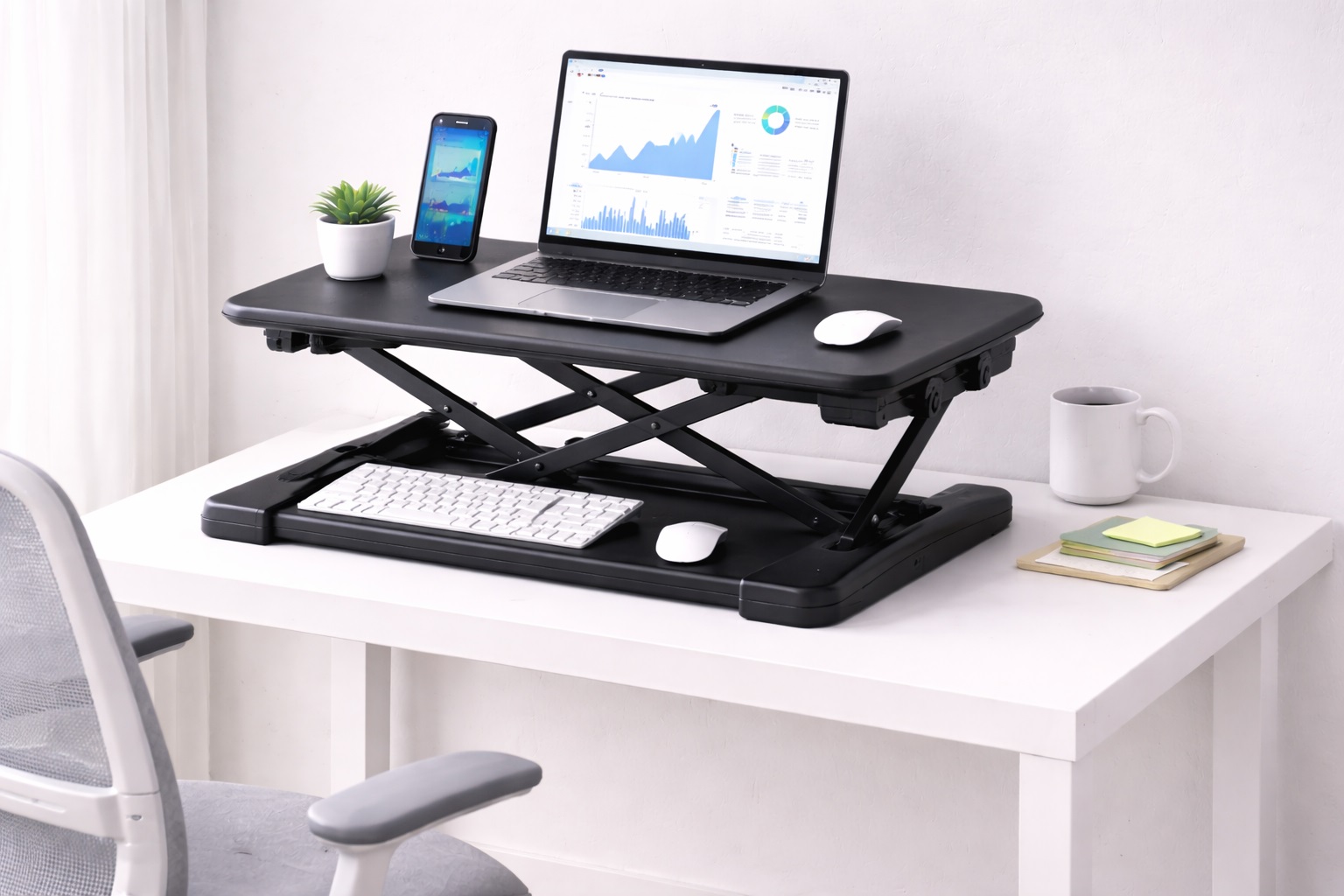
A manual Z-lift converter uses a gas-spring or friction-assisted scissor mechanism to raise and lower the workspace by hand, without the added cost of an electric motor. This mechanism has become widely available at accessible prices, delivering the same fundamental sit-stand functionality as pricier electric alternatives, just with a bit more physical effort required to make the switch.
- Pros:
- Gas-spring assisted height adjustment available even at low price points
- No motor or power connection required
- Raises the entire workspace simultaneously — monitor and keyboard together
- Generally the most affordable adjustable converter style
- Cons:
- Requires more physical effort than an electric model
- Budget-tier gas springs can weaken gradually over a few years of daily use
Because the mechanism has no motor or circuit board, there's meaningfully less that can fail compared to an electric converter, which is a genuine reliability advantage at the budget end of the market where electrical components are often the first thing to cut corners on. Reading reviews specifically for comments about the gas spring holding its lift strength after a year or more of use is the most useful check within this category. A gas spring rated for the specific weight you're actually lifting tends to hold its strength longer than one operating near the upper edge of its rated capacity, so matching the spring rating to your equipment weight, rather than just meeting the minimum, is worth the extra attention.
Best For: Home office workers who want reliable sit-stand functionality at the lowest reasonable cost and don't mind a small amount of physical effort during each transition.
Why We Recommend It: The manual Z-lift mechanism delivers the core sit-stand benefit without the added cost and potential failure points of a motor, making it the most consistently good value across the entire budget converter category. It's a reasonable default recommendation for anyone shopping primarily on price who hasn't yet decided whether motorized adjustment is worth the added cost to them personally.
2. Fixed-Height Converter With Keyboard Tray – Best Rock-Bottom Price
A fixed-height converter permanently raises the workspace to standing height with a separate keyboard tray at typing level, and because there's no lift mechanism to manufacture at all, this style is consistently the least expensive option in the standing desk converter category. For anyone who mainly wants to stand rather than needing fluid transitions between sitting and standing, this no-frills design solves the problem at the lowest possible cost.
- Pros:
- The most affordable style in the entire converter category
- No mechanism to fail, wobble, or wear out over time
- Stable platform since there's nothing to adjust
- Separate keyboard tray at correct standing typing height
- Cons:
- Cannot lower to sitting position
- Requires a stool for occasional seated use
Because manufacturing this style requires no lift hardware, gas springs, or motors, the cost savings compared to adjustable converters are substantial, and the simplicity also means there's very little that can go wrong even in a genuinely low-cost version of the product. It's arguably the safest possible purchase in this entire category from a reliability standpoint, precisely because there's so little to it that could fail in the first place.
Best For: Budget-conscious buyers who primarily want to stand at their desk and are comfortable with a stool for occasional seated tasks, in exchange for the lowest price in the category. It also suits anyone who has tried a sit-stand routine before and found they mostly stayed standing anyway, since a fixed-height unit removes the temptation to leave the workspace lowered out of habit.
Why We Recommend It: When the goal is spending the absolute least while still gaining genuine standing desk functionality, a fixed-height converter delivers exactly that, with no compromise on stability since there's no adjustment mechanism to skimp on.
3. Basic Electric Converter – Best Budget Motorized Option
Entry-level electric converters bring motorized, button-press height adjustment down to a more accessible price point than the premium electric models with memory presets and app connectivity. These stripped-down electric options typically skip programmable presets and fine finishing touches but retain the core benefit of effortless, motorized adjustment.
- Pros:
- Motorized adjustment at a meaningfully lower price than premium electric models
- No manual lifting effort required
- Simpler control panel than higher-end alternatives, often just up and down buttons
- Still meaningfully easier to use than a manual mechanism for some users
- Cons:
- Lacks programmable height presets found on pricier models
- Motor components are generally less refined than premium electric converters
For users who specifically want motorized convenience but don't need memory presets or app control, this style captures the core benefit of electric adjustment — no physical effort — without paying for extra features that many users don't end up relying on regularly anyway. Many buyers who initially assume they'll use memory presets heavily find in practice that they settle into just two or three go-to heights within the first month, which they can just as easily remember and select manually on a simpler control panel.
Best For: Budget-conscious buyers who specifically want the convenience of motorized adjustment without paying for programmable presets or other premium electric features.
Why We Recommend It: This style proves that motorized convenience and an accessible price aren't mutually exclusive, delivering the single feature that matters most about electric converters — effortless adjustment — without the additional cost of features many buyers rarely use. For anyone who has ruled out a manual lift because of a wrist or shoulder issue, this tier makes motorized adjustment accessible without requiring a jump to premium pricing.
Buying Guide: How to Choose the Best Budget Standing Desk Converter
Use these factors to separate genuinely good budget products from ones that are simply cheap, since the two are not the same thing in this category.
1. Read Reviews for Long-Term Durability
A strong overall star rating can hide a pattern of gas springs weakening or motors failing after six months to a year, particularly if most reviews come from buyers in their first few weeks of ownership. Sort reviews by most recent and look specifically for comments about long-term performance. Reading a handful of one- and two-star reviews specifically, rather than only the five-star ones at the top of the list, often surfaces a recurring failure point faster than working through the entire review section in order.
2. Stability at Full Standing Height
Budget converters are more likely to wobble at maximum extension than premium models, and this is the single most commonly cited complaint in negative reviews across the category. Check specifically for comments about standing-height stability rather than relying on sitting-height impressions. A converter can feel completely solid at desk height during a brief in-store test and still develop a noticeable wobble once fully extended, since the leverage on the base changes considerably between the two positions.
3. Weight Capacity With a Comfortable Margin
Confirm the converter's rated weight capacity comfortably exceeds your actual monitor and equipment weight rather than sitting right at the limit. A unit operating near its rated capacity tends to show wear in its mechanism and base sooner than one with margin to spare. Weigh your actual equipment on a bathroom scale if you're at all uncertain, since monitor weight varies more between similarly sized models than people generally expect.
4. Gas Spring or Motor Longevity
For manual converters, gas springs can weaken gradually over years of use, making the lift feel harder over time. For electric models, motor quality varies more at the budget end of the market. Reviews specifically mentioning performance after a year or more are the most useful signal here. A pattern of complaints appearing specifically around the one-year mark, rather than scattered randomly across review dates, is a particularly strong signal of a component that reliably wears out at a predictable point in the product's life.
5. Warranty Length as a Confidence Signal
A reasonable warranty, even a modest one, suggests the manufacturer expects the product to hold up under normal use. A complete absence of warranty coverage on an otherwise similarly priced converter is worth treating as a caution flag rather than a coincidence, since including even a basic warranty costs a manufacturer relatively little against the overall price of the product.
6. Return Policy Before Ordering
Quality varies more within the budget tier than in the premium tier, so a flexible return window matters more here. Check the seller's specific policy before ordering and keep the original packaging until you've tested the converter under real working conditions. A generous return window is often a better indicator of a seller's confidence in a product than the star rating alone, since a high return rate costs them real money.
7. Base Footprint and Desk Compatibility
Confirm the converter's base fits your desk's surface area without overhanging the edges, and that your desk's own weight rating comfortably supports the converter plus your equipment once fully loaded. It's easy to focus entirely on the converter's own specifications and forget that the desk underneath it is also carrying that combined weight, particularly on older or lighter-duty desks not originally designed with this kind of load in mind.
8. Cable Management Through the Full Height Range
Verify your cables have enough slack to move with the converter through its complete range of motion without straining connectors or pinching during adjustment, regardless of which mechanism you choose. A simple cable clip or a loop of velcro along the lift column keeps loose cables from tangling or catching as the converter moves through its full range.
9. Avoiding Unnecessary Premium Features
Some converters near the top of the budget range add features like programmable memory presets or app connectivity that push the price higher without meaningfully improving the core sit-stand benefit. If genuine functionality is the priority, a simpler model without these extras is often the better use of a limited budget. Extra features also tend to be the first components to fail on a budget-tier product, since they're rarely engineered with the same attention as the core lift mechanism.
10. Anti-Fatigue Mat as Part of the Budget
Budgeting for a basic anti-fatigue mat alongside the converter itself matters more than it might seem, since standing on a hard floor without one is a common reason people abandon standing desk use within the first few weeks regardless of how good the converter is. Treat the mat as part of the same purchase decision rather than an optional add-on you might get to later, since the two together are really what deliver a genuinely comfortable standing experience.
11. Price Per Expected Year of Use
Rather than comparing sticker price alone, estimate how many years a specific product is likely to last based on reviews and warranty length, then weigh that against its price. A slightly pricier option that lasts twice as long is often the better overall value even though it costs more upfront, even if the sticker price makes the cheaper listing look more appealing at first glance.
12. Assembly Time and Tools Required
Most budget converters ship partially assembled and list an estimated setup time in the product description or manual; treat that number as optimistic and budget extra time on your first attempt. Check whether the required tools are included in the box, since a converter that needs a hex key you don't own turns a fifteen-minute job into a trip to the hardware store. Reviews that mention assembly difficulty specifically, rather than just product quality, are worth reading before you order if you'd rather not spend an evening on setup.
13. Noise and Smoothness During Adjustment
A gas-spring converter should rise and fall with a controlled, even motion rather than a sudden jump or a noticeable jolt at the top or bottom of its range, and an electric unit should run its motor smoothly without grinding or straining under load. Both issues are more common on budget-tier units than premium ones, and both are usually mentioned explicitly in reviews from buyers who've used the converter around other people in a shared home office or open floor plan. If working near others while adjusting height matters to you, this is worth checking before ordering rather than after.
14. Tray Depth for Keyboard and Mouse Together
Some budget keyboard trays are sized tightly enough that a full-size keyboard and mouse barely fit side by side, which forces an awkward reach or an angled mouse position during regular use. Check the listed tray dimensions against your actual keyboard width, including any wrist rest you use, rather than assuming a "standard" tray will accommodate your specific setup. This is a small detail on a spec sheet that has an outsized effect on daily comfort once the converter is in regular use.
Frequently Asked Questions
1. Can a budget standing desk converter really work as well as an expensive one?
For the core function — raising and lowering your workspace between sitting and standing height — yes, in many cases. The differences tend to show up in mechanism smoothness, long-term durability, and extra features rather than in whether the basic sit-stand benefit exists at all. Most of the everyday benefit of standing desk use comes from the ability to change position at all, which a well-chosen budget converter provides just as effectively as a much pricier one.
2. What's the biggest risk with a very cheap converter?
The most common issues are wobbling at full standing height, a gas spring or motor that weakens after a year or so, or a base that doesn't quite fit the desk it was intended for. Reading recent reviews specifically for these three issues is the best way to avoid them, since they represent the areas most likely to reveal a corner that was cut somewhere to hit an aggressive price point.
3. Is a manual or electric converter the better budget choice?
Manual gas-spring converters are generally the more reliable budget choice, since there's no motor to potentially fail. Basic electric models are a reasonable middle ground if motorized convenience matters enough to you to accept a slightly higher price and one more mechanical component. Be honest with yourself about how much the physical effort of a manual lift actually bothers you day to day, since that's really the deciding factor between the two approaches.
4. How do I know if a budget converter will hold up over time?
Sort reviews by most recent and look for comments from buyers who've owned the product for six months or longer rather than just the first week. Consistent recent complaints about the same specific issue are a stronger signal than the overall star average, particularly if that same issue appears across reviews written months apart by different buyers.
5. Should I buy the cheapest converter available?
Not necessarily. The cheapest option in a category sometimes represents good value, but it's also where corners are most likely to be cut on stability or long-term durability. Comparing a few options slightly above the rock-bottom price often reveals a meaningfully better product for a modest difference in cost. Treat the very lowest price in a category as a starting reference point for comparison rather than an automatic winner.
6. Does brand name matter for a budget converter?
Somewhat. Established brands tend to offer more consistent quality control even in their lower-priced lines, while unfamiliar brands can be hit or miss. Verified purchase reviews are a reasonable way to evaluate a lesser-known brand before committing. Checking whether the same manufacturer sells other products with a longer, more established review history can also give a useful sense of their general track record.
7. How long should a budget converter last?
A reasonably well-made budget product should last two to four years with regular use, somewhat less than premium alternatives that may last five years or more. Matching your expectations to the price point helps avoid disappointment. A budget converter still performing well after its first full year of daily use is generally a good sign it will continue to hold up for the remainder of its expected lifespan.
8. Can I return a budget converter if it feels unstable?
Most retailers offer a 15 to 30 day return window, generally enough time to test the converter at full standing height under your actual equipment load before deciding whether to keep it. Use the entire window deliberately rather than judging the product in the first few minutes, since stability issues at full extension sometimes take a few days of normal use to become genuinely noticeable.
9. What should I prioritize on a limited budget?
Stability at full height and weight capacity margin matter more day to day than extra features like memory presets. Prioritize a stable converter that comfortably handles your equipment over one with more features but a wobbly platform. These two qualities affect every single day of use, while extra features are only occasionally relevant to your actual routine.
10. Is it worth waiting for a sale on a pricier converter instead of buying budget now?
If your current desk setup causes genuine discomfort, a reasonable budget option now is usually better than continued discomfort while waiting for a discount elsewhere. You can always upgrade later once you know exactly which features matter most to you, and a reasonable budget purchase rarely turns into wasted money even if you eventually decide to move to a pricier model.
11. Do I need an anti-fatigue mat with a budget converter?
Yes, just as much as with a premium converter. The mat addresses standing comfort directly and is arguably more important to the overall experience than which specific converter mechanism you choose, since foot and leg fatigue from a hard floor is one of the most common reasons people stop using a standing desk setup altogether.
12. Do budget converters work well with dual-monitor setups?
Some do, but weight capacity becomes the deciding factor once you're supporting two monitors instead of one. Add up the combined weight of both monitors and their mounting hardware, then compare that total against the converter's rated capacity with a comfortable margin, since a unit that's fine for a single monitor can be pushed right to its limit by a second one.
13. Does a budget converter work on any desk, or does it need a specific type?
Most converters simply sit on top of an existing desk surface, so they work with a standard desk rather than requiring a specific type. The two things worth confirming beforehand are that the converter's base fits within your desk's surface area and that the desk itself is rated to carry the converter's weight plus your equipment once everything is set up.
14. How much should I budget in total, including accessories?
Beyond the converter itself, plan for a basic anti-fatigue mat and, if needed, a hex key or screwdriver not included in the box. These additions are modest compared to the converter's own price but meaningfully affect how comfortable and complete the finished setup feels, so it's worth accounting for them in your overall budget rather than treating the converter's sticker price as the full cost.
Final Verdict
- Best Overall Budget Value: Manual Z-Lift Converter — reliable sit-stand functionality without the cost or failure points of a motor.
- Best Rock-Bottom Price: Fixed-Height Converter With Keyboard Tray — the lowest-cost way to gain genuine standing desk use.
- Best Budget Motorized Option: Basic Electric Converter — motorized convenience without paying for presets you may not need.
A limited budget doesn't mean settling for a converter that wobbles or fails within a year. Focus on stability, weight capacity margin, and recent reviews rather than price alone, and pair whichever converter you choose with a proper anti-fatigue mat, and you'll get genuine sit-stand functionality that holds up for years rather than months. Spending a little extra time comparing a handful of listings against the specific factors covered above is a far better investment than hoping the cheapest option on the page happens to work out, and it's the difference between a converter you're still happy with next year and one you're already looking to replace.