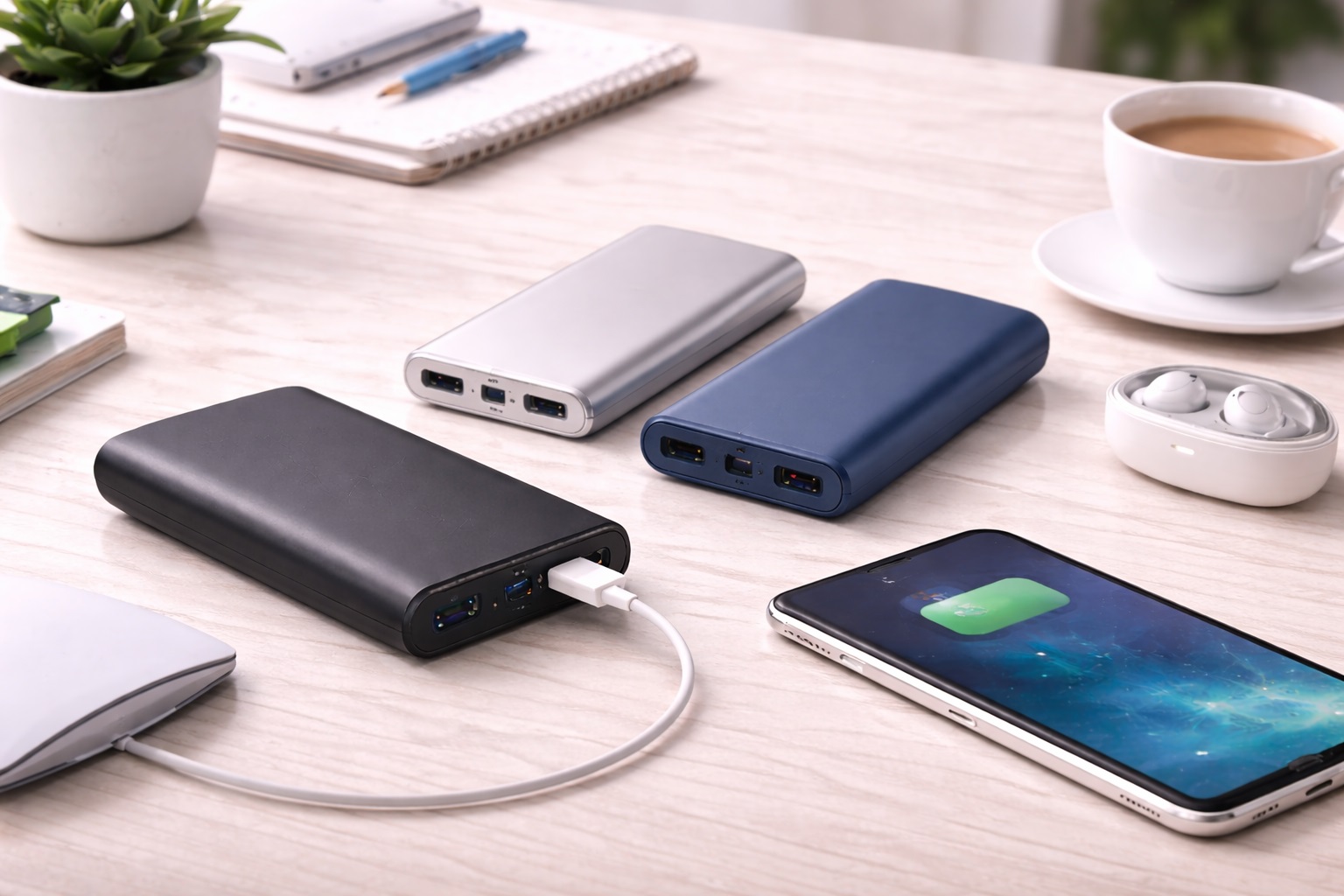
Best Power Banks for Small Desks: Tidy Desktop Charging
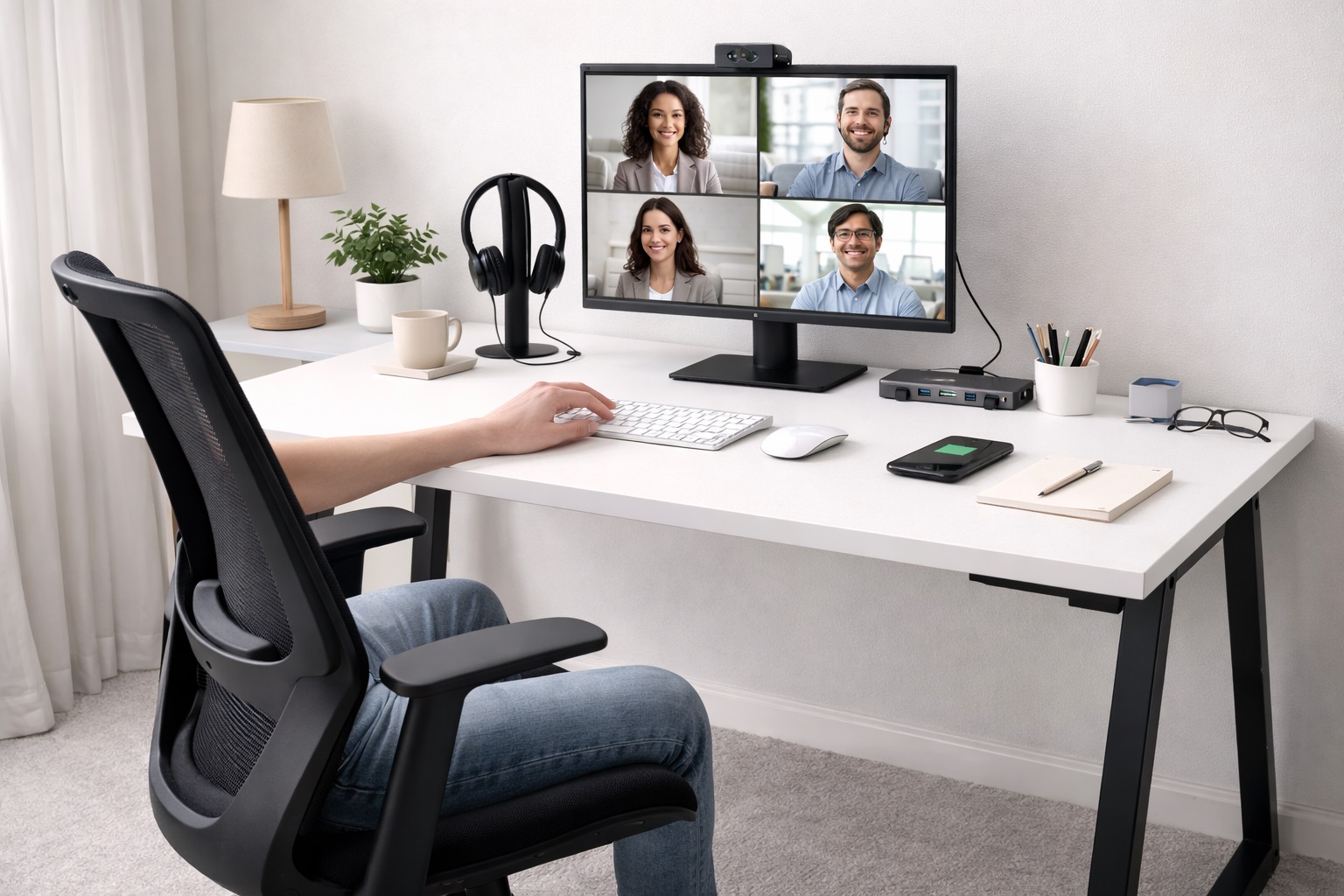
A small desk rarely has room for a permanent charging station, and a wall-mounted multi-port charger takes up an outlet that might be needed for a monitor or a lamp. A power bank sized and chosen for desk use solves this differently — it sits quietly in a corner, keeps two or three devices topped up throughout the workday, and can be unclipped and dropped into a bag the moment you need to work somewhere else. That dual role is exactly what separates a desk-suited power bank from one built purely for backpack duty. Most generic power bank buying advice assumes constant movement — airports, hiking trails, long commutes — while a desk-based buyer is really solving a much calmer problem: keeping a handful of devices topped up in a fixed spot without adding visual clutter to a workspace that's already tight on room.
This guide focuses on what actually matters when a power bank needs to live on a compact desk — footprint that doesn't compete with a keyboard or monitor stand, enough ports to cover a phone, earbuds case, and a secondary device at once, and a capacity that survives a full workday without needing a midday recharge. We also look at the features that make a bank pull double duty as portable backup power when the desk setup isn't where you need to be, since very few buyers want a bank that only ever does one job.
Below you'll find a side-by-side comparison, detailed reviews of the models that consistently work well on compact desks, a buying guide covering every factor worth checking before you order, and answers to the questions desk-based buyers ask most often about capacity, footprint, and cable management.
Top 5 Power Banks for Small Desks (Detailed Reviews)
1. 20,000mAh High-Capacity Power Bank – Best for All-Day Desk Coverage
A 20,000mAh power bank charges most smartphones four to six times and delivers a full tablet charge, which is more than enough to cover a full workday of phone, earbuds, and secondary-device charging without a single trip to a wall outlet. Models built around 65W USB-C Power Delivery can also top up a laptop directly from the desk, which matters on days when the nearest outlet is awkwardly placed behind furniture. Sitting flat on a desk corner, this capacity tier essentially functions as a small charging station that happens to be portable.
- Pros:
- Four to six full smartphone charges per cycle — enough for a full workday plus backup
- 65W USB-C output can charge a laptop directly from the desk
- Multiple USB-A and USB-C ports handle phone, earbuds case, and a second device at once
- Doubles as portable power the moment it leaves the desk
- Cons:
- Larger footprint takes up more desk space than a slim model
- A full recharge of the bank itself takes six to eight hours
Best For: Desk setups where multiple devices need charging throughout the day and the bank occasionally needs to travel with you.
Why We Recommend It: The dual role — desk charging station on a busy workday, portable power bank the moment you leave — is exactly what a compact-desk buyer is usually looking for, and it avoids the wasted expense of owning two separate charging devices for two overlapping needs.
2. 10,000mAh Slim Fast-Charge Power Bank – Best Footprint-to-Capacity Balance
A 10,000mAh slim power bank delivers two to three full smartphone charges in a body thin enough to sit flat against a monitor stand or laptop riser without visually cluttering the desk. USB-C Power Delivery in the 18W–30W range provides a meaningful top-up in thirty to forty-five minutes, which suits the stop-start nature of a workday where a phone gets picked up and set down repeatedly between charges.
- Pros:
- Slim profile sits unobtrusively against a monitor stand or desk organizer
- Two to three full phone charges per cycle
- USB-C PD fast charging in well under an hour
- Small enough to tuck into a drawer at the end of the day
- Cons:
- Not enough capacity for laptop charging
- Two to three ports is typically the practical limit at this size
Best For: Desks where visual tidiness matters as much as charging capability, and where laptop charging isn't a daily requirement.
Why We Recommend It: This size disappears into a desk setup rather than becoming another cable-tangled object competing for space.
3. Multi-Port Power Bank with Stand – Best for Active Desk Charging
A power bank built with an integrated fold-out stand lets a phone charge while propped upright for video calls or notifications, which is a genuinely useful feature for a desk that doubles as a video-conferencing spot. These banks typically pair three or more ports with a stable base, so a phone, tablet, and a secondary accessory can all charge simultaneously without cables sliding around the desk surface.
- Pros:
- Built-in stand keeps a phone visible and charging during calls
- Three or more ports for simultaneous multi-device charging
- Stable desk footprint reduces cable slippage
- Doubles as a bedside or kitchen counter charger when moved
- Cons:
- Larger footprint than a slim bank designed purely for portability
- Stand adds bulk that isn't useful once the bank leaves the desk
Best For: Remote workers and anyone taking frequent video calls who wants a phone visible and charging at the same time.
Why We Recommend It: Combining charging with a stand solves two desk annoyances — a dying phone and a phone lying flat where you can't see notifications — in one object.
4. 5,000mAh Ultra-Slim Power Bank – Best for Minimal Desk Footprint
A 5,000mAh ultra-slim power bank provides one full smartphone charge in a footprint barely larger than the phone itself, which suits a desk where every inch of surface area is already spoken for by a keyboard, monitor, and notebook. USB-C input allows a quick overnight recharge, so the bank is ready again each morning even though its own capacity is modest.
- Pros:
- Smallest footprint of any option on this list
- One full phone charge — adequate for topping up between meetings
- Easy to slide into a drawer or pen cup when not in use
- Fast USB-C input for quick overnight recharge
- Cons:
- Only one full phone charge, not enough for a demanding workday
- Single port limits it to one device at a time
Best For: Desks with genuinely no spare surface area, where even a slim bank feels like too much added clutter.
Why We Recommend It: When desk space is the binding constraint rather than charging capacity, this is the size that actually gets used instead of being pushed aside.
5. Power Bank with Wireless Charging Pad – Best for Cable-Free Desk Charging
A power bank with a built-in wireless charging pad lets you set a phone down flat on the desk to charge, removing one more cable from an already crowded workspace. Paired with one or two wired ports for faster charging when needed, this style balances the tidiness of wireless charging with the speed of a cable when time matters more than convenience.
- Pros:
- No cable needed for the primary phone-charging spot on the desk
- Wired ports remain available for faster charging or a second device
- Flat design integrates cleanly into a desk layout
- Reduces visible cable clutter more than any wired-only option
- Cons:
- Wireless charging is slower than a wired connection
- Phone must stay in place on the pad to keep charging
Best For: Buyers whose top priority is a clean, cable-free desk surface rather than maximum charging speed.
Why We Recommend It: For a desk where visual tidiness is the whole point, removing the last visible cable is worth a small charging-speed trade-off.
Buying Guide: How to Choose the Best Power Bank for Small Desks
Use these factors to match a power bank to a compact workspace rather than to backpack or travel use. A desk-focused buyer often has different priorities than a traveler — footprint and simultaneous-device support matter more than raw portability — so it's worth reading through all twelve before settling on a model rather than assuming a bank marketed for travel will automatically suit a stationary desk role just as well.
1. Physical Footprint and Desk Fit
A bank's footprint matters as much as its specifications on a small desk, where every object competes for the same limited surface area. Measure the actual dimensions against your available desk space before ordering, rather than judging size from a product photo alone, since photos rarely convey how a bank sits relative to a keyboard or monitor stand in practice. A bank that looks compact in a marketing image can still turn out taller than a monitor riser or wider than the gap between a keyboard and a desk edge, so checking the listed dimensions against a quick tape-measure check of your own desk avoids an awkward return.
2. Capacity and Actual Output
Stated capacity in mAh is measured at 3.7V battery voltage, but output happens at 5V through USB, so real-world usable capacity is typically 60–70% of the number printed on the box. A 10,000mAh bank realistically delivers closer to 6,000–7,000mAh to your device, which is worth remembering when estimating whether a given capacity will actually cover a full workday of desk charging. A desk setup that also charges a wireless earbuds case or a smartwatch throughout the day should budget slightly more capacity than a simple phone-only estimate would suggest, since those small accessories draw from the same shared capacity pool.
3. Port Count for Simultaneous Desk Devices
A desk setup often needs to charge a phone, a wireless earbuds case, and a tablet or secondary device at the same time, which makes port count more important on a desk than it typically is for pure travel use. Match the number of ports to how many devices realistically sit on your desk during a working day, not just to how many devices you own in total. Counting the devices that are actually plugged in by mid-morning on a typical day is a more reliable guide than counting everything you technically own, since most people charge only a subset of their devices at the desk at any given time.
4. Charging Speed: Input and Output
Output speed determines how quickly a connected device charges; input speed determines how quickly the bank itself recharges overnight. USB-C Power Delivery at 18W or higher gives modern phones a meaningful fast charge, while 30W to 65W is needed to usefully charge a laptop directly from the desk. Check both figures independently rather than assuming a high-capacity bank automatically charges quickly. On a desk, output speed matters most during the short window between meetings when a phone needs a quick top-up rather than a full overnight charge, so a bank that's fast but slightly lower in capacity can outperform a slower high-capacity model for typical desk habits.
5. Safety Certifications
Look for CE, FCC, or UL certification markings on the bank and its packaging, confirming the product passed basic electrical safety testing. This matters especially for a bank that sits powered and connected to devices for extended periods at a desk, since it's under more sustained load than a bank used only for occasional travel top-ups. A desk bank that stays connected for eight or more hours a day accumulates far more total charging cycles over a year than one used only occasionally, which makes verified certification a more important safeguard than it might first appear.
6. Recharge Time for the Bank
A 20,000mAh bank charging at 18W input can take six to eight hours to fully recharge, while a 10,000mAh bank typically takes three to four hours. A desk setup usually has convenient access to a wall outlet overnight, which makes recharge time less critical than it is for travel use, but a faster input speed still shortens any daytime top-up when the bank runs low mid-afternoon. On a desk with a spare outlet, plugging the bank in for even twenty minutes during a lunch break can meaningfully extend its afternoon capacity if the input speed is fast enough to matter over that short window.
7. Pass-Through Charging
Pass-through charging lets a bank charge a connected device while it is itself being recharged from a wall outlet — a genuinely useful feature at a desk, where the bank can simply stay plugged in permanently and act as an always-topped-up charging hub. Not every bank supports this safely, so check the specification explicitly if you plan to leave the bank connected to power throughout the day. Without pass-through support, a bank that's permanently plugged in and also charging a device can experience more wear over time than one that cycles normally between charge and discharge, which is worth confirming before committing to an always-on desk setup.
8. Weight and Portability for Dual Desk-and-Travel Use
If the bank occasionally needs to leave the desk for a trip or a day out, weight becomes relevant even in a primarily desk-bound setup. A 20,000mAh bank weighs roughly 400–500g, a 10,000mAh slim bank around 200–250g, and a 5,000mAh ultra-slim model under 130g. Choose based on how often the bank genuinely travels versus how often it simply sits in place. Someone who works from the same desk five days a week and rarely takes the bank elsewhere can reasonably prioritize desk-friendly features over portability, while a hybrid worker who alternates locations benefits more from a lighter, more travel-friendly design.
9. Display and Status Indication
Basic LED indicators show remaining charge in rough 25% increments, which is often sufficient for a bank that's frequently topped up at a desk. A numeric percentage display gives a clearer read on exactly how much charge remains, which is more useful for a bank that also needs to serve as reliable backup power away from the desk. Knowing the exact percentage before leaving the desk for a meeting elsewhere in the building removes the guesswork of whether the bank will actually last through the rest of the day.
10. Heat Management
Fast charging generates heat, and a bank sitting on a desk near a laptop vent or in direct sunlight through a window compounds that heat. Quality designs use metal housings or internal thermal management to dissipate it safely. A bank that becomes uncomfortably hot during normal desk use is operating beyond its intended thermal margin and is worth moving to better airflow. Placing the bank a few inches away from a laptop's exhaust vent, rather than directly against it, is a simple habit that noticeably reduces heat buildup during a long charging session.
11. Wireless Charging Compatibility
A built-in wireless charging pad is particularly well suited to desk use, since the bank stays in a fixed position where setting a phone down repeatedly throughout the day is more convenient than plugging and unplugging a cable each time. Wireless charging is slower than wired, so pair it with at least one wired port for moments when speed matters more than convenience. A phone left on the pad through an entire meeting will typically end up better charged than one quickly plugged in and unplugged several times, so wireless charging suits the rhythm of desk work better than it suits a quick top-up on the move.
12. Desktop Footprint and Cable Management
Beyond the bank's own size, consider how its cables integrate into your existing desk setup — a bank with a built-in cable or a magnetic dock reduces the tangle of loose cords that accumulates around a keyboard and monitor stand. Cable clips, a small tray, or routing cables along the back edge of the desk all help keep a charging bank from becoming another source of visual clutter on an already compact surface. Spending a few dollars on basic cable management accessories alongside the bank itself often does more for a tidy desk than the choice of power bank does on its own.
Frequently Asked Questions
1. What size power bank fits best on a small desk?
A slim 10,000mAh bank or a compact stand-style bank typically offers the best balance of capacity and footprint for a small desk. Measure your available surface area first, since the right capacity is only useful if the bank actually fits comfortably alongside your keyboard and monitor. A stand-style bank works well if you also want the phone visible during calls, while a flat slim bank suits a desk where the phone typically stays face-down while charging.
2. Can a power bank replace a wall charger on a desk permanently?
Yes, provided it supports pass-through charging so it can stay connected to power indefinitely while still charging your devices. Without pass-through support, leaving a bank permanently plugged in and also connected to a device can shorten its battery lifespan over time. Checking this specification before committing to an always-on desk setup avoids a slow, easily missed form of battery wear.
3. How do I know when to replace my power bank?
Replace it once it no longer holds the charge it used to, typically noticeable after two to three years of regular use. If the bank runs unusually hot, develops a swollen shape, or stops charging altogether, replace it immediately for safety, particularly if it sits on a desk near paper or other flammable materials for long stretches each day.
4. Will a desk power bank work well if I also travel with it?
Most desk-suited banks in the 10,000–20,000mAh range travel well, though a bank with an integrated stand adds bulk that's less useful once it leaves the desk. If dual use is a priority, a slim model without a stand strikes the better balance, since it avoids carrying bulk that only serves a purpose while sitting on the desk.
5. Does a wireless charging pad slow down desk charging noticeably?
Yes, wireless charging is measurably slower than a wired USB-C connection, though the difference matters less at a desk where a phone often sits charging for hours at a time rather than needing a rapid top-up. For a quick charge between meetings, a wired port remains the faster choice, so keeping both options available on the same bank covers both scenarios without compromise.
6. Is the most expensive power bank for small desks always the best?
Not always. Price reflects features and build quality, but many mid-range options outperform expensive alternatives for everyday desk charging needs. Match the product to your actual use case — footprint, port count, and whether laptop charging matters — rather than assuming higher price means better desk performance. A mid-range bank that fits your desk well will consistently outperform an expensive one that's the wrong size or shape for your setup.
7. How long should a quality power bank for small desks last?
A well-built power bank from a reputable manufacturer typically lasts two to five years with reasonable care, and desk use is generally gentler on a bank than frequent travel handling. Warranty length is a useful indicator of manufacturer confidence in durability, and a bank that mostly stays on the desk rather than getting jostled in a bag often outlasts its rated lifespan.
8. Can I return a power bank for small desks if it doesn't suit me?
Most retailers offer a fifteen- to thirty-day return window. Test the bank at your actual desk setup — checking footprint, cable routing, and port access — before the window closes, since these practical fit issues are easy to miss from a listing photo alone. Sitting the bank in its intended spot for a full day before deciding is the clearest way to confirm it actually belongs there.
9. What should I prioritize when buying a power bank for small desks?
Start with your desk's actual available surface area and how many devices need simultaneous charging, then match capacity and port count to those constraints. Specifications that matter for pure travel use, like ultra-light weight, are less important for a bank that mostly stays in place. Prioritizing footprint and port count over portability specs usually produces a better desk match.
10. Does brand name matter for a power bank for small desks?
Established brands typically offer more consistent quality control and more reliable warranty support. Newer brands can offer excellent value, so weigh verified purchase reviews carefully, particularly ones that mention long-term desk use rather than travel use, since a bank praised for portability isn't necessarily praised for sitting still all day plugged into a wall.
11. Can one power bank charge a laptop and a phone at the same desk at once?
Yes, if the bank offers at least 45–65W USB-C Power Delivery on one port alongside a separate port for the phone. Check that the total combined output across both ports matches what both devices need simultaneously, since some banks reduce output per port when multiple devices draw power at once. Reading the fine print on shared versus dedicated port wattage avoids the disappointment of a laptop charging slower than expected while a phone is also connected.
12. Is a stand-style power bank worth it if I don't take video calls?
Not necessarily. The stand's main benefit is keeping a phone visible while charging, which matters most for video calls or frequent notification checking. If neither applies to your workday, a slimmer bank without a stand saves desk space without losing charging capability, and the money saved can go toward higher capacity or faster charging speed instead.
Final Verdict
- Best for All-Day Desk Coverage: 20,000mAh High-Capacity Power Bank — functions as a small charging station that can still travel when needed.
- Best Footprint-to-Capacity Balance: 10,000mAh Slim Fast-Charge Power Bank — disappears into a desk setup without sacrificing daily capacity.
- Best for Active Desk Charging: Multi-Port Power Bank with Stand — keeps a phone visible and charging during video calls.
- Best for Minimal Desk Footprint: 5,000mAh Ultra-Slim Power Bank — the right size when desk space is the binding constraint.
- Best for Cable-Free Desk Charging: Power Bank with Wireless Charging Pad — removes the last visible cable from a tidy desk surface.
The right power bank for a small desk comes down to matching footprint and port count to how your workspace actually gets used, rather than defaulting to the largest capacity available. Use the comparisons and buying guide above to find a bank that earns its small patch of desk space instead of becoming one more thing you have to work around. A bank chosen with your actual desk layout in mind will get used every day without a second thought, which is the real test of whether it was the right pick.