Best Power Banks for Travel: Stay Charged on Every Adventure
A dead phone at a boarding gate or a camera that quits halfway through a hike is one of the more avoidable travel headaches, yet it happens constantly because people grab whatever power bank is cheapest or closest to the checkout counter. The right portable charger for travel isn't necessarily the one with the biggest number printed on the box — it's the one that matches how you actually move through an airport, a trail, or a long train ride.
Capacity, airline rules, charging speed, port count, and physical size all pull against each other. A pack large enough to refill a laptop three times over is rarely the one you want stuffed into a daypack pocket on a six-mile hike, and a featherweight charger built for a jacket pocket won't get a tablet through a transatlantic flight. This guide breaks down the factors that actually matter for travelers, adventurers, and frequent flyers, then reviews the main categories of travel power bank so you can match the product to the trip rather than the other way around.
Whether you're weighing airline lithium-battery limits, deciding between one high-output port or three modest ones, or just trying to avoid another dead-weight gadget in your carry-on, the sections below are organized to get you to a confident decision quickly.
It also helps to think about the shape of your typical trip before comparing specific models. A single weekend city break has very different power needs than a two-week backpacking route through areas with unreliable electricity, and a business traveler juggling a laptop, phone, and wireless earbuds needs something entirely different from a parent trying to keep two kids' tablets charged in the back seat of a car. None of that requires guesswork. Once you understand the handful of specifications that actually matter, matching a power bank to a trip becomes a fairly quick exercise rather than an hour spent scrolling through near-identical listings that all claim to be the best option available.
Top Travel Power Banks (Detailed Reviews)
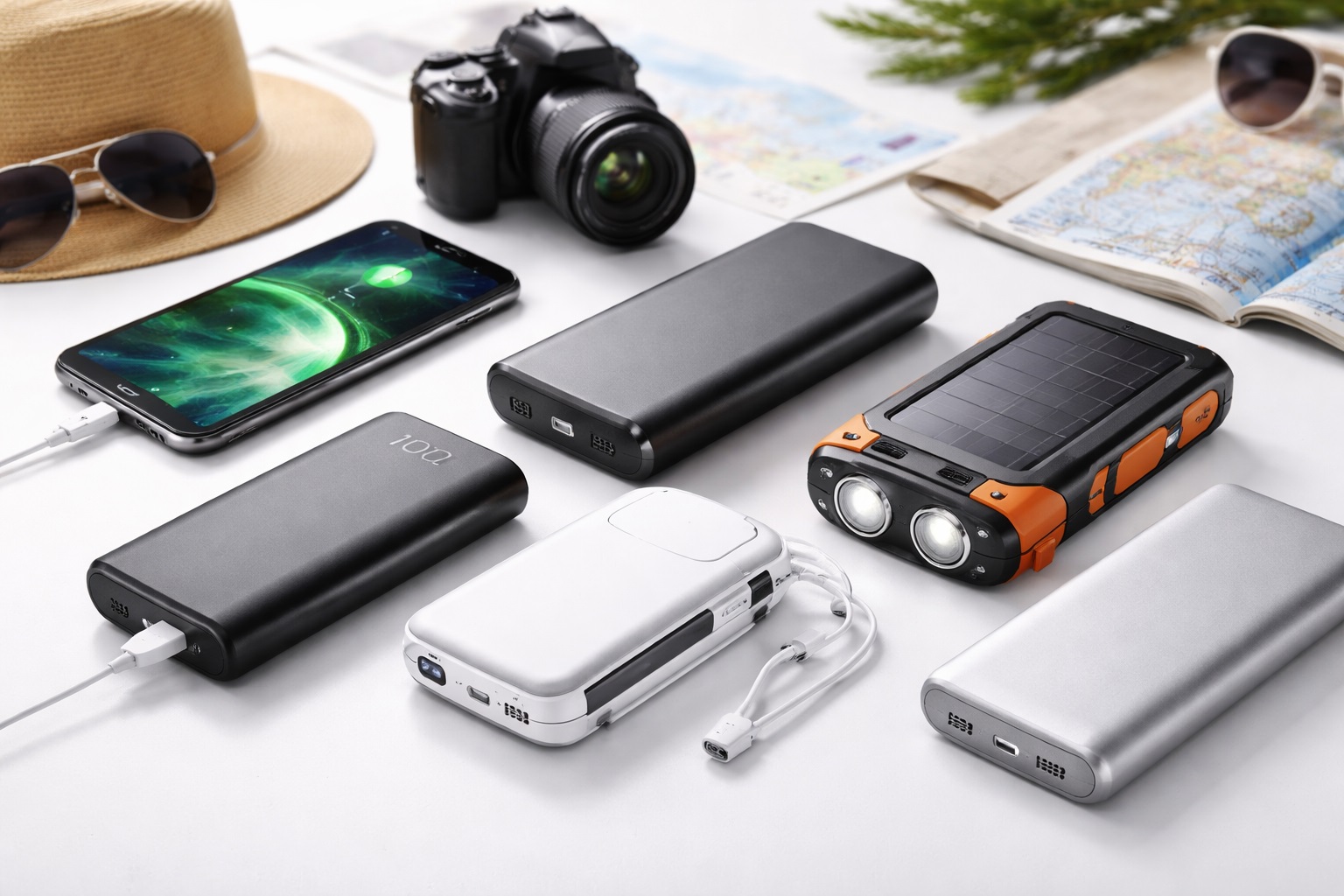
20000mAh Travel Power Bank – Best Overall
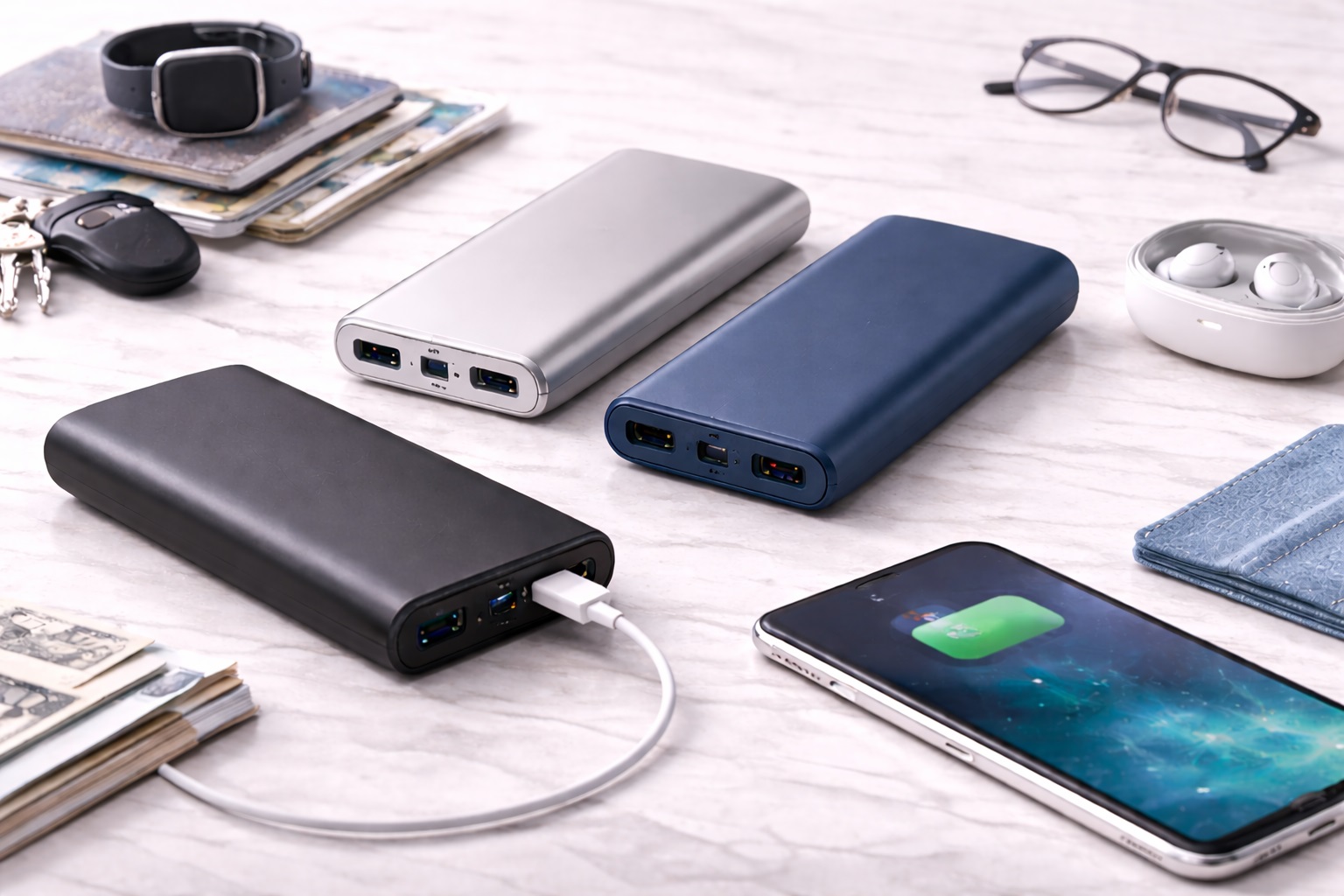
A 20000mAh capacity sits at the sweet spot for most trips: enough to recharge a phone four to five times or a tablet once or twice, without tipping into the bulk and weight of the largest packs on the market. This is the capacity most travelers reach for when they want one charger that covers a full day of sightseeing, a long layover, and the occasional laptop top-up, without needing to think much about it. It typically supports modern fast-charging standards, which shortens the time spent tethered to an outlet in a hotel room before heading out. Many buyers who aren't sure which capacity to choose end up here anyway, simply because it rarely feels either too small or unnecessarily oversized.
- Pros:
- Balances capacity and portability better than higher-mAh alternatives
- Comfortably handles a full day of phone and accessory charging
- Widely compatible with fast-charging phones and tablets
- Cons:
- Not quite enough for multi-day off-grid trips without a recharge point
- Heavier than ultralight packs meant for minimalist travel
Best For: Travelers who want a single power bank that covers a normal travel day without carrying excess bulk.
Why We Recommend It: The 20000mAh capacity hits the point where you get real day-long coverage without the pack becoming a burden to carry, which is why it remains the default recommendation for most trips.
Airline-Safe 26800mAh Bank – Best for Air Travel
Frequent flyers face a specific constraint that other travelers don't: airline rules generally cap carry-on lithium-ion batteries at 100Wh, and most airlines require any bank between 100Wh and 160Wh to be pre-approved. A 26800mAh model built to stay just under that 100Wh ceiling gives you the largest capacity you can carry without extra paperwork or a conversation with gate staff. That makes it the practical maximum for anyone who wants serious capacity but doesn't want to risk a bag search flagging an oversized battery. It's worth printing or saving the watt-hour specification sheet before a trip, since gate agents occasionally ask for confirmation on borderline devices.
- Pros:
- Sits just under the common 100Wh airline threshold
- Higher capacity than standard packs without special approval hassles
- Suited to long-haul flights and multi-leg itineraries
- Cons:
- Larger and heavier than mid-capacity options
- Some airlines and countries apply stricter or different limits, so rules should be checked in advance
Best For: Frequent flyers who want the maximum capacity a battery can carry in the cabin without needing airline pre-clearance.
Why We Recommend It: Staying deliberately under the 100Wh line removes a genuine source of travel-day stress, and the extra capacity over a standard bank is a real advantage on long international routes.
Lightweight Compact Charger – Best Ultralight Option
Not every trip calls for maximum capacity. For day hikes, city breaks, or anyone who simply hates carrying dead weight, a compact charger built around a smaller cell prioritizes pocketability over runway numbers. These models are designed to disappear into a jacket pocket or the front sleeve of a daypack, trading some total capacity for a shape and weight that you genuinely won't notice you're carrying. For travelers who already carry a full daypack or camera bag, that difference in weight adds up meaningfully over the course of a long day.
- Pros:
- Slim, pocket-friendly footprint
- Noticeably lighter than mid- and high-capacity banks
- Convenient for quick top-ups rather than full recharges
- Cons:
- Limited total capacity compared to larger banks
- May only manage one or two partial charges before needing a refill itself
Best For: Minimalist packers, day-trippers, and anyone who wants backup power without the bulk.
Why We Recommend It: When the goal is a quick top-up rather than a full day of charging, the smaller footprint is worth far more than the capacity you give up.
Solar Power Bank for Outdoor Use – Best for Off-Grid Adventures
Hikers, campers, and travelers heading somewhere without reliable outlets face a different problem entirely: it doesn't matter how big the battery is if there's no way to recharge it for days at a time. A solar power bank addresses that by adding a panel that can trickle-charge the internal cell during daylight, which is less about fast charging and more about extending how long the bank stays useful when you're off the grid. These models are usually built with rugged, often water-resistant housings suited to backpacks and exposed conditions. Clipping one to the outside of a pack during a hike lets it collect sunlight passively throughout the day rather than requiring dedicated charging time.
- Pros:
- Can extend battery life on multi-day trips without outlet access
- Typically built with rugged, weather-resistant housings
- Doubles as an emergency backup in remote settings
- Cons:
- Solar charging is slow and highly dependent on sunlight conditions
- Bulkier and heavier than banks without an integrated panel
Best For: Campers, hikers, and off-grid travelers who need a backup charging option when outlets aren't available.
Why We Recommend It: As a supplement to a primary battery rather than a replacement for one, the solar panel provides genuine peace of mind on trips where recharging any other way simply isn't possible.
Multi-Port Travel Charger – Best for Multiple Devices
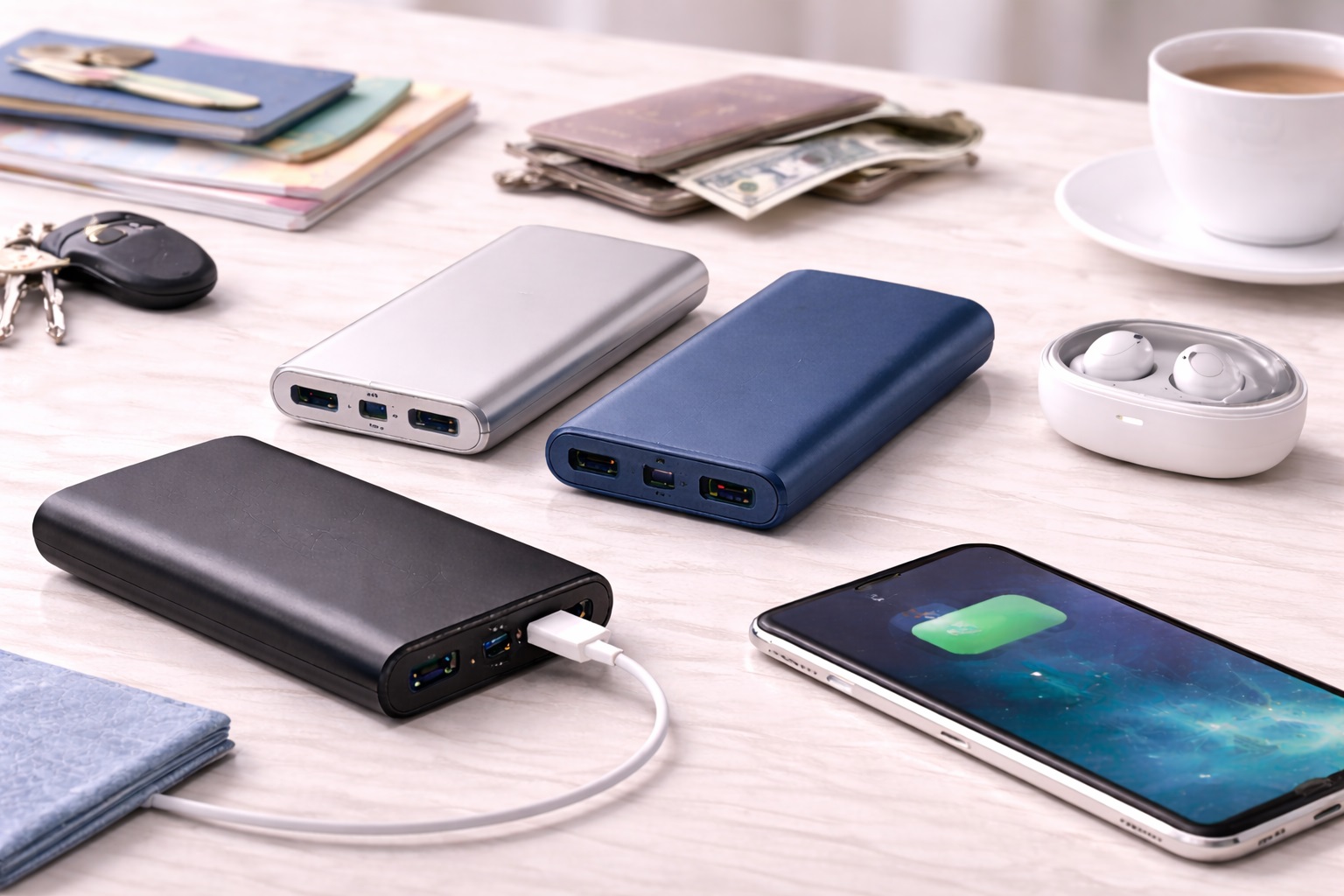
Traveling with a partner, family, or simply a phone, smartwatch, earbuds case, and tablet all at once creates a real logistical problem: only one device can plug into a single-port bank at a time. A multi-port travel charger is built specifically to solve that, offering two or three simultaneous outputs so an entire group's devices — or one person's full gadget collection — can charge together instead of queuing for a single cable. This also cuts down on the evening ritual of negotiating over the one available outlet in a shared hotel room.
- Pros:
- Charges multiple devices at once instead of one at a time
- Well suited to couples, families, or gadget-heavy travelers
- Reduces the need to carry multiple separate chargers
- Cons:
- Total output is shared across active ports, so simultaneous charging is slower per device
- Generally larger than single-port banks of similar capacity
Best For: Groups, families, or travelers carrying several devices that all need power at the same time.
Why We Recommend It: Splitting one charger across multiple devices at once is simply more convenient for anyone not traveling with a single lone gadget, and it cuts down on the number of accessories you need to pack.
Budget Travel Power Bank – Best Value
Not everyone needs a feature-packed charger for the occasional trip, and a budget-focused power bank exists for exactly that gap. These models strip out extras like solar panels, high-wattage fast charging, or multiple simultaneous outputs in favor of a straightforward, reliable charge at a lower price point. For occasional travelers or anyone who mainly wants a backup rather than a primary charging solution, this is often the most sensible purchase. It also makes a reasonable spare to leave in a suitcase for emergencies, since losing or damaging it isn't a significant financial setback.
- Pros:
- Lower upfront cost than feature-rich alternatives
- Straightforward to use with no unnecessary extras
- A sensible option for infrequent travelers
- Cons:
- Slower charging speeds than premium fast-charging models
- Build quality can vary more at this price point
Best For: Occasional travelers or anyone who wants dependable backup power without paying for features they won't use.
Why We Recommend It: For trips where charging speed and extra ports aren't priorities, the lower price makes this a practical choice that still delivers on the basics.
Buying Guide: How to Choose the Best Travel Power Bank
Before settling on a specific model, it helps to understand the handful of factors that actually separate a power bank that earns its place in your luggage from one that ends up left behind after the first trip. None of these factors matter equally for every traveler — a business commuter and a backcountry hiker will weigh the same list very differently — so read through with your own travel pattern in mind rather than treating this as a universal checklist.
1. mAh Capacity
Capacity determines how many charges you'll get before needing an outlet yourself. As a rough guide, 10,000mAh covers roughly two phone charges, 20,000mAh covers four to five, and anything above that starts approaching airline limits. Match capacity to trip length and outlet access rather than simply buying the largest number available. A useful rule of thumb is to add up the battery capacity of every device you'll carry, then multiply by the number of days between reliable outlet access, so the number you buy is grounded in your actual gear rather than guesswork.
2. Airline Compliance (100Wh Limit)
Most airlines restrict carry-on lithium-ion batteries to 100 watt-hours without special approval, and batteries above 160Wh are typically banned outright from passenger flights. Before buying, check the watt-hour rating (not just the mAh figure) printed on the bank, since this is what airline staff and security actually reference. If the number isn't printed anywhere on the housing, the manufacturer's product listing or user manual will usually list it, and it's worth confirming before a trip rather than discovering a problem at the gate.
3. Fast Charging Protocol Support
Fast-charging standards like USB Power Delivery and Quick Charge cut recharge time significantly, both for your phone and for the power bank itself. If your devices support fast charging, a bank without matching protocol support will bottleneck the whole setup regardless of its capacity. Checking your phone's supported charging wattage against the bank's output wattage takes a minute and avoids paying for a fast-charging feature that your specific device can't actually use.
4. Number and Types of Output Ports
A single USB-A port is fine for solo, single-device travel, but anyone charging more than one item at a time benefits from a bank with at least one USB-C and one USB-A output, or dedicated multi-port designs. Check whether ports can deliver full power simultaneously or if output is shared and reduced when multiple devices are connected. Product listings usually disclose per-port versus total output wattage in the fine print, and that distinction matters far more than the raw port count advertised on the box.
5. Weight and Compact Size
Every additional 10,000mAh of capacity adds real, noticeable weight. For carry-on travel, hiking, or anywhere you're covering distance on foot, weigh the marginal benefit of extra capacity against the physical burden of carrying it all day. Picking the bank up in a store, or checking the listed weight against a household object you already know, gives a far better sense of real-world bulk than the capacity number alone.
6. Input Charging Speed
A power bank that charges slowly overnight can leave you departing with less than a full charge if your schedule is tight. Look for banks that accept fast charging on the input side as well as the output side, so recharging the bank itself doesn't become its own bottleneck. A bank that takes six or more hours to refill overnight can still be short of a full charge by morning if the room's power went out or you plugged it in late.
7. Build Quality and Durability
Travel is hard on gear — bags get dropped, thrown into overhead bins, and exposed to temperature swings. A durable housing, and ideally some degree of water or dust resistance for outdoor use, meaningfully extends how long a power bank stays reliable under real travel conditions. An IP-rated housing is a reasonable shorthand for this, though even a modestly splash-resistant design is a meaningful step up from a bare plastic shell for anyone traveling near water or in unpredictable weather.
8. Display and Charge Indicators
A simple LED indicator tells you roughly how much charge remains, while a digital percentage display gives a far more precise read on whether the bank will get you through the rest of the day. This small feature matters more than it sounds like on long travel days. Knowing you have 23 percent left rather than a vague single LED blink can be the difference between confidently skipping a charging stop and detouring to find an outlet you didn't actually need.
9. Pass-Through Charging
Pass-through charging lets you charge the power bank and a connected device at the same time from a single outlet, which is genuinely useful at cramped airport gates or hotel rooms with few available plugs. Not every model supports this safely, so it's worth confirming before relying on it. When it is supported, it's particularly useful in airport lounges and hotel rooms where only one outlet is within reach of both your bag and your bed.
10. Price and Value
Price should be weighed against how the bank will actually be used rather than against its feature list in isolation. A frequent flyer benefits from paying more for airline-safe capacity and fast charging, while an occasional traveler may get equal satisfaction from a simpler, cheaper model. It's also reasonable to own more than one power bank — a compact option for day trips and a larger, airline-safe unit reserved for longer journeys — rather than trying to find one model that does everything.
11. Brand Reliability and Warranty
Lithium-ion batteries carry real safety considerations, and established brands generally maintain more consistent quality control and safety testing than unfamiliar, ultra-cheap alternatives. A meaningful warranty period is a reasonable proxy for how confident a manufacturer is in their own battery cells. It's also worth registering a warranty when the option is offered, since a battery issue discovered months into ownership is far easier to resolve with proof of purchase already on file.
12. Matching the Bank to the Trip Type
A single best travel power bank doesn't exist in the abstract — the best choice depends on whether you're flying internationally, hiking off-grid, traveling with a family, or just running errands around a new city for a weekend. Revisit the categories above with your actual next trip in mind rather than a generic "best" ranking. Many frequent travelers eventually settle on two power banks rather than one: a compact everyday option and a higher-capacity, airline-compliant unit reserved for longer trips.
Frequently Asked Questions
Can I bring a power bank on a plane?
Yes, in almost all cases power banks must travel in carry-on luggage rather than checked bags, and most airlines cap capacity at 100Wh without prior approval. Always check your specific airline's policy before flying, since rules can vary by carrier and region.
What's the difference between mAh and Wh?
mAh (milliamp-hours) is the raw capacity rating most brands advertise, while Wh (watt-hours) factors in voltage and is the figure airlines actually regulate. As a rough conversion, a 20,000mAh bank at standard voltage sits around 74Wh, comfortably under the common 100Wh limit.
How many times can a 20000mAh power bank charge my phone?
Typically four to five full charges for an average smartphone, though this varies based on your specific phone's battery size and any energy lost during conversion between the bank and the device.
Do solar power banks actually work well?
They work, but slowly. Solar panels on portable chargers are best treated as a supplemental trickle-charge for multi-day outdoor trips rather than a fast or primary charging method, since panel size and available sunlight both limit their real-world output.
Is it safe to bring a power bank through airport security?
Yes, power banks are permitted through security screening in carry-on bags in nearly all jurisdictions, though they may need to be removed from bags for X-ray screening depending on the airport, similar to laptops.
How do I know if my power bank is airline compliant?
Check the watt-hour rating printed directly on the device. If it only lists mAh, most manufacturers also publish the Wh equivalent on the product page or packaging, which you can cross-reference against your airline's stated limit.
Should I choose USB-C or USB-A for charging?
USB-C has become the more versatile standard, supporting faster charging speeds and working across a wider range of modern devices including many laptops. USB-A remains useful mainly for compatibility with older accessories, so a bank offering both ports covers the most scenarios.
Can a power bank charge a laptop?
Some higher-capacity power banks with USB-C Power Delivery output can charge laptops, but only if the wattage output matches what the laptop requires. Smaller or lower-wattage banks generally cannot charge laptops effectively, so check the output specification before assuming compatibility.
How long does a travel power bank last before needing replacement?
Lithium-ion cells generally maintain strong performance for a few hundred charge cycles before capacity noticeably declines. With normal travel use, a well-built bank from an established brand typically remains useful for a few years before it's worth replacing.
What size power bank is best for a carry-on bag?
A 10,000–20,000mAh bank strikes the best balance for most carry-on travel, offering solid coverage without adding excessive bulk or weight to a bag that's already carrying a laptop, chargers, and other essentials.
Can I use a power bank while it's charging?
Many modern power banks support pass-through charging, allowing simultaneous input and output, though this can generate more heat and, on some cheaper models, isn't recommended by the manufacturer. Check the product specifications to confirm before relying on this feature regularly.
How much should I expect to pay for a good travel power bank?
Prices vary widely based on capacity, charging speed, and extra features like solar panels or multiple ports, and a reasonable mid-range bank typically costs noticeably less than a premium smartphone accessory. Rather than anchoring to a specific price, compare a few models with the features you actually need and let the price differences guide you from there.
What should I do with an old or damaged power bank?
Never dispose of a lithium-ion power bank in regular household trash. Most regions have dedicated battery recycling programs or drop-off points at electronics retailers, and a swollen, damaged, or overheating bank should be handled and disposed of with particular care.
Will a power bank set off airport security alarms?
No, a standard lithium-ion power bank within legal capacity limits does not trigger security alarms on its own. It will simply appear on the X-ray scan like any other electronic device and typically doesn't draw extra attention unless its capacity looks unusually large.
Do I need a different power bank for international travel versus domestic trips?
Not usually, though it's worth checking the specific rules of any country you're transiting through, since a small number of regions apply stricter battery restrictions than the general international norm. For most domestic and international travel, an airline-compliant bank under 100Wh covers both cases without issue.
Is a higher mAh rating always better?
Not necessarily. A higher mAh rating means more total charges, but it also means more weight, a larger physical size, and a greater chance of bumping into airline capacity limits. The better question is how many charges you actually need on a typical trip, then buying capacity to match that rather than the highest number available.
Final Verdict
- Best Overall: The 20000mAh travel power bank, for balancing real-world capacity against portability.
- Best for Air Travel: The airline-safe 26800mAh bank, for maximizing capacity within common carry-on limits.
- Best Ultralight: The lightweight compact charger, for travelers who prioritize packability above all else.
- Best for Off-Grid Trips: The solar power bank, for extending charge life away from outlets.
- Best Budget: The budget travel power bank, for occasional travelers who want dependable basics at a lower cost.
There isn't a single correct answer to which travel power bank is best — there's only the one that fits how you actually travel. Think honestly about your next few trips, weigh capacity against weight and airline rules, and choose the option built around the way you'll really use it rather than the one with the most impressive spec sheet. A power bank that sits unused in a drawer because it was too heavy to bother packing does less for you than a smaller one that actually makes it into the bag every time, so practicality on the day of travel should outweigh the appeal of a bigger number on the spec sheet.