Best Travel Mice: Pocket-Sized Precision for Remote Work
Working from a hotel desk, an airport lounge, or a coworking table in a different city every few weeks changes what you actually need from a mouse. A device that's perfectly comfortable at a permanent home office desk can become an awkward burden the moment it has to survive a carry-on, fit in a laptop sleeve, and still track precisely on whatever surface happens to be available that day — a marble hotel desk, a wobbly café table, or the arm of an airplane seat.
For remote workers and digital nomads, a mouse is less a fixed piece of desk equipment and more a piece of travel gear, judged by the same criteria as anything else that has to survive repeated packing and unpacking: size, weight, battery reliability, and how well it holds up to being tossed in a bag alongside chargers and cables. Precision still matters — client presentations, spreadsheet work, and detailed edits don't get easier just because you're on the road — but it has to be delivered in a much smaller, more resilient package than a typical office mouse.
This guide breaks down the mouse styles best suited to frequent travel and remote work, then walks through the specific buying factors — connectivity, battery life, durability, and grip comfort — that matter most when a mouse has to work reliably across constantly changing locations. Whether you work from a single home base with occasional trips or move between cities every few weeks, the goal is the same: dependable precision that fits in whatever space and bag you're carrying that day.
It's also worth being honest about the trade-offs involved. A mouse built primarily for portability will rarely match a full-size ergonomic mouse for comfort during an eight-hour desk session, and a mouse built for maximum comfort will rarely be the easiest thing to fit into a crowded laptop bag. The reviews and buying advice below are built around helping you weigh that trade-off against your actual travel frequency and daily working habits, rather than assuming one style fits every remote worker equally well.
Top 3 Travel Mice (Detailed Reviews)
1. Wireless Ergonomic Mouse – Best Overall for Frequent Travelers
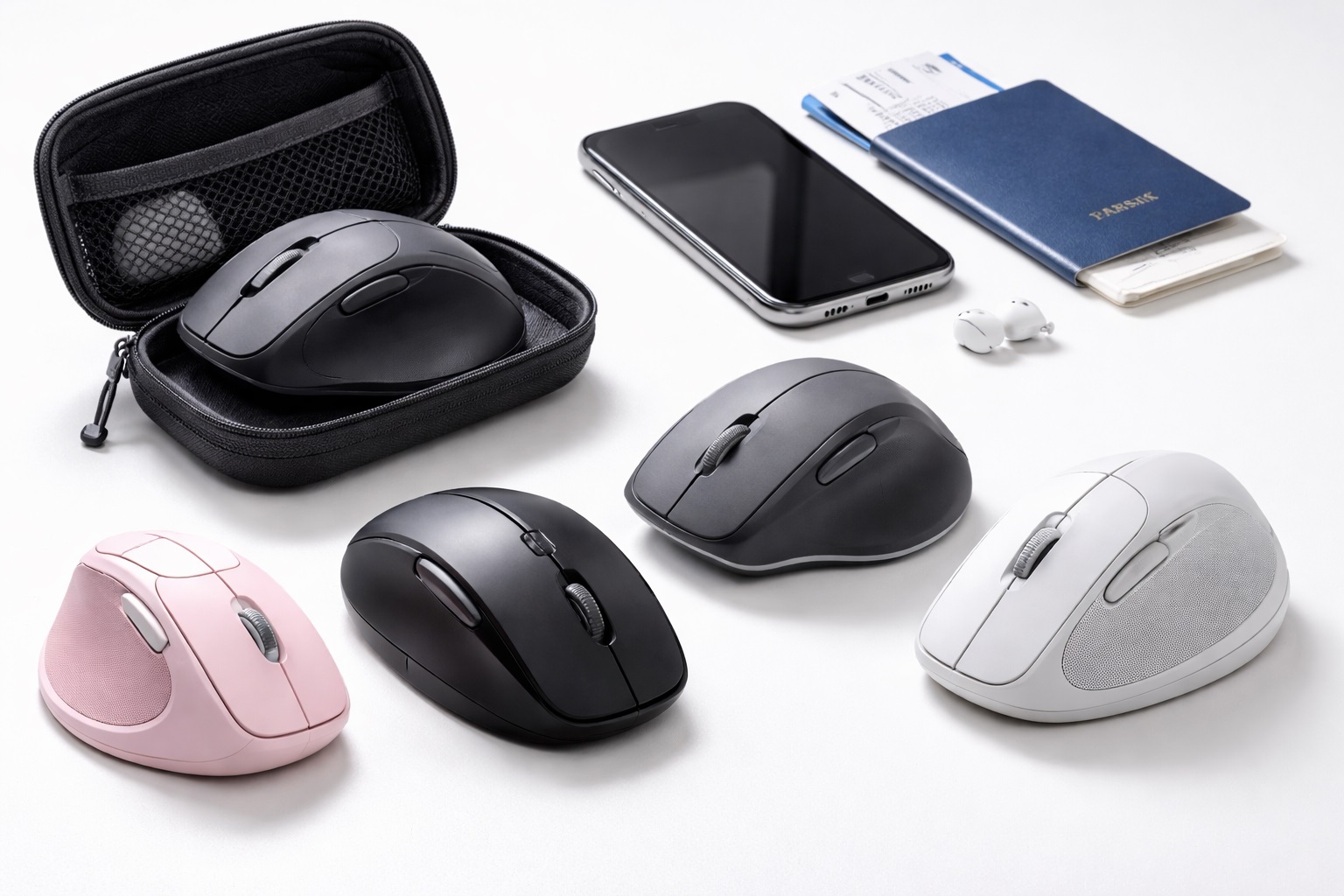
A wireless ergonomic mouse shapes the hand into a more neutral, rotated position rather than forcing the wrist flat against whatever surface is available, which matters for anyone doing long client calls or detailed work while away from home. Most models in this category are designed for right-handed users, though ambidextrous options exist for travelers who want the ergonomic benefit without a hand-specific shape. Connectivity is typically handled through a 2.4GHz USB receiver, Bluetooth, or both, and most models include multiple DPI presets that can be adjusted for different tasks on the road.
- Pros:
- Neutral hand position reduces strain during long working sessions away from home
- Wireless connection avoids one more cable to manage in a hotel room or coworking space
- Adjustable DPI presets adapt to different screen sizes and tasks
- Generally strong battery life reduces the need to pack a charger for short trips
- Cons:
- Bulkier than a dedicated compact travel mouse, taking up more room in a bag
- Shape is usually right-hand specific
Best For: Remote workers and consultants who travel occasionally but still spend long stretches at a laptop each day, especially those prone to wrist or forearm fatigue during extended work sessions.
Why We Recommend It: For travelers who work full days rather than checking email between flights, comfort during extended use matters as much on the road as it does at a home desk. The larger footprint is a reasonable trade-off for anyone whose trips involve genuine full-time work rather than occasional light use. Given that business travel and remote-work trips increasingly blur into full working weeks rather than short excursions, a mouse that holds up across a genuine eight-hour day earns its slightly larger footprint many times over.
Because ergonomic shapes reduce the twisting motion a flat mouse forces on the wrist, they're particularly useful for travelers working from unconventional setups — a hotel desk that's slightly too high, or a lap-based arrangement on a train or plane. The improved hand position helps compensate for less-than-ideal working conditions that come with life on the road.
2. Compact Wireless Mouse – Best for Minimal Packing
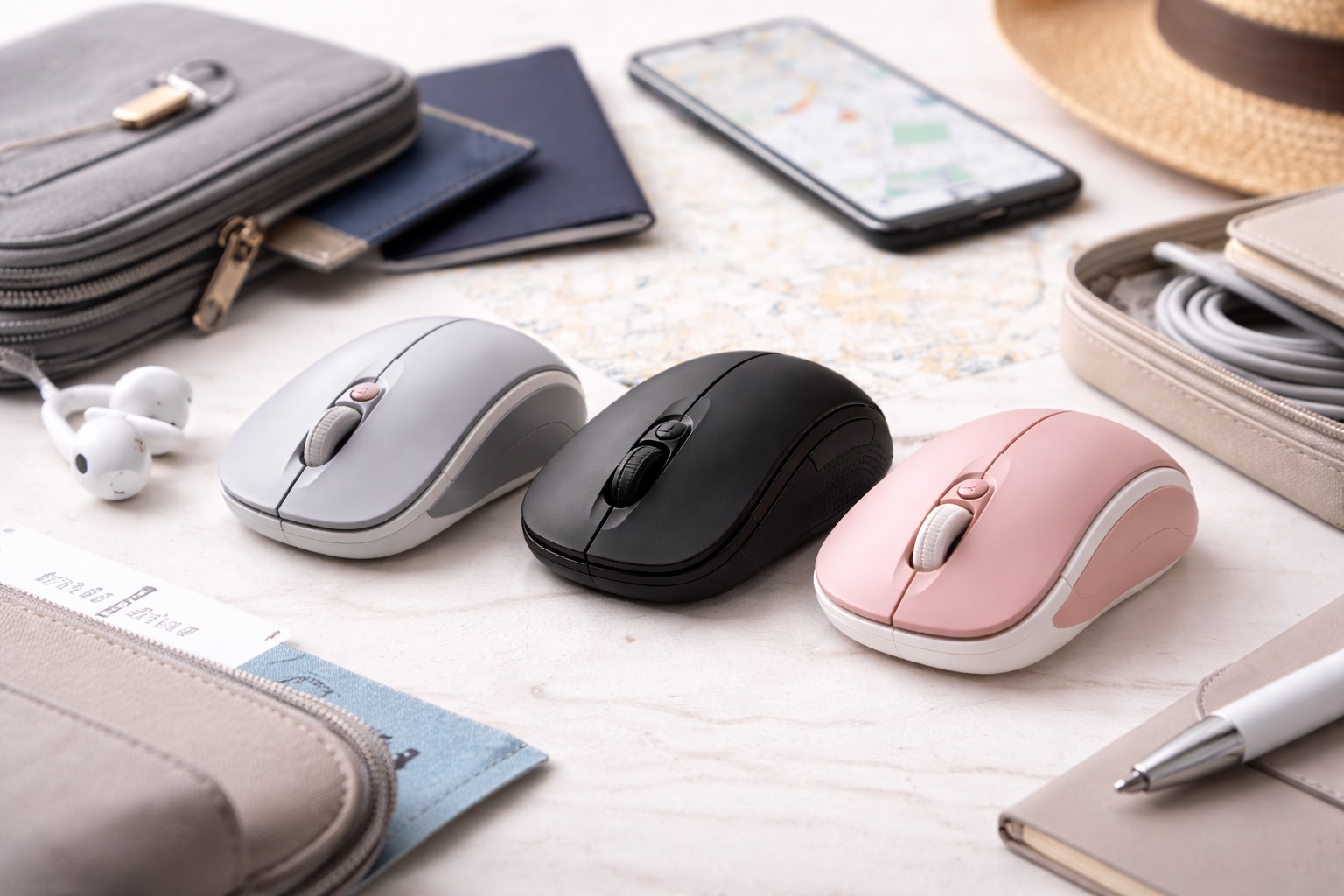
Compact wireless mice are built around a single priority: taking up as little space as possible, both on the desk and in a bag. Most weigh under 80 grams and pair with a small USB receiver that stores inside the mouse body, so nothing gets lost loose in a laptop sleeve or travel pouch. Because the shape sacrifices some of the contouring found in larger ergonomic designs, these mice suit shorter working sessions better than a full eight-hour day, but for travelers prioritizing minimal packing weight, that trade-off is usually the right one.
- Pros:
- Small enough to disappear into a laptop sleeve or jacket pocket
- Receiver stores inside the mouse body, reducing lost-parts risk while traveling
- Light enough that it barely registers as extra carry weight
- Many models offer Bluetooth-only operation for one less accessory to track
- Cons:
- Less comfortable than full-size ergonomic designs during long sessions
- Smaller shape can tire the hand faster with extended use
Best For: Digital nomads, frequent flyers, and anyone whose work sessions on the road tend to be shorter bursts between meetings, flights, or sightseeing rather than a full uninterrupted workday.
Why We Recommend It: Packing efficiency is a genuine priority for frequent travelers, and this style solves that directly without sacrificing meaningful tracking accuracy. For anyone who values a lighter bag over maximum hand comfort, the compact format is the more sensible everyday travel companion. Digital nomads especially tend to accumulate small accessories over time — adapters, cables, portable chargers — and every item that stays genuinely small helps keep an already crowded bag manageable.
Because the receiver tucks away inside the mouse itself, there's also less chance of losing a small dongle in the bottom of a bag or a hotel room drawer — a small but real advantage for anyone who's ever had to search a suitcase for a misplaced USB receiver before an important call.
3. Silent Click Wireless Mouse – Best for Shared Workspaces and Quiet Rooms
Silent click mice use a modified switch mechanism that dampens the audible snap of a standard click without changing how precisely the click registers. For remote workers regularly working from shared coworking spaces, quiet cafés, or hotel rooms with thin walls, that reduced noise makes a genuine difference — a loud, clicky mouse becomes noticeably more obvious in unfamiliar, quiet environments than it ever would in a busy home office. Silent switches are available in both compact and ergonomic body styles, so travelers don't need to choose between a quiet click and their preferred shape.
- Pros:
- Meaningfully reduced click noise compared to standard switches
- Tracking accuracy and click registration remain unaffected
- Available in both compact and ergonomic designs
- Well suited to coworking spaces, hotel rooms, and video calls from shared environments
- Cons:
- Some users notice the click feels slightly softer than a standard switch
- Silent switches may wear somewhat differently over long-term daily use
Best For: Remote workers who regularly take video calls from coworking spaces, hotel rooms, or shared apartments where every click is audible through a laptop microphone or to people working nearby.
Why We Recommend It: A loud mouse click becomes far more noticeable in an unfamiliar coworking space or a quiet hotel room than it does at home, and video calls amplify that further by picking up every click through the microphone. This style removes that friction entirely, without any compromise on tracking precision. For anyone whose income depends on making a polished impression during client calls, small details like click noise contribute more to that impression than most people initially assume.
For anyone whose work involves frequent client-facing video calls from changing locations, a quieter click is a small detail that consistently improves the professional impression left on the other end of the call, particularly during screen-sharing sessions where clicking is constant and clearly audible.
Buying Guide: How to Choose the Best Travel Mouse
A travel mouse has to satisfy two competing priorities at once: genuine portability and dependable performance in unpredictable conditions. Use the factors below to weigh your options against your actual travel frequency and working style.
1. Size and Packing Footprint
Before anything else, consider how much space the mouse will realistically take up in a bag that's already carrying a laptop, charger, and other travel essentials. A mouse that's a few millimeters smaller may seem trivial in isolation, but across a laptop sleeve packed with cables and adapters, that difference adds up. Look at actual dimensions rather than marketing descriptions like "compact" or "slim," which vary considerably between brands. Comparing listed measurements against an item you already own — a phone or a wallet, for example — gives a more intuitive sense of real-world size than millimeter figures alone.
2. Weight
Every gram matters more for frequent travelers than for someone who uses a mouse at a single fixed desk. Mice under 80 grams are common in the travel category and barely register in a packed bag, while heavier ergonomic designs, though more comfortable during long sessions, add noticeably more bulk. Decide whether comfort or minimal packing weight matters more for your specific travel pattern. Frequent flyers subject to strict carry-on weight limits sometimes find that small accessory weight adds up more than expected once laptops, chargers, and adapters are all accounted for.
3. Connectivity Type and Reliability
A 2.4GHz USB receiver typically delivers a more consistent, lower-latency connection, which matters for detailed work like spreadsheet editing or design software. Bluetooth removes the need for a dedicated USB port, which is valuable on ultra-thin travel laptops with limited connectivity, but introduces a small amount of extra latency. Some travel mice support both connection types, letting you switch depending on what's available at a given location. This flexibility matters more for travelers than for anyone working from a single fixed setup, since the available ports and interference conditions can change dramatically between a hotel room, a coworking space, and a café.
4. Battery Life and Charging Convenience
For travelers, battery life is less about total duration and more about charging convenience. A mouse that charges via the same USB-C cable already used for a phone or laptop simplifies packing considerably, since it removes the need for a separate charging cable or spare batteries. Battery-powered models last longer between service but require carrying spares, which adds bulk that frequent travelers often prefer to avoid. Cable consolidation is a small detail that experienced travelers learn to prioritize quickly, since every unique cable or charger format is one more thing that can get left behind in a hotel room.
5. Durability Under Frequent Handling
A travel mouse gets packed and unpacked far more often than one that stays permanently on a home desk, so build quality genuinely matters here. Look for solid, well-fitted construction and a scroll wheel that feels smooth and consistent, since scroll wheel wear is one of the first signs a lower-quality mouse is beginning to fail — a problem that surfaces faster under frequent handling than under stationary desk use. Buttons and seams that feel loose or rattle slightly when new are a reasonable warning sign that the mouse may not hold up well to months of regular travel.
6. Surface Compatibility for Unpredictable Desks
Travelers rarely control the surface they're working on — a glass hotel desk, a fabric café table, or an airplane tray table are all common scenarios. Optical sensors handle most everyday surfaces reliably, while laser sensors extend that range to glass and glossy surfaces, which is a genuinely useful feature for anyone who frequently works from hotel rooms with reflective desk surfaces. Packing a small folding mousepad is a low-cost backup for the rare surface that gives any sensor trouble, and it takes up almost no additional space in a bag.
7. Storage for the Wireless Receiver
A USB receiver that stores inside the mouse body when not in use is a small but meaningful feature for travelers, since it removes the risk of losing a tiny dongle in the bottom of a bag or a hotel room. If a mouse doesn't offer internal receiver storage, consider a small dedicated pouch or case to keep the receiver from getting separated from the mouse during travel. Losing a receiver mid-trip typically means falling back to Bluetooth if available, or working with a trackpad until a replacement can be ordered, so this small design detail carries more real-world consequence than it might initially seem.
8. Click Noise for Shared and Quiet Environments
Coworking spaces, hotel rooms, and quiet cafés all amplify the sound of a standard mouse click more than a typical home office would. A silent-click design meaningfully reduces that noise without affecting tracking precision, which matters for anyone regularly taking video calls or working near strangers in shared spaces. This is one of those features that's easy to overlook while shopping but becomes immediately obvious the first time a client comment mentions hearing constant clicking in the background of a call.
9. Grip Style and Comfort Trade-Offs
Palm grip users generally prefer a larger mouse body, while claw and fingertip grip users tend to do well with smaller, lighter designs — which happens to align conveniently with the compact shapes common in travel mice. Still, if you do full workdays on the road rather than short bursts, it's worth weighing comfort more heavily against pure portability. Testing a mouse's grip comfort during an actual multi-hour work session, rather than a brief in-store trial, gives a far more accurate sense of whether the trade-off is worth making.
10. DPI Range for Varying Screen Sizes
Remote workers often switch between a laptop screen, an external monitor at a coworking space, and occasionally a larger display at a client site. Adjustable DPI settings let a single mouse adapt to these different screen sizes without needing separate devices, which is a meaningful convenience for anyone whose working setup changes from week to week. A quick-access DPI button on the mouse itself is especially useful here, letting you adjust sensitivity in seconds when switching between an unfamiliar monitor and your own laptop screen.
11. Software Dependency and Onboard Memory
Some mice require companion software to adjust settings, which can be inconvenient when working from a shared or unfamiliar computer where installing new software isn't practical. Mice that store custom DPI and button settings in onboard memory avoid this dependency entirely, letting settings travel with the mouse across different machines. This matters more than it might initially seem for remote workers who occasionally use a client's computer or a shared coworking workstation rather than exclusively their own laptop.
12. Case or Pouch Availability
A small carrying case or pouch, whether included or purchased separately, protects a travel mouse from scratches and impacts inside a bag full of harder items like chargers and adapters. This is a minor detail on paper but a genuinely useful one for anyone who travels frequently enough that the mouse spends more time in transit than sitting still on a desk. A pouch also keeps the mouse and its receiver together as a single unit, rather than letting the small receiver drift to the bottom of a bag separately.
Frequently Asked Questions
1. What makes a mouse suitable for frequent travel specifically?
Size, weight, and durability under frequent packing matter more for a travel mouse than for one used at a fixed desk. A compact design with a stored receiver and reliable battery life tends to serve frequent travelers better than a larger ergonomic mouse, even though tracking accuracy is comparable across both styles. How often you travel, and for how long each trip lasts, should ultimately guide which trade-offs matter most to you.
2. Is Bluetooth or a USB receiver better for travel?
A USB receiver typically offers a more consistent, lower-latency connection, useful for precision work. Bluetooth frees up a port on ultra-thin travel laptops, which often have limited connectivity, at the cost of a small amount of extra latency most users won't notice for everyday tasks.
3. How long does a travel mouse's battery typically last?
Rechargeable USB-C models often last three to eight weeks per charge under normal use, while mice powered by AA batteries can run for several months. For travel specifically, a mouse that shares a charging cable with your phone or laptop simplifies packing considerably.
4. Is a compact travel mouse durable enough for frequent packing?
Generally yes, provided the build quality is solid. Compact mice are specifically designed with portability in mind, and a receiver that stores inside the mouse body reduces the risk of losing small parts during frequent travel. A dedicated pouch adds an extra layer of protection against bumps in a crowded bag, particularly for travelers checking luggage rather than carrying everything on.
5. Can a travel mouse cause wrist pain during long work sessions?
A flat, compact mouse used for many hours at a stretch can contribute to wrist and forearm strain, similar to any standard mouse. For travelers who work full days rather than short bursts, an ergonomic travel-friendly design offers a better balance between comfort and portability.
6. How do I know if a travel mouse will fit my hand comfortably?
Many manufacturers list physical dimensions on the product page. Measuring your hand from the base of the palm to the tip of the middle finger and comparing it to the mouse's length gives a reasonable estimate, particularly for a palm grip, though compact travel mice are generally better suited to claw or fingertip grips regardless of hand size. Reading reviews from buyers with a similar hand size adds a useful second opinion before committing to a purchase.
7. Is a silent-click mouse worth it for coworking spaces?
Yes, particularly for anyone taking frequent video calls in shared or open coworking environments. The reduced click noise makes a noticeable difference without any loss in tracking precision, which matters when working near strangers or during screen-sharing sessions.
8. Does the most expensive travel mouse always perform the best?
Not necessarily. Higher prices often add extra materials or features like onboard memory, but many mid-range travel mice deliver excellent day-to-day performance. Matching features to your actual travel habits is more useful than assuming price alone indicates quality.
9. How long should a well-built travel mouse last with frequent use?
A quality travel mouse typically lasts two to five years with reasonable care, though frequent packing and handling can accelerate wear compared to a mouse that stays on one fixed desk. Scroll wheel performance is usually the first sign of aging to watch for, followed by looser click buttons after extended daily transport.
10. Can I return a travel mouse if it doesn't suit my needs?
Most retailers offer a return window of 15 to 30 days. It's worth testing the mouse on a few different surfaces and during an actual travel day before that window closes, since real-world conditions on the road often differ from a quick test at home.
11. Does surface compatibility matter more for a travel mouse?
Yes, since travelers rarely control what surface they're working on. Optical sensors handle most everyday surfaces reliably, while laser sensors add compatibility with glass or glossy hotel desks, which is a genuinely useful feature for frequent travelers who can't predict where they'll be working next. A small folding mousepad is a reasonable backup for the rare problematic surface, taking up almost no room in a bag.
12. Is it worth buying a dedicated travel mouse instead of using a standard one while traveling?
For occasional trips, a standard mouse works fine. For frequent travel, a dedicated travel mouse's smaller size, lighter weight, and internal receiver storage genuinely reduce daily packing friction in ways that add up meaningfully over months of regular travel.
Final Verdict
- Best Overall for Frequent Travelers: Wireless Ergonomic Mouse – the strongest choice for anyone doing full workdays away from a home desk.
- Best for Minimal Packing: Compact Wireless Mouse – the lightest, most travel-friendly option for shorter working sessions.
- Best for Shared Workspaces and Quiet Rooms: Silent Click Wireless Mouse – the most considerate pick for coworking spaces, hotels, and video calls.
The right travel mouse ultimately depends on how you actually work while away from home — whether trips involve full workdays or short bursts between meetings, how much packing weight matters to your specific routine, and how much your click noise affects the people around you in shared spaces. Matching those habits to the right style will serve you better on the road than chasing the most feature-packed option available.
For remote workers whose location changes regularly, it's also worth revisiting this choice periodically. A mouse that suited occasional weekend trips may not hold up well once travel becomes a weekly routine, and a compact mouse chosen purely for minimal packing weight may start to feel limiting if work sessions on the road grow longer over time. Reassessing against your current travel pattern, rather than the one you had when you first bought a mouse, keeps the choice matched to how you're actually working now.
None of the three styles covered here require a significant compromise on tracking accuracy — the differences come down to comfort, portability, and noise, all of which map directly onto how and where you actually work while traveling. A little honest reflection on your own travel habits will point toward the right pick far more reliably than any single spec on a product page.