Best Mouse Pads for Gaming & Office Work: Top Picks
A mouse pad looks like the simplest accessory on any desk, yet the surface underneath your mouse quietly affects how accurately you aim in a game, how comfortably your wrist rests through an eight-hour workday, and how well your desk itself is protected from spills, scratches, and wear. Not every mouse pad is built for the same job. A thin fabric pad tuned for fast flick shots behaves very differently under the sensor than a dense desk mat meant to anchor a full keyboard-and-mouse setup, and picking the wrong one can leave you fighting your own equipment instead of your opponents or your workload.
This guide breaks down the main categories of mouse pads available today — speed surfaces, control surfaces, extended desk mats, standard office pads, RGB gaming pads, and budget-friendly options — and explains what separates a genuinely useful pad from one that only looks appealing in a product photo. Rather than assuming one style suits everyone, each entry below is matched to the situation it actually fits best, whether that's competitive gaming, long typing sessions, or protecting an expensive desk surface.
Alongside the reviews, you'll find a practical buying guide covering the factors that matter most — surface texture, size, edge durability, base grip, and material quality — plus answers to the questions people most commonly ask before buying a new pad. The goal is to help you match a mouse pad to your actual habits rather than to marketing claims.
It's also worth noting that a mouse pad rarely needs replacing on the same schedule as the mouse or keyboard sitting on top of it, which means getting the choice right the first time pays off over a longer stretch of daily use. A pad that fights your play style or wears out within months isn't just an inconvenience — it can quietly undermine consistency in games where every fraction of a second counts, or add friction to a workday that should otherwise feel effortless.
Top 6 Mouse Pads for Gaming and Office Work (Detailed Reviews)
1. Speed Surface Gaming Pad – Best for Fast-Paced, Low-Sensitivity Play
Speed surfaces use a smoother, lower-friction weave that lets the mouse glide with minimal resistance across the pad. This matters most to players who rely on quick flicks and wide arm movements, such as those competing in fast-paced shooters where reaction time and swift target acquisition outweigh pinpoint micro-adjustments. Because the surface offers less drag, sensor tracking tends to feel lighter and more responsive, though that same low friction can make fine aiming trickier for players who prefer slower, more deliberate cursor movement.
- Pros:
- Low-friction weave supports fast, fluid mouse movement
- Well suited to low-sensitivity, high-speed playstyles
- Typically thin and easy to pack for travel or LAN events
- Cons:
- Reduced control can make precise, slow aiming harder
- Thinner construction may wear faster under heavy daily use
Best For: Gamers who play fast, twitch-reflex titles and prefer swift, low-effort mouse glide over fine-grained control.
Why We Recommend It: For players whose style depends on speed over precision, a dedicated speed surface removes unnecessary resistance from every movement, which can translate directly into quicker reaction times during competitive play.
2. Control Surface Gaming Pad – Best for Precision Aiming
Control surfaces take the opposite approach, using a tighter weave with more texture to slow the mouse down slightly and give the player more command over exactly where the cursor lands. This is the preferred surface type for games that reward pixel-level accuracy, such as tactical shooters or any title where a single well-placed shot matters more than raw speed. The added friction does mean more physical effort is needed to cover large distances on the pad, which is why many control-surface users also run higher mouse sensitivity settings.
- Pros:
- Textured surface allows for precise, controlled cursor placement
- Reduces overshoot on fine aiming adjustments
- Often paired with denser, more durable base materials
- Cons:
- Requires more physical arm movement for large swipes
- Not ideal for players who prefer very low sensitivity settings
Best For: Players in precision-focused games who value accuracy over raw speed, and anyone who fine-tunes aim at higher sensitivity.
Why We Recommend It: The added texture gives you more predictable feedback under the sensor, which helps build muscle memory for consistent, repeatable aim over time.
3. Extended XL Desk Mat – Best for Full Desk Setups
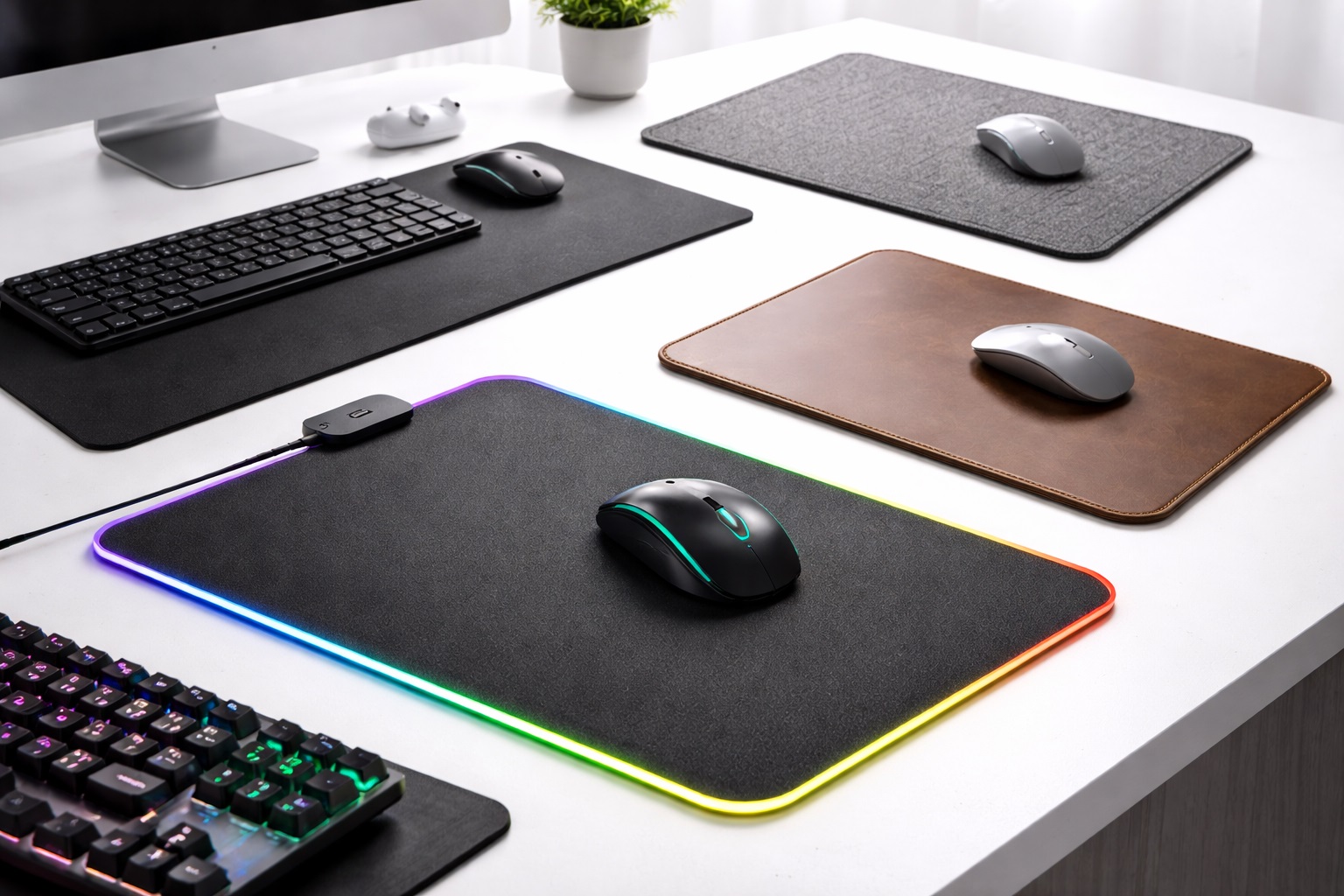
An extended desk mat covers the entire desk surface beneath both keyboard and mouse, unifying the two into one consistent surface. Beyond the tracking benefits, this style is really about desk protection and aesthetics — it shields the desk from scratches, spills, and the wear that comes from years of typing and mouse movement, while giving a cluttered setup a cleaner, more cohesive look. The trade-off is size: an XL mat takes up the whole desk, so it only makes sense if you're willing to commit your entire workspace to one surface.
- Pros:
- Unifies keyboard and mouse tracking on one continuous surface
- Protects the entire desk from scratches, spills, and wear
- Creates a cleaner, more organized visual setup
- Cons:
- Takes up the full desk, leaving no room for a different surface elsewhere
- Can be harder to clean thoroughly given its larger surface area
Best For: Desk setups where you want one continuous surface under both keyboard and mouse, plus full desk protection.
Why We Recommend It: For anyone tired of a mouse pad sliding around a bare desk or a keyboard sitting directly on an unprotected surface, an XL mat solves both problems with a single purchase.
4. Standard Office Mouse Pad – Best for Everyday Work
The standard office pad is built for a simpler goal than gaming performance: a comfortable, unobtrusive surface for everyday clicking, scrolling, and cursor movement through a typical workday. These pads tend to be compact, simply designed, and priced to be an easy addition to any desk rather than a centerpiece purchase. They won't offer the specialized tracking benefits of a gaming-tuned surface, but for word processing, spreadsheets, and general office tasks, that specialization usually isn't necessary anyway.
- Pros:
- Comfortable, no-frills surface for daily office tasks
- Compact footprint fits easily on crowded desks
- Usually the most affordable option in the category
- Cons:
- Lacks the specialized surface tuning gamers look for
- Smaller size may not accommodate very large mouse movements
Best For: Office workers and everyday computer users who need reliable comfort rather than competitive-grade tracking performance.
Why We Recommend It: It does exactly what most people actually need from a mouse pad — a stable, comfortable surface — without paying for gaming features that would go unused in an office context.
5. RGB Gaming Mouse Pad – Best for Setup Aesthetics
RGB mouse pads combine a gaming-oriented surface with built-in lighting along the edges, letting the pad match or complement other lit-up components on a gaming desk. Functionally, the surface itself usually falls somewhere between speed and control, aiming for a balanced feel that suits a broad range of players rather than one extreme. The lighting is the real differentiator here, and it typically requires a USB connection and companion software to control colors and effects, which adds a small layer of setup compared to a plain fabric pad.
- Pros:
- Adds customizable lighting that ties a gaming setup together visually
- Balanced surface works reasonably well for varied playstyles
- Often includes software for syncing lighting with other peripherals
- Cons:
- Requires a USB connection, adding one more cable to manage
- Balanced surface won't specialize as well as a dedicated speed or control pad
Best For: Gamers who want their desk setup to look as good as it performs, especially alongside other RGB-lit peripherals.
Why We Recommend It: Beyond the lighting, it offers a genuinely usable middle-ground surface, making it a reasonable pick for players who haven't settled firmly into a speed or control preference.
6. Budget Mouse Pad – Best Budget Option
A budget mouse pad strips things back to the essentials: a basic fabric surface with a rubber base, sized for typical desk use, at the lowest price point in the category. These pads won't offer premium stitching, specialized surface tuning, or lighting, but for anyone who just needs something better than a bare desk or an old cloth, they get the job done reliably. The main limitation is longevity — cheaper materials tend to fray, thin out, or lose their grip sooner than higher-priced alternatives.
- Pros:
- Low upfront cost makes it an easy, low-risk purchase
- Covers the basic function of any mouse pad without extras
- Widely available in multiple sizes
- Cons:
- Edges may fray faster without reinforced stitching
- Surface and base materials typically wear out sooner than premium pads
Best For: Budget-conscious buyers who want a functional mouse pad without paying for gaming-specific tuning or lighting.
Why We Recommend It: It covers the core job of a mouse pad — a stable, cushioned surface — at a price that makes it an easy add-on to any order rather than a considered purchase.
Buying Guide: How to Choose the Best Mouse Pad
With the main categories covered, the following factors will help you narrow down which specific pad fits your desk, your play style, and your budget. None of these considerations exist in isolation — the right mouse pad is usually the one that balances several of them well rather than maximizing any single one.
1. Surface Texture (Speed vs. Control)
This is the single most important decision for gaming use. Speed surfaces reduce friction for fast, sweeping mouse movements, while control surfaces add texture that makes fine, precise aiming easier. If you're not sure which you prefer, think about the games you play most: fast-paced titles that reward quick reactions favor speed, while titles rewarding pinpoint accuracy favor control. Office and everyday users generally won't notice much difference between the two and can prioritize other factors instead.
Some players find it useful to own one pad of each type and switch depending on the game, especially if they split time between fast-paced shooters and slower, precision-based titles. If you can only own one, base the decision on whichever style of play makes up the majority of your time at the desk.
2. Size (Desk Mat vs. Standard)
Standard pads sit under the mouse alone, usually in the range that comfortably fits most desks without taking up excessive space. Extended desk mats stretch to cover the keyboard as well, sometimes the entire desk surface. Choose based on how much of your desk you actually want unified under one surface — a standard pad is easier to reposition or clean, while a desk mat offers a more complete, cohesive look and stronger desk protection.
It also helps to measure your desk and your typical mouse swing distance before buying, particularly if you use a low sensitivity setting that requires wide arm movements. A pad that's too small will force you to lift and reposition the mouse mid-motion, which can interrupt otherwise smooth tracking.
3. Stitched Edge Durability
Fabric mouse pads without reinforced edges are prone to fraying over time, especially at the corners where the mouse or wrist frequently brushes against the border. Stitched edges add a layer of reinforcement that noticeably extends the usable life of the pad, particularly for daily or heavy use. If you plan to keep the pad for years rather than months, stitching is worth prioritizing even if it adds slightly to the cost.
Pay attention to how the stitching is described in the product listing — a fully stitched perimeter offers more consistent protection than partial stitching limited to just the corners or one edge.
4. Non-Slip Rubber Base
A pad that shifts around during use is a genuine distraction, especially mid-game. A quality rubber base grips the desk surface firmly, keeping the pad in place through fast movements and repeated use. Cheaper pads sometimes use thinner or lower-quality rubber that loses its grip faster, so checking for a full-coverage non-slip base — rather than just a few adhesive dots — is a reasonable way to judge base quality before buying.
Desk material matters here too. Glass or highly polished desk surfaces are harder for any rubber base to grip than a textured wood or laminate surface, so if your desk is unusually smooth, prioritize a pad with reviews specifically confirming it stays put.
5. Material Quality
The fabric weave, the foam or rubber layer beneath it, and how well those layers are bonded together all affect how the pad feels and how long it lasts. Higher-quality materials tend to maintain consistent surface texture over months of use, while lower-quality ones can develop shiny, worn patches where the mouse travels most, which changes the tracking feel over time.
Thickness also plays a role in comfort, particularly for users who rest their wrist on the pad for long stretches. A thicker foam layer offers more cushioning but can slightly raise the mouse relative to the keyboard, which is worth considering if you're sensitive to wrist angle.
6. Price and Value
Mouse pads span a wide price range, from inexpensive basic pads to premium desk mats with reinforced stitching and specialized surfaces. Rather than defaulting to the cheapest or the most expensive option, weigh the price against how often you'll use the pad and how much the surface texture and size actually matter to your daily routine.
A useful way to think about value here is cost per year of expected use rather than upfront price alone — a slightly pricier pad with stitched edges that lasts three times as long as a budget option may actually be the cheaper choice over time.
7. Brand Reliability
Established peripheral brands generally offer more consistent manufacturing quality and clearer product specifications, which makes it easier to know what you're actually buying. Lesser-known brands can still offer solid value, but it's worth reading verified reviews carefully before trusting vague or inconsistent product descriptions.
Consistency across a brand's product line is also worth noting — if a company's other peripherals have a reputation for durability, that's a reasonable, if imperfect, signal for their mouse pads as well.
8. Warranty and Support
Mouse pads are simple products, so warranty coverage is usually modest compared to electronics, but it still signals how confident a manufacturer is in their stitching and materials holding up. If a warranty or replacement policy is offered, check what specifically it covers — fraying edges, base delamination, or surface defects are the most common claims.
Keep any purchase confirmation or receipt until you're satisfied the pad is holding up, particularly if you're trying an unfamiliar brand for the first time.
9. User Reviews and Real-World Feedback
Because surface feel is subjective, reading a range of user reviews helps reveal patterns that specifications alone won't show — whether a "speed" pad actually feels fast, whether the stitching holds up after months of use, or whether the base stays put on a particular desk material. Look for reviews from users with a similar use case to yours, whether that's competitive gaming or everyday office work.
Pay closer attention to reviews written after several months of ownership rather than first-impression reviews, since durability issues like fraying or base wear typically only surface with extended use.
10. Compatibility With Your Mouse Sensor
Most modern optical sensors track reliably across fabric mouse pads, but very glossy, transparent, or unusually smooth surfaces can occasionally cause tracking inconsistencies with certain sensors. If you already own a mouse with a specific sensor, it's worth checking whether the manufacturer notes any surface recommendations before committing to an unusual pad material.
If you're unsure, a standard cloth surface remains the safest, most broadly compatible choice across the widest range of optical and laser sensors on the market.
Frequently Asked Questions
1. What's the actual difference between a speed and a control mouse pad?
Speed surfaces use a smoother weave that reduces friction, letting the mouse glide faster with less effort. Control surfaces use more texture to slow the mouse slightly and improve precision. Neither is objectively better — the right choice depends on whether your games or tasks reward quick, broad movements or fine, accurate ones. Trying both, even briefly, is the most reliable way to learn your own preference.
2. Do I need an extended desk mat, or is a standard pad enough?
A standard pad is enough if you only need a surface under your mouse. An extended mat makes more sense if you want your keyboard on the same surface, want stronger desk protection, or prefer the cleaner look of one continuous mat across the whole workspace. If your desk is shared or frequently rearranged, a standard pad is also easier to move around.
3. How long should a mouse pad last before needing replacement?
With regular use, a well-made mouse pad with stitched edges and a solid rubber base can last several years. Cheaper, unstitched pads tend to fray or thin out sooner, sometimes within a year of daily use, particularly at the edges and in the area the mouse travels most. Rotating the pad occasionally can help spread out wear more evenly.
4. What are the most common complaints about mouse pads?
The most frequent issues are fraying edges on pads without reinforced stitching, rubber bases that lose their grip over time, and surfaces that develop shiny worn patches that subtly change how the mouse tracks. Reading verified reviews before buying helps flag these issues ahead of time, especially reviews left several months after purchase.
5. Can I clean a fabric mouse pad, and how?
Most fabric mouse pads can be hand washed with mild soap and cool water, then air dried flat. Always check the specific product's care instructions first, since some bases or coatings don't hold up well to machine washing or high heat. Avoid wringing the pad, which can damage the internal foam layer.
6. Does mouse pad size affect sensor accuracy?
Size itself doesn't directly change sensor accuracy, but a pad too small for your play style can force your mouse off the edge mid-movement, which does affect consistency. Match the pad size to how far you physically move the mouse during normal use, particularly if you play at low sensitivity.
7. Are RGB mouse pads worth the extra cost over a plain pad?
If the lighting genuinely matters to your setup's aesthetic, and you're already running other RGB peripherals, it can be a reasonable addition. If lighting isn't a priority, a plain pad with the same surface quality will perform identically for tracking purposes at a lower price, without the extra USB cable to manage.
8. Is a hard (plastic) mouse pad better than a fabric one?
Hard pads offer a very consistent, low-friction glide and are easy to wipe clean, but they can feel harsher on the wrist over long sessions and often lack the cushioning fabric pads provide. The right choice comes down to personal comfort preference as much as performance, so testing both textures if possible is worthwhile.
9. Will a mouse pad protect my desk from spills?
A quality mouse pad, especially an extended desk mat, adds a meaningful layer of protection against minor spills and scratches, though most aren't fully waterproof. Wipe up spills promptly and check the specific product's water-resistance claims before assuming full protection, especially around electronics on the same desk.
10. Should I buy a mouse pad in-store or online?
Online marketplaces typically offer a wider range of surface types and sizes at competitive prices, while a physical store lets you feel the texture before buying. Since surface feel is highly personal, testing a pad in-store first — even if you ultimately order online — can help avoid an unwanted purchase and unnecessary returns.
11. Can I use a mouse pad with a wireless mouse?
Yes. Surface texture affects wireless and wired mice in the same way, since it's the optical sensor rather than the connection type that interacts with the pad. The main extra consideration with wireless mice is battery life, which isn't affected by pad choice at all.
12. Do gaming mouse pads make a noticeable difference for casual players?
Casual players are less likely to notice the difference between speed and control surfaces compared to competitive players who rely on split-second precision. For casual use, comfort, size, and durability are usually more relevant factors than the specific surface tuning.
Final Verdict
Choosing the right mouse pad comes down to matching the surface and size to how you actually use your desk, not to whichever option has the most marketing behind it. A competitive gamer chasing quick reactions will get more out of a speed surface, while one who values pinpoint accuracy will feel more at home on a control surface. Anyone looking to unify and protect their whole desk should lean toward an extended mat, and those who simply need a stable, comfortable surface for daily work are well served by a standard office pad.
- Best Overall: The Control Surface Gaming Pad, for its balance of precision and everyday usability.
- Best Budget: The Budget Mouse Pad, for anyone who just needs a functional, no-frills surface.
- Best Premium: The Extended XL Desk Mat, for full desk coverage and protection.
- Best for Office Use: The Standard Office Mouse Pad, for reliable everyday comfort.
- Best for Aesthetics: The RGB Gaming Mouse Pad, for setups built around lighting.
Whichever direction you lean, spend a moment matching the surface texture and size to your actual habits before buying. A mouse pad is a small purchase, but the right one quietly makes every session at your desk a little more comfortable and a little more consistent, and it's a decision worth making deliberately rather than as an afterthought tacked onto a larger order.