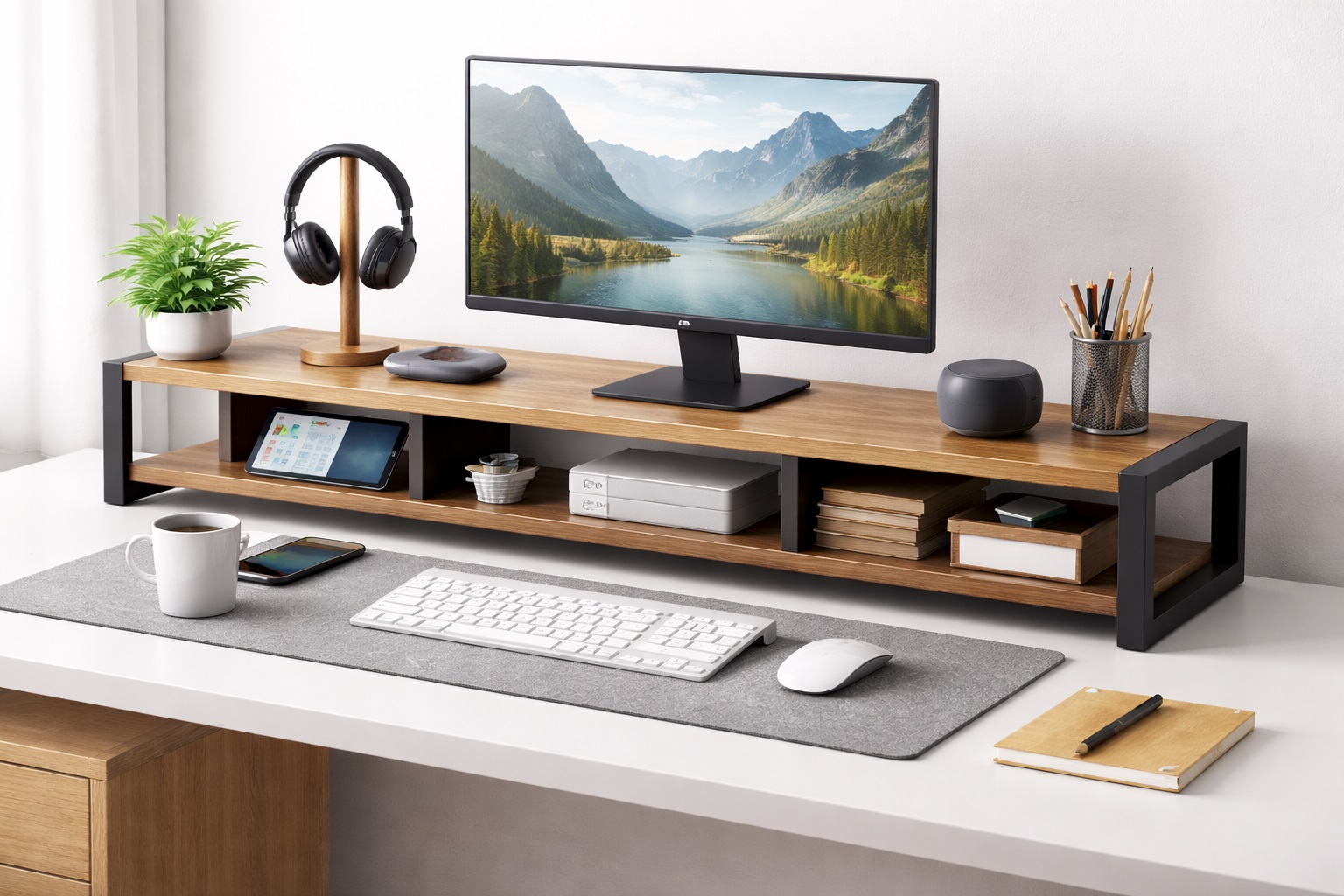
Best Compact Desk Shelves: Maximum Organization in Minimum Footprint
Small desks punish clutter faster than large ones. On a spacious desk, a stray charger or a stack of notebooks can drift to a corner and stay out of the way. On a compact desk, the same items eat directly into the space you need for a keyboard, a mouse, and your actual work. A compact desk shelf is built specifically for this constraint — it adds vertical storage capacity without asking for more desk footprint than you already have to give.
The challenge with shopping for a compact shelf is that "compact" gets used loosely across very different products. Some are simply smaller versions of full-size organizers, scaled down without much thought to whether the scaling actually preserves usefulness. Others are purpose-built to minimize their depth or width while still solving the monitor-height and storage problems that any desk shelf needs to address. Knowing which type of compact actually matters for your situation — narrow footprint, shallow depth, or low overall bulk — makes the difference between a shelf that solves your space problem and one that just becomes another small obstacle. It's a distinction that rarely shows up clearly in a product photo, which is exactly why checking the listed dimensions against your own desk measurements is worth doing before, not after, a purchase.
This guide compares the three shelf formats most relevant to minimal desk environments: the monitor riser with lower storage, the freestanding multi-zone organizer, and the wall-mounted floating shelf, which for small-desk users is often the single most effective option since it removes items from the desk footprint entirely. Below you'll find detailed reviews, a ten-point buying guide focused on the measurements that matter most in tight spaces, and answers to the questions compact-desk users ask most often.
Because every inch of a small desk counts, the buying decisions here carry slightly more weight than they would on a larger surface. A shelf that's a few inches too deep on a spacious desk is a minor inconvenience; the same overage on a compact desk can mean losing the clearance you need to actually type comfortably, which over a full working day can translate into a hunched posture rather than just a mildly annoying layout. Reading the dimensions closely before ordering matters more here than in almost any other desk accessory category.
It also helps to separate two things that get conflated in most product listings: a shelf being physically small, and a shelf being efficient with the space it occupies. A tiny shelf that only holds a phone isn't necessarily more useful on a compact desk than a slightly larger one that genuinely replaces three separate accessories. The goal on a small desk isn't minimizing the shelf's size for its own sake — it's maximizing the amount of clutter it removes relative to the footprint it adds, and those two goals don't always point to the same product. Keeping this distinction in mind while comparing listings will steer you away from novelty-sized products that look impressively small in photos but don't actually solve the clutter you started with.
Top Picks Reviewed
Each of the three formats below approaches the small-footprint problem differently. The riser-shelf keeps its footprint fixed but concentrates two functions into one compact piece. The freestanding organizer can be sized down to match a narrow desk directly. The wall-mounted shelf sidesteps the footprint question entirely by moving storage off the desk surface altogether — worth strong consideration if your desk truly has no spare inches left to give and you have a wall within reach of the desk. None of the three is a wrong choice in absolute terms — the mismatch only happens when the format doesn't match the specific constraint your desk actually presents.
1. Monitor Riser with Lower Storage Shelf – Best All-Purpose Desk Shelf
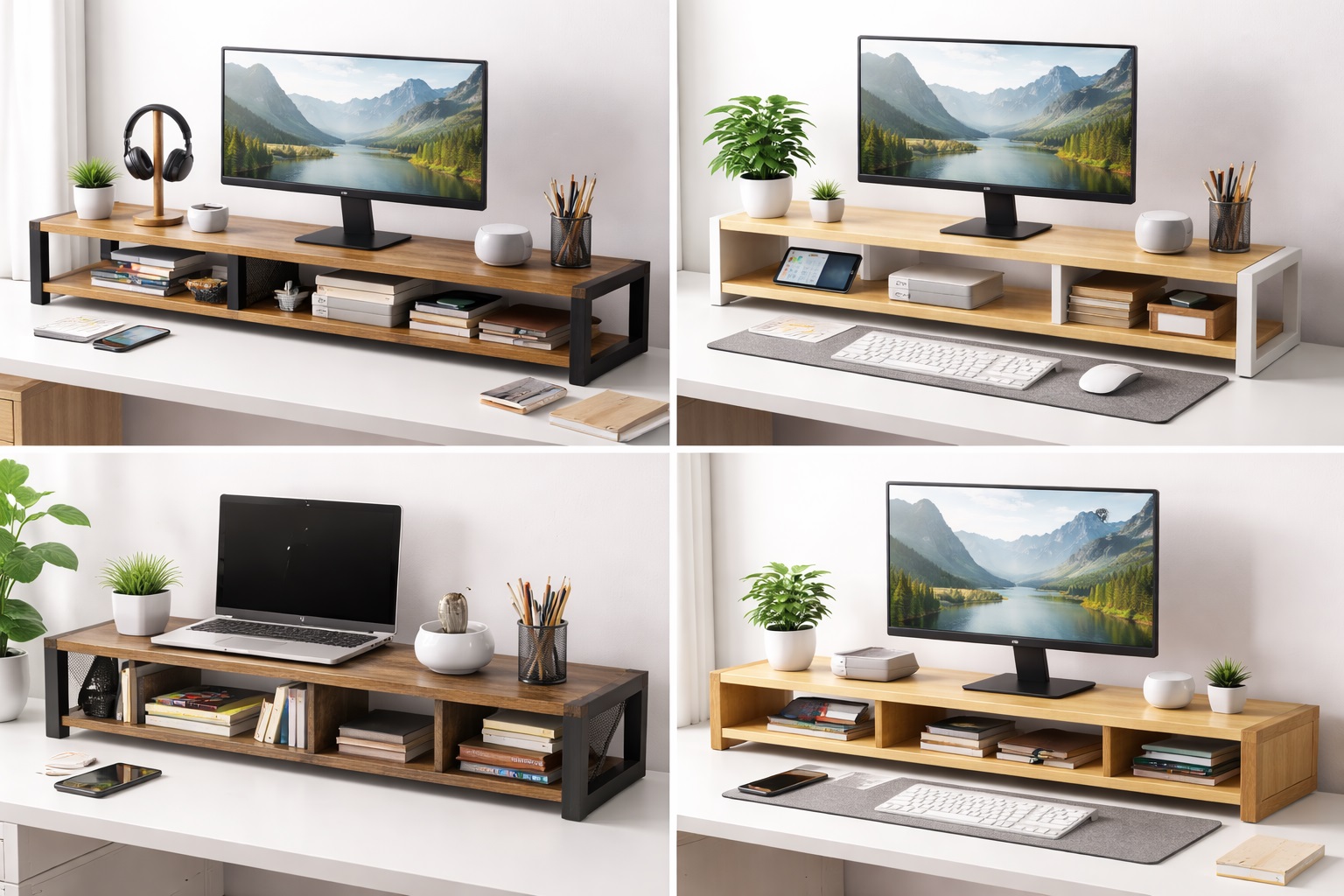
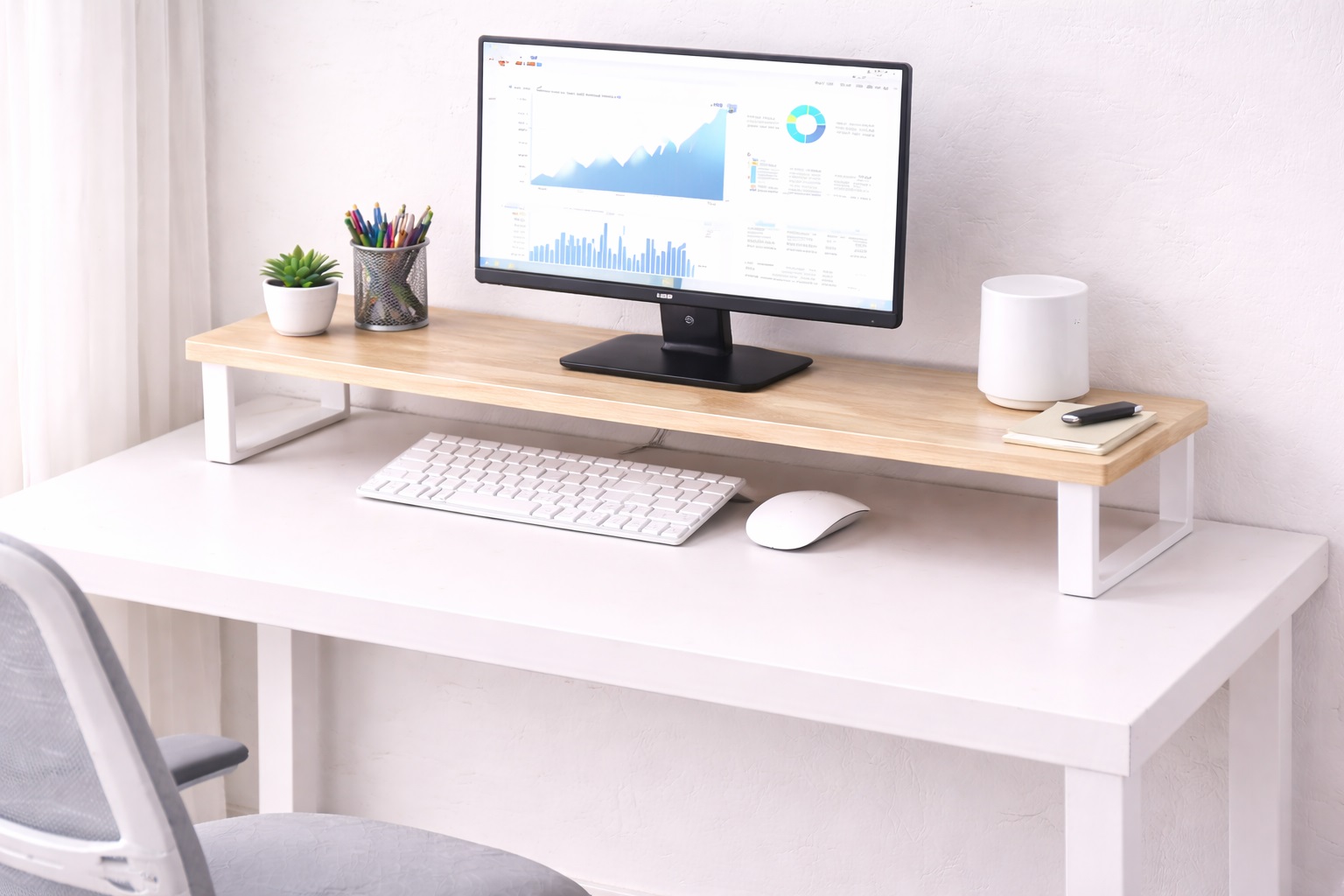
A monitor riser shelf raises the monitor to ergonomic eye level while creating an accessible storage space underneath for keyboards, notebooks, or accessories. This single piece solves monitor height and storage simultaneously. Most are made from bamboo, MDF, or metal and suit most desk aesthetics. On a compact desk, this format earns extra credit for efficiency: it doesn't expand your footprint so much as reorganize the vertical space already sitting above your existing desk surface, turning otherwise wasted air above the desk into usable storage.
For small-desk users specifically, look for a riser with a narrower base than the standard width, since a full-width riser on a compact desk can eliminate side-to-side space you'd otherwise use for a notepad or a phone. The better compact-oriented risers keep the platform width tight while still providing enough underneath clearance for a slim keyboard. A few models also taper the rear legs inward rather than running them straight down at full width, which recovers a small but genuinely useful strip of desk space along the back edge without changing the platform size that actually holds the monitor.
- Pros:
- Raises monitor to correct ergonomic height
- Storage space below for keyboard or accessories
- Single purchase solves two desk problems
- Available in natural, white, and dark finishes
- Cons:
- Fixed height — not adjustable after placement
- Takes defined desk footprint at the rear
Best For: Home office workers with limited desk space who want ergonomic screen positioning and accessible storage without adding a second accessory to an already tight surface, particularly anyone whose desk currently forces them to choose between a comfortable monitor height and enough room to work.
Why We Recommend It: The monitor riser-shelf is the most practical desk organization purchase available for compact setups — it improves posture and creates storage in one piece, using vertical space rather than claiming additional desk width the way two separate accessories would. For a small desk specifically, that distinction between vertical and horizontal space is the whole ballgame, since vertical space above the desk surface is almost always underused compared to the horizontal space in front of you.
2. Freestanding Desktop Organizer Shelf – Best for Multi-Zone Storage
A freestanding desktop shelf unit provides multiple storage zones at different heights — reference books at the top, accessories in middle compartments, and items in lower sections. These typically span 18–24 inches of desk width and create a visual organizing system for frequently accessed items. On a compact desk, width is the number to watch most closely, since even a well-designed organizer becomes a liability if it consumes a third of an already small surface.
The advantage for small-desk owners is that narrower versions of this format exist specifically for tight spaces, often trading a bit of horizontal spread for additional vertical tiers instead. Choosing a taller, narrower unit over a wide, low one is usually the better tradeoff when desk width is the binding constraint rather than desk height. It's also worth checking whether the compartments are fixed or adjustable, since a shelf that lets you reconfigure tier spacing can adapt better to an unusual mix of small items than one built around a single fixed layout.
- Pros:
- Multiple storage compartments for organized access
- No installation — sits directly on desk
- Repositionable as needs change
- Available in various widths to match desk size
- Cons:
- Takes desk footprint across the width it covers
- Heavier than wall-mounted alternatives
Best For: Users with a small desk who still need organized multi-category storage and are willing to trade some desk width for a compact but genuinely organized system, especially those who cycle through several small tools or reference items throughout a typical working day.
Why We Recommend It: The multi-level freestanding shelf creates a vertical organization system that keeps everything visible and accessible without the items consuming the primary working desk surface, and on a compact desk, choosing a narrow-footprint version keeps that benefit without sacrificing your typing space. It remains the most flexible of the three options for anyone who isn't ready to commit to a fixed monitor height or a permanent wall installation.
3. Wall-Mounted Floating Shelf – Best for Freeing Desk Surface Completely
A wall-mounted floating shelf above the desk stores monitors, speakers, plants, and reference items completely off the desk surface, freeing the entire desk for working use. Installation requires basic tools and appropriate wall anchors. Once mounted, the shelf provides stable, permanent storage with no desk footprint at all — which makes it arguably the single best option specifically for compact desks, since it is the only format on this list that adds zero additional desk-surface demand.
For a small desk pushed against a wall, this format effectively doubles your usable storage without touching the footprint you already have. The tradeoff is the same one every compact-desk buyer eventually faces: a wall shelf commits to a fixed position, so it's worth planning the exact height and placement carefully against your specific small-desk layout before drilling. Because there's no desk footprint cost either way, it's worth measuring generously and mounting a slightly larger shelf than you think you need — the wall has more spare room than the desk does, and it's the one place in a compact setup where oversizing carries no real downside.
- Pros:
- Frees entire desk working surface below
- Permanent, stable storage at any height
- Creates a clean, organized visual appearance
- Suitable for heavier items when correctly anchored
- Cons:
- Requires wall drilling — not suitable for renters
- Shelf position is fixed after installation
Best For: Compact-desk users who want maximum working surface and have wall access near the desk to mount a shelf without eating into an already limited footprint, especially those who've already tried a freestanding organizer and still feel the desk is too crowded.
Why We Recommend It: Moving items from the desk surface to a wall shelf above creates the most working space of any desk organization approach, and for a genuinely small desk, that recovered surface area often matters more than it would on a larger one, since there's simply less of it to spare in the first place. Of the three formats reviewed here, it's the one most likely to make a genuinely small desk feel, for the first time, like it has enough room.
Buying Guide: How to Choose the Best Compact Desk Shelf
Use these ten factors to match your purchase to a genuinely small desk rather than assuming any shelf labeled "compact" will automatically fit.
1. Measure Your Actual Available Footprint
Before anything else, measure the exact clear space on your desk — not the total desk size, but what's left once your keyboard, mouse, and monitor stand are accounted for. This is the number that determines whether a given shelf format will genuinely fit or simply relocate your clutter problem a few inches. Write the measurement down and keep it handy while comparing listings, since it's easy to forget the exact figure once you're a few product pages deep into browsing.
2. Prioritize Depth Over Width When Space Is Tight
On a compact desk, shelf depth usually matters more than width, since depth eats directly into the space between you and your keyboard. A narrower but deeper shelf can feel more cramped day to day than a wider but shallower one, even if the total footprint numbers look similar on paper. This is because depth directly reduces the distance between your hands and the shelf, while width mostly affects space you weren't necessarily using anyway.
3. Height for Monitor Ergonomics
If using a monitor riser-shelf, verify the height still places your screen center at or slightly below seated eye level. Most risers sit in the 4–6 inch range regardless of their footprint size, so a compact riser shouldn't sacrifice ergonomic height just to save a few inches of depth. If a specific model's marketing emphasizes its small size without listing an actual height figure, treat that as a reason to look closer rather than a reason to trust it by default.
4. Weight Capacity for Smaller Builds
Compact shelves are sometimes built lighter to match their smaller footprint, which can mean a lower weight capacity than a full-size equivalent. Verify the stated capacity still comfortably covers your monitor and anything else you plan to place on it before assuming smaller automatically means adequate. A shelf built to save space should never be a shelf that compromises on the basic job of holding your monitor securely, and it's worth reading a handful of reviews specifically looking for mentions of wobble or flex under normal use.
5. Vertical Storage as a Footprint Substitute
When floor-level desk space is limited, look for shelf designs that build upward in tiers rather than outward across the desk. A taller, narrower organizer often stores the same volume of items as a wider one while claiming a fraction of the desk footprint. Vertical stacking does add a small stability consideration, so a slightly wider base relative to overall height is generally a good sign on tall, narrow designs.
6. Material Choice
Bamboo is durable, sustainable, and scratch-resistant. MDF is affordable but heavier, which matters more on a compact desk where every accessory competes for the same limited base area. Metal frames are lightweight and often the better structural choice for slim, vertically-built compact shelves. Solid wood remains an option too, though its added weight and cost make it a less common pick specifically within the compact category, where lighter, slimmer materials tend to serve the underlying goal better.
7. Rental Compatibility
Renters with small apartments and small desks should generally favor freestanding or monitor-riser designs that require no wall installation. A wall-mounted compact shelf is still the most footprint-efficient option, but it isn't available to everyone, so C-clamp desk accessories are worth considering as a middle-ground alternative, since they attach to the desk edge itself rather than the wall and can still recover some of the footprint benefit a wall shelf would otherwise provide.
8. Cable Management Integration
Cable clutter is more visually disruptive on a small desk than a large one, simply because there's less surrounding space to absorb the mess. Monitor riser shelves with built-in cable routing holes are worth prioritizing specifically for compact setups where every visible tangle stands out more. A small cable clip or adhesive channel added alongside the shelf can also handle what the shelf design itself doesn't account for.
9. Under-Shelf Clearance for Keyboard Storage
If you plan to slide a keyboard or laptop underneath a riser shelf when not in use, confirm the clearance height accommodates it. This detail is frequently overlooked in compact shelf listings but makes a meaningful difference in how much of the freed-up space you actually get to use. Some compact risers list clearance in the product description, but many don't, so checking customer photos or asking the retailer directly is often necessary to confirm it.
10. Assembly and Portability
Compact shelves are generally easier to assemble than full-size versions simply due to their smaller scale, but confirm this before ordering. Portability also matters more for compact-desk users, who are statistically more likely to be in smaller living spaces where furniture gets rearranged or relocated more often. A lightweight compact shelf that can be picked up with one hand and moved to a different desk entirely offers a kind of flexibility that a larger, bulkier organizer simply can't match.
Frequently Asked Questions
1. What actually counts as a "compact" desk shelf?
There's no single industry-standard definition, but compact generally means a reduced footprint in at least one dimension — narrower width, shallower depth, or a design that builds vertically instead of spreading across the desk. Always check the specific measurements rather than relying on the word "compact" in a product title, since two products both marketed as compact can differ by several inches in the dimension that actually matters for your desk.
2. Is a wall-mounted shelf really better for small desks than a desktop organizer?
For pure footprint efficiency, yes — a wall shelf adds zero desk-surface demand, while even a compact freestanding organizer still occupies some desk width. The tradeoff is installation and permanence, which matters more if you rent or plan to move soon. If you're weighing the two, ask yourself how long you expect to stay at this desk in this location, since that answer often settles the decision faster than any feature comparison.
3. What material is best for a compact desk shelf?
Bamboo remains a strong all-around choice for durability and scratch resistance. Metal frames are often preferable for compact, vertically-built designs since they provide structural strength without adding bulk. MDF works but tends to feel heavier relative to its small size, and its lower moisture resistance can matter more on a small desk pushed against a window or in a kitchen-adjacent workspace.
4. Is the most expensive compact desk shelf always the best?
Not always. Price reflects features and build quality, but many mid-range options outperform expensive alternatives for everyday needs, particularly in the compact category where the core function — saving space — doesn't necessarily improve with a higher price tag. A higher price more often buys a nicer finish or a slightly sturdier build than it buys a meaningfully smaller footprint.
5. How long should a quality compact desk shelf last?
A well-built compact desk shelf from a reputable manufacturer typically lasts several years with reasonable care, similar to full-size equivalents. Warranty length remains a useful indicator of manufacturer confidence in durability regardless of the shelf's size, and it's worth confirming the warranty explicitly covers the specific compact variant rather than assuming it matches the manufacturer's full-size product line.
6. Can I return a compact desk shelf if it doesn't suit me?
Most retailers offer 15–30 day return windows. Given how easy it is to misjudge measurements on a small desk, keeping original packaging during your evaluation period is especially worthwhile for compact shelf purchases. It's also worth testing the shelf with your actual monitor and accessories in place for a few days rather than judging it empty, since fit issues often only become apparent once the shelf is loaded.
7. What should I prioritize when buying a compact desk shelf?
Start with your exact available footprint, measured after accounting for your keyboard and mouse space, rather than your total desk size. Matching the shelf's real dimensions to that number matters more than any other single factor for compact-desk buyers, well ahead of secondary considerations like finish, brand, or the number of compartments a listing advertises.
8. Does brand name matter for compact desk shelves?
Established brands offer better warranty support and consistent quality control. Newer brands can offer excellent value, especially in the compact category where many smaller manufacturers specialize specifically in space-saving furniture design and often understand the practical constraints of tight desks better than larger, more general furniture brands do.
9. Can a compact shelf still hold a full-size monitor?
Generally yes, since monitor weight and footprint don't necessarily scale with shelf size — a compact riser is usually built with a narrower base, not a lower weight rating. Still, always confirm the stated capacity against your specific monitor's weight before assuming compatibility, particularly with larger curved or ultrawide monitors that can weigh noticeably more than a standard flat panel of the same screen size.
10. Should I choose width-focused or depth-focused compact designs?
It depends on which dimension is actually constrained on your desk. If your desk is narrow but reasonably deep, prioritize a shelf with a small width. If it's shallow but wide, prioritize reduced depth. Measuring both dimensions before shopping avoids fixing the wrong constraint. When both dimensions feel tight, the wall-mounted format sidesteps the question entirely, which is often the simplest resolution if drilling is an option.
Final Verdict
- Best All-Purpose Desk Shelf: Monitor Riser with Lower Storage Shelf — Best two-in-one desk organization and ergonomic improvement without added footprint.
- Best for Multi-Zone Storage: Freestanding Desktop Organizer Shelf — Best multi-category organized vertical storage in a narrow-footprint build.
- Best for Freeing Desk Surface Completely: Wall-Mounted Floating Shelf — Best zero-footprint storage recovery for genuinely small desks.
The right compact desk shelf depends on which dimension of your desk is actually limited — width, depth, or overall surface area — and how much you're willing to commit to a permanent wall installation versus a flexible freestanding piece. Use the buying guide and reviews above to match a shelf format to your desk's real constraints rather than to whichever listing uses the word "compact" most convincingly.
Small-desk organization tends to reward precision more than any other category of desk accessory, simply because there's so little margin for a poor fit. Taking the extra few minutes to measure your actual clear space, compare it against a shelf's real dimensions, and choose the format that solves your specific constraint — width, depth, or footprint entirely — will consistently produce a better result than picking based on price or popularity alone.
It's also worth remembering that a compact desk isn't a limitation to work around so much as a specific set of constraints to design for. The three formats above each solve those constraints differently, and none of them requires sacrificing organization or ergonomics just because the available surface is smaller than average. A well-matched compact shelf often ends up feeling more deliberate and considered than a larger, more generic organizer would on the same desk, simply because every inch of it had to earn its place.