Best Power Banks Under $100: Real Value, Real Charging
Spending less than $100 on a power bank no longer means settling for a slow, low-capacity brick. The sub-$100 category now covers everything from basic 5,000mAh emergency chargers to 20,000mAh laptop-capable banks with fast USB-C Power Delivery, which means the real challenge is knowing which specifications actually matter at this price point rather than assuming every listing under the limit performs the same. Two banks can carry nearly identical price tags and still differ enormously in real-world charging speed, port selection, and long-term durability, so the price bracket alone tells you almost nothing about which one deserves your money.
This guide focuses on what separates a genuinely capable sub-$100 power bank from one that just looks good in a photo — real usable capacity, honest charging speed, port selection that matches modern devices, and build quality that survives daily use rather than failing after a few months. None of these traits require the very top of the price bracket — they simply require knowing what to check before adding an item to your cart.
Below you'll find a side-by-side comparison, detailed reviews of the models that consistently deliver strong value in this price bracket, a buying guide covering every factor worth checking before you order, and answers to the questions buyers ask most often when shopping with a fixed budget in mind.
Top 5 Power Banks Under $100 (Detailed Reviews)
1. 20,000mAh High-Capacity Power Bank – Best for Multi-Day Use
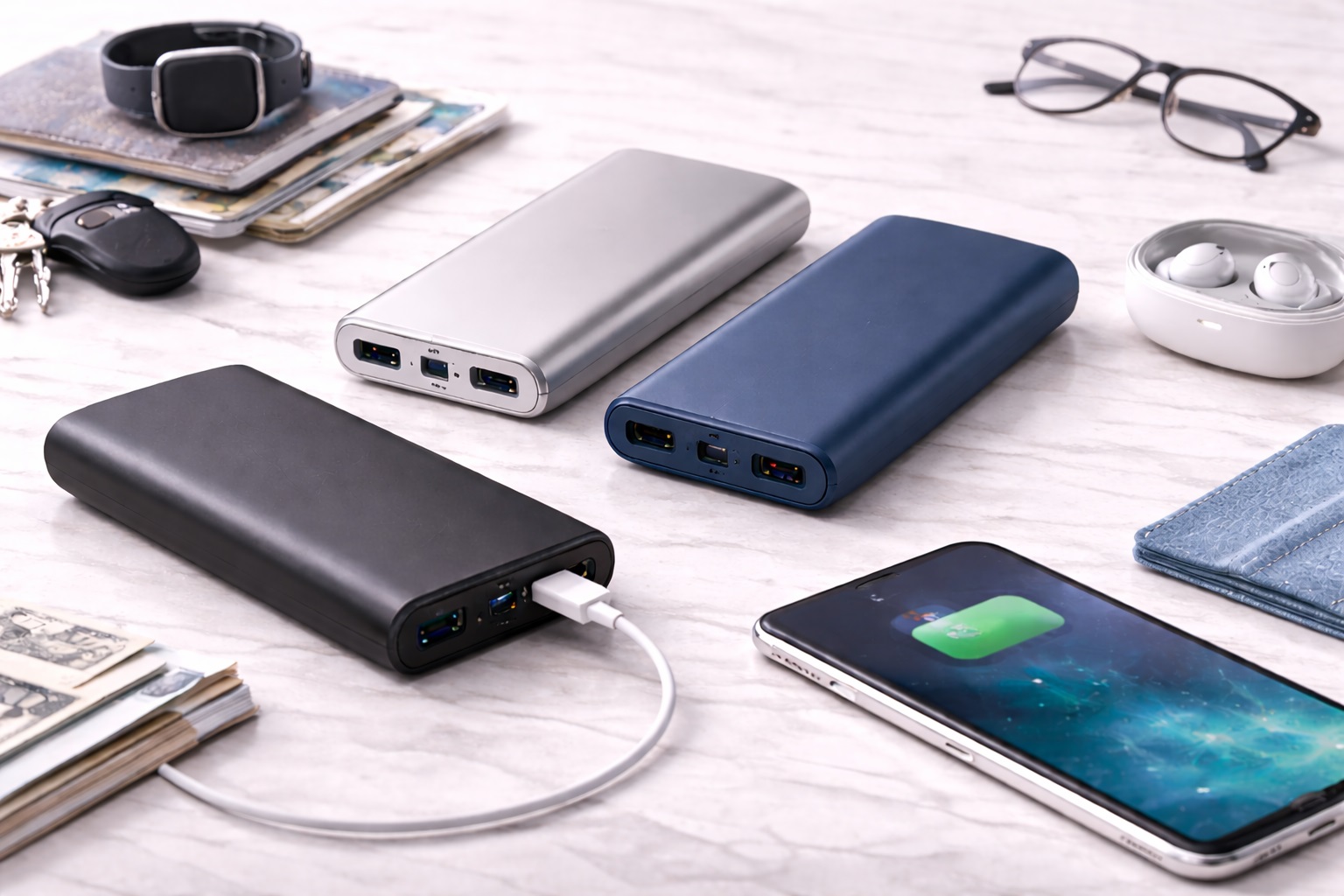
A 20,000mAh power bank charges most smartphones four to six times and delivers a full tablet charge, which puts serious multi-day capacity within reach of a sub-$100 budget. Models built around 65W USB-C Power Delivery go further and charge laptops, meaningfully expanding what the bank can do beyond phone top-ups. At this price bracket, a 20,000mAh unit with fast charging represents some of the strongest capacity-per-dollar value in the category, provided the internal cells are efficient enough to deliver close to their rated output. Buyers should still expect the same real-world efficiency loss that applies to every power bank regardless of price, so treat the printed capacity as a starting point rather than a guarantee. Shoppers comparing several 20,000mAh listings at similar prices should weigh the certifications and port selection just as heavily as the headline capacity number, since those details separate a genuinely capable travel-ready bank from one that simply matches the spec sheet on paper.
- Pros:
- Four to six full smartphone charges per cycle
- 65W USB-C output can charge a laptop in addition to phones and tablets
- Multiple USB-A and USB-C ports for simultaneous charging
- Strong capacity-per-dollar value at this price point
- Cons:
- Noticeably heavier than smaller-capacity alternatives, typically 400–500g
- A full recharge of the bank itself takes six to eight hours
Best For: Budget-conscious buyers who need genuine multi-day capacity, including laptop charging, without paying a premium brand markup.
Why We Recommend It: Laptop-charging capability at a sub-$100 price is the single best value signal in this category — it's the feature that most separates a serious power bank from a basic phone charger.
2. 10,000mAh Slim Fast-Charge Power Bank – Best Balance of Capacity and Price
A 10,000mAh slim power bank delivers two to three full smartphone charges in a body thin enough for a jacket pocket or bag sleeve. USB-C Power Delivery in the 18W–30W range provides a meaningful top-up in thirty to forty-five minutes, and this capacity tier typically represents the sweet spot of the sub-$100 market — enough real-world performance for daily use without paying for capacity most buyers won't use. It's also the capacity range where competition among value brands is fiercest, which tends to push charging speed and build quality upward even as prices stay low.
- Pros:
- Slim enough for a jacket pocket or small bag
- Two to three full phone charges per cycle
- USB-C PD fast charging in well under an hour
- Typically the best-value capacity tier in this price range
- Cons:
- Not enough capacity for laptop charging
- Doesn't stretch across multiple days for heavy device users
Best For: Everyday users who want dependable phone charging without paying for capacity or features they won't regularly use.
Why We Recommend It: This capacity tier consistently delivers the strongest real-world value per dollar, since it covers the actual daily charging need most buyers have.
3. 5,000mAh Ultra-Slim Power Bank – Best Budget Entry Point
A 5,000mAh ultra-slim power bank provides one full smartphone charge in a form factor barely larger than a smartphone itself, and it's typically the lowest-priced tier within the sub-$100 category. USB-C input allows a fast overnight recharge, and the minimal size means the bank adds almost nothing to a bag, making it an easy entry point for buyers who want backup charging without spending toward the top of the budget. It's also a sensible first purchase for anyone who has never owned a power bank and wants to confirm they'll actually use one before committing to a larger, pricier model.
- Pros:
- Credit-card slim or smartphone-sized footprint
- One full phone charge — adequate for light or occasional use
- Usually the lowest-cost tier in the sub-$100 range
- Fast USB-C input for quick overnight recharge
- Cons:
- Only one full phone charge, not enough for heavy daily use
- Not suitable for tablets or laptops
Best For: Light users and buyers who want a genuine backup charger without spending toward the top of their budget.
Why We Recommend It: For occasional use, this size delivers exactly what most people need at the most accessible price point in the category.
4. Power Bank with Built-In Cables – Best for All-In-One Value
A power bank with integrated charging cables folds a USB-C and Lightning-style or USB-C-to-USB-C cable directly into the housing, so there's no separate cable to buy, lose, or forget. These banks typically sit in the 5,000–10,000mAh range and prioritize convenience, which makes them an efficient way to get a complete charging solution — bank plus cable — within a single purchase price. For buyers who have previously lost or damaged as many charging cables as power banks, folding the two into one unit removes an entire category of accessory shopping.
- Pros:
- No separate cable purchase needed
- Reduces the total accessories you need to buy and manage
- Compact and pocket-friendly
- Often includes both USB-C and Lightning-style connectors
- Cons:
- Built-in cables can't be replaced individually if damaged
- Capacity is typically modest compared to dedicated high-capacity banks
Best For: Buyers who want one complete purchase that covers both the battery and the cable without shopping separately.
Why We Recommend It: Bundling a quality cable into the unit itself is a straightforward way to get more real value out of a single purchase.
5. Multi-Port Power Bank with Wireless Charging – Best for Feature-Complete Value
A multi-port power bank that adds a wireless charging pad on top typically costs only marginally more than an equivalent wired-only model, making it one of the better feature-per-dollar picks under $100. Setting a phone down on the pad to charge without connecting a cable is a genuine convenience, even though wireless charging remains slower and less efficient than a wired connection. Buyers who regularly misplace cables or simply prefer setting a phone down rather than plugging it in will find the wireless pad earns its keep quickly despite the modest price premium.
- Pros:
- Wireless pad adds convenience at minimal extra cost
- Multiple wired ports still available for faster charging when needed
- Good total feature set for the price
- Works with any wireless-charging-compatible phone case
- Cons:
- Wireless charging is slower than wired charging
- Adds slightly more bulk than a wired-only bank of the same capacity
Best For: Buyers who want the most features for their money without stepping into premium pricing tiers.
Why We Recommend It: It packs in a genuinely useful extra feature without pushing the price meaningfully higher than a basic wired bank.
Buying Guide: How to Choose the Best Power Bank Under $100
Use these factors to separate genuine value from specifications that look good on paper but don't hold up in daily use. Reading through all twelve before comparing listings takes a few minutes and consistently prevents the most common budget-shopping mistake — choosing the highest advertised mAh number without checking whether the rest of the specification actually supports it. Retailers rely on shoppers scanning quickly and picking the biggest number, so taking the slower, more deliberate route through these factors is itself a meaningful advantage.
1. Capacity and Actual Output
Stated capacity in mAh is measured at 3.7V battery voltage, but output happens at 5V through USB, so real-world usable capacity is typically 60–70% of the number printed on the box. A 10,000mAh bank realistically delivers closer to 6,000–7,000mAh to your device. At the budget end of the market, some listings inflate the printed mAh figure well beyond what the cells can actually deliver, so a bank from a seller with verifiable reviews is a safer bet than the cheapest unbranded listing with the highest claimed number. Two banks priced identically can differ by a full charge cycle or more in real-world performance simply because one uses higher-quality cells, which rarely shows up anywhere in the marketing copy.
2. Charging Speed: Input and Output
Output speed determines how quickly your device charges from the bank; input speed determines how quickly the bank recharges. USB-C Power Delivery at 18W or higher gives modern phones a meaningful fast charge, while 30W to 65W is needed to usefully charge a laptop. A budget-priced bank can still offer fast charging — this spec is no longer reserved for premium models — so don't assume a lower price means slower charging without checking the listed wattage directly. Manufacturers competing hard in the sub-$100 bracket have pushed fast-charging chipsets down into their entry-level lineups, which is good news for anyone shopping strictly on price. The same competitive pressure has also improved build quality across the board, since brands know a bank that fails quickly will show up in reviews within weeks.
3. Port Selection and Cable Compatibility
USB-A ports remain useful for older cables and accessories, while USB-C has become the standard for phones, tablets, and many laptops. A bank offering both port types covers more scenarios for the same price, letting you charge two different devices with two different cable types at once. Check the exact port count against how many devices you typically need charged simultaneously before assuming more ports automatically means better value. A bank with three ports but weak shared bandwidth can end up slower in practice than a two-port bank that delivers full speed to each connection.
4. Safety Certifications
Look for CE, FCC, or UL certification markings on the bank and its packaging, confirming the product passed basic electrical safety testing. This matters more, not less, at the budget end of the market, where uncertified banks from unfamiliar sellers carry real risk of overheating or overcharging. A genuinely good sub-$100 bank will list its certifications clearly rather than relying on a vague safety claim with no specifics. Spending an extra minute checking the product listing or manual for a certification number is a small habit that meaningfully lowers the risk of buying an unsafe unit.
5. Recharge Time for the Bank
A 20,000mAh bank charging at 18W input can take six to eight hours to fully recharge, while a 10,000mAh bank typically takes three to four hours. Faster input speed (45W or higher) is increasingly available even in budget-priced models, and it meaningfully shortens the wait when you need the bank ready again quickly rather than only overnight. Checking this figure is especially worthwhile for anyone who tends to grab the bank on the way out the door rather than charging it well in advance.
6. Pass-Through Charging
Pass-through charging lets a bank charge a connected device while it is itself being recharged from a wall outlet, useful when only one outlet is available for both. Not every budget bank supports this safely, so check the specification explicitly rather than assuming it's included by default — it's a feature worth prioritizing if you regularly charge the bank and a phone from the same outlet overnight. Without it, you're forced to choose which device gets to charge first, which defeats some of the convenience a power bank is supposed to provide in the first place.
7. Weight and Portability
Higher capacity always means more physical weight. A 20,000mAh bank weighs roughly 400–500g, a 10,000mAh slim bank around 200–250g, and a 5,000mAh ultra-slim model under 130g. Weigh this trade-off against how you'll actually carry the bank day to day, since a bank that's inconvenient to carry ends up left at home rather than used when it's needed. The best-value bank on paper is worthless if its bulk means you stop bringing it along after the first few weeks.
8. Display and Status Indication
Basic LED indicators show remaining charge in rough 25% increments, which is adequate for casual use. A numeric percentage display gives a clearer read on exactly how much charge remains, and this feature has become common even in budget-priced models, so it's reasonable to expect it rather than settle for basic LEDs alone at this price point. If a listing doesn't mention the display type at all, it's a fair sign the bank uses the more basic indicator style.
9. Heat Management
Fast charging generates heat, and quality designs dissipate it through metal housings or internal thermal management rather than letting it build up. A bank that becomes uncomfortably hot during normal use is operating beyond its intended thermal margin, and this is one area where genuinely cheap, uncertified banks tend to cut corners compared to a reputable budget brand. A bank that stays cool to the touch during a full fast-charge session is a good sign of solid internal engineering, regardless of what the price tag says.
10. Wireless Charging Compatibility
Some budget-friendly banks now include a built-in wireless charging pad, letting you set a phone down to charge without connecting a cable. Wireless charging is slower and less power-efficient than a wired connection, so it's best treated as a convenience feature layered on top of solid wired performance rather than the main reason to choose a particular bank. Treat it as a pleasant bonus on an otherwise well-specced bank rather than a deciding factor on its own.
11. Battery Chemistry and Cycle Life
Most modern power banks use lithium-polymer cells, which tend to be lighter and more resistant to swelling than older lithium-ion designs. Cycle life — typically several hundred full charge cycles before capacity noticeably degrades — is rarely advertised prominently at the budget end, but reputable manufacturers will state it if asked, and it's a fair proxy for whether a bank will still perform well after a year or two of regular use. A bank with meaningfully more rated cycles is worth a slightly higher price within your budget, since it directly extends how long the purchase keeps paying off.
12. Getting the Most Capacity for Your Budget
Within a fixed sub-$100 budget, the smartest approach is comparing the ratio of usable capacity and charging speed to price across several listings rather than fixating on the single highest mAh number available. A well-reviewed 10,000–15,000mAh bank with fast charging and solid build quality often delivers more real value than an unbranded 25,000mAh listing at a similar price, and it typically arrives with better documentation, clearer certifications, and more responsive customer support if something goes wrong, all of which matter more over the life of the product than the number printed on the packaging, since the larger number frequently comes with weaker cells, slower charging, or both. Building a simple mental checklist — real capacity, charging speed, certification, and reviews — before comparing prices keeps the decision grounded in performance rather than the size of the number on the box. Running through that checklist against two or three finalists before checkout takes only a few minutes and reliably improves the outcome.
Frequently Asked Questions
1. What capacity power bank can I get for under $100?
Depending on the brand and features, $100 typically buys anywhere from a 10,000mAh fast-charging bank with premium build quality to a 20,000mAh laptop-capable bank from a value-focused brand. Established brands generally charge more per mAh than newer brands, so budget allocation depends partly on how much you weigh brand reputation against raw capacity. Deciding which of the two matters more to you before browsing listings makes comparison shopping considerably faster, since it immediately narrows the field from dozens of options to a handful worth a closer look.
2. Are cheaper power banks less safe than expensive ones?
Not inherently, but the risk of skipped safety certification is higher among unbranded budget listings. A sub-$100 power bank from a recognized brand with CE, FCC, or UL certification is just as safe as a more expensive model; the danger comes from unverified sellers cutting corners on safety testing, not from the price bracket itself. Checking for a listed certification takes seconds and is the single best safety habit for any budget purchase.
3. How do I know when to replace my power bank?
Replace it once it no longer holds the charge it used to, typically noticeable after two to three years of regular use. If the bank runs unusually hot, develops a swollen shape, or stops charging altogether, replace it immediately for safety rather than waiting for it to fail completely. A bank at this price point is inexpensive enough that replacing it at the first warning sign is always the right call.
4. Can a sub-$100 power bank charge a laptop?
Yes, provided it offers USB-C Power Delivery at 45W or higher, which is now available in a number of budget-friendly 20,000mAh models. Check the exact PD wattage against your laptop's charging requirement before assuming any USB-C port will work — some laptops need 65W or more to charge reliably, and connecting a mismatched bank simply won't charge the laptop at all rather than charging it slowly.
5. Is a higher price always a sign of better performance?
Not necessarily. Price at this level often reflects brand reputation, accessory bundling, or design finish more than raw charging performance. Two banks with identical capacity and wattage specifications can perform almost identically despite a meaningful price gap between them, which is why comparing the actual spec sheet matters more than comparing price tags. A recognizable logo can justify a modest premium for peace of mind, but it rarely translates into a measurably faster charge.
6. Should I worry about counterfeit or mislabeled capacity claims?
It's worth some caution at the very bottom of the price range, where a small number of listings state capacity figures the actual cells can't support. Checking verified buyer reviews that mention real-world charge counts, rather than relying on the listed mAh number alone, is the most reliable way to confirm a bank performs as advertised. A pattern of reviews describing fewer charges than expected is a clear warning sign worth taking seriously before ordering, and a single glowing review from an account with no other purchase history is worth discounting entirely.
7. Is the most expensive power bank under $100 always the best?
Not always. Price reflects features and build quality, but many mid-range options in this bracket outperform pricier alternatives for everyday needs. Match the specific features — capacity, output speed, port count — to your actual use case rather than assuming the top of the range is automatically the better buy. The middle of the sub-$100 bracket often represents the strongest overall balance of features and reliability.
8. How long should a quality power bank under $100 last?
A well-built power bank from a reputable manufacturer typically lasts two to five years with reasonable care, even at a budget-friendly price. Warranty length is a useful indicator of how confident the manufacturer is in the bank's durability, and a one-year warranty at this price point is a reasonable baseline to expect.
9. Can I return a power bank under $100 if it doesn't suit me?
Most retailers offer a fifteen- to thirty-day return window regardless of price. Keep the original packaging during your evaluation period, and test the bank under normal daily conditions before the window closes, since a defect that only shows up after several charge cycles is easy to miss in the first few days.
10. What should I prioritize when buying a power bank under $100?
Start with your primary use case — how many devices, how often, and how much capacity you genuinely need — before comparing listings. Matching specifications to real needs, rather than chasing the largest number available at the price, is what actually delivers value over the life of the bank.
11. Does brand name matter for a power bank under $100?
Established brands typically offer more consistent quality control and more reliable warranty support at this price point. Newer or lesser-known brands can still deliver excellent value, so weigh verified purchase reviews carefully before choosing an unfamiliar name, particularly reviews left several months after purchase rather than immediately after unboxing, since long-term reliability is exactly what a first-impression review can't tell you.
12. Can I find fast charging and laptop compatibility together under $100?
Yes — this combination has become increasingly common in the 15,000–20,000mAh range from value-focused brands. It's one of the clearest signs the sub-$100 category has matured, since laptop-charging capability used to be reserved for premium-priced banks only, and its arrival at this price tier is one of the better recent shifts for budget-conscious buyers.
Final Verdict
- Best for Multi-Day Use: 20,000mAh High-Capacity Power Bank — the strongest capacity-per-dollar pick for laptop-carrying users.
- Best Balance of Capacity and Price: 10,000mAh Slim Fast-Charge Power Bank — the sweet spot most buyers should start with.
- Best Budget Entry Point: 5,000mAh Ultra-Slim Power Bank — genuine backup charging at the most accessible price.
- Best for All-In-One Value: Power Bank with Built-In Cables — one purchase covers both battery and cable.
- Best for Feature-Complete Value: Multi-Port Power Bank with Wireless Charging — the most features for the money.
Under $100, the best power bank is the one whose real usable capacity, charging speed, and certifications match your actual needs rather than the listing with the biggest number in its title. Use the comparisons and buying guide above to identify genuine value rather than marketing, and you'll end up with a bank that performs the same on day three hundred as it did on day one. Spending a few extra minutes reading specifications carefully, rather than sorting listings by price alone, is the difference between a purchase that quietly disappoints within months and one that keeps earning its place in your bag for years.