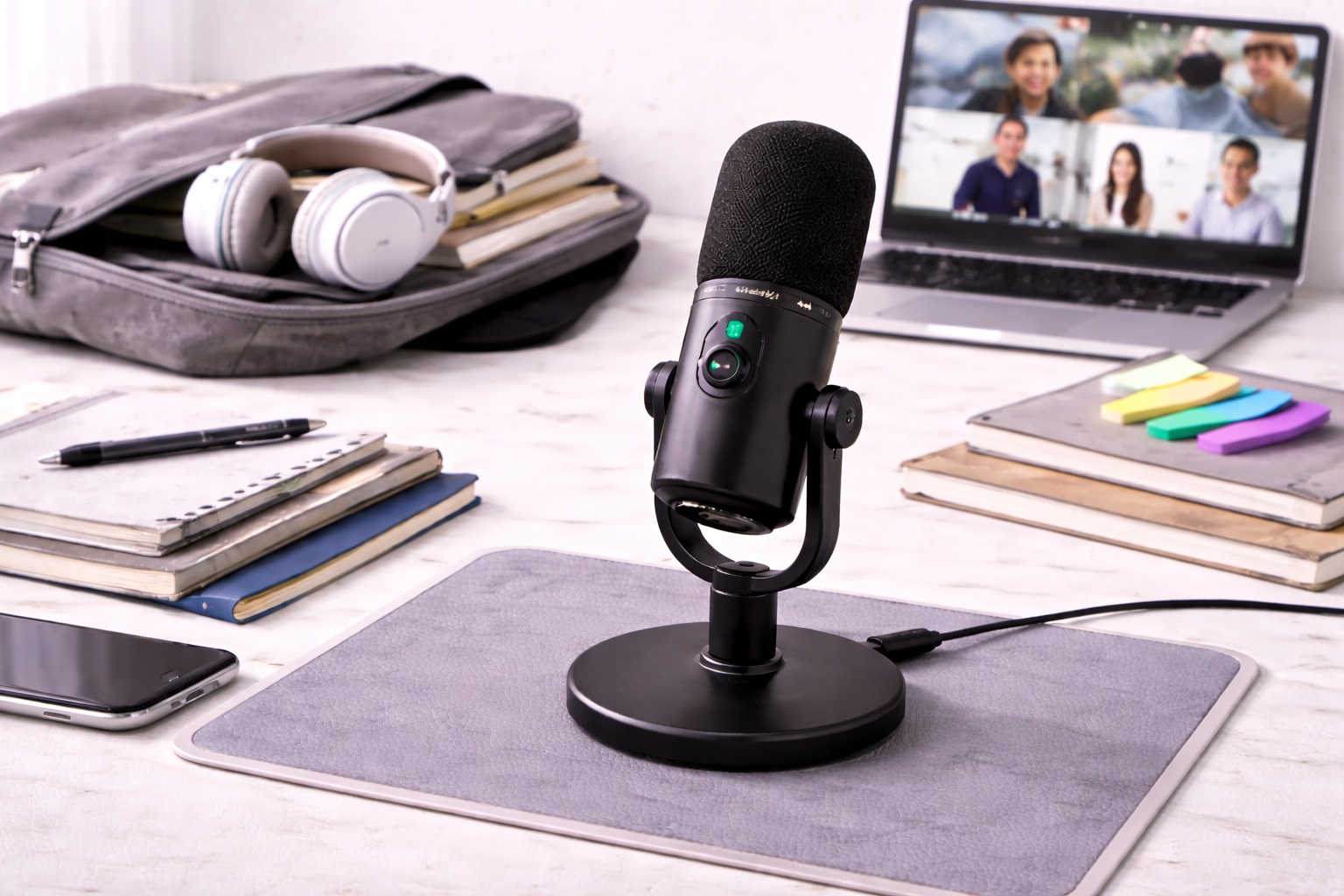
Best Travel Microphones: Studio-Quality Audio Wherever You Work
Working from the road means your recording environment changes constantly - a hotel room one week, a coworking space the next, a friend's guest room after that. None of those spaces are acoustically ideal, and none of them are yours to modify with foam panels or heavy curtains. A travel microphone has to accept that reality and still deliver a clear, professional-sounding voice regardless of which unfamiliar room you're calling from this week, without adding meaningful weight or bulk to a bag that's already carrying a laptop, charger, and everything else remote work requires.
The specific challenge for digital nomads, traveling journalists, and remote workers on the move is that a microphone built for a stable home studio often assumes conditions travel simply doesn't offer: a permanent desk position, a treated room, a fixed power setup. A genuinely good travel microphone instead prioritizes packability, durability against the bumps of transit, and forgiving performance in whatever room you land in, even when that room has hard walls, street noise, or an air conditioning unit humming in the background. The gear that works well at home is not automatically the gear that works well from a rolling suitcase.
It's worth being realistic about what travel gear can and can't fix. No microphone will make an echoey hotel room sound like a treated studio - that takes soft furnishings and time you don't have between meetings - but the right type will noticeably reduce how much of that room noise reaches the recording in the first place, which is the practical bar that actually matters when you're recording between flights. Expectations set correctly here save a lot of disappointment after the purchase.
Price also behaves differently in this category than it does for home studio gear. A travel microphone doesn't need every premium feature a stationary setup might justify; it needs to survive being packed and unpacked dozens of times a year while still sounding clearly better than a laptop's built-in mic. That reframes the buying decision away from chasing the highest spec sheet and toward matching the format to the actual rhythm of your travel.
This guide compares the three microphone formats that hold up best under travel conditions, covering what each one does well, where it struggles, and which travel routine it actually suits. The buying guide and FAQ sections that follow dig into the packing, durability, and setup details worth checking before you buy, so that the decision holds up once you're actually living out of a suitcase rather than shopping from a comfortable home office.
It also helps to think about how often you'll actually use the microphone once it's purchased. A device that sounds excellent in a single controlled test but sits unused because it's inconvenient to pack or slow to set up isn't actually solving the travel problem, no matter how good its spec sheet looks. The three formats compared below were chosen specifically because each represents a genuinely different trade-off between audio quality, weight, and setup speed, rather than three minor variations on the same idea.
Top 3 Travel Microphones (Detailed Reviews)
1. USB Condenser Microphone – Best Overall for Clear Calls on the Road
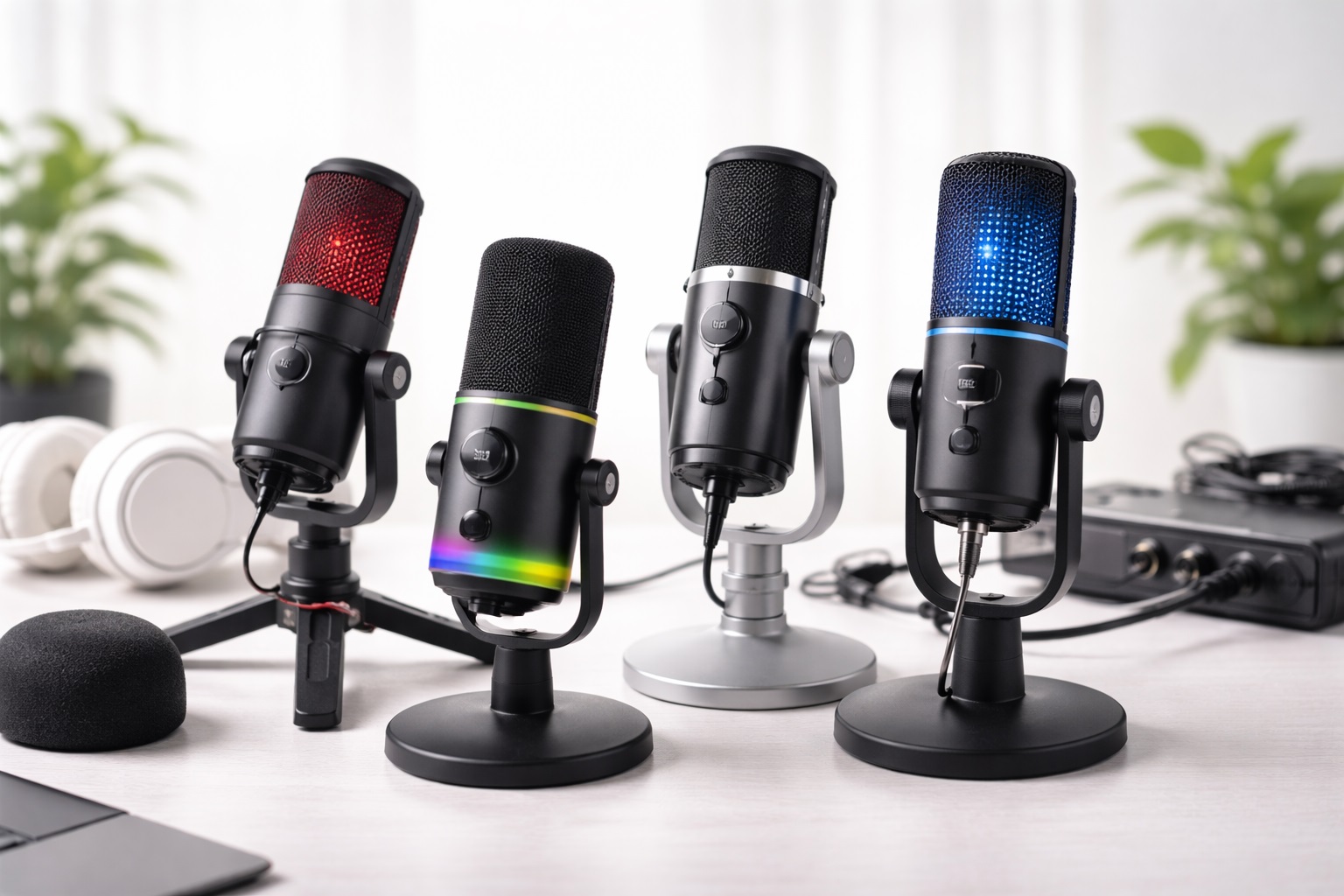
A compact USB condenser microphone delivers the clearest voice quality of the three formats here, which matters when a client call or recorded interview needs to sound professional regardless of which hotel room or Airbnb you're in that week. Condenser capsules are more sensitive than dynamic capsules, capturing detail that makes a voice sound present rather than distant over an unfamiliar internet connection. It connects directly over USB with no separate interface to pack - plug it into a laptop, select it as the input device, and it's ready in the time it takes to unpack a bag. A cardioid pattern focuses on the voice directly in front while quieting whatever unfamiliar room noise surrounds it. For anyone whose work involves recorded interviews, podcast segments, or client-facing video calls from a rotation of different locations, this is the format most likely to be noticed - and appreciated - by the people on the other end of the line.
- Pros:
- Clearest voice detail of the three travel-friendly formats
- True plug-and-play setup with nothing extra to carry or configure
- Cardioid pattern rejects noise from an unfamiliar room's layout
- Compatible with essentially any laptop and call platform
- Compact body fits easily in a laptop bag's accessory pocket
- Cons:
- More sensitive to a noisy hotel hallway or thin apartment walls
- Needs at least a reasonably calm moment to sound its best
Best For: Remote workers and digital nomads taking client calls or recording content from hotel rooms, coworking spaces, or short-term rentals that are reasonably quiet most of the time.
Why We Recommend It: This is the format most travelers notice the biggest improvement with over a laptop mic - clearer client calls, more intelligible recorded content, and a more professional impression regardless of which country or city you're working from. The caveat: if your travel routine regularly puts you in loud transit hubs or thin-walled rentals, the next option handles that better.
2. Dynamic USB Microphone – Best for Noisy Hotels and Shared Spaces
Travel accommodations are rarely acoustically friendly - hard hotel walls, street noise below a window, or a shared coworking space with constant background chatter. A dynamic USB mic is built specifically for that unpredictability. Because the capsule needs more energy to respond, it naturally rejects quieter ambient sound that a condenser would pick up readily, making it a genuinely practical choice for anyone whose work takes them through a rotation of imperfect rooms rather than one controlled home studio. It also tends to be more rugged, tolerating the wear of being packed and unpacked at every stop. Where a condenser rewards a calm environment, a dynamic mic is far more forgiving of one you didn't get to choose, which for frequent travelers is often the more consequential trait day to day.
- Pros:
- Rejects hotel, hallway, and street noise better than a condenser
- Consistent performance regardless of a room's acoustic quality
- More durable construction for frequent packing and transit
- Reliable results whether you're in a quiet cabin or a busy hostel
- Tolerates handling and travel bumps better than delicate condenser designs
- Cons:
- Captures slightly less fine vocal detail than a condenser
- Needs closer positioning to sound its fullest
Best For: Digital nomads and traveling professionals who move through a rotation of hotels, hostels, and short-term rentals where acoustic quality varies unpredictably from stop to stop.
Why We Recommend It: A dynamic mic solves the problem a condenser can't on the road: it doesn't require a good room to sound professional, which matters enormously when you don't get to choose your recording environment. For frequent travelers, this is often the more dependable everyday pick, precisely because it lowers the number of things that need to go right for a call to sound good.
3. Clip or Lapel Microphone – Best for Minimal Packing Weight
For travelers who count every gram in a carry-on, a clip-on lapel mic solves the packing problem entirely. It weighs next to nothing, requires no stand or boom arm, and clips directly to a shirt collar or lanyard, staying close to the mouth regardless of how a hotel desk is arranged. It's also genuinely quick to set up between meetings scheduled across time zones, with nothing to mount or position beyond clipping it on. For anyone whose itinerary means unpacking and repacking a bag daily, removing one more object that needs a stand or careful placement is a real, cumulative convenience rather than a minor one.
- Pros:
- Minimal weight and packing footprint for carry-on travel
- Consistent mic-to-mouth distance regardless of desk setup
- No stand or mount required in an unfamiliar room
- Fast to set up between back-to-back calls across time zones
- Doubles as a reliable option for recorded video content while standing
- Cons:
- Overall audio quality trails a dedicated desk microphone
- Clip and cable can be visible on camera during calls
Best For: Frequent flyers and minimalist packers who prioritize weight and setup speed over the last increment of audio fidelity.
Why We Recommend It: When every ounce in a carry-on matters and meetings are scheduled back to back across time zones, this is the format that adds the least friction to an already demanding travel routine, while still sounding meaningfully better than a laptop mic. It won't out-record a condenser in a quiet room, but it will get you through a packed travel week without a second thought.
Taken together, these three formats cover the realistic range of travel situations: reasonably calm rooms where clarity is the priority, noisy or unpredictable rooms where rejection matters more, and minimal-weight setups where packing space is the binding constraint. Few frequent travelers fall entirely outside these three situations, which is why narrowing down the type first - before comparing individual listings and prices - saves the most time and avoids buying gear that looks good on a spec sheet but doesn't fit your actual routine.
Buying Guide: How to Choose the Best Travel Microphone
Durability, weight, and packability matter as much as audio quality for gear that travels. These are the factors worth checking before buying, and reading through all twelve first will help you avoid focusing on the wrong spec once you start comparing listings side by side.
1. Pickup Pattern
Cardioid patterns capture sound from directly in front while rejecting noise from the sides and rear - the right default for solo calls from an unfamiliar room. Omnidirectional patterns pick up everything equally, amplifying whatever room noise surrounds you, which rarely helps in a hotel or shared space. Figure-8 patterns capture front and back, useful mainly for two-person interviews recorded on the road, but a poor fit for the single-speaker calls most travelers make daily. If your work occasionally involves recording a co-worker or interview subject sitting across from you, it's worth checking whether the mic can switch patterns, since a fixed cardioid design won't accommodate that use case at all.
2. Dynamic vs. Condenser Capsules
Condensers capture more detail but also more of an unfamiliar room's flaws - echo, hum, distant traffic. Dynamics reject more of that noise in exchange for slightly less fine detail. Since you rarely control your recording environment while traveling, a dynamic mic often produces the more consistently professional result across a rotation of different rooms, even if a condenser wins outright in a single quiet space. Think of it as choosing consistency over peak performance - a reasonable trade for anyone who can't predict next week's recording environment.
3. Weight and Packed Size
Every travel accessory competes for limited bag space and weight allowance. Compare the packed dimensions and weight of a mic including its stand or case, not just the microphone body alone, since accessories often add more bulk than the mic itself. A mic that looks compact in product photos can still take up an entire accessory pocket once its stand and cable are folded in with it. If your travel style involves a single carry-on for a week-long trip, this detail matters more than it might seem from a product listing alone.
4. Connection Type: USB vs. XLR
USB microphones plug directly into a laptop with no additional hardware to pack, which matters enormously for travel. XLR requires a separate interface, adding weight, bulk, and another item that can get lost or damaged in transit. USB covers nearly every travel use case without compromise, and it removes an entire category of things that can go wrong on the road. Unless you're doing multi-track music recording, there's little practical reason to add an XLR interface to a travel bag.
5. Build Durability for Transit
A travel mic gets packed, unpacked, and jostled far more than a stationary home setup. Favor solid construction over a delicate design, and consider a padded case or pouch if one isn't included, since a scratched or dented mic body is a common casualty of frequent travel. Metal housings generally tolerate this treatment better than lightweight plastic ones. Look closely at how the cable connects to the mic body too, since a permanently fixed cable that gets bent repeatedly in a bag is a more common failure point than the capsule itself.
6. Self-Noise Level
Self-noise is the faint hiss a mic produces even in silence. Lower is better, with under 20dB considered good for voice work. This matters slightly more when recording in already-imperfect rooms, where added hiss compounds with existing ambient noise from traffic, air conditioning, or a hallway on the other side of a thin wall. Manufacturers don't always publish this figure clearly, so a missing spec on a budget listing is itself a small signal worth noticing.
7. Power Source and Charging
Most travel-friendly mics draw power directly from the USB connection, avoiding a separate battery or charger to pack and remember. Confirm this before buying, since a mic requiring its own charging cable or battery is one more item to track across time zones, outlets, and airport security trays. A USB-powered mic also means one less thing to remember to charge the night before an early flight.
8. Mount and Stand Compatibility
A compact desk stand or a clip-on mount both travel well; a full-size boom arm generally doesn't. Check whether the mic's stand folds flat or detaches easily for packing, since a bulky fixed stand can be the single largest item in an otherwise minimal setup, undermining the whole point of choosing travel-friendly gear. A mount that folds flat against the mic body itself, rather than a separate piece entirely, is generally the easiest to keep track of over a long trip.
9. Cable Length and Management
Shorter cables pack more easily but may not reach a laptop positioned across an unfamiliar hotel desk. A mic with a moderate, coiled, or detachable cable offers more flexibility across different room layouts than a fixed, overly long one that tangles at the bottom of a bag. A detachable cable also means you can replace just the cable if it eventually frays, rather than replacing the whole microphone.
10. Real-World Noise Rejection
Published specs only tell part of the story. A dynamic cardioid mic close to the mouth rejects more room noise than a condenser further away, regardless of datasheet claims. Consider the rooms you'll actually be recording in - hotel rooms, shared coworking desks, guest bedrooms - rather than theoretical performance in a treated studio you'll likely never use. When possible, read reviews from people who mention using the mic while traveling specifically, since that context tells you more than a review written from a permanent home setup.
11. International Power and Voltage Compatibility
Since USB microphones draw power through a laptop or a standard USB adapter, voltage compatibility is rarely an issue across countries, unlike some standalone electronics that require a dedicated adapter. It's still worth confirming the cable and any included adapter work with the plug types you'll actually encounter on your route, particularly if your travel spans regions with notably different outlet standards.
12. Warranty and Repair Access While Abroad
Consider how a warranty claim would actually work if something failed while you're overseas. A well-known brand with an established online support process is generally easier to deal with remotely than a brand requiring a mailed return to a single domestic address, which can be impractical when you won't be back home for months. A quick search for how a brand handles international warranty claims before you buy can save considerable frustration later.
Frequently Asked Questions
These are the questions that come up most often from digital nomads and frequent travelers shopping for a reliable microphone.
1. Will a travel microphone work in hotel rooms with unreliable Wi-Fi?
The microphone itself doesn't affect internet reliability, but a clear voice signal matters more when connection quality is already compromised, since it reduces the chance of being misheard on a choppy call. USB microphones work the same regardless of network conditions, so the audio quality on your end stays consistent even when the connection isn't. If anything, a clearer signal makes it easier for the person on the other end to understand you when the connection itself is stuttering.
2. Do I need a stand for a travel microphone?
Many travel-friendly mics include a compact folding stand or a simple desk mount that packs flat. A clip-on lapel mic needs no stand at all, which is worth considering if minimizing packed items is a priority over the marginal audio quality gain from a desk-mounted design. Either approach beats propping a mic against a stack of hotel notepads, which rarely holds position through an entire call.
3. How close should I sit to a travel microphone?
Six to twelve inches away at a slight angle gives the best balance of clarity and reduced plosive pops for most USB condenser mics, regardless of which room you're recording in that week. Dynamic mics generally want closer positioning, within a few inches, to sound their fullest. Speaking slightly across the capsule rather than directly into it also reduces harsh plosive sounds without needing a separate pop filter.
4. Does the hotel room actually affect microphone quality?
Significantly. A condenser mic in a hard-surfaced hotel room will capture more echo than the same mic in a room with carpet and heavy curtains. A dynamic mic rejects that room noise more effectively when you can't control the space, which is exactly why it's a common recommendation for frequent travelers. If you have any control over your room assignment, a carpeted room away from an elevator or ice machine also helps, regardless of which mic you're using.
5. Can one travel microphone handle both client calls and recorded content?
Yes. A cardioid USB microphone covers both uses well. You might fine-tune gain for recorded content specifically, but for calls, simply selecting it as your input device in the meeting application is enough - no additional configuration required. Keeping one microphone for both purposes also means one less piece of gear to pack and one less thing to configure at each new stop.
6. Is the most expensive travel microphone always the best choice?
Not necessarily. Many mid-range travel-friendly options deliver excellent voice clarity in a genuinely packable size. Focus on durability and weight alongside audio quality rather than price alone, since the highest-priced option isn't always the one best suited to a travel routine. A mid-range mic that's actually durable and light beats a premium studio mic that gets left at home because it's inconvenient to pack.
7. How long should a travel microphone last under regular use?
A well-built travel mic from a reputable brand typically lasts several years of regular travel with reasonable care, even accounting for the extra wear frequent packing and transit causes compared to a mic that stays on one desk. The cable and any folding stand tend to show wear first, well before the capsule itself degrades.
8. Can I return a travel microphone that doesn't hold up to travel?
Most retailers offer a 15- to 30-day return window. Test it during a trip or two within that window if possible, since real travel conditions reveal durability and noise-rejection issues that a quick home test simply won't show. Keep the original packaging until you're confident it's a keeper, in case you need to ship it back.
9. Is a travel microphone compatible with both Mac and Windows laptops?
Virtually all USB microphones in this category are class-compliant across both operating systems, with no dedicated drivers required, which matters if you switch devices or borrow a laptop between trips. Plug it in, wait a moment for the operating system to recognize it, and select it as the input source - that's the entire setup process on either platform.
10. How do I protect a travel microphone in transit?
Use a padded pouch or hard case, keep it away from the bottom of a bag where heavier items can crush it, and remove any detachable stand for separate, protected packing rather than leaving it attached and exposed. A dedicated inner pocket you use consistently for the mic, rather than tossing it in with whatever else fits, also reduces the odds of it getting crushed under a laptop charger.
11. What's the best travel microphone for digital nomads and journalists overall?
There isn't one universal answer - it depends on how much weight you're willing to carry and how unpredictable your typical accommodation is. Match your priorities against the buying guide factors above rather than defaulting to whichever option is most popular. Popularity reflects broad appeal, not necessarily fit for your specific travel pattern.
12. Does brand matter when choosing a travel microphone?
Established brands tend to offer more consistent quality control and easier remote warranty support while traveling. Newer brands can still offer solid value, but verified reviews are worth checking first, especially for a purchase you're relying on far from home. Look specifically for reviews mentioning long-term durability rather than only first-impression audio quality.
Final Verdict
Once you've weighed how much weight you can spare in your bag against how unpredictable your typical accommodation tends to be, the right pick becomes fairly clear. Each of the three formats below solves the travel problem from a different angle, and none of them is a compromise once matched correctly to your routine.
- Best Overall: USB Condenser Microphone – the clearest voice quality for calls and content from reasonably calm rooms.
- Best for Noisy Hotels and Shared Spaces: Dynamic USB Microphone – the most forgiving choice across unpredictable accommodations.
- Best for Minimal Packing Weight: Clip or Lapel Microphone – the lightest, fastest option for frequent flyers.
There's no single best travel microphone for every route - only the one that matches how much weight you can spare and how much control you have over your accommodation. Weigh the three formats above against your actual travel routine, and the decision becomes far more straightforward than scanning spec sheets alone.