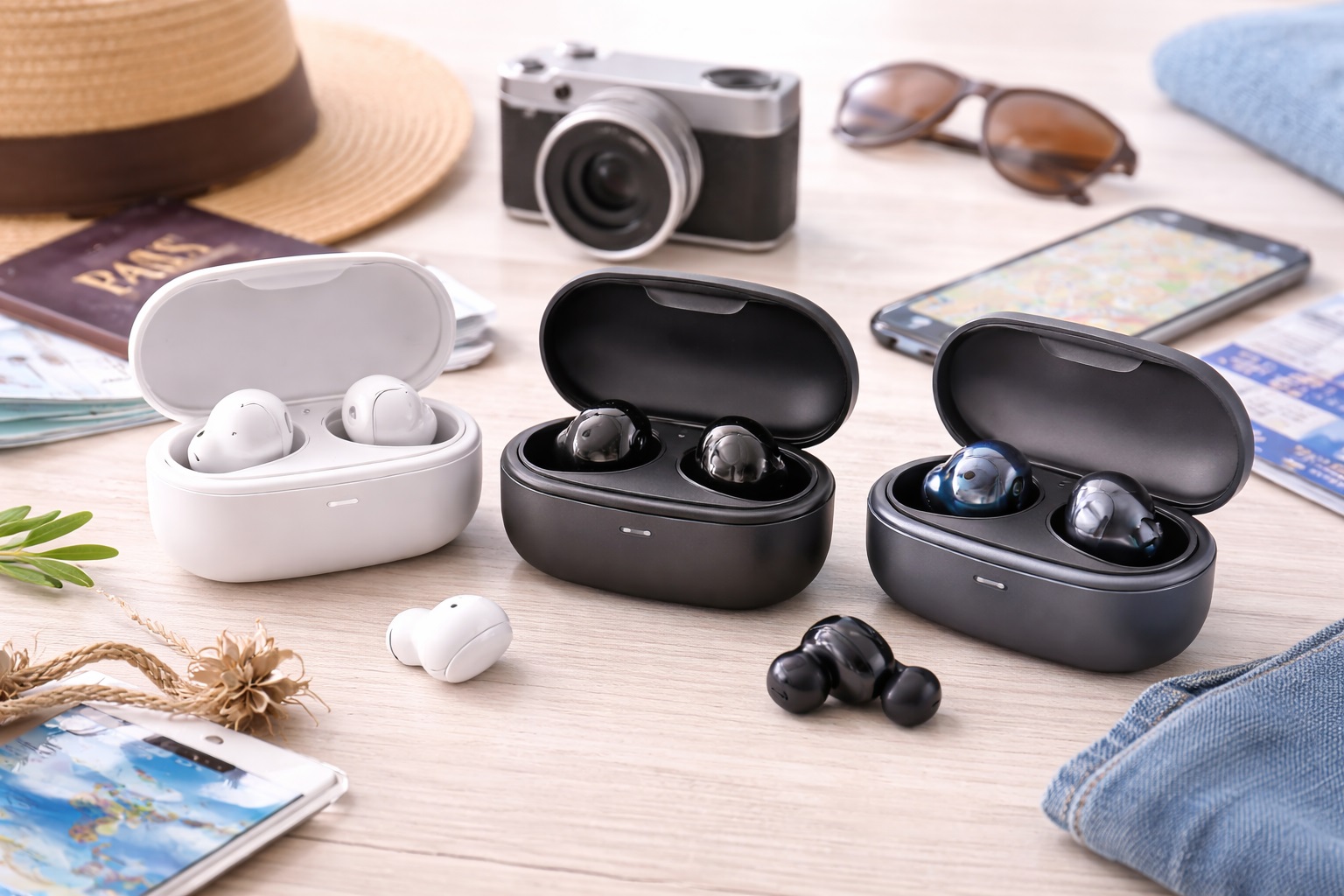
Best Bluetooth Earbuds for Travel: ANC and Battery That Last
Travel puts earbuds through conditions ordinary daily use rarely does: hours of continuous wear, cabin noise that never lets up, security lines where earbuds go in and out of pockets, and long stretches away from a charger. What works well for a short commute does not always hold up across a full travel day, which is why the earbuds that suit frequent flyers and commuters look a little different from a general everyday pick.
This guide compares the most practical options for frequent travelers who need compact, reliable earbuds with good ANC and long battery for flights and commutes. Rather than chasing the newest release, the focus is on the qualities that actually matter mid-journey — how well they block engine drone, how long they last between charges, how small the case is in a crowded bag, and how they hold a connection through the wireless interference of an airport terminal.
Below is a full comparison table, detailed reviews of the earbud types worth considering for travel, a buying guide built around the factors that matter most in transit, and answers to the questions travelers ask most often.
Why Travel Changes What Matters in a Pair of Earbuds
An earbud that sounds great for an hour at a desk is not automatically a good travel companion. Cabin noise is a low, constant drone rather than the intermittent noise ANC is sometimes tuned for, and a long flight or layover means hours of continuous wear that can turn a slightly uncomfortable fit into a genuine problem by the halfway point. Battery life also matters differently in transit — there is rarely a convenient outlet nearby, and a case that needs frequent topping up becomes a source of stress rather than convenience, especially on a multi-leg itinerary with tight connections between flights.
Case size is another factor that rarely comes up in a general buying guide but matters enormously for travel. A bulky case competes for space with cables, a passport, and snacks in an already full travel bag, and it is one of the more overlooked differences between models that otherwise sound similar on paper. The picks below are chosen with these travel-specific realities in mind rather than around general everyday listening, since a pair that excels at a desk does not always translate to a genuinely good travel companion.
Top Picks (Detailed Reviews)
1. ANC Flagship Travel Earbuds – Best Overall for Frequent Flyers
A flagship pair built around strong active noise cancellation is the clearest all-around choice for someone who flies often. Effective ANC cuts through the steady low-frequency drone of jet engines far better than passive isolation alone, making a genuine difference in perceived cabin noise during a long flight, and the accompanying battery life is usually tuned to survive a full travel day.
- Pros:
- Strong ANC performance against low-frequency cabin and engine noise
- Battery life suited to long-haul flights and layovers
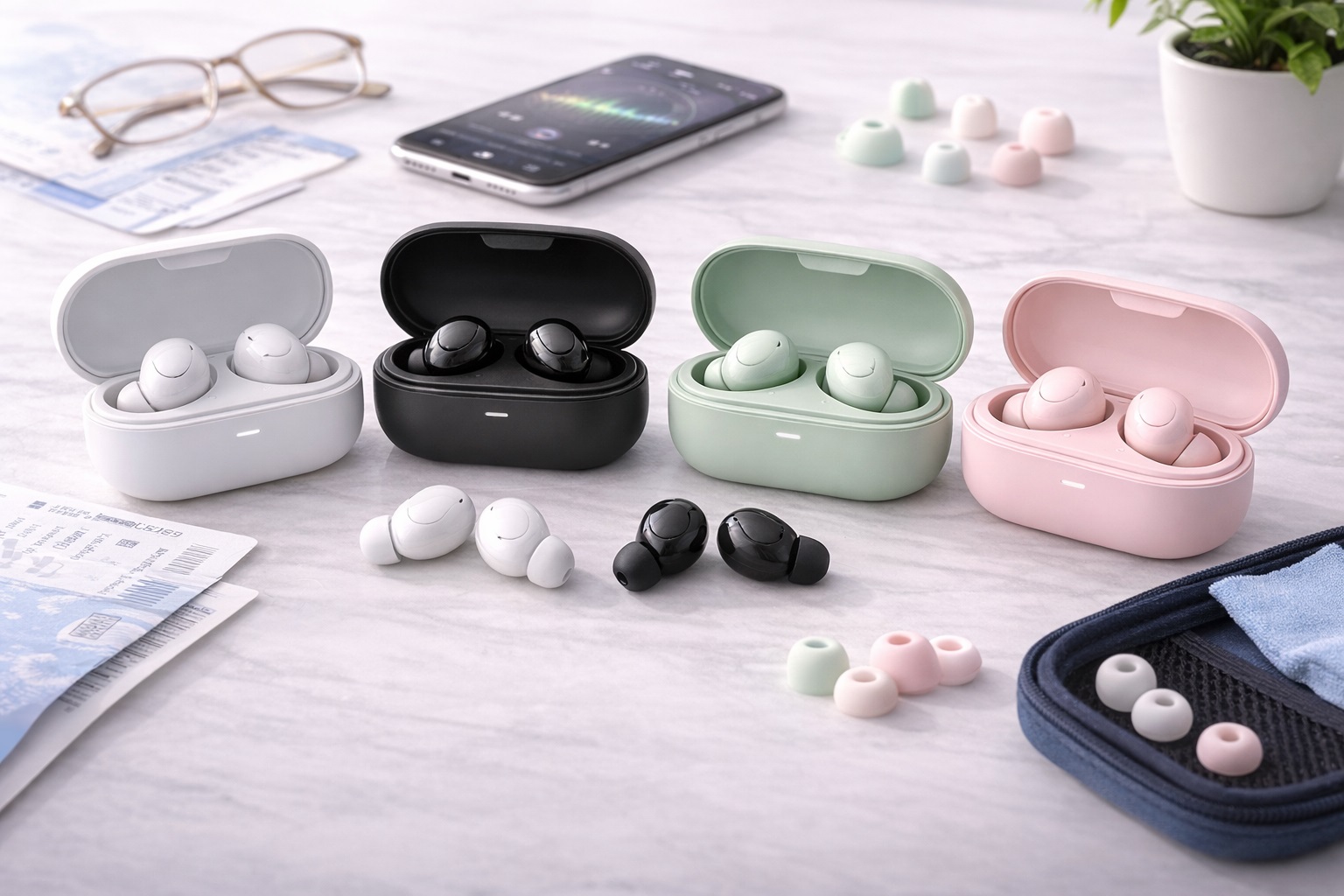
- Comfortable ear tip options for extended continuous wear
- Case typically includes wireless charging for flexible top-ups
- Cons:
- Premium ANC performance comes at a higher price point
- Case size is usually average rather than especially compact
Best For: Frequent flyers who prioritize noise cancellation and all-day comfort above every other feature.
Why We Recommend It: Strong ANC is the single feature that most changes the experience of a long flight, and a flagship-tier pair is built specifically to sustain that performance and comfort across many hours of continuous wear.
2. Compact Low-Profile Earbuds – Best for Minimal Carry Weight
For travelers who pack light and want their electronics to take up as little space as possible, a compact, low-profile earbud and case combination trims down both the earbud size and the case footprint without giving up core functionality. This makes them easy to slip into a jacket pocket or a small pouch alongside other travel essentials.
- Pros:
- Small case footprint saves valuable bag space
- Lightweight earbuds reduce ear fatigue on long wear days
- Still includes reliable core ANC and call functionality
- Easy to carry in a pocket rather than requiring a dedicated bag compartment
- Cons:
- Smaller case sometimes means a slightly smaller battery reserve
- Compact design can mean fewer size options for ear tips
Best For: Minimalist packers and travelers who prioritize a small carry footprint over maximum battery capacity.
Why We Recommend It: Every item that fits in a smaller space matters more when packing for a trip, and this option delivers dependable travel performance without asking for a dedicated spot in the bag.
3. Long-Battery-Life Earbuds – Best for Long-Haul Flights
Some models are built specifically around maximizing total playback time, both in the earbuds themselves and across multiple case recharges, which matters most on long-haul international flights and multi-leg itineraries where charging opportunities are limited or inconvenient.
- Pros:
- Extended per-charge battery life reduces mid-flight anxiety about running out
- Case holds multiple additional full charges for multi-day trips
- Efficient power management still allows for ANC use throughout
- Well suited to itineraries with limited access to charging outlets
- Cons:
- Larger battery cells can add some weight to the case
- Not the most compact option if carry size is the top priority
Best For: Long-haul international travelers and anyone on a multi-leg itinerary with limited charging access.
Why We Recommend It: Battery anxiety is a real concern on long flights without convenient charging, and this option is built around removing that concern almost entirely.
4. Multipoint Connection Earbuds – Best for Switching Between Devices on the Go
Travel often means switching between a phone for boarding passes and calls, a laptop for work, and an in-flight entertainment system or tablet for media. Multipoint connection support lets earbuds stay paired to two devices simultaneously and switch between them without a manual re-pairing step each time.
- Pros:
- Switches seamlessly between phone and laptop without manual re-pairing
- Useful for travelers who work and consume media on different devices during a trip
- Reduces the friction of constantly opening Bluetooth settings mid-journey
- Generally paired with solid everyday ANC and call performance
- Cons:
- Multipoint connections can occasionally introduce a brief delay when switching
- Battery drain is marginally higher when maintaining two active connections
Best For: Business travelers and anyone regularly switching between a phone and a laptop during a trip.
Why We Recommend It: Constant manual re-pairing is one of the more common daily frustrations for travelers juggling multiple devices, and multipoint support removes that friction almost entirely.
5. Budget ANC Travel Earbuds – Best Value for Occasional Travelers
Not everyone flies often enough to justify a flagship price tag, and a solid budget ANC option covers the core travel needs — noise reduction, reasonable battery life, and stable connectivity — without the premium features that occasional travelers may not use often enough to value.
- Pros:
- Meaningfully lower price than flagship travel-focused models
- Functional ANC that still reduces cabin and airport noise
- Reasonable battery life for shorter trips and regional flights
- Good option for a dedicated travel-only pair kept separate from daily-use earbuds
- Cons:
- ANC performance is noticeably less refined than flagship options
- Battery life may fall short on the longest international routes
Best For: Occasional travelers who want dependable ANC and battery performance without paying for flagship extras.
Why We Recommend It: Most of the practical benefit of travel earbuds comes from the basics done well, and this option delivers those basics at a price that makes sense for someone who travels a few times a year rather than every week.
6. Rugged IPX-Rated Earbuds – Best for Outdoor and Adventure Travel
Travel is not always airports and hotel rooms. For hiking trips, humid climates, and outdoor excursions, an earbud with a solid IPX water and sweat resistance rating holds up to conditions that would put a standard pair at risk, without sacrificing the core travel features.
- Pros:
- Water and sweat resistance suited to humid or wet outdoor conditions
- Secure fit options hold steady during active movement
- Still includes usable ANC for transit between outdoor destinations
- More resilient to the general wear and tear of adventure travel
- Cons:
- Rugged casing sometimes adds slight bulk compared to sleeker models
- Water resistance ratings do not cover full submersion
Best For: Travelers combining outdoor activity — hiking, humid climates, watersports-adjacent trips — with more conventional transit.
Why We Recommend It: Adventure travel puts different demands on equipment than a standard business trip, and this option is built to handle both without needing a second pair packed just for the outdoor portion of a trip.
7. Transparency-Mode Earbuds – Best for Staying Aware During Transit
A strong transparency or ambient mode lets outside sound — gate announcements, a conductor's instructions, a tour guide — pass through clearly without needing to remove the earbuds entirely, which is particularly useful during the parts of travel that involve moving through unfamiliar public spaces.
- Pros:
- Clear transparency mode preserves awareness of announcements and surroundings
- Quick toggle between ANC and transparency without removing earbuds
- Useful for public transit, airports, and unfamiliar cities
- Still delivers solid ANC and battery performance when full isolation is preferred
- Cons:
- Transparency mode quality varies more between brands than ANC quality does
- Not quite as specialized for pure noise blocking as an ANC-first flagship model
Best For: Travelers who move through unfamiliar transit systems and want to stay aware of their surroundings without removing earbuds constantly.
Why We Recommend It: Missing a gate change announcement or a transit stop because both ears are fully isolated is a common travel frustration, and a strong transparency mode solves it directly.
Common Travel Earbud Assumptions Worth Questioning
It is easy to assume the earbuds with the highest advertised ANC rating will automatically perform best on a flight, but ANC tuning matters more than a single headline number. Some models are tuned aggressively for low, constant drone like an airplane cabin, while others are tuned more for variable environments like an office or street. Two earbuds with similar marketing claims can feel very different once you are actually seated on a plane for six hours.
Another common assumption is that a bigger case always means a better travel companion because of the larger battery reserve inside. In practice, a bulky case is itself a travel cost — it takes up bag space that could hold something else, and it is more likely to end up loose in a bag rather than in a dedicated pocket where it is easy to find quickly at security or boarding.
There is also a tendency to treat battery specifications as fixed numbers rather than figures that assume ANC is off. Running ANC continuously, which is exactly how most travelers use their earbuds on a flight, reduces total battery life compared to the advertised maximum. Checking whether a stated battery figure assumes ANC on or off gives a more realistic sense of what to expect during actual travel use.
Buying Guide: How to Choose the Best Bluetooth Earbuds for Travel
These are the factors that matter most once earbuds leave the daily commute and head into a full travel itinerary.
1. ANC Effectiveness Against Cabin Noise
Airplane cabin noise is a steady low-frequency drone, and ANC quality varies significantly in how well it targets that specific frequency range. Reading feedback specifically about flight use, rather than general noise cancellation claims, gives a clearer picture than marketing copy alone. A pair praised for blocking street traffic will not necessarily perform the same way against a jet engine's steady hum.
2. Battery Life and Case Recharge Cycles
Check both per-charge battery life and how many additional full charges the case holds, since a long-haul or multi-day trip depends more on total case capacity than on single-charge duration alone. Remember that continuous ANC use will reduce the advertised maximum somewhat, so building in a margin is wise.
3. Case Size and Portability
A compact case matters more when packing light, while a slightly larger case is a reasonable trade-off if it means meaningfully more battery capacity. Decide which trade-off fits your travel style before comparing models on this factor, since the two priorities genuinely pull in different directions.
4. Comfort for Extended Continuous Wear
A long flight or travel day involves far more continuous wear than a typical commute. Ear tip fit and shape matter more here than in everyday use, since minor discomfort compounds significantly over several hours, and a pair with multiple included tip sizes gives a better chance of finding a lasting fit.
5. Call Clarity for Travel Communication
Whether checking in with someone back home or handling a work call from an airport lounge, clear call audio in a noisy environment depends on microphone quality and background noise suppression during calls specifically, not just music playback quality, which is a separate specification worth checking on its own.
6. Connection Stability in Crowded Wireless Environments
Airports and transit hubs are dense with competing wireless signals. A stable connection in that kind of crowded environment is a meaningfully different test than a quiet home, and it is worth checking for feedback on real-world performance in busy public spaces rather than assuming lab-tested range figures will hold up identically.
7. Multipoint and Multi-Device Pairing
Multipoint support removes the friction of manually re-pairing between a phone, laptop, or in-flight entertainment system, which becomes more valuable the more devices a traveler typically juggles during a trip, particularly for business travelers moving between work and personal devices throughout a single day.
8. Transparency Mode for Announcements and Safety
A reliable ambient or transparency mode allows awareness of gate changes, transit announcements, and surroundings without fully removing the earbuds, which matters especially in unfamiliar transit systems where missing a single announcement can mean missing a connection.
9. Water and Sweat Resistance for Varied Climates
An IPX rating matters more for travel than it might for a purely indoor daily routine, since travel often means humid climates, unexpected weather, or physically active side trips during the same journey, and a rating that covers light rain and humidity is a reasonable minimum to look for.
10. Charging Options and Flexibility
USB-C charging is now close to standard, and wireless charging case compatibility adds flexibility when traveling with a portable charging pad. Confirm the charging cable included matches what you are already carrying to avoid packing an extra adapter just for one device.
11. Touch Controls and Ease of Use While Traveling
Simple, reliable touch controls matter more while managing luggage, boarding passes, and a crowded gate area. Overly sensitive or overly complex control schemes are more of a liability in transit than at a desk, where a misfired gesture is a minor annoyance rather than a missed call.
12. Price vs. Features Trade-off
Frequent flyers get more value out of premium ANC and battery features than occasional travelers do. Matching spending to actual travel frequency avoids paying for capability that will not be used often enough to matter, and it is worth being honest about how many trips a year actually justifies a flagship purchase.
Frequently Asked Questions
1. Do Bluetooth earbuds work well on airplanes?
Yes, most modern Bluetooth earbuds function normally on airplanes in flight mode with Bluetooth enabled, which most airlines permit. They pair with a phone, tablet, or in some cases directly with newer in-flight entertainment systems, though it is worth checking a specific airline's policy before departure.
2. How much battery life do I need for long flights?
For long-haul flights, look for earbuds with several hours of per-charge battery life plus a case that holds at least two to three additional full charges, covering a full journey without needing an outlet, especially if ANC will run continuously throughout.
3. Is ANC necessary for travel earbuds?
It is not strictly necessary, but it makes a significant difference on flights specifically, since it reduces the steady engine and cabin drone that passive isolation alone does not fully block, which can meaningfully reduce fatigue on a long flight.
4. Can earbuds connect to in-flight entertainment systems?
Some newer in-flight entertainment systems support Bluetooth pairing directly, though many older systems still rely on a wired headphone jack, in which case a small Bluetooth transmitter adapter can bridge the gap and is worth packing for older aircraft.
5. What is the best earbud case size for travel?
There is no single correct size — a smaller case saves bag space, while a larger case usually holds more total battery capacity. The right choice depends on whether packing light or maximizing battery life matters more for the kind of trips you typically take.
6. Do travel earbuds need to be waterproof?
Full waterproofing is not necessary for most travel, but a reasonable IPX sweat and splash resistance rating is a useful buffer against humid climates or unexpected weather during a trip, particularly for travelers combining outdoor activities with standard transit.
7. How do I keep earbuds from disconnecting in crowded airports?
Keeping firmware updated and choosing a model known for stable performance in dense wireless environments both help. Persistent disconnection issues in one specific location are sometimes about interference rather than the earbuds themselves, and moving a short distance can resolve it.
8. Are wired adapters needed for airplane audio jacks?
If the aircraft's entertainment system uses an older wired headphone jack rather than Bluetooth, a small Bluetooth transmitter adapter is the simplest way to use wireless earbuds with it, and these adapters are compact enough to keep permanently in a travel bag.
9. Should I prioritize battery life or ANC for travel?
For long-haul flights, battery life is often the more critical factor since running out mid-flight cannot be easily fixed. For noisy short-haul routes and commutes, ANC quality often matters more day to day, so the right priority depends on your typical trip length.
10. Can I use one earbud while keeping the other in the case?
Most true wireless earbuds support single-earbud use, which extends total listening time and is useful when you want to stay partially aware of your surroundings during a layover or short walk through an unfamiliar terminal.
11. How do multipoint earbuds help while traveling?
They let earbuds stay connected to two devices — a phone and a laptop, for instance — at the same time, switching automatically rather than requiring a manual disconnect and re-pair each time you swap devices during a work trip.
12. What is the best fit type for long travel days?
A secure, comfortable fit tested across several ear tip sizes generally holds up best over many hours of continuous wear. Trying multiple included tip sizes before a trip is worth the few minutes it takes and can prevent discomfort hours into a flight.
Matching Earbuds to Your Actual Travel Style
Not every traveler needs the same set of features, and it is worth being specific about your own travel pattern before settling on a pick. A frequent long-haul international flyer has genuinely different priorities than someone who takes a handful of short regional trips a year, and a business traveler juggling a phone and laptop all day has different needs than someone traveling primarily for leisure with a single device.
For frequent long-haul flyers, battery life and ANC performance tend to matter more than price sensitivity, since the earbuds are doing heavy daily work across many trips. For occasional travelers, a solid budget option covers the core needs without paying for capability that would otherwise sit unused most of the year. For business travelers moving constantly between devices, multipoint support often ends up mattering more day to day than a small improvement in ANC performance.
Being honest about which of these categories describes your own travel pattern — rather than defaulting to whichever option has the most impressive specification sheet — is the fastest way to narrow this list down to the one or two picks that will actually suit how you travel.
Final Verdict
- Best Overall for Frequent Flyers: ANC Flagship Travel Earbuds — strongest noise cancellation and all-day comfort.
- Best for Minimal Carry Weight: Compact Low-Profile Earbuds — smallest footprint without sacrificing core function.
- Best for Long-Haul Flights: Long-Battery-Life Earbuds — removes battery anxiety on extended international routes.
- Best for Multi-Device Switching: Multipoint Connection Earbuds — seamless handoff between phone and laptop.
- Best Value for Occasional Travelers: Budget ANC Travel Earbuds — core travel features without flagship pricing.
- Best for Outdoor and Adventure Travel: Rugged IPX-Rated Earbuds — holds up to humid climates and active side trips.
- Best for Staying Aware in Transit: Transparency-Mode Earbuds — clear ambient sound for announcements and unfamiliar cities.
The right travel earbuds depend heavily on how you actually travel — how often, how far, and what kind of trips you take alongside standard flights and commutes. A frequent long-haul flyer has different priorities than someone who travels twice a year on short regional trips, and being honest about which category you fall into narrows this list quickly. Whichever option fits, prioritizing the travel-specific factors above over general everyday specs tends to produce a pair that actually holds up across a full journey rather than just sounding good in a quiet room.
It is also worth reassessing your travel earbuds every year or two rather than assuming an old favorite still performs as well as it once did. Battery capacity in any rechargeable device degrades gradually with charge cycles, and a pair that comfortably lasted a long-haul flight when new may fall short after a few years of regular travel use. Testing battery performance before a major trip, rather than discovering a shortfall mid-flight, is a simple habit that avoids an easily preventable travel frustration.
Packing a small backup plan is also worth considering for anyone who travels frequently enough that a single equipment failure would be genuinely disruptive. A spare charging cable, a basic wired backup, or simply knowing your airline's policy on borrowing headphones can turn a dead battery or a lost earbud from a ruined flight into a minor inconvenience. None of this requires overpacking — it is more about recognizing that travel electronics fail at the least convenient moments, and a small amount of preparation goes a long way toward keeping a trip on track regardless of which pair of earbuds you ultimately choose from the picks above.