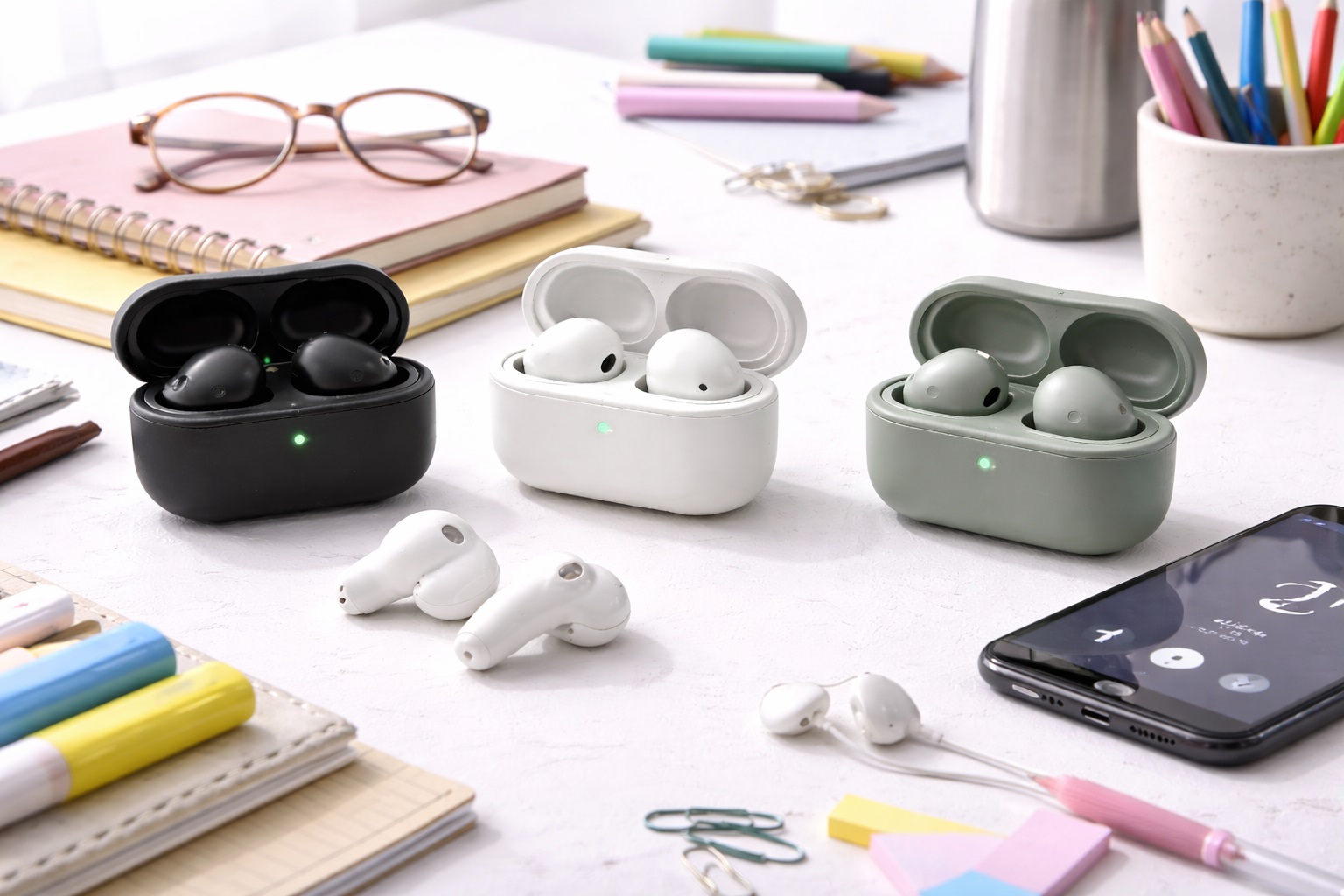
Best Bluetooth Earbuds for Students: Study, Focus & Stay Connected
Student budgets and student schedules create a very specific set of demands that most general earbud reviews don't account for. A student needs earbuds that survive being tossed into a backpack between classes, that last through a full day on campus without a midday charging break, that handle a Zoom lecture just as well as a study playlist, and that don't eat into money better spent on textbooks or meal plans. None of that requires flagship pricing, but it does require picking the right category rather than the flashiest one.
This guide is organized around the actual rhythms of student life: tight budgets, long days away from an outlet, noisy dorms and libraries where focus is hard to come by, and the now-routine mix of in-person and online classes. Each category below solves a specific piece of that puzzle, and the honest pros and cons are laid out so you can match the pick to your actual schedule rather than to a generic "best earbuds" list that assumes an office worker's routine instead of a student's.
Below you'll find a quick comparison table, six picks organized by the specific student need each one addresses best, a buying guide covering the factors that matter most for this use case, and answers to common questions students have before buying.
It's also worth thinking about how your needs might shift over the course of a semester rather than assuming your first pick will remain the perfect fit indefinitely. A student who starts the term with mostly in-person classes might find themselves relying more heavily on recorded lectures and online participation by midterms, at which point microphone quality and clarity suddenly matter more than they did in week one. Keeping this in mind while comparing categories below can help you weigh a pick's secondary strengths, not just its standout feature, a little more carefully.
| Category | Standout Strength | Best For |
|---|---|---|
| Affordable student earbuds | Lowest reasonable price with solid basics | Tight budgets |
| Earbuds with great isolation | Passive noise blocking for focus | Noisy dorms and libraries |
| Earbuds with long battery life | All-day runtime without recharging | Long days on campus |
| Budget campus earbuds | Reasonable durability at low cost | Everyday campus carry |
| Earbuds for online classes | Clear microphone for participation | Hybrid and remote coursework |
| Earbuds for commuting students | Stable connection, comfortable wear | Long commutes to campus |
Top 6 Bluetooth Earbuds for Students (Detailed Reviews)
1. Affordable Student Earbuds – Best Overall Value
This category is built around the reality that most students are working with a limited budget and don't want to spend more on earbuds than the situation calls for. It focuses spending on the fundamentals — decent sound, a stable connection, and reasonable comfort — rather than premium extras that inflate the price without adding much day-to-day value for typical student use.
The trade-off is that these earbuds won't compete with pricier options on refinement, but for the core tasks students actually use earbuds for — lectures, study playlists, calls home, the occasional podcast during a walk across campus — they cover the essentials well. This makes them a sensible default recommendation for most students who don't have a specific specialized need pulling them toward one of the other categories.
- Pros:
- Strong overall value for typical day-to-day student use
- Covers core needs without unnecessary extras inflating the price
- Reasonable starting point for students without a specialized need
- Cons:
- Doesn't lead in any single specialized area like isolation or battery life
- Build materials are more basic than pricier alternatives
Best For: Students who want reliable, well-rounded earbuds without spending more than the situation requires.
Why We Recommend It: It delivers the best overall balance of price and everyday usefulness for the broadest range of student needs, making it the sensible first option to consider before looking at more specialized categories.
2. Earbuds With Strong Passive Isolation – Best for Focus
Dorms, shared apartments, and busy libraries are rarely quiet, and this category addresses that directly through ear tip design and a snug fit that physically blocks more ambient sound, rather than relying on active noise cancellation circuitry. For students trying to concentrate on reading or lecture recordings in a noisy environment, this passive approach can be just as effective as ANC, and often at a lower price.
Because the isolation comes from physical seal rather than processing, it also tends to be more consistent — there's no battery-drain trade-off for turning the feature on, and it works the same whether the earbuds are freshly charged or nearly dead. The downside is that a poor fit undermines the entire feature, so trying different ear tip sizes matters more here than with other categories.
- Pros:
- Effective, consistent noise blocking without draining extra battery
- Often available at a lower price than earbuds relying on active noise cancellation
- Well suited to focused studying in noisy shared spaces
- Cons:
- Effectiveness depends heavily on finding the right ear tip fit
- Blocks less of sudden, sharp noises compared to steady background sound
Best For: Students who need to concentrate in noisy dorms, libraries, or shared study spaces.
Why We Recommend It: For the specific challenge of studying amid constant ambient noise, a properly fitted pair with strong passive isolation solves the problem directly and reliably, without needing a battery-draining active feature.
3. Earbuds With Long Battery Life – Best for Full Campus Days
A full day of back-to-back classes, study sessions, and commuting leaves little time or opportunity to sit near an outlet. This category prioritizes maximum combined battery life from earbuds and case, so a single morning charge can realistically last through a long day without needing a midday top-up.
This focus sometimes comes at a modest cost to sound refinement or feature richness, since battery capacity competes for limited internal space with other components. For students whose days genuinely run long — classes, a part-time job shift, evening study group — that trade-off is usually worth it, since a dead pair of earbuds by mid-afternoon defeats the purpose entirely.
- Pros:
- Extended combined runtime covers a full day away from a charger
- Reduces the need to remember a midday charging break
- Particularly useful for students with long, irregular daily schedules
- Cons:
- Slightly larger case in some models to accommodate extra battery capacity
- Sound tuning is a secondary priority to battery capacity
Best For: Students with long, unpredictable daily schedules who can't reliably charge earbuds midday.
Why We Recommend It: Battery anxiety is a real and common frustration for busy students, and this category removes that concern directly by prioritizing runtime over other, less critical refinements.
4. Budget Campus Earbuds – Best for Daily Durability
Textbooks, laptops, water bottles, and loose change all compete for space in a student's backpack, and earbuds tossed in alongside them take a beating. This category focuses on reasonable physical durability at a low price — a case that can survive being dropped, cables and hinges that don't fail after a few weeks of daily jostling — without requiring a premium price for that resilience.
It doesn't lead on sound quality or advanced features, but for the specific problem of earbuds surviving the physical wear and tear of daily campus carry, it's a sensible, low-cost solution. Students who have previously gone through several cheap pairs due to case or cable failures tend to appreciate this category the most.
- Pros:
- Reasonable physical durability for daily backpack carry
- Priced accessibly for students replacing a previously damaged pair
- Solid choice for careless or high-wear daily use
- Cons:
- Sound quality and features are basic compared to pricier options
- Durability improvements are incremental, not a guarantee against all damage
Best For: Students whose previous earbuds failed due to daily wear and tear from backpack carry.
Why We Recommend It: For students who are hard on their gear simply by virtue of a busy, mobile daily routine, this category directly addresses the most common reason budget earbuds fail early.
5. Earbuds for Online Classes – Best for Remote and Hybrid Coursework
With hybrid and remote coursework now a routine part of student life, microphone quality for class participation matters as much as playback sound for many students. This category prioritizes clear voice pickup and stable connections specifically for video conferencing platforms, so raising a question or joining a breakout room discussion comes through clearly.
Unlike categories built purely for calls, this one also needs to handle straightforward music and lecture-recording playback well, since students use the same pair for both purposes throughout the day. The balance struck here tends to favor reliability during live class sessions over premium audio tuning for casual listening.
- Pros:
- Clear microphone pickup suited to video conferencing and class participation
- Stable connection performance for extended online class sessions
- Reasonably balanced for both class use and casual listening
- Cons:
- Not as specialized as dedicated call-focused earbuds for heavy voice use
- Music-focused listeners may find the tuning slightly conservative
Best For: Students taking hybrid or fully remote courses who need reliable microphone performance during live sessions.
Why We Recommend It: As remote and hybrid learning have become a permanent fixture rather than a temporary arrangement, this category addresses a genuinely common student need that general-purpose earbuds often handle poorly.
6. Earbuds for Commuting Students – Best for Long Travel to Campus
Many students commute a meaningful distance to campus, whether by bus, train, or a long walk, and this category is tuned specifically around that routine: a stable connection through crowded transit environments, comfortable extended wear, and enough passive isolation to make a commute feel less noisy without needing full active noise cancellation.
It doesn't lead on any single flashy feature, but the combination of comfort and connection stability makes it a strong fit for the specific daily grind of a long commute, where reliability matters more than any individual spec.
- Pros:
- Stable connectivity in crowded transit and signal-congested environments
- Comfortable for extended wear during longer commutes
- Reasonable passive noise isolation for commute noise
- Cons:
- No dedicated active noise cancellation in most models at this tier
- Sound tuning is adequate rather than a standout feature
Best For: Students with a long daily commute to and from campus who want dependable, comfortable earbuds for that specific routine.
Why We Recommend It: A long commute is one of the most consistent, repeated stresses on a pair of earbuds, and this category is specifically tuned to hold up to that daily demand without requiring a premium price.
Buying Guide: How to Choose the Best Bluetooth Earbuds for Students
Before making a purchase decision, consider these factors, each weighted toward the realities of student schedules and budgets rather than generic earbud shopping advice.
1. Price Relative to Features You'll Actually Use
Student budgets rarely have room for paying for features that go unused. Before comparing specific models, list the two or three things you'll actually use daily — calls, study focus, commuting — and weigh price against how well a given option covers those specific needs rather than its full feature list. It's easy to get pulled toward a longer spec sheet when comparing product pages side by side, but most of those extra features quietly go unused once the earbuds settle into an actual daily routine.
2. Noise Isolation for Study Focus
Whether through passive seal or active cancellation, isolation directly affects how well you can concentrate in a noisy dorm or library. Consider where you actually study most and prioritize accordingly, since a pair great for commute noise isn't necessarily the best for a chatty roommate. Steady background hum, like an HVAC system or traffic, responds differently to isolation than sudden, unpredictable noise like conversation, so match the type of isolation to the type of noise you deal with most.
3. Battery Life for a Full Campus Day
Map your typical day, from the first class to the last commitment, and check whether a given model's combined battery life realistically covers that span. A pair that needs a midday recharge you can't fit into your schedule is a genuine daily inconvenience. Even a short ten-minute quick-charge feature can matter more in practice than a slightly higher maximum runtime figure, since it fits more naturally into the small gaps between classes.
4. Microphone Quality for Online Class Participation
If your coursework includes any hybrid or remote component, don't assume general call quality automatically translates to good performance on video conferencing platforms. Check reviews that specifically mention video call or classroom use if this is a regular part of your routine. A microphone that sounds fine on a standard phone call can still perform inconsistently on a specific video conferencing platform, so platform-specific feedback is worth the extra search effort.
5. Durability for Daily Backpack Carry
Earbuds carried loose in a backpack alongside books and a laptop face more physical stress than those kept in a dedicated case at a desk. Look for a sturdy charging case and reviews mentioning long-term daily carry rather than just first-impression build quality. A case with a firm hinge and secure closing mechanism is a small detail that matters enormously once it's been opened and closed dozens of times a week for a full semester.
6. Overall Price and Value
Consider total value over the likely ownership period, not just the sticker price. A slightly pricier pair that lasts through multiple semesters can be a better financial decision than repeatedly replacing a cheaper pair that fails after a few months. Doing quick napkin math on cost per semester, rather than just comparing sticker prices, often reveals that the cheapest option upfront isn't actually the cheapest option over a full degree program.
7. Brand Reliability Even on a Tight Budget
Some established brands offer genuinely competitive budget-friendly lines specifically because they know students represent a large part of their customer base. Checking whether a brand has a track record with student-oriented pricing can be a useful shortcut. Reading reviews from a few different price tiers within the same brand can also reveal whether their entry-level products get the same quality-control attention as their flagship lines, which varies more than buyers might expect.
8. Warranty and Support Terms
A functioning warranty matters more for students on a tight budget, since an unexpected replacement cost can be a genuine financial strain. Check the specific terms and how straightforward the claims process is before committing. A warranty that requires mailing a defective unit back and waiting weeks for a replacement is far less useful during a busy semester than one offering a quick, straightforward exchange.
9. User Reviews From Other Students Specifically
Reviews from other students, or at least from buyers describing similar daily routines, tend to be more relevant than general reviews. Look for mentions of classroom use, commuting, or dorm noise specifically. Campus subreddits, student forums, and social media groups dedicated to a specific school can sometimes surface more relevant, candid feedback than a general marketplace review section.
10. Compatibility With Your Laptop and Phone
Many students switch between a phone and a laptop throughout the day, for calls, music, and online classes respectively. Confirm smooth compatibility and easy switching between both devices before assuming any pair handles this seamlessly.
11. Comfort for Extended Daily Wear
Between classes, studying, and commuting, many students wear earbuds for a large portion of their waking hours. Prioritize comfort during extended wear over specs that only matter in short listening sessions.
12. Ease of Replacement If Lost
Earbuds are easy to misplace in a busy student schedule between classrooms, libraries, and dorms. Consider how easily and affordably a specific model or a single earbud can be replaced if lost, since this happens more often to students than to buyers with a fixed daily routine.
13. Sound Signature for Lectures vs. Music
Not all earbuds tune sound the same way, and the difference matters more for students juggling recorded lectures, podcasts, and music than it does for casual listeners. Earbuds tuned with boosted bass for music can occasionally make spoken word content sound muddier, since heavy low-end frequencies can compete with the clarity of a professor's voice in a recorded lecture. If you split your listening fairly evenly between lecture audio and music, look for reviews that specifically mention vocal clarity rather than just bass response, since a flatter, more neutral sound signature often serves double duty better than one tuned aggressively for one type of content.
14. Charging Case Battery vs. Standalone Earbud Battery
Manufacturer battery claims usually list two separate numbers: how long the earbuds last on a single charge, and the extended total once the charging case is factored in. For a student sitting through a three-hour lab or a long lecture block, the single-charge figure matters more than the combined total. Check the standalone earbud runtime against your longest single stretch without a break, rather than relying on the more impressive-sounding combined total printed on the box.
Frequently Asked Questions
What's the most important factor for students choosing Bluetooth earbuds?
It depends on your specific routine, but battery life and noise isolation tend to matter most for typical student schedules, since long days and noisy shared spaces are nearly universal challenges regardless of major or campus. Think through your own weekly schedule honestly before deciding, since a commuter student and a resident student living on campus often have meaningfully different priorities despite both being full-time students.
Do I need noise cancellation or is passive isolation enough for studying?
Passive isolation from a well-fitted ear tip can be just as effective for consistent background noise, and it doesn't drain extra battery, making it a strong and often more affordable choice for study focus specifically. Try a few different ear tip sizes before settling on one, since the difference between a mediocre seal and a great one can be the difference between noticeable noise bleed and genuinely effective isolation.
How important is microphone quality for a student who takes some online classes?
Fairly important if you regularly participate in discussions or breakout sessions, since a poor microphone can make it harder to be heard clearly during live class interaction, which affects both grades and participation confidence. Instructors and classmates form quick impressions based on audio clarity during a call, so this is a small factor that can have an outsized effect on how comfortably you engage during discussion-heavy sessions.
Are cheap earbuds durable enough for daily campus use?
Many are, particularly models specifically built with durability for daily carry in mind. Reading reviews that mention several months of backpack use, rather than just initial impressions, is the most reliable way to check this before buying. Pay particular attention to any recurring mentions of a specific failure point, like a cracked case hinge or a charging port that loosens over time, since that pattern is far more informative than a single isolated complaint.
Should I prioritize battery life over sound quality?
For most students, yes, since a longer daily schedule with no reliable place to recharge is a bigger daily obstacle than modestly better sound tuning. Prioritize based on your actual daily routine rather than a general ranking.
Can I use the same earbuds for online classes and casual music listening?
Yes, and many models are designed to balance both reasonably well. If both are equally important to you, look specifically for reviews mentioning satisfaction with both use cases rather than one optimized heavily for calls alone.
What's a reasonable amount to spend on earbuds as a student?
This depends on your overall budget, but many students find good value in the affordable and budget-focused categories covered here, since they cover the core daily needs well without unnecessary extras.
How do I know if earbuds will survive being carried in a backpack daily?
Look for a sturdy charging case, reviews mentioning long-term daily carry specifically, and a design that isn't overly delicate. Durability-focused categories are built with exactly this kind of daily wear in mind.
Is it worth buying a spare pair as a student?
It can be, particularly given how easily earbuds get lost or damaged during a busy schedule. A low-cost backup pair can prevent a lost primary pair from becoming a bigger disruption during a busy semester.
Do student-marketed earbuds actually differ from general earbuds?
Not always in the underlying technology, but the categories that perform well for student routines — long battery life, strong isolation, durable builds, reliable microphones — genuinely address common student needs, regardless of specific marketing language.
Can I return earbuds if they don't fit my schedule as expected?
Most retailers offer a return window of roughly 15 to 30 days. Testing the earbuds against your actual daily routine early within that window is a sensible way to confirm the fit before the option expires.
Is it better to buy earbuds online or from a campus bookstore?
Online marketplaces typically offer better selection and pricing, while a campus store might allow an in-person look. For most students, comparing prices online before buying tends to offer better overall value.
11. Do I need a separate feature for calls and for noise isolation, or can one pair handle both?
Most modern earbuds handle both reasonably well, since the same design elements that isolate ambient noise for listening also tend to help a built-in microphone pick up your voice more clearly by reducing competing background sound. If both matter equally to you, look for reviews that specifically mention call clarity in noisy environments rather than assuming isolation and microphone quality are unrelated features.
12. How should I clean earbuds I use every day during a semester?
Wipe the outer surfaces and ear tips with a soft, slightly damp cloth regularly, and remove silicone ear tips periodically to clean any buildup separately from the earbud body itself. Avoid submerging any part of the earbuds in water unless the specific model is explicitly rated for it, and let any ear tips dry fully before reattaching them. A quick wipe-down at the end of each day is a small habit that meaningfully extends the comfortable lifespan of a pair used daily for months on end.
Final Verdict
- Best Overall Value: Affordable student earbuds cover the core daily needs without unnecessary cost.
- Best for Focus: Earbuds with strong passive isolation help concentration in noisy dorms and libraries.
- Best for Full Campus Days: Earbuds with long battery life remove the anxiety of a dead pair mid-afternoon.
- Best for Remote Coursework: Earbuds for online classes ensure clear participation during hybrid learning.
There's no single best pair of earbuds for every student, because no two schedules look exactly alike. A student with a long commute and back-to-back classes has different priorities than one who studies mostly from a quiet dorm room with occasional online sessions. Matching the category to your actual daily routine, rather than defaulting to whichever option has the most reviews, is the surest way to end up with earbuds that genuinely make your semester a little easier. Spend a few minutes mapping out a typical week before deciding — the classes, the commute, the study sessions, the calls home — and let that concrete picture guide the choice rather than a generic ranking built for an entirely different kind of buyer.
It's also worth revisiting your needs each semester, since course schedules, commute patterns, and study habits often shift from term to term. What worked well during a semester of mostly in-person classes might not serve you as well once your schedule shifts toward remote coursework or a longer commute, so don't assume the same pair will remain the ideal fit indefinitely. Reassessing your setup at the start of each new semester, right alongside planning your class schedule, is a simple habit that keeps small daily frustrations from quietly accumulating over the course of a degree.