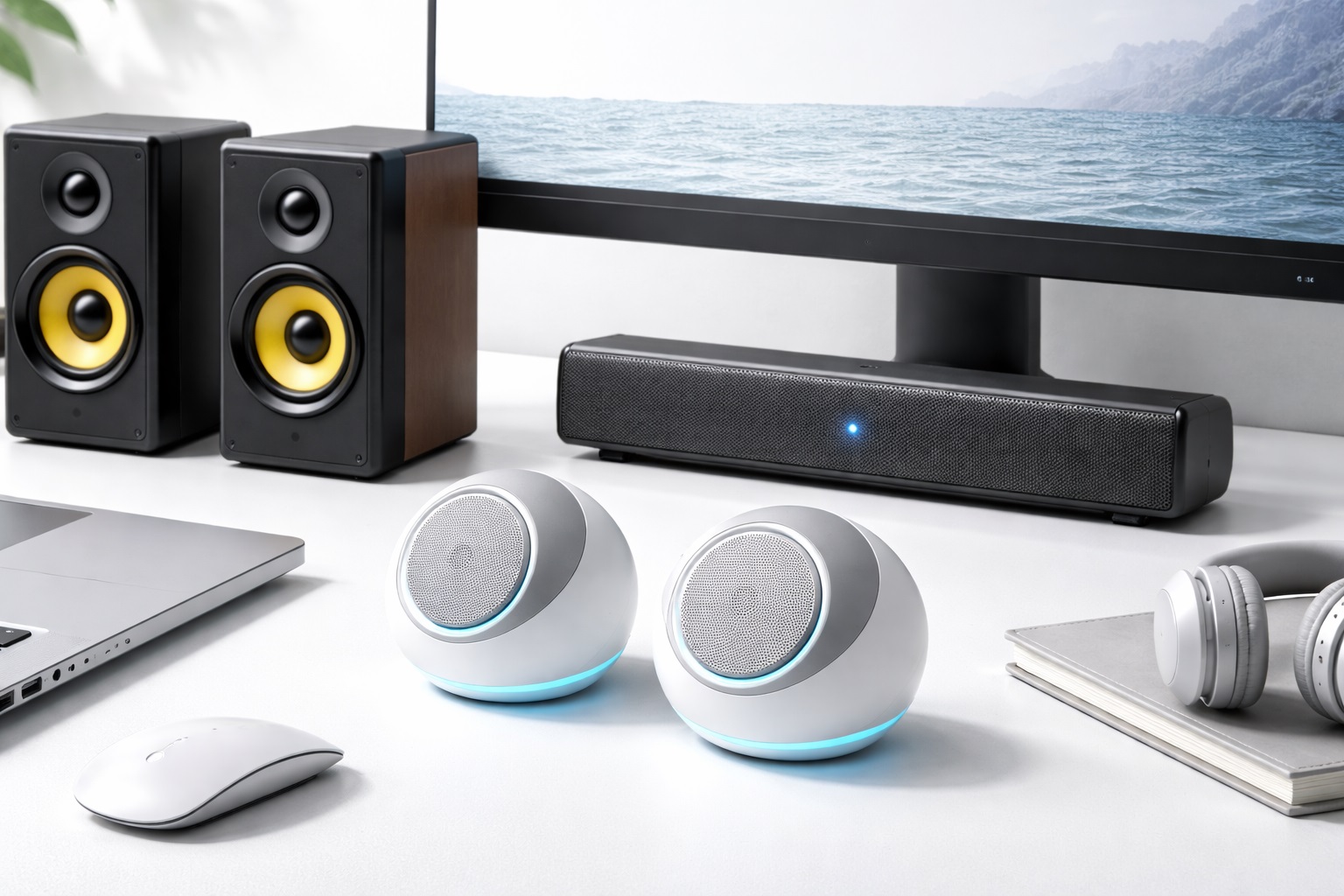
Best Budget Speakers: Real Sound Without Overspending
The budget speaker market is crowded with products that look nearly identical in a listing but deliver very different listening experiences once they're actually sitting on your desk. A twenty-five dollar pair of speakers can genuinely transform how music, videos, and calls sound compared to whatever is built into your laptop, but only if you understand which design compromises matter for how you'll actually use them. Marketing copy on these listings tends to sound interchangeable, which makes it hard to tell a genuinely well-engineered budget pair from one that simply looks similar in a photo.
This guide focuses on three speaker formats that consistently show up as smart budget purchases: a traditional stereo pair, a 2.1 system that adds a subwoofer, and a portable Bluetooth speaker pressed into desktop duty. Each takes a different approach to the same basic problem — producing better sound than a laptop speaker at minimal cost — and each suits a different kind of listener. None of them require a big financial commitment, but the right choice still depends heavily on what you actually listen to and how much desk space you're willing to give up.
None of these are audiophile products, and treating them as such sets the wrong expectations. What they do reliably is close the gap between sound simply coming out of a device and sound you actually want to listen to, which for most desk setups is exactly the upgrade that matters. The sections below break down what each type gets right, where it falls short, and how to match your pick to your daily use.
It also helps to think about budget speakers in terms of what they're replacing rather than what they're competing against. Nobody buying a thirty dollar speaker is choosing between that and a full home theater system; the real comparison is almost always against the tinny, thin sound of built-in laptop or monitor speakers. Framed that way, even a modest upgrade tends to feel like a meaningful improvement, which is worth keeping in mind as you weigh the trade-offs described in the reviews and buying guide below.
Cost of ownership is also worth thinking about beyond the sticker price. A five dollar difference between two listings often comes down to enclosure material, driver quality, or a longer warranty rather than any single headline feature, and those differences tend to show up months later rather than on day one. A speaker that feels fine out of the box but rattles at moderate volume within a few weeks isn't actually the bargain it looked like at checkout, which is part of why the reviews below spend as much time on build quality and practical trade-offs as on raw sound.
Top 3 Budget Speakers (Detailed Reviews)
Compact Stereo Pair – Best for Everyday Desktop Listening
A basic stereo pair remains the most dependable starting point in the budget category. Two independent drivers positioned left and right of your monitor reproduce genuine stereo separation, something no single speaker, however good, can replicate. Budget models in this format typically run 2.75 to 4-inch drivers in a ported cabinet, which is enough to add real body to vocals and midrange instruments without the boxy, tinny character common to laptop audio.
In daily use, this format tends to disappear into the background in the best possible way. You plug it in once, set a comfortable volume, and forget it's there until you notice how much fuller a podcast or a video call sounds compared to a bare laptop speaker. Because there's no wireless pairing step and no battery to manage, it's also the format least likely to introduce any daily friction, which matters more than it sounds like for a speaker you'll be using for hours every day.
- Pros:
- Genuine left-right stereo imaging
- Noticeably fuller sound than built-in laptop speakers
- Straightforward 3.5mm or USB setup with no pairing required
- Low price relative to the sound improvement delivered
- Cons:
- Takes up two spots on a desk rather than one
- Bass extension is limited without a companion subwoofer
Best For: Anyone replacing laptop or monitor speakers who wants an immediate, noticeable upgrade for music, videos, and everyday computer use without spending much.
Why We Recommend It: A stereo pair is the format where budget money translates most directly into audible improvement. There's no wireless overhead, no battery to manage, and no compromise for portability, just two drivers doing the one job they're built for. Even within this format, small differences add up: a pair with a slightly larger driver or a ported rather than sealed cabinet will usually sound fuller at the same price, so it's worth comparing driver diameter and enclosure design rather than judging two stereo pairs as interchangeable just because they look similar.
2.1 Subwoofer System – Best for Bass and Movie Audio
A 2.1 setup pairs two smaller satellite speakers with a dedicated subwoofer, splitting the frequency range so each driver only has to handle what it's good at. The satellites focus on mids and highs while the subwoofer takes over everything below roughly 80Hz, a range that a small satellite driver simply cannot reproduce with any authority regardless of price.
This division of labor is precisely why 2.1 systems tend to punch above their price point when it comes to perceived sound quality. A satellite speaker that only has to handle mids and highs can be built smaller and more efficiently, while the subwoofer, often placed on the floor or tucked under a desk, handles the physically demanding job of moving enough air to produce real low-end. The result is a system that sounds considerably bigger than its individual components would suggest.
- Pros:
- Noticeably deeper, more physical bass than satellite speakers alone
- Satellite speakers can be smaller since bass duty is offloaded
- Better suited to movies and bass-forward music genres
- Subwoofer can be tucked under the desk out of sight
- Cons:
- Takes up more total desk and floor space than a stereo pair
- An extra subwoofer cable adds to desk cable clutter
Best For: Budget shoppers who watch a lot of video content or listen to bass-heavy music and want that low end to actually register rather than sound thin.
Why We Recommend It: Adding a subwoofer at the budget tier is one of the most effective ways to close the gap with pricier all-in-one speakers. The improvement in perceived quality from bass alone is often larger than what you'd get by spending the same extra money on bigger satellite drivers. Just be realistic about the footprint: between the two satellites and the subwoofer box, a 2.1 system needs meaningfully more real estate than a stereo pair, so it's worth measuring your desk and the floor space nearby before committing to this format.
Portable Bluetooth Speaker – Best for a Single Multi-Use Purchase
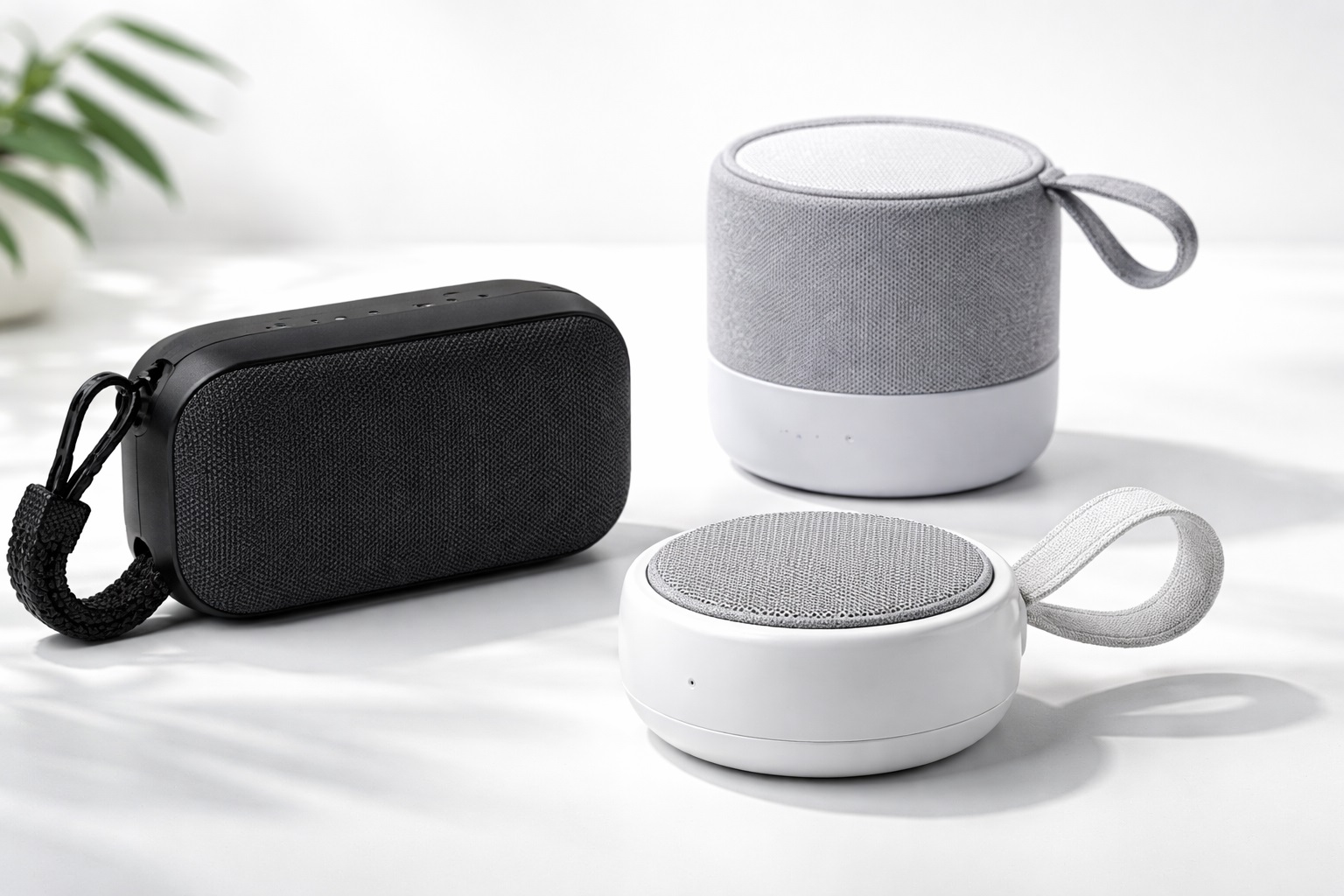
Using a portable Bluetooth speaker as a desktop speaker means buying one product that covers two jobs. Compact battery-powered units connect wirelessly, sit anywhere on the desk without cable routing, and can be picked up and taken to another room, a patio, or a friend's place whenever needed.
The appeal here isn't purely about sound quality, it's about how much use you can get out of a single purchase. A speaker that spends its weekdays on a desk handling video calls and background music can just as easily move to a kitchen counter or a backyard gathering on a weekend, something neither a stereo pair nor a 2.1 system can do without being physically disconnected and relocated as a permanent fixture.
- Pros:
- One purchase covers both desktop and portable use
- No cables running to the computer
- Rechargeable battery means no dependence on desk power
- Compact footprint fits tight desk setups
- Cons:
- Single-unit design means no true stereo separation
- Needs periodic recharging like any battery device
Best For: Budget-conscious buyers who want one speaker that works equally well parked on a desk and carried elsewhere, rather than a setup dedicated solely to the desktop.
Why We Recommend It: Value in the budget category isn't only about sound per dollar, it's also about utility per dollar. A portable speaker that handles desk duty during the week and travels on weekends often delivers more total use than a stationary pair that never leaves the desk. It's worth checking battery life specifically for desk use, since a unit rated for ten hours of playback at moderate volume may run considerably shorter if it's left on for a full workday at a higher listening level.
Buying Guide: How to Choose the Best Budget Speakers
Budget speaker shopping rewards a little research, since the difference between a genuinely good thirty dollar pair and a disappointing one rarely shows up on the spec sheet. Use the factors below to narrow the field before you buy.
1. Driver Size and What It Means for Bass
Driver diameter is a reasonable, if imperfect, predictor of low-frequency capability. Drivers in the 2.75 to 4-inch range, common in budget stereo pairs, produce noticeably more body than the roughly 1.5 to 2-inch drivers packed into most laptops. Anything below that range typically needs a ported enclosure or a subwoofer to avoid sounding thin. Larger drivers also tend to distort less at higher volumes, since they don't need to move as far or as fast to produce the same output as a smaller driver working near its limit. When comparing two listings, driver size is usually listed plainly in the specs, and it's one of the few numbers at this price point that correlates fairly reliably with how full the sound will feel in practice.
2. Wired vs Wireless Connections
A 3.5mm cable remains the simplest and most universally compatible connection, working with virtually any laptop, phone, or audio source without pairing or drivers. USB input bypasses your computer's built-in sound card, which can mean cleaner output on machines with weak onboard audio. Bluetooth trades a small amount of audio latency for the convenience of no cables at all, which is a fair trade for casual listening but worth avoiding for anything where audio needs to stay tightly synced to video. Many budget models today offer more than one input, letting you keep a wired connection to your desktop while still pairing a phone over Bluetooth for quick, cable-free listening when needed.
3. Powered vs Passive Design
Nearly every budget speaker sold for desktop use is a powered, or active, design, meaning the amplifier is built in and you simply plug in and go. Passive speakers, which need a separate external amplifier, are rare in this category and generally not worth pursuing unless you already own an amp, since sourcing one specifically for a budget speaker purchase usually erases whatever money you saved in the first place. If you do come across a passive pair at a tempting price, factor the cost of a basic amplifier into your total budget before deciding it's actually the cheaper option.
4. Matching Output to Your Room
At a typical 50 to 80cm desktop listening distance, even modest driver sizes perform well because you're sitting close to the source. If you're using the same speakers to fill a larger bedroom or shared space, prioritize higher rated output over driver size alone, since sound intensity drops off quickly with distance and a speaker that sounds plenty loud up close can feel underpowered from across a room. Wattage figures on budget listings are also worth reading skeptically, since peak output numbers are often inflated compared to the more meaningful continuous, or RMS, rating.
5. Stereo Imaging vs Single-Speaker Sound
Two speakers positioned left and right create a sense of space that a single unit, however well engineered, cannot fully replicate. If music and video enjoyment is a priority, a genuine stereo pair is worth choosing over a single portable unit even at the same price point, particularly for content that was mixed with intentional left-right separation in mind. Music production and film sound design both lean heavily on stereo placement, so a single-speaker setup will always lose some of that intended detail regardless of how good the individual driver sounds.
6. Reading Frequency Response Numbers Correctly
A wide advertised frequency response, such as 20Hz to 20kHz, sounds impressive but doesn't guarantee good sound on its own. Enclosure design and driver quality affect how that range is actually reproduced, and two speakers with identical published specs can sound noticeably different in practice. Treat the spec as a loose reference point rather than a definitive quality measure, and weigh it alongside genuine listening impressions where you can find them. When two products list nearly identical frequency ranges, differences in real-world sound usually trace back to the crossover design and cabinet construction rather than anything printed on the box.
7. Deciding Whether You Need a Subwoofer
If your listening leans toward electronic music, hip-hop, or movies with heavy low-end effects, a 2.1 system's subwoofer makes a real, immediately audible difference. For podcasts, audiobooks, and voice-heavy content, that extra bass extension matters much less and may not justify the added desk space, so matching the format to your actual listening habits saves both money and clutter. A useful test is to think back on the last week of listening and estimate honestly how much of it was bass-driven content versus speech, since that ratio is a better guide than any marketing claim.
8. Speaker Placement on Your Desk
Where you put budget speakers affects their sound as much as their specs do. Pushing them flush against a wall boosts bass but can muddy clarity, while angling them slightly toward your listening position, known as toe-in, sharpens stereo imaging. Small placement adjustments are free and worth experimenting with before assuming a speaker simply sounds mediocre out of the box. Even raising a speaker a few centimeters off the desk surface with a small stand or a stack of books can reduce the vibration and buzz that flat placement sometimes introduces.
9. Headphone Output for Private Listening
A headphone jack built into the speaker unit lets you switch to private listening in seconds without unplugging or replugging cables. This is a genuinely useful feature in shared households or late-night sessions where you don't want to disturb anyone else, and it's a detail that's easy to overlook when comparing spec sheets that focus mainly on driver size and wattage. It's a small line item on a spec sheet, but for anyone sharing a room or working odd hours, it ends up being used far more often than expected.
10. Enclosure Material and Build
Wood or MDF cabinets dampen internal resonance better than the thin plastic shells common at the very bottom of the budget range. A well-built enclosure noticeably reduces the buzzy, hollow character that cheap speakers are known for, even when the driver itself is unremarkable, which is part of why two speakers with similar driver specs can still sound meaningfully different side by side. Tapping gently on the cabinet is a quick, informal way to gauge this in a store; a dull, solid thud suggests a denser, better-damped enclosure than a hollow, tinny knock.
11. Setting a Realistic Budget Tier
Budget speakers roughly split into an entry tier under twenty dollars that mainly beats laptop audio, a twenty to fifty dollar tier where genuine stereo imaging and better bass become common, and a fifty to one hundred dollar tier where 2.1 systems and sturdier build quality start to appear. Knowing which tier you're shopping in keeps expectations realistic and prevents overpaying for marginal gains, or underspending and ending up disappointed with a purchase that never had a chance of meeting your expectations. Setting a tier before you start browsing also makes comparison shopping faster, since you can filter out options far outside your range instead of getting distracted by listings that don't match your actual budget.
12. Warranty and Return Policy
Because budget speakers vary in reliability even within the same brand's lineup, a longer warranty or a generous return window is a useful hedge. Keeping original packaging during the first few weeks of use makes returning a disappointing pair far less of a hassle if the sound doesn't match expectations, and it's a small habit that costs nothing but can save real frustration later. It's also worth noting whether the warranty is handled directly by the manufacturer or only through the retailer, since that can affect how smoothly a claim gets processed months down the line.
Frequently Asked Questions
1. Are budget speakers actually worth buying over just using laptop speakers?
In most cases, yes. Even an inexpensive stereo pair typically has larger drivers and a proper enclosure, both of which laptop speakers lack due to space constraints. The improvement in fullness and clarity is usually noticeable within the first few minutes of use, and it tends to hold up over weeks of regular listening rather than being a novelty that fades.
2. Do I need a separate amplifier for a budget desktop speaker?
No. The overwhelming majority of budget speakers are powered models with the amplifier built in, so they connect directly to your computer and work immediately. Passive speakers requiring an external amp are uncommon at this price point and rarely worth seeking out for a first purchase.
3. What's the easiest way to connect budget speakers to a laptop?
A 3.5mm cable is the most universal option and requires no setup beyond plugging in. USB is available on some models and can offer cleaner sound by bypassing your laptop's internal audio hardware. Bluetooth is convenient if you want to avoid cables entirely, though it adds a pairing step the first time you use it.
4. Is a 2.1 system worth the extra desk space compared to a stereo pair?
It depends on what you listen to. If bass-heavy music or movies are a regular part of your use, the subwoofer's contribution is significant and hard to replicate any other way at this price. For voice-focused content like calls, podcasts, or lectures, a compact stereo pair alone is usually sufficient and easier to fit on a crowded desk.
5. Can a portable Bluetooth speaker really replace dedicated desktop speakers?
For many users, yes, particularly if the added portability matters to them. The main trade-off is stereo separation, since most portable units are a single enclosure. If spatial sound quality matters more than portability, a stereo pair is the better fit, but for background music and calls the difference is often less noticeable than expected.
6. How much should I expect to spend on speakers that sound genuinely better than laptop audio?
Even the lower end of the budget range, roughly fifteen to twenty-five dollars, typically delivers an audible improvement. Spending toward the forty to sixty dollar range tends to bring noticeably better bass, cleaner mids, and sturdier build quality, which is often where the best value in the category sits.
7. Does driver size matter more than brand name?
Driver size and enclosure design generally tell you more about likely sound quality than brand recognition alone, particularly at the budget tier where many brands source similar components. That said, established brands tend to offer more consistent quality control and better warranty support, which is worth factoring in alongside raw specs.
8. Where should I place budget speakers for the best sound?
Position them at roughly ear level, angled slightly inward toward where you sit, with equal distance to each speaker. A few centimeters of clearance from the wall behind them usually improves clarity compared to pushing them flush against it, and small adjustments here often matter more than people expect.
9. Will budget speakers work fine for video calls as well as music?
Generally yes, though speakers can occasionally pick up their own output through a nearby microphone and create mild echo. This is a microphone issue more than a speaker issue, and it's easily avoided by using a headset mic or lowering volume slightly during calls rather than replacing the speakers themselves.
10. How long do budget speakers typically last?
A reasonably well-made pair from an established brand commonly lasts several years of regular use. Checking the warranty length before buying is a useful shortcut, since manufacturers who stand behind their products longer tend to build them to match, even within the budget category.
11. What's the most common mistake people make buying budget speakers?
Chasing the highest number on a spec sheet rather than matching the product to actual listening habits is the most common mistake. A shopper who mostly makes calls and watches short videos has very different needs than one who listens to bass-heavy music for hours, and the right budget pick differs accordingly even when the price tags look similar.
12. Should I buy budget speakers online or in a store?
Online shopping typically offers a wider selection and easier price comparison, while in-store shopping lets you sometimes hear a demo unit before buying. Either way, checking verified customer reviews for real-world sound impressions is worthwhile regardless of where you buy, since listening notes from other everyday users often say more than the spec sheet does.
Final Verdict
- Best for Everyday Desktop Listening: Compact Stereo Pair — the most direct, reliable upgrade over laptop speakers for daily use.
- Best for Bass and Movie Audio: 2.1 Subwoofer System — the clearest choice when bass-heavy music or movies are a regular part of your routine.
- Best for a Single Multi-Use Purchase: Portable Bluetooth Speaker — the practical pick when one product needs to cover both desk and on-the-go listening.
There isn't a single best budget speaker for every desk, there's a best match for how you actually listen. Weigh how much you value stereo separation, deep bass, and portability against each other, and the right pick from this list should be an easy call, especially once you've matched the format to the way you actually use your desk day to day. Whichever format you land on, the biggest jump in satisfaction almost always happens the moment you move away from built-in laptop audio at all, and everything past that point is really just fine-tuning to your own listening habits.