Best Portable Monitors for Travel: A Second Screen on the Road
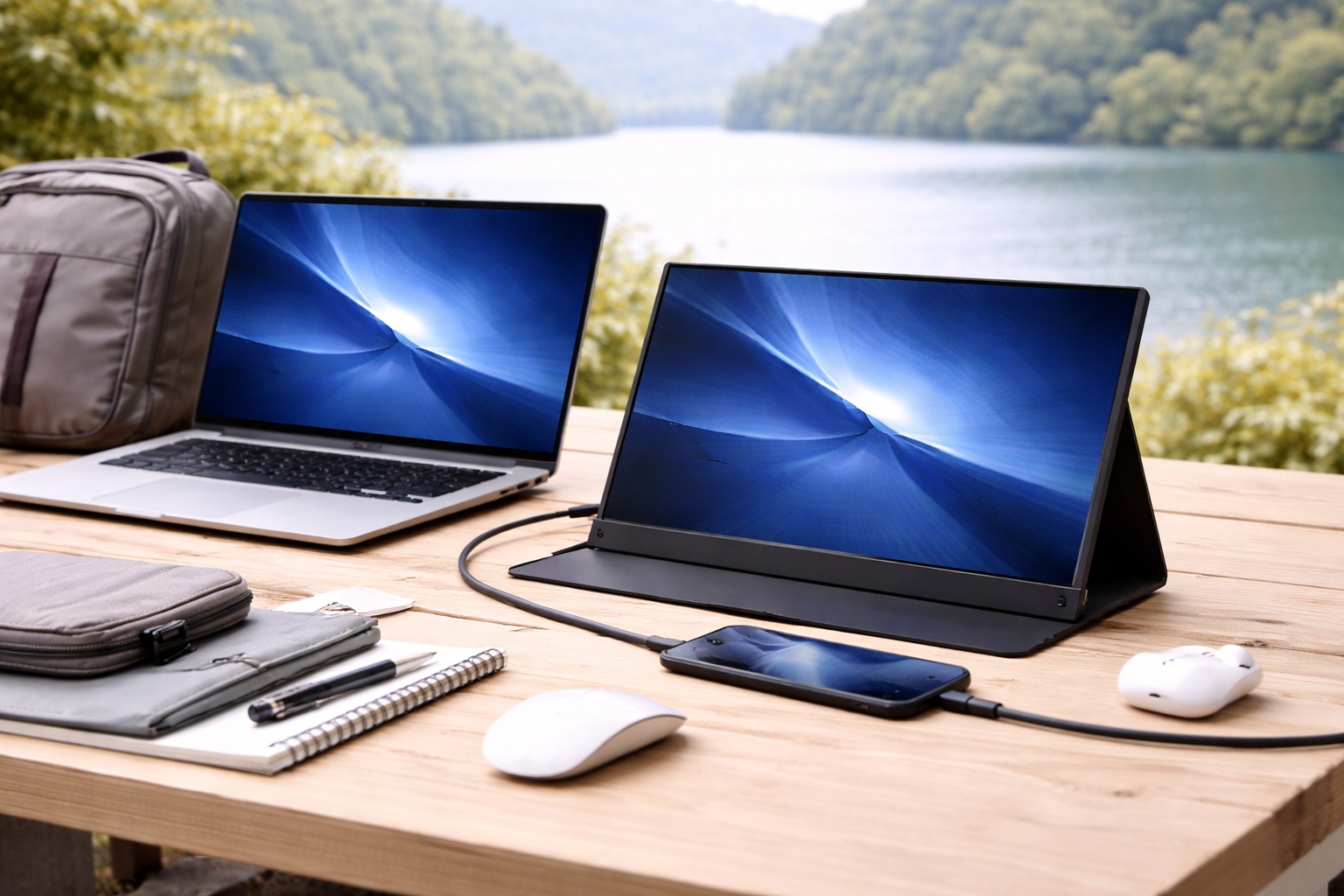
Working from a laptop alone is manageable for an afternoon, but it wears on productivity fast once you're doing it every day from hotel rooms, coworking desks, and rented apartments. A second screen changes that, letting you keep a video call open on one display while working in a document on the other, or simply giving cramped spreadsheet columns and dense code editors the room they need. The challenge for anyone who travels regularly is finding a display that earns its place in a suitcase without becoming a burden to carry, set up, and pack away again.
The three formats compared below aren't purpose-built travel monitors in the ultra-thin, battery-powered sense some readers might expect — they're the standard desktop formats that a frequent traveler is realistically choosing between: a 24-inch IPS 1080p display that keeps size and weight to a minimum, a 27-inch 1440p screen for travelers who need sharper detail and are willing to carry a slightly larger case, and an ultrawide curved monitor for travelers who set up in one place for extended stretches and want maximum screen space once they arrive.
None of them folds into a laptop bag the way a dedicated slim panel does, so this guide leans heavily on the factors that matter most once you're the one carrying, connecting, and repositioning a monitor in an unfamiliar room: single-cable connectivity, a stand that sets up quickly on an unfamiliar desk, and a screen coating that copes with whatever lighting a hotel room or coworking space happens to have.
If your travel is occasional rather than constant — a few work trips a year rather than a nomadic lifestyle — the tradeoffs below matter less, and the deciding factor becomes how much you'll actually use the second screen once you're back on a permanent desk between trips.
There's also a mental shift worth making before comparing specific models: a travel monitor is judged less by how it performs in a controlled review setup and more by how little friction it adds to an already disrupted routine. A screen that takes two minutes to unpack, connect, and adjust wins out over one that looks sharper on paper but takes ten minutes of fiddling every single time you arrive somewhere new. Keep that practical lens in mind as you weigh the comparison below against your own travel habits.
Top 3 Monitors for Travel (Detailed Reviews)
1. IPS 1080p Monitor 24-inch – Best Overall for Frequent Travel
Of the three formats here, a 24-inch IPS 1080p monitor has the smallest overall size and the lightest typical build, which matters directly when you're the one lifting it into a car trunk or a suitcase repeatedly. IPS panels deliver accurate, consistent color and wide viewing angles, which is useful when you're setting up in an unfamiliar room and can't always position the screen at an ideal angle relative to your seat. It's also the format most likely to fit into a padded sleeve designed for laptops or tablets, since its dimensions are closer to that category than the larger formats below, which makes finding affordable protective cases considerably easier than it is for the bigger screens compared here.
- Pros:
- Smallest and lightest of the three formats, easiest to pack and carry repeatedly
- IPS color accuracy and wide viewing angles suit improvised desk positioning
- Comfortable 1080p pixel density without demanding a powerful laptop GPU
- Widely available, making replacement parts or a same-model backup easier to find on the road
- Cons:
- Still noticeably bulkier than a purpose-built ultra-thin travel panel
- 1080p resolution feels less sharp if paired with a larger companion screen later
Best For: Frequent travelers who need a dependable, easy-to-pack second screen for video calls, documents, and general remote work.
Why We Recommend It: For someone setting up and breaking down a workspace in a new location every few days, the smallest reasonable footprint usually wins over specs. This is the format least likely to feel like a burden by the fifth or sixth trip. Travelers who have previously abandoned a second screen after a couple of trips because it felt like more hassle than it was worth often find that the smaller footprint here changes that calculation considerably.
2. 27-inch 1440p Monitor – Best for Extended Work Trips
A 27-inch 1440p panel makes more sense for travelers who stay in one place for weeks rather than days — a monthlong work stay, a project-based relocation, or a semester abroad. The sharper resolution reduces eye strain during long documents or code-heavy sessions, and the larger screen area reduces how much window-juggling you need to do on unfamiliar, often smaller desks. The tradeoff is a larger case and more weight, which only pays off if you're not repacking it every few days.
- Pros:
- Sharper 1440p resolution for detail-heavy or document-intensive travel work
- More usable screen space reduces reliance on constant window switching
- IPS variants retain the same color accuracy as the 24-inch option
- Better suited to extended stays where setup effort is amortized over more days
- Cons:
- Larger case and more weight than the 24-inch option, less ideal for frequent short trips
- Requires a somewhat more capable GPU to run comfortably at native resolution
Best For: Travelers on extended stays or long-term project relocations who set up a workspace once and use it for weeks rather than days.
Why We Recommend It: The extra sharpness and screen space pay for themselves when you're working from the same desk for an extended period, since the one-time setup cost is spread across far more working days than a short trip allows. Anyone who has tried to write a long report or review a dense spreadsheet on a small laptop screen alone knows how much that extra resolution and space is worth once the days of use start adding up.
3. Ultrawide Curved Monitor – Best for Long-Term Remote Bases
An ultrawide curved display makes the least sense for someone moving frequently, but for travelers who set up a semi-permanent base — a rented apartment for a season, a long sabbatical, or a slow-travel arrangement — it delivers roughly a third more horizontal space than a standard screen of the same height, effectively replacing the need for a second monitor in a temporary home office. The curve reduces head movement across the width, useful when desk space in a rental doesn't allow ideal seating distance.
- Pros:
- Replaces the need for two monitors in a temporary or rented workspace
- Significant horizontal space for split-window remote work
- Curved design reduces head movement in tighter rental desk arrangements
- Best screen-space-to-footprint ratio of the three formats once it's set up
- Cons:
- Least practical to transport frequently due to size and case requirements
- Needs a capable GPU and a genuinely available desk width in the rental
Best For: Slow travelers and long-term remote workers who set up in one location for months at a time rather than moving between cities every few days.
Why We Recommend It: If your version of travel means settling into one place for an extended stretch, an ultrawide gives you a proper home-office-grade setup without needing to source or transport two separate monitors. It's the closest any of these three formats gets to replicating a permanent office environment temporarily, which matters if the length of your stay makes that comfort worth pursuing.
Buying Guide: How to Choose the Best Portable Monitor for Travel
The right travel monitor depends heavily on how often you move and how long you stay in each place. Use the factors below to match the format to your actual travel pattern rather than the specs that look most impressive on paper.
1. Match the Monitor to Your Travel Frequency
Someone changing locations every few days should prioritize the smallest, lightest option available, since setup and teardown effort repeats constantly, and a bulky screen becomes a genuine burden by the third or fourth relocation even if it seemed manageable the first time. Someone settling into one place for weeks or months can reasonably choose a larger, sharper screen, since the effort of transporting and setting it up happens far less often relative to how much use it gets. Be honest with yourself about which category you actually fall into, since it's easy to imagine an idealized nomadic lifestyle while your real travel pattern looks more like a handful of week-long trips a year.
2. Single-Cable Connectivity Matters More on the Road
USB-C with power delivery lets a laptop connect to the monitor and charge through a single cable, which meaningfully reduces the number of cables and adapters you need to carry and keep track of between locations. Confirm your specific laptop supports video output over USB-C before relying on this, since not every model does, and carry an HDMI cable as a backup if there's any doubt. Keeping a small pouch of cables and adapters together, rather than loose in a bag, saves real time when you're setting up under a tight schedule in an unfamiliar location.
3. Panel Technology for Inconsistent Lighting
IPS panels offer the widest viewing angles and the most accurate color, which matters when you're setting up in rooms with lighting and desk arrangements you don't control. A narrow-viewing-angle panel that looks fine at home can look washed out the moment you're forced into an awkward seating position in a hotel room. Hotel desks in particular are rarely positioned with monitor use in mind, so the extra flexibility a wide viewing angle provides is more valuable here than it would be on a permanent, carefully arranged home desk.
4. Weight and Case Protection
None of these formats is purpose-built for constant travel, so protecting the screen in transit matters. A padded sleeve, a hard case, or careful packing inside a suitcase with soft items around it reduces the risk of cracked panels or damaged corners, which is one of the more common ways a travel monitor gets ruined. It's worth budgeting for proper protection at the time of purchase rather than treating it as an afterthought once the monitor has already arrived unprotected.
5. Stand Setup Speed on Unfamiliar Desks
A stand that assembles or folds out quickly saves real time when you're setting up in a new location repeatedly. Stands requiring multiple screws or a complicated base assembly are more likely to get left partially set up, or to have parts lost between trips, than a stand with a simple clip or slide mechanism. Practicing the setup once at home before the first trip is a small step that avoids fumbling through an unfamiliar assembly process in an unfamiliar room.
6. Screen Coating for Variable Lighting Conditions
Hotel rooms, coworking spaces, and cafes vary enormously in their lighting, and you rarely have full control over where windows or overhead lights sit relative to your desk. Matte coatings diffuse reflections and cope better with this unpredictability than glossy coatings, which look great in controlled lighting but show every reflection in a poorly positioned setup. Since you rarely get to choose the exact desk and window arrangement of a temporary space, a coating that tolerates imperfect conditions is worth more on the road than it would be in a permanent, purpose-arranged office.
7. Resolution and GPU Compatibility While Traveling
If you're connecting through a laptop rather than a desktop, check that its integrated or discrete graphics can drive the monitor's resolution comfortably. A 1440p or ultrawide panel that runs smoothly on a desktop GPU at home may strain a thin, lightweight travel laptop more than expected. Testing the combination at home before a trip, rather than discovering a compatibility or performance issue after you've already arrived somewhere with no easy way to troubleshoot it, saves considerable frustration.
8. Refresh Rate and Response Time for Everyday Work
For travel-based remote work — documents, calls, and browsing — 60Hz and a response time in the 5ms range or below is entirely sufficient. Higher refresh rates matter mainly for gaming, and paying extra for that spec adds cost and often size without benefiting a typical work-focused travel setup. Reserve the budget for better connectivity, a more durable case, or a sharper panel instead, since those improvements pay off on every single trip rather than only in a niche use case.
9. VESA Mounting for Semi-Permanent Setups
If you're staying somewhere long enough to justify it, a monitor with VESA mounting can be paired with a portable or clamp-style arm, freeing up desk space in a rental that may already be tight. This is more relevant to extended stays than short trips, where the standard stand is usually easier to manage. If a rental already has a suitable desk edge, a compact clamp arm can be worth including in your luggage for a stay long enough to justify the extra piece of equipment.
10. Power Requirements in Different Countries
Check the monitor's power adapter voltage range and plug type before international travel. Many modern monitor power supplies handle a wide voltage range automatically, but the physical plug will still need a local adapter, and it's worth confirming this detail before departure rather than discovering it on arrival. A universal travel adapter that covers plug shapes rather than voltage conversion is usually all that's needed, but double-checking the monitor's own specification sheet removes any guesswork.
11. Backup and Replacement Availability
Choosing a monitor from a widely available brand and size class makes it easier to source a replacement or a temporary loaner if something goes wrong while you're away from home. A niche or highly specialized model may be harder to replace quickly in an unfamiliar city. This matters most for travelers whose work genuinely depends on having a second screen available, rather than those for whom it's a convenience they could temporarily do without.
12. Insurance and Warranty Coverage While Traveling
Some travel insurance policies and credit card purchase protections cover electronics damaged or lost while traveling. Checking this before a trip, and keeping the receipt and original packaging where possible, can make a real difference if the monitor is damaged in transit. It's a five-minute check before a trip that can save a much longer and more expensive headache if luggage handling doesn't go as planned.
Frequently Asked Questions
1. What's the best monitor size for frequent travel?
A 24-inch IPS 1080p monitor is the most practical choice for travelers who move frequently, since it balances usable screen size against weight and packing convenience better than the larger formats. Travelers who stay longer in each location can reasonably consider a larger screen. Weigh the size against how many times you'll realistically pack and unpack it before assuming bigger is automatically better.
2. Can I use a standard monitor as a travel monitor, or do I need a dedicated portable model?
Standard desktop monitors like the ones compared here work for travel, particularly for travelers who set up a temporary home base rather than moving every few days. They're bulkier than dedicated ultra-thin travel panels, but they typically offer better image quality and connectivity options for the price. Dedicated ultra-thin travel panels are worth considering separately if minimizing weight matters more to you than image quality or cost, though that's a different product category from the ones compared in this guide.
3. How do I protect a monitor while traveling with it?
A padded sleeve or a hard case designed for the monitor's size is the safest option. If neither is available, packing the monitor upright in a suitcase surrounded by soft clothing, away from the case's exterior walls, reduces the risk of impact damage during handling. Checking that the case or sleeve fits snugly, rather than loosely, also helps prevent the screen from shifting and absorbing repeated small impacts throughout a journey.
4. Does a travel monitor need its own power source?
Most standard monitors require their own power adapter connected to a wall outlet rather than drawing power solely from a laptop, unlike some dedicated ultra-thin travel monitors. Confirm the power requirements and plug type for your destination before departure. Packing the correct adapter alongside the monitor, rather than assuming a general travel adapter kit will include the right shape, avoids a frustrating surprise on arrival.
5. Is USB-C connectivity essential for a travel monitor?
It's not essential, but it meaningfully simplifies setup by combining video and laptop charging into a single cable. If your laptop doesn't support video over USB-C, HDMI remains a reliable and widely compatible alternative. Carrying both cable types covers the widest range of laptops and desktops you might encounter or need to connect to during a trip.
6. Is the most expensive travel monitor always the best choice?
Not necessarily. Higher price often reflects a larger screen or higher refresh rate that doesn't matter for typical remote work while traveling. Matching size and weight to your actual travel frequency is more useful than chasing the highest specs. A mid-range model that's actually the right size for your travel pattern will get more real-world use than a premium one that ends up left behind because it's inconvenient to pack.
7. How long should a travel monitor last with frequent transport?
A well-built monitor from a reputable brand, protected properly in transit, can last several years of regular travel use. The biggest risk to longevity is physical damage during transport rather than normal wear from daily use. Inspecting the case, corners, and cable connectors periodically for early signs of wear helps catch a problem before it results in a broken screen mid-trip.
8. Can I return a travel monitor if it's too bulky to pack comfortably?
Most retailers offer a return window of two to four weeks. Test the monitor's actual packed size against your travel bag or case as soon as it arrives, since size and weight concerns are among the more common reasons travelers return this type of purchase. Packing it into your actual travel bag as a test, rather than just eyeballing the dimensions, gives a much more honest answer than the listed measurements alone.
9. What is the best monitor for remote workers who need a second screen while traveling?
For most frequent travelers, a 24-inch IPS 1080p monitor offers the best balance of usability and portability. Travelers with longer stays or heavier multitasking needs may find the 27-inch 1440p option or an ultrawide better suited to their setup. The right answer ultimately depends on how the balance between screen quality and portability fits your specific pattern of movement.
10. Does brand name matter when choosing a travel monitor?
Established brands generally offer more consistent build quality and easier access to replacement parts or support while away from home. Reading recent, verified reviews helps confirm that a specific model holds up to repeated handling. Reviews from other frequent travelers specifically, rather than general home-office buyers, tend to surface durability issues that a stationary review setup would never encounter.
11. Should I buy a monitor stand or a monitor arm for travel use?
A standard folding stand is usually more practical for travel than a monitor arm, since arms typically require a compatible desk edge and more setup time. VESA-compatible portable arms exist for longer stays, but a simple stand remains the easier default for frequent movers. Save the more elaborate mounting solutions for a stay long enough that the extra setup effort actually pays off across the duration of your visit.
12. Can two people share one travel monitor on a trip?
Yes, particularly with an IPS panel's wide viewing angles, which make it easier for two people to view the screen together during a call or a shared document review. This is one advantage of choosing IPS over other panel types specifically for travel use. It's a small detail that doesn't show up on a spec sheet comparison but matters in practice whenever a call or a review session happens with more than one person present.
Final Verdict
- Best Overall for Frequent Travel: IPS 1080p Monitor 24-inch – the lightest, most packable option for repeated short trips.
- Best for Extended Work Trips: 27-inch 1440p Monitor – sharper detail worth the extra size for longer stays.
- Best for Long-Term Remote Bases: Ultrawide Curved Monitor – a full home-office setup for slow travelers and extended relocations.
Travel monitor shopping really comes down to being honest about your own travel pattern rather than picking the most feature-rich option available. Someone living out of a suitcase every week needs the smallest, lightest setup that still gets the job done, while someone settling into a rental for a season can justify the extra size and sharper resolution of a larger screen. Match the monitor to how you actually travel, prioritize single-cable connectivity and a coating that copes with unpredictable lighting, and the rest of the buying decision becomes much more straightforward.
It's worth revisiting this decision periodically too, since travel patterns shift over time. A monitor bought for a season of frequent short trips might sit unused during a stretch of longer stays, or the reverse. Keeping the original case and cables organized, rather than scattered across different bags, makes it easier to adapt the same equipment to whatever your travel schedule looks like a year from now without starting the buying process over from scratch.