Best Power Banks for Students: Charge Through Every Class
A campus day rarely follows a predictable schedule — back-to-back classes, a library session that runs longer than planned, a laptop that needs to survive a lecture and a study group afterward, all without guaranteed access to an open outlet. A power bank chosen for student life needs to cover phone, tablet, and often laptop charging across a day that can stretch from an early class to a late study session, while still fitting into a backpack already loaded with books, a laptop, and everything else that comes along for the day. General power bank advice rarely accounts for this specific combination of long unpredictable hours, multiple devices, and a backpack that's already carrying more weight than most people carry in a typical commute.
This guide focuses on what actually matters for student use: enough capacity to genuinely last a full day on campus, laptop-charging capability for anyone relying on a laptop through lectures and assignments, weight that doesn't add meaningfully to an already-heavy backpack, and a price that respects a student budget without sacrificing the basics of safety and reliability. None of these priorities require an expensive purchase — they mostly require matching the bank to how a student's day actually unfolds rather than buying based on maximum specifications alone.
Below you'll find a side-by-side comparison, detailed reviews of the models that consistently work well for student life, a buying guide covering every factor worth checking before you order, and answers to the questions students ask most often about capacity, laptop compatibility, and price. Whether your priority is surviving exam week or simply not being the person whose phone always dies before the last class, the same core factors apply.
Top 5 Power Banks for Students (Detailed Reviews)
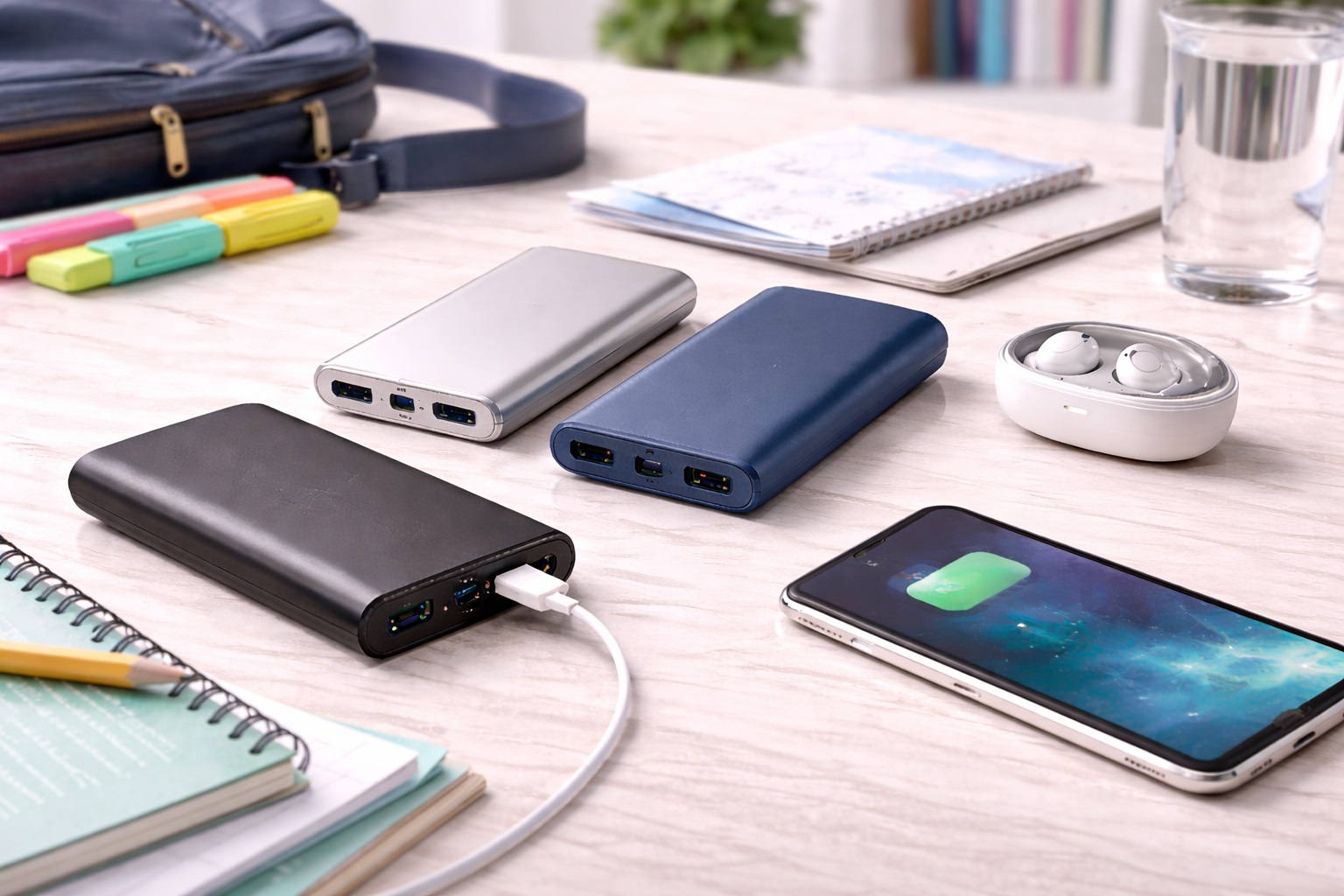
1. 20,000mAh High-Capacity Power Bank – Best for All-Day Campus Coverage
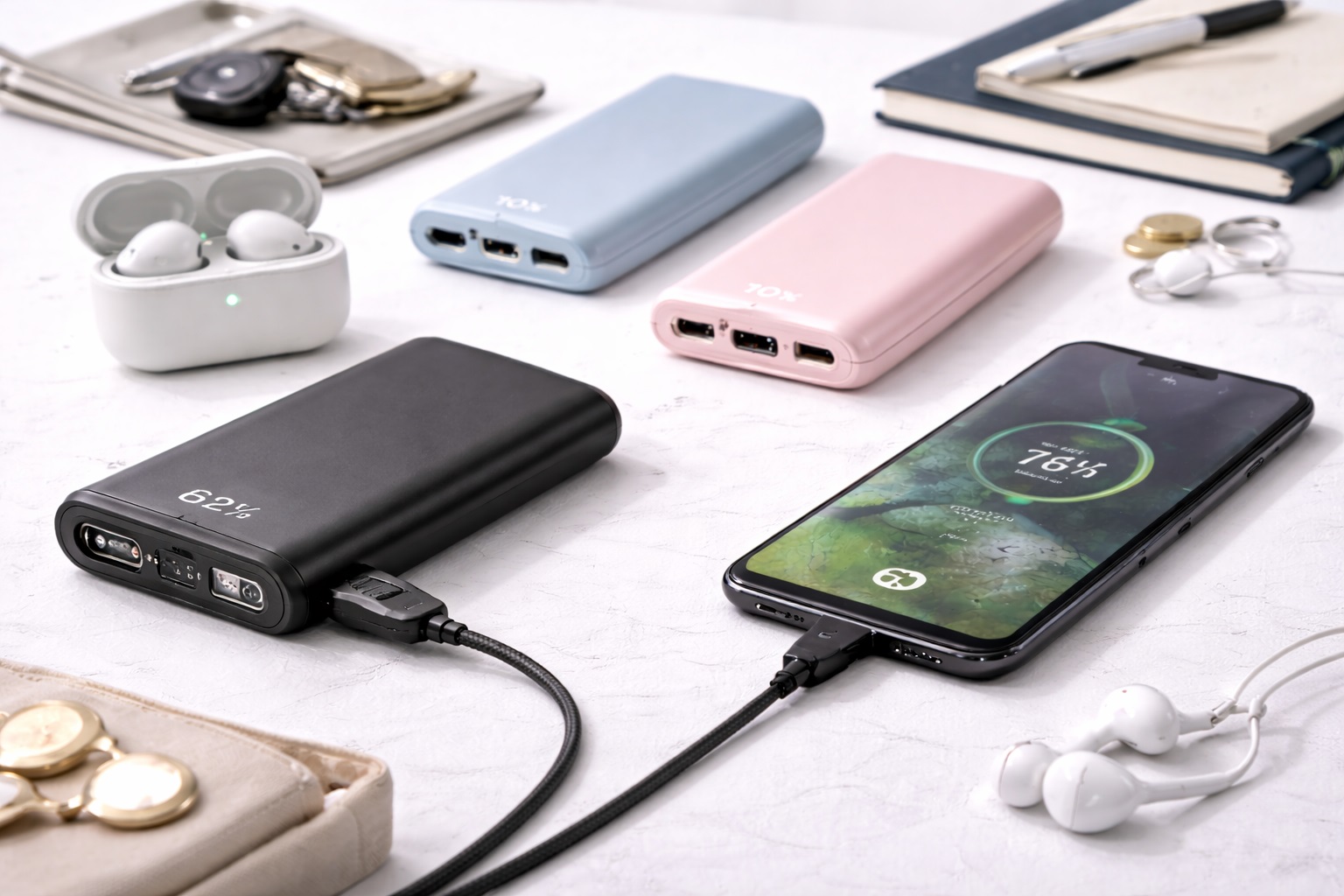
A 20,000mAh power bank delivers four to six full smartphone charges and, with 65W USB-C Power Delivery, can also charge a laptop through a long lecture or library session. For students whose day runs from an early class through evening study group without a reliable path back to a dorm room outlet, this capacity removes the daily uncertainty of whether the laptop and phone will both last until the day is done. That uncertainty is a real source of low-grade stress during exam weeks or heavy assignment periods, when the last thing anyone needs is to also worry about finding an open outlet in a crowded library.
- Pros:
- Four to six full smartphone charges plus laptop-charging capability
- 65W USB-C output handles most student laptops through a long day
- Multiple ports for phone, tablet, and laptop as needed
- Removes daily dependency on finding an open dorm or library outlet
- Cons:
- Heavier than smaller options, typically 400–500g, adding to an already-loaded backpack
- Higher price than smaller-capacity alternatives
Best For: Students with long, laptop-dependent days who need genuine backup for phone, tablet, and laptop together.
Why We Recommend It: Laptop-charging capability is the single feature that most changes a student's relationship with campus outlets, and this capacity provides real margin for a full day without one. Students who commute to campus rather than living in a dorm benefit even more from this margin, since a commute adds hours away from any home outlet at both ends of the day.
2. 10,000mAh Slim Fast-Charge Power Bank – Best Balance for Typical Class Days
A 10,000mAh slim power bank delivers two to three full smartphone charges in a body thin enough to slide into a backpack pocket without adding noticeable bulk. USB-C Power Delivery in the 18W–30W range provides a meaningful top-up during a lunch break or between classes, which suits a typical day that doesn't require laptop charging from the bank itself. Most laptops sold in the last few years comfortably last a standard school day on their own battery, which makes this size the more proportionate choice for students who aren't specifically relying on the bank for laptop backup.
- Pros:
- Slim enough for a backpack pocket without adding real bulk
- Two to three full phone charges per cycle
- USB-C PD fast charging usable during short breaks between classes
- More affordable than a high-capacity laptop-charging bank
- Cons:
- Not enough capacity for laptop charging
- May run short on days with unusually heavy phone and tablet use
Best For: Students whose laptop reliably lasts a school day and who mainly need backup phone and tablet charging.
Why We Recommend It: This size covers the actual daily need for most students without the added weight and cost of laptop-charging capacity most days won't require, making it the more sensible default choice for anyone unsure which capacity to start with.
3. Power Bank with Built-In Cable – Best for Avoiding Lost Cables
A power bank with an integrated charging cable solves a specifically common student problem: a charging cable left in a dorm room, borrowed by a roommate, or lost somewhere between classes. With the cable built into the housing, there's one less item to remember packing each morning, and one less thing that can go missing during a busy semester. Shared living situations — roommates, shared study spaces, communal kitchens — create far more opportunities for a loose cable to wander off than a solo living arrangement typically does. Many built-in-cable models also include a small loop or fold-out connector for a second cable type, so the single unit can still cover both an older USB-A accessory and a newer USB-C phone without needing to carry anything extra.
- Pros:
- No separate cable to lose, forget, or have borrowed
- One less item to remember packing each morning
- Compact and simple to use between classes
- Often includes more than one connector type built in
- Cons:
- Built-in cable can't be replaced individually if it wears out
- Capacity is typically modest compared to dedicated high-capacity banks
Best For: Students who consistently lose track of charging cables during a busy, shared-living semester.
Why We Recommend It: Removing one more small, losable item from the daily backpack routine is a genuinely practical simplification for student life specifically, where the sheer number of small items being tracked across a busy day makes losing any one of them fairly likely.
4. 5,000mAh Ultra-Slim Power Bank – Best Budget-Friendly Backup
A 5,000mAh ultra-slim power bank provides one full smartphone charge at a price point that respects a tight student budget, in a form factor barely larger than a phone itself. It won't cover a full day of heavy laptop use, but as backup insurance against a phone dying between classes, it does the job at minimal cost and minimal added weight. For a student stretching a limited budget across textbooks, food, and everything else a semester requires, keeping this particular purchase small and inexpensive is a completely reasonable trade-off. It also makes a sensible second bank to keep permanently in a backpack side pocket even after buying a larger one for laptop duty, since the larger bank tends to stay in a dorm room more often than it gets carried to every single class.
- Pros:
- Low price point suited to a tight student budget
- One full phone charge — sufficient backup for most days
- Negligible weight addition to an already-loaded backpack
- Fast USB-C input for quick overnight recharge in a dorm room
- Cons:
- Only one full phone charge, not enough for heavy daily use
- Not suitable for tablets or laptops
Best For: Budget-conscious students who need basic phone backup rather than full-day laptop charging.
Why We Recommend It: For a tight student budget, this size covers the most common emergency — a phone running low before the day is over — at the lowest reasonable cost. It's a sensible first purchase for a student who has never carried a power bank before and isn't yet sure how much they'll actually rely on one.
5. Multi-Port Power Bank with Wireless Charging – Best for Shared Study Sessions
A multi-port power bank with a built-in wireless charging pad is genuinely useful in a shared study environment — a library table or a dorm common room — where setting a phone down to charge without a cable is more convenient than passing a cable back and forth between roommates or study partners. Additional wired ports remain available for faster charging or a second device. In a small dorm room with limited outlets and multiple people needing to charge at once, a shared charging hub like this genuinely reduces friction over whose device gets priority.
- Pros:
- Wireless pad convenient for shared study spaces and dorm rooms
- Wired ports remain available for faster charging when needed
- Useful for charging a roommate's or study partner's phone without cable-sharing
- Good overall feature set for group living situations
- Cons:
- Wireless charging is slower than a wired connection
- Slightly bulkier than a wired-only bank of similar capacity
Best For: Students in shared living situations — dorms, shared apartments — who regularly charge devices around roommates or study partners.
Why We Recommend It: The wireless pad specifically suits the shared, communal nature of student living in a way a purely wired bank doesn't, since it removes one more small point of friction from an environment already full of shared resources and schedules.
Buying Guide: How to Choose the Best Power Bank for Students
Use these factors to match a power bank to the realities of a student schedule and budget. Reading through all twelve before comparing specific listings takes only a few minutes and consistently prevents the two most common student mistakes: under-buying capacity relative to laptop needs, and overspending on features a typical class day never actually uses.
1. Capacity and Actual Output
Stated capacity in mAh is measured at 3.7V battery voltage, but output happens at 5V through USB, so real-world usable capacity is typically 60–70% of the printed number. A 10,000mAh bank realistically delivers closer to 6,000–7,000mAh, which is worth factoring in when estimating whether a given capacity covers a full day between morning classes and an evening study session. Estimating slightly conservatively rather than optimistically avoids the disappointment of a bank running out an hour before the day was supposed to end.
2. Laptop Charging Compatibility
USB-C Power Delivery at 45W or higher can charge many student laptops, though some machines require 65W or more. Check your specific laptop's charging requirement before assuming any USB-C power bank will work, since a mismatched wattage means the laptop simply won't charge rather than charging slowly. This is one of the most common disappointments in student power bank purchases — buying a bank advertised as laptop-compatible without confirming it actually matches your specific laptop's charging requirement.
3. Charging Speed: Input and Output
Output speed determines how quickly a device charges from the bank; input speed determines how quickly the bank itself recharges. USB-C Power Delivery at 18W or higher provides meaningful fast charging during a short break between classes, which matters more for a tightly scheduled student day than for more flexible general use. A ten-minute gap between back-to-back classes is a realistic charging window for a student, and a bank that delivers meaningful charge in that time is more useful than one that only performs well over longer stretches.
4. Port Selection and Cable Compatibility
USB-A remains useful for older accessories and chargers; USB-C is standard for most current phones, tablets, and laptops. A bank offering both port types covers more scenarios, including helping a classmate whose device uses a different connector than yours. Being the person in a study group who can lend out a charge, regardless of what device someone else carries, is a small but genuinely appreciated convenience.
5. Safety Certifications
Look for CE, FCC, or UL certification markings on the bank and its packaging, confirming the product passed basic electrical safety testing. This matters especially in a dorm room where a bank often charges overnight near bedding and other flammable materials, making certified safety non-negotiable. Checking for a listed certification takes only a moment and is genuinely the single most important safety habit for anyone charging devices overnight in close quarters with shared bedding and furniture.
6. Recharge Time for the Bank
A 20,000mAh bank charging at 18W input can take six to eight hours to fully recharge, while a 10,000mAh bank typically takes three to four hours. Overnight charging in a dorm room is usually straightforward, but a faster input speed helps on days when the bank needs a midday top-up between classes instead. Building the habit of plugging the bank in overnight alongside a phone is the simplest way to make sure it's ready without needing to think about timing each morning.
7. Pass-Through Charging
Pass-through charging lets a bank charge a connected device while it is itself being recharged from a wall outlet — useful in a dorm room with limited outlets shared among a roommate's devices as well as your own. Not every bank supports this safely, so check the specification explicitly if outlet access is genuinely limited in your living situation. Dorm rooms are notorious for having far fewer outlets than the number of devices that need charging, which makes this feature more valuable in student housing than in most other living situations.
8. Weight and Portability
Higher capacity always means more physical weight. A 20,000mAh bank weighs roughly 400–500g, a 10,000mAh slim bank around 200–250g, and a 5,000mAh ultra-slim model under 130g. A backpack already carrying textbooks and a laptop benefits from the lightest bank that still covers your actual daily capacity need. Every extra hundred grams matters more at the end of a long day carrying a backpack across campus than it does when comparing specifications on a product page.
9. Display and Status Indication
Basic LED indicators show remaining charge in rough 25% increments. A numeric percentage display gives a clearer read on exactly how much charge remains, which is useful for planning whether the bank will last through an unexpectedly long library session. A quick glance at a clear percentage before settling in for a few extra hours of studying removes any guesswork about whether devices will make it through.
10. Heat Management
Fast charging generates heat, and a bank charging inside a packed backpack alongside a warm laptop compounds that heat. Quality designs use metal housings or internal thermal management to dissipate heat safely. A bank that becomes uncomfortably hot during normal use is worth giving open-air space to cool before repacking, rather than immediately zipping it back into a tightly packed backpack pocket.
11. Wireless Charging Compatibility
A built-in wireless charging pad is a genuine convenience in a shared dorm room or library table setting, letting a phone charge without a cable tangled among books and notes. Wireless charging is slower than wired, so it suits gradual charging during a long study session better than a rapid top-up between classes. A phone left on the pad through a two-hour lecture will end up better charged than one plugged and unplugged repeatedly throughout a short break.
12. Multi-Device Charging for Classes and Dorm Life
A typical student day may require charging a phone, a tablet used for notes, and a laptop across a single day, sometimes simultaneously during a long library session. Prioritize a bank with enough ports and combined output to handle your specific device combination rather than assuming any multi-port bank automatically covers all of them well. Some banks reduce output per port when multiple devices draw power at once, which is worth checking directly rather than assuming from the port count alone.
13. Price-to-Capacity Value on a Student Budget
Comparing price per mAh across a shortlist of banks is a more useful exercise than comparing sticker price alone, since a slightly more expensive bank with meaningfully more capacity or faster charging can be the better value over a full degree program. Watch for seasonal sales around back-to-school periods, when many retailers discount power banks specifically because they know students are shopping for dorm essentials at that time. A bank bought during a back-to-school sale often costs meaningfully less than the same model bought mid-semester out of sudden necessity.
14. Durability for Daily Backpack Wear
A power bank carried in a backpack every day gets jostled against textbooks, water bottles, and everything else riding alongside it, so a reasonably rugged housing matters more here than for a bank that mostly sits on a desk. Aluminum or reinforced plastic housings tend to hold up better against daily bumps and drops than the thinnest, lightest options, which sometimes trade durability for a slightly smaller footprint. A bank that survives being dropped once in a crowded hallway is worth more over a semester than one that saves a few grams of weight but cracks on first impact.
Frequently Asked Questions
1. What size power bank do most students actually need?
For phone and tablet backup without laptop charging, 10,000mAh typically covers a full day. For laptop charging as well, 20,000mAh with 45W or higher USB-C Power Delivery is the more reliable choice. Buying based on your laptop's charging requirement first, rather than a general capacity number, is the more accurate way to size a student power bank correctly the first time.
2. Can a power bank really charge a laptop through a full day of classes?
A 20,000mAh bank with 65W output can meaningfully extend a laptop's battery life through a long day, though it won't provide unlimited power — it adds real hours of use rather than eliminating the need to charge the laptop directly at some point. Think of it as buying yourself several extra hours of runtime on a long day, not as an unlimited replacement for a wall charger.
3. How do I know when to replace my power bank?
Replace it once it no longer holds the charge it used to, typically noticeable after two to three years of regular use. If the bank runs unusually hot, develops a swollen shape, or stops charging altogether, replace it immediately for safety, especially given how often it ends up charging overnight in close proximity to bedding in a shared dorm room.
4. Is it safe to charge a power bank overnight in a dorm room?
Yes, provided the bank carries genuine safety certification (CE, FCC, or UL) and isn't left charging directly on soft bedding, which can trap heat. A certified bank on a hard surface is standard, safe practice, and it's worth mentioning this basic habit to a roommate who may not have thought about it before.
5. What's the most budget-friendly way to get laptop-charging capability?
Value-tier 20,000mAh banks with basic 45W USB-C Power Delivery are increasingly available at prices that fit a student budget, though checking certification and reviews matters more at this combination of high capacity and lower price, since it's exactly the combination where corner-cutting is most likely if it happens at all.
6. Should I get a power bank with a wireless charging pad for dorm use?
It's a genuine convenience for shared dorm or study spaces, letting a phone charge without a cable getting tangled among shared belongings. If you mostly charge alone in a private space, a wired-only bank is simpler and often cheaper, so match this feature to your actual living situation rather than buying it as a default upgrade.
7. Is the most expensive power bank for students always the best?
Not always. Price reflects features and build quality, but many mid-range options outperform expensive alternatives for typical student needs. Match the product to your actual daily device use rather than assuming higher price guarantees better performance, since a well-matched mid-range bank will consistently outperform an expensive one chosen without regard to actual laptop and device requirements.
8. How long should a quality power bank for students last?
A well-built power bank from a reputable manufacturer typically lasts two to five years with reasonable care — long enough to cover an entire degree program for most students, which makes it a genuinely reasonable one-time purchase rather than something to expect replacing every year.
9. Can I return a power bank for students if it doesn't suit me?
Most retailers offer a fifteen- to thirty-day return window. Test the bank through a genuinely representative class day, including laptop charging if that's a priority, before the window closes, since a single light day of testing won't reveal how it performs during exam-week levels of use.
10. What should I prioritize when buying a power bank for students?
Start with whether your laptop needs to be part of the charging plan, since that decision drives capacity and wattage requirements more than any other factor. Everything else — weight, price, extra features — follows from that starting point, and getting this one decision right early avoids the frustration of realizing mid-semester that the bank you bought can't actually handle your laptop.
11. Does brand name matter for a power bank for students?
Established brands typically offer more consistent quality control and reliable warranty support. Newer, value-focused brands can offer excellent capacity-per-dollar, so weigh verified purchase reviews carefully against a tight budget, particularly reviews that mention months of use rather than a first impression out of the box.
12. Can I bring a power bank to campus, or are there restrictions?
Most campuses have no specific restriction on personal power banks, though checking your institution's specific policy is worth doing if you're bringing a particularly high-capacity model, similar to airline guidance around watt-hour limits. This is rarely an issue for the capacities discussed in this guide, but it's worth a quick check if your institution has specific housing or safety rules around personal electronics.
13. Is it worth buying two power banks instead of one large one?
For many students, yes. Keeping a small, ultra-slim bank permanently in a backpack for daily phone backup, plus a larger high-capacity bank left in a dorm room for laptop-heavy study sessions, often ends up more practical than carrying one large bank everywhere every day. It also protects against the scenario where the one bank you own is left charging at home on the exact day you needed it most.
14. How can I tell if a power bank listing is exaggerating its capacity?
Compare the listed capacity against typical real-world output — a genuine 20,000mAh bank should deliver roughly four to six smartphone charges, not more. A listing claiming eight or more full phone charges from a 10,000mAh rating is a red flag worth checking against verified buyer reviews before ordering, since inflated capacity claims are one of the more common issues in budget power bank listings.
Final Verdict
- Best for All-Day Campus Coverage: 20,000mAh High-Capacity Power Bank — removes daily dependency on finding an open outlet.
- Best Balance for Typical Class Days: 10,000mAh Slim Fast-Charge Power Bank — covers most students' actual daily need without excess weight or cost.
- Best for Avoiding Lost Cables: Power Bank with Built-In Cable — one less item to misplace during a busy semester.
- Best Budget-Friendly Backup: 5,000mAh Ultra-Slim Power Bank — basic phone backup at minimal cost.
- Best for Shared Study Sessions: Multi-Port Power Bank with Wireless Charging — suits dorm and library sharing well.
The right power bank for student life comes down to whether a laptop needs to be part of the daily charging plan, then matching capacity, weight, and price to the rest of a genuinely busy campus schedule. Use the comparisons and buying guide above to find a bank that keeps every class, library session, and study group powered through to the end of the day. A bank chosen with a real semester in mind — not just a single ordinary Tuesday — will hold up through the busy weeks that actually test it most.