Best Power Banks for Students: Power Through Lectures, Labs & Life
A campus day rarely follows a predictable schedule, and neither does the drain on a student's phone or laptop battery. Between note-taking apps running through a three-hour lecture, group chats coordinating a study session, navigation apps for finding an unfamiliar lab building, and hours of streaming or gaming once classes wrap up, a full charge at 8 a.m. can be gone well before dinner. Unlike a typical office job where a desk charger is always within reach, student life moves between lecture halls, libraries, dorms, and part-time jobs, often with no outlet in sight for hours at a stretch.
A power bank built for this reality has to satisfy a few competing demands at once: enough capacity to matter, a price that fits a student budget, and a size that doesn't turn a backpack into a chore to carry. Not every power bank manages all three well, and the products that try to do everything at once often end up compromising on at least one.
This guide walks through six distinct approaches that solve the student charging problem in different ways, followed by a detailed buying framework and answers to the questions students ask most often before buying. The goal isn't to name one universal winner — it's to help match the option to your actual schedule, budget, and the devices you carry.
It's also worth thinking about how your needs might shift over the course of a semester. Exam periods often mean longer library sessions and more time away from a dorm charger, while a lighter week of classes might make a smaller, more compact bank perfectly sufficient. Rather than buying strictly for the busiest possible week, it can help to think about what a typical week actually looks like, and treat unusually demanding periods as the exception rather than the baseline the whole purchase is built around.
Top Picks Reviewed
10000mAh Student Bank – Best For Everyday Campus Use
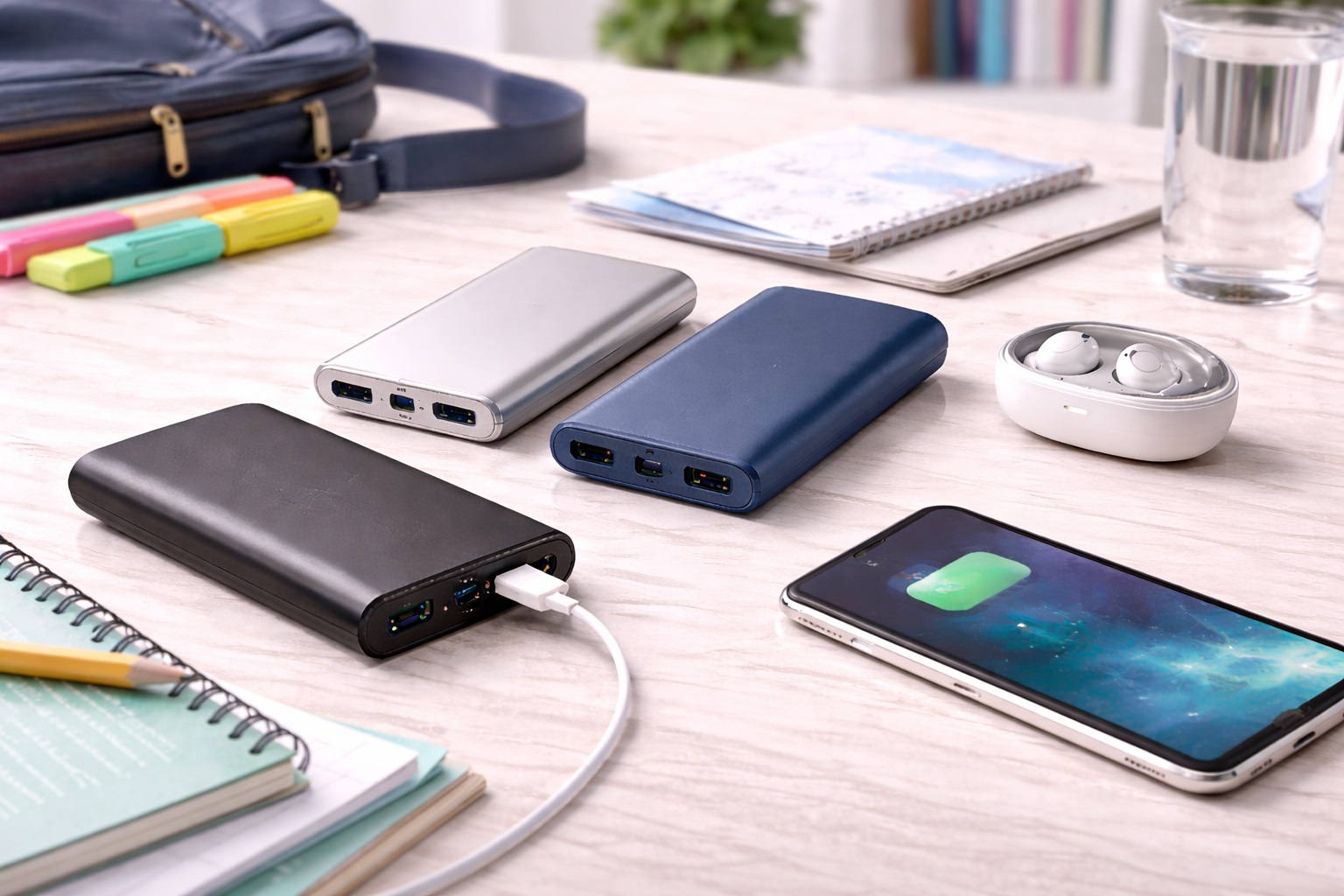
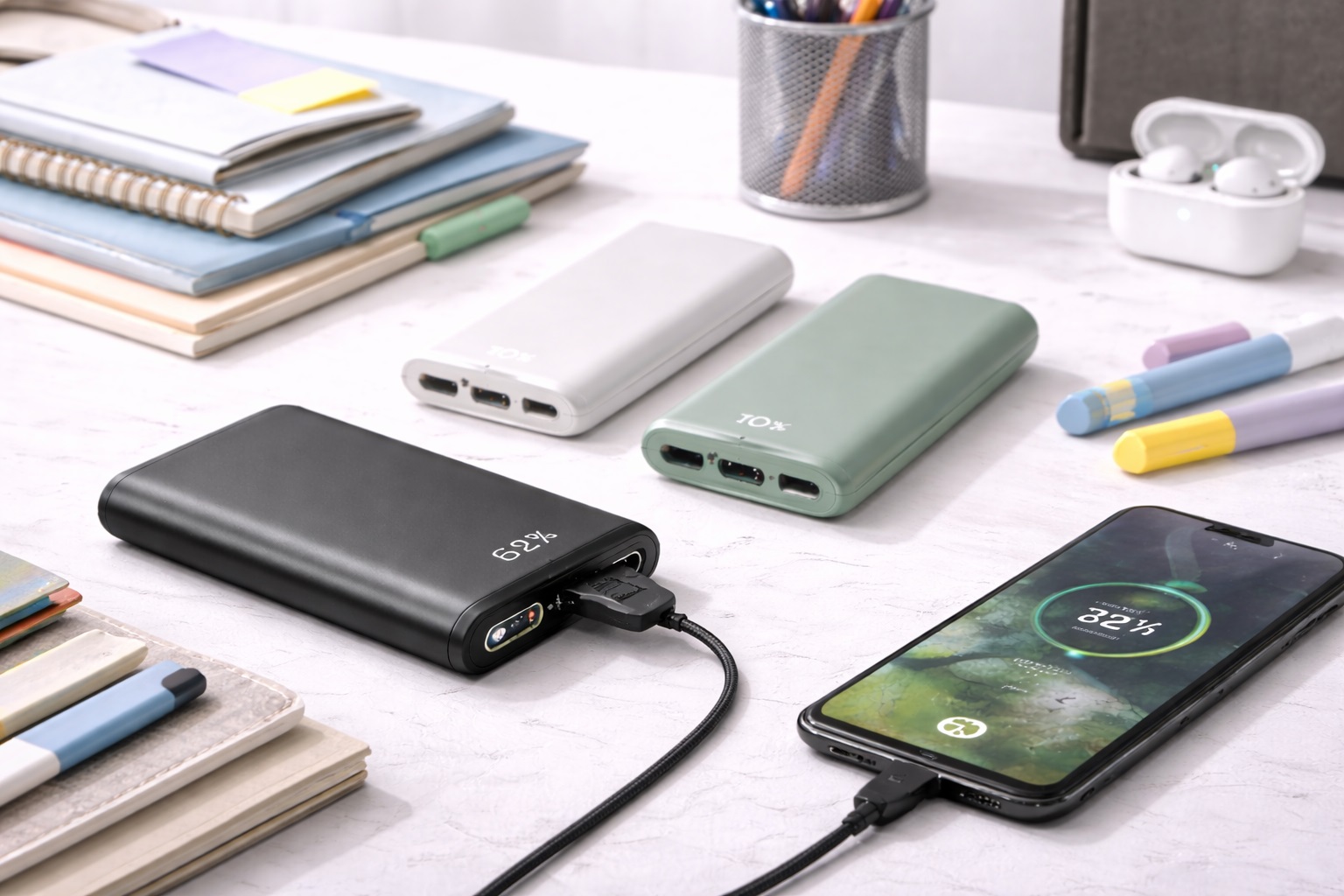
A 10000mAh capacity is generally enough to take a phone from empty to full more than twice, which covers the typical drain of a full day between classes, study sessions, and evening downtime. This capacity range strikes a practical balance: substantial enough to matter, but still light and compact enough to toss into a backpack without a second thought. For most students whose main concern is keeping a phone alive through a normal day on campus, this middle-ground capacity tends to be the most broadly useful choice. It also tends to be the easiest capacity to find at a reasonable price, since it sits at the most competitive point in the market rather than at either extreme.
- Pros:
- Covers a full day of typical phone use with room to spare
- Compact enough to carry daily without adding noticeable bulk
- Reasonable price point relative to the capacity offered
- Cons:
- Not enough capacity to also meaningfully charge a laptop
- May need a recharge every one to two days with heavy use
Best For: Students who mainly need to keep a phone charged through a normal day of classes and evening activities.
Why We Recommend It: It matches the capacity to the actual problem most students face — a phone battery that can't survive a full day — without overshooting into size or price that most people won't need.
20000mAh High Capacity Option – Best For Multi-Day Power Without a Charger
For students juggling long days, back-to-back classes, and evenings in a library that offers few available outlets, a 20000mAh bank offers a substantial buffer. This capacity can charge a phone four or more times, or handle a phone alongside a tablet or smaller device across a couple of days without needing to find a wall outlet at all. For anyone who has ever hunted for a free outlet in a crowded library during finals week, the extra reserve this capacity provides can remove that entire concern from the equation.
- Pros:
- Covers multiple days of phone use, or a phone plus a secondary device
- Reduces how often you need to search for an available outlet on campus
- A practical option for exam weeks or long days away from a dorm
- Cons:
- Noticeably heavier and bulkier than smaller-capacity options
- Takes longer to recharge itself due to the larger total capacity
Best For: Students with long, unpredictable days who want to avoid ever running out of backup charge.
Why We Recommend It: When the actual problem is unreliable access to outlets rather than just a single day's drain, this category solves it directly by carrying enough reserve power to bridge multiple days if needed.
Budget Student Power Bank – Best For Tight Budgets
Not every student has room in their budget for a premium power bank, and not every use case demands one. A budget-oriented option focuses on the essential function — storing and delivering charge reliably — without extras like fast-charge protocols or premium materials that push up the price. For a first power bank purchase, especially for a student still figuring out how much they'll actually rely on one, this category offers a low-risk way to get started.
- Pros:
- Lowest upfront cost, making it accessible on a limited student budget
- Straightforward to use without extra features to learn or configure
- A sensible choice for occasional rather than constant daily use
- Cons:
- Charging speed and capacity are typically more modest than premium options
- Build quality can vary more at the lowest price points
Best For: Students who need reliable backup charge without spending more than necessary on a device they'll mostly use occasionally.
Why We Recommend It: It delivers the core function students actually need without asking them to pay for speed or capacity they may rarely use, which matters when every dollar of a student budget counts.
Fast Charge Student Bank – Best For Short Breaks Between Classes
A class schedule with tight ten- or fifteen-minute gaps between lectures doesn't leave much time for a slow charge. A fast-charging bank is built specifically to deliver a meaningful percentage of battery in a short window, which matters more to a busy student than raw total capacity if the actual charging opportunities during the day are brief. Even five or ten extra minutes of charging squeezed between classes can be the difference between a phone that survives an evening and one that dies before dinner.
- Pros:
- Restores significant battery in short breaks between classes
- Well suited to a packed schedule with little downtime
- Reduces the daily anxiety of watching a battery percentage drop
- Cons:
- Actual fast-charge speed depends on the phone supporting a matching protocol
- Rapid charging can generate more heat than a slower charge
Best For: Students whose class schedule is packed with short gaps rather than long stretches of free time.
Why We Recommend It: It solves the real bottleneck for a busy student — limited time, not necessarily limited total capacity — by making the most of every short charging opportunity during the day.
Power Bank for Laptop and Phone – Best For Charging a Laptop and Phone Together
Many students carry a laptop for lectures and assignments alongside a phone, and a bank built to charge both extends its usefulness well beyond a typical phone-only power bank. This category generally supports USB-C Power Delivery output at a wattage sufficient for common laptop charging needs, in addition to standard phone charging. It's especially useful during long stretches on campus where a laptop might otherwise run down mid-lecture or mid-assignment with no outlet nearby.
- Pros:
- Can meaningfully extend laptop battery life during a long day of classes
- Covers both a laptop and phone from a single device, reducing what you carry
- Useful for library study sessions where outlets are limited or unavailable
- Cons:
- Costs more than a phone-only power bank of similar physical size
- Needs a larger capacity to meaningfully charge a laptop, adding weight
Best For: Students who bring a laptop to campus daily and need backup power for more than just a phone.
Why We Recommend It: It's the closest option here to a single all-purpose charging solution, covering the two devices most students actually rely on throughout a school day.
Slim Student Power Bank – Best For Backpack and Bag Carry
A backpack already carries textbooks, a laptop, notebooks, and various daily essentials, and a bulky power bank competes for space that's already tight. A slim, lightweight bank prioritizes an easy fit into a backpack pocket or bag pouch over maximum capacity, making it the option most likely to actually get carried every day rather than left behind on busy mornings. On a morning when you're already juggling textbooks, a laptop, and running late for a lecture, a slim bank is one less reason to leave backup charging behind entirely.
- Pros:
- Slides easily into a backpack pocket without adding noticeable bulk
- Light enough that it doesn't register as extra weight in an already full bag
- Practical for students who prioritize convenience over maximum capacity
- Cons:
- Lower capacity than bulkier high-capacity options
- May need more frequent recharging with heavy daily use
Best For: Students who want backup charge available every day without the bulk of a larger power bank competing for backpack space.
Why We Recommend It: A power bank that's inconvenient to carry often ends up sitting in a dorm room instead of a backpack. This category solves that specific problem by prioritizing a size students will actually bring with them.
Buying Guide: How to Choose the Best Power Bank for Students
Before making a purchase, it helps to separate the features that genuinely matter for student life from the ones that sound impressive on a spec sheet but rarely make a practical difference on campus.
1. Enough Capacity for a Full Day
Think honestly about how much you actually use your phone and other devices between waking up and getting back to a charger at night. A capacity that comfortably covers that pattern, with some buffer for unpredictable days, is more useful than simply choosing the largest number available. Tracking your actual battery drain for a week gives a far more reliable answer than guessing.
2. Affordable Price for a Student Budget
A power bank doesn't need to be the most expensive option to be effective. Weigh the price against the capacity and features you'll actually use regularly, rather than paying extra for specifications that won't meaningfully change your day-to-day experience, especially on a budget that also has to stretch across textbooks and everyday living costs.
3. Lightweight for Backpack Carry
A power bank that adds noticeable weight to an already-full backpack is more likely to get left behind on a rushed morning. Consider both the weight and physical dimensions relative to how much space you already have in your bag alongside textbooks, a laptop, and everyday supplies.
4. Fast Charge for Short Breaks Between Classes
If your schedule is built around short gaps rather than long free periods, prioritize charging speed over raw capacity. A bank that delivers a meaningful top-up in ten minutes is often more useful day-to-day than one with a larger capacity but a slower charging rate that never gets a real chance to work during your actual breaks.
5. USB-C Compatibility for Modern Devices
Most current phones and laptops use USB-C charging, and a bank that supports USB-C Power Delivery offers the broadest compatibility across devices you're likely to own now and in the near future, reducing the need for extra adapters or cables that are easy to misplace on a busy campus.
6. Number and Type of Ports
Consider how many devices you typically need to charge at once. A single port may be enough if you're only charging a phone, while students charging a phone, tablet, and earbuds case simultaneously should look for multiple output ports rather than swapping cables throughout the day.
7. Recharge Speed of the Bank Itself
A power bank is only useful if it can recharge in a reasonable window, whether overnight in a dorm or during a break between classes. Check the input charging speed, not just how fast it charges your devices, especially if you plan to top it up daily rather than letting it sit for several days between charges.
8. Build Quality and Everyday Durability
A power bank carried daily in a backpack will experience more bumps, drops, and general wear than one used occasionally. Favor options with a reasonable reputation for durability, since a unit that fails partway through a semester creates exactly the disruption it was meant to prevent, often at the worst possible time.
9. Safety Certifications and Battery Quality
Look for basic safety certifications relevant to lithium battery products. This matters especially for a device that will be carried in a backpack alongside laptops and other electronics daily, where battery safety has real practical consequences rather than being a purely theoretical concern.
10. Warranty and Manufacturer Support
A warranty offers a reasonable signal of how confident a manufacturer is in their own product. Given that a semester often lasts several months, a warranty long enough to cover at least a full academic year offers useful peace of mind for a purchase you'll rely on daily.
11. Weight-to-Capacity Ratio
Rather than looking at weight or capacity in isolation, consider the ratio between the two. Some products manage to pack meaningfully more capacity into a similar weight than others, which matters over a semester of daily carrying far more than it might seem when comparing spec sheets in isolation.
12. Compatibility With Your Specific Devices
Confirm the bank's output supports your phone's fast-charging protocol and, if relevant, your laptop's power requirements. A power bank with excellent general specifications is less useful if it doesn't actually charge your specific devices efficiently or at the speed you were expecting.
Frequently Asked Questions
What capacity power bank is enough for a typical day of classes?
For most students, a capacity in the 10000mAh range comfortably covers a full day of typical phone use, including navigation, note-taking apps, and messaging. Students with longer or more unpredictable days, or who also need to charge a laptop, often benefit from a higher capacity in the 20000mAh range.
Can a power bank actually charge a laptop, or just top it up slightly?
This depends entirely on the power bank's output wattage and your laptop's charging requirements. A bank designed with laptop charging in mind, typically supporting USB-C Power Delivery at a sufficient wattage, can meaningfully extend a laptop's battery life through a long day, though very high-power laptops may charge more slowly than they would from a wall outlet. It's worth checking your specific laptop's charging wattage requirement and comparing it against the power bank's rated output before assuming full compatibility.
Is it worth paying more for a fast-charging power bank as a student?
If your schedule involves short breaks rather than long free periods, yes — fast charging directly addresses the actual constraint of limited charging time. If your schedule allows for longer stretches to plug in, a higher-capacity but slower-charging bank might serve you just as well for less money. Comparing your own timetable against the two approaches usually makes the right choice fairly obvious.
How often will I need to recharge a student power bank?
This depends on both the bank's capacity and how heavily you use your devices day to day. A 10000mAh bank used to top up a single phone might need recharging every one to two days with regular use, while a 20000mAh bank charging multiple devices could last a few days between charges.
What's the safest way to carry a power bank in a backpack with a laptop?
Most power banks are safe to carry alongside a laptop in a standard backpack, provided the unit is from a reputable manufacturer with proper safety certifications. It's sensible to avoid tossing a power bank in with sharp objects like metal water bottles or exposed pens that could damage the casing over time.
Do I need a different power bank for a laptop versus just a phone?
Not necessarily, but the requirements shift. Phone-only charging needs are met by almost any basic power bank, while laptop charging requires a higher output wattage, typically through USB-C Power Delivery, along with a larger overall capacity to make a meaningful difference in laptop battery life.
How long should a student power bank last through a degree program?
With regular use, most well-built power banks maintain solid performance for a couple of years before capacity noticeably declines, which often comfortably covers a shorter degree program but may mean replacement is worth considering partway through a longer one. Checking warranty length gives a reasonable sense of expected lifespan.
Are cheaper power banks actually reliable for daily student use?
Many budget power banks from reasonably established brands are reliable for daily use, though quality control tends to be less consistent at the very lowest price points. Reading verified user reviews for a specific budget product is a practical way to gauge reliability before committing to a purchase, particularly reviews that mention performance after several months rather than only initial impressions.
Can I bring a power bank into exam halls or lecture rooms?
Policies vary significantly by institution and even by specific exam or classroom setting, so it's worth checking your school's specific rules rather than assuming. Many campuses allow power banks in general lecture settings but may restrict electronic devices during exams.
Is it better to buy one high-capacity bank or two smaller ones?
This depends on your priorities. One high-capacity bank means less to keep track of and charge, while two smaller banks offer flexibility — for example, keeping one in a bag for daily use and one at a desk as backup. Budget and how organized you are with charging habits both factor into which approach suits you better.
What should I do if my power bank isn't charging my phone as fast as expected?
First check that both the power bank and your phone support a matching fast-charge protocol, since mismatched standards default to a slower charging speed. Using the cable that came with the power bank, rather than a random spare cable, can also make a meaningful difference in achieving the advertised charging speed, since lower-quality cables can bottleneck even a capable charger.
Is it normal for a power bank to feel warm while charging multiple devices?
Yes, a certain amount of warmth is normal, particularly when charging multiple devices at once or using fast-charge features. If the unit becomes uncomfortably hot to hold, or you notice a burning smell, that's a sign to stop using it and consider whether it needs to be replaced rather than something to simply monitor and continue using.
Can I return a student power bank if it doesn't meet my needs after a few days?
Most retailers offer a return window, typically between 15 and 30 days. It's worth checking the specific return policy before purchasing and keeping the original packaging during your evaluation period in case you need to return it.
Should I buy a power bank before starting a new semester or wait until I know my schedule?
If budget allows, waiting a week or two into a new semester to understand your actual class schedule, commute pattern, and charging habits can help you choose a more appropriate capacity and feature set. That said, a mid-capacity option purchased in advance is flexible enough to suit most schedules reasonably well if you'd rather not wait.
Do power banks work well in cold weather during winter semesters?
Lithium batteries generally perform somewhat less efficiently in cold temperatures, which can mean slightly reduced capacity or slower charging in very cold conditions. For most campus environments, where a power bank spends most of its time inside a heated backpack or building, this isn't a significant practical concern.
Final Verdict
There's no single best power bank for every student, because the actual constraints differ so much from one schedule to the next. A student living in a dorm with easy access to outlets has different needs than one commuting across town with long gaps between opportunities to charge.
- For most students: a 10000mAh bank covers a typical day of phone use without adding much bulk to a backpack.
- For long or unpredictable days: a 20000mAh bank or a laptop-capable option provides a larger buffer against running out of power.
- For tight budgets: a straightforward budget bank covers the essential need without paying for extras that may go unused.
Think honestly about your actual schedule, your budget, and which devices you rely on most, and let those specifics guide the decision rather than choosing whatever has the most impressive capacity number. A power bank that fits naturally into your daily routine and actually gets carried to campus is worth more than one with better specifications sitting unused in a dorm room drawer.
It's also worth keeping in mind that this is a relatively low-cost purchase compared to most of what fills a student budget, which means a first choice that turns out to be slightly wrong for your routine isn't a major setback. Many students end up adjusting over time — starting with a budget or mid-capacity option in a first year and upgrading to something with more capacity or faster charging once their actual daily patterns become clear. Treating the decision as something you can refine, rather than something that has to be perfect on the first try, takes some of the pressure off a purchase that ultimately just needs to keep you connected through a busy semester.