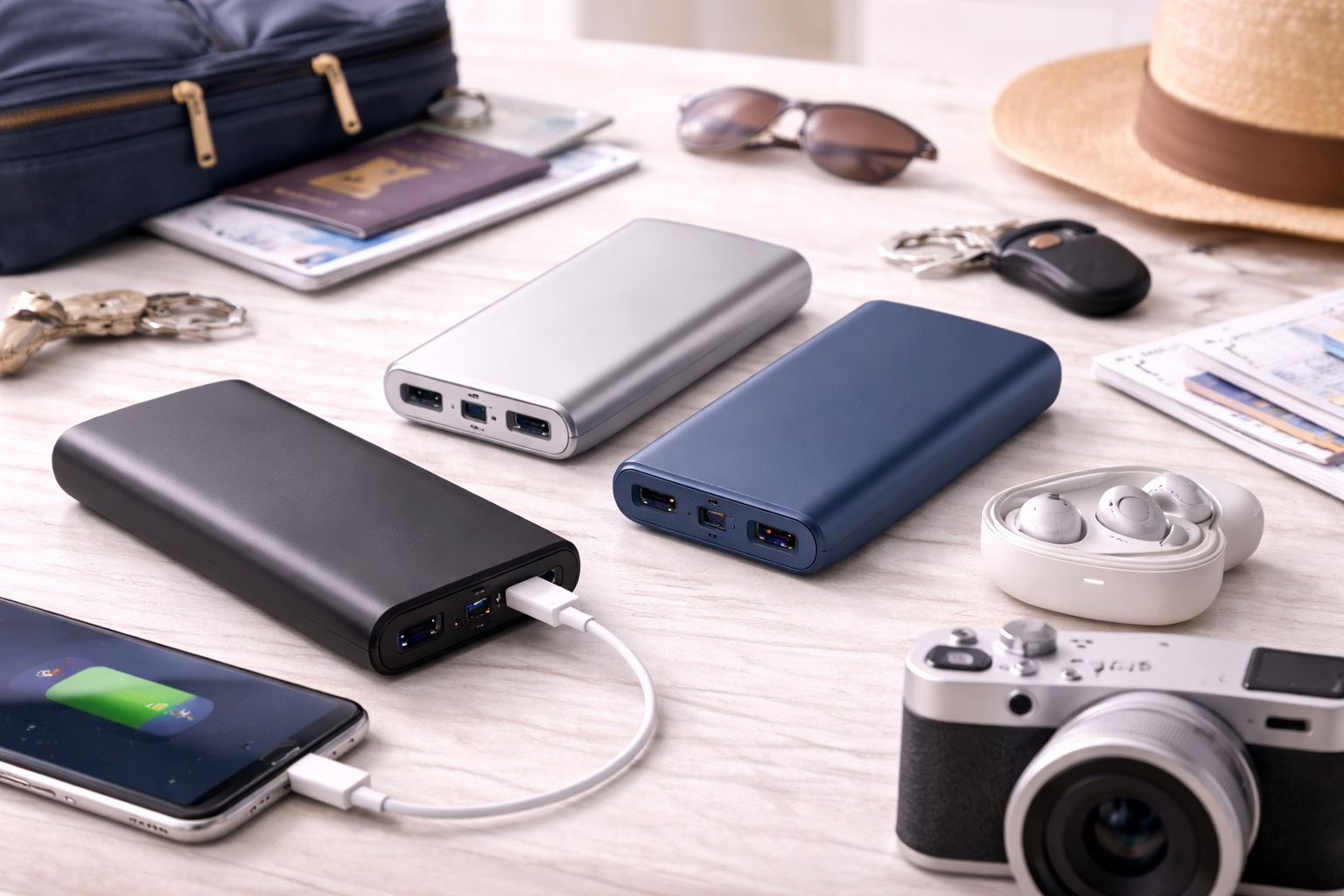
Best Power Banks for Travel 2026: Charge Anywhere You Go
A dead phone in an unfamiliar airport, a tablet that won't survive a ten-hour flight, a laptop that needs one more hour of battery before the hotel check-in — these are the moments a power bank for travel exists to solve. Frequent travelers have different priorities than everyday commuters: airline compliance, multi-day endurance away from a wall outlet, and the ability to keep two or three devices alive at once without hunting for an airport charging kiosk. A power bank that works fine for a daily commute can fall apart on a real itinerary once you factor in unpredictable layovers, shared hotel outlets, and the simple fact that a dead phone abroad is a bigger problem than a dead phone at home.
This guide focuses specifically on what matters for travel use — capacity that survives a long-haul flight or a multi-day road trip, charging speeds fast enough to top up during a layover, and weight that won't punish your shoulder on the walk to the gate. We also cover the airline rules that trip up first-time travelers, since a power bank that gets confiscated at security does nobody any good.
Below you'll find a side-by-side comparison, detailed reviews of the models that consistently perform well for travel, a buying guide that walks through every factor worth checking before you order, and answers to the questions travelers ask most often about carrying and using a power bank on the road.
None of this needs to be complicated. Most travelers overthink capacity and underthink the practical details — airline compliance, actual recharge time, and whether the ports match the cables already in the bag. Working through the comparison and buying guide below in order, rather than jumping straight to the highest mAh number, tends to produce a better match for how you actually travel.
Top 5 Power Banks for Travel (Detailed Reviews)
1. 20,000mAh High-Capacity Power Bank – Best for Multi-Day Travel
A 20,000mAh power bank charges most smartphones four to six times and delivers a full tablet charge, which is exactly the endurance a multi-day trip demands. For travelers who won't see a hotel outlet until evening, this capacity removes the daily anxiety of managing battery percentage. Models built around 65W USB-C Power Delivery go a step further and charge laptops, turning the bank into a genuine travel power system rather than a phone-only accessory. It's worth noting that 100Wh — roughly 27,000mAh at 3.7V — is the maximum capacity most airlines permit in carry-on luggage, so a 20,000mAh bank sits comfortably within that ceiling.
- Pros:
- Four to six full smartphone charges per cycle
- 65W USB-C output can charge a laptop in addition to phones and tablets
- Multiple USB-A and USB-C ports allow simultaneous charging for a travel companion
- Comfortably within airline carry-on watt-hour limits
- Cons:
- Noticeably heavier than smaller-capacity alternatives, typically 400–500g
- A full recharge of the bank itself takes six to eight hours
Best For: Frequent flyers, multi-day road-trippers, and travelers carrying a laptop who need to go a full day or more without a wall outlet.
Why We Recommend It: Laptop-charging capability is what separates a serious travel power bank from a basic phone charger, and a 20,000mAh capacity is large enough to matter without tipping into checked-baggage-only territory.
2. 10,000mAh Slim Fast-Charge Power Bank – Best Balance of Capacity and Portability
A 10,000mAh slim power bank delivers two to three full smartphone charges in a body thin enough to slip into a jacket pocket or the front sleeve of a daypack. USB-C Power Delivery in the 18W–30W range means a meaningful top-up — enough for a few more hours of navigation and photos — in thirty to forty-five minutes at a coffee-shop table or airport gate. For travelers who want backup power without dedicating a whole bag pocket to it, this capacity is the sensible middle ground.
- Pros:
- Slim enough to carry in a jacket pocket or small daypack
- Two to three full phone charges per cycle
- USB-C PD fast charging delivers a useful top-up in well under an hour
- Meaningfully lighter than high-capacity alternatives
- Cons:
- Not enough capacity for laptop charging
- Won't stretch across a multi-day trip for heavy device users
Best For: Day-trippers, city-break travelers, and anyone who wants reliable phone backup without carrying a bulky brick.
Why We Recommend It: This is the capacity most travelers actually reach for day to day — light enough to forget it's in the bag, large enough to matter when a phone battery runs low mid-excursion.
3. 5,000mAh Ultra-Slim Power Bank – Best for Minimal Carry Weight
A 5,000mAh ultra-slim power bank provides one full smartphone charge in a form factor that adds almost nothing to a bag. The smallest models are no larger than a smartphone and weigh under 130g, which matters for travelers packing light or carrying everything in a single small bag through security. USB-C input allows a quick overnight recharge, so the bank is ready again by the next morning even though its own capacity is modest.
- Pros:
- Credit-card slim or smartphone-sized footprint
- One full phone charge — enough for light or occasional use
- Negligible weight addition to carry-on or day bag
- Fast USB-C input for quick overnight recharging
- Cons:
- Only one full phone charge, insufficient for heavy travel-day use
- Not suitable for tablets or laptops
Best For: Minimalist packers and travelers who want a true emergency backup rather than a primary charging solution.
Why We Recommend It: When the whole point of a trip is packing light, a bank this small removes the excuse to leave backup power behind altogether.
4. Power Bank with Built-In Cables – Best for Cable-Free Convenience
A power bank with integrated charging cables folds a USB-C and Lightning or USB-C-to-USB-C cable directly into the housing, eliminating one of the most common travel-packing failures: reaching for a power bank and discovering the cable is in a different bag. These banks typically land in the 5,000–10,000mAh range, prioritizing convenience over maximum capacity, and are particularly useful for travelers who consolidate everything into one small pouch.
- Pros:
- No separate cable to pack, lose, or forget
- Built-in connectors reduce fumbling at security lines or on a moving train
- Compact enough for a jacket pocket or bag organizer
- Often includes both USB-C and Lightning-style connectors in one unit
- Cons:
- Built-in cables can't be replaced if damaged, unlike a separate cable
- Capacity is typically modest compared to dedicated high-capacity banks
Best For: Travelers who consistently lose or forget charging cables and want one self-contained charging solution.
Why We Recommend It: Removing cable management from the travel-packing equation is a small change that solves a surprisingly common frustration on the road.
5. Solar-Assisted Power Bank – Best for Off-Grid Charging
A solar-assisted power bank pairs a modest internal battery, typically 10,000–20,000mAh, with a fold-out solar panel that trickle-charges the bank when it's clipped to a backpack in direct sunlight. It won't replace a wall charge for daily use since panel output is small relative to a full recharge, but on a multi-day hiking leg of a trip or a beach stretch with no outlet in sight, it extends how long the bank can be relied upon. Rugged models add IP65 or better water and dust resistance, which suits rougher outdoor travel itineraries where a standard bank would be at risk from rain or sand.
- Pros:
- Passive solar trickle-charge extends usable range without an outlet
- Rugged, weather-resistant housings suit outdoor and adventure travel
- Reduces total dependency on finding a wall outlet on multi-day treks
- Often includes a carabiner or webbing loop for attaching to a pack
- Cons:
- Solar charging alone is far too slow to be a primary charging method
- Bulkier and heavier than a standard bank of equivalent capacity
Best For: Hikers, campers, and travelers on itineraries that include stretches of several days without reliable access to electricity.
Why We Recommend It: For genuinely off-grid legs of a trip, the ability to top up passively while walking is a meaningful backup even though it should never be the sole charging plan.
Buying Guide: How to Choose the Best Power Bank for Travel
Use these factors to match a power bank to how, where, and how long you actually travel. Reading through all twelve before you shortlist a model takes ten minutes and consistently prevents the most common regret: buying based on capacity alone and discovering later that charging speed, weight, or airline compliance mattered more for your trip.
1. Capacity and Actual Output
Stated capacity in mAh is measured at 3.7V battery voltage, but output happens at 5V through USB. Real-world usable capacity is typically 60–70% of the stated number because of this voltage conversion. A 10,000mAh bank realistically delivers closer to 6,000–7,000mAh to your device — about one and a half to two full smartphone charges rather than a number that looks larger on the box. When comparing two banks with identical mAh ratings, the one with the more efficient internal circuitry will consistently deliver more usable charge, which is one reason two banks both rated at 10,000mAh can feel noticeably different in daily travel use.
2. Airline Restrictions and Travel Compliance
Airlines allow power banks up to 100Wh in carry-on luggage and generally prohibit them in checked bags entirely. At 3.7V, 100Wh works out to roughly 27,000mAh, so most standard travel power banks fall well under the limit. Check the watt-hour rating printed on the bank's label against your specific airline's policy before you fly, since a small number of carriers apply stricter rules. If the label only lists mAh and voltage rather than Wh directly, multiply mAh by voltage and divide by 1,000 to get the watt-hour figure airline staff will actually ask about.
3. Charging Speed: Input and Output
Output speed determines how quickly your phone or tablet charges from the bank; input speed determines how quickly the bank itself recharges overnight or during a layover. USB-C Power Delivery at 18W or higher gives modern phones a meaningful fast charge, while 30W to 65W is needed to usefully charge a laptop. Check both numbers independently — a high-capacity bank with slow output speed will still leave you waiting. It's easy to assume a bank marketed around its large capacity automatically charges fast, but capacity and speed are separate specifications set by different internal components, so read both before deciding.
4. Port Selection and Cable Compatibility
USB-A ports remain useful for older cables and accessories, while USB-C has become the standard for phones, tablets, and many laptops. A bank offering both port types covers more travel scenarios, especially when charging a companion's older device alongside your own. Match port count to how many devices you typically need charged at the same time, such as during a shared hotel room evening. Traveling with a partner or family member roughly doubles the practical port count you'll want, since taking turns charging single devices from one port quickly becomes an evening-long inconvenience.
5. Safety Certifications
Look for CE, FCC, or UL certification markings on the bank and its packaging, which indicate the product has passed basic electrical safety testing. Uncertified banks from unfamiliar sellers carry a real risk of overheating or overcharging, a risk amplified when the device is packed tightly against other items in a suitcase. Certification is not optional for something carried this close to your body for hours at a time. Reputable listings state the certifying body directly rather than a vague safety-tested claim with no specifics, and it's worth a few extra minutes to confirm before ordering an unfamiliar brand for an international trip.
6. Recharge Time for the Bank
A 20,000mAh bank charging at 18W input can take six to eight hours to fully recharge, while a 10,000mAh bank typically takes three to four hours. If an overnight recharge at the hotel isn't guaranteed — hostel dorms and shared outlets are common travel realities — a bank with faster input speed (45W or higher) becomes more valuable than raw capacity alone. Charging the bank during a short layover or a lunch stop, rather than only overnight, becomes realistic once input speed climbs into that range, which is a meaningful convenience on a packed multi-city itinerary.
7. Pass-Through Charging
Pass-through charging lets a bank charge a connected device while it is itself being recharged from a wall outlet, which is useful when hotel outlets are scarce and multiple devices need power overnight. Not every bank supports this safely, so check the specification explicitly if you plan to charge the bank and a phone simultaneously from one outlet. It's a small feature on paper, but on a night when a hotel room has only one usable outlet behind a heavy piece of furniture, pass-through support quietly solves a problem that would otherwise mean choosing which device gets to charge first.
8. Weight and Density Trade-off
Higher capacity always means more physical weight. A 20,000mAh bank weighs roughly 400–500g, a 10,000mAh slim bank around 200–250g, and a 5,000mAh ultra-slim model under 130g. Weigh this trade-off against how you actually pack — a carry-on-only traveler will feel every extra 100g far more than someone checking a bag. Picking up the bank in-store, or checking a retailer's exact listed weight rather than estimating from capacity alone, avoids an unpleasant surprise when it's already packed into a carry-on that's pushing the airline's weight limit.
9. Display and Status Indication
Basic LED indicators show remaining charge in rough 25% increments, which is often enough for casual use. A numeric percentage display gives a clearer read on exactly how much charge remains before a long travel day, which matters more when you're trying to plan whether the bank will last until the next outlet. On a long transit day with no fixed schedule for the next charging opportunity, knowing the difference between 40% and 55% remaining is genuinely useful rather than a nice-to-have.
10. Heat Management
Fast charging generates heat, and a bank sitting inside a warm bag in direct sun — a real scenario on a beach trip or a car dashboard — compounds that heat. Quality designs use metal housings or internal thermal management to dissipate it safely. A bank that becomes uncomfortably hot during normal use is operating beyond its intended thermal margin. Give the bank a few minutes of open-air rest after fast-charging a laptop before packing it away, rather than zipping it straight into an insulated bag pocket while still warm.
11. Wireless Charging Compatibility
Some travel power banks include a built-in wireless charging pad on top, letting you set a phone down to charge without connecting a cable — convenient at a cramped airport gate table. Wireless charging is slower and less power-efficient than a wired connection, so treat it as a convenience feature rather than the primary charging method for a device that needs to reach full charge quickly. It's most useful during a short café stop or a train seat with no easy access to your bag, where setting the phone down briefly beats digging for a cable.
12. Battery Chemistry and Cycle Life
Most modern power banks use lithium-polymer cells, which tend to be lighter and more resistant to swelling than older lithium-ion designs, an advantage when a bank spends hours in a hot car or checked bag. Cycle life — typically several hundred full charge cycles before capacity noticeably degrades — is rarely advertised prominently, but reputable manufacturers will state it if asked, and it's a fair proxy for expected multi-year durability. Over several years of regular travel, a bank rated for more cycles will keep delivering close to its original capacity, while a cheaper cell degrades faster and quietly starts falling short of the charges it once provided.
Frequently Asked Questions
1. What capacity power bank do I need for travel?
For an emergency single phone charge, 5,000mAh is enough. For a full travel day of heavy phone use, 10,000mAh is the practical minimum. For multi-day trips or laptop charging, 20,000mAh is the right range. Match the number to your device's battery size and how many days you'll go between reliable outlets. It's worth erring slightly larger than your minimum estimate, since travel days rarely go exactly to plan and a delayed flight or an unexpected long layover will draw down a bank faster than a normal day at home.
2. Can I take a power bank on a plane?
Power banks up to 100Wh are permitted in carry-on baggage by most airlines and are not allowed in checked luggage at all. A 20,000mAh bank at 3.7V works out to roughly 74Wh, comfortably inside the limit. Always confirm your specific airline's current policy before departure, since rules can vary slightly, and international connections may involve a second carrier with its own policy on the return leg.
3. How do I know when to replace my power bank?
Replace it once it no longer holds the charge it used to, which typically becomes noticeable after two to three years of regular use. If the bank runs unusually hot, develops a swollen shape, or stops charging altogether, replace it immediately for safety rather than waiting for a trip to force the issue. A swollen cell is a genuine hazard in a pressurized cabin, so don't pack a bank you've already noticed physical changes in.
4. Will airport security stop me for carrying a power bank?
Security screening typically just requires the power bank to be visible and easily removable from your bag, similar to a laptop. It travels in carry-on only, never checked luggage, and staying under the 100Wh threshold avoids any additional scrutiny or paperwork at the gate. Banks between 100Wh and 160Wh sometimes require airline approval in advance, so it's simpler to stay under the standard limit if you're carrying more than one bank.
5. Can one power bank charge multiple devices on a long flight?
Yes, if the bank has multiple output ports and enough total capacity. A 20,000mAh bank with two or three ports can keep a phone and a tablet charged simultaneously for most of a long-haul flight, though simultaneous charging draws down the bank's capacity faster than charging one device at a time. Splitting charging between two devices sequentially rather than simultaneously stretches total capacity slightly further if the flight is long enough that timing isn't critical.
6. Does cold weather affect power bank performance while traveling?
Lithium-based batteries lose some efficiency in cold conditions, so a bank carried in an unheated bag during a winter trip may charge devices slightly slower than usual. Keeping the bank in an inside jacket pocket rather than an outer bag pocket helps maintain more consistent performance in cold climates. Letting the bank warm to closer to room temperature before charging, rather than plugging it in straight from a freezing car or ski lift bag, also helps it charge closer to its normal speed.
7. Is the most expensive power bank for travel always the best?
Not necessarily. Price often reflects brand reputation and extra features, but many mid-range banks deliver the same practical charging performance travelers actually need. Match the specific features — capacity, output speed, port count — to your trip rather than assuming a higher price guarantees better travel performance. Paying more sometimes buys a nicer finish or a smaller footprint for the same capacity, which is a legitimate reason to spend more, but it isn't the same as buying more charging performance.
8. How long should a quality power bank for travel last?
A well-built power bank from a reputable manufacturer typically lasts two to five years of regular travel use. Warranty length is a reasonable proxy for how confident the manufacturer is in the bank's long-term durability. Frequent travelers who use their bank on every trip will typically see the lower end of that range, while occasional travelers can expect a bank to last considerably longer.
9. Can I return a power bank for travel if it doesn't suit me?
Most retailers offer a fifteen- to thirty-day return window. Test the bank on a shorter trip before committing it to a longer one, and keep the original packaging until you're confident it meets your needs. A weekend trip is a low-risk way to confirm real-world capacity and charging speed before relying on the bank for a longer international itinerary.
10. What should I prioritize when buying a power bank for travel?
Start with your actual trip pattern — trip length, whether you'll have laptop-charging needs, and how much weight you're willing to carry — before comparing specifications. The right capacity and port selection follow naturally once the use case is clear. Travelers who try to buy one bank to cover every possible trip type often end up over-specced and overpaying for capacity or ruggedness they rarely use.
11. Does brand name matter for power bank for travel?
Established brands typically offer more consistent quality control and more reliable warranty support, which matters when a bank fails mid-trip. Newer or lesser-known brands can still offer good value, so weigh verified purchase reviews carefully before choosing an unfamiliar name for international travel. Pay particular attention to reviews that mention long-term use rather than just an unboxing, since travel reliability shows up after months of repeated packing and charging cycles.
12. Should I pack my power bank in checked luggage or carry-on?
Always carry-on. Airlines worldwide prohibit power banks in checked baggage due to fire-risk regulations around lithium batteries, regardless of capacity. Keep it accessible in your bag in case security asks to see it during screening, since digging through a fully packed carry-on at the checkpoint slows down the whole line behind you.
Final Verdict
- Best for Multi-Day Travel: 20,000mAh High-Capacity Power Bank — the closest thing to a travel power system for laptop-carrying road warriors.
- Best Balance of Capacity and Portability: 10,000mAh Slim Fast-Charge Power Bank — the capacity most travelers reach for on an average trip.
- Best for Minimal Carry Weight: 5,000mAh Ultra-Slim Power Bank — backup power that never feels like an extra item to pack.
- Best for Cable-Free Convenience: Power Bank with Built-In Cables — removes one of travel's most common packing frustrations.
- Best for Off-Grid Charging: Solar-Assisted Power Bank — a practical backup for hiking and camping legs of a longer trip.
The right power bank for travel comes down to how you actually move through a trip — how many days between outlets, how much weight you're willing to carry, and whether a laptop needs to stay charged alongside your phone. Use the comparisons and buying guide above to match a bank to your next itinerary rather than defaulting to whichever one is most popular. A bank chosen around your actual habits — how you pack, how far apart your outlets are, and how many devices travel with you — will get used and trusted on every trip that follows, which is the real measure of a good pick.