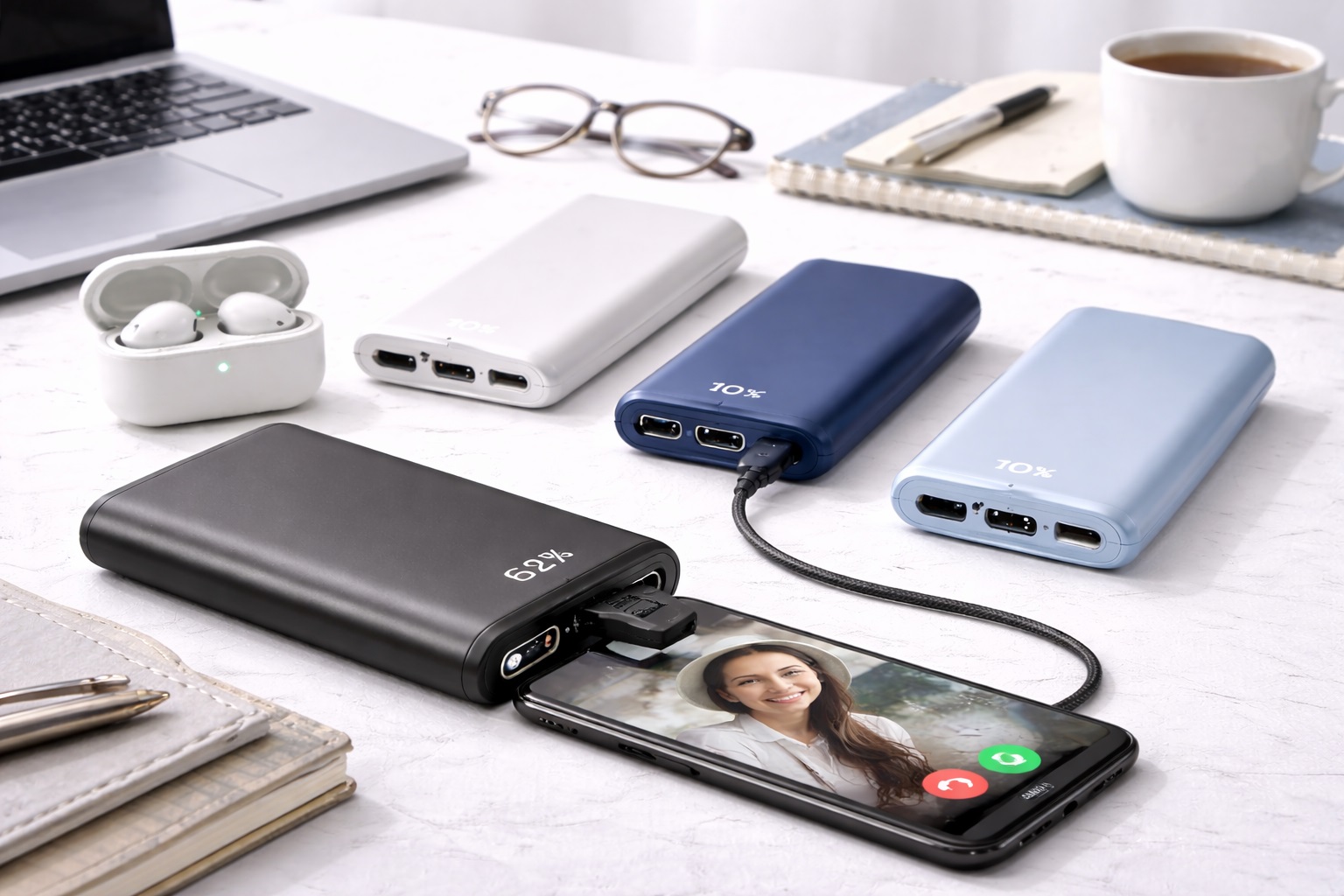
Best Power Banks for Calls & Meetings: Never Miss a Connection
A dead phone thirty minutes before a client call is a specific kind of stress that almost every remote worker has experienced at least once. Between back-to-back video meetings, screen-share sessions, and the constant pull of messaging apps, a phone or laptop battery can drain far faster on a workday than it does on a weekend. A power bank built with calls and meetings in mind is not just a backup battery — it is a piece of communication infrastructure, no different in importance than a reliable headset or a stable internet connection.
Not every power bank is designed with this use case in mind. Many are optimized purely for raw capacity, intended to charge a phone five or six times over a weekend trip. Others are built for speed above all else, designed to blast a nearly-dead phone back to 50 percent in twenty minutes. For someone who needs steady, quiet, reliable power throughout a working day — often while the device is actively in use during a call — the priorities shift. Desk footprint, port count, charging stability, and noise-free operation start to matter as much as total capacity.
This guide walks through six distinct approaches to solving the calls-and-meetings charging problem, followed by a detailed buying framework and answers to the questions professionals ask most often before making a purchase. Each option below serves a genuinely different scenario, so the goal is to help match the product to the way you actually work rather than simply picking whatever ranks highest in general searches.
It's also worth acknowledging that the "right" power bank often changes as a job or routine changes. Someone who recently shifted from an office to a hybrid schedule may find that what worked for occasional backup charging no longer covers a full week of home-based video calls. Revisiting the decision periodically, rather than assuming the first power bank purchased will suit every future working arrangement, tends to produce better long-term satisfaction with whatever option is chosen.
Top Picks Reviewed
10000mAh Desk-Friendly Bank – Best For All-Day Desk Use
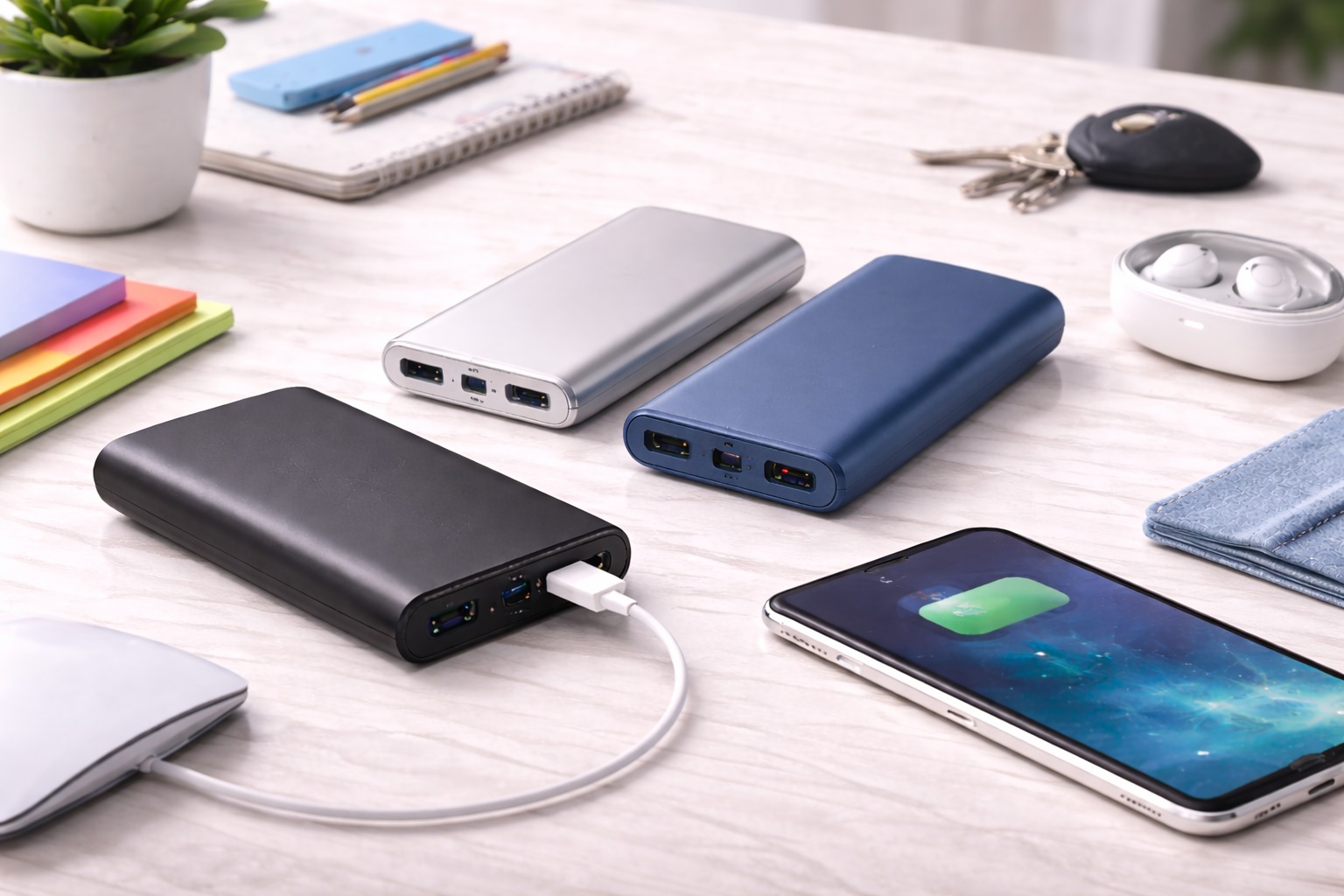
A 10000mAh capacity sits in a practical middle ground for a desk-based worker. It is enough to take a phone from empty to full more than twice over, or to keep a phone topped up continuously through a full day of calls, without becoming a bulky object that competes for space with a laptop, monitor, and notebook. This category is generally built with a flat or slightly curved profile designed to sit flush next to a keyboard rather than roll around on a desk. Because it's rarely moved, buyers in this category also tend to favor a matte or non-slip finish that resists picking up desk clutter, plus a status indicator that's easy to glance at without picking the unit up.
- Pros:
- Capacity is well matched to a single working day of typical call volume
- Compact footprint that doesn't dominate desk space
- Generally lighter and easier to keep permanently plugged in and charging
- Cons:
- Not enough capacity for multi-day travel without recharging
- Usually has fewer output ports than larger units
Best For: Professionals who work primarily from a single desk and want a permanent, unobtrusive charging companion rather than a travel battery.
Why We Recommend It: The capacity-to-size ratio is close to ideal for someone whose charging needs reset every evening. It solves the actual problem — keeping a phone alive through a day of meetings — without over-engineering the solution.
Fast Charge Bank for Phones – Best For Quick Top-Ups Between Calls
Some workdays don't allow for a phone to sit on a charger for hours. A fast-charging bank is built around getting meaningful battery back in the shortest possible window — the kind of top-up you can get during a ten-minute gap between one meeting ending and the next one starting. This category typically prioritizes charging speed and supported fast-charge protocols over sheer battery capacity. The tradeoff is usually a smaller total capacity relative to its physical size, since the internal components that enable rapid charging take up space that would otherwise go toward additional cells.
- Pros:
- Restores a large percentage of battery in a short window
- Well suited to unpredictable schedules with short breaks
- Reduces anxiety about squeezing in a full charging session
- Cons:
- Fast charging speed depends on both the bank and the phone supporting matching protocols
- Rapid charging can generate more heat than slower charging
Best For: Professionals whose calendars are packed with short gaps rather than long stretches of downtime.
Why We Recommend It: When time is the scarce resource, not battery capacity, a fast-charge-focused bank solves the actual bottleneck. It's built for the reality of a meeting-dense schedule rather than an idealized one.
Multi-Port Call-Ready Bank – Best For Charging Multiple Devices at Once
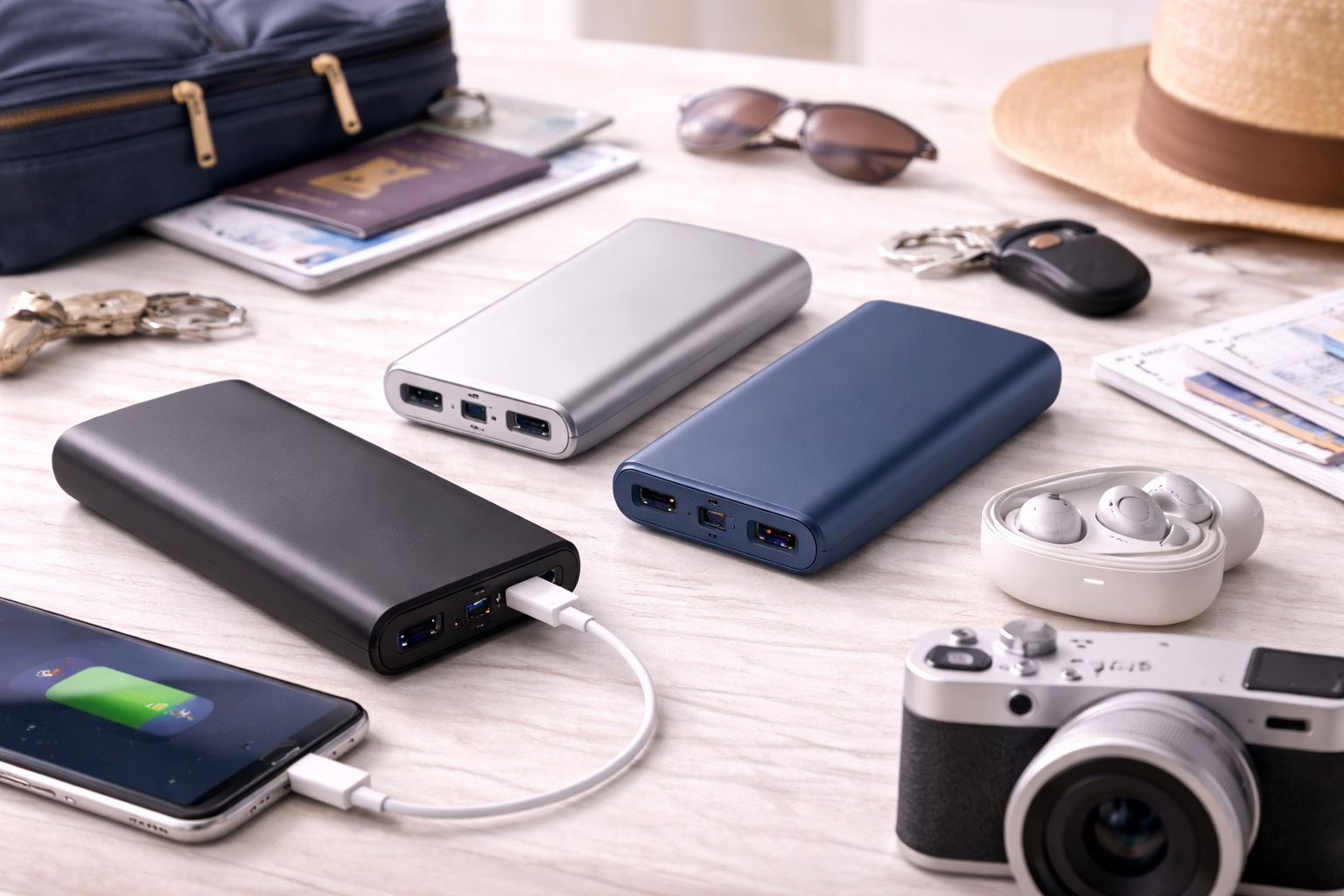
A modern work setup rarely involves just one device. A phone, a wireless headset case, a tablet used for notes, and sometimes a laptop may all need power throughout the day. A multi-port bank is designed around this reality, offering two, three, or more simultaneous outputs so that nothing has to wait in line for a turn at the single available cable. For households where more than one person works remotely, this category also removes the daily negotiation over whose device gets the charger next.
- Pros:
- Charges several devices at the same time without swapping cables
- Reduces the need to own several smaller single-port banks
- Useful for shared desks or households with multiple work-from-home devices
- Cons:
- Charging multiple devices simultaneously typically slows the speed delivered to each
- Larger port count often means a larger physical unit
Best For: Anyone juggling a phone, headset, and tablet who is tired of unplugging one device to charge another.
Why We Recommend It: This category directly addresses the multi-device reality of a modern home office. It trades a little raw speed per device for the convenience of never having to prioritize which gadget gets power first.
Wireless Charging Power Bank – Best For Cable-Free Desk Setups
For a desk that's already crowded with a laptop stand, monitor arm, and keyboard, one fewer cable can make a meaningful difference. A wireless charging power bank lets a compatible phone charge simply by resting on top of it — useful during a call when picking the phone up to plug in a cable would be an unwelcome interruption. This type also tends to appeal to anyone who's tired of worn-out charging ports or frayed cables, since the phone's port sees far less daily wear when charging happens wirelessly instead.
- Pros:
- No cable required for topping up a compatible phone
- Convenient to set a phone down and pick it back up mid-call without unplugging anything
- Tends to double as a stand, propping the phone at a usable angle
- Cons:
- Wireless charging is generally slower than a wired connection
- Phone must stay positioned correctly on the charging pad, which limits movement during a call
Best For: Desk workers who value a clean, cable-free surface and don't need the fastest possible charge speed.
Why We Recommend It: It solves a convenience problem more than a speed problem — quick, cable-free top-ups that fit naturally into the rhythm of a desk-bound workday.
Budget Work Power Bank – Best For Cost-Conscious Professionals
Not every charging need justifies a premium price tag. A budget-oriented power bank strips away extras like wireless charging pads or multiple fast-charge protocols and focuses on the core function: storing and delivering power reliably. For someone who mainly needs backup charge in case a desk charger isn't available, this category can be entirely sufficient. It's a sensible starting point for anyone unsure exactly how much they'll rely on a power bank day-to-day, since it avoids over-investing in a category of use that may turn out to be occasional rather than constant.
- Pros:
- Lower upfront cost makes it accessible and easy to justify as a backup unit
- Simple to use with no learning curve or extra features to configure
- A sensible option for occasional rather than constant use
- Cons:
- Charging speed and capacity are usually modest compared to premium options
- Build quality can vary more at lower price points
Best For: Professionals who need a dependable backup rather than a primary all-day charging solution.
Why We Recommend It: It delivers the essential function without asking buyers to pay for features they won't use, which makes it a reasonable choice for lighter or occasional charging needs.
Power Bank With USB-C PD – Best For Laptop and Headset Charging
USB-C Power Delivery (PD) support extends a power bank's usefulness beyond phones. A PD-capable bank can top up a compatible laptop, provide stable power to a USB-C headset dock, or fast-charge newer phones that rely on the USB-C PD standard rather than older proprietary fast-charging methods. This makes it the most versatile option for someone whose work setup spans multiple device types. It's also the category most likely to still be useful years from now, as more accessories and laptops continue to standardize around USB-C rather than older proprietary charging connectors.
- Pros:
- Can charge laptops and other higher-power devices, not just phones
- Broad compatibility with modern USB-C devices across brands
- Often delivers stable, consistent output suited to sensitive electronics
- Cons:
- Typically costs more than a basic phone-only power bank
- Larger capacity needed to meaningfully charge a laptop, which adds weight
Best For: Professionals who need one power bank to cover a phone, headset, and laptop rather than carrying separate chargers for each.
Why We Recommend It: Of all the options here, this is the closest to a single universal solution — provided the buyer is willing to pay for the added versatility and carry the extra size that PD-capable capacity requires.
Buying Guide: How to Choose the Best Power Bank for Calls and Meetings
Before making a purchase decision, it helps to separate the features that genuinely matter for call-and-meeting use from the ones that sound impressive on a spec sheet but rarely come into play in everyday work. The following factors are the ones worth spending real time evaluating.
1. Fast Top-Up Speed Between Calls
If your schedule is built from short gaps rather than long breaks, charging speed matters more than total capacity. Look at how quickly the bank can deliver a meaningful percentage of charge — not just its maximum wattage rating, which often assumes ideal conditions that don't match a quick ten-minute window between meetings. A bank that only reaches its advertised speed under narrow lab conditions won't necessarily perform the same way plugged in for a rushed ten-minute top-up.
2. Simultaneous Multi-Device Charging
Check how many devices the bank can charge at once, and just as importantly, whether charging multiple devices reduces the speed delivered to each one. A bank with three ports that throttles heavily under full load may not be meaningfully better than a two-port unit for your actual use pattern. It's worth checking whether the product documentation specifies per-port output when multiple devices are connected simultaneously, since this detail is often left out of general marketing copy.
3. Freedom From Wireless Interference
If you take calls over Bluetooth headphones or use wireless peripherals at your desk, it's worth checking whether the charging method — particularly wireless charging pads — has any documented tendency to interfere with nearby wireless signals. This is a niche concern but a frustrating one if it affects your call quality, especially during a client-facing meeting where audio dropouts reflect poorly on your setup rather than your connection.
4. Compact Size for Desk Use
A power bank that's meant to live permanently on a desk should be evaluated differently than one meant for travel. Measure the space you actually have available and compare it against the bank's footprint before assuming a larger-capacity unit will fit comfortably alongside your other equipment. A unit that looks modest in a product photo can feel surprisingly large once it's competing for space with a keyboard, mouse, and monitor stand.
5. Stable Output for Sensitive Devices
Wireless headsets, dongles, and some laptops are more sensitive to inconsistent power delivery than a phone is. A bank with stable, well-regulated output reduces the risk of a headset randomly disconnecting or a laptop reporting charging errors mid-call. This matters most for anyone relying on a wireless headset dock or USB dongle that stays connected throughout the workday.
6. Total Capacity Versus Actual Daily Need
More capacity is not automatically better. Estimate how much charge you actually use in an average workday and choose a capacity that comfortably covers that, plus a reasonable buffer — rather than buying the largest available option and carrying unused weight every day. Tracking your phone's actual battery drain over a typical workday for even a week gives a far more accurate picture than guessing.
7. Port Types and Cable Compatibility
Confirm the bank's output ports match the cables and devices you already own. A bank with excellent specifications is far less useful if it requires buying new cables or adapters just to make it work with your existing gear, which quietly adds to the real cost of the purchase.
8. Charging Speed of the Bank Itself
A power bank is only useful if it recharges in a reasonable time overnight or during a lunch break. Check the input charging speed, not just the output speed, especially if you plan to recharge it daily rather than letting it sit for days between uses. A bank that takes most of a day to refill defeats the purpose if your routine depends on it being ready every morning.
9. Build Quality and Long-Term Reliability
A power bank used daily for work will see far more charge cycles over its life than one used occasionally for travel. Favor options with a reputation for consistent build quality, since daily use accelerates wear on batteries and connectors alike, and a unit that fails after a few months creates exactly the kind of disruption it was bought to prevent.
10. Price Relative to Actual Feature Use
Price should be weighed against which features you'll genuinely use. Paying extra for wireless charging or multi-device support only makes sense if those features solve a real problem in your specific workday, not because they sound useful in the abstract. It's easy to pay for versatility that never actually gets used in practice.
11. Warranty and Manufacturer Support
A warranty is a reasonable signal of how much confidence a manufacturer has in their own product. For something used daily and depended upon for work continuity, warranty length and the ease of getting support if something goes wrong are worth checking before purchase, particularly for higher-priced units where a failure would be more costly to replace.
12. Portability for Occasional Travel
Even a desk-focused power bank sometimes needs to travel — to a conference, a client site, or a co-working space. Consider whether the option you're choosing can still function reasonably well outside its primary desk setting, even if that isn't its main use case, so a single purchase doesn't leave you needing a second bank for occasional trips.
Frequently Asked Questions
What capacity power bank do I actually need for a workday of calls?
For most people, a capacity in the 10000mAh range is enough to keep a phone charged through a full day of calls and meetings, especially if the bank is also being topped up periodically from a wall outlet. Heavier users, or those charging multiple devices, may want to look toward higher capacity or a multi-port option instead.
Will fast charging damage my phone's battery over time?
Fast charging from a reputable power bank that supports your phone's specific charging protocol is generally considered safe for regular use, since modern phones manage their own charging curve internally. Consistently charging in extreme heat or letting the battery sit at very low or very high charge for long periods has more impact on long-term battery health than charging speed alone.
Can I use a power bank while my phone is actively on a call?
Yes, most power banks are designed to charge a device while it's in use, including during phone or video calls. Some users notice the phone or bank getting slightly warmer during simultaneous use and charging, which is normal, though it's worth monitoring if it becomes excessive.
Does wireless charging really interfere with Bluetooth headsets?
In most everyday situations, this isn't a significant issue, though wireless charging pads do generate electromagnetic fields that can, in rare cases, cause minor interference with very nearby wireless devices. If you notice call quality issues while wirelessly charging, moving the headset or its receiver slightly further from the charging pad usually resolves it.
How many charging ports do I actually need?
This depends entirely on how many devices you charge during a typical workday. A single port is sufficient for someone charging only a phone. Anyone regularly charging a phone alongside a headset case, tablet, or laptop should prioritize a bank with at least two or three usable output ports.
Is USB-C Power Delivery necessary if I only charge a phone?
Not necessarily. USB-C PD becomes valuable when you need to charge higher-power devices like laptops. If your charging needs are limited to a phone and small accessories, a simpler and often less expensive charging standard may cover your needs just as well.
How long should a quality power bank for calls last before needing replacement?
With regular daily use, most well-built power banks maintain solid performance for a couple of years before capacity begins to noticeably decline. Battery degradation is a normal part of the lifecycle of any rechargeable battery, and checking warranty terms can give a reasonable indication of how long the manufacturer expects the unit to perform reliably.
What's the most common mistake people make when buying a power bank for work use?
Buying based on maximum capacity alone, without considering desk space, port count, or charging speed, is one of the most common mistakes. A power bank that's technically powerful but awkward to keep on a desk or slow to recharge overnight often ends up underused.
Can I return a power bank if it doesn't fit my workflow after a few days of use?
Most retailers offer a return window, commonly somewhere between 15 and 30 days. It's worth checking the specific return policy before purchasing and keeping the original packaging during the evaluation period in case a return becomes necessary.
Do I need a different power bank for travel versus everyday desk use?
Not necessarily, but the priorities shift. A desk-focused bank prioritizes footprint and stable output for a stationary setup, while a travel-focused bank often needs higher capacity and better portability to cover multiple days away from a wall outlet. Some buyers choose one bank that balances both needs reasonably well rather than owning two separate units.
How important is brand reputation when choosing a power bank?
Brand reputation is a meaningful, though not absolute, signal. Established brands tend to offer more consistent quality control, clearer safety certifications, and more reliable customer support than lesser-known alternatives, though reasonable options exist at various brands and price points.
Should I prioritize speed or capacity if I can't get both in one product?
This depends entirely on your schedule. If your day is full of short gaps, prioritize charging speed. If your day includes longer stretches without access to a charger, prioritize capacity. Reflecting honestly on your actual calendar pattern, rather than an idealized one, leads to a better decision.
Can a power bank overheat if it's used constantly throughout a workday?
Continuous use can raise the temperature of any power bank somewhat, which is normal, but a well-built unit is designed to manage this safely and will typically throttle its own output before reaching an unsafe temperature. If a bank consistently feels excessively hot during normal use, that's usually a sign of a lower-quality unit rather than something to work around.
Is it better to keep the power bank always plugged in, or let it fully drain between charges?
Modern lithium-based power banks don't require full drain-and-recharge cycles to stay healthy, and many people simply top them up whenever convenient. Leaving a bank plugged in constantly at full charge for extended periods can, in some cases, contribute to gradual capacity loss over time, so periodically letting it draw down through normal use is a reasonable habit rather than something to actively avoid.
Final Verdict
There isn't a single best power bank for calls and meetings — there's a best option for your specific situation, and getting there means being honest about how your workday actually unfolds. Someone glued to a single desk all day has very different needs than someone bouncing between a home office, a co-working space, and the occasional client visit.
- For steady desk-based work: a compact, moderate-capacity bank keeps a phone reliably charged without cluttering the workspace.
- For packed, back-to-back schedules: prioritize charging speed so short gaps between meetings can meaningfully restore battery.
- For multi-device workflows: a multi-port or USB-C PD bank avoids the daily hassle of choosing which device gets to charge first.
Match the product to the actual rhythm of your workday rather than chasing the highest capacity or the longest feature list. A power bank that fits naturally into how you already work will get used consistently — and a charging solution you actually use every day beats an impressive one that sits in a drawer.
It's also worth remembering that this is a low-risk category of purchase relative to most work equipment. Most options across every category discussed here are inexpensive enough that a mismatched first choice isn't a significant setback, and many professionals end up owning more than one type over time — a desk-focused bank for daily use and a smaller, faster-charging option for travel. Rather than treating this as a single, permanent decision, it's reasonable to start with whichever category best matches your current routine and adjust as that routine changes.