Best Power Banks for Beginners: Simple Charging Made Easy
Buying a first power bank means wading through mAh figures, wattage numbers, USB standards, and pass-through charging claims that mean very little if nobody has explained them before. Most of that complexity exists because power banks genuinely do differ in meaningful ways, but a first-time buyer doesn't need to master every specification — they need to understand the handful of numbers that actually determine whether a bank will work well for daily phone charging, and ignore the rest with a clear conscience.
This guide is written specifically for that first purchase. Rather than assuming familiarity with charging terminology, each section explains what a specification means in plain terms before covering what to look for, so a buyer with zero prior experience can read straight through and come away confident rather than more confused than when they started. Nothing here assumes you've ever owned a power bank before, and nothing here requires understanding electrical engineering to make a good decision.
Below you'll find a side-by-side comparison, detailed reviews of the models that consistently work well for first-time buyers, a buying guide that explains every factor in plain language, and answers to the questions beginners ask most often before their first power bank purchase. None of it requires reading in order — feel free to jump straight to whichever question is bothering you most and come back to the rest afterward.
Top 5 Power Banks for Beginners (Detailed Reviews)
1. 10,000mAh Slim Fast-Charge Power Bank – Best Overall Starter Pick
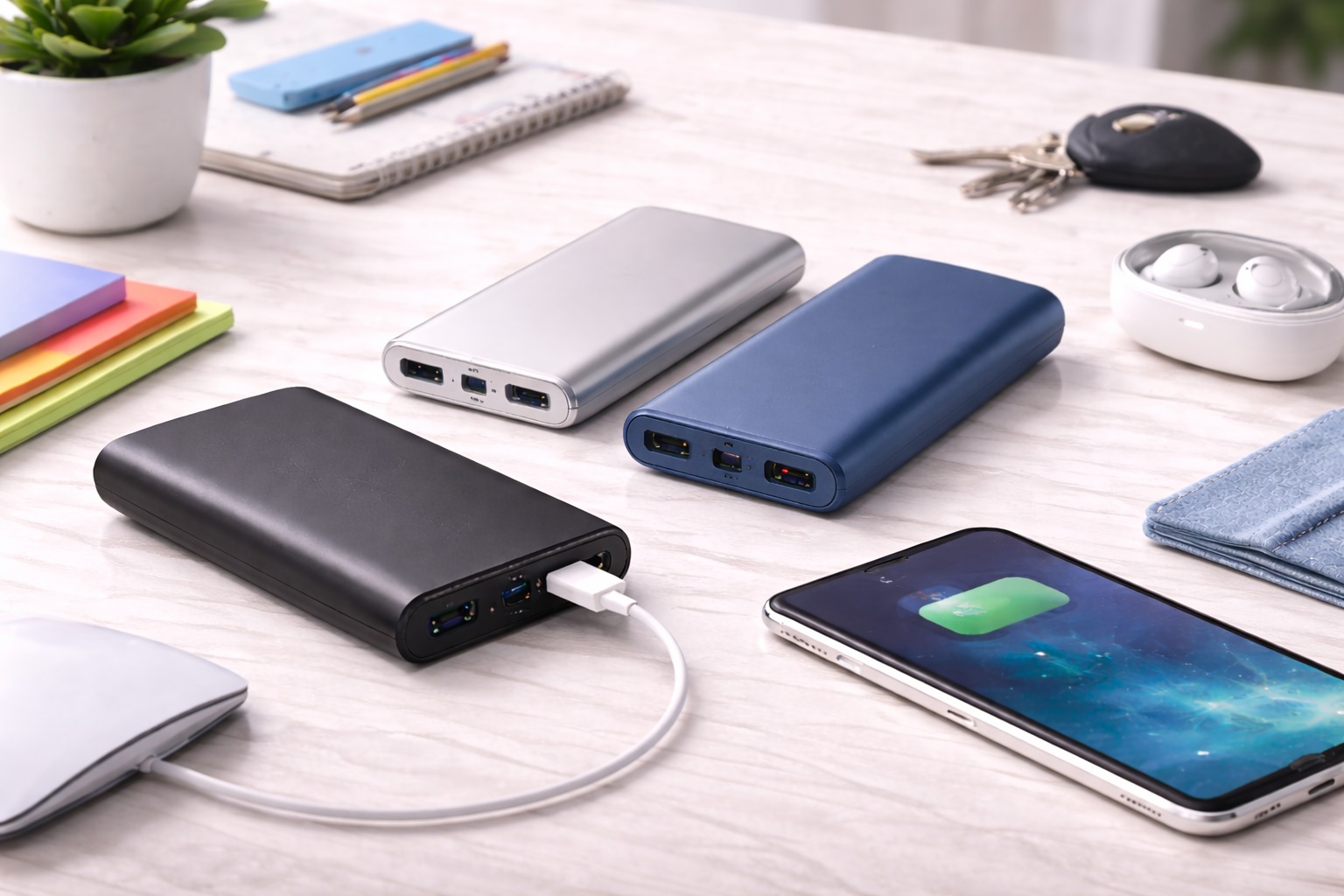
A 10,000mAh slim power bank delivers two to three full smartphone charges in a body thin enough to slide into any bag, which makes it the single easiest recommendation for a first-time buyer who isn't yet sure how heavily they'll use it. USB-C Power Delivery in the 18W–30W range provides a meaningful top-up in thirty to forty-five minutes without requiring any technical knowledge beyond plugging in a cable, since modern fast charging happens automatically once both ends of the connection support it. There's genuinely nothing to configure or switch on — you plug the cable in, and the bank and phone handle the rest of the negotiation between themselves.
- Pros:
- Two to three full phone charges per cycle — enough for most daily situations
- Slim enough to carry in any bag without a second thought
- USB-C fast charging works automatically with no settings to configure
- Priced in the range most first-time buyers are comfortable spending
- Cons:
- Not enough capacity for laptop charging
- Heavy phone users may want to step up to a larger capacity after their first few weeks of use
Best For: First-time buyers who want one dependable bank that covers ordinary daily phone charging without extra complexity.
Why We Recommend It: This capacity and size combination is difficult to get wrong — it's large enough to be genuinely useful and simple enough that there's nothing confusing to figure out.
2. 5,000mAh Ultra-Slim Power Bank – Best Low-Commitment Entry Point
A 5,000mAh ultra-slim power bank provides one full smartphone charge in a form factor barely larger than a smartphone, making it an easy, low-cost way to find out whether carrying a power bank actually fits your daily habits before spending more on a larger model. USB-C input allows a quick overnight recharge, so there's no complicated charging routine to learn. The whole appeal of this size is that it asks almost nothing of you beyond remembering to bring it along, which makes it an ideal way to build the habit before committing to anything larger.
- Pros:
- Simple, single-purpose design with nothing to configure
- One full phone charge — enough to see if you'll actually use a power bank regularly
- Low price point reduces the risk of an unfamiliar first purchase
- Small enough to carry without adjusting existing bag habits
- Cons:
- Only one full phone charge, which some users outgrow quickly
- Not suitable for tablets or laptops
Best For: Buyers who aren't sure yet how often they'll actually use a power bank and want a low-risk way to find out.
Why We Recommend It: Starting small removes the pressure of a big purchase decision and still solves the basic problem of an unexpectedly dead phone.
3. 20,000mAh High-Capacity Power Bank – Best for Heavy Daily Use
A 20,000mAh power bank charges most smartphones four to six times and delivers a full tablet charge, which suits a beginner who already knows they use their phone heavily throughout the day and don't want to think about charging again until the bank itself needs a recharge. Despite the larger capacity, operation is exactly as simple as a smaller bank — plug in a cable, and charging begins automatically. The added size and weight are the only real trade-off for the extra capacity, and for someone who already knows they'll use it heavily, that trade-off is an easy one to accept.
- Pros:
- Four to six full smartphone charges per cycle — rarely needs recharging
- Simple operation despite the higher capacity
- Multiple ports allow charging a second device or helping a friend
- One purchase covers charging needs for days at a time
- Cons:
- Noticeably heavier and bulkier than smaller options, typically 400–500g
- More expensive than a beginner strictly needs if usage turns out to be light
Best For: Beginners who already know they're heavy phone users and would rather buy the right capacity once than upgrade later.
Why We Recommend It: For someone confident about their usage pattern from day one, this capacity avoids the common beginner mistake of under-buying and needing a second purchase within months.
4. Power Bank with Built-In Cable – Best for Avoiding Cable Confusion
A power bank with an integrated charging cable removes one of the most common beginner frustrations: buying a bank only to discover it needs a specific cable type that isn't included or doesn't match the devices at home. With the cable built directly into the housing, there's no need to learn the difference between USB-C, Lightning, and USB-A connectors before the first use. For a buyer who just wants something that works without any research into connector standards, this is the most forgiving option on the list.
- Pros:
- No separate cable to buy, identify, or match to your phone
- Removes an entire category of beginner confusion around connector types
- Compact and simple to use straight out of the box
- Often includes more than one connector type built in
- Cons:
- Built-in cable can't be replaced individually if it wears out
- Capacity is typically modest compared to dedicated high-capacity banks
Best For: Buyers who find cable types and connector standards confusing and want a single unit that just works.
Why We Recommend It: Eliminating the cable-matching step is a genuinely helpful simplification for a first-time buyer with no prior charging accessory experience.
5. Power Bank with Simple LED Display – Best for Understanding Remaining Charge
A power bank with a basic but clear LED percentage display removes the guesswork of wondering how much charge remains, which is one of the more confusing aspects of early power bank ownership. Rather than interpreting a row of small dot indicators, a straightforward number makes it immediately obvious whether the bank needs recharging soon.
- Pros:
- Clear numeric display removes guesswork about remaining charge
- Easy to understand without reading a manual
- Helps beginners learn their own charging habits over the first few weeks
- Reduces the chance of the bank running out unexpectedly
- Cons:
- Slightly higher price than an equivalent bank with basic LED dots
- Display adds a small amount of extra bulk
Best For: Beginners who want to understand exactly how much charge is left rather than guessing from a row of small lights.
Why We Recommend It: A clear display turns an unfamiliar device into something genuinely easy to read at a glance, which matters most in the first few weeks of ownership, before the habit of checking remaining charge becomes second nature. Some buyers find that a clear display alone makes the difference between forgetting to recharge the bank and building a reliable weekly routine around it.
Buying Guide: How to Choose the Best Power Bank for Beginners
Use these twelve factors, each explained in plain terms, to make a confident first purchase without needing to become an expert in charging technology first. Skim the headings first to see which ones you already understand, then slow down only on the handful that feel new.
1. Capacity and Actual Output (What mAh Actually Means)
Stated capacity in mAh is measured at 3.7V battery voltage, but your device charges at 5V through USB, so real-world usable capacity is typically 60–70% of the number printed on the box. A 10,000mAh bank realistically delivers closer to 6,000–7,000mAh to your phone — roughly one and a half to two full charges rather than the larger number the packaging suggests. Understanding this one conversion clears up most of the confusion around why a bank doesn't seem to charge a phone as many times as its mAh rating implies. It also explains why two banks with the same printed mAh number can genuinely charge a phone a different number of times — the conversion efficiency varies slightly between manufacturers, even though neither company is doing anything dishonest by printing the raw cell capacity on the box.
2. Charging Speed: Input and Output (Why Some Banks Charge Faster)
Output speed determines how quickly your phone charges from the bank; input speed determines how quickly the bank itself recharges. USB-C Power Delivery at 18W or higher gives modern phones a noticeably faster charge than older 5W or 10W charging. You don't need to configure anything for fast charging to work — it happens automatically as long as both the bank and your cable support it, which is worth confirming since an old cable can silently limit charging speed even on a fast-charging bank. If a brand-new power bank still seems to charge your phone slowly, the cable is the first thing worth checking before assuming the bank itself is faulty — an old or damaged cable is a far more common culprit than people expect.
3. Port Selection and Cable Compatibility
USB-A is the older, rectangular port style found on older accessories; USB-C is the newer, reversible port style used by most current phones. Check which port type your phone's charging cable uses before buying, since a bank with the wrong port type simply won't connect to your existing cable without an adapter. A bank offering both port types is the safest choice if you're not certain which one you'll need, and it also means the same bank can charge a friend's or family member's device even if their phone uses a different connector than yours.
4. Safety Certifications (What to Look For)
Look for CE, FCC, or UL certification markings on the bank and its packaging — these confirm the product has passed basic electrical safety testing by an independent body. This single check is the most important thing a beginner can do to avoid an unsafe purchase, since certification is far more reliable than trying to judge safety from a product photo or price alone. A quick search of the certification number, if one is listed, can confirm it's genuine rather than simply printed on the packaging without being backed by actual testing.
5. Recharge Time for the Bank
A 20,000mAh bank charging at 18W input can take six to eight hours to fully recharge, while a 10,000mAh bank typically takes three to four hours. Plugging the bank in overnight, the same way you'd charge a phone before bed, is the simplest habit to build so it's always ready in the morning without needing to think about timing.
6. Pass-Through Charging (An Optional Extra, Not a Requirement)
Pass-through charging lets a bank charge a connected device while it is itself being recharged from a wall outlet. It's a genuinely convenient feature, but it isn't essential for a first power bank — most beginners simply charge the bank overnight and use it fully charged the next day, which sidesteps the need for pass-through entirely. Learning about this feature is useful for future purchases, but a beginner shouldn't feel they've made a mistake by choosing a bank without it.
7. Weight and Portability
Higher capacity always means more physical weight. A 20,000mAh bank weighs roughly 400–500g, a 10,000mAh slim bank around 200–250g, and a 5,000mAh ultra-slim model under 130g. For a first purchase, err toward the lighter, slimmer end of that range — it's easier to build the habit of actually carrying a bank you barely notice than one that feels like a burden in a bag. Many first power banks end up left in a drawer simply because they were too heavy or bulky to want to carry every day, which defeats the entire purpose of the purchase.
8. Display and Status Indication
Basic LED indicators show remaining charge in rough 25% increments using a row of small lights. A numeric percentage display is easier for a beginner to read at a glance and removes any need to interpret how many lights are lit. If your budget allows, the clearer display is worth the modest price difference for a first-time buyer, since it removes one more small source of uncertainty during the early weeks of getting used to a new device.
9. Heat Management (What's Normal and What Isn't)
A power bank will feel mildly warm during fast charging — that's normal. It should never become uncomfortably hot to hold, however; if it does, disconnect it and let it cool before further use. Quality designs use metal housings or internal thermal management to keep heat at a comfortable level throughout normal use. If you're ever unsure whether the warmth you're feeling is normal, comparing it to how warm a phone gets during fast charging is a reasonable reference point for what's expected.
10. Wireless Charging Compatibility (A Nice-to-Have, Not a Must)
Some power banks include a built-in wireless charging pad, letting you set a phone down to charge without connecting a cable. It's a pleasant convenience but is slower than a wired connection, so a beginner shouldn't prioritize it over the fundamentals of capacity, charging speed, and safety certification covered above. Think of wireless charging the way you'd think of a bonus feature on any appliance — welcome if it's there, but not worth chasing at the expense of the basics.
11. Battery Chemistry and Cycle Life (Why It Matters Long-Term)
Most modern power banks use lithium-polymer cells, which handle repeated charging better over time than older battery types. Cycle life — the number of full charges a bank can handle before its capacity noticeably declines — is rarely advertised prominently, but a reputable brand's product will typically last two to five years of regular use without significant capacity loss. This is not something a beginner needs to actively research before buying — it's simply useful background for understanding why a bank's performance will very gradually decline rather than fail suddenly.
12. Ease of Use and Setup
A good beginner-friendly power bank requires no app, no account, and no configuration — plug in a cable, and charging starts. Avoid any bank marketed with complicated companion software or unusual proprietary connectors, since the simplest bank to operate is almost always the right choice for someone buying their first one. If a listing spends more time describing an app or a special mode than it does describing charging speed and capacity, that's usually a sign to look elsewhere for a first purchase.
Frequently Asked Questions
1. What size power bank should a beginner buy?
A 10,000mAh bank is the safest starting point for most first-time buyers — large enough to be genuinely useful, small enough to carry without a second thought, and priced reasonably enough that it isn't a major financial commitment while you learn your own usage habits. Once you've lived with it for a month or two, you'll have a clear sense of whether you want more capacity next time or whether this size already covers everything you need.
2. Do I need to charge a new power bank fully before first use?
It's good practice to charge a new power bank to full before using it the first time, though modern lithium-based banks don't require the lengthy initial charging rituals older battery types once did. A normal first full charge is sufficient, and there's no special waiting period or conditioning process required before using it normally afterward.
3. How do I know when to replace my power bank?
Replace it once it no longer holds the charge it used to, typically noticeable after two to three years of regular use. If the bank runs unusually hot, develops a swollen shape, or stops charging altogether, replace it immediately for safety rather than trying to troubleshoot a device showing physical warning signs.
4. Is a more expensive power bank always easier to use for a beginner?
Not necessarily. Price often reflects capacity, brand reputation, or extra features rather than ease of use. Some of the simplest, most beginner-friendly banks are mid-range models that focus on doing the basics reliably rather than adding features a first-time buyer doesn't need. A higher price sometimes buys a nicer finish or a well-known logo rather than anything that makes the bank meaningfully easier to use day to day.
5. What's the difference between mAh and watts?
mAh (milliamp-hours) describes how much total energy the bank stores — think of it as the size of the fuel tank. Watts describe how fast energy moves in or out — think of it as the speed of the fuel pump. A bank can have a large mAh rating but slow wattage, or vice versa, so both numbers matter for different reasons. A useful shortcut for a beginner is to check mAh for how many charges you'll get and wattage for how fast each one happens, and stop there rather than digging deeper into the electrical details.
6. Can I damage my phone by using a power bank incorrectly?
Modern phones and power banks include built-in safeguards that prevent overcharging or delivering too much power, so normal use with a certified bank and a working cable is safe. Damage risk comes mainly from uncertified banks or damaged cables, not from typical everyday charging. This is another reason the safety certification check matters more than almost anything else in this guide — it's the single factor most directly tied to avoiding any real risk.
7. Is the most expensive power bank for beginners always the best?
Not always. Price reflects features and build quality, but many mid-range options outperform expensive alternatives for straightforward beginner needs. Match the product to your actual use case rather than assuming the priciest option is automatically easiest to use, since ease of use has more to do with simple, clear design than with cost.
8. How long should a quality power bank for beginners last?
A well-built power bank from a reputable manufacturer typically lasts two to five years with reasonable care. Warranty length is a useful indicator of how confident the manufacturer is in the bank's durability, and it's worth registering the warranty if the manufacturer offers that option, since it simplifies any future claim.
9. Can I return a power bank for beginners if it doesn't suit me?
Most retailers offer a fifteen- to thirty-day return window. Use the bank normally during that period — charge a few devices, test the ports you'll actually use — before deciding whether it fits your habits. There's no benefit to leaving it in the box untested until the return window is nearly closed.
10. What should I prioritize when buying my first power bank?
Start with a straightforward capacity like 10,000mAh, confirm the port type matches your existing cables, and check for basic safety certification. Everything beyond that — displays, wireless charging, pass-through — is a nice-to-have rather than a requirement for a good first purchase. Trying to optimize for every possible feature at once usually just delays the decision without meaningfully improving the outcome.
11. Does brand name matter for a first power bank?
Established brands typically offer clearer instructions, more consistent quality control, and more reliable customer support if something goes wrong — all genuinely helpful for a first-time buyer still learning what to expect from the category. That said, several newer brands now offer comparable support, so brand name is a helpful signal rather than the only thing worth checking.
12. Will I need to learn anything technical to use a power bank day to day?
No. Once purchased, day-to-day use is simply plugging your phone in when it needs charge and plugging the bank into a wall outlet when it runs low. All of the specifications in this guide matter for the purchase decision, not for daily operation. Once the right bank is in your bag, using it correctly is no harder than charging your phone from any other outlet.
Final Verdict
- Best Overall Starter Pick: 10,000mAh Slim Fast-Charge Power Bank — hard to get wrong for a first purchase.
- Best Low-Commitment Entry Point: 5,000mAh Ultra-Slim Power Bank — a low-risk way to test the habit before spending more.
- Best for Heavy Daily Use: 20,000mAh High-Capacity Power Bank — the right choice for buyers who already know they'll use it often.
- Best for Avoiding Cable Confusion: Power Bank with Built-In Cable — removes an entire category of beginner uncertainty.
- Best for Understanding Remaining Charge: Power Bank with Simple LED Display — makes an unfamiliar device easy to read at a glance.
A first power bank doesn't need to be a complicated decision. Pick a straightforward capacity that matches your daily phone use, confirm the port type fits your existing cables, and check for basic safety certification — everything else in this guide is a helpful refinement rather than a requirement. Once you've used one for a few weeks, you'll have a much clearer sense of whether your next power bank should be bigger, smaller, or exactly the same. That real-world experience will teach you more about your own charging habits than any specification sheet could, and it's a perfectly good reason to treat a first purchase as a starting point rather than a final answer.