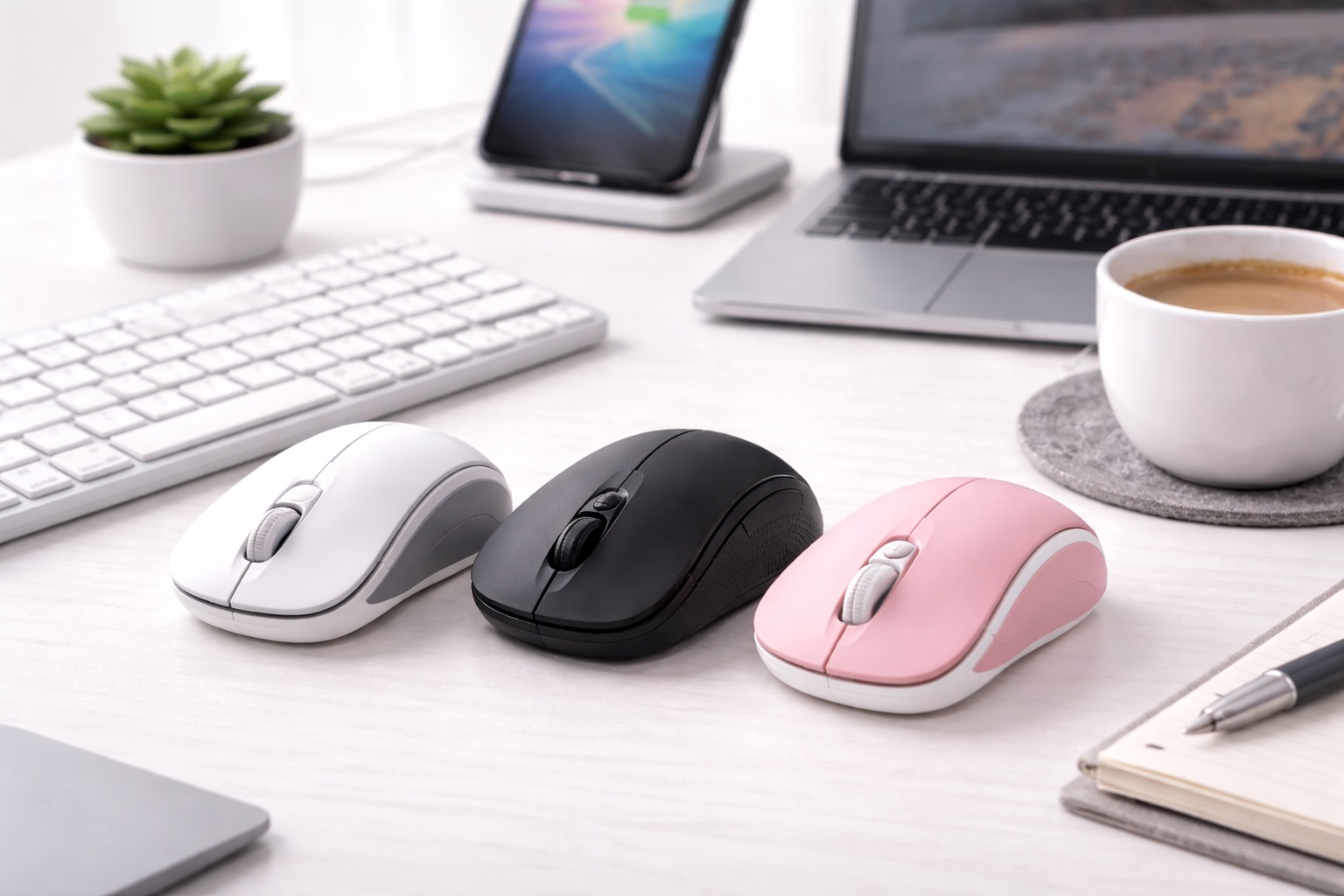
Best Mice for Small Desks: Accurate Control in Compact Workspaces
A cramped desk changes what you need from a mouse. There's less room for wide sweeping motions, less clearance around a keyboard tray, and often a mousepad that has to double as a coaster, a notepad, and a phone stand all at once. In that kind of environment, a mouse that demands a large flat surface or a wide gesture radius becomes a daily annoyance rather than a tool that fades into the background.
The good news is that desk size has very little to do with tracking accuracy. A well-built sensor performs just as precisely in a twelve-inch tracking zone as it does on an open desk, provided the DPI settings and grip style are matched to the available space. What actually separates a good small-desk mouse from a frustrating one is footprint, cable management, click noise in tight shared spaces, and how comfortably the hand sits during hours of close-quarters use.
This guide walks through the practical differences between the main mouse styles suited to compact workspaces, then breaks down how to weigh sensor type, connectivity, grip style, and build quality against your own habits. Whether the desk in question is a dorm room table, a corner nook, or a shared coworking surface, the goal is the same: accurate control without sacrificing the limited real estate you have.
It also helps to think about how a small desk changes the way you actually interact with a mouse over the course of a day. On a spacious desk, you can let a mouse sit wherever it lands and rarely think about it again. On a compact surface, the mouse tends to get nudged, picked up, and repositioned far more often — next to a notebook, around a coffee cup, or out of the way when a laptop lid opens. That extra handling means grip comfort, weight, and button placement end up mattering more on a small desk than they would on a larger one, even though the core tracking technology inside the mouse hasn't changed at all.
Price is a secondary consideration here, and deliberately so. A mouse that costs more but doesn't fit your grip or your available space isn't a better purchase than a cheaper one that does. The comparisons and buying advice below are built around matching real desk constraints and daily habits to the mouse style that suits them, rather than pushing toward whichever product carries the highest price tag or the most marketing around it.
Top 3 Mice for Small Desks (Detailed Reviews)
1. Wireless Ergonomic Mouse – Best Overall for Small Desks
An ergonomic wireless mouse tilts the hand into a more vertical, handshake-like position rather than forcing the wrist to twist flat against the desk. That rotated grip reduces the pronation that builds up over a full workday of standard mouse use. Most models in this category are shaped for right-handed users, though a smaller number of ambidextrous designs exist for people who want the ergonomic benefit without committing to a hand-specific shape. Connectivity is typically handled through a 2.4GHz USB receiver, Bluetooth, or both, and nearly every model in this class includes multiple DPI presets so sensitivity can be adjusted for different tasks throughout the day.
- Pros:
- Rotated grip reduces wrist and forearm strain during long sessions
- Wireless operation keeps the limited desk surface free of cable clutter
- Multiple DPI presets adapt sensitivity to different tasks
- Battery life is generally strong compared to compact alternatives
- Cons:
- Shape is usually right-hand specific
- Larger footprint than a compact travel mouse, which matters on the smallest desks
Best For: Remote workers, developers, and anyone who spends six or more hours a day with a hand on a mouse and notices wrist or forearm fatigue by the afternoon.
Why We Recommend It: The vertical grip directly addresses a well-documented cause of hand and wrist discomfort — the twisted, palm-down posture a flat mouse forces on the forearm. For a small desk, the wireless connection is just as valuable as the ergonomic shape, since it removes one more cable from an already tight surface. Because the receiver is small and the mouse itself doesn't need to be picked up constantly, it also tends to stay put in the corner of a cramped desk rather than sliding around the way a lighter, flatter mouse sometimes does.
Adjusting to the shape takes a short period for anyone used to a standard flat mouse, since the hand rests at an angle rather than lying palm-down. Most users report the transition takes a few days at most, and the comfort payoff afterward is significant enough that going back to a flat design starts to feel noticeably worse by comparison. For a desk where the mouse effectively becomes a permanent fixture rather than something carried elsewhere, this upfront adjustment period is a reasonable trade for the long-term ergonomic benefit.
2. Compact Wireless Mouse – Best for Portability
Compact wireless mice are built around one priority: taking up as little space as possible, both on the desk and in a bag. Most weigh under 80 grams and pair with a small USB receiver that tucks into a slot inside the mouse body when not in use, so nothing gets lost in transit. Because the shape sacrifices some of the contouring found in larger ergonomic designs, these mice are better suited to shorter working sessions than to a full eight-hour shift, but for a laptop that moves between a small desk, a coffee shop table, and a backpack, the trade-off is usually worth it.
- Pros:
- Small enough to fit in a jacket pocket or laptop sleeve
- Receiver stores inside the mouse body, reducing the chance of losing it
- Light weight makes it easy to reposition on a crowded desk
- Many models offer a Bluetooth-only mode for an even cleaner setup
- Cons:
- Less supportive than full-size ergonomic mice over long sessions
- Smaller shape can tire the hand faster during extended use
Best For: Students, frequent travelers, and anyone using a laptop across multiple locations who needs a pointing device that disappears into a bag without a second thought.
Why We Recommend It: On a genuinely small desk, footprint is often the deciding factor, and this style solves that problem directly. It also solves the adjacent problem of portability, which matters for anyone who doesn't work from the same compact desk every day.
Because these mice are designed around minimal bulk, they also tend to leave more usable space around a keyboard and notebook, which matters disproportionately on the smallest desks where every inch counts. The smaller body does mean less surface area for the hand to rest on, so buyers who plan marathon sessions at a single desk should weigh that against the convenience of a mouse that fits in a coat pocket without a second thought.
3. Silent Click Wireless Mouse – Best for Quiet Use
Silent click mice replace the standard switch mechanism with one that dampens the audible snap of a click by a significant margin, without changing how the click registers. The tracking and button response feel identical to a standard mouse — only the sound is different. That makes this style a practical fit for small desks that sit close to roommates, family members, or coworkers, where every click would otherwise be audible in a quiet room. Silent switches are now available across both ergonomic and compact body styles, so the quiet-click feature isn't limited to one particular shape.
- Pros:
- Click noise is dramatically reduced compared to standard switches
- Tracking precision and click registration remain unaffected
- Available in both ergonomic and compact body styles
- Well suited to shared offices, libraries, and thin-walled apartments
- Cons:
- Some users find the muted click feels slightly softer or less tactile
- Silent switches can wear differently over time compared to standard clicks
Best For: Anyone whose small desk sits in a shared or noise-sensitive space — a studio apartment, a library carrel, an open-plan office, or a room shared with someone else on a call.
Why We Recommend It: The clicking sound of a standard mouse becomes noticeably more intrusive in a small, quiet room than it ever is in an open office. This style removes that friction entirely while keeping the same click accuracy buyers expect from a full-price mouse.
This is one of those upgrades that's easy to overlook until you're actually sitting a few feet from someone else on a video call, at which point every click becomes obviously audible through a laptop microphone. For anyone working from a small home office, a shared bedroom desk, or a co-working table close to other people, the switch to a quieter mechanism is a small change that noticeably improves the daily experience for everyone nearby, not just the person using the mouse.
Buying Guide: How to Choose the Best Mouse for a Small Desk
A compact desk doesn't change what makes a mouse accurate, but it does change which trade-offs are worth making. Use the factors below to weigh your options against your actual desk space and daily habits rather than defaulting to whichever model has the most reviews.
1. Footprint Relative to Available Desk Space
Before considering sensor quality or button count, measure the actual clear space around your keyboard. A mouse needs room not just to sit, but to move — a few inches of lateral travel in every direction. On a genuinely small desk, a compact or travel-oriented mouse paired with a moderate-to-high DPI setting will often serve you better than a large ergonomic mouse that constantly bumps into the edge of a keyboard tray or a monitor stand. It's worth doing this measurement with your keyboard, notebook, and any other regular desk items already in place, since the usable space on a cluttered small desk is often considerably smaller than the desk's total surface area would suggest.
2. Sensor Type (Optical vs. Laser)
Optical sensors track reliably on the vast majority of desk surfaces, including cloth mousepads, wood, and laminate. Laser sensors extend that range to glossy or glass surfaces but can occasionally over-accelerate on certain textured mats. For most small-desk setups, where the mouse is likely to sit directly on the desk surface rather than a dedicated pad, a quality optical sensor is the safer, more predictable choice.
3. DPI Range and Adjustability
DPI determines how far the cursor travels per inch of physical mouse movement, which matters more on a small desk where the mouse has less room to travel across the pad. A higher DPI setting lets you cover a full-size monitor without running out of desk space mid-swipe. Most office tasks are comfortable in the 800–1600 DPI range, but adjustable presets let you drop down for detail work and increase for general navigation without switching devices. A dedicated DPI button on the mouse itself is a convenient touch, letting you change sensitivity on the fly without opening any software, which is especially handy on a desk where reaching for a keyboard shortcut or a settings menu takes an extra motion you'd rather skip.
4. Wireless Connectivity Type
A 2.4GHz USB receiver typically delivers the most consistent, low-latency connection and is a sensible default for anyone doing precision work. Bluetooth removes the need for a dedicated USB port, which is valuable on laptops with limited connectivity, but introduces a small amount of additional latency. For general browsing, writing, and office tasks, either connection type is perfectly usable. Some mice support both modes and let you switch between them depending on what's plugged into the machine that day, which is a useful feature if you regularly move a laptop between a small desk and a docking setup elsewhere.
5. Mouse Shape and Grip Style
Palm grip users rest their entire hand across the mouse and generally do better with a larger body. Claw grip users arch their fingers over a mid-size shape, contacting the mouse mainly at the fingertips and the base of the palm. Fingertip grip users barely touch the rear of the mouse at all and tend to prefer smaller, lighter designs. On a small desk where the mouse may need to be picked up and repositioned often, a shape that matches your natural grip reduces unnecessary hand fatigue.
6. Weight
Lighter mice, generally under 80 grams, require less arm effort to move and reposition, which adds up over a full day of frequent small movements — something that happens more often on a cramped desk where the mouse regularly runs out of room. Heavier mice can feel more planted and stable, which some users prefer for precision tasks, but they demand more from the wrist and forearm during sustained use.
7. Click Weight and Button Feedback
The resistance of the primary click buttons affects both comfort and accuracy. A switch that's too light can lead to accidental double-clicks; one that's too stiff causes finger fatigue during repetitive clicking. Most consumer mice land in a comfortable middle range, but if you click frequently throughout the day, it's worth reading reviews that specifically mention click feel rather than relying on spec sheets alone.
8. Battery Life and Charging Method
Wireless mice vary enormously in how they're powered — some use replaceable AA or AAA batteries that last months at a time, while others use an internal rechargeable battery topped up through USB-C. Rechargeable models are convenient and avoid battery waste but need periodic charging; battery-powered models last longer between service but require you to keep spares on hand. Neither approach is objectively better — the right choice depends on whether you'd rather remember to charge or remember to restock batteries. If you go the rechargeable route on a small desk, consider where the charging cable will actually sit during use, since not every mouse can be used comfortably while it's plugged in and charging.
9. Side Button Placement
Most mice include two programmable side buttons for forward and back navigation, and some offer additional buttons for custom shortcuts. What matters more than the count is placement — buttons that sit naturally under the resting position of your thumb get used; buttons that require shifting your grip to reach usually don't. This is especially relevant on a small desk, where you're less likely to reposition your whole arm just to hit an awkwardly placed button.
10. Build Quality and Long-Term Durability
Plastic quality varies more between mice than most buyers expect. Matte finishes resist fingerprint buildup and tend to grip better under a sweaty palm than glossy alternatives. Pay particular attention to the scroll wheel — inconsistent or skippy scrolling is one of the most common failure points on lower-quality mice, often appearing well before the sensor or buttons show any wear. It's also worth checking how the mouse's feet — the small pads on the underside that glide across the desk — are attached, since these tend to wear down or peel off over years of daily use and are often among the first visible signs of aging on an otherwise functional mouse.
11. Companion Software and Customization
Many mice pair with desktop software for adjusting DPI curves, remapping buttons, or setting up macros. If customization matters to your workflow, confirm the software supports your operating system and doesn't require a constantly running background process just to retain your settings. Some higher-end models store custom profiles directly in onboard memory, which removes the software dependency entirely. This is a particularly useful feature for anyone who switches between a small desk at home and a different machine elsewhere, since the settings travel with the mouse rather than staying tied to one installation of the manufacturer's software.
12. Cable Management and Desk Real Estate
Even a wireless mouse touches your desk's cable situation — a USB receiver occupies a port, and a rechargeable model periodically needs a charging cable running to it. On a small desk, plan for where the receiver and any charging cable will sit day to day, rather than discovering after purchase that there's nowhere convenient to route them. A short USB extension cable or a small cable clip near the edge of the desk can keep a charging cord from becoming yet another object competing for space on an already tight surface.
Frequently Asked Questions
1. Does a small desk actually require a different type of mouse?
Not a fundamentally different one, but footprint and DPI settings matter more. A compact or moderately sized mouse paired with a higher DPI setting makes better use of limited tracking space than a large mouse that constantly runs into the edge of the available surface. The underlying sensor technology performs the same regardless of desk size — it's the practical fit and daily handling that change.
2. What DPI setting works best on a small desk?
Because there's less physical room for the mouse to travel, a slightly higher DPI setting — often in the 1200–1600 range — helps the cursor cover a full monitor without repeatedly lifting and repositioning the mouse. Lower settings around 800 DPI still work fine for detail-focused tasks like photo editing.
3. How long does a wireless mouse's battery typically last?
This varies by design. Rechargeable USB-C models often last three to eight weeks per charge under normal use, while mice powered by AA batteries can run for several months to close to a year. Actual battery life depends on usage intensity, DPI settings, and whether power-saving features are enabled. Leaving a rechargeable mouse plugged in overnight periodically is usually enough to keep it from running dry mid-task.
4. Is a lighter mouse always more comfortable?
For most people using a mouse for several hours a day, yes — less weight means less cumulative arm effort. Some users still prefer a heavier mouse for the sense of stability it provides during precision tasks, so this ultimately comes down to personal preference rather than a universal rule.
5. Can a poorly chosen mouse contribute to wrist pain?
A flat, standard-shaped mouse used for long stretches without breaks can contribute to wrist and forearm strain over time. An ergonomic design that keeps the hand in a more neutral, rotated position can meaningfully reduce that strain when combined with reasonable break habits and a properly set up desk.
6. How do I know if a mouse will actually fit my hand?
Many manufacturers now list the physical dimensions of a mouse on the product page. Measure your hand from the base of the palm to the tip of your middle finger and compare it to the mouse's length — for a palm grip, these should roughly match. Reviews from buyers with a similar hand size are also a useful reference point, and some retailers include width and height measurements alongside overall length, which helps if your hand is notably wide or narrow relative to its length.
7. Is a silent-click mouse a good option for shared spaces?
Yes. Silent click mechanisms significantly reduce the audible snap of each click without changing how precisely the click registers, which makes them a sensible pick for shared offices, thin-walled apartments, or any small desk situated near someone else on a call. The reduced sound is especially noticeable during video calls, where a laptop microphone can otherwise pick up every click clearly.
8. Does the most expensive mouse always perform the best?
Not necessarily. Higher prices often buy additional features like onboard memory, extra buttons, or premium materials, but many mid-range mice deliver excellent day-to-day performance. It's more useful to match features to your actual needs than to assume price alone indicates quality.
9. How long should a well-built mouse last before it needs replacing?
A quality mouse from a reputable brand typically holds up for two to five years or longer with normal care. Scroll wheel wear tends to be the first sign of aging, so a warranty length is often a reasonable proxy for expected durability.
10. Can I return a mouse if it doesn't suit my hand or desk setup?
Most retailers offer a return window somewhere between 15 and 30 days. It's worth keeping the original packaging during that evaluation period so you retain the option to send it back if the fit or feel isn't right for your desk and grip style. Testing the mouse across a few different tasks — typing, clicking, and scrolling for an extended stretch — during that window gives a more realistic sense of comfort than a quick five-minute trial.
11. Bluetooth or a USB receiver — which is better for a small desk?
A 2.4GHz USB receiver generally offers a more consistent, lower-latency connection, which matters for precision-heavy work. Bluetooth frees up a USB port, which can be valuable on a laptop with limited connectivity, at the cost of a small amount of extra latency that most users won't notice during everyday tasks.
12. Does brand reputation matter when choosing a mouse?
Established brands tend to offer more consistent quality control, more responsive customer support, and clearer warranty terms. That said, newer or lesser-known brands sometimes provide strong value — it's worth reading verified user reviews closely before committing to an unfamiliar name.
Final Verdict
- Best Overall for Small Desks: Wireless Ergonomic Mouse – the strongest long-term investment in hand and wrist comfort during daily use.
- Best for Portability: Compact Wireless Mouse – the easiest option to carry between a small desk, a bag, and other locations.
- Best for Quiet Use: Silent Click Wireless Mouse – the most considerate choice for shared or noise-sensitive spaces.
There's no single correct mouse for every small desk — the right pick depends on how many hours you spend using it, whether you move between locations, and how much your click noise matters to the people around you. Matching the mouse's shape, weight, and connectivity to your actual habits will do more for daily comfort than chasing the highest-rated option on a spec sheet.
If you're still undecided, start by ranking your own priorities: comfort during long sessions, ease of carrying the mouse elsewhere, or quiet operation in a shared space. Whichever priority comes out on top will usually point you toward one of the three categories above more clearly than any single spec on a product listing. A small desk rewards a mouse that's been chosen deliberately for the space it has to work in, rather than one picked purely on brand recognition or star rating.