Best Budget Foot Rests: Proper Leg Support Without the Premium Price
Furnishing a home office on a limited budget usually means making trade-offs somewhere, and a foot rest is one of the few items where those trade-offs don't have to be significant. A budget foot rest doesn't have to mean a compromise foot rest. The core function — lifting your feet to a supportive height and angle — depends far more on basic design and construction than on brand markup or added extras. Plenty of inexpensive options deliver the same postural benefit as far pricier alternatives, provided you know which features actually matter and which are just marketing. The trick is separating the two categories before you shop rather than after you've already spent the money and started using the product.
Where budget shopping goes wrong is usually not the price itself but the shortcuts some manufacturers take to hit that price — thinner plastic that flexes under weight, bases that slide on hard flooring, or surfaces that lose their texture after a few months of daily use. None of these shortcuts are visible in a product photo, which is exactly why it helps to know what separates a genuinely good budget product from one that's simply cheap. A product photo, after all, can't show you how a base grips a hardwood floor after six months, or whether a tilt dial still holds its position after a hundred adjustments.
This guide compares the practical foot rest types available at accessible prices, walks through the buying factors that predict whether a low-cost product will actually hold up, and answers the questions people ask most often when shopping on a limited budget. Nothing here assumes you need to spend more than necessary — the goal is spending well, not spending more, and that distinction is what separates a satisfied budget shopper from one who ends up buying the same category of product twice within a year.
It also helps to remember that ergonomic accessories are one of the few product categories where price and quality don't track each other as closely as you might expect. A monitor arm or an office chair often does show meaningful quality differences across price tiers, but a foot rest is a mechanically simple product, and the manufacturing techniques used to make a $12 version and a $45 version aren't always as different as the price gap suggests. That doesn't mean every cheap option is equally good — some genuinely are built to lower standards — but it does mean price alone is a weak signal of quality in this particular category, which is exactly why the factors below focus on specific, checkable details rather than price bracket.
It's also worth setting expectations early: a budget foot rest is not going to include every premium feature on the market, and that's fine. The question isn't whether a low-cost model matches a $150 executive version feature for feature — it's whether it solves your actual problem, which for most people is simply getting their feet off the floor at a supported angle for a reasonable number of hours per day. Once that basic need is met, everything else — massage rollers, heating elements, premium fabric covers — is a nice-to-have rather than a genuine requirement, and it's fine to decide those extras aren't worth the added cost.
Top Picks Reviewed
1. Adjustable Tilt Foot Rest – Best Overall Value
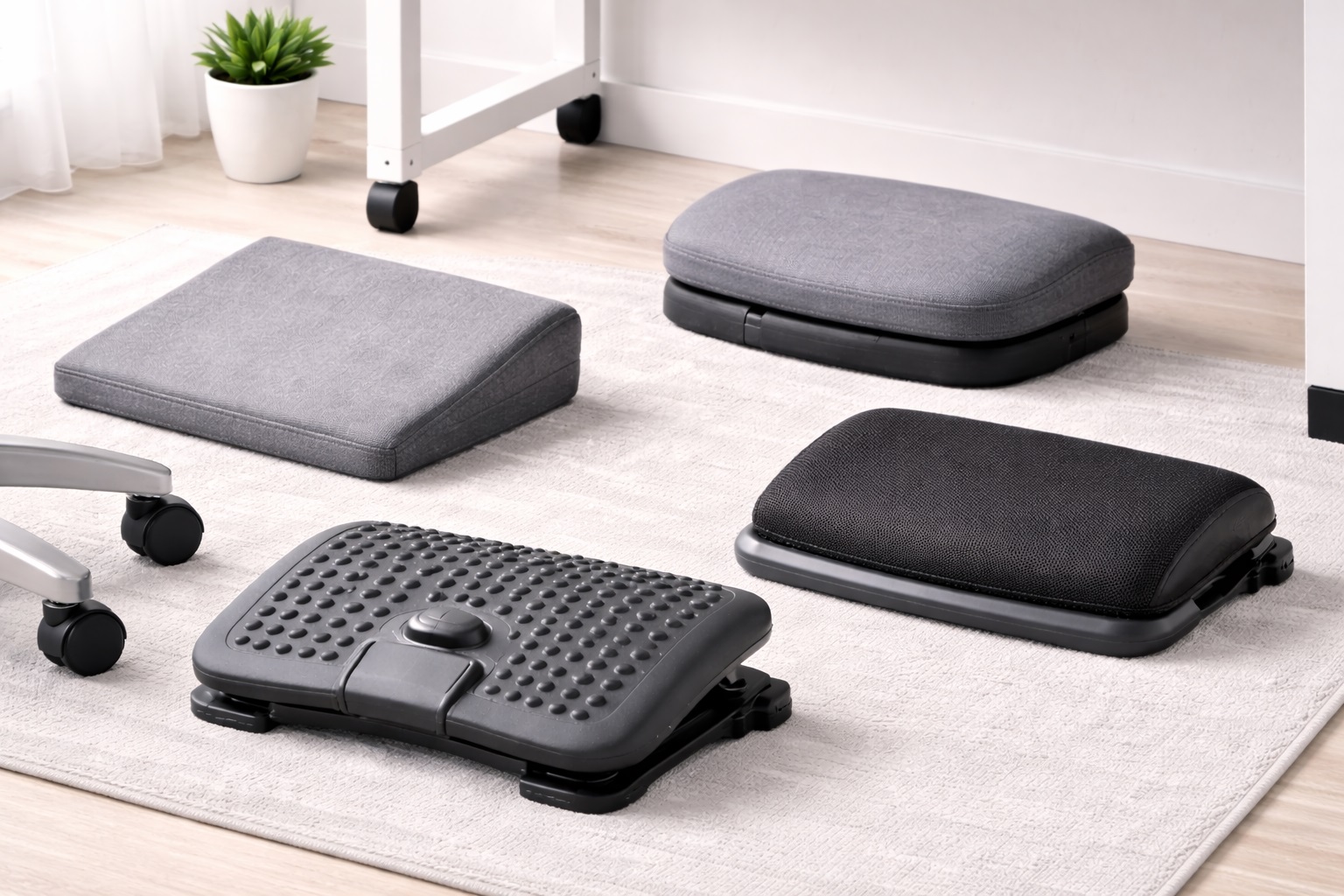
An adjustable tilt foot rest lets you set both height and angle to place your feet in a neutral position for your leg length and chair height, and this feature set is available at budget price points more often than shoppers expect. Multiple angle settings accommodate different sitting postures through the day, and a non-slip top surface paired with a stable base keeps the unit in place during normal use. The main difference between a $15 version and a $60 version is usually the plastic grade and how smoothly the tilt mechanism operates, not whether the core adjustment feature exists at all. Manufacturers have largely standardized around a small number of tilt-adjustment designs, which is part of why the feature has become so widely available across price tiers rather than being reserved for a premium product line.
- Pros:
- Height and angle adjustment available even at low price points
- Accommodates different chair heights without a second purchase
- Non-slip surface keeps feet positioned correctly
- Stable base prevents shifting during use
- Cons:
- Plastic construction on the least expensive models feels less premium
- Some low-cost tilt mechanisms require more effort to adjust or loosen over time
Because adjustability is now common across most price tiers, there's rarely a good reason to buy a budget foot rest that skips this feature entirely. Read reviews for specific mentions of the tilt mechanism holding up after months of use, since that's the detail that separates durable budget units from ones that fail early. It's also worth noting how the mechanism is described in terms of effort — a stiff dial that takes two hands to adjust is a minor inconvenience compared with one that slips out of position on its own, and reviewers usually mention whichever problem they've personally experienced.
Best For: Home office workers and students who want personalized height and angle support without paying premium prices for a feature that's now standard even in lower-cost models.
Why We Recommend It: Adjustable tilt used to be a premium feature reserved for expensive ergonomic lines, but it has become widely available at accessible prices. Choosing a fixed-height budget option today usually means missing out on a feature you could have had for a similar or only slightly higher price, so it's worth comparing before settling for the very cheapest listing. Spending an extra few dollars for adjustability, when it's available, tends to deliver more day-to-day comfort improvement than almost any other change you could make to a budget setup.
2. Rocking Foot Rest – Best Budget Pick for Circulation
A rocking foot rest allows gentle foot and leg movement throughout the day, supporting circulation and reducing the fatigue that comes from holding feet in one static position. The rocking motion is subtle by design — enough to encourage small movements without becoming distracting during focused work. Simple curved-base designs keep manufacturing costs down, which is why this category tends to be one of the more affordable options in the ergonomic foot rest space. There's also less variation between brands in this style than in adjustable models, since a curved rocker base is a fairly fixed shape once the size and material are decided, leaving fewer opportunities for a manufacturer to introduce a design flaw.
- Pros:
- Promotes leg movement and circulation during sitting
- Reduces fatigue from static foot positioning
- Simple curved-base construction keeps prices low
- Comfortable for extended daily use
- Cons:
- Rocking motion requires a brief adjustment period
- Less suitable for users who need a completely fixed foot platform
Because the rocking mechanism is mechanically simple — essentially a curved base rather than a hinge or gear system — it's less prone to the kind of wear that affects more complex budget mechanisms. That simplicity is part of why this style holds up reasonably well even at lower price points. There isn't a tilt dial or a locking hinge that can strip or loosen, which is precisely the kind of small mechanical part that tends to fail first on the least expensive adjustable models.
Best For: Remote workers and students on a budget who sit for extended periods and want to reduce leg fatigue without spending extra for a premium ergonomic brand.
Why We Recommend It: The rocking design's simplicity works in its favor for budget shoppers — there's less mechanism to fail, which means the affordable versions tend to perform closer to their premium counterparts than adjustable tilt models do at the low end of the price range. If your priority is reliability above all else on a tight budget, this is often the safer category to shop in, and it's a reasonable default recommendation when you're not sure which style to start with.
3. Flat Non-Slip Foot Rest – Best Rock-Bottom Price
A flat foot rest elevates the feet at a fixed height with no tilt or rocking mechanism, and it's consistently the least expensive style available because there's simply less to manufacture. For anyone whose only issue is feet not reaching the floor comfortably, this no-frills option solves the problem at the lowest possible cost. It's also the style you'll see recommended most often for students or anyone furnishing a first home office on a tight budget, since it does one job well without asking for a bigger commitment.
- Pros:
- Simple, reliable design with no moving parts to fail
- The most affordable category of foot rest available
- Immediately improves posture for short-legged users
- Non-slip surface on most models even at low prices
- Cons:
- Fixed height — not adjustable
- No tilt for personalized foot angle
Because there's no adjustment mechanism to manufacture, cut corners on a flat foot rest tend to show up in the surface material and base grip rather than in a failing mechanical part — which means checking those two things carefully is more useful than reading about durability in the abstract. A quick scan of reviews for the words "slippery" or "slides" will surface most of the products worth avoiding in this category faster than reading full paragraph reviews one at a time.
Best For: Budget shoppers whose only requirement is getting their feet off the floor at a fixed comfortable height, without needing tilt or rocking features.
Why We Recommend It: When the entire goal is spending the least amount possible while still solving the core problem, a flat foot rest with a decent non-slip surface delivers exactly that — no wasted spending on features you may not use. If a tilt or rocking feature later turns out to matter to you, the low cost of this style means the initial purchase was never a significant financial risk in the first place, and the unit can still be repurposed elsewhere in the house rather than sitting unused.
Buying Guide: How to Choose the Best Budget Foot Rest
Use these factors to separate genuinely good budget products from ones that are simply cheap. A little attention here goes a long way toward avoiding a purchase you'll want to replace within a few months. Each of these factors is something you can check in five minutes on a typical product listing page, without needing to contact the seller or wait for a sample.
1. Read Reviews for Durability, Not Just Star Rating
A 4.5-star average can hide a pattern of failures after three or four months if most reviews are from the first week of ownership. Sort reviews by "most recent" and look specifically for mentions of the product holding up — or not — after extended use, which tells you more than the overall average. Many marketplaces let you filter reviews by star rating too, so reading a handful of one- and two-star reviews specifically can reveal a recurring failure point that the overall average conceals.
2. Height Adjustment Range
Even at a low price, check that the adjustment range actually covers the height you need — knees at roughly 90 degrees with thighs close to parallel to the floor. A budget adjustable model with a limited range isn't meaningfully better than a fixed-height one if it doesn't reach your specific measurement. Product listings usually state a minimum and maximum height in inches or centimeters, and it takes only a moment to compare that range against the measurement you took at your own desk.
3. Base Material and Grip
The base is where manufacturers most often cut costs on budget models. Rubber-padded bases resist sliding on hard floors; thin, hard plastic feet slide more easily and can scratch flooring over time. This detail matters more for long-term satisfaction than almost any other spec on a budget purchase, largely because it's the one part of the product in constant contact with the floor and under repeated pressure every single day.
4. Surface Texture and Grip
A non-slip top surface keeps feet from drifting during the day. Cheaper materials sometimes lose their texture faster than higher-grade rubber or textured plastic, so reviews mentioning surface wear over time are worth reading carefully before you commit. A surface that felt grippy out of the box but turned smooth and slick after a few months of sock-covered feet sliding across it is one of the more common complaints in this price bracket.
5. Weight Capacity Versus Actual Use
Budget foot rests sometimes list lower weight capacities than premium alternatives. Confirm the rated capacity comfortably exceeds your actual needs rather than assuming all foot rests are rated the same, since a unit rated near your body weight will wear out faster than one with margin to spare. A comfortable safety margin — a rated capacity well above your actual weight — generally means the base and internal supports were built with sturdier material rather than the bare minimum needed to pass a rating test.
6. Warranty Length as a Quality Signal
A manufacturer confident in their product's durability typically backs it with a reasonable warranty, even at a low price point. A complete absence of warranty coverage on an otherwise similarly priced item is worth treating as a caution flag rather than a coincidence. Even a 90-day warranty is enough to reveal an early manufacturing defect, while a complete lack of any coverage suggests the seller isn't expecting the product to be evaluated closely after purchase.
7. Return Policy Before You Buy
Because budget products vary more in quality than premium ones, a flexible return window matters more here. Check the seller's return policy before ordering, and keep the original packaging until you're confident the product is holding up as expected. Setting a reminder near the end of the return window is a simple habit that saves you from missing the deadline while you're still on the fence about keeping it.
8. Material Feel Versus Photos
Photos can't convey how a plastic surface feels or how solid a base is underfoot. Reviews that specifically mention the material — "feels sturdier than expected" or "flimsier than the photos suggest" — are more useful than the product description itself for gauging real quality at a given price. Manufacturer descriptions are written to sell the product, while reviewer language, even when brief, tends to reflect an honest reaction to the item in hand.
9. Rocking vs Static for Your Situation
Static platforms hold a fixed position; rocking designs allow gentle movement. Since rocking mechanisms are mechanically simpler and often equally affordable, they're worth considering even if you weren't originally planning on a rocking style, particularly if budget is the primary constraint. Trying the motion in a showroom or on a friend's unit before buying, if that's an option, can settle any hesitation faster than reading descriptions online.
10. Avoid Paying for Unnecessary Extras
Some budget-adjacent listings add features like built-in massage rollers or heating elements that push the price higher without meaningfully improving posture support. If your goal is genuine ergonomic value rather than novelty features, a simpler model without these extras is often the better use of a limited budget. Novelty add-ons also tend to be the first component to fail, since they're rarely engineered with the same attention as the core structural elements of the product.
11. Compare Price Per Expected Year of Use
Instead of comparing sticker price alone, estimate how many years a product is likely to last based on reviews and warranty length, then divide the price by that number. A slightly pricier option that lasts twice as long is often the better budget decision even though it costs more upfront. This kind of simple math is easy to skip when comparing listings side by side, but it's the calculation that actually reflects long-term value rather than short-term savings.
Frequently Asked Questions
1. Can a budget foot rest really be as good as an expensive one?
For the core function — elevating feet to a supportive height and angle — yes, in many cases. The differences between budget and premium models tend to show up in material grade, mechanism smoothness, and long-term durability rather than in whether the basic ergonomic benefit exists at all. Most of the improvement in seated comfort comes from correct height and angle, both of which are achievable at a modest price.
2. What's the biggest risk with a very cheap foot rest?
The most common issues are a base that slides on hard flooring, a surface that loses grip after a few months, or a tilt mechanism that loosens with regular use. Reading recent reviews specifically for these three issues is the best way to avoid them, since they're the complaints that appear most consistently across low-cost listings when a manufacturer has cut a corner somewhere.
3. Is an adjustable budget foot rest worth it over a fixed one?
Usually, yes, since adjustability is now available at most price points and provides meaningfully better personalized support. Only choose a fixed-height model if you've confirmed your specific height needs match its fixed dimensions or if price difference is a genuine constraint. In most cases the price gap between fixed and adjustable budget models is small enough that it's worth paying the little extra.
4. How do I know if a budget foot rest will hold up over time?
Sort product reviews by most recent and look for comments from buyers who've owned the product for several months rather than just the first week. Consistent recent complaints about a specific part failing are a much stronger signal than an overall star average. If three or more recent reviewers mention the same problem independently, treat that as far more informative than a single detailed complaint or a single glowing review.
5. Should I buy the cheapest foot rest available?
Not necessarily. The cheapest option in a category is sometimes the best value, but it's also where corners are most likely to be cut on base grip or surface durability. Comparing a few options slightly above the rock-bottom price often reveals a meaningfully better product for only a small difference in cost. Treat the very lowest price in a category as a starting reference point rather than an automatic winner.
6. Does brand name matter for a budget foot rest?
Somewhat. Established brands tend to offer more consistent quality control even in their lower-priced lines, while unfamiliar brands can be hit or miss. Reading verified purchase reviews is a reasonable way to evaluate a lesser-known brand before committing. A brand's track record on similar products, even in a different category, can also offer a useful hint about their general manufacturing standards.
7. How long should a budget foot rest last?
A reasonably well-made budget product should last one to three years with regular use, somewhat less than premium alternatives that may last five years or more. Matching your expectations to the price point helps avoid disappointment. If a budget product is still functioning well after its first year, that's usually a good sign it will continue performing for the remainder of its expected lifespan.
8. Can I return a budget foot rest if it feels flimsy?
Most retailers offer a return window of 15 to 30 days, which is generally enough time to assess whether a budget product feels solid enough for regular use. Test it within that window rather than putting off the evaluation, since retailers are far less likely to accept a return once that window has closed, regardless of the reason.
9. What should I prioritize on a limited budget?
Base stability and surface grip matter more day to day than extra features. Prioritize a stable, grippy foot rest with basic height adjustment over one with more features but a wobbly or slippery base. These two qualities affect every single session of use, while extra features are only occasionally relevant.
10. Are rocking foot rests more reliable at low prices than adjustable ones?
Often, yes, because the mechanism is simpler and has fewer parts that can wear out or loosen. This makes the rocking style a reasonably safe choice when shopping strictly by price, particularly for buyers who haven't yet decided which specific feature set matters most to them.
11. Is it better to wait for a sale on a mid-range model instead of buying budget now?
If your current setup causes real discomfort, a reasonable budget option now is usually better than continued discomfort while waiting for a sale. You can always upgrade later once you know exactly which features matter most to you, and the money spent on a reasonable budget option now is rarely wasted since it can move to a second desk or be passed along later.
Final Verdict
- Best Overall Value: Adjustable Tilt Foot Rest — personalized support that's no longer reserved for premium price points.
- Best Budget Pick for Circulation: Rocking Foot Rest — a simple mechanism that holds up well even at low prices.
- Best Rock-Bottom Price: Flat Non-Slip Foot Rest — the lowest-cost way to solve the basic problem of feet not reaching the floor.
A limited budget doesn't mean settling for poor ergonomic support. Focus on base stability, surface grip, and recent reviews rather than price alone, and you'll come away with a foot rest that does its job well for years rather than months. The small amount of extra time spent comparing a handful of listings against these factors is a far better investment than hoping the cheapest option happens to work out.