Best Ergonomic Foot Rests: Scientifically Designed for All-Day Comfort
Ergonomics as a design principle is really just applied observation about how the human body holds up under sustained postures, and foot support is one of the more overlooked pieces of that picture. Most people focus their ergonomic attention on the chair, the monitor height, or the keyboard angle, and leave the feet to dangle or rest flat on whatever the floor happens to offer. Yet correct lower-body positioning is part of the same postural chain that determines whether your back, hips, and legs feel fine or fatigued at the end of an eight-hour day.
The physiological logic behind a good ergonomic foot rest is straightforward. When your knees sit at roughly a 90-degree angle and your thighs run close to parallel with the floor, weight distributes evenly through the seat and legs rather than concentrating pressure under the thighs or forcing the lower back to compensate for a tilted pelvis. If your chair height doesn't naturally put your feet at that position — which is common, since chairs and desks are built to average dimensions that don't fit everyone — a foot rest closes that gap.
This guide focuses specifically on the ergonomic reasoning behind foot rest design rather than treating it as a generic accessory. We cover the mechanisms that have genuine postural backing, the buying factors that separate a functional ergonomic tool from a gimmick, and the questions professionals ask most often when trying to build out a properly supported home office setup.
It's worth being direct about what "ergonomic" actually means in this context, since the word gets applied loosely across furniture marketing. An ergonomic foot rest is one whose design responds to how the body actually behaves in a seated position — adjustable height to match individual leg length, tilt options that reduce static muscle tension, and movement features that counter the circulation effects of prolonged stillness. It isn't a specific brand or a certification; it's a set of functional design choices you can evaluate directly.
There's also a useful distinction between features that address a genuine biomechanical need and features that simply sound scientific in a product description. Adjustable height addresses a real, measurable mismatch between your body and standard furniture dimensions. Tilt range addresses the fact that a completely flat foot position isn't universally the most comfortable static angle. Movement — whether through a rocking base or a textured surface that encourages small foot adjustments — addresses the well-documented reality that any fixed posture, however aligned, becomes fatiguing if held rigidly for hours. Each of these has a clear mechanical reason behind it. By contrast, claims about "enhanced circulation" or "clinically inspired design" without any specific mechanism attached are usually marketing language layered on top of an otherwise ordinary product, and it's worth reading past that language to the actual design features underneath.
None of this means you need to research spinal biomechanics before buying a foot rest. It means paying attention to whether a product's features map onto a specific, sensible reason, and treating vague comfort claims with a bit of healthy skepticism. The three product types reviewed below were chosen because each represents a genuinely distinct ergonomic approach rather than a cosmetic variation on the same idea.
Top Picks Reviewed
1. Adjustable Tilt Foot Rest – Best Overall Ergonomic Support
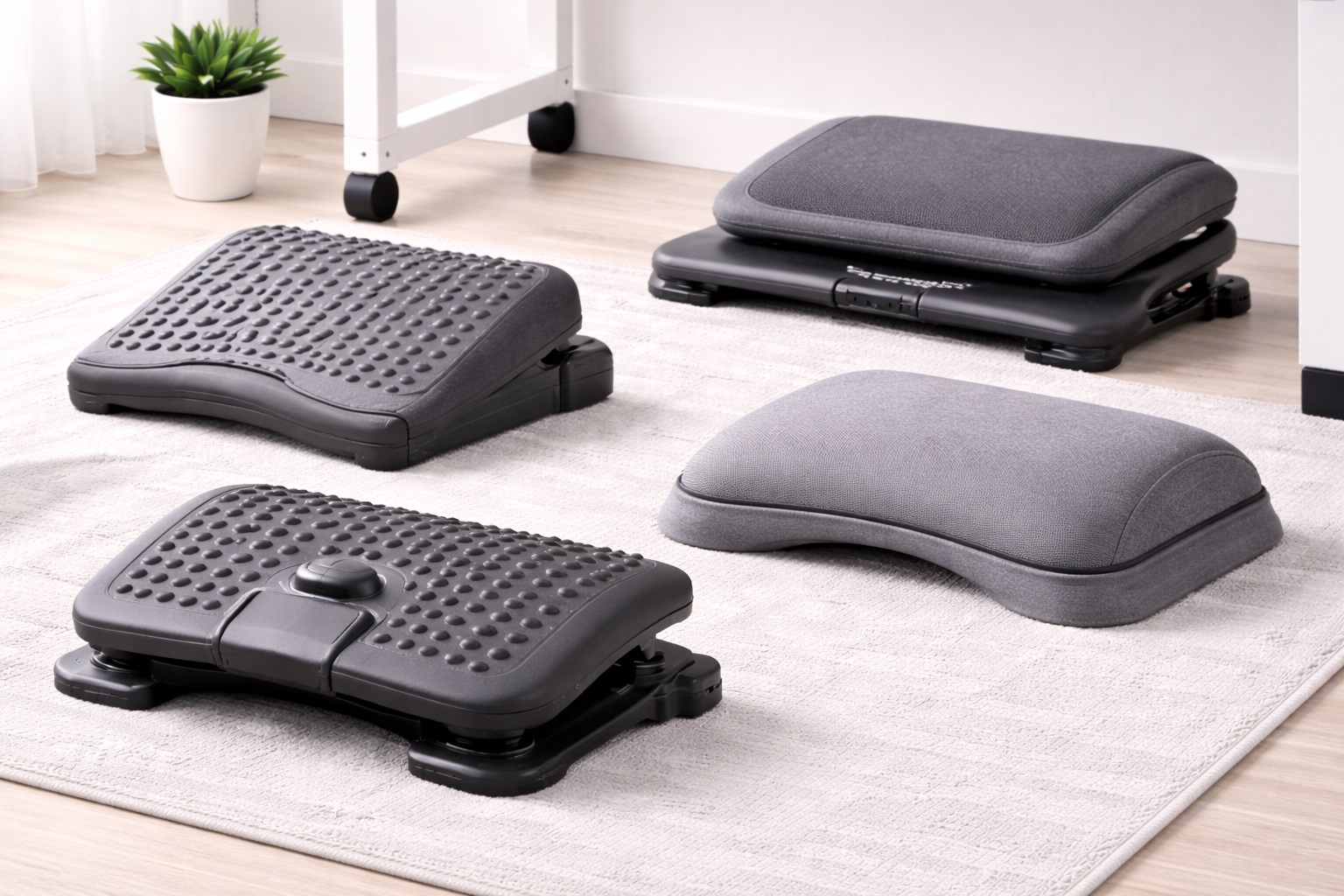
An adjustable tilt foot rest allows you to set both height and angle to place your feet in a neutral position matched to your specific leg length and chair height. This is the design most directly grounded in ergonomic principle, since it lets you correct for the exact mismatch between your body and your furniture rather than approximating it with a fixed-size product. Multiple angle positions accommodate different sitting postures throughout the day, and a non-slip top surface combined with a stable base keeps the platform in place during normal use.
- Pros:
- Height and angle adjustment for personalized support
- Accommodates different chair heights and leg lengths precisely
- Non-slip surface keeps feet positioned correctly
- Stable base prevents shifting during use
- Cons:
- Plastic construction on entry-level models feels less premium
- Some tilt mechanisms require more effort to adjust
The dorsiflexed foot position — toes slightly elevated relative to the heel — that a tilt setting allows is often cited in ergonomic literature as more comfortable for extended static holds than a completely flat foot position, though individual preference varies enough that having the option to adjust matters more than any single fixed angle.
Best For: Home office workers and professionals who want foot support genuinely customized to their own leg length and chair height rather than a one-size-fits-most compromise.
Why We Recommend It: Adjustable tilt is the feature most directly tied to the ergonomic reasoning behind foot rests in the first place — the whole point is matching support to your specific body, and a fixed-height, fixed-angle product only achieves that by coincidence. Consider two people of noticeably different heights sharing the same desk at different times of day, or even one person whose preferred posture shifts between an alert morning session and a more relaxed afternoon stretch — a fixed unit serves one of those situations well and the other poorly, while an adjustable unit serves both. That flexibility is the practical expression of the ergonomic principle at work, not an incidental convenience.
2. Rocking Foot Rest – Best for Circulation and Movement
A rocking foot rest allows gentle foot and leg movement throughout the day, which supports circulation and reduces the fatigue that builds from holding a static position for hours. The rocking motion is subtle by design — enough to encourage small movements without becoming distracting during focused work. This design responds to a specific ergonomic concern: that any single fixed posture, however "correct" on paper, becomes uncomfortable if held without variation for too long.
- Pros:
- Promotes leg movement and circulation during sitting
- Reduces fatigue from static foot positioning
- Quiet rocking mechanism on well-built models
- Comfortable for extended use
- Cons:
- Rocking motion requires a brief adjustment period
- Less suitable for users who need a completely fixed foot platform
Ergonomic research on sitting has increasingly emphasized movement variety over any single ideal static posture, on the reasoning that the human body isn't designed to hold one position for hours regardless of how well that position is aligned. A rocking foot rest is one of the few desk accessories that builds this movement principle directly into its mechanism rather than requiring you to remember to stretch or shift periodically.
Best For: Professionals who sit for extended periods and want built-in movement variety without needing to consciously remember to stretch or stand throughout the day.
Why We Recommend It: The rocking foot rest addresses a real gap in most ergonomic setups — the tendency to achieve a technically correct static posture and then hold it rigidly for hours, which research on prolonged sitting suggests is itself a source of discomfort regardless of alignment. This is broadly the same reasoning behind advice to alternate between sitting and standing throughout the workday, or to take short walking breaks even when a desk setup is otherwise well-configured — the body responds better to periodic change than to being locked into any single position, no matter how carefully that position was optimized on paper. A rocking foot rest simply brings a version of that principle down to the level of the feet and lower legs specifically, offering small continuous adjustment rather than requiring you to consciously interrupt your work to stand up and move.
3. Massage-Surface Foot Rest – Best for Added Stimulation
A foot rest with a textured or roller-based massage surface adds mild stimulation to the feet during use, which some users find helps with the sensation of stiffness that accumulates over a long sitting session. This is more of a comfort preference feature than a core ergonomic necessity, but for users who specifically deal with foot tension or mild discomfort during long days, the added texture provides a benefit beyond simple elevation.
- Pros:
- Textured or roller surface adds mild stimulation during use
- Can be combined with height elevation for dual benefit
- Some models include multiple texture zones
- Popular with users who deal with foot tension during long sessions
- Cons:
- Massage benefit is a comfort preference, not a core ergonomic requirement
- Textured surfaces can wear down faster than smooth non-slip designs
Because the massage element is additive rather than foundational, this style is best considered a secondary purchase criterion rather than the primary reason to choose one foot rest over another — the height, angle, and stability fundamentals still matter more for overall postural benefit.
Best For: Users who already have their height and angle needs met and want an additional comfort feature layered on top of solid ergonomic fundamentals.
Why We Recommend It: For professionals who spend long hours seated and experience mild foot tension by the afternoon, the added stimulation from a textured surface is a genuine quality-of-life improvement, provided it doesn't come at the expense of the more fundamental height and stability features. It's worth being clear-eyed about sequencing here: a textured or roller surface layered onto a foot rest with poor height range or a wobbly base doesn't compensate for those shortcomings, it just adds a pleasant sensation on top of an otherwise incomplete ergonomic solution. Choose the massage feature as a tiebreaker between two products that are otherwise well matched on the fundamentals, not as the deciding factor on its own.
Buying Guide: How to Choose the Best Ergonomic Foot Rest
Use these factors to evaluate genuine ergonomic value rather than marketing language. Each one reflects a specific, checkable design choice rather than a vague claim about comfort.
1. Height Adjustment Matched to Your Measurements
The foot rest should bring your feet to a position where your knees sit at roughly 90 degrees and your thighs run close to parallel with the floor. Measure this at your own desk with your usual chair rather than guessing, since the correct height depends entirely on your specific leg length and chair height combination. A simple way to check is to sit normally, have someone measure the vertical gap between the sole of your foot and the floor, and use that number as your target adjustment height rather than relying on a generic "average" setting that a product might ship with by default. Because that gap can differ by several inches between a shorter and taller person using the same chair, a foot rest with only a narrow adjustment range may fail to reach the correct number for either extreme.
2. Tilt Angle Range
A tilted surface places the feet in a slightly toes-up position that many people find reduces static tension compared to flat, though preference varies enough that a range of adjustable angles is more valuable than any single fixed setting. Test a few angles if you can before settling on a favorite. Some people find a moderate toes-up tilt noticeably more comfortable within the first few minutes of trying it, while others notice no meaningful difference from flat — there isn't a universally correct angle, only a correct angle for your own body and habits, which is exactly why a fixed single-angle design is a gamble compared to an adjustable one.
3. Surface Texture and Grip
The top surface should hold your feet in place without feeling sticky or overly soft. Non-slip textures prevent the small foot movements that happen naturally over a workday from sliding your feet off the platform, which undermines the postural benefit the height and angle were providing in the first place. A foot rest with perfect height and angle specifications but a slick surface can still leave you slouched forward by mid-afternoon simply because your feet have crept off the edge of the platform without you noticing, quietly undoing the benefit the product was supposed to provide.
4. Base Stability
A foot rest that slides when you push against it defeats its own purpose, since correct posture requires a stable platform to push against. Rubber-padded bases resist movement on hard flooring; check the base material against your specific floor type before ordering. Rubber and silicone pads generally perform well on hardwood, tile, and laminate, while some carpet-optimized bases with wider, softer feet can slide more readily on smooth flooring, so it's worth verifying the base is suited to what's actually under your desk rather than assuming a universal design works everywhere.
5. Movement Type: Static vs Rocking
Static platforms hold one fixed position; rocking designs allow gentle motion. The ergonomic evidence increasingly favors movement variety over pure static alignment, which makes a rocking design worth genuine consideration even for users who initially assume they want a completely fixed platform. If your work involves tasks requiring precise, stationary foot positioning — certain instrument pedals or specialized equipment, for instance — a static platform remains the more appropriate choice, but for typical desk-based knowledge work, the flexibility of gentle motion tends to be an asset rather than a drawback.
6. Weight Capacity and Build Quality
Most foot rests rate for standard adult weight, generally 250–300 pounds, tied to base construction and material strength. A unit with a comfortable margin above your actual weight tends to hold its stability and adjustment mechanisms longer than one operating near its rated limit. This matters more for adjustable and rocking designs, since their moving parts experience ongoing mechanical stress with regular use, whereas a simple flat static platform has fewer components that can be affected by weight over time.
7. Footprint and Desk Compatibility
Measure your under-desk clearance and available floor space before ordering. An ergonomically excellent foot rest that doesn't physically fit your desk setup provides no benefit at all, so this practical check should happen before you evaluate any of the more nuanced ergonomic features. It's a common ordering mistake to research the finer points of tilt angle and surface texture in depth before confirming the product will even fit the physical space it needs to occupy, which is a fast way to end up with a well-reviewed product that simply doesn't work in your setup.
8. Material Durability Under Daily Use
Plastic construction is lightweight and affordable but can feel less substantial over time. Metal-framed designs generally last longer under daily professional use. Match your material expectations to how many hours per day you'll realistically be using the product. Someone using a foot rest for occasional evening tasks has different durability needs than someone in a full-time professional role sitting at the same desk for eight or more hours a day, and it's worth being honest about which category actually describes your situation before choosing based on price alone.
9. Evidence Behind Specific Feature Claims
Some products claim particular ergonomic benefits without much design rationale behind them. Focus on features with a clear mechanical logic — adjustable height and angle, non-slip surfaces, stable bases — over vaguer marketing claims that don't explain how a specific design choice produces a specific benefit. If a listing describes a feature as "ergonomically engineered" without saying what the feature actually does, that's a reasonable cue to look elsewhere in the description for the concrete design detail, or to check reviews for what buyers actually noticed rather than what the copy promised.
10. Compatibility with the Rest of Your Setup
A foot rest works best as one piece of a broader ergonomic approach that includes correct monitor height, a supportive chair, and a keyboard at the right level. Evaluate it as a contributor to overall posture rather than a stand-alone fix for unrelated discomfort elsewhere in the body. If your monitor sits too low or your chair lacks lumbar support, correcting foot position alone won't resolve those separate issues, so it's worth taking stock of your full desk setup before assuming a foot rest is the single missing piece.
11. Long-Term Comfort Over Initial Impression
A foot rest that feels good in the first few minutes of testing may behave differently after several hours of real use. Where possible, favor products with a return window generous enough to genuinely trial the item across a full workday or two before committing. A quick five-minute test at a store display, if one is available, can rule out an obviously poor fit, but it can't tell you how your feet will feel after six continuous hours of typing, which is really the only test that matters for a purchase you intend to use every working day.
Frequently Asked Questions
1. Is there real ergonomic evidence behind foot rests?
Yes, in the sense that correct lower-body positioning is a well-established part of overall seated posture, and a foot rest is one practical way to achieve it when your chair and desk height don't naturally place your feet correctly. It isn't a cure for unrelated pain, but it addresses a real and common postural gap that standard office furniture, built to average dimensions, frequently leaves unaddressed for anyone outside that average range.
2. What height should an ergonomic foot rest be set to?
The correct height places your knees at roughly 90 degrees with your thighs close to parallel to the floor and your feet flat or slightly tilted on the rest's surface. This varies by individual, so an adjustable model is the more reliable way to find your specific correct setting. Two people of different heights sitting at the same desk will often need noticeably different foot rest heights, which is a good illustration of why a fixed-height product is really only ever correct for one specific person.
3. Can an ergonomic foot rest help with back pain?
Indirectly. Correct lower-body positioning contributes to overall seated posture alignment, and reduced strain in one area of the postural chain can ease compensating strain elsewhere, including the lower back. It's one component of a broader ergonomic setup rather than a standalone treatment, and anyone dealing with persistent back pain should treat a foot rest as one supporting factor among several rather than expecting it to resolve the issue on its own.
4. Is a rocking foot rest more ergonomic than a fixed one?
For most users, current thinking on movement variety suggests yes — alternating gentle motion reduces the fatigue associated with completely static positioning. Users who need a precisely fixed foot platform for specific tasks may still prefer a static design, and there's no harm in trying the rocking motion for a week or two to see how your own body responds before deciding it isn't for you.
5. Do massage or textured surfaces have real ergonomic value?
They add a comfort benefit for users who experience foot tension, but the core ergonomic value of a foot rest comes from correct height and angle rather than surface texture. Consider massage features a bonus on top of solid fundamentals rather than a replacement for them, since no amount of surface texture compensates for a foot rest that's simply the wrong height for your body.
6. How is an ergonomic foot rest different from a regular one?
The distinction is really about design intent rather than a strict category boundary — a product built with adjustable height, angle options, and a stable non-slip base is applying ergonomic principles directly, while a simple fixed platform with no such features is providing basic elevation without the same level of customization. Both can be legitimate choices depending on your specific needs — the label "ergonomic" is best treated as a description of design intent rather than a guarantee of superiority.
7. Should I combine a foot rest with a standing desk?
A foot rest supports seated use specifically. When your desk is in standing mode, an anti-fatigue mat serves the equivalent ergonomic purpose. Many home offices keep both and switch between them as posture changes throughout the day.
8. How long should a quality ergonomic foot rest last?
A well-built product from a reputable manufacturer typically lasts three to five years or longer with reasonable care. Warranty length is a useful proxy for how confident the manufacturer is in the product's own durability.
9. Can I return an ergonomic foot rest if it doesn't suit my needs?
Most retailers offer a 15 to 30 day return window, which is generally enough time to evaluate whether the height, angle, and surface genuinely improve your seated comfort across a normal workweek.
10. Is the most expensive ergonomic foot rest always the best?
Not necessarily. Higher price sometimes reflects genuine engineering refinement, but many mid-range products deliver the same core ergonomic benefits as premium ones. Focus on the specific design features rather than price positioning alone.
11. What should I prioritize when choosing an ergonomic foot rest?
Prioritize adjustable height and angle first, since these directly address the postural mismatch that makes a foot rest useful in the first place. Treat surface texture, added movement features, and material premium as secondary considerations once the fundamentals are covered.
Final Verdict
- Best Overall Ergonomic Support: Adjustable Tilt Foot Rest — the design most directly matched to individual body proportions.
- Best for Circulation and Movement: Rocking Foot Rest — built-in movement variety backed by current sitting research.
- Best for Added Stimulation: Massage-Surface Foot Rest — a comfort layer on top of solid ergonomic fundamentals.
Genuine ergonomic value in a foot rest comes down to a small number of concrete design choices — adjustable height, tilt range, stable non-slip construction — rather than marketing language. Evaluate products against those specific features, match them to your own measurements, and you'll end up with support that actually reflects how your body sits rather than a generic approximation of it. The extra few minutes spent measuring and comparing specific design choices, rather than trusting a product description's promises, is what separates a genuinely useful ergonomic purchase from one that simply looks the part.