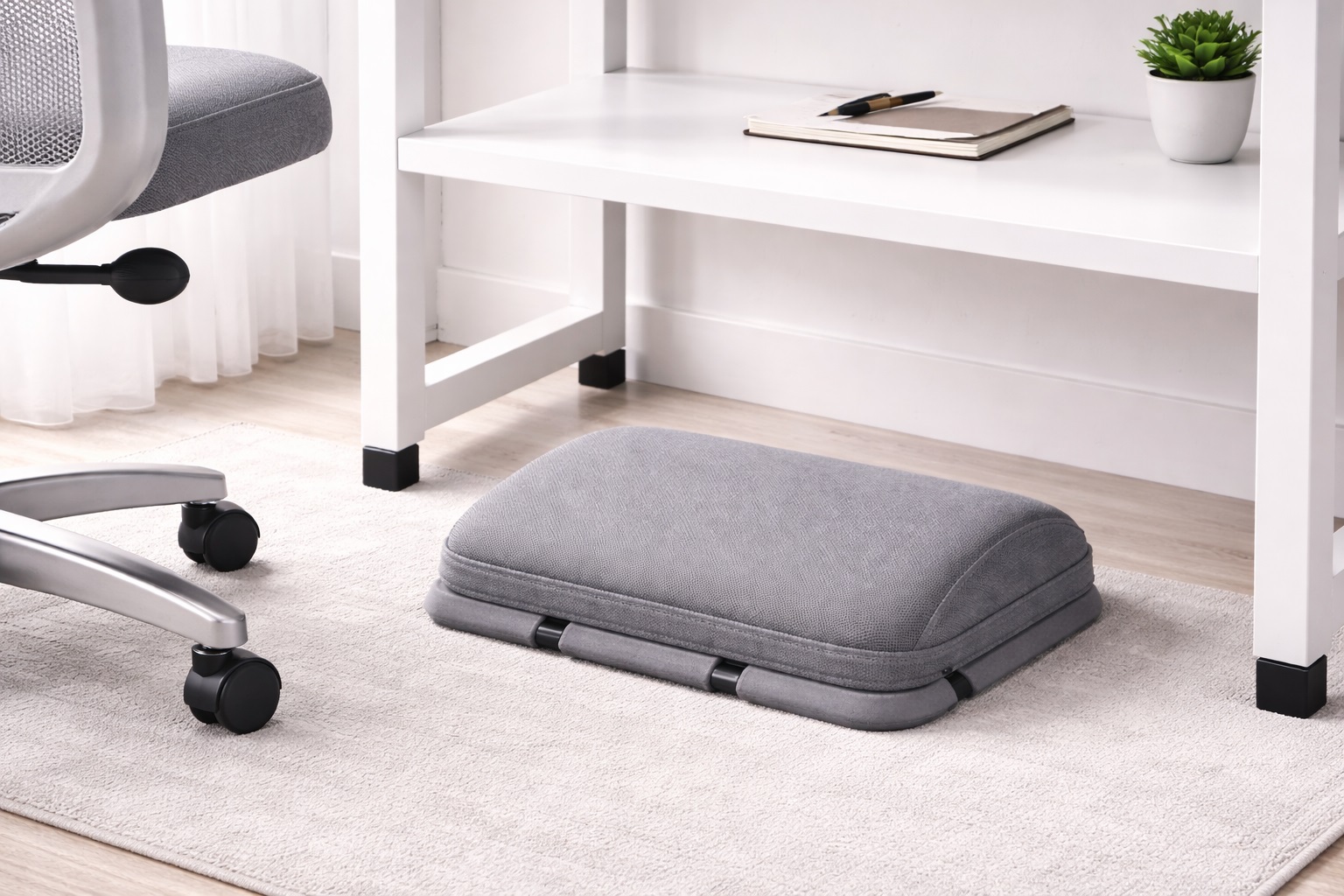
Best Foot Rests for Small Desks: Compact Support in Tight Spaces
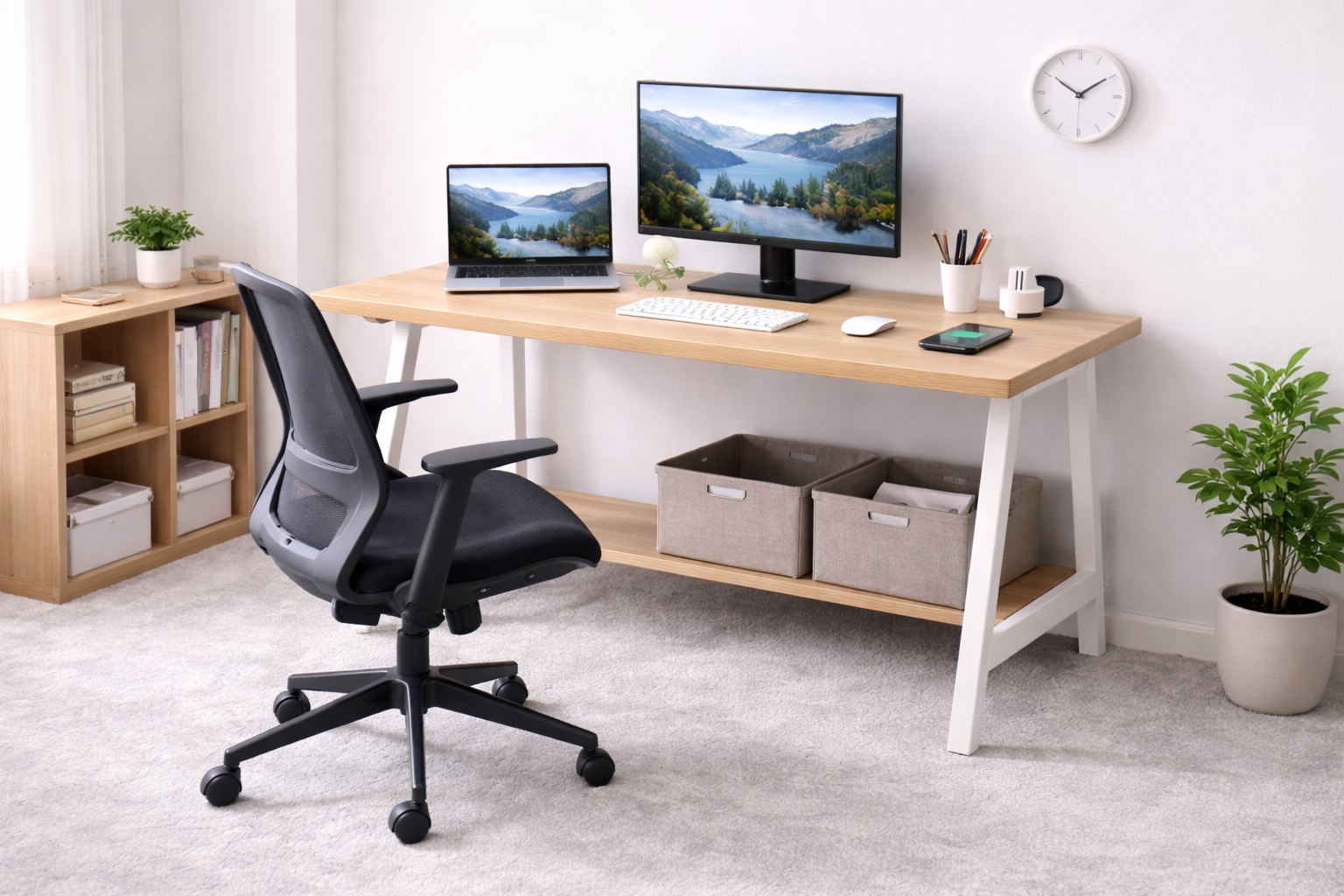
Small desks create a specific ergonomic problem that generic foot rest advice rarely addresses: there simply isn't much floor space left once you account for the desk legs, a chair with casters, and whatever storage crowds the area underneath. A foot rest that would work fine under a large L-shaped desk can feel like an obstacle course under a 40-inch writing desk tucked into a corner or a compact home office nook.
The good news is that footprint size and ergonomic quality aren't mutually exclusive. Several foot rest designs deliver correct height and angle support while occupying a fraction of the floor area of bulkier models. The challenge is knowing which features actually matter for a small-desk setup and which ones are just added bulk you don't need.
This guide walks through the foot rest types best suited to tight under-desk spaces, followed by the specific factors worth checking before you buy and the questions people in cramped home offices ask most often. None of the advice here assumes unlimited floor space — every recommendation accounts for the reality of working from a small desk.
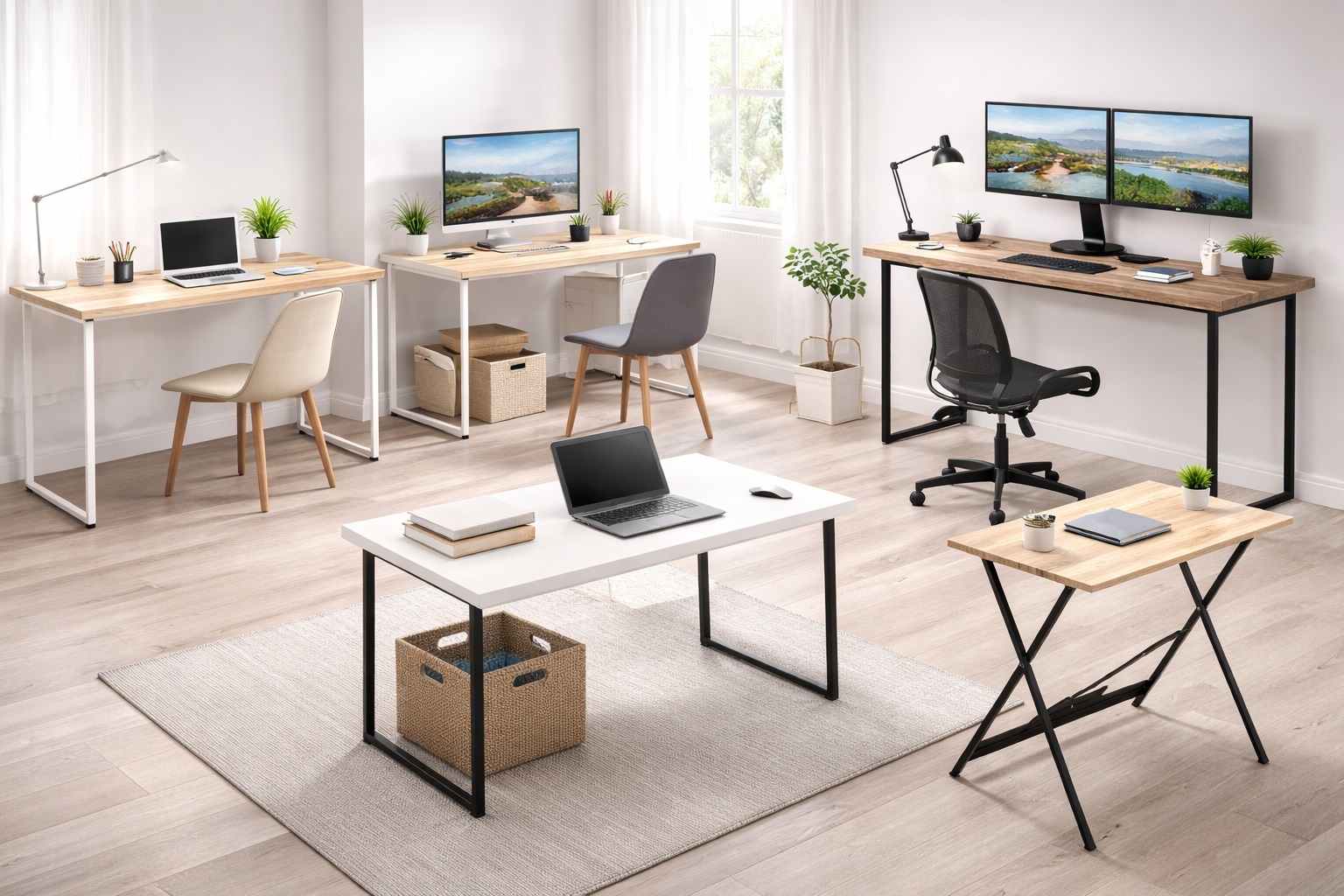
It also helps to think about the room as a whole rather than just the desk itself. A small desk is frequently paired with a small room — a corner of a bedroom, a converted closet, a shared study nook — where the foot rest has to coexist with a chair that gets pushed in and out several times a day, a trash can, or a stack of storage boxes. A product that seemed reasonably sized in an online listing can turn out to be the one thing that makes the whole area feel cluttered. Reading dimensions carefully and, where possible, comparing them against a tape measure on your own floor before ordering saves the hassle of a return.
There's also a tendency, once you start shopping for ergonomic accessories, to keep adding items — a monitor arm, a wrist rest, a lumbar cushion — until the small desk that was supposed to stay simple becomes as cluttered as a full-size setup. A foot rest is worth adding on its own merits, but it helps to think of it as one deliberate addition rather than the first of many, especially when floor space is the scarce resource you're trying to protect in the first place.
Top Picks Reviewed
1. Adjustable Tilt Foot Rest – Best Overall Ergonomic Support
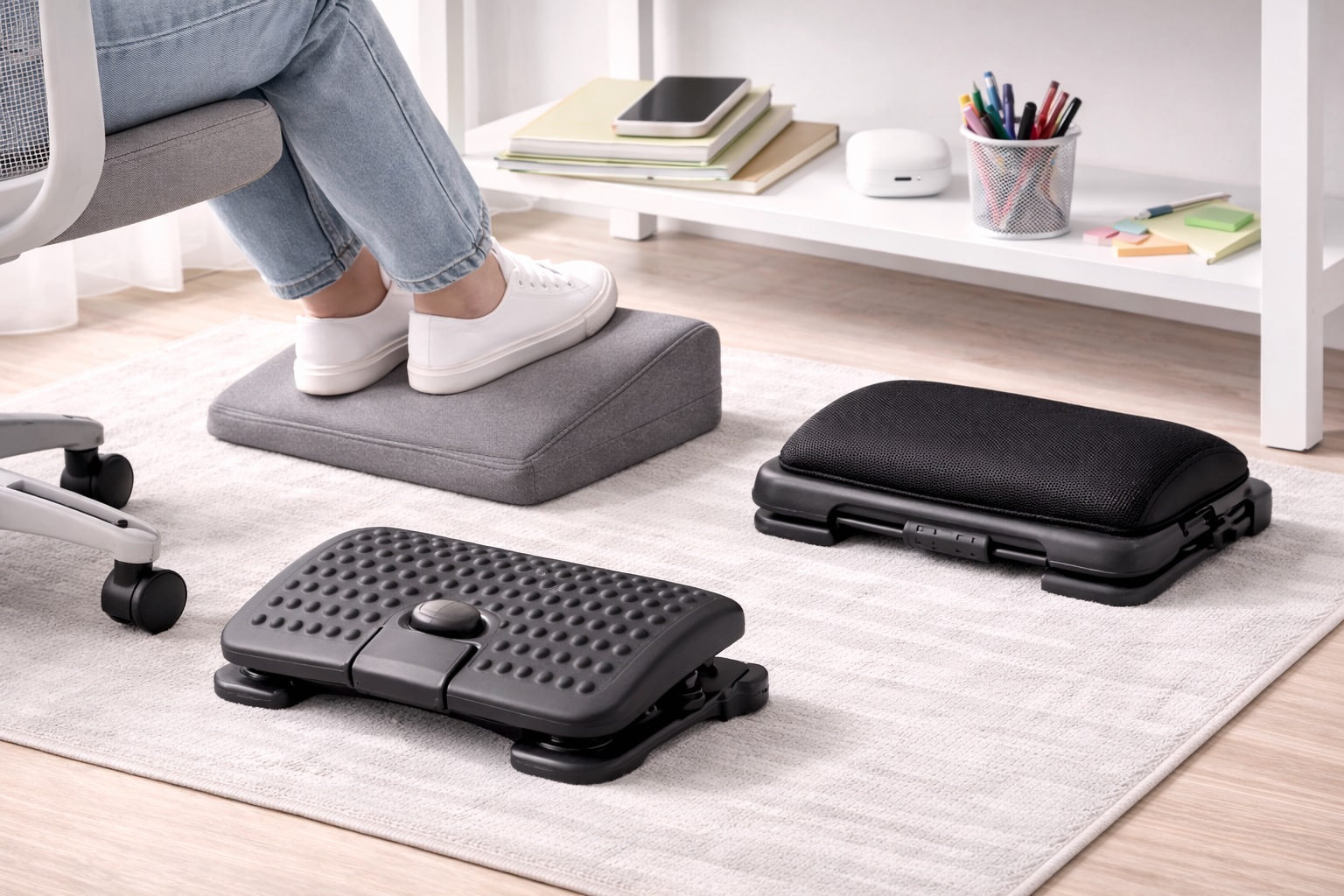
An adjustable tilt foot rest lets you dial in both the height and the angle that puts your feet in a neutral position for your specific leg length and chair height. For small-desk users, the appeal is that a single compact unit adapts to your body rather than requiring you to hunt for a fixed-size model that happens to fit. Multiple angle settings accommodate different sitting postures through the day, and a non-slip top surface combined with a stable base keeps the unit from sliding around in a tight footwell.
- Pros:
- Height and angle adjustment for personalized support
- Accommodates different chair heights without needing a second unit
- Non-slip surface keeps feet positioned correctly
- Stable base resists shifting in a confined footwell
- Cons:
- Plastic construction on budget models feels less premium
- Some tilt mechanisms require more effort to adjust
Because these units are typically compact by design — the adjustment mechanism is built into a small base rather than a wide platform — they tend to be a natural fit for desks where floor space is already claimed by a chair, cables, or a small filing cabinet. Look for a model whose footprint is listed in the product specifications, since some adjustable units are wider than they appear in photos. Photos are typically shot from an angle that makes a base look narrower than it actually is, so treat the written measurement as the authority and the image as a general impression only.
Best For: Home office workers in compact rooms who need foot support customized to their specific leg length and chair height without adding a bulky floor obstacle.
Why We Recommend It: Adjustable tilt is the single most useful feature in a foot rest, and it happens to pair well with small-space constraints because the adjustment mechanism is usually housed in a small, self-contained unit rather than a sprawling platform. A foot rest with fixed height and angle only suits users who happen to match those exact dimensions — unlikely odds in a shared or multi-user small office. Even for a single user, leg length and preferred sitting posture can vary between morning and evening sessions, which is another argument for a range of adjustment rather than a single fixed point.
In practice, the adjustment range matters more in a small-desk setting than people expect, because compact desks are often used by more than one person over time — a student who later becomes a remote employee, a spare-room desk shared between partners on different schedules, or a chair that gets swapped out for a different height. An adjustable unit absorbs those changes without needing to be replaced, which is a meaningful advantage when the whole point of a small setup is to avoid accumulating extra furniture.
2. Rocking Foot Rest – Best for Leg Circulation
A rocking foot rest allows gentle foot and leg movement throughout the day, which helps circulation and reduces the leg fatigue that builds up from sitting still in a cramped space where you can't easily stretch your legs out. The rocking motion is subtle — just enough to encourage small movements without being distracting during focused work. In a small desk setup where there's little room to shift your chair or extend your legs, this built-in movement becomes more valuable, not less.
- Pros:
- Promotes leg movement and circulation during sitting
- Reduces fatigue from static foot positioning
- Compact curved base takes up minimal floor area
- Comfortable for extended use in confined seating positions
- Cons:
- Rocking motion requires a brief adjustment period
- Less suitable for users who need a completely fixed foot platform
The curved rocker base is usually narrower front-to-back than a flat platform of equivalent size, which matters when your knees are already close to the underside of the desk. Some models also fold flat for storage when the desk is shared or reconfigured for other use, which is a genuine consideration in a room that occasionally needs to become something other than an office for an afternoon.
Best For: Remote workers in small home offices who sit for extended periods and want to reduce leg fatigue without needing extra floor space to stretch or stand.
Why We Recommend It: The rocking design introduces movement variety that static sitting doesn't provide, and it does this from within a small curved footprint rather than requiring you to physically move your chair or legs — a real advantage when your desk area is already tight.
Anyone who has tried to push a chair back for a stretch in a room too small to allow it will recognize the value here. Rather than needing physical space to move, the movement happens at the foot rest itself, which is one of the few genuine workarounds for the circulation downsides of sitting in a confined area for hours at a stretch.
3. Flat Non-Slip Foot Rest – Best Simple Platform
A flat foot rest elevates the feet at a fixed height with no tilt or rocking mechanism, and it's typically the smallest and thinnest option available, which makes it the easiest to slide into a shallow footwell. For small-desk users whose legs are slightly short for their chair height — causing feet to dangle — a simple low-profile platform solves the immediate posture problem without adding bulk. This is a more common situation than people expect, since standard chair and desk heights are built around average adult proportions that don't match everyone.
- Pros:
- Simple, reliable design with no moving parts
- Low profile fits under desks with minimal ground clearance
- Immediately improves posture for short-legged users
- Affordable entry-level ergonomic support
- Cons:
- Fixed height — not adjustable
- No tilt for personalized foot angle
Because there's no mechanism to house, flat foot rests can be built thinner than adjustable or rocking designs, which is exactly what a shallow under-desk area needs. Some slide completely out of the way when not in use, an advantage in a small room that doubles as another living space. A handful of designs are thin enough to stand upright against a wall or slide under a bed for storage, which matters more than it sounds like it should once you've lived with a cluttered small room for a few months.
Best For: Small-desk users whose feet don't comfortably reach the floor and who need a low-profile platform that doesn't compete for space with a chair or nearby furniture.
Why We Recommend It: For the specific problem of feet not reaching the floor comfortably, a flat foot rest solves the issue immediately at minimal cost and minimal footprint — no complex mechanism, no extra bulk, just reliable elevation in a space that has little room to spare. It's the option we'd point a first-time buyer toward if the only issue is dangling feet and nothing more complex, since it fixes exactly that problem without asking you to pay for features you don't need.
Because it's the least expensive category as well as the smallest, a flat foot rest is often the first thing worth trying if you're not yet sure whether you need a foot rest at all. If it solves the problem, you've spent very little; if you find yourself wanting angle adjustment after a few weeks, upgrading to an adjustable tilt model is a low-cost lesson learned, and you'll have a clearer sense of exactly which feature you were missing rather than guessing at the outset.
Buying Guide: How to Choose the Best Foot Rest for Small Desks
Use these factors to match your purchase to the realities of a compact workspace rather than defaulting to whichever model has the most reviews. None of these require special tools — a tape measure and five minutes of attention to your existing setup are enough to rule out the wrong products before you spend money. Working through them in order, starting with footprint, will eliminate the majority of unsuitable listings before you get to the finer points of surface texture or material.
1. Footprint Before Anything Else
For a small desk, footprint size should be the first filter, not an afterthought. Measure the actual clear floor area under your desk — width and depth — before you even look at features. A foot rest that looks compact in a product photo can still be too wide once you account for chair casters and any cables running along the floor. Write the measurement down and keep it on hand while browsing, since it's easy to forget the exact number once you're a few product pages deep and comparing prices instead of dimensions.
2. Height Adjustment Range
The foot rest should bring your feet to a position where your knees sit at roughly 90 degrees and your thighs are close to parallel with the floor. The exact height you need depends on your chair and leg length, so check that the adjustment range actually covers your measurement rather than assuming a mid-range setting will work. Sitting down in your usual chair and having someone else measure the gap between your feet and the floor is the most reliable way to get this number right, more reliable than eyeballing it while standing.
3. Tilt Angle Options
A tilted surface places the feet in a slightly toes-up position that many people find more comfortable than flat, though preferences vary. Models with multiple tilt settings let you experiment; a fixed tilt only works well if it happens to match what you prefer. There's no way to know your preference in advance without trying it, which is one more reason an adjustable model is the lower-risk choice for a first-time buyer.
4. Under-Desk Clearance
Small desks sometimes have a lower center support bar or a shallow modesty panel that reduces usable vertical clearance. Measure this clearance specifically, since a foot rest that's a comfortable height in open space might not physically fit once you slide it into your particular desk's leg area. A folding tape measure pushed into the footwell with the chair in its normal position gives a far more accurate number than measuring the desk empty.
5. Surface Texture and Grip
The top surface should hold your feet in place without feeling sticky or overly soft. Non-slip textures keep feet from sliding off during the small movements that happen naturally over a workday, which matters more in a tight space where a foot rest that shifts can bump into a desk leg or chair base. A surface that's too smooth will let feet drift over the course of a few hours even if it feels fine in the first few minutes of use, so texture is worth checking in reviews rather than photos alone.
6. Base Stability on Your Specific Floor
A foot rest that slides when you push against it becomes an annoyance quickly, and in a small space it can slide into contact with your chair or desk leg. Rubber-padded bases resist movement on hard flooring; carpet-oriented bases may not grip tile or hardwood as well, so match the base material to your actual floor type. If your small desk sits on a mix of surfaces — a rug under the chair and bare floor under the desk, for instance — check that the base grips both rather than assuming one type of flooring throughout the room.
7. Rocking vs Static Movement
Static platforms hold one fixed position, while rocking designs allow gentle motion. If your small-desk chair doesn't leave room to shift your legs or stand up often, a rocking foot rest can supply the movement variety you'd otherwise be missing. If you prefer a completely stable platform, a static design is the better match. There's no objectively correct answer here — it comes down to whether you find gentle motion soothing or distracting during concentrated work, which is worth honestly assessing before you buy rather than after.
8. Weight and Ease of Moving It
In a small, multi-use room, you may need to move the foot rest out of the way periodically. Most units weigh only one to three pounds, and a low weight combined with a compact shape makes it easy to tuck away or relocate without disrupting your setup. If the room serves double duty as a guest space or a place where a partner or roommate needs the desk cleared occasionally, this portability turns out to matter more than it might seem when you're only picturing the product sitting permanently in place.
9. Material Durability
Plastic construction keeps units lightweight and inexpensive but can feel less substantial over time. Metal-framed designs last longer under daily use. Cushioned top surfaces are more comfortable initially but wear faster than textured plastic or rubber, so weigh comfort against longevity based on how many hours you'll actually spend using it. Someone at a small desk for an hour or two of evening study has different priorities than someone working an eight-hour shift from that same corner, and it's worth being honest about which situation actually describes you.
10. Cable and Cord Interference
Small desks often route power strips or charging cables along the floor near the footwell. Check that the foot rest's shape and position won't trap or pinch cables, and consider a design with a lower rear profile if cables need to pass behind it. Running a quick check with the foot rest in its final position, then moving your feet through a normal range of motion, is a simple way to catch any cable conflict before it becomes a recurring annoyance.
11. Weight Capacity
Most foot rests are rated for standard adult use, generally up to 250–300 pounds, with the rating tied to base construction and material strength. Confirm the listed capacity matches your needs, particularly for models with thinner plastic bases designed primarily for compactness. This is a detail that's easy to overlook when everything else about a listing looks appealing, but it's a quick check against the product specification page and worth the thirty seconds it takes.
Frequently Asked Questions
1. Will a foot rest actually fit under a small desk?
Most compact and flat-profile foot rests are designed with small spaces in mind and will fit under the majority of small desks, but you should still measure your available floor area and clearance before ordering, since "compact" varies quite a bit between product listings. Reading the listed dimensions against your own measurement, rather than trusting the word "compact" on its own, is the difference between a good fit and a returned package.
2. What height should my foot rest for a small desk be?
The right height places your knees at roughly 90 degrees with your thighs close to parallel to the floor. This depends on your height and chair, so an adjustable model is generally the safer choice when you're not certain of the exact measurement you need. If two people share the same small desk at different times of day, adjustability removes the need to compromise on one fixed setting.
3. Can a small foot rest still provide real ergonomic benefit?
Yes. Footprint size affects how much floor space a unit occupies, not how effectively it supports your feet at the correct height and angle. A well-designed compact foot rest delivers the same postural benefit as a larger one for most users, since the mechanism responsible for support — the tilt, the height, the surface grip — doesn't need a large platform to function well.
4. Is a rocking foot rest a good choice for a small desk?
Often, yes, because the curved base is usually narrower than a flat platform and the built-in movement compensates for the limited ability to stretch your legs in a tight space. If you prefer a completely stable surface, a flat or adjustable static model is the better fit. Trying the motion for a few days before deciding it isn't for you is worth doing, since some people find the adjustment period shorter than expected.
5. Can I use a foot rest with a standing desk converter on a small desk?
Foot rests are intended for seated use. When your small desk is in standing mode via a converter, an anti-fatigue mat serves the equivalent purpose. Keep both nearby and use whichever matches your current sitting or standing position, and store the one you're not using out of the footwell so it doesn't become a tripping hazard in a small room.
6. Do compact foot rests cost more than standard-size ones?
Not typically. Footprint size and price aren't closely linked — many compact and flat designs are among the more affordable options because they use simpler construction and less material than larger, feature-heavy models. It's worth comparing a few compact options side by side on price before assuming size dictates cost.
7. How long should a small-desk foot rest last?
A well-built unit from a reputable manufacturer typically lasts three to five years or longer with normal use. Warranty length is a reasonable proxy for how confident the manufacturer is in its own durability, and it's worth checking that figure alongside the price rather than assuming all budget options carry the same coverage.
8. Can I return a foot rest if it doesn't fit my desk?
Most retailers offer a 15–30 day return window. Keep the original packaging until you've confirmed the fit under your specific desk, since dimensions that look fine on paper don't always translate once the unit is in place. Photographing the footwell area before and after placing the unit gives you a quick reference if you need to explain a return reason later.
9. What should I measure before buying?
Measure the clear width and depth under your desk, the vertical clearance to any center support bar, and the distance from your chair to the desk when seated normally. These three measurements rule out most poor-fit purchases before you order, and taking five minutes to record them once means you won't have to remeasure every time you compare a new product listing.
10. Does a foldable foot rest make sense for a small desk?
If your small desk doubles as another surface — a dining table, a craft table, or a shared workspace — a foldable or easily stored foot rest adds flexibility without giving up ergonomic support during work hours. Look specifically for a folded thickness that fits wherever you plan to store it, whether that's a closet shelf or leaned against a wall.
11. Does brand name matter for a compact foot rest?
Established brands typically offer more consistent quality control and better warranty support. Lesser-known brands sometimes offer good value in the compact category specifically, so reading verified purchase reviews for footprint accuracy is worth the extra few minutes. Pay particular attention to reviewers who mention their own desk dimensions, since their experience is more directly comparable to yours than a generic star rating.
Final Verdict
- Best Overall Ergonomic Support: Adjustable Tilt Foot Rest — personalized support in a self-contained, space-conscious unit.
- Best for Leg Circulation: Rocking Foot Rest — built-in movement from a narrow curved base.
- Best Simple Platform: Flat Non-Slip Foot Rest — the lowest-profile, most affordable option for shallow footwells.
Small-desk ergonomics come down to matching real measurements to real products rather than assuming any "compact" label guarantees a fit. Measure your space first, then use the comparisons above to find the foot rest that gives you correct posture support without crowding the little floor area you have to work with. Whichever type you choose, giving it a genuine two-week trial before judging it will tell you more than any single afternoon of testing, since posture habits and preferences tend to settle in gradually rather than all at once.