Best Compact Foot Rests: Ergonomic Support in a Minimal Footprint
"Compact" gets used loosely across foot rest listings, and it can mean anything from a genuinely small platform designed to disappear under a desk to a standard-size unit that's simply marketed as space-conscious without much to back that up. Knowing what actually makes a foot rest compact — footprint dimensions, folded thickness, base shape — matters more than trusting the word in a product title, since two products both called "compact" can differ meaningfully in how much floor space they actually occupy once installed. One listing might genuinely mean a platform barely larger than a shoebox, while another applies the same word to a unit only modestly smaller than a standard-size foot rest, and there's no way to tell the difference without checking the actual numbers.
The genuine advantage of a well-designed compact foot rest is that it delivers the same core ergonomic benefit as a larger unit while leaving room for the other things competing for space under a desk — a chair's forward roll, a cable management box, a small trash bin, or simply your own legs when you want to stretch. None of the ergonomic function depends on size; a small, well-built platform supports your feet just as effectively as a larger one, provided the height, angle, and grip are right. What compactness actually costs you, if anything, tends to show up in stability margin or feature availability rather than in the fundamental postural benefit, and understanding that trade-off clearly is more useful than assuming size and quality are directly linked.
Compact shopping also tends to reward a slightly more deliberate approach than shopping for a standard-size product, simply because there are fewer options within any specific footprint range and each one deserves closer comparison on the details that actually matter to a tight space, rather than a quick scan of star ratings across dozens of nearly identical standard-size listings.
This guide focuses specifically on genuinely compact foot rest designs, the measurements and features worth checking before ordering, and the questions people ask most often when shopping with limited floor space in mind. Every recommendation here treats footprint as a primary factor rather than an afterthought, since that's the entire reason you're looking at this category in the first place.
It's worth setting a practical baseline before comparing products: measure your actual available floor space, not just under the desk in general but specifically in the spot where your feet naturally rest during normal typing posture, since that's where the product actually needs to fit. A tape measure and two minutes of attention here will save you more disappointment than reading through pages of reviews.
It also helps to think through how the space is actually used across a typical day rather than just how it looks with the chair pushed in and nobody sitting there. Do you shift your feet frequently, cross your ankles, or push your chair back periodically to stretch? Each of those habits interacts with the footprint of whatever foot rest you choose, and a product that measures fine in a static check can still feel cramped if your natural movement patterns need more clearance than the bare dimensions suggest. Spending a moment observing your own habits before shopping is a small step that prevents a common source of post-purchase disappointment.
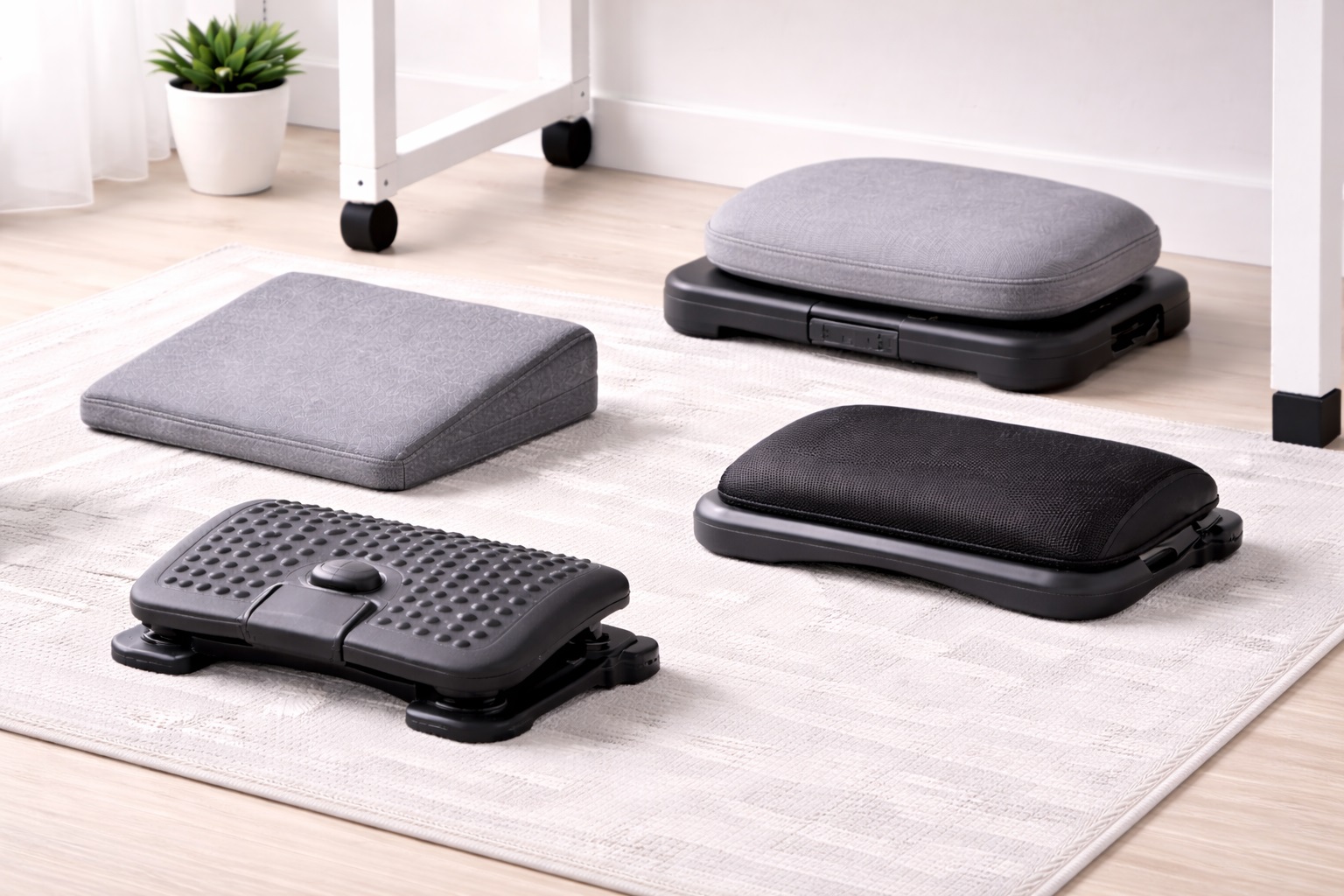
The three product types below were selected specifically because they represent genuinely different approaches to minimizing footprint — one through mechanical simplicity, one through a narrower adjustable base, and one through the ability to fold away entirely. Depending on which specific constraint matters most in your situation, one of these approaches will likely suit you better than the others. If pure floor area is the binding limit, mechanical simplicity wins; if you also want personalized height and angle, a narrower adjustable base is worth the modest search effort; and if the same square footage needs to serve other purposes at different times, foldability solves a problem the other two approaches simply don't address.
Top Picks Reviewed
1. Flat Non-Slip Foot Rest – Best Minimal Footprint
A flat foot rest elevates the feet at a fixed height with no tilt or rocking mechanism, and because there's no adjustment hardware to house, it's consistently the thinnest and smallest style available. For genuinely tight spaces, this simplicity translates directly into footprint — there's no bulky base or hinge mechanism adding width or depth beyond what's strictly necessary to support your feet. In practice this means the footprint of a flat foot rest is close to the true minimum possible size for any product that still needs to support the weight and pressure of a resting foot, which is a useful reference point when comparing it against bulkier styles.
- Pros:
- Smallest footprint of the common foot rest styles
- Low profile fits under desks with minimal ground clearance
- Simple, reliable design with no moving parts
- Often light enough to reposition or store easily
- Cons:
- Fixed height — not adjustable
- No tilt for personalized foot angle
Because manufacturers building this style are specifically optimizing for a minimal, unobtrusive shape, it's one of the few categories where the marketing claim of "compact" is usually accurate rather than exaggerated, and it's a reasonable default starting point for anyone shopping under a genuinely tight floor space constraint who hasn't yet decided between the three styles covered here. Still, verify the specific dimensions listed against your own measurement rather than assuming all flat foot rests are equally small. Some flat designs include a slightly raised lip or textured edge for grip that adds a small amount to the overall footprint beyond the platform itself, so check the full outer dimensions rather than just the platform surface size when comparing listings. It also helps to note the platform's surface texture pattern specifically, since a ribbed or dimpled surface tends to hold a shoe in place better over a long sitting session than a perfectly smooth one, even though both look equally low-profile from a product photo.
Best For: Users with genuinely tight under-desk floor space who need the smallest possible footprint and whose feet simply need elevation rather than tilt or movement features.
Why We Recommend It: When floor space is the binding constraint, a flat design solves the elevation problem with the least possible bulk, since there's no mechanism inside the unit competing for the space your feet would otherwise occupy. It's also the style most likely to slide fully under a desk's front edge when not in use, which matters if you occasionally need the floor area clear for other purposes, such as vacuuming or rearranging furniture.
2. Compact Adjustable Tilt Foot Rest – Best for Personalized Support in a Small Footprint
Some adjustable tilt foot rests are specifically engineered with a narrow, space-conscious base rather than the wider platform common in standard-size units. These compact adjustable models let you dial in height and angle to match your leg length and chair height while keeping the base footprint close to that of a simpler flat design.
- Pros:
- Height and angle adjustment in a narrower base than typical adjustable units
- Accommodates different chair heights without needing a larger footprint
- Non-slip surface keeps feet positioned correctly
- Balances personalization with genuine space efficiency
- Cons:
- Narrower base can feel slightly less stable than a wider adjustable platform
- Fewer compact options exist compared to standard-size adjustable models
Because the market for genuinely compact adjustable units is smaller than for standard-size ones, it's worth reading the specific footprint dimensions carefully rather than trusting a product photo, since some listings use the word "compact" loosely even within this specific style. A base width within an inch or two of a comparable flat foot rest is a reasonable benchmark for genuinely compact adjustable construction, while anything noticeably wider suggests the manufacturer prioritized the adjustment mechanism over the footprint.
Best For: Users who need both a small footprint and the personalization that height and angle adjustment provides, rather than choosing one priority over the other.
Why We Recommend It: This style avoids the common trade-off between adjustability and size — you get genuine customization without giving up the compact footprint that a tight desk area requires. For anyone who assumed adjustability and small size were mutually exclusive based on browsing standard-size products, this style is worth specifically searching out rather than settling for a fixed-height model by default.
3. Foldable Rocking Foot Rest – Best for Storage Flexibility
A foldable rocking foot rest combines the circulation benefit of gentle rocking movement with a design that collapses flat when not needed, which is particularly useful in a small space that serves more than one purpose throughout the day or week. The curved rocker base is typically narrower front-to-back than a flat platform of similar footprint, and folding it away entirely when the desk is repurposed adds a layer of flexibility that fixed designs can't match. This combination of benefits makes it a somewhat more complex product than a simple flat platform, so it's worth reading reviews specifically about the folding hinge's durability over time in addition to the usual base and surface checks.
- Pros:
- Promotes leg movement and circulation during sitting
- Folds flat for storage when floor space is needed for other purposes
- Narrower footprint than many standard-size rocking designs
- Comfortable for extended use in confined seating positions
- Cons:
- Rocking motion requires a brief adjustment period
- Folding mechanism adds a component that can loosen over years of repeated use
For anyone whose small desk area doubles as a dining table, a craft space, or a shared surface, the ability to fold this style away completely is a genuine practical advantage that a fixed compact design, however small, still can't fully replicate. Check the folded dimensions specifically before buying, since some folding mechanisms reduce depth significantly while leaving width mostly unchanged, which may or may not solve your particular storage constraint depending on which dimension is actually the binding one in your space. It's also worth testing the folding action a few times right after unboxing, since a hinge that feels slightly stiff out of the box usually loosens with normal use, while one that feels loose from the very first fold is more likely to develop play or rattle sooner than the warranty period would suggest.
Best For: Users in multi-purpose small rooms who want both the circulation benefit of a rocking design and the flexibility to clear the floor space entirely when needed.
Why We Recommend It: Folding storage solves a problem that even the smallest fixed-footprint foot rest doesn't — the need to reclaim the floor space completely on the days or evenings when the desk serves a different purpose.
Buying Guide: How to Choose the Best Compact Foot Rest
Use these factors to evaluate genuine space efficiency rather than trusting marketing language alone, since "compact" is applied inconsistently across product listings.
1. Actual Footprint Dimensions
Always check the specific width and depth listed in the product specifications rather than relying on how compact a product looks in photos, since camera angles can make a base appear narrower than it actually measures. Look specifically for width, depth, and height listed in inches or centimeters within the specification section, and treat any listing that omits these numbers entirely with some suspicion regardless of how the photos look.
2. Your Own Available Space
Measure the clear floor area under your desk in the exact spot your feet naturally rest, accounting for chair casters and any cables running along the floor, before comparing that measurement against any product's listed footprint. Doing this measurement with your chair pulled all the way into its normal working position, rather than with the desk area empty, gives you the realistic usable space rather than a theoretical maximum you won't actually have available during normal use.
3. Folded or Storage Thickness
If you want the option to store the foot rest away entirely, check the folded thickness specifically, not just the working footprint, since some designs that appear compact in use still fold into a surprisingly bulky shape for storage. If you plan to slide the folded unit under a bed, into a closet, or behind a piece of furniture, measure that specific storage spot too, since a product that folds reasonably flat can still be too wide or too tall for an intended storage location.
4. Height Profile, Not Just Footprint
Compactness isn't only about width and depth — the vertical height of the unit matters too, particularly if your desk has a lower center support bar or shallow modesty panel that limits usable clearance. A foot rest with an excellent footprint on paper can still fail to fit if its overall height exceeds the vertical gap available in your specific desk, so measure clearance as carefully as you measure floor area.
5. Base Shape and Stability Trade-Offs
Narrower bases save space but can feel less stable than wider ones, particularly for adjustable or rocking designs with moving parts. Balance your genuine space constraint against how much stability you actually need for your use case. If your floor is uneven or you tend to push firmly against the foot rest while adjusting position, a slightly wider base may be worth the small amount of additional footprint it requires.
6. Weight for Easy Repositioning
A lighter compact foot rest is easier to move out of the way temporarily, which matters more in a small, multi-use space than in a dedicated home office where the unit can stay permanently in place. Most compact designs already weigh only one to two pounds, but it's worth checking this specifically if you plan to relocate the product regularly between rooms or store it away between uses.
7. Surface Grip Regardless of Size
A compact footprint doesn't excuse a slippery surface — non-slip grip matters just as much on a small platform as a large one, since your feet still need to stay in place during normal use. A small platform with a slick surface is arguably worse than a large one, since there's less margin for your feet to drift before they slide entirely off the edge.
8. Cable Clearance in a Tight Area
Small desks often route cables along the floor near the footwell. Verify a compact foot rest's shape and position won't trap or pinch cables in a space where there's less room to route them around the unit. Testing the final placement with your feet moving through a normal range of motion is a quick way to catch a cable conflict before it becomes a recurring daily annoyance.
9. Material and Build Quality at Small Scale
Compact doesn't have to mean flimsy. Check that the smaller footprint hasn't come at the cost of base material quality or weight capacity, since some manufacturers reduce both size and durability simultaneously to hit a lower price point. Reading reviews for comments about the base flexing or feeling insubstantial is a reasonable way to catch this specific trade-off before committing to a purchase.
10. Weight Capacity Independent of Size
A smaller base doesn't necessarily mean a lower weight rating, but it's worth confirming the specific capacity rather than assuming size and rated weight are directly proportional across every product. Two compact units that look nearly identical can carry meaningfully different weight ratings depending on the internal reinforcement each manufacturer used, which is exactly the kind of detail that only shows up in the specification sheet rather than the photos.
11. Return Policy for Fit Verification
Since footprint accuracy varies between listings even within this specific category, a generous return window is a useful safety net if the product turns out to be larger than expected once it's actually in place under your desk. Keep the original packaging until you've had a chance to test the fit for at least a few days of normal use, since a footprint that seemed acceptable on day one can start to feel cramped once you've lived with it during a full workweek.
12. Noise and Under-Desk Contact
A compact footprint often means the unit sits closer to a desk's center support bar, side panels, or a nearby wall, so it's worth checking whether normal foot movement causes the foot rest to knock against anything nearby during regular use. This is a detail that rarely shows up in a product listing but is easy to spot in customer reviews that specifically mention placement in a tight footwell. A foot rest with a rubberized base tends to stay quieter and grippier against hard flooring than one with a bare plastic or metal underside, which matters more in a small space where the unit sits close to other fixed surfaces.
13. Compatibility With Standing Desks
If your desk is height-adjustable, confirm that the compact foot rest you're considering is meant to be used at a seated height rather than left permanently in place through every desk position. Some compact units are light enough to slide out of the way quickly when you raise the desk to a standing position, which is a genuine advantage over bulkier standard-size platforms that are harder to move aside several times a day. If you switch between sitting and standing frequently, weigh this repositioning convenience alongside footprint when comparing compact options.
Frequently Asked Questions
1. What actually makes a foot rest "compact"?
Genuinely compact designs minimize footprint through simpler mechanisms, narrower bases, or foldable construction, rather than simply being described that way in marketing copy. Checking the specific listed dimensions is the only reliable way to confirm a product is actually compact, since the word itself carries no fixed definition across different sellers or product categories.
2. Do compact foot rests provide the same ergonomic benefit as larger ones?
Yes. Footprint size doesn't determine how effectively a foot rest supports correct height and angle — a well-designed small unit delivers the same postural benefit as a larger one for most users. The mechanism responsible for that benefit — the height, the angle, the surface grip — doesn't require a large platform to function properly.
3. Are compact foot rests less stable than standard-size ones?
Sometimes, particularly with narrower bases on adjustable or rocking designs. If stability is a specific concern, check reviews for comments about wobbling before choosing the smallest available option. There's often a small trade-off between the absolute minimum footprint and maximum stability, and it's worth deciding deliberately where you land on that spectrum rather than defaulting to the smallest product without considering it.
4. Can a compact foot rest still be adjustable?
Yes, though the selection is smaller than for standard-size adjustable models. Compact adjustable units exist and balance a narrow base with genuine height and angle personalization, though they can require a slightly more targeted search since they're less common than standard-size adjustable models in most retailers' listings.
5. Is a foldable compact foot rest worth the extra cost?
If your space serves multiple purposes throughout the day or week, yes — the ability to clear the floor entirely adds real practical value beyond what a fixed compact design provides. If your desk is dedicated solely to work and never repurposed, this specific benefit matters less, and a simpler fixed compact design may serve you just as well at a lower price.
6. How do I measure my space correctly before buying?
Measure the clear width and depth under your desk with your chair pulled into its normal working position, and check vertical clearance to any center support bar, rather than measuring the desk area empty. Writing these numbers down and keeping them handy while comparing product listings saves you from having to remeasure every time you find a new option worth considering.
7. Do compact foot rests cost more than standard-size ones?
Not typically. Many compact designs, particularly simple flat platforms, are among the more affordable options since they use less material and simpler construction than larger, feature-heavy models. It's worth comparing a few compact options directly on price rather than assuming the smallest product automatically carries a premium.
8. How long should a compact foot rest last?
A well-built compact product should last three to five years with normal use, similar to standard-size alternatives, provided the smaller footprint hasn't come at the cost of material quality. Checking the warranty length alongside the price is a reasonable way to gauge how confident the manufacturer is in the compact design's own durability.
9. Can I return a compact foot rest if the footprint is larger than expected?
Most retailers offer a 15 to 30 day return window, which is generally enough time to confirm the actual footprint matches your available space once the product is in place. Photograph the footwell area before and after placing the unit so you have a clear reference if you need to describe a return reason later.
10. What should I prioritize when shopping for a compact model?
Verified footprint dimensions first, followed by surface grip and base stability. Treat any additional features as secondary once you've confirmed the product will genuinely fit your available space, since none of those extra features matter if the unit doesn't physically work in your setup to begin with.
11. Does brand name matter for compact foot rests specifically?
Somewhat less than for larger categories, since compact designs are often simpler and less prone to complex mechanical failure. Still, reading verified purchase reviews for footprint accuracy is worth the extra few minutes regardless of brand. Pay particular attention to reviewers who mention their own desk dimensions, since their experience translates more directly to your situation than a generic star rating ever could.
12. Can I use a compact foot rest with a standing desk?
Yes, as long as you remember it's intended for use while seated. Many compact designs are light enough to slide aside or tuck under the desk's front edge when you raise the desk to standing height, which is one of the practical advantages of choosing a smaller footprint in the first place.
13. Do compact foot rests work well for shorter users or petite frames?
Often, yes — a narrower base doesn't reduce the platform's height range, and shorter users frequently benefit from the reduced overall bulk since it leaves more visible floor space around their feet. Still, check the specific height range listed rather than assuming a compact product is automatically better suited to a smaller frame, since footprint and height adjustment are separate specifications.
Final Verdict
- Best Minimal Footprint: Flat Non-Slip Foot Rest — the smallest possible profile for genuinely tight spaces.
- Best for Personalized Support in a Small Footprint: Compact Adjustable Tilt Foot Rest — customization without sacrificing space efficiency.
- Best for Storage Flexibility: Foldable Rocking Foot Rest — circulation benefit combined with the option to clear the floor entirely.
Genuine compactness comes down to verified dimensions rather than marketing language, so measure your own space first and compare that number directly against listed specifications before you buy. Do that, and a small footprint doesn't have to mean settling for less ergonomic support than a larger unit would provide. The small amount of extra time spent confirming actual dimensions against your own space, rather than trusting a product's marketing description, is what separates a genuinely satisfying compact purchase from one that ends up back in a return box a week later.