Best Air Purifier for Smoke in 2026
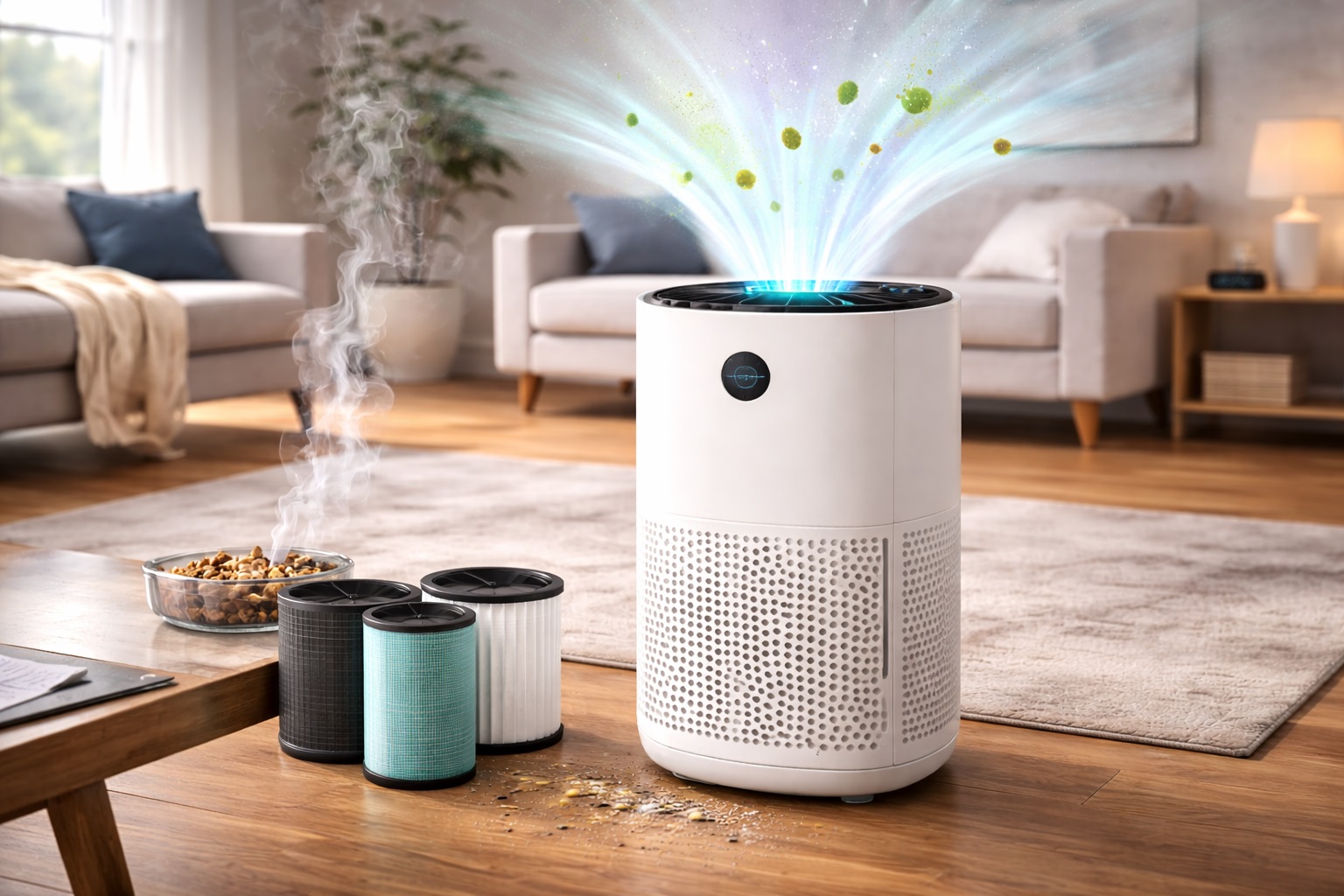
Smoke is one of the tougher challenges an air purifier can face, since it combines fine particulate matter with lingering gaseous odors that a particle filter alone can't fully address. Whether the source is wildfire smoke drifting indoors, cooking smoke, or lingering cigarette odor, an effective purifier for odor removal typically needs an activated carbon component in addition to strong particle filtration. This guide compares eight established air purifiers, focusing on which ones genuinely combine both types of filtration versus which ones are primarily built for particles alone.
It's worth setting realistic expectations upfront: no air purifier will make a heavily smoke-damaged room completely odor-free on its own, and ventilation, cleaning, and source control all play a role too. What a good purifier can do is meaningfully reduce airborne smoke particles and, with the right filter media, cut down on the lingering smell over time. Below, we walk through where each of these eight models fits into that picture, and where their strengths and limitations for smoke specifically lie.
We've also included models here that are excellent general-purpose purifiers but aren't specifically engineered for odor and gas removal, and we say so directly rather than stretching their strengths to fit the smoke use case. That honesty matters more here than in most other categories, since a purifier that excels at capturing dust may still leave a smoky smell behind if it lacks a real carbon filtration stage. Households dealing with recurring wildfire smoke, frequent cooking odors, or lingering cigarette smell each have somewhat different priorities, and we've tried to flag which models suit which scenario rather than treating smoke as a single uniform problem.
Keep in mind that filter design changes fairly often across product generations, so always double-check the current specification sheet for a specific model before assuming it still includes the same carbon filtration described here. Manufacturers sometimes revise a filter lineup without changing the overall product name, which can catch buyers off guard if they're shopping based on older reviews.
Top 8 Best Air Purifier Picks for Smoke and Odor (Detailed Reviews)
1. Blueair Blue Pure 211+ – Best For Whole-Room Smoke Particle Capture
The Blueair Blue Pure 211+ uses a 3-stage filtration system that combines particle capture with an activated carbon layer, making it a reasonably well-rounded choice for smoke-affected rooms. At around $300, it sits in the middle of this comparison's price range, and its high airflow helps it cycle a larger room's air more quickly during a heavy smoke event, which matters when particle and odor levels are elevated. Its washable pre-filter also captures larger ash particles before they reach the deeper filtration layers, which can extend the working life of the main filter during a prolonged smoke event.
- Pros:
- Premier build quality
- 3-stage filtration including a carbon layer for odor
- Reputable brand known for large-room airflow
- Cons:
- Higher price point than entry-level models
- Limited availability of colored pre-filter covers in some regions
Best For: Larger rooms dealing with both smoke particles and lingering odor.
Why We Recommend It: Its combination of strong airflow and carbon-assisted filtration makes it one of the more genuinely well-rounded picks for smoke-affected spaces.
2. GermGuardian AC4825 – Best For Budget Odor and Smoke Control
The GermGuardian AC4825 pairs a HEPA-type filter with a charcoal-infused layer aimed at odor control, plus a UV-C light sanitizer, all at a price around $100. For anyone dealing with smoke odor on a tight budget, this combination of features at the lowest price point in this comparison makes it a practical starting option, particularly for a smaller room. Its compact tower design also makes it easy to move between rooms if smoke odor is concentrated in one particular area of the home, such as near a fireplace or kitchen.
- Pros:
- Premier build quality
- Charcoal-infused filter aimed at odor plus a UV-C sanitizer
- Reputable, widely available brand at the lowest price point here
- Cons:
- Lower fan power than larger, pricier units
- Limited availability of specialty filter refills in some stores
Best For: Smaller rooms affected by smoke odor where budget is the primary constraint.
Why We Recommend It: Its odor-focused filter layer at a low price makes it one of the more accessible options for tackling smoke smell in a smaller space.
3. Winix 5500-2 – Best For PlasmaWave Odor Neutralization
The Winix 5500-2 combines a True HEPA filter with PlasmaWave technology, an ionization-style process specifically marketed toward neutralizing odor-causing particles, at a price around $160. This makes it a reasonably targeted choice for odor concerns without spending at the premium end of this comparison, and its price makes it easy to place in more than one room affected by smoke smell. Running it on a higher setting during the worst hours of a smoke event, then dialing back once conditions improve, is a practical way to get the most out of it.
- Pros:
- Premier build quality
- PlasmaWave technology aimed specifically at odor
- Reputable brand with widely available replacement filters
- Cons:
- Coverage area is more moderate than premium large-room models
- Limited availability of newer filter variants in some markets
Best For: Households wanting targeted odor neutralization without a premium price tag.
Why We Recommend It: Its odor-focused PlasmaWave technology gives it a genuine edge for smoke smell at a moderate price point.
4. Medify MA-40 – Best For Fine Smoke Particle Filtration
The Medify MA-40 uses a medical-grade H13 True HEPA filter, which excels at capturing the fine particulate matter that makes up much of wildfire and cooking smoke. At around $300, it's priced similarly to the Blueair 211+, and while its primary strength is particle capture rather than odor neutralization specifically, that fine-particle performance still matters a great deal during active smoke events, since much of the health concern around wildfire smoke specifically comes from the smallest particles the H13 rating is designed to capture.
- Pros:
- Premier build quality
- H13 True HEPA filter for fine particle capture
- Reputable brand with a growing following
- Cons:
- Higher price point than basic models
- Limited availability of the largest filter cartridges at some retailers
Best For: Rooms where fine smoke particle capture matters more than lingering odor.
Why We Recommend It: Its H13-grade filtration makes it a strong performer against the particulate side of smoke, even if odor control isn't its primary focus.
5. Dyson Pure Cool TP04 – Best For Combined Gas and Particle Filtration
The Dyson Pure Cool TP04 includes an activated carbon filter specifically designed to help capture gases and odors alongside its particle filtration, making it one of the more deliberately dual-purpose options in this comparison for smoke concerns. At around $550, it's the most expensive model here, but its combination of gas-phase and particle filtration is a genuine match for the smoke use case this guide focuses on. Its app also displays live air quality readings, which can help you track whether indoor conditions are actually improving as outdoor smoke clears.
- Pros:
- Premier build quality
- Activated carbon filtration aimed at gases and odors
- Reputable brand with strong app-based air quality monitoring
- Cons:
- Highest price point in this comparison
- Limited availability of certain color finishes
Best For: Buyers who want dedicated gas and odor filtration alongside strong particle capture.
Why We Recommend It: Its carbon filtration specifically targets the gaseous side of smoke, which is a meaningful advantage over purely particle-focused competitors.
6. Coway Airmega 400 – Best For Large-Space Wildfire Smoke Response
The Coway Airmega 400 uses a dual filtration system and is generally rated for larger coverage areas, making it a strong option for whole-room response during a significant smoke event, such as sustained wildfire smoke affecting a large living space. At around $500, it's a considerable investment, but its combination of capacity and dual-stage filtration makes it one of the more capable options here for a bigger room. Households in areas that experience recurring wildfire smoke seasons may find the higher upfront cost justified by years of repeated use.
- Pros:
- Premier build quality
- Dual filtration system
- Reputable brand known for higher-capacity units
- Cons:
- Higher price point than mid-tier options
- Limited availability in smaller retail footprints
Best For: Larger rooms needing sustained filtration capacity during extended smoke events.
Why We Recommend It: Its higher-capacity dual filtration system makes it well suited to larger spaces during prolonged smoke exposure.
7. Levoit Core 400S – Best For Smart Monitoring During Smoke Events
The Levoit Core 400S includes Smart WiFi control with real-time air quality monitoring through its companion app, which is genuinely useful during a smoke event when conditions can change quickly. At around $220, it offers a reasonable middle-ground price, and being able to check air quality readings remotely helps you decide when to run the unit harder or when conditions have improved enough to ease off. This kind of visibility is particularly valuable during multi-day smoke events when outdoor conditions can shift significantly from morning to evening.
- Pros:
- Premier build quality
- Smart WiFi control with real-time air quality monitoring
- Reputable, well-supported brand
- Cons:
- Higher price relative to some competitors
- Limited availability of specialty filters in some regions
Best For: Households that want to track air quality changes remotely during a smoke event.
Why We Recommend It: Its app-based air quality monitoring adds real practical value specifically during fluctuating smoke conditions.
8. Honeywell HPA300 – Best For Fine Particle Filtration, Less Focused on Odor
The Honeywell HPA300 delivers strong True HEPA particle filtration at a price around $250, but it's worth being upfront that it isn't built around dedicated odor or gas-phase filtration the way some other models on this list are. It remains genuinely useful for filtering the fine particulate matter in smoke, but if lingering smell is your primary concern rather than particle count, a model with a stronger carbon component may serve you better. It remains a solid all-around purifier outside of smoke season, which is worth factoring in if you're weighing year-round usefulness against smoke-specific performance.
- Pros:
- Premier build quality
- True HEPA filtration
- Reputable brand with a long track record
- Cons:
- Less focused on odor and gas-phase filtration than some alternatives here
- Limited availability of turbo-speed replacement filters in some regions
Best For: Rooms where filtering smoke particles matters more than eliminating lingering odor.
Why We Recommend It: Its strong particle filtration is genuinely useful during smoke events, even though it's honestly not the best choice here for odor specifically.
Buying Guide: How to Choose the Best Air Purifier for Smoke
1. Understand Why Activated Carbon Matters for Smoke
Smoke contains both solid particles and gaseous compounds, and a HEPA filter alone captures particles while doing little for the gases that carry much of the smell. An activated carbon layer chemically adsorbs many of these odor-causing gases, which is why purifiers combining both HEPA and carbon filtration tend to perform better against smoke than particle-only models. The amount of carbon media in a filter also matters, since a thin carbon layer saturates and stops adsorbing odors much sooner than a denser one.
2. Check CADR Ratings Specifically for Smoke
Many manufacturers publish separate CADR figures for dust, pollen, and smoke, since smoke particles are typically finer than dust or pollen. Comparing the smoke-specific CADR number, rather than a general averaged figure, gives a more accurate sense of how a unit will actually perform during a smoke event. If a listing only provides a single generalized CADR figure, it's worth reaching out to the manufacturer or checking independent test data for the smoke-specific number.
3. Recognize the Difference Between Particle and Gas Filtration
HEPA filtration addresses the visible particulate side of smoke, while carbon filtration addresses the invisible gaseous compounds responsible for much of the lingering smell. A purifier that only does one of these well will leave a gap, so understanding which problem you're primarily trying to solve helps guide your choice. If you're dealing with both a visible haze and a persistent smell, prioritizing a unit that addresses both is worth the likely increase in price.
4. Size Up for Wildfire Season or Heavy Smoke Events
During sustained heavy smoke conditions, it's often worth choosing a unit rated for a larger area than your room actually is, since particle concentrations can be significantly higher than typical indoor conditions. Extra capacity gives the purifier headroom to keep up during the worst days rather than being overwhelmed. This is particularly worth considering for households in regions with a predictable annual wildfire season, where the investment pays off year after year.
5. Plan for Continuous Operation During Poor Air Quality Days
Running a purifier continuously, rather than intermittently, matters more during active smoke events than in typical daily use, since particle levels can climb quickly if filtration pauses. Setting the unit to auto mode, if available, helps it respond to changing conditions without needing constant manual adjustment. Pairing indoor operation with a local outdoor air quality index reading can help you decide how aggressively to run the unit at any given time.
6. Seal the Room for Maximum Effectiveness
An air purifier works best in a room with limited fresh air infiltration during a smoke event, so closing windows, doors, and exterior vents helps the unit keep up with incoming smoke rather than fighting a constant new supply. This is especially relevant during wildfire smoke advisories. Using a rolled towel or weatherstripping along door gaps can further reduce how much outdoor smoke seeps into an otherwise sealed room.
7. Expect More Frequent Filter Replacement During Heavy Exposure
Filters exposed to sustained heavy smoke clog and saturate faster than they would under normal household conditions, particularly activated carbon layers, which have a finite capacity to adsorb odor compounds. Check filters more frequently during smoke season and be prepared to replace them sooner than the standard schedule suggests. A visibly darkened or ash-covered filter is a clear sign that it needs attention regardless of how long it's technically been in service.
8. Use Smart Monitoring and Air Quality Alerts
A purifier with real-time air quality sensing and app-based alerts can help you track conditions without needing a separate monitor, which is particularly useful when smoke levels fluctuate throughout the day. This kind of visibility helps you decide when to run the unit at full power versus when conditions have eased. Some apps can also send a notification when indoor readings cross a threshold you set, which removes the need to check manually throughout the day.
9. Consider Placement Near Smoke Sources
For cooking smoke, positioning a purifier closer to the kitchen, within reason, can help address odor at the source rather than only after it spreads through the home. For cigarette smoke or fireplace use, placing the unit near the room's main air circulation path tends to be more effective than tucking it into a corner. Avoid placing it directly behind furniture or curtains, since restricted airflow reduces how much smoke-laden air actually reaches the filter.
10. Consider Multiple Units for Whole-Home Smoke Protection
A single purifier can only meaningfully treat one room or open area, so during a significant smoke event, placing units in the rooms where your household spends the most time, such as bedrooms and the main living area, offers more practical protection than trying to cover an entire house with one unit. Rotating a single unit between rooms is a reasonable lower-cost alternative if buying multiple purifiers isn't feasible.
11. Look for Certifications Relevant to Smoke and VOC Claims
AHAM Verifide ratings that specifically include a smoke CADR figure are a good sign that a manufacturer's smoke-related performance claims have been independently tested. For gas and VOC claims, look for clear documentation of the carbon filter's capacity rather than vague marketing language. Manufacturers that publish detailed filter specifications tend to be more transparent about real-world performance overall.
12. Anticipate Higher Noise Levels When Running on High
During a heavy smoke event, you may need to run a purifier at higher fan speeds than usual to keep up with elevated particle levels, which means accepting more noise than you might during typical daily operation. This trade-off is generally worth it during short-term heavy smoke periods, and dialing the fan back down once conditions improve restores quieter everyday operation.
13. Weigh Budget Against Premium Odor-Specific Features
A budget model with a basic carbon layer can meaningfully reduce smoke odor in a smaller room, while a premium unit with dedicated gas-phase filtration and greater capacity makes more sense for a larger space or more severe, recurring smoke exposure. Match your spending to the actual severity and frequency of the smoke issue you're dealing with. Someone dealing with occasional cooking odor has very different needs than a household in a region with a multi-month wildfire season each year.
Frequently Asked Questions
Can air purifiers remove smoke smell?
A purifier with an activated carbon filter can meaningfully reduce smoke odor over time by adsorbing many of the gaseous compounds responsible for the smell, though a HEPA-only filter will do much less for lingering odor even if it captures particles well. Complete odor elimination in a heavily affected space usually also requires cleaning fabrics and surfaces that have absorbed smoke.
Do air purifiers help with wildfire smoke?
Yes, a properly sized purifier with strong particle filtration can meaningfully reduce indoor particulate levels during wildfire smoke events, especially when combined with sealing the room to limit incoming outdoor air. Checking local air quality index readings alongside your indoor monitor can help you judge how well the strategy is working.
What filter type is best for smoke odor?
A combination of True HEPA filtration for particles and an activated carbon layer for gases and odors generally performs best against smoke, since the two filter types address different aspects of the problem. Checking that a listing explicitly names both filter types, rather than just "advanced filtration," helps confirm you're getting genuine odor control.
How long does it take to clear smoke from a room?
This varies widely based on room size, purifier capacity, and how much fresh smoke continues entering the space, but a well-matched purifier running continuously in a sealed room can noticeably reduce particle levels within a few hours. Lingering odor from gaseous compounds may take longer to fully clear than visible particulate levels.
Should I run my purifier constantly during wildfire season?
Continuous operation during periods of poor outdoor air quality generally gives the best results, since pausing allows particle levels to climb back up before the unit can catch up again. An auto mode that scales fan speed with real-time readings can help balance this against noise and energy use.
Can HEPA filters alone remove smoke odor?
Not effectively on their own. HEPA filters are designed to capture particulate matter, not gaseous odor compounds, so a purifier without an activated carbon component will typically leave more lingering smell than one that includes both filtration types. This is one of the most common misconceptions shoppers have when buying a purifier specifically for smoke.
Do air purifiers remove cigarette smoke?
A purifier with both HEPA and activated carbon filtration can help reduce both the visible particulate and the lingering odor associated with cigarette smoke, though completely eliminating the smell from a heavily smoke-affected room may also require cleaning surfaces and textiles, since cigarette residue tends to cling to fabric and painted walls over time.
How often should carbon filters be replaced?
Carbon filters generally need more frequent replacement than HEPA filters, especially under heavy odor exposure, since their capacity to adsorb gases is finite. Follow the manufacturer's recommended schedule and replace sooner if you notice odor control declining, since a saturated carbon filter can start releasing trapped odors back into the room.
Can an air purifier make a room fully smoke-free?
An air purifier can significantly reduce smoke particles and odor, but it works best alongside source control, ventilation when air quality improves outside, and cleaning of surfaces and fabrics that have absorbed smoke residue. Treat the purifier as one part of a broader smoke-response strategy rather than a complete solution on its own.
Is it safe to run an air purifier during an active fire nearby?
A purifier can help manage indoor air quality during nearby fire conditions, but always follow official evacuation and safety guidance from local authorities first, since air purification does not address direct fire safety risks. Air quality management should always be secondary to physical safety in an active fire situation.
Do air purifiers help with cooking smoke and odors?
Yes, a purifier with carbon filtration can help reduce lingering cooking odors and fine particulate matter from cooking smoke, working alongside kitchen ventilation like a range hood rather than replacing it entirely. Running the purifier during and shortly after cooking tends to produce the best results for controlling lingering food odors.
What size purifier do I need for smoke removal?
Sizing up beyond your room's standard square footage rating is generally a good idea for smoke-specific use, since particle concentrations during active smoke events can exceed typical daily conditions the unit was rated for. A unit sized for double your actual room area gives useful headroom during the worst air quality days.
Can air purifiers remove smoke stains from walls?
No, air purifiers only address airborne particles and odors and cannot remove smoke residue or staining that has already settled on walls, ceilings, or furniture, which requires separate cleaning or repainting. Addressing airborne smoke early with a purifier can help reduce how much residue eventually settles on surfaces in the first place.
Final Verdict
- Top Pick: Blueair Blue Pure 211+ for its balance of strong airflow and carbon-assisted odor filtration in larger rooms.
- Budget Choice: GermGuardian AC4825 for affordable odor control with a charcoal filter in smaller spaces.
- Premium Choice: Dyson Pure Cool TP04 for dedicated gas-phase carbon filtration alongside strong particle capture.
Smoke is genuinely one of the harder air quality problems to solve with a purifier alone, since it demands both strong particle filtration and dedicated gas-phase odor control working together. The Blueair Blue Pure 211+, GermGuardian AC4825, and Dyson Pure Cool TP04 all include a real carbon filtration component, which gives them a meaningful edge over particle-only models like the Honeywell HPA300 when lingering smell is the main concern. Whichever model you choose, pairing it with proper room sealing and realistic expectations about ongoing filter replacement will get you the best results during an actual smoke event. Keep a spare set of filters on hand if you live somewhere prone to recurring smoke events, since being caught without a replacement right when you need it most is a common and avoidable frustration.