Best Air Purifier for Large Rooms in 2026
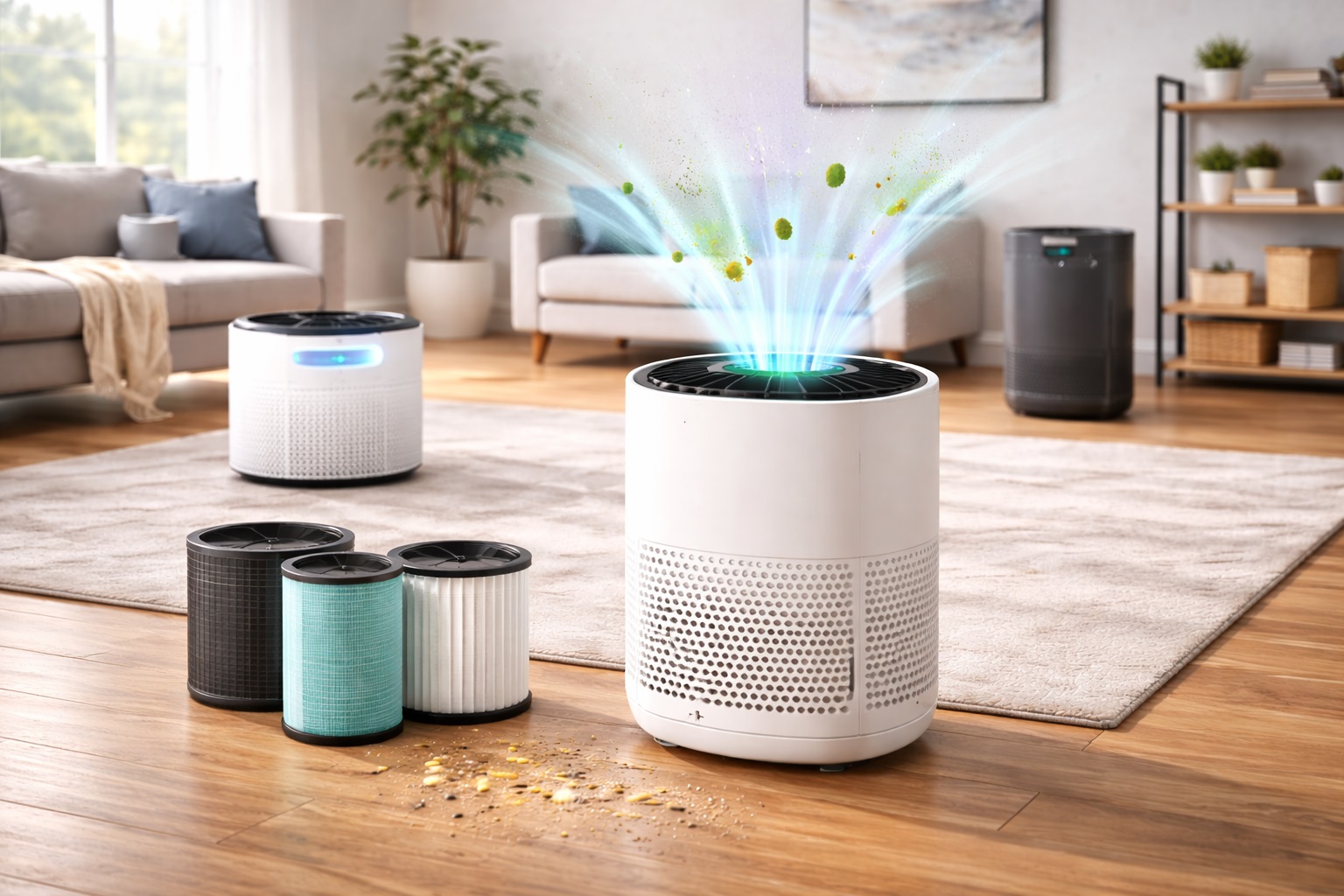
Large rooms and open-concept layouts create a real challenge for air purification: more square footage means more airborne dust, pollen, and odor particles to filter, and a unit built for a small bedroom simply won't keep up. In 2026, several air purifiers stand out for their ability to move a high volume of air across an entire living room, loft, or open-plan floor without leaving the far corners under-filtered. This guide compares the top models built around high coverage area performance, focusing on practical factors like clean air delivery rate, filtration stages, and noise output at higher fan speeds rather than marketing claims alone.
Whether you're outfitting a great room, a finished basement, or a combined kitchen-living space, the right purifier needs enough airflow to cycle the entire volume of air in the room several times per hour. Below, we break down eight well-known models, are upfront about which ones genuinely excel in large spaces versus which are better suited to smaller zones, and walk through the buying criteria that matter most when square footage is the priority.
It also helps to think about how your large room actually gets used from day to day, since a great room that hosts guests, pets, and open kitchen cooking generates a different mix of particles and odors than a quiet home office of the same size. A purifier that looks strong on paper for one large-room scenario might be the wrong fit for another, which is why this guide pairs each product with an honest description of the type of large space it suits best, rather than treating every big room the same way. We also flag which models are genuinely engineered for high coverage area performance versus which ones are simply large-looking appliances that top out at moderate square footage.
Top 8 Best Air Purifier Picks for Large Rooms (Detailed Reviews)
1. Levoit Core 400S – Best For Mid-Sized Open Layouts
The Levoit Core 400S is one of the most popular smart air purifiers on the market, largely thanks to its smartphone app and voice-assistant integration through Smart WiFi control. It's worth noting upfront that the Core 400S is sized for mid-range rooms rather than sprawling open floor plans, so in a genuinely large room it performs best as a secondary unit or in a smaller adjoining space rather than as the sole purifier for an open floor. At around $220, it sits in the middle of the price range covered in this guide, and its build quality and app-based scheduling make it a convenient option for anyone who wants to automate air purification alongside other smart home devices.
- Pros:
- Premier build quality
- Smart WiFi control for remote scheduling and monitoring
- Reputable, well-supported brand with easy-to-find filters
- Cons:
- Higher price relative to its actual room coverage
- Limited availability of specialty filters in some regions
Best For: Homeowners who want app-based control in a mid-sized room adjacent to their main living space.
Why We Recommend It: The Core 400S delivers dependable filtration and smart-home integration, making it a strong secondary purifier for large homes even though it isn't the single best choice for wall-to-wall large-room coverage.
2. Winix 5500-2 – Best For Multi-Room Households on a Budget
The Winix 5500-2 pairs a True HEPA filter with PlasmaWave technology, an ionization-style process designed to help neutralize odor-causing particles without meaningfully increasing ozone output. Priced around $160, it's one of the more affordable options in this lineup, which makes it appealing if you need to cover several rooms in a large home without buying the priciest unit for every space. It isn't the highest-CADR unit here, so in a genuinely oversized room it works best in the largest room you have while more budget-friendly models handle smaller adjoining areas.
- Pros:
- Premier build quality
- PlasmaWave technology for added odor control
- Reputable brand with widely available replacement filters
- Cons:
- Coverage area is more moderate than premium large-room models
- Limited availability of newer filter variants in some markets
Best For: Larger households that need to equip multiple rooms without spending premium prices on every unit.
Why We Recommend It: Its combination of True HEPA filtration and affordability makes the 5500-2 a smart way to extend coverage across a large home on a reasonable budget.
3. Dyson Pure Cool TP04 – Best For Combining Air Purification With Cooling
The Dyson Pure Cool TP04 is a bladeless tower fan and air purifier in one, using Dyson's Air Multiplier technology to circulate purified air throughout a room. At roughly $550, it's the most expensive model in this comparison, and that price reflects its dual-purpose design as much as sheer square-footage coverage. In a large room, the TP04's fan function helps distribute filtered air further than a purifier-only design might, which can be a real advantage in open layouts where a seating area sits far from the unit itself.
- Pros:
- Premier build quality
- Air Multiplier technology that doubles as a cooling fan
- Reputable brand with strong app support
- Cons:
- Higher price point than most dedicated purifiers
- Limited availability of certain color finishes
Best For: Anyone who wants a two-in-one appliance that purifies and cools a large, open living space.
Why We Recommend It: The TP04's fan-assisted airflow helps purified air reach further corners of a large room, which is a genuine advantage in open floor plans even at a premium price.
4. Blueair Blue Pure 211+ – Best For True Large-Room Coverage
The Blueair Blue Pure 211+ is widely regarded as one of the stronger large-room purifiers in its class, built around a 3-stage filtration system housed behind a simple, washable fabric pre-filter. At around $300, it lands in the middle of the price range while offering some of the highest airflow performance in this lineup, which is exactly what's needed when square footage is the primary concern. Its cylindrical design also promotes 360-degree air intake, helping it pull in air from all directions in an open room rather than from just one side.
- Pros:
- Premier build quality
- 3-stage filtration with a washable fabric pre-filter
- Reputable brand known specifically for large-room performance
- Cons:
- Higher price point than entry-level models
- Limited availability of colored pre-filter covers in some regions
Best For: Households with a genuinely large living room, loft, or open-concept space that needs real coverage rather than a room-size label.
Why We Recommend It: The 211+ is one of the few purifiers in this guide actually engineered around large-room airflow, making it a legitimate fit for the exact use case this list is built around.
5. Medify MA-40 – Best For Large Living Rooms and Open-Concept Spaces
The Medify MA-40 uses a medical-grade H13 True HEPA filter and is frequently positioned toward larger rooms thanks to its higher-capacity fan and filtration stack. At about $300, it's priced similarly to the Blueair 211+, and the two make a reasonable comparison for anyone deciding between large-room purifiers in the same tier. The MA-40's straightforward controls and sturdy housing make it a practical option for a family room or an open kitchen-living combination where fine-particle filtration matters as much as raw airflow.
- Pros:
- Premier build quality
- H13 True HEPA filter for fine particle capture
- Reputable brand with a growing following among allergy sufferers
- Cons:
- Higher price point than basic models
- Limited availability of the largest filter cartridges at some retailers
Best For: Large open-plan spaces where fine particle filtration is the top priority alongside coverage.
Why We Recommend It: Its H13-grade filtration combined with a large-room-oriented fan makes the MA-40 a legitimate contender for genuinely spacious rooms.
6. GermGuardian AC4825 – Best For Small Zones Within a Large Home
The GermGuardian AC4825 is a compact tower purifier featuring a UV-C light sanitizer alongside its HEPA-type filter, and at around $100 it's the most budget-friendly option in this comparison. It's important to be upfront that the AC4825 is designed for smaller spaces, so in a truly large room it works best as a supplemental unit for a bedroom, home office, or reading nook off the main living area rather than as the sole purifier for an open floor plan.
- Pros:
- Premier build quality
- UV-C light sanitizer as an added filtration layer
- Reputable, widely available brand
- Cons:
- Fan power is a real constraint in genuinely large rooms
- Limited availability of specialty filter refills in some stores
Best For: Homeowners who want an inexpensive secondary unit for smaller rooms within a larger house.
Why We Recommend It: While not built for wall-to-wall large-room coverage, its low price makes it a sensible add-on for smaller adjoining spaces.
7. Honeywell HPA300 – Best For Whole-Floor Air Circulation
The Honeywell HPA300 has long been a favorite for larger rooms thanks to its True HEPA filtration and a fan powerful enough to circulate air across sizable spaces. Priced around $250, it sits comfortably between the budget and premium tiers while still delivering the kind of airflow that larger rooms actually require. Its boxy, no-frills design prioritizes function over styling, with multiple fan speeds so you can dial in stronger circulation on high-pollen days or quieter operation overnight.
- Pros:
- Premier build quality
- True HEPA filtration
- Reputable brand with a long track record in large-room purifiers
- Cons:
- Higher price point than entry-level towers
- Limited availability of turbo-speed replacement filters in some regions
Best For: Larger living rooms, finished basements, or open floor plans that need consistent, dependable circulation.
Why We Recommend It: The HPA300 balances genuine large-room airflow with a mid-range price, making it one of the more practical picks on this list.
8. Coway Airmega 400 – Best For Maximum Square Footage Coverage
The Coway Airmega 400 is built around a dual filtration system and is generally positioned toward some of the largest coverage areas among consumer air purifiers, making it a natural fit for anyone whose top priority is square footage. At around $500, it's the second most expensive model in this guide, but that cost reflects genuinely higher-capacity components rather than just a premium finish. Its air quality sensors and auto mode also help it scale fan speed up and down as particle levels change across a large space.
- Pros:
- Premier build quality
- Dual filtration system
- Reputable brand known for higher-capacity units
- Cons:
- Higher price point than mid-tier options
- Limited availability in smaller retail footprints
Best For: The largest rooms and open-concept living areas in this comparison, where coverage area matters more than anything else.
Why We Recommend It: Between its filtration capacity and its reputation for handling bigger spaces, the Airmega 400 stands out as the top pick specifically for large-room performance.
Buying Guide: How to Choose the Best Air Purifier for Large Rooms
1. Understand CADR Before You Buy
Clean Air Delivery Rate, or CADR, measures how much filtered air a purifier produces per minute for dust, pollen, and smoke. In a large room, a low CADR rating means the unit simply cannot cycle enough air to keep up, no matter how good the filter media is. Rather than trusting a marketing phrase like "whole-home coverage," look at the actual CADR numbers and compare them against your room's square footage before deciding. Reputable manufacturers typically publish separate CADR figures for dust, pollen, and smoke, and it's worth checking all three if your household deals with a mix of concerns.
2. Match Coverage Area to Your Actual Square Footage
Manufacturers list a maximum coverage area, but that figure is often based on the highest fan speed, which can be noisy for everyday use. Measure your room, account for ceiling height and open adjoining spaces, and choose a unit rated comfortably above your actual square footage so you have headroom to run it quietly on lower settings. This extra margin also means the purifier won't need to labor at maximum output just to keep up with everyday conditions, which can extend the working life of the motor and filter.
3. Prioritize Air Changes Per Hour (ACH)
ACH describes how many times per hour a purifier can theoretically replace the air in a room. For allergy or asthma sufferers, four to five air changes per hour is a commonly cited target. Larger rooms need a proportionally more powerful fan and filter stack to hit the same ACH that a small unit achieves easily in a bedroom. If a listing doesn't state ACH directly, you can often estimate it by dividing the unit's CADR-based airflow by your room's volume, giving you a more realistic sense of turnover speed.
4. Compare Filtration Technologies
HEPA and True HEPA filters capture fine particulate matter, while activated carbon layers target odors and gases, and ionizing technologies like PlasmaWave add another layer of particle neutralization. In a large room with mixed concerns, such as pet dander plus cooking odors, a combination filtration approach tends to outperform a single-stage filter. Rotating or upgrading the pre-filter regularly also helps the primary HEPA layer last longer, since it catches larger debris before it ever reaches the finer media.
5. Factor In Noise at Higher Fan Speeds
Large rooms often require higher fan speeds to maintain adequate airflow, so check decibel ratings at the speed you'll actually use rather than the quietest setting listed in the spec sheet. A purifier that's silent on low but must run on high in a large room may end up louder day-to-day than expected. If noise is a major concern, look for a model with a dedicated sleep mode that dims lights and softens the fan curve without shutting off filtration entirely.
6. Look For Smart Features That Add Real Value
App control, automatic mode driven by built-in air quality sensors, and scheduling are genuinely useful in large rooms, where manually adjusting fan speed throughout the day is less practical than in a small bedroom. These features let the purifier respond to changing conditions without you having to monitor it constantly. Some apps also log historical air quality trends, which can help you spot recurring problem times, such as evening cooking or a nearby wildfire season, and adjust settings in advance.
7. Budget For Ongoing Filter Replacement
Large-capacity purifiers often use bigger filters that cost more to replace, and heavier use in a large room can mean more frequent swaps. Before buying, check the manufacturer's recommended replacement interval and the going price of replacement filters so you understand the total cost of ownership, not just the sticker price. Buying filters in multi-packs or subscribing to an auto-replenishment program, where available, can also shave a meaningful amount off the annual cost of running a large-room unit continuously.
8. Consider Energy Use for Continuous Operation
Large rooms typically benefit from round-the-clock purifier operation rather than occasional use, so it's worth checking a unit's wattage at various fan speeds. An energy-efficient model can meaningfully reduce the cost of that continuous runtime over a full year. Many newer large-room units also include an eco or auto mode that automatically lowers fan speed once air quality readings improve, cutting power draw without sacrificing responsiveness.
9. Plan Placement Carefully
Position the purifier centrally in the room where possible, away from walls, curtains, or furniture that could block the intake or output vents. Elevating it slightly on a stand or low table, rather than tucking it into a corner on the floor, can also improve how evenly it circulates air across a larger space. In rooms with high ceilings, keep in mind that particles can linger in upper air layers longer than sensors at floor or tabletop height might suggest.
10. Decide Between One Large Unit or Multiple Smaller Units
In an especially large or irregularly shaped open floor plan, two mid-size purifiers placed in different zones can sometimes outperform a single large unit that has to work harder to reach the far corners of the space. Consider your room's layout, not just its total square footage, when making this call. Running two units also builds in some redundancy, since the room retains partial coverage if one unit needs a filter change or a repair.
11. Check for Independent Certifications
Look for AHAM Verifide ratings, Energy Star certification, and CARB compliance where applicable. These third-party verifications give you a more objective sense of a purifier's real-world performance and safety than manufacturer marketing alone. Ozone output is another thing worth confirming, especially for ionizing technologies, since well-designed models keep any byproduct well below recognized safety thresholds.
12. Evaluate Build, Design, and Footprint
Large-room purifiers tend to be physically larger, so think about where the unit will actually sit and whether it fits your furniture layout. If you plan to move it between rooms occasionally, factor in weight and the presence of carrying handles or wheels. A cylindrical design with 360-degree intake can also be easier to fit into an open layout than a boxy unit that only pulls air from one face.
13. Balance Price Against Actual Performance Needs
It's easy to overspend on premium smart features that don't materially change how well a purifier handles a large room, and just as easy to undersize a purchase to save money when the room genuinely needs a higher-capacity unit. Match the spec sheet to your actual square footage first, then let secondary features guide your final choice. If you're torn between two models at different price points, ongoing filter costs over two or three years often matter more to your total spending than the upfront purchase price.
Frequently Asked Questions
What size air purifier do I need for a large room?
Look for a unit whose manufacturer-rated coverage area comfortably exceeds your room's actual square footage, ideally with enough headroom to run quietly on a lower fan speed rather than maxing out the unit constantly. As a rough starting point, measure length times width in feet to get square footage, then compare that number against the manufacturer's rated coverage before adding any margin.
How many air purifiers do I need for an open floor plan?
It depends on the shape and size of the space. A single high-capacity unit can work for a moderately large open room, but very large or oddly shaped layouts often perform better with two smaller units placed in different zones. An L-shaped or split-level open floor plan is a good example where a second unit usually pays off.
Does a higher CADR always mean better performance?
Generally yes for raw airflow, but CADR should be considered alongside noise level, filter quality, and your room's actual size. A very high CADR unit run on its lowest setting may still underperform a well-matched mid-range model. Treat CADR as one input among several rather than the single deciding number.
Can one air purifier cover an entire house?
A single unit is realistically limited to one large room or an open connected area, since air doesn't circulate freely between separate rooms with closed doors. Whole-house coverage typically requires multiple units or a purifier integrated into your HVAC system. For most households, prioritizing the rooms where people spend the most time, such as the living room and primary bedroom, is a more practical approach.
How often should filters be replaced in a large-room purifier?
Replacement intervals vary by model and usage, but heavier use in a large room, especially running continuously, tends to shorten filter life compared to occasional use in a small bedroom. Always follow the manufacturer's recommended schedule, and check filters visually between scheduled swaps if the room sees unusually heavy dust, smoke, or pet traffic.
Are large-room air purifiers noisier than smaller models?
They can be, particularly at the higher fan speeds needed to move more air. Many large-room units include a genuinely quiet low or sleep setting, so it's worth checking decibel ratings across the full speed range, not just the minimum. Reading verified owner feedback on real-world noise, rather than relying solely on spec sheets, can also be revealing.
How much does it cost to run a large air purifier daily?
Operating cost depends on wattage and how many hours per day you run the unit, but continuous operation in a large room typically costs more than intermittent use in a small space. Energy Star-certified models tend to be more economical over time, and running a unit on auto mode rather than a fixed high speed usually lowers the average daily cost.
Should I run my air purifier continuously in a large room?
Continuous operation, often on a lower or auto setting, generally keeps air quality more consistent in a large space than running the unit only occasionally, since larger rooms take longer to fully cycle their air, and pausing for long stretches lets particle counts creep back up before the unit catches up again.
What's the difference between HEPA and True HEPA?
True HEPA filters are held to a specific industry standard for capturing a high percentage of particles at a defined size, while filters simply labeled "HEPA-type" or "HEPA-like" may not meet that same tested standard. When coverage area and fine-particle capture both matter, it's worth paying attention to which term a listing actually uses.
Do large-room purifiers need more maintenance?
They often do, since they process more air and pick up more particulate matter over time. Regularly checking and cleaning pre-filters, in addition to replacing the main filter on schedule, helps maintain performance in a large space. Wiping down the exterior sensors periodically also keeps auto mode readings accurate.
Can a large-room air purifier help with allergies?
A properly sized True HEPA purifier can help reduce airborne allergens like pollen, dust, and pet dander in a large room, though it works best alongside other allergy-management steps like regular cleaning, reducing clutter, and washing bedding frequently.
Is Wi-Fi connectivity necessary for a large-room purifier?
It isn't strictly necessary, but app control and automatic sensor-based adjustment can be genuinely convenient in a large room where you might not want to manually change fan speed throughout the day. It becomes especially useful if the purifier sits somewhere you can't easily reach the physical controls.
Where should I place a large air purifier for best results?
Central placement away from walls, heavy furniture, and curtains generally gives the best airflow. Avoid corners, since they can restrict intake and reduce how effectively the unit circulates air across the rest of the room. If the room has a clear activity zone, such as a main seating area, positioning the purifier to face that zone tends to give the most noticeable results.
Final Verdict
- Top Pick: Coway Airmega 400 for the largest genuine coverage area and dual filtration capacity.
- Budget Choice: GermGuardian AC4825 as an affordable secondary unit for smaller zones within a large home.
- Premium Choice: Dyson Pure Cool TP04 for households that want purification and cooling combined in one high-end unit.
When square footage is the deciding factor, it pays to look past marketing labels and focus on real coverage area, CADR, and airflow design. The Coway Airmega 400 and Blueair Blue Pure 211+ are genuinely built around large-room performance, while models like the Levoit Core 400S and GermGuardian AC4825 still earn a place in a large home as capable secondary units for smaller adjoining rooms. Matching the purifier to the actual size of your space, rather than the size you wish it covered, is the single most important decision in this entire buying process.