Best Foot Rests for Long Sitting: Stay Comfortable Through Every Long Session
The comfort problems that show up after six or eight hours of continuous sitting are different in kind from the ones that show up after one or two. A foot rest that feels perfectly fine for a short session can start to feel restrictive, or simply stop providing any noticeable benefit, once you're several hours into a full workday. Long sitting sessions punish any weak point in a product's design — a base that's just barely stable enough becomes genuinely wobbly by hour five, and a surface that's just barely grippy enough starts letting your feet drift by hour six.
This means the buying priorities for long-sitting use are somewhat different from general foot rest shopping. Durability under sustained pressure, surface texture that holds up over many consecutive hours, and features that actively counter fatigue rather than simply providing static elevation all matter more here than they would for someone using a foot rest for an hour here and there throughout the day.
This guide focuses specifically on what changes when you're shopping for extended daily use — the product types best suited to long sessions, the buying factors that predict whether something will still feel good after hour six, and the questions people ask most often when their workday routinely runs long. Nothing here treats an occasional-use scenario and an all-day scenario as the same shopping problem, because they aren't.
It's also worth acknowledging that no foot rest, however well designed, fully substitutes for actually getting up and moving periodically during a long sitting session. The products reviewed below meaningfully improve comfort and reduce fatigue across a long day, but they work best as one part of a broader approach that still includes standing, stretching, or walking breaks at reasonable intervals rather than as a way to make uninterrupted sitting entirely consequence-free.
It's worth thinking about a long sitting session the way you'd think about a long drive. A well-designed seat and good lumbar support make hour six feel meaningfully better than a poorly designed one would, but no seat design eliminates the value of stopping periodically to walk around. A foot rest built for long sitting occupies a similar role at the level of your feet and legs specifically — it won't remove every consequence of sitting for most of a workday, but it addresses a real, specific, and common source of discomfort that compounds hour after hour, and addressing it well is worth doing properly rather than treating any foot rest as interchangeable with any other.
The three product types below were chosen specifically because each responds to a different aspect of what makes long sessions harder than short ones — sustained movement, precise positioning, and lasting surface comfort. A product that excels in a five-minute store demo doesn't necessarily excel eight hours in, which is the entire reason this guide treats long-session shopping as its own distinct category rather than folding it into general foot rest advice.
Top Picks Reviewed
1. Rocking Foot Rest – Best for Sustained Multi-Hour Sitting
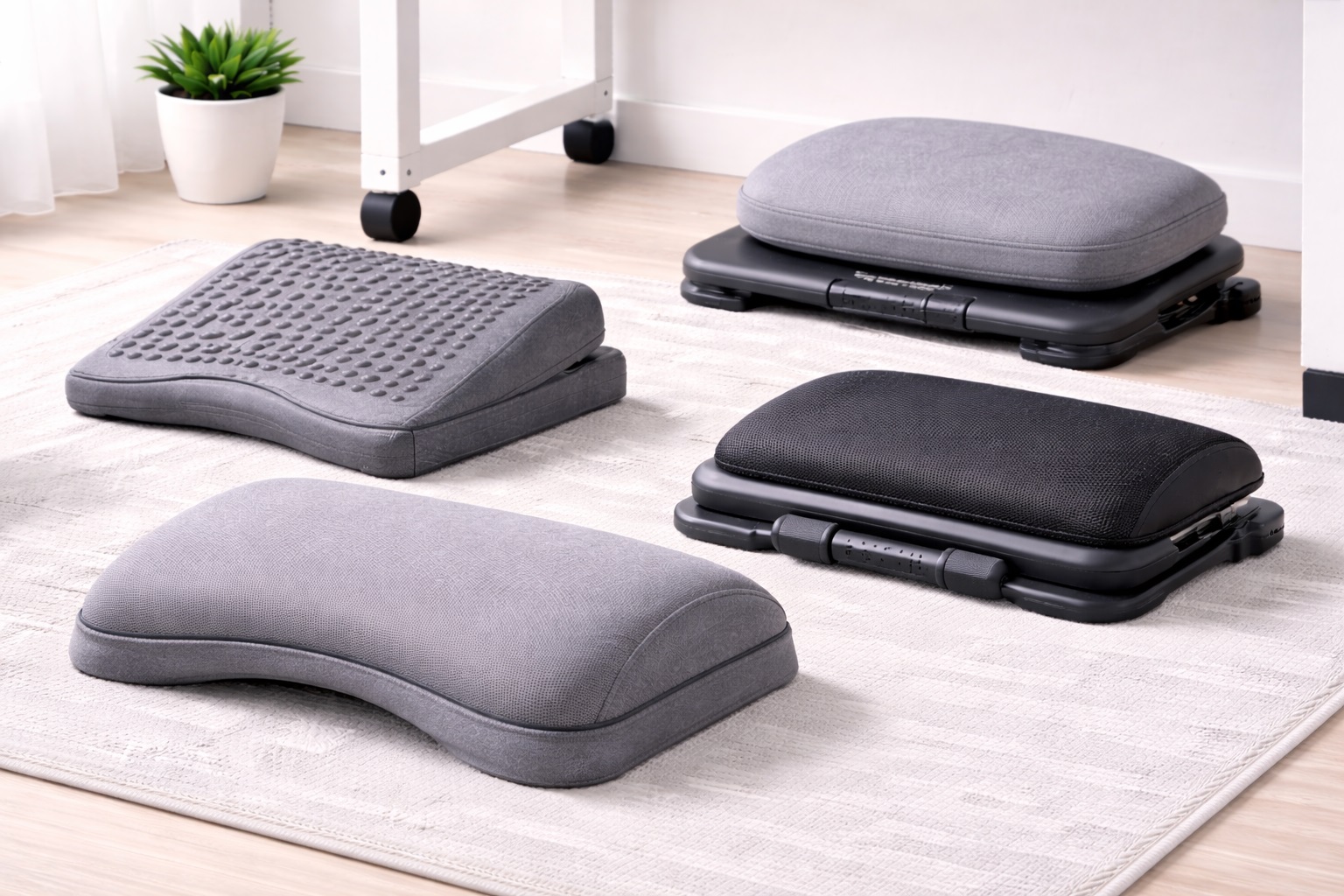
A rocking foot rest allows continuous gentle foot and leg movement, which is precisely the feature that matters most once you're several hours into a sitting session. Rather than holding your feet in one static position for the entire day, the subtle rocking motion lets you shift almost unconsciously, which helps circulation and reduces the specific kind of stiffness that accumulates from hours of stillness rather than from any single incorrect posture. For long sitting sessions specifically, this built-in movement tends to matter more than any other single feature.
- Pros:
- Continuous gentle movement counters long-session stiffness
- Promotes circulation across extended sitting periods
- Comfortable for six or more consecutive hours for most users
- Quiet mechanism on well-built models doesn't distract during focused work
- Cons:
- Requires a brief adjustment period for new users
- Less suitable if you need a completely fixed platform for precision tasks
Because the entire value proposition of this style is sustained comfort rather than a single correct static position, it's worth specifically checking reviews from long-session users — remote workers, writers, and anyone else who routinely sits for most of a workday — rather than reviews focused on short, occasional use. A five-star rating built mostly from buyers who use a product for an hour here and there tells you comparatively little about how the same unit performs across a genuinely full workday, which is the specific scenario this style is meant to address.
Best For: Remote workers and students whose typical day involves six or more hours of continuous desk time and who want built-in movement to counter the fatigue that comes with that duration.
Why We Recommend It: For long sitting specifically, static elevation alone tends to stop feeling beneficial after a few hours, while the continuous gentle movement a rocking design provides keeps working across the entire length of an extended session rather than only in the first hour or two. That's a meaningful distinction for anyone whose workday genuinely runs long, since the whole point of a foot rest chosen for long sitting is that it keeps delivering benefit at hour seven the same way it did at hour one, rather than fading in usefulness the longer the session continues.
2. Adjustable Tilt Foot Rest – Best for Custom All-Day Positioning
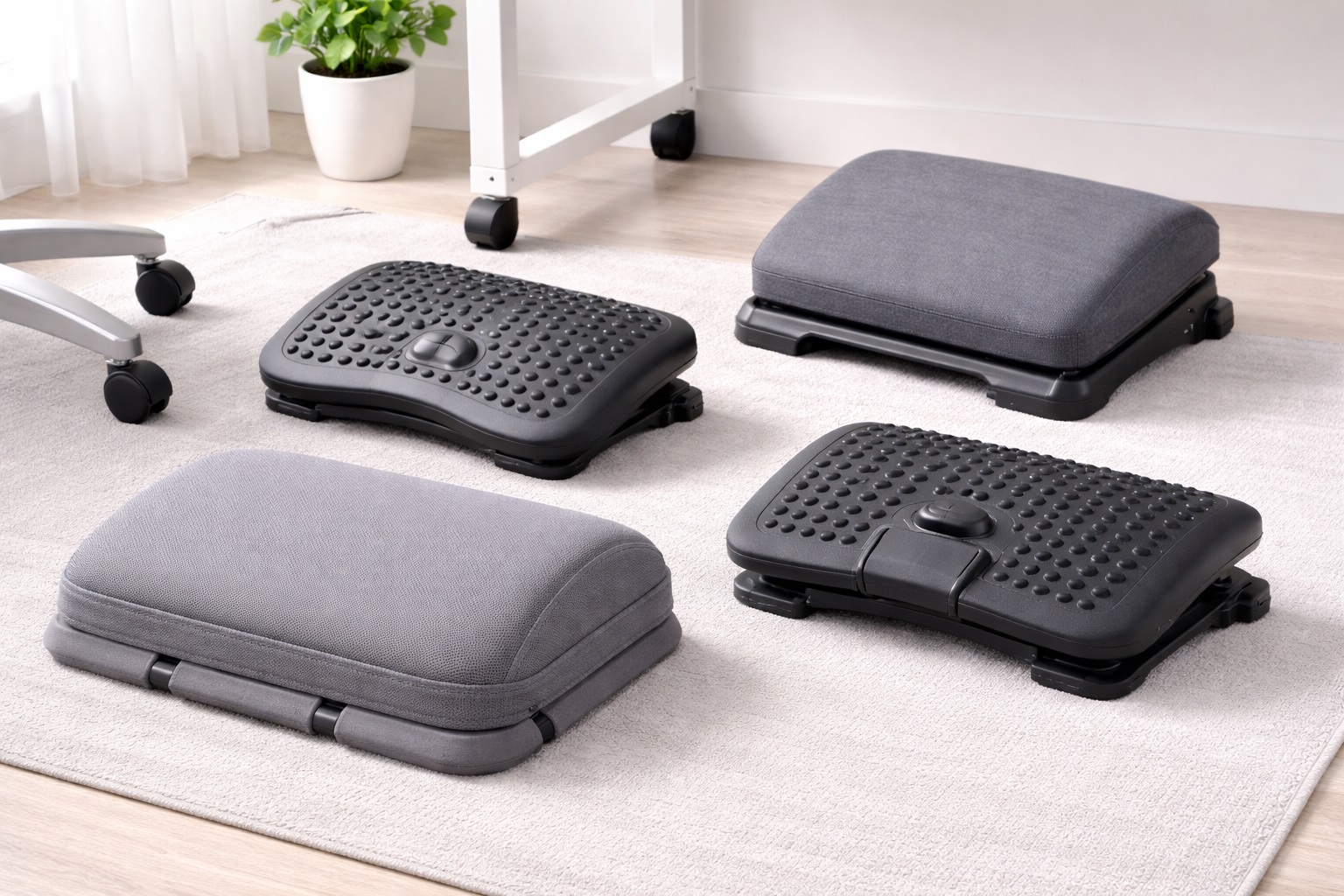
An adjustable tilt foot rest lets you set both height and angle to place your feet in a neutral position matched to your leg length and chair height, and the ability to fine-tune that position becomes more valuable the longer you're actually sitting in it. A position that feels acceptable for twenty minutes can feel noticeably wrong by hour four if it wasn't quite matched to your body in the first place, which makes precise adjustability a long-session priority rather than a minor convenience.
- Pros:
- Height and angle adjustment for a precisely matched all-day position
- Accommodates different chair heights across shared or multi-shift desks
- Non-slip surface keeps feet positioned correctly across long sessions
- Stable base holds position through hours of use
- Cons:
- Plastic construction on entry-level models feels less substantial over long-term use
- Some tilt mechanisms require more effort to adjust
For all-day use, small positioning errors compound over the course of a session in a way they simply don't over a shorter one, which is why getting the height and angle precisely right matters more here than for occasional use, and why a wider adjustment range is worth prioritizing over a narrower one even if both technically cover your measurement.
Best For: Professionals with consistently long desk sessions who want a foot position precisely matched to their body rather than an approximate fit that starts to feel wrong partway through the day.
Why We Recommend It: The value of precise adjustability scales with how long you're actually using the product — a position that's slightly off matters little for twenty minutes but becomes a real source of discomfort across a full workday, which is exactly the scenario this style is built to address. Because a wider adjustment range with finer increments allows for more precise dialing in of the exact angle and height your body settles into over a long day, it's worth favoring a model with more granular adjustment steps over one with only two or three widely spaced settings, even if the price difference is modest.
3. Cushioned Flat Foot Rest – Best for Sustained Surface Comfort
A cushioned flat foot rest elevates the feet at a fixed height with a padded top surface designed to remain comfortable under sustained pressure rather than becoming firm or uncomfortable after extended contact. For long sitting sessions, surface comfort over many hours matters in a way it doesn't for brief use, since a hard or thin surface that's barely noticeable in the first twenty minutes can become genuinely uncomfortable by the fourth or fifth hour.
- Pros:
- Padded surface stays comfortable across extended sessions
- Simple, reliable design with no moving parts to fail
- Immediately improves posture for short-legged users
- Non-slip base keeps the platform in place through hours of use
- Cons:
- Fixed height — not adjustable
- Cushioning can compress and lose some support over years of daily use
Because there's no adjustment mechanism to fail, the main long-term consideration with this style is how well the cushioning material holds its shape after months of daily pressure, which is worth checking specifically in reviews from buyers who've owned the product for an extended period rather than those reviewing it fresh out of the box.
Best For: Long-session users whose feet reach the floor comfortably in terms of height but who want a softer, more forgiving surface than a hard plastic platform provides across many consecutive hours.
Why We Recommend It: Surface comfort compounds the same way positioning accuracy does — a slightly firm surface is barely noticeable briefly but becomes a genuine irritant across a full day, and cushioning specifically addresses that long-session pain point. It's a similar logic to why a firm mattress can feel perfectly acceptable for a short nap but genuinely uncomfortable for a full night's sleep — duration changes what "comfortable enough" actually means, and a surface built with that in mind performs differently than one that was only ever tested briefly.
Buying Guide: How to Choose the Best Foot Rest for Long Sitting Sessions
Use these factors to evaluate products specifically for sustained daily use rather than occasional convenience, since the priorities genuinely differ between the two use cases.
1. Hours of Realistic Daily Use
Be honest about how many hours you'll actually spend using the product each day. Six-plus hours of daily use justifies prioritizing durability and sustained surface comfort more heavily than you would for a couple of hours here and there, and it changes which specific features are worth paying extra for. A rough weekly total is a useful exercise here — someone logging thirty or more hours a week at a desk is dealing with a fundamentally different level of cumulative wear and sustained comfort demand than someone using the same desk for five or six hours a week.
2. Movement Features for Sustained Sessions
Continuous static positioning becomes uncomfortable over many hours regardless of how correct the position is on paper. A rocking or gently mobile design counters this in a way a purely static platform cannot, which makes movement a genuine priority for long-session shoppers specifically. Think of it less as a feature you might enjoy and more as a functional requirement once your typical session crosses into multi-hour territory, since the alternative is holding a single position for a stretch of time the human body generally isn't built to tolerate without complaint.
3. Height Adjustment Precision
Small positioning inaccuracies compound over a long session. Look for models with fine-grained height adjustment rather than only a few widely spaced fixed positions, since the difference between an approximate fit and a precise one matters more the longer you're using the product. Measure your own ideal height at your actual desk before comparing products, and treat any listing whose adjustment increments are larger than roughly half an inch apart as a compromise rather than a precise fit for long-session use.
4. Surface Material for Extended Contact
A surface that's fine for brief use can become uncomfortable after hours of continuous pressure. Cushioned or textured surfaces designed for extended contact are worth prioritizing over harder, simpler platforms if your sessions routinely run long. Consider how the surface responds under sustained weight rather than brief pressure, since a material that feels pleasant for a moment can behave quite differently after several hours of continuous contact from your feet.
5. Base Stability Over Many Hours
A base that seems stable in a five-minute test can start to feel less secure after hours of repeated pressure and small foot movements. Reviews from long-term daily users are more informative here than short initial impressions, so look specifically for comments describing extended use. A brief in-store or first-day impression tells you almost nothing about how a base holds up after months of daily pressure and repeated small foot adjustments, which is exactly the kind of detail long-term reviewers are best positioned to describe accurately.
6. Weight Capacity With Margin
Sustained daily pressure over months of use benefits from a comfortable margin above your actual weight in the rated capacity. A unit operating near its rated limit day after day tends to show wear in its base and mechanism sooner than one with headroom to spare. This is particularly relevant for anyone whose daily use genuinely stretches into the six-, seven-, or eight-hour range, since the cumulative pressure across a full year of that kind of use is substantially higher than for a product used only occasionally.
7. Material Durability Under Daily Pressure
Products used for six or more hours daily experience meaningfully more cumulative wear than those used occasionally. Metal-reinforced bases and higher-grade plastics tend to hold up better under this kind of sustained daily use than the thinnest, most basic construction. If your job involves a genuinely full workday at your desk, the incremental cost of a more durable build is generally justified by the difference in how many years the product ultimately lasts before needing replacement.
8. Cushioning Longevity
If you choose a cushioned surface, check reviews specifically for how the padding holds up after months of daily compression. Cushioning that flattens out after a few months provides less benefit over time than firmer padding that maintains its shape. Higher-density foam generally resists this kind of compression better than a thin, soft layer, even though the softer option may feel more immediately pleasant in a brief first impression at the time of purchase.
9. Combining With Movement Breaks
Even the best foot rest for long sitting works better alongside periodic standing or walking breaks rather than as a substitute for them. Consider pairing a quality foot rest with a habit of standing every hour or two for genuinely comprehensive comfort across a long day. A simple reminder on your phone or computer calendar is often enough to build this habit, and it costs nothing beyond the small interruption to your workflow, which is a reasonable trade for the comfort and circulation benefit it provides.
10. Warranty Length as a Durability Signal
Products intended for heavy daily use benefit from checking warranty length specifically, since a longer warranty suggests the manufacturer expects the product to hold up under sustained, repeated pressure rather than occasional light use. A short warranty on a product marketed toward all-day professional use is worth treating with some skepticism, since it may indicate the manufacturer's own testing didn't extend to genuinely heavy daily use.
11. Under-Desk Clearance for All-Day Positioning
Confirm the foot rest fits comfortably under your desk in the exact position you'll use it throughout a full day, since a product that requires awkward foot placement to fit will undermine the comfort benefit it's meant to provide over long sessions. Test the fit with your chair pulled all the way in to its normal working position, not just with the desk area otherwise empty, since the real constraint is how everything interacts together during actual use.
Frequently Asked Questions
1. Does a foot rest actually help during very long sitting sessions?
Yes, particularly designs that incorporate some form of movement, since continuous static positioning is a common source of discomfort during extended sitting regardless of how correct the initial posture is. The benefit tends to become more noticeable the longer a session runs, and users who initially doubt they'll notice a difference often report that the improvement becomes clear specifically in the later hours of a long day rather than at the start.
2. Is a rocking foot rest better than a static one for long sitting?
For most users doing six or more hours of daily sitting, yes, since the continuous movement counters the specific fatigue that builds from extended stillness. Users needing a completely fixed platform for precision tasks may still prefer a static design, though it's worth trying the rocking motion for at least a few full working days before ruling it out, since the adjustment period tends to be shorter than people expect.
3. How often should I take breaks even with a good foot rest?
Standing or moving briefly every 30 to 60 minutes is a reasonable general guideline, even with a foot rest that's helping manage seated comfort. A foot rest reduces some fatigue but doesn't eliminate the general benefit of periodic movement, and the two approaches work best in combination rather than as substitutes for one another.
4. What surface type holds up best for six-plus hours daily?
Non-slip textured or cushioned surfaces designed for extended contact tend to outperform simple hard plastic platforms for genuinely long daily sessions, since they maintain grip and comfort better across many consecutive hours of use, and a surface that starts to feel slick partway through a long day is one of the more common complaints reported by heavy daily users of basic hard-plastic designs.
5. Should I prioritize adjustability or durability for long sitting?
Both matter, but if forced to choose, precise adjustability that gets your position genuinely correct tends to prevent more discomfort than durability alone, since an incorrectly positioned foot rest causes fatigue regardless of how well it's built. Ideally you'd find a product strong on both counts, but when comparing two otherwise similar options, weighting adjustability slightly higher is generally the better tiebreaker.
6. Can a foot rest replace the need to stand periodically?
No. A foot rest improves seated comfort and reduces some fatigue, but current thinking on prolonged sitting still recommends periodic standing or movement regardless of how well-supported the seated position is. Treat a foot rest as harm reduction for the hours you are seated rather than a justification for sitting longer without a break than you otherwise would.
7. How long should a foot rest built for daily long sessions last?
A well-built product intended for heavy daily use should last three to five years with reasonable care, similar to other daily-use ergonomic accessories, though sustained six-plus hour daily use may wear a product somewhat faster than occasional use. Checking the specific warranty terms for any limitations tied to commercial or heavy daily use is worth doing if your situation genuinely falls into that category rather than lighter, occasional use.
8. Can I return a foot rest if it stops feeling comfortable after a few hours?
Most retailers offer a 15 to 30 day return window, which is generally enough time to genuinely test the product across several full workdays rather than just a brief initial trial. Use that full window deliberately, tracking how your feet and legs feel at the end of a long day rather than judging the product only on how it feels the moment you first try it.
9. What should remote workers with long days prioritize most?
Movement features and sustained surface comfort matter more for remote workers with consistently long days than for occasional users, since the product needs to perform well not just initially but across the cumulative hours of a full week. A remote worker logging a full-time schedule at home is closer to a professional daily-use scenario than a casual desk user, and shopping accordingly tends to produce a more satisfying long-term result.
10. Does base stability matter more for long sitting than short sitting?
Yes. A base that feels adequately stable in a brief test can feel less secure after hours of repeated pressure, so it's worth reading reviews specifically from long-term daily users rather than relying on initial impressions alone. This is one of the areas where the gap between a brief store test and real-world daily performance tends to be widest.
11. Is cushioning worth it for long sitting sessions?
Often, yes, since a firm or thin surface that's barely noticeable briefly can become genuinely uncomfortable after several consecutive hours. Check how the cushioning holds up over time in reviews before assuming initial comfort will last, since a padded surface that compresses and flattens within the first few months delivers noticeably less benefit than one built to maintain its shape through years of daily use.
Final Verdict
- Best for Sustained Multi-Hour Sitting: Rocking Foot Rest — continuous gentle movement that keeps working across a full day.
- Best for Custom All-Day Positioning: Adjustable Tilt Foot Rest — precise fit that matters more the longer a session runs.
- Best for Sustained Surface Comfort: Cushioned Flat Foot Rest — a softer surface built for many consecutive hours of contact.
Long sitting sessions expose weaknesses that shorter use simply doesn't, which is why durability, sustained surface comfort, and movement features deserve more weight in this specific buying decision than they would for occasional use. Pair whichever foot rest you choose with regular movement breaks, and you'll get meaningfully more comfort out of a genuinely long workday than either habit provides on its own. The small amount of extra research into how a specific product performs after months of daily use, rather than just how it looks in the first week, is what separates a purchase that still feels good a year from now from one you'll be replacing far sooner than expected.