Best Desk Lamps for Small Desks: Compact, Bright Lighting
A small desk changes the calculus for almost every accessory you put on it, and lighting is no exception. A lamp that looks modest in a showroom photo can still eat up the one corner of desk space you were counting on for a notebook, a mug, or a second monitor stand. The real question isn't which lamp is brightest or most feature-packed in the abstract — it's which one gives you enough usable light while taking up the least amount of real estate and getting out of your way when you don't need it.
This guide is built around that specific problem. Every option covered here was chosen because it solves small-desk lighting in a distinct way: some clamp to the edge so the base disappears entirely, some fold flat for storage, some prioritize a minimal footprint over adjustability, and some lean on affordability rather than extra features. None of them is universally "the best" — the right pick depends on how much desk space you actually have, how you position your monitor or laptop, and whether you need the lamp for reading, close detail work, video calls, or general ambient light.
It also helps to think about your desk holistically rather than shopping for a lamp in isolation. A desk that already has a monitor arm, a laptop stand, a small speaker, and a cable management tray has very little tolerance left for a wide lamp base, whereas a mostly bare desk has more flexibility. Consider, too, how long you actually spend at the desk each day and under what lighting conditions the room already provides — a desk near a window with strong daylight has different lighting needs than one in a dim corner used mostly in the evening.
Below you'll find detailed breakdowns of six practical desk lamp styles for small workspaces, a buying guide that walks through the factors that actually matter when shopping for one, and a FAQ section addressing the questions people most often have before buying. Use the comparison table to see how the options stack up at a glance, then read the detailed reviews for the context behind each recommendation.
Top 6 Desk Lamps for Small Desks (Detailed Reviews)
1. Clip-on Desk Lamp – Best Overall for Small Desks
A clip-on desk lamp attaches directly to the edge of the desk, a shelf, or a headboard rather than resting on a base, which means it occupies essentially zero desktop footprint. For anyone working with a desk under 40 inches wide, that alone can be the deciding factor — every square inch you don't lose to a lamp base is an inch you get back for a keyboard, notebook, or drink. Most clip-on models pair the clamp with an adjustable arm or gooseneck, so you still get reasonable control over where the light lands even without a traditional base. Because the clamp does the structural work, the lamp head itself can often be made lighter and slimmer than a freestanding equivalent, which keeps the overall visual footprint on the desk to almost nothing even when the arm is extended.
- Pros:
- Frees up desktop space since the mount clips to the desk edge rather than sitting on top
- Works on shelves, headboards, and desk dividers in addition to standard desks
- Often pairs the clip mount with an adjustable neck or arm for directional lighting
- Cons:
- Requires a desk edge thick enough and accessible enough for the clamp to grip securely
- Not ideal for glass desks or edges with rounded trim, where the clamp may not seat properly
Best For: Anyone with a small or shared desk who wants to reclaim every inch of surface space without giving up adjustable, focused lighting.
Why We Recommend It: Of all the formats covered here, a clip-on lamp does the most to solve the actual problem of limited desk space, since it removes the base from the equation entirely while still delivering directed light where you need it.
2. Mini LED Desk Lamp – Best for Minimalist Setups
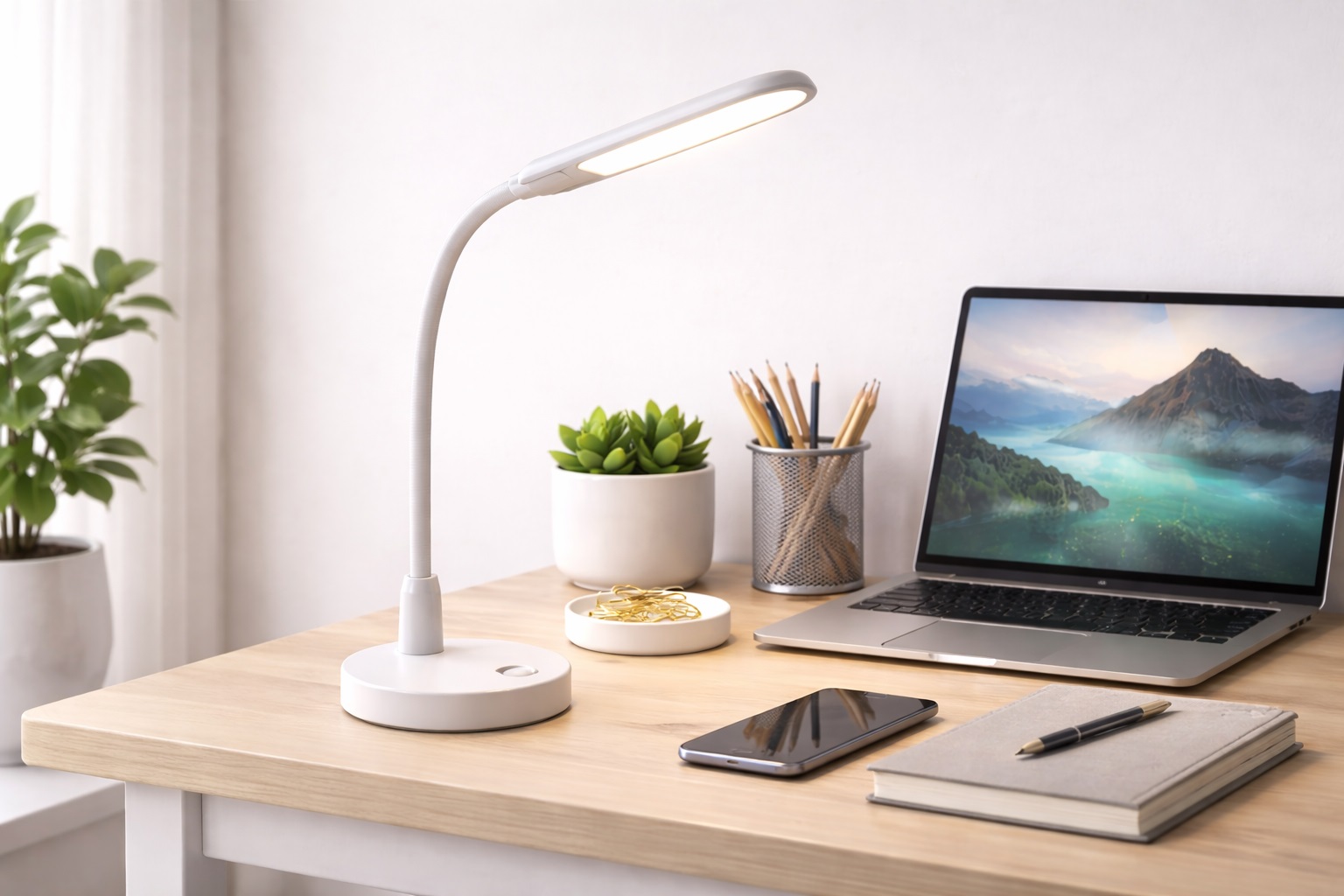
A mini LED desk lamp keeps a traditional freestanding base but shrinks the footprint down as far as it will go, usually pairing a small round or square base with a slim LED panel or bulb housing. This style suits people who want a clean, low-profile look on their desk rather than a mounted or clipped solution, and who don't mind giving up a small amount of desk space in exchange for a lamp that simply sits there and works without needing a compatible edge to clip onto. Because there's no clamp mechanism involved, setup is essentially instant — unbox it, place it, and it's ready to use, which appeals to buyers who don't want to fuss with mounting hardware.
- Pros:
- Compact base takes up far less room than a standard desk lamp while remaining freestanding
- Simple to set up anywhere on the desk without needing a clampable edge
- Tends to have a clean, unobtrusive design that fits minimalist desk setups
- Cons:
- Still occupies some desk space, unlike clip-on or mounted alternatives
- Smaller bases can be less stable if the desk gets bumped frequently
Best For: Buyers who prefer a simple, freestanding lamp with a small footprint and don't need a clamp or fold-flat mechanism.
Why We Recommend It: It offers a straightforward middle ground — you keep the simplicity of a traditional lamp but with a footprint scaled down specifically for smaller desks.
3. Foldable Compact Desk Lamp – Best for Storage and Portability
A foldable compact desk lamp is designed around collapsibility. The arm, neck, and base fold down into a flat or near-flat profile, which matters most for people who don't have a permanent desk setup or who need to put the lamp away between uses — think dorm rooms, shared workspaces, or desks that double as dining or hobby tables. When unfolded, these lamps typically function like any other adjustable desk lamp, but their real advantage shows up when they're not in use. Many fold down thin enough to slide into a laptop bag or backpack pocket, which makes them a realistic option for anyone who moves between a home desk, a library table, or a co-working space during the week.
- Pros:
- Folds flat for easy storage in a drawer, bag, or shelf when not in use
- Convenient for temporary desks, dorm rooms, or shared workspaces
- Lightweight construction makes it easy to move between rooms or locations
- Cons:
- Folding joints can feel less sturdy over time compared to fixed-arm designs
- May prioritize compactness over the widest range of positioning options
Best For: Students, renters, and anyone who needs a desk lamp that can be tucked away rather than left permanently set up.
Why We Recommend It: For desks that serve multiple purposes or get reconfigured often, the ability to fold the lamp flat and store it out of the way is a genuinely practical advantage that fixed lamps can't match.
4. Gooseneck Small Desk Lamp – Best for Precise Light Positioning
A gooseneck desk lamp uses a flexible, bendable neck rather than a jointed or hinged arm, which allows for very fine control over exactly where the light points. On a small desk where you might be working close to a monitor, tablet, or paperwork stacked in a tight space, that precision matters — you can angle the light narrowly to avoid glare on a screen or aim it directly at a keyboard or notebook without the beam spilling everywhere. The bendable design also makes it easy to make small mid-task adjustments, nudging the head an inch or two without needing to reposition the entire lamp the way you would with a rigid arm.
- Pros:
- Highly adjustable neck allows precise, narrow direction of light
- Compact base footprint is common on models built specifically for small desks
- Easy to reposition throughout the day as tasks or lighting conditions change
- Cons:
- Flexible necks can loosen slightly with heavy repositioning over time
- Some models still need a small stable base, which uses a bit of desk space
Best For: Detail-oriented tasks like reading, writing, or close work where you need to aim light precisely without it spilling onto a nearby screen.
Why We Recommend It: The bendable neck design solves a specific problem that fixed-arm lamps can't — the ability to redirect light instantly and precisely as your task or seating position changes.
5. Budget Small Desk Lamp – Best Budget Pick
A budget small desk lamp strips away the extras — multiple color temperature settings, USB charging ports, app controls — and focuses on the basics: a compact size and enough brightness for everyday tasks. This category exists for buyers who need functional task lighting without paying for features they won't use, and for anyone testing out whether a desk lamp fits their workflow before investing in something more elaborate. It's also a sensible choice for a secondary desk, a kid's homework station, or a guest room where the lamp won't see daily heavy use but still needs to work reliably when called on.
- Pros:
- Lower price point makes it accessible for tight budgets or secondary desks
- Straightforward operation without unnecessary features to learn or troubleshoot
- Still compact enough to suit smaller desk surfaces
- Cons:
- Fewer brightness levels or color temperature options than pricier alternatives
- Build quality and materials are typically more basic
Best For: Buyers who want reliable, no-frills task lighting on a small desk without spending extra on features they don't need.
Why We Recommend It: Not every desk needs a lamp with a dozen settings — for straightforward task lighting on a budget, this category delivers the essentials without the added cost.
6. USB-Powered Small Desk Light – Best for Laptop and USB-Powered Setups
A USB-powered small desk light draws power from a laptop, monitor, power bank, or USB wall adapter rather than requiring its own dedicated outlet plug. This matters more than it might seem on a small desk, where outlet access is often already stretched thin by a laptop charger, monitor, and other accessories. Because these lights typically use low-voltage LEDs, they tend to run cool and are often compact enough to clip onto a laptop lid or monitor edge. For anyone who works from more than one location — a home office one day, a co-working space or coffee shop the next — the ability to plug straight into a laptop rather than hunting for a free wall outlet is a genuine convenience.
- Pros:
- Powers directly from a USB port, reducing dependence on limited wall outlets
- Compact and often clips or attaches directly to a laptop or monitor
- Runs cool and typically draws very little power
- Cons:
- Light output is generally lower than lamps with dedicated AC power
- Depends on a nearby USB port or power bank, which isn't always available
Best For: Laptop users and anyone working from a desk where outlet space is already occupied by other chargers and devices.
Why We Recommend It: For portable or minimal setups, drawing power from an existing USB port instead of another wall outlet solves a real practical constraint that many small desks share.
Buying Guide: How to Choose the Best Desk Lamp for a Small Desk
Once you've narrowed down the general style you're interested in, the details below will help you evaluate specific models within that category. These are the factors that most directly affect how well a lamp performs on a small desk, day to day.
1. Base Footprint and Desk Space
Before anything else, look at how much desk surface the lamp's base actually occupies. A lamp with a wide, heavy base defeats the purpose on a small desk even if its light quality is excellent. Compare the base diameter or footprint dimensions listed in the product specifications, not just the overall lamp height, since height rarely affects usable desk space the way the base does. If the listing doesn't specify base dimensions, that's worth treating as a small red flag, since manufacturers who understand small-desk buyers typically make a point of highlighting this measurement.
2. Mounting Style: Clip, Clamp, or Freestanding Base
Decide early whether you want a lamp that clips or clamps to the desk edge, one with a small freestanding base, or one designed to fold away entirely. Clamp-style mounts free up the most space but require a desk edge the clamp can grip. Freestanding mini lamps are more flexible about placement but always use some surface area, however small. Measure your desk's edge thickness before buying a clamp-style lamp, since most clamps list a maximum grip range and a desk that's thicker or has an unusual edge profile may not be compatible.
3. Flexible Arm and Adjustability
An adjustable arm or gooseneck lets you redirect light as your tasks change throughout the day — angled down for reading, aimed sideways to avoid screen glare, or raised for broader ambient light. On a small desk, where you're often working close to the light source, this adjustability matters more than it would on a larger desk where you have room to simply move the lamp itself. Pay attention to how many points of articulation the arm has, since a lamp with two or three joints generally offers more useful positioning range than one with a single pivot point.
4. Brightness Levels and Lumen Output
Check the brightness specifications, usually listed in lumens, and whether the lamp offers multiple brightness settings. A single fixed brightness level can be too harsh for evening use or too dim for detailed daytime work. Multiple levels, even just two or three, add meaningful flexibility without significantly increasing the lamp's size or cost. As a general reference point, task lighting for reading or writing is typically more comfortable in the 400–800 lumen range, though personal preference and ambient room lighting both play a role.
5. Color Temperature and Light Modes
Warmer light (measured in lower Kelvin values) tends to feel more comfortable for reading and relaxed evening work, while cooler, whiter light supports focus and alertness during the day. Lamps with adjustable color temperature let you switch between these depending on the time of day or task, which is a genuinely useful feature if you spend long hours at your desk. If the lamp will be used late at night, a warmer setting or a dedicated night mode can also help reduce disruption to your sleep routine compared to staring into cool white light right before bed.
6. Portability and Foldability
If your desk setup changes often, or if the desk itself serves multiple purposes, a lamp that folds flat or breaks down easily for storage is worth prioritizing over one that must stay assembled and in place. Consider how often you'd realistically need to move or store the lamp before paying extra for this feature, since a rarely-moved lamp doesn't need to justify the added mechanical complexity that folding designs introduce.
7. Power Source: USB vs. AC Adapter
Think about your desk's existing outlet and port situation. If you're already short on wall outlets due to a laptop charger, monitor, and other devices, a USB-powered lamp that can plug into a laptop, hub, or power bank may be more practical than one requiring its own dedicated outlet. On the other hand, if brightness is a priority, an AC-powered lamp generally has more headroom to deliver stronger output than one limited to USB power delivery.
8. Build Material and Durability
Metal arms and bases generally hold their position better over time than plastic ones, particularly on gooseneck or adjustable-arm designs that get repositioned frequently. If you plan to move the lamp's arm multiple times a day, check whether the joints are described as metal, reinforced plastic, or a combination, since this affects how well the lamp holds an angle after months of use. A lamp that droops or slips out of position after a few weeks of daily adjustment is a common complaint worth watching for in buyer feedback.
9. Price and Value for Money
Match the price to the features you'll actually use. A budget lamp with a single brightness setting may be all you need for occasional evening reading, while someone doing detailed close-up work for hours each day may find the extra cost of adjustable brightness and color temperature genuinely worthwhile. Resist the temptation to buy the most feature-rich option by default; extra settings you never touch don't add value, they just add cost.
10. Brand Reliability and Manufacturing Quality
Established lighting brands typically offer more consistent quality control across their product lines, which matters for electronics that will run for hours daily. Newer or lesser-known brands aren't necessarily worse, but there's less of a track record to evaluate, so checking verified buyer feedback becomes more important. Look specifically for feedback that mentions long-term use rather than only first-impression reviews, since issues with joints, switches, or LED consistency often surface only after weeks or months of regular use.
11. Warranty and Customer Support
A longer warranty period is generally a sign that the manufacturer expects the product to hold up over time. For a lamp you'll be using daily, warranty coverage can matter more than it would for an occasional-use item, since LED components and moving joints are the parts most likely to need attention after extended use. Also check whether replacement parts, such as an adapter or clamp piece, are sold separately, since that can extend the useful life of an otherwise good lamp.
12. Compatibility With Your Desk Setup
Consider how the lamp will interact with everything else already on your desk — monitor arms, cable management trays, docking stations, or a stack of books. A clamp-mounted lamp needs clear desk edge access, while a freestanding lamp needs a stable, uncluttered spot. Think through your actual desk layout before choosing a mounting style, rather than assuming any lamp will simply fit wherever there's a gap. Sketching out your desk's current layout, even roughly, can reveal whether a clamp has anywhere left to grip or whether a freestanding base actually has room to sit without crowding your keyboard.
Frequently Asked Questions
1. What's the biggest advantage of a clip-on or clamp-mounted lamp over a freestanding one?
The main advantage is desktop space. A clamp-mounted lamp attaches to the desk edge rather than sitting on the surface, which means the entire base footprint is eliminated. On a small desk, that can be the difference between comfortably fitting your other essentials and constantly working around the lamp.
2. Will a small desk lamp provide enough brightness for reading or detailed work?
Many compact lamps are specifically designed with task lighting in mind, so a smaller size doesn't automatically mean less brightness. Check the lumen output and available brightness settings rather than assuming a smaller lamp is necessarily dimmer, since LED technology allows even small lamp heads to produce strong, focused light.
3. Can a clamp-style lamp damage my desk?
Most clamp mechanisms use padded or rubberized grips designed not to mark or damage desk surfaces under normal use. That said, it's worth checking the clamp's maximum desk thickness and grip material before purchasing, especially for glass, laminate, or finished wood desks where marks are more visible.
4. Are USB-powered desk lamps as bright as ones with a standard AC plug?
Generally, USB-powered lamps run at lower brightness levels than lamps drawing from a standard wall outlet, since USB ports supply less power. They're well suited to supplemental or close-range lighting but may not be the best choice as a sole light source for a dimly lit room.
5. What color temperature is best for desk work?
Cooler, whiter light (typically in the 4000K–5000K range) tends to support focus and alertness for computer work, while warmer light (around 2700K–3000K) feels more comfortable for reading or relaxed evening use. A lamp with adjustable color temperature lets you switch between the two as needed throughout the day.
6. How much desk space does a compact lamp actually save compared to a standard one?
It varies by model, but clip-on and gooseneck designs built specifically for small desks are often significantly smaller in footprint than standard desk lamps, sometimes freeing up the equivalent of several square inches of usable surface. Comparing base diameter specifications directly is the most reliable way to judge this before buying.
7. Do foldable lamps lose durability compared to fixed-arm designs?
Foldable lamps do introduce additional joints and hinge points, which can wear differently than a fixed arm over years of heavy use. For lamps that get folded and unfolded daily, checking the build material at the folding joints is worth doing before purchasing, since metal hinges tend to hold up better than plastic ones over repeated use.
8. Is it worth paying more for a lamp with multiple brightness and color settings?
It depends on how you use your desk. If you work at your desk for extended hours across different times of day, adjustable settings add real value. If you only need occasional light for short tasks, a simpler single-setting lamp may be all you need, and the money saved can go toward other desk accessories.
9. Can these lamps be used with a monitor arm or dual-monitor setup?
Compact clip-on and gooseneck lamps generally work well alongside monitor arms since they don't require their own desk footprint. Just make sure the clamp has enough clear desk edge to grip, since a monitor arm's own clamp may already be using part of that space.
10. How long does a typical small desk lamp last?
With LED lamps, the bulb or panel itself often outlasts the lamp's other components, sometimes rated for tens of thousands of hours of use. The more common point of wear is the adjustable arm or joint losing its grip over time, which is why build material and warranty terms are worth checking closely before you buy.
11. What should I do if the lamp doesn't fit my desk once it arrives?
Check the retailer's return window before purchasing, and keep the original packaging until you've confirmed the lamp fits your desk and clamp requirements. Most retailers offer a return period of two to four weeks, which is typically enough time to test the lamp in your actual workspace under normal conditions.
12. Is a smaller lamp always the better choice for a small desk?
Not necessarily. The right choice depends on more than size alone — brightness, adjustability, and mounting style all affect how well a lamp performs in a small space. A slightly larger lamp with a clamp mount that frees up desk space may end up being more space-efficient than a tiny freestanding lamp that still occupies surface area.
Final Verdict
There isn't a single desk lamp that's correct for every small desk, because the constraints and priorities differ from one setup to the next. The categories below reflect where each option tends to perform best.
- Best Overall: The clip-on desk lamp, for eliminating the base footprint entirely while keeping adjustable, directed light.
- Best Budget: The budget small desk lamp, for straightforward task lighting without paying for unused features.
- Best for Precision: The gooseneck small desk lamp, for detailed work that requires exact light placement.
- Best for Portability: The foldable compact desk lamp, for setups that need to be stored or moved regularly.
Whichever style fits your situation, the goal is the same: enough usable light for the work you actually do, without sacrificing the limited desk space you're trying to protect in the first place. Take a moment to consider not just today's setup but how your desk might change over the next year or two, whether that means adding a second monitor, switching to a laptop-only workflow, or moving to a new space entirely. Match the lamp to your desk's real constraints rather than its marketing photos, and it should serve you well for years of daily use.