Best Lightweight Laptop Stands: Eye-Level Comfort, No Bulk
For anyone who moves their laptop stand around regularly — between a desk and a kitchen table, between a backpack and a coworking space, or simply between rooms in a shared apartment — every extra gram and every extra centimeter of folded bulk matters more than it would for something that sits in one place permanently. A stand that's genuinely excellent on a fixed desk can be a frustrating add-on if it's heavy, awkward to fold, or simply too bulky to justify carrying daily. The frustration usually shows up quietly at first — the stand stays in a drawer one morning because packing it felt like more effort than it was worth — and then becomes a habit, at which point the ergonomic benefit it was bought for stops happening at all.
This guide focuses specifically on the lightest practical options for users who travel with their stand or move it between locations regularly. Weight and folded size are treated as primary criteria here rather than secondary details, because for this specific use case, they're the factors that determine whether a stand actually gets used every day or ends up left behind because it wasn't worth the hassle of carrying.
None of this means sacrificing the core ergonomic benefit. Every option below still raises the laptop screen toward eye level and improves airflow underneath the chassis — the weight savings come from smarter material choices and simpler mechanisms, not from cutting corners on the actual function of the stand.
It helps to think about weight and bulk as a genuine feature category of its own, rather than a minor detail tacked onto a stand's product listing. A stand that's ten percent lighter but requires giving up meaningful stability isn't automatically the better choice, and a stand that folds impressively flat but doesn't actually reach a comfortable height isn't solving the original problem either. The three options below each strike that balance differently, which is exactly why the right pick depends on how you personally weigh portability against the other factors that make a stand worth using in the first place.
Top 3 Lightweight Laptop Stands (Detailed Reviews)
Adjustable Aluminum Laptop Stand – Best Overall
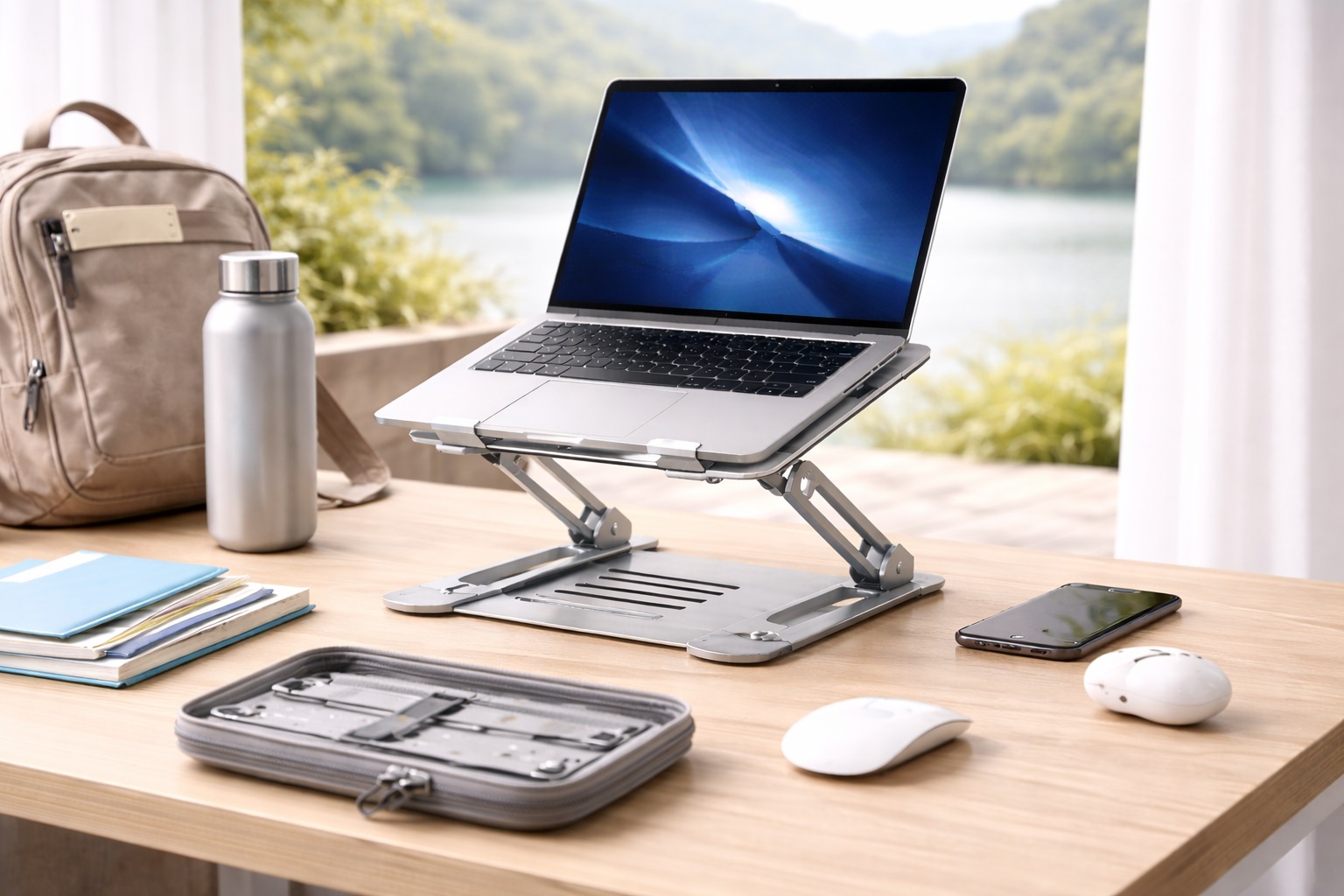
Aluminum sits at a genuinely good point on the weight-versus-stability curve, and the adjustable aluminum stand proves it. It raises the laptop screen toward eye level, cutting down on the neck and upper-back strain that builds up from looking down at a flat laptop for hours at a time, while staying light enough to lift with one hand and move between rooms without a second thought. The metal itself is far lighter than its rigidity would suggest, and it holds its adjusted position instead of sagging under the laptop's weight the way some plastic alternatives eventually do. The open-frame design is a genuine bonus rather than an afterthought: lifting the laptop's underside off a flat surface lets trapped heat escape from the bottom vents, which most laptops rely on for cooling. Most models in this range adjust to fit laptops from 11 to 17 inches and fold flat enough to carry comfortably. Picking it up feels closer to handling a phone case than a piece of desk furniture, which is a large part of why it suits daily repositioning as well as it suits a permanent desk setup. Because the hinge mechanism typically offers a genuine range of positions rather than a small number of fixed notches, it's straightforward to fine-tune the exact height on whatever surface you're using that day, whether that's a proper desk or a slightly awkward kitchen table. The one place this design gives something up compared to the ultra-light option below is a marginally bulkier folded profile, which is a fair trade for most people given the added stability and adjustment range it buys back.
- Pros:
- Eye-level screen position meaningfully reduces neck and upper-back strain
- Genuinely light for a metal stand, without feeling flimsy
- Open-frame design improves airflow and cooling under the laptop
- Folds flat, making it easy to carry between rooms or locations
- Wide adjustment range fits most laptop sizes
- Cons:
- Requires a separate external keyboard once the laptop is raised to a working height
- Fold mechanisms on lower-quality versions can loosen with repeated use
Best For: Anyone who needs one stand that stays genuinely light while still adjusting to a proper working height, whether it moves between rooms at home or comes along on regular trips.
Why We Recommend It: It delivers the full ergonomic benefit of a proper adjustable stand without the weight penalty that heavier, bulkier designs carry. For most people who need to move their stand at all regularly, this is the option that doesn't ask them to compromise on either front.
Foldable Portable Stand – Best for Minimum Weight
When weight is the single deciding factor, the foldable portable stand is built specifically around that priority. It collapses down to a flat or compact shape that adds essentially no noticeable weight to a bag — the lightest versions come in well under 200 grams, which is lighter than many phone chargers. Construction uses aluminum alloy or a sturdy reinforced plastic depending on the specific model, with rubber grip points that keep the laptop from sliding forward during typing despite the reduced overall mass. It sets up and folds away in under 30 seconds, which matters for anyone repositioning their workspace multiple times a day. The folded shape is thin enough to slide into the same laptop sleeve pocket the laptop already occupies, rather than needing dedicated space of its own, which is often the detail that determines whether a stand actually gets carried every day or gets left at home because it felt like one more thing to manage.
- Pros:
- The lightest practical option — under roughly 300 grams on most models
- Folds small enough to disappear into a bag or laptop sleeve
- Sets up or packs away in under 30 seconds
- Rubber grip points keep the laptop secure despite the reduced weight
- Cons:
- Height adjustment range is typically narrower than a full-size desktop stand
- Lighter build materials feel less substantial than heavier aluminum alternatives
Best For: Users who prioritize minimum weight above all else, particularly those repositioning their stand several times a day or carrying it as one more item in an already full bag.
Why We Recommend It: It delivers essentially the same ergonomic lift as heavier stands while adding almost nothing to what you're already carrying. For someone whose main complaint about laptop stands in general is that they're too heavy or bulky to bother with, this is the direct answer.
Fixed-Height Riser Stand – Best for a Permanent Spot
Not every user actually needs a stand that moves constantly — some simply want the lightest option for a spot that, once chosen, stays fixed. The fixed-height riser is a single stable platform set at a preset height, with no hinges, joints, or adjustment mechanisms adding weight or bulk. Because there's nothing to adjust, the design can often be simpler and lighter than an equivalent adjustable stand, while still providing the same core eye-level benefit. The trade-off is the obvious one — a single fixed height rather than a range — but for a stand destined for one specific desk or table, that's rarely a meaningful downside. It's a reasonable pick for someone who has already found their ideal setup and simply wants the lightest possible object that gets them there, rather than paying for an adjustment mechanism they've already decided they won't use.
- Pros:
- Simpler construction often means less overall weight than adjustable versions
- No mechanical joints means nothing to loosen or wobble over time
- Usually less expensive than adjustable alternatives
- Nothing to adjust once it's positioned on the desk
- Cons:
- No way to change the height for different chairs or seated positions
- Not a practical option if you switch between multiple desks with different heights
Best For: Users who want the lightest possible stand for one specific, unchanging spot and don't need the flexibility of height adjustment or frequent repositioning.
Why We Recommend It: When a stand only ever needs to serve one desk at one height, the simpler, lighter fixed design gives up nothing meaningful in exchange for shedding both weight and moving parts.
Buying Guide: How to Choose the Best Lightweight Laptop Stand
Use these factors to weigh (literally) the trade-offs between weight, stability, and features before choosing a stand built for frequent movement.
1. Actual Weight in Grams
Look for the specific weight listed in grams or ounces rather than relying on a general label like lightweight, since the term gets applied loosely across very different products. Anything under roughly 300 grams is genuinely light enough to carry daily without a second thought, while stands in the 500-to-800-gram range are still reasonable but noticeably heavier in a bag. Comparing the exact figure across a few models, rather than trusting a marketing label, is the only reliable way to know how a given stand actually compares to the alternatives you're considering.
2. Weight Versus Stability Trade-off
Lighter materials can sometimes mean less rigidity at maximum height, particularly under a heavier laptop. It's worth reading reviews specifically for comments about stability rather than assuming a lighter stand automatically performs as well as a heavier one at full extension. A stand that wobbles noticeably while typing has effectively lost the ergonomic advantage it was bought for, regardless of how little it weighs in a bag.
3. Height Adjustment Range
A stand's core purpose is raising the screen toward eye level — roughly two to three inches below eye level for a seated position is a reasonable target. Lighter, more minimal stands sometimes offer a narrower range than bulkier alternatives, so check the actual numbers rather than assuming a lighter design covers the same span. A stand that only reaches a modest height might still be fine for a smaller laptop or a taller chair, so match the specific range against your own setup rather than a general assumption.
4. Folded Dimensions
Weight is only half the portability equation — folded size matters just as much for anyone slipping the stand into a bag pocket or laptop sleeve. A stand that's light but doesn't fold down much smaller than its open form can still be awkward to carry, even if it doesn't weigh much. Checking the specific folded dimensions against the pocket or sleeve you actually intend to use it in avoids discovering a poor fit only after the stand has already arrived.
5. Weight Capacity
Confirm the stand's rated weight capacity comfortably exceeds your laptop's actual weight, even on a lighter-built stand. Most stands in this category still support 10 to 22 pounds, which covers nearly all consumer laptops, but it's worth double-checking on the lightest designs specifically, since shaving weight sometimes means a manufacturer has also reduced the rated capacity to keep the structure safely within its design limits.
6. Material Trade-offs
Aluminum alloy stands generally offer the best balance of low weight and real rigidity, while some ultra-light designs use thinner-gauge metal or reinforced plastic to shave off additional grams. Thinner materials can flex slightly more under load, so it's worth weighing the weight savings against how much rigidity you actually need for your laptop. A heavier laptop generally benefits more from the added stiffness of a slightly heavier stand, while a smaller, lighter laptop can usually get away with a more minimal build without any noticeable downside.
7. Anti-Slip Surface Quality
Rubber or silicone contact points stop the laptop from creeping forward while typing at an angle. Lighter stands sometimes use thinner grip padding to save weight, so check that the surface material still provides genuine grip rather than a token amount. Thin padding also tends to wear down faster with repeated use, so it's a reasonable spot to inspect closely on a lighter-built stand from an unfamiliar brand.
8. Ventilation Design
An open-frame design lets a laptop's bottom vents breathe, which a flat surface blocks almost entirely. This benefit doesn't depend on the stand's weight, so a lighter design shouldn't sacrifice the airflow gap that makes the ergonomic and thermal benefits work in the first place. A stand that saves weight by using a more solid, closed platform rather than an open frame gives up this benefit entirely, which is worth checking in product photos before buying.
9. Setup and Packing Speed
For a stand that moves often, how quickly it opens and folds matters in daily practice. Lighter designs tend to favor instant-fold mechanisms that open and close in a few seconds, which suits frequent repositioning better than a slower screw-adjustment design. If you're moving the stand several times a day, this small difference in setup time adds up to a genuinely noticeable amount of saved effort over a week.
10. Laptop Size Compatibility
Check the maximum width a stand is rated to hold against your specific laptop. Lighter, more compact stand designs sometimes have a narrower maximum width than bulkier alternatives, so it's worth measuring your laptop's footprint against the stand's rated dimensions before buying. This is particularly relevant for anyone with a larger 16- or 17-inch laptop, where a stand optimized purely for minimum weight may not have been designed with a wider chassis in mind.
11. Durability of Lightweight Materials
Shaving weight sometimes means thinner metal or lighter-grade plastic at stress points like hinges and fold joints. These areas take more repeated wear on a stand that's moved and refolded often, so it's worth favoring designs with a track record of holding up rather than the absolute lightest option available. A small amount of extra weight at exactly these stress points is often a worthwhile trade if it noticeably extends how long the stand lasts under daily folding.
12. Price Versus Actual Need
Ultra-light designs sometimes carry a price premium for the engineering required to shave off weight without losing stability. Weighing that premium against how often you'll actually be carrying the stand helps determine whether the extra cost is worth it for your specific routine. Someone repositioning a stand multiple times daily gets real, ongoing value from shaving off weight, while someone who moves it only occasionally may be better served putting that budget toward a sturdier, slightly heavier option instead.
Frequently Asked Questions
Do lighter laptop stands sacrifice stability?
Not necessarily, but it varies by design. A well-engineered lightweight stand made from quality aluminum can be just as stable as a heavier one, while poorly designed ultra-light stands sometimes flex more at maximum height. Checking reviews specifically for stability comments is the most reliable way to tell the difference before buying. Reviewers who mention their specific laptop weight alongside their stability impressions tend to give the most directly useful information for judging whether a stand will hold up for your own machine.
Do I need an external keyboard with a lightweight laptop stand?
In most cases, yes. Once the laptop is raised to eye level, its built-in keyboard sits at an uncomfortable upward angle for typing. Pairing the stand with a compact external keyboard restores a natural typing position — screen at eye level, keyboard at elbow height — without adding much weight to what you're already carrying. Several compact folding keyboards on the market weigh little more than a phone, so the combined weight penalty for proper ergonomics stays minimal even when carried daily.
What height should I set a lightweight laptop stand to?
Aim to have the center of the screen sit roughly at your eye level when seated in your normal posture, which usually means raising the laptop five to eight inches above its flat position. Since lighter stands sometimes have a narrower adjustment range, check that your ideal height actually falls within what the specific model offers. A quick test with your own laptop before committing to daily use helps confirm the range suits your particular chair and desk combination.
Can a lightweight laptop stand improve laptop performance?
Yes, indirectly. Most laptops exhaust heat through vents on the underside, and a flat surface blocks a good portion of that airflow. An open-frame lightweight stand still allows air to move underneath, which can help avoid thermal throttling during demanding tasks, just as a heavier stand would. The thermal benefit comes from the airflow gap itself rather than the stand's mass, so a lighter design loses nothing here as long as it keeps an open frame underneath the laptop.
Will a lightweight laptop stand damage my laptop?
Not if it has rubber or silicone contact points and is used within its stated weight capacity. The main risk is bare metal or thin plastic contact scratching the laptop's finish, so check that contact points are actually padded, particularly on ultra-light designs that may have minimized padding to save weight. A quick visual check before first use, confirming the contact points are cushioned rather than bare, is a sensible habit regardless of how light the stand is.
How much lighter are these stands compared to standard options?
The lightest foldable designs weigh under 200 grams, compared to some standard adjustable stands that can weigh several times that. The exact difference depends on the specific models being compared, so checking the listed weight for each option is the most reliable way to judge. Even a difference of a few hundred grams becomes noticeable after carrying a bag through a full day of moving between locations.
Is a lightweight stand durable enough for daily use?
A well-built lightweight stand from a reputable brand holds up fine to daily folding and repositioning over months of regular use. Lower-quality budget versions are more likely to develop looseness in the fold mechanism sooner, which is why checking build material and reviews matters even for a lighter design. A stand built from quality aluminum, even in a minimal form, generally outlasts a bulkier stand made from lower-grade plastic.
Can I use a lightweight laptop stand on a standing desk?
Yes, with adjustable versions that provide enough height range to suit both seated and standing positions. Check the maximum height specifically, since some ultra-light designs trade off a shorter overall range to save on material and weight. Standing desk use typically requires a taller maximum height than seated use, so it's worth confirming the specific figures rather than assuming any adjustable stand covers both scenarios equally well.
Is the most expensive lightweight laptop stand always the best?
Not necessarily. Higher price sometimes reflects genuine engineering to reduce weight without sacrificing stability, but it can also just reflect a premium finish or brand name. Matching the price to features that matter for your specific routine is a better guide than price alone. It's worth reading a handful of verified reviews to see whether buyers feel the premium price was justified by real weight savings and durability, rather than assuming a higher number automatically means a better product.
How long should a quality lightweight laptop stand last?
A well-built stand from a reputable brand typically lasts two to five years or longer with reasonable care, even with frequent folding and repositioning. Checking warranty terms is a reasonable way to gauge a manufacturer's confidence in its own build quality. A stand backed by at least a one-year warranty is generally a safer bet than one with no stated coverage, particularly for a lighter-weight design that's more likely to see frequent handling.
Can I return a lightweight laptop stand if it doesn't suit me?
Most retailers offer a return window of roughly two to four weeks. Keeping the original packaging during that evaluation period is worth doing, since a stand's true stability and comfort often only become clear after several days of actual daily use. Testing it at your actual desk with your own laptop, rather than judging it from the listing photos alone, gives a much more accurate sense of whether it earns a permanent spot in your daily routine.
Does brand name matter when choosing a lightweight laptop stand?
Established brands generally offer better quality control, customer support, and warranty reliability, which matters more for engineered lightweight designs than for simpler, bulkier stands. Newer brands sometimes offer good value, so reading verified reviews carefully before purchasing is worthwhile either way. Looking specifically for reviews describing months of regular use, rather than a single unboxing, tends to reveal durability issues that a first impression won't show.
Final Verdict
- Best Overall: Adjustable Aluminum Laptop Stand – the best balance of low weight, real stability, and a usable adjustment range.
- Best for Minimum Weight: Foldable Portable Stand – the lightest practical option for anyone repositioning their stand constantly.
- Best for a Permanent Spot: Fixed-Height Riser Stand – the simplest, lightest option once a stand doesn't need to move anymore.
Weight and bulk are the deciding factors for anyone who actually carries or repositions a laptop stand regularly, and the right pick here comes down to how much adjustment range you're willing to trade for how many fewer grams you'll be carrying. None of the three options above ask you to give up the core ergonomic benefit to get there — they just get you to it with less to carry along the way. Given how often the decision comes down to a genuinely close call between two well-built options, it's worth revisiting your own actual habits one more time before ordering: how many times a day the stand will really move, how much space it needs to occupy in a bag, and whether the desk it lands on most often ever changes. Answering those three questions honestly tends to point clearly toward one of the three categories above, which makes the final choice far less complicated than the number of available products on the market might suggest.