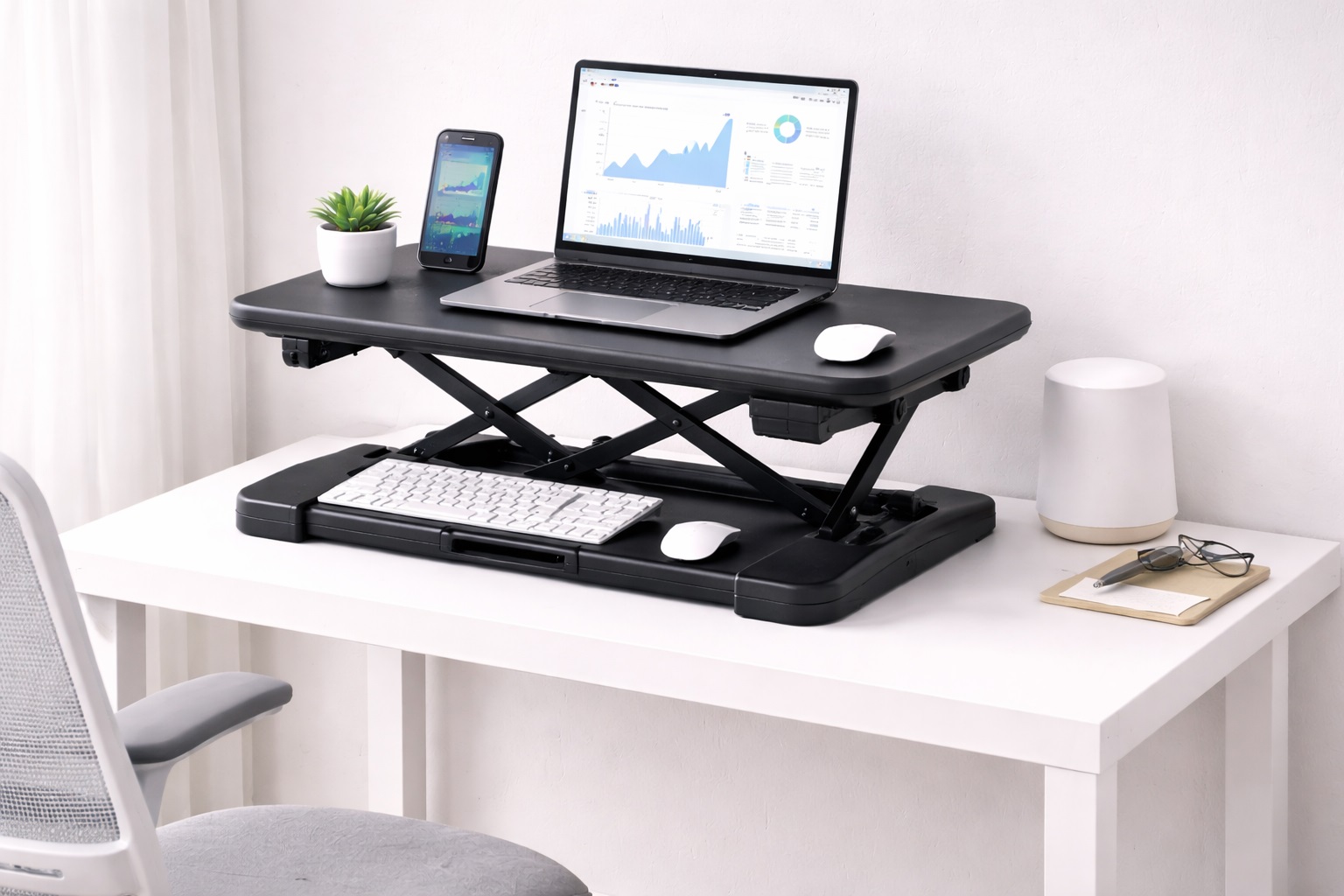
Best Standing Desk Converters for Small Desks: Sit-Stand in a Compact Footprint
Most standing desk converters are designed around a standard-size desk, which means their base footprint can consume a genuinely disproportionate share of the surface area on a smaller desk. A converter that leaves plenty of room to spare on a 60-inch desk can dominate nearly the entire top of a 30-inch writing desk, crowding out any remaining space for a notebook, a coffee cup, or simply your own arms while typing. This isn't a minor cosmetic issue either — a workspace that feels cramped and cluttered tends to undermine focus over the course of a workday in a way that's easy to underestimate until you're actually living with it. Finding one that respects a small desk's limited footprint takes more deliberate comparison than shopping for a standard-size setup.
The good news is that footprint and functionality aren't strictly linked in this category any more than they are for other desk accessories. Several converter designs deliver genuine sit-stand capability while occupying a meaningfully smaller base than the market average, and understanding which specific features drive footprint — a single-monitor platform instead of a dual-monitor one, a narrower keyboard tray, a slimmer lift column — helps you find one that fits without giving up the core functionality you're actually buying it for. It's worth approaching this category the way you'd approach any purchase where dimensions genuinely matter more than usual — treating the specification sheet as the primary source of truth and the marketing photos as a secondary, less reliable impression, since a wide-angle product photo can make almost any base look more compact than it actually measures once it's sitting on your own desk.
This guide focuses specifically on converter types and buying factors relevant to small desks, along with the questions people in compact home offices ask most often before committing to this kind of purchase. Every recommendation here treats footprint as a primary constraint rather than a secondary consideration, since that's the entire reason you're shopping this specific category. It's also worth noting that a small desk doesn't automatically mean a small budget or a compromise on quality — several of the more space-conscious designs available today are genuinely well engineered, not simply scaled-down or stripped-down versions of a standard-size product, and treating them as a lesser category would be a mistake.
Before comparing products, it's worth measuring your actual available desk surface with your other essential items already accounted for — not just the desk's total dimensions, but what's genuinely left over once you factor in anything you need permanent access to, such as a notepad, a phone stand, or a small speaker. That real, remaining number is what any converter you choose actually needs to fit within.
It's also worth thinking about how a converter interacts with everything else already competing for space on a small desk. A desk lamp, a phone charging stand, a small plant, or a stack of notebooks all claim some portion of the surface before a converter even enters the picture, and a product that would fit comfortably on an otherwise empty desk can feel considerably tighter once those everyday items are accounted for. Doing this exercise honestly, with your desk in its normal cluttered state rather than a tidied-up version of it, gives a far more realistic sense of what will actually work.
The three approaches below were chosen because they solve the footprint problem through genuinely different means — sizing the platform to match single-monitor use, moving the mechanism off the desk surface entirely through a clamp mount, and eliminating the lift mechanism altogether in exchange for a fixed standing height. Each trades away something different, and the right choice depends on which trade-off fits your actual situation best.
Top Picks Reviewed
1. Single-Monitor Compact Z-Lift Converter – Best Balance of Footprint and Function
A converter built specifically around a single monitor and keyboard, rather than a wider dual-monitor platform, keeps the base footprint meaningfully smaller while still providing the core scissor-lift sit-stand mechanism found in larger models. For small desks supporting one monitor, this design delivers essentially the same functional benefit as a larger converter in a noticeably reduced footprint.
- Pros:
- Narrower base designed specifically around single-monitor use
- Gas-assisted or single-handle height adjustment
- Stable at both sitting and standing heights despite the smaller footprint
- Leaves more usable desk space than a standard dual-monitor converter
- Cons:
- Limited or no room to add a second monitor later without a footprint upgrade
- Smaller keyboard tray than wider models, which can feel tight with a full-size keyboard and mouse together
Reviewers who specifically mention their own desk width in feedback are worth reading closely here, since their reported experience translates far more directly to your situation than a general star rating that could be coming from someone with twice the available desk surface. Because the platform is specifically sized around a single-monitor workflow, it avoids the wasted footprint of a wider converter supporting equipment you don't actually have, which is the single most common source of unnecessary bulk on a small desk in this category. It's a small but consistent theme across nearly every recommendation in this guide: buy the size that matches your equipment today rather than the size that might match some hypothetical equipment in the future, since the cost of guessing wrong is a converter that permanently crowds your workspace.
Best For: Small-desk users running a single-monitor setup who want genuine sit-stand functionality without a converter base that dominates their limited desk surface.
Why We Recommend It: Matching the converter's footprint to your actual equipment, rather than buying a wider dual-monitor model "just in case," is the most direct way to reclaim usable desk space on a small setup while keeping the core sit-stand benefit fully intact. It's a straightforward principle that's easy to overlook when browsing product listings sorted by popularity, since the most popular converters tend to be dual-monitor models built for a broader market rather than specifically for smaller single-monitor setups.
2. Clamp-Mount Monitor Riser With Keyboard Shelf – Best Minimal Footprint
Rather than a freestanding platform sitting on top of the desk, a clamp-mount design attaches directly to the desk's rear edge, with a pull-out keyboard shelf beneath it. Because the mounting hardware itself takes up very little desk surface, this style leaves considerably more usable space on a small desk than a standard freestanding converter base.
- Pros:
- Clamp mount uses minimal desk surface compared to a freestanding base
- Pull-out keyboard shelf keeps typing height separate from monitor height
- Frees up desk space directly beneath the mounted arm for other items
- Often more affordable than full-platform converters
- Cons:
- Requires a desk edge suitable for clamping, which not every small desk has
- Generally less overall stability at full height than a wider freestanding base
Because the clamp attaches to the desk edge rather than resting on the surface, this design essentially eliminates the base footprint problem altogether, though it does require checking that your specific desk edge is compatible with a clamp mount before ordering. Measuring the thickness of your desk's rear edge with a tape measure or ruler, and comparing that figure against the manufacturer's stated compatible range, takes only a minute and prevents one of the more common fit problems in this specific style of converter. It's also worth checking that there's enough clear space underneath the desk edge for the clamp's tightening mechanism, since a drawer, cable tray, or support bracket positioned in exactly the wrong spot can block installation even when the edge thickness itself is perfectly compatible. Some manufacturers list a minimum as well as a maximum edge thickness, and a desk edge that's too thin for the clamp to grip firmly is just as much of a fit problem as one that's too thick, so check both ends of the stated range rather than only the maximum.
Best For: Small-desk users whose desk has a suitable edge for clamping and who want to minimize desk surface footprint as much as possible.
Why We Recommend It: When floor and desk space are both genuinely limited, a clamp-mount design solves the footprint problem more completely than any freestanding converter can, by moving the mechanism off the working surface entirely. This is a genuinely different approach from simply choosing a smaller freestanding model, since it removes the base footprint question altogether rather than just reducing it, which matters most on a desk where every inch of surface is already accounted for.
3. Narrow Fixed-Height Converter With Compact Keyboard Tray – Best for Simplicity
A fixed-height converter built with a narrow footprint and a compact keyboard tray raises the workspace to standing height permanently, without the added width that an adjustable lift mechanism typically requires. For small-desk users who mainly want to stand rather than needing to switch fluidly between positions, this simpler design keeps the footprint tighter than most adjustable alternatives.
- Pros:
- Narrower footprint than most adjustable converters
- Stable platform with no adjustment mechanism to wobble
- Compact keyboard tray suited to smaller desk surfaces
- Generally the most affordable option in this category
- Cons:
- Cannot lower to sitting position
- Requires a stool for occasional seated use
Because there's no lift mechanism to house, this style's footprint is driven almost entirely by the size of the monitor shelf and keyboard tray, both of which can be kept genuinely narrow for a single-monitor small-desk setup.
Best For: Small-desk users who primarily want to stand and are comfortable with an occasional stool for seated use, in exchange for the tightest footprint among adjustable-height options.
Why We Recommend It: Simplicity translates directly into a smaller footprint here — without an adjustment mechanism to accommodate, the entire converter can be built around the true minimum space a monitor and keyboard actually require. That minimalism is exactly what makes it worth considering even for shoppers who initially assumed they needed the flexibility of a sit-stand mechanism, since the space savings can be substantial enough to outweigh giving up the lowered sitting position.
Buying Guide: How to Choose the Best Standing Desk Converter for a Small Desk
Use these factors to find genuine sit-stand functionality without a converter that overwhelms your available desk surface.
1. Measure Your Actual Usable Surface First
Before comparing converters, measure your desk's total surface area minus whatever you need to keep permanently accessible. This real, remaining number — not the desk's total dimensions — is what the converter's footprint needs to fit within. Write this number down before you begin comparing listings, since it's easy to forget the exact figure once you're several product pages deep and focused on price and features instead.
2. Base Footprint Versus Working Surface
A converter's working surface and its base footprint are not always the same size; some designs have a wider base than the platform above it for stability. Check both measurements specifically rather than assuming the platform size tells the whole story. A base that flares out wider than the platform above it for added stability is common, and it's exactly the kind of detail that only shows up in a full specification sheet rather than the main product photo.
3. Single-Monitor Versus Dual-Monitor Platforms
If you only use one monitor, a converter built specifically around single-monitor use will have a meaningfully smaller footprint than a dual-monitor model, even if you might theoretically want to add a second screen someday. Weigh how likely that future upgrade actually is against the immediate benefit of a smaller footprint today, since buying larger "just in case" often means living with unnecessary bulk for years while waiting for a change that may never happen.
4. Clamp-Mount Compatibility
If floor and desk space are both tight, a clamp-mount design can eliminate most of the footprint problem, but only if your desk has a suitable edge thickness and clearance underneath for the mounting hardware to attach securely. Glass desktops, very thin composite edges, and desks with a rear support bar close to the edge can all rule out this style regardless of how appealing its footprint savings look on paper, so verify compatibility before ordering rather than after.
5. Keyboard Tray Width
A narrower keyboard tray saves space but can feel cramped with a full-size keyboard and mouse side by side. Measure your actual keyboard and mouse combined width against the tray's listed dimensions before assuming a compact tray will comfortably fit both. A tray that's an inch or two narrower than your actual equipment combined width will feel cramped every single day, which is a persistent minor annoyance worth avoiding through a simple measurement check up front.
6. Stability Trade-Offs at Small Sizes
Narrower bases can feel less stable at full standing height than wider ones, particularly for adjustable mechanisms. Weigh this trade-off honestly against your specific space constraint rather than assuming the smallest option is automatically the right choice. If your desk is against a wall and unlikely to be bumped or leaned on heavily, a narrower base is a reasonably safe trade for the space it saves.
7. Weight Capacity for Your Actual Equipment
Compact converters don't necessarily have lower weight ratings, but it's worth confirming the specific capacity against your monitor's actual weight rather than assuming a smaller footprint means a lower limit by default. Two compact converters that look nearly identical can carry meaningfully different weight ratings depending on the internal reinforcement used by each specific manufacturer.
8. Height Range Still Matters
A compact footprint shouldn't come at the cost of an adequate height range. Confirm the converter still spans your seated-to-standing height difference, typically 12 to 16 inches, regardless of how small its base is. A converter that saves impressive amounts of desk space but doesn't actually reach a comfortable standing height for your monitor solves the wrong problem, so treat this as a non-negotiable requirement rather than something to compromise on for the sake of a smaller footprint.
9. Desk Edge and Surface Compatibility
Glass desktops, rounded edges, or unusually thin desk surfaces can limit which converter styles are physically compatible with your specific desk, particularly for clamp-mount designs. Check compatibility notes carefully before ordering, and contact the seller directly if your desk has an unusual edge profile the listing doesn't specifically address, since a quick question before purchase is far less hassle than a return afterward.
10. Cable Management in a Tight Space
Small desks often have less room to route cables around a converter's lift column or clamp arm. Verify the specific design won't trap or pinch cables in the tighter clearance a small desk provides. Test this with the converter in its final position and the cables connected, moving through a full range of height adjustment before considering the setup finished.
11. Return Policy for Fit Verification
Since footprint expectations can be harder to judge accurately from photos alone in this category, a generous return window is a useful safety net if the converter turns out to be larger, or less stable, than expected once installed. Keep the original packaging until you've tested the converter for at least a few days of normal use, since a footprint that seemed acceptable on day one can start to feel cramped once you've lived with it during a full workweek.
12. Vertical Clearance and Ceiling Height
A compact footprint on the desk surface doesn't guarantee adequate vertical clearance above it, particularly in a small home office with a low ceiling, a sloped attic wall, or shelving mounted directly above the desk. Measure the clear vertical space from your desk surface to whatever is above it, and compare that against the converter's maximum extended height plus your monitor's own height, since a converter that fits the desk perfectly can still bump into a shelf or slanted ceiling at full standing extension.
13. Portability for Multi-Use Small Desks
A small desk often serves more than one purpose over the course of a day, doubling as a hobby table, a dining spot, or a shared family workspace during off hours. A lighter, easily lifted converter can be moved aside temporarily when the desk needs to serve a different purpose, which is a genuine practical advantage over a heavier, permanently fixed unit in a room where the desk isn't dedicated solely to computer work.
Frequently Asked Questions
1. Will a standing desk converter fit on my small desk at all?
Many converters are specifically designed with a compact or single-monitor footprint suited to smaller desks, but you should measure your actual usable surface area and compare it against listed dimensions rather than assuming any given converter will fit. Treat this as a firm requirement rather than a rough guideline, since a converter that's even an inch too wide for your available space can make the whole setup feel cramped rather than helpful.
2. Does a smaller converter sacrifice stability?
Sometimes, particularly at full standing height with narrower bases. Reading reviews specifically for comments about wobbling at maximum extension is a reasonable way to check before choosing the smallest available option. There's often a small trade-off between the absolute minimum footprint and maximum stability, so it's worth deciding deliberately where you want to land on that spectrum rather than defaulting to whichever option looks smallest in a photo.
3. Is a clamp-mount converter a good option for a small desk?
Often, yes, since it uses minimal desk surface compared to a freestanding platform. It does require a compatible desk edge, so check your desk's specific edge thickness and underside clearance before choosing this style. Most manufacturers list a compatible edge thickness range directly in the product specifications, which is worth confirming against your own desk with a simple ruler measurement before ordering.
4. Can I still fit a second monitor later with a compact converter?
Generally not without upgrading to a wider platform, since single-monitor converters are specifically sized around one display. If you expect to add a second monitor soon, it's worth planning for that footprint from the start, since retrofitting a single-monitor converter for dual-monitor use is rarely as simple or cost-effective as buying the right size initially.
5. Do compact converters cost less than standard-size ones?
Not always, though simpler fixed-height compact designs tend to be among the more affordable options in the category, since they avoid the cost of a full adjustable lift mechanism. Comparing a few options directly on price rather than assuming the compact category always carries a premium is worth the extra few minutes before you commit.
6. How do I measure my desk correctly before buying?
Measure your desk's total surface, subtract space for anything you need permanently accessible, and compare that real remaining number against the converter's listed footprint rather than the desk's total dimensions. Doing this with your desk in its normal, slightly cluttered state gives a more realistic picture than measuring an empty, freshly tidied surface.
7. What's the biggest mistake people make shopping for this category?
Buying a converter sized for equipment they don't actually have, such as a dual-monitor platform for a single-monitor setup, which wastes desk space unnecessarily on a desk that's already tight. This single mistake accounts for a large share of the disappointment people report with converters on small desks, and it's entirely avoidable with a moment's thought about actual current equipment rather than hypothetical future needs.
8. How long should a compact standing desk converter last?
A well-built compact converter should last three to five years with normal use, similar to standard-size alternatives, provided the smaller footprint hasn't come at the cost of build quality. Checking the warranty length alongside the footprint dimensions is a reasonable way to gauge how confident the manufacturer is in the compact design's own durability.
9. Can I return a compact converter if it's too large for my desk?
Most retailers offer a 15 to 30 day return window, generally enough time to confirm the converter's actual footprint works with your desk once it's fully assembled and in place. Photograph the setup before and after assembly so you have a clear reference if you need to describe a return reason later.
10. What should I prioritize when shopping for a small desk?
Verified footprint dimensions first, followed by height range and weight capacity for your actual equipment. Treat additional features as secondary until you've confirmed the converter genuinely fits your available space, since none of those extra features matter if the unit simply doesn't work in your setup to begin with.
11. Is a fixed-height compact converter a reasonable choice for a small desk?
Yes, particularly if you mainly want to stand rather than switch fluidly between positions, since the absence of a lift mechanism allows for a genuinely tighter footprint than most adjustable alternatives. Pair it with a comfortable stool for the occasional seated task, and the combination covers most of what a small-desk user typically needs from a standing setup.
12. Can a compact converter be used on a corner desk?
Yes, though a corner desk's angled or curved surface can affect how much of the converter's base actually rests on solid support, particularly for clamp-mount designs that need a straight edge. Measure the specific spot where the converter will sit, not just the desk's overall corner dimensions, before assuming a standard footprint will work cleanly in that position.
13. Does a smaller converter still support a monitor arm?
Some do, but not all compact platforms include a clamp-compatible edge or VESA mount for an arm, since minimizing footprint sometimes means simplifying the platform itself. Check the specific listing for arm compatibility if you already use one, rather than assuming every compact converter accommodates it the same way a standard-size model would.
Final Verdict
- Best Balance of Footprint and Function: Single-Monitor Compact Z-Lift Converter — full sit-stand capability sized to match a single-monitor setup.
- Best Minimal Footprint: Clamp-Mount Monitor Riser With Keyboard Shelf — moves the mechanism off the desk surface almost entirely.
- Best for Simplicity: Narrow Fixed-Height Converter With Compact Keyboard Tray — the tightest footprint for committed standing use.
Genuine footprint efficiency in this category comes down to matching the converter to your actual equipment and measuring carefully before you buy, not assuming a product marketed as "compact" will automatically fit your specific desk. Do that groundwork first, and a small desk doesn't have to mean giving up sit-stand flexibility altogether. The small amount of extra time spent confirming actual dimensions against your own space, rather than trusting a product's marketing description, is what separates a genuinely satisfying purchase in this category from one that ends up back in a return box within the first week.