Best Desk Shelves for Students: Organized Study Space on a Student Budget
A student desk carries a different kind of pressure than a typical home office setup. It usually sits in a dorm room or a shared apartment bedroom that's already tight on space, it needs to survive an annual move at the end of the school year, and the budget behind it is almost always tighter than what a working professional might spend on the same category of furniture. A desk shelf built with students in mind has to solve the usual problems — monitor height, accessory storage, a clear working surface — while also being affordable, easy to move, and forgiving of a space that isn't fully under the student's control.
Textbooks, notebooks, chargers, a laptop stand, and often a second monitor all compete for the same small desk surface in a typical dorm room. Without a system for keeping these organized, the desk becomes the default catch-all for everything a student owns that doesn't have another home, which quietly undermines focus during study sessions in ways that are easy to blame on distraction rather than on the actual physical clutter causing it. A desk that visibly signals "unfinished business" every time a student sits down to study makes it that much easier to get up and find a reason to procrastinate instead.
This guide compares the three desk shelf formats most relevant to student budgets and student living situations: the monitor riser with lower storage, the freestanding multi-zone organizer, and the wall-mounted floating shelf, which comes with an important caveat for students living in dorms or rentals where drilling isn't allowed. Below you'll find detailed reviews of each, a ten-point buying guide built around the specific constraints of student life, and answers to the questions students and their parents ask most often before buying one.
Budget is naturally a bigger factor here than in most desk shelf buying guides, but it isn't the only one. A shelf that's cheap but falls apart halfway through a semester, or one that can't be packed up easily for summer break, ends up costing more in frustration than a slightly pricier option that's actually built for how students really live and move, packing up, unpacking, and adjusting to a new room every year without fail. Balancing upfront cost against durability and portability is the core tension this guide is built to help you navigate.
It's also worth noting that a well-organized desk tends to have a bigger effect on study habits for students than for almost any other group covered in guides like this one. A dorm room typically has fewer separate spaces to retreat to than a house or apartment, which means the desk often serves as the single dedicated spot for focused work, and its condition directly affects whether that work actually happens there or gets pushed off to a library or common room instead. A desk that's genuinely pleasant and functional to sit at removes one small excuse to avoid studying, which over the course of a semester can add up to real, measurable time.
Top Picks Reviewed
Each format below carries a different tradeoff for student use specifically. The monitor riser-shelf is usually the easiest first purchase since it requires no installation and travels well between dorm rooms or apartments. The freestanding organizer scales to fit whatever a student's actual course load and materials demand. The wall-mounted shelf offers the most dramatic space recovery but is only realistic where the housing situation actually permits drilling, which for many students means checking with a landlord or resident advisor first. None of the three is universally right for every student — the correct pick depends heavily on the specific rules of your building, the length of your lease, and how much you're storing.
1. Monitor Riser with Lower Storage Shelf – Best All-Purpose Desk Shelf
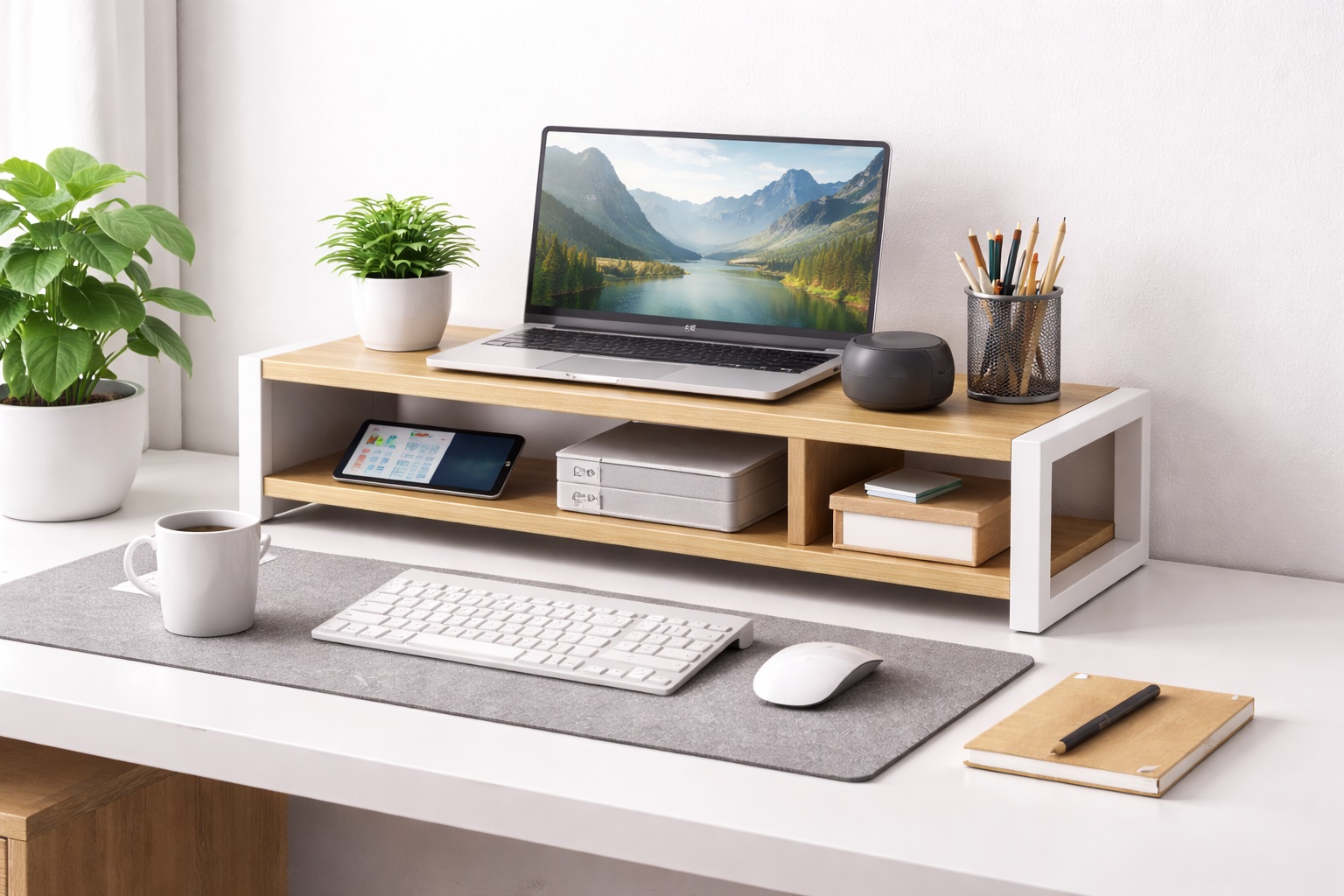
A monitor riser shelf raises the monitor to ergonomic eye level while creating an accessible storage space underneath for keyboards, notebooks, or accessories. This single piece solves monitor height and storage simultaneously. Most are made from bamboo, MDF, or metal and suit most desk aesthetics. For a student spending long stretches of the day looking at a laptop or monitor screen during lectures, assignments, and late study sessions, correcting screen height is one of the more overlooked ways to reduce fatigue during exam periods.
It's also one of the more budget-friendly desk upgrades a student can make relative to the problem it solves, since it replaces what would otherwise be two separate purchases — a monitor stand and a small storage tray — with one lightweight, easily packed piece. For students who move dorm rooms or apartments every year, that portability matters as much as the price tag.
- Pros:
- Raises monitor to correct ergonomic height
- Storage space below for keyboard or accessories
- Single purchase solves two desk problems
- Available in natural, white, and dark finishes
- Cons:
- Fixed height — not adjustable after placement
- Takes defined desk footprint at the rear
Best For: Students who want ergonomic screen positioning and accessible storage in a single, affordable piece that's easy to move between dorm rooms or apartments each year, particularly those who don't yet know whether their next housing situation will allow wall mounting.
Why We Recommend It: The monitor riser-shelf is the most practical desk organization purchase available for a student budget — it improves posture and creates storage in one piece, with no separate accessory required for either function, and it packs down easily for the annual move-out that most student housing requires. Because it doesn't depend on any specific room's wall access or lease terms, it's also the safest first purchase to make before you've even seen your assigned room.
2. Freestanding Desktop Organizer Shelf – Best for Multi-Zone Storage
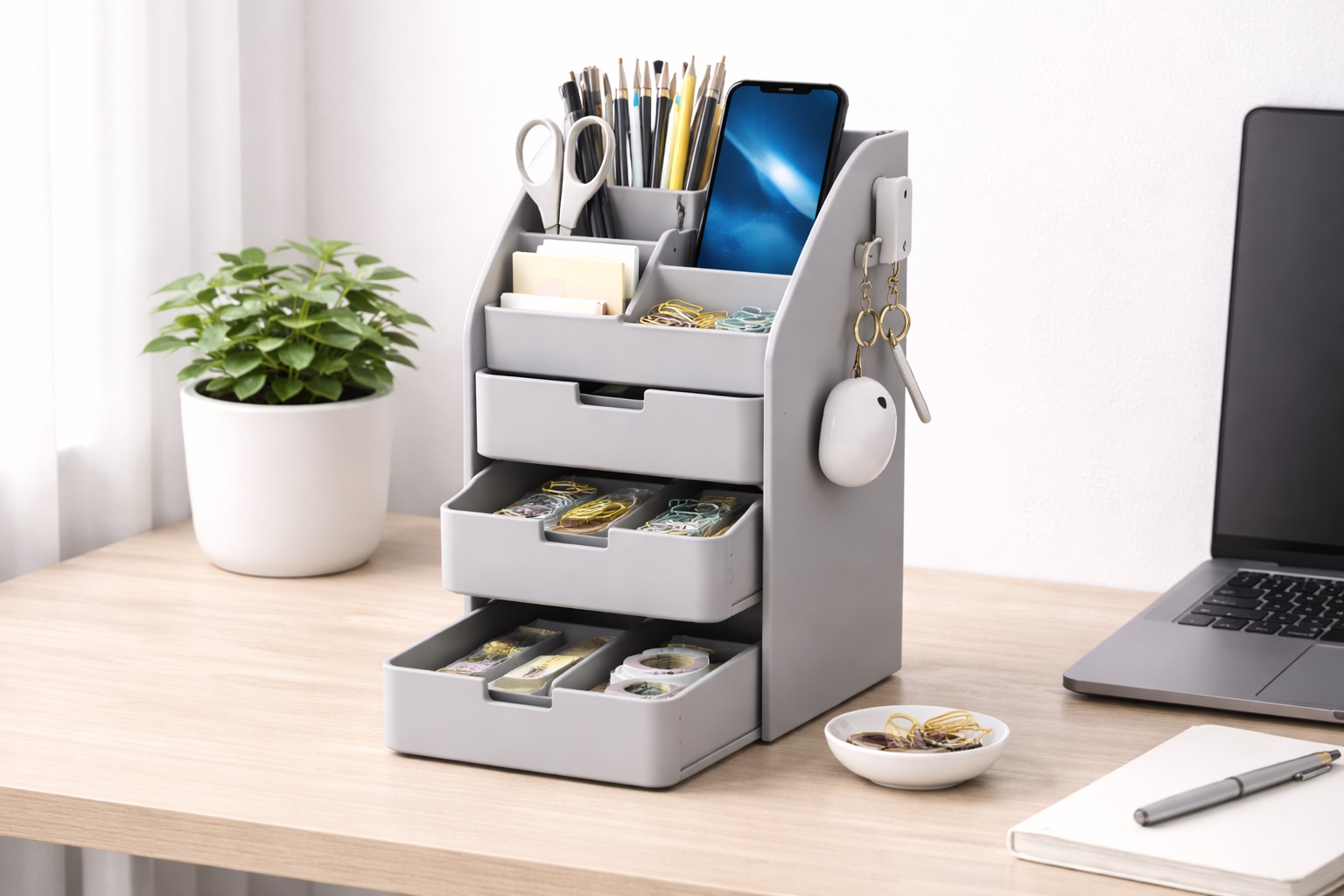
A freestanding desktop shelf unit provides multiple storage zones at different heights — reference books at the top, accessories in middle compartments, and items in lower sections. These typically span 18–24 inches of desk width and create a visual organizing system for frequently accessed items. For a student juggling textbooks for several classes plus notebooks, a calculator, chargers, and assorted study materials, having a defined zone for each category prevents the pile-up that happens fast in a compressed dorm room schedule.
Because these units require no installation, they're also the easiest to bring into a dorm room on move-in day and set up in minutes, with no tools and no landlord approval needed. That same lack of permanence means it travels well from year to year as course loads and material needs shift.
- Pros:
- Multiple storage compartments for organized access
- No installation — sits directly on desk
- Repositionable as needs change
- Available in various widths to match desk size
- Cons:
- Takes desk footprint across the width it covers
- Heavier than wall-mounted alternatives
Best For: Students who need organized multi-category storage for textbooks, accessories, and study materials, and who want a setup that requires zero installation approval or effort, especially those juggling several courses with distinct material needs at once.
Why We Recommend It: The multi-level freestanding shelf creates a vertical organization system that keeps everything visible and accessible without the items consuming the primary working desk surface, which matters in a dorm room where the desk is often also the only real workspace in the room. Unlike the wall shelf, it also travels intact from room to room with no reinstallation required, which fits the realities of student housing better than a fixed installation would.
3. Wall-Mounted Floating Shelf – Best for Freeing Desk Surface Completely
A wall-mounted floating shelf above the desk stores monitors, speakers, plants, and reference items completely off the desk surface, freeing the entire desk for working use. Installation requires basic tools and appropriate wall anchors. Once mounted, the shelf provides stable, permanent storage with no desk footprint. This is the format that offers the biggest single improvement to a cramped dorm desk, but it's also the one most likely to run into housing restrictions, so checking your specific dorm or lease policy before considering this option is an essential first step, not an afterthought.
Some dorms and apartments do permit small anchors or specific mounting hardware designed to leave minimal wall damage, so it's worth asking rather than assuming this option is automatically off the table. Where it is permitted, it tends to be the single most transformative change a student can make to a small dorm desk, since it's the only format in this comparison that turns an entire section of unused vertical wall space into functional storage rather than asking the desk surface to give something up.
- Pros:
- Frees entire desk working surface below
- Permanent, stable storage at any height
- Creates a clean, organized visual appearance
- Suitable for heavier items when correctly anchored
- Cons:
- Requires wall drilling — not suitable for renters
- Shelf position is fixed after installation
Best For: Students in housing that permits wall mounting who want maximum desk working surface for the remainder of their time in that specific room, particularly upperclassmen with more stable, longer-term housing arrangements.
Why We Recommend It: Moving items from the desk surface to a wall shelf above creates the most working space of any desk organization approach, and for a dorm room where the desk often has to double as a workspace for everything from studying to hobbies, that reclaimed surface area makes a meaningful daily difference, particularly for students who use the same desk for hobbies, hobbies-adjacent equipment, or a side project alongside their coursework. It's also worth asking whether your specific building uses drywall or a harder surface like cinder block behind the paint, since the two require different anchor types, and a hardware store or your housing office can usually tell you which applies to your particular building before you buy anchors that turn out to be the wrong kind.
Buying Guide: How to Choose the Best Desk Shelf for Students
Use these ten factors to match your purchase to student housing realities and a student budget, rather than to whichever shelf looks nicest on a dorm-room inspiration board.
1. Check Your Housing Rules First
Before anything else, confirm what your dorm, lease, or landlord actually allows. Wall mounting is off the table for many students, which immediately narrows the choice to freestanding or riser-style shelves. Knowing this upfront saves time comparing products you won't actually be able to use in your specific room. Housing offices and property managers vary widely in how strictly they enforce these rules, so a quick email or a question at check-in is worth the small effort before you commit to a shopping list.
2. Budget Realistically Against Semester Length
A cheaper shelf that needs replacing partway through the year can cost more over four years of school than a slightly pricier one that lasts through graduation. Weigh the sticker price against how many semesters you actually expect to use it before deciding purely on upfront cost. Splitting the price by the number of semesters you expect to get out of it turns an intimidating upfront number into a much more reasonable per-semester cost, which can make a slightly better-built option feel worth the difference.
3. Height for Monitor Ergonomics
If using a monitor riser-shelf, verify the height places your screen center at or slightly below seated eye level. Most risers sit in the 4–6 inch range, which works for most desk chair combinations found in standard dorm furniture, but it's worth double-checking against your specific desk and chair before ordering. Dorm chairs, in particular, are frequently non-adjustable, which makes getting the riser height right even more important than it would be with a fully adjustable office chair at home.
4. Weight Capacity for Textbooks
Textbooks are heavier than most other desk items, and a shelf intended to hold several of them needs a genuinely adequate weight rating rather than one calculated around lighter accessories. Check the stated capacity carefully if textbook storage is part of your plan for the shelf. A stack of hardcover textbooks for a full course load can easily exceed the assumed load for a shelf marketed around lighter desk accessories, so err toward a higher-rated model if textbooks are a significant part of what you're storing.
5. Desk Depth in Standard Dorm Furniture
Many dorm-issued desks are shallower than typical home office desks. A monitor riser shelf needing 10–14 inches of depth can consume a disproportionate share of a dorm desk's surface. Measure your specific dorm desk rather than assuming standard dimensions apply. If you haven't moved in yet, checking your school's furniture specifications online or asking a returning student in the same building can save you from ordering before you actually know the numbers.
6. Portability for Move-Out
Since most students move at the end of each school year, favor shelves that disassemble easily, pack flat, or are simply light enough to carry without a struggle. A heavy, bulky shelf becomes a genuine hassle during a stressful move-out week that's usually already packed with exams, packing, and saying goodbye to roommates. Anything that adds friction to that week is worth avoiding from the outset.
7. Material Durability for Shared, High-Traffic Rooms
Dorm rooms see more physical wear than a private home office — roommates, frequent guests, and general dorm-life chaos all take a toll. Bamboo and metal frames tend to hold up better under these conditions than lighter MDF construction, which can chip or swell if it's ever exposed to a spilled drink or a humid, poorly ventilated room.
8. Cable Management for Shared Power Strips
Dorm rooms often run multiple devices off a single power strip, and a monitor riser with built-in cable routing helps keep that tangle contained rather than spreading across an already small desk. This small feature matters more in a shared, compact space than it would in a private office, particularly in rooms where the desk sits close to a bed or a roommate's side of the room and visible cable clutter is harder to simply ignore.
9. Aesthetic Fit for a Shared or Assigned Room
Since dorm rooms are rarely decorated from scratch the way a personal home office is, choosing a neutral finish that works with whatever furniture the room came with is usually more practical than chasing a specific aesthetic that might clash with existing dorm furniture. A simple natural wood tone or a neutral white finish tends to blend in regardless of whatever color scheme the school assigned to the room's existing furniture.
10. Assembly Simplicity Without Special Tools
Dorm rooms rarely come with a toolbox on hand. Favor shelves that assemble with the included hardware and minimal or no external tools, since borrowing tools for a one-time assembly is an added hassle many students would rather skip entirely. Look specifically for listings that mention "tool-free" or "no assembly required" if this is a priority, and check reviews for confirmation that the claim holds up in practice.
11. Sharing a Desk Shelf With a Roommate
In a shared dorm room with two desks pushed close together, it's worth considering whether a single wider shelf serving both desks makes more sense than two separate smaller units, particularly for the freestanding organizer format. This depends heavily on whether both roommates actually want to share storage or would rather keep belongings clearly separated, which is worth a quick conversation before either of you buys anything.
12. Noise Considerations for Late-Night Study
Most desk shelves are entirely silent once assembled, but it's worth thinking about the noise generated while setting one up or reorganizing it, particularly late at night when a roommate may already be asleep. A freestanding shelf that can be adjusted quietly, without sliding loudly across a hard desk surface, is a small but real consideration in close dorm-room quarters.
Frequently Asked Questions
1. Are wall-mounted shelves ever allowed in dorm rooms?
It depends entirely on the specific school and housing policy. Some dorms permit small, low-damage anchors while others prohibit any wall modification. Always check with your housing office or landlord before assuming a wall shelf is an option. Command-strip style mounting hardware rated for wall shelves is sometimes an accepted middle ground even in buildings that prohibit drilling, so it's worth asking specifically about that option rather than assuming the answer is a blanket no.
2. What's the most budget-friendly desk shelf option for students?
Freestanding organizer shelves and monitor risers are generally the most affordable formats, since they require no installation hardware and are typically made from cost-effective materials like MDF or bamboo. Comparing a few models directly on price per storage zone is a reasonable way to shop within a tight budget, and it's worth checking back-to-school sales windows in late summer, when desk accessories aimed at students are frequently discounted.
3. What material is best for a student desk shelf?
Bamboo is a strong all-around choice for durability and a reasonable price point. MDF is the most affordable but slightly less durable under heavy dorm-room use. Metal frames hold up well to the wear and tear of shared living spaces. The right choice depends on your specific budget and how rough your living situation tends to be on furniture. If you're sharing a room with a roommate who has their own habits and guests, leaning toward the more durable end of that range is usually the safer bet.
4. Is the most expensive desk shelf for students always the best?
Not always. Price reflects features and build quality, but many mid-range options outperform expensive alternatives for everyday student needs. Matching the product to your actual dorm setup and budget matters more than chasing the priciest listing, since many premium features on higher-end shelves are aimed at permanent home offices rather than a dorm room a student will leave in a year.
5. How long should a quality desk shelf for students last?
A well-built desk shelf for students from a reputable manufacturer typically lasts through several years of moves and regular use with reasonable care. Warranty length is a useful indicator of manufacturer confidence in durability, which matters more for students who'll be relocating it annually. A shorter warranty isn't automatically disqualifying for a student purchase, but it's worth factoring into the overall value comparison alongside price and expected years of use.
6. Can I return a desk shelf for students if it doesn't suit me?
Most retailers offer 15–30 day return windows. Keeping original packaging during your evaluation period simplifies any return, which is especially useful if the shelf turns out not to fit your specific dorm desk once you've actually moved in and measured against the real furniture rather than a generic listing photo.
7. What should I prioritize when buying a desk shelf for students?
Start with your housing rules, then your budget, then your actual storage needs for the semester ahead. Matching the shelf to those real constraints produces a better outcome than shopping by price or appearance alone, and doing this thinking before move-in day rather than after tends to avoid an unnecessary extra shipping wait once classes have already started.
8. Does brand name matter for a desk shelf for students?
Established brands offer better warranty support and consistent quality control, which can matter for a piece of furniture expected to survive several moves. Newer or budget brands can still offer solid value for a shorter-term or lower-budget purchase, and for a piece of furniture you might only need for the length of a degree program, that tradeoff is often perfectly reasonable.
9. Can a desk shelf survive being packed away every summer?
Shelves designed with simple assembly — screw-in legs or slot-together panels — generally survive repeated disassembly and reassembly well. Avoid glued or permanently bonded construction if you plan to pack the shelf away each summer, since that type is more likely to be damaged by repeated moves. Check specifically whether legs or panels attach with screws, clips, or dowels, since these tend to hold up to repeated disassembly far better than adhesive joints.
10. Is it worth asking a landlord or RA about wall-mounted options before buying?
Yes. It takes a single short conversation and can unlock the format that frees up the most desk space, which is a meaningful upgrade for a small dorm room. Worst case, you've confirmed you need a freestanding option instead and can shop with that clarity from the start rather than discovering the restriction after a wall shelf has already arrived and can't be returned once opened.
11. Can a desk shelf actually help during finals week specifically?
Indirectly but meaningfully — an organized desk removes one small source of friction right when study time is at its most valuable, and not having to hunt for a specific notebook or charger buried under clutter saves real minutes across the many hours a finals-week study schedule typically demands.
12. What if my roommate and I have different storage needs?
Choosing two separate, smaller shelves rather than one large shared unit is usually the more practical solution when storage needs or preferences genuinely differ, since each person can then organize and rearrange their own section without needing to coordinate with the other.
Final Verdict
- Best All-Purpose Desk Shelf: Monitor Riser with Lower Storage Shelf — Best affordable, portable desk organization and ergonomic improvement for student housing.
- Best for Multi-Zone Storage: Freestanding Desktop Organizer Shelf — Best multi-category organized storage that needs no installation approval.
- Best for Freeing Desk Surface Completely: Wall-Mounted Floating Shelf — Best desk surface recovery for students in housing that permits mounting.
The right desk shelf for students depends on your specific housing rules, your budget, and how much you're moving each year. Use the buying guide and reviews above to match a format to your actual dorm or apartment situation rather than to whichever option looks best online. When in doubt, the monitor riser-shelf is the safest starting point for almost any student, since it requires no permission, no tools, and no long-term commitment to a specific room layout.
A well-organized desk matters more during exam season than at any other point in the year, precisely when there's the least time to fix a cluttered setup after the fact. Choosing the right shelf format early in the semester, rather than tolerating a messy desk until finals week forces the issue, tends to pay off in fewer distractions and an easier study routine for the rest of the year. It's a small investment relative to tuition, books, and everything else that goes into a semester, but it's one of the few that pays off every single day the desk gets used.