Best Desks for Students: Study Space & Storage Picks
A desk seems like a simple purchase until you actually try to fit one into a dorm room the size of a walk-in closet, or you sit down for a three-hour reading session and realize the surface is too shallow to hold a laptop and a textbook at the same time. Students face a narrower set of constraints than the average home-office shopper: limited floor space, shared rooms, tight budgets, and the need for a desk that can survive a few years of moves between dorms, apartments, and back home for the summer.
This guide breaks down the desk styles that consistently work well for students, rather than treating every option as interchangeable. Some rooms need a desk that disappears against a wall. Others need enough surface area for a monitor and a stack of books. A few students are looking for something they can adjust between sitting and standing during long study blocks. The right pick depends less on brand reputation and more on how closely a desk's shape and footprint match the room it has to live in.
It also helps to think about a desk the way you'd think about any piece of furniture that has to survive years of student life: repeated disassembly, the occasional coffee spill, a roommate leaning on the edge while talking, and a move at the end of every school year. A desk that photographs well but flexes under normal use, or one whose drawer slides jam after a few months, ends up costing more in frustration than it saved in sticker price. None of that means every student needs to spend heavily — it means the details behind the category matter more than the label on the box.
Below, each style is reviewed on its own terms, with an honest look at where it excels and where it compromises. After the reviews, a detailed buying guide walks through the practical factors worth weighing before you commit, followed by answers to the questions students and parents ask most often when shopping for a study desk.
It's also worth setting expectations early: no single desk style is objectively "the best" across every dorm, apartment, and study routine. A desk that's perfect for a student who mostly reads on a tablet and takes a few notes will feel underbuilt for a student running a dual-monitor coding setup, and the reverse is just as true. Reading through each style below with your own room and habits in mind, rather than looking for a universal winner, will get you to the right answer faster than comparing star ratings alone.
Top Student Desk Styles (Detailed Reviews)
Dorm-Friendly Compact Desk – Best Overall
The compact dorm desk is built around one constraint: floor space is scarce, and every square foot has to earn its place. This style typically keeps a footprint small enough to slide next to a dorm bed or into a corner, while still offering a surface wide enough for a laptop, a notebook, and a lamp. It's the style most students end up living with day to day, simply because it fits into almost any room layout without requiring a full furniture rearrangement. Because it doesn't demand a specific room shape or a free corner, it's also the easiest style to plan around sight unseen, before you've even walked into your assigned room for the first time.
- Pros:
- Small footprint fits into tight dorm corners and shared rooms
- Lightweight enough for most students to move or reposition alone
- Surface size is usually sufficient for laptop-based coursework
- Cons:
- Limited surface area for spreading out multiple textbooks at once
- Little to no built-in storage, so an extra organizer may be needed
Best For: Students living in a standard dorm room or a shared bedroom where floor space is the primary constraint.
Why We Recommend It: It solves the space problem first, which is usually the deciding factor for dorm living, without sacrificing enough usability to make daily studying uncomfortable.
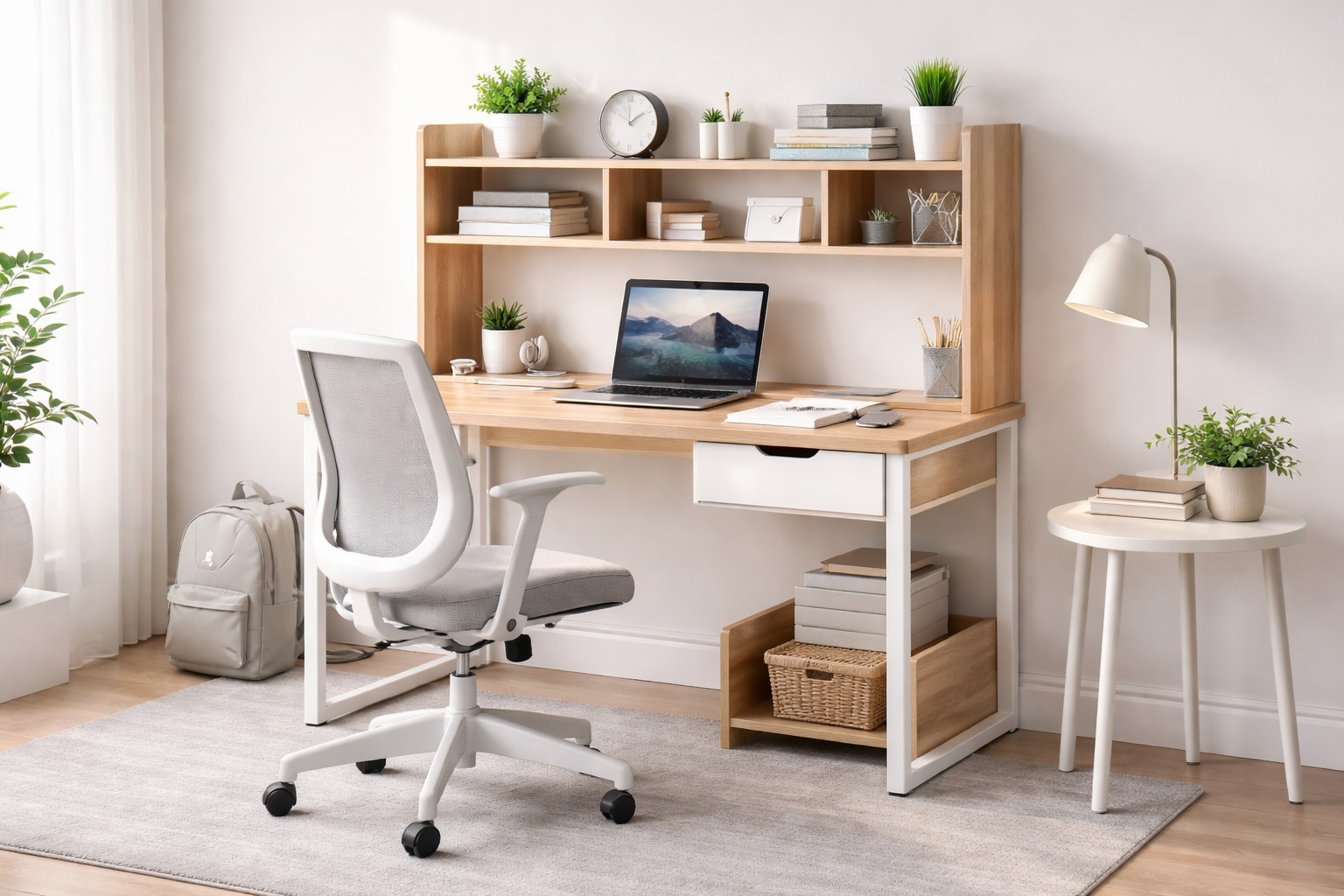
Study Desk with Shelf – Best for Organization
This style adds a riser shelf or a small hutch above the main work surface, giving students somewhere to keep textbooks, a printer, or desk supplies off the primary workspace. For anyone who tends to accumulate papers, binders, and reference books throughout a semester, the extra shelf keeps the desk itself clear for actual studying rather than becoming a storage pile. It's a particularly good fit for students in majors that still rely heavily on printed materials, lab manuals, or reference texts that need to stay within arm's reach but off the working surface.
- Pros:
- Built-in shelf keeps books and supplies off the working surface
- Helps maintain a clutter-free desktop during busy exam periods
- Useful vertical storage in rooms where floor space is limited
- Cons:
- The added shelf increases overall height, which can feel bulky in low-ceiling rooms
- Shelf weight limits mean it isn't suited to heavy equipment
Best For: Students who accumulate books, binders, and supplies and need a place to store them without buying separate shelving.
Why We Recommend It: The added shelf directly addresses the clutter problem that many flat desks create over a full semester, keeping the actual work surface usable.
L-Shaped Student Desk – Best for Multiple Monitors
An L-shaped layout wraps around a corner, effectively doubling the usable surface without doubling the footprint along a single wall. This makes it a strong option for students working with a laptop plus an external monitor, or those who need one section for computer work and another for handwritten notes and reading. It asks more of a room's corner space than a compact desk does, so it's best suited to apartments or larger dorm rooms rather than the smallest shared spaces. Students in design, engineering, or media programs who juggle large files, multiple applications, or physical drafting materials alongside a computer tend to get the most out of the extra surface.
- Pros:
- Significantly more usable surface area than a straight desk of similar footprint
- Corner placement can free up floor space elsewhere in the room
- Enough room to separate computer work from reading or writing tasks
- Cons:
- Requires a usable corner, which many dorm rooms don't have
- Larger overall size can make it harder to move between residences
Best For: Students in apartments or larger rooms who work across a laptop and a second monitor, or who need distinct zones for different tasks.
Why We Recommend It: It offers the most usable surface area of the styles reviewed here, which matters for students juggling multiple screens or study materials at once.
Floating Wall Desk for Dorms – Best Space-Saving Option
A wall-mounted floating desk skips legs entirely, attaching directly to the wall and leaving the floor beneath it completely open. In the smallest rooms, that reclaimed floor space can make the difference between a room that feels workable and one that feels cramped. It's a more permanent installation than a freestanding desk, which is worth weighing against dorm policies on wall mounting before choosing this style. For students in micro-dorms or rooms shared three or four ways, the open floor space underneath can double as storage for bins or shoes, which a leggy desk simply can't offer.
- Pros:
- Frees up floor space that a freestanding desk would otherwise occupy
- Can make small rooms feel noticeably more open
- Fixed wall mounting means no legs to bump into or work around
- Cons:
- Requires wall mounting, which may not be allowed in some dorms or rentals
- Less flexible if you need to move or reposition the desk later
Best For: Students in especially small rooms where reclaiming floor space matters more than flexibility, and where wall mounting is permitted.
Why We Recommend It: It's the most effective option purely for maximizing open floor space, which can meaningfully change how livable a small dorm room feels.
Budget Student Desk – Best Budget
Not every student needs a feature-rich setup, and the budget desk category exists for exactly that reason. These are straightforward, no-frills desks that cover the basics: a flat surface, a stable frame, and a price point that doesn't strain a student budget already stretched by tuition, books, and living costs. They won't include shelving, adjustability, or premium materials, but for a student who mainly needs somewhere to set a laptop, that's often beside the point. This category also makes sense for a first-year student who isn't yet sure what their long-term study habits will look like and would rather not commit to a pricier desk before knowing what they'll actually need.
- Pros:
- Lowest price point among the styles reviewed here
- Simple assembly and lightweight construction
- Adequate for basic laptop use and occasional studying
- Cons:
- Materials and hardware are generally less durable over the long term
- Lacks the storage or ergonomic features found in pricier options
Best For: Students on a tight budget who need basic desk functionality without extra features they won't use.
Why We Recommend It: It covers the essential need — a stable surface to work at — at a price that fits realistic student budgets without unnecessary extras.
Adjustable Student Desk – Best for Long Study Sessions
An adjustable desk, whether height-adjustable or convertible between sitting and standing, is aimed at students who spend long stretches of time working at the same surface — thesis writing, late-night study sessions, or extended online coursework. The ability to change position throughout a session can ease the physical strain of sitting still for hours, which matters more the longer a student's workload keeps them at the desk. Graduate students and upperclassmen working on longer-form writing projects, in particular, tend to notice the benefit most, simply because their desk time per day is considerably higher than a typical first-year course load requires.
- Pros:
- Adjustability supports better posture during long study sessions
- Can be shared comfortably by students of different heights
- Reduces the strain of sitting in one position for extended periods
- Cons:
- Typically the most expensive style in this category
- Adjustment mechanisms add weight and complexity versus a fixed desk
Best For: Students with heavy workloads who spend several hours a day at their desk and want the option to change position.
Why We Recommend It: The adjustability directly targets the physical discomfort that comes with long, sedentary study sessions, which is a real and common complaint among students.
Buying Guide: How to Choose the Best Desk for Students
Once you understand the general styles available, the next step is matching a desk's specific attributes to your room, your coursework, and your budget. The following factors are the ones that make the most practical difference for students in dorms, bedrooms, and shared apartments.
1. Measure the room before you shop
It's tempting to pick a desk based on photos or reviews alone, but the single most useful step is measuring your actual room, including the wall space, corner clearance, and door swing. A desk that looks compact online can still be too deep for a narrow dorm layout once you account for a chair and walking space. If you haven't seen the room yet, check with your housing office for floor plans or standard dimensions, since many schools publish these for incoming students specifically to help with furniture planning.
2. Match surface size to your actual coursework
A student who works almost entirely on a laptop needs far less surface area than one who reads print textbooks, takes handwritten notes, or works with lab materials. Be honest about how you actually study rather than assuming more surface is always better — a larger desk that doesn't fit the room is worse than a smaller one that does. Think back to how you studied in high school, or how you expect a particular major's coursework to look, and size the surface accordingly rather than guessing.
3. Consider storage needs realistically
Built-in shelving or drawers can reduce clutter, but only if you'll actually use them. Some students prefer a completely flat surface and separate storage elsewhere in the room. Think about how you currently store books and supplies before assuming a desk with shelving is automatically the better choice. If your current setup already involves a bookshelf or storage bins, a desk with its own built-in storage may be redundant rather than helpful.
4. Check weight limits for monitors and equipment
If you plan to add an external monitor, printer, or other equipment, check the desk's stated weight capacity. Lightweight dorm desks aren't always built to support additional hardware on top of a laptop, and overloading a shelf or surface can shorten its usable life. This is especially worth checking for shelving components, which are often rated for lighter loads than the main desktop surface.
5. Think about how often you'll move it
Students frequently relocate between dorms, apartments, and home over school breaks. A heavier, more elaborate desk may offer more features but be considerably harder to disassemble and transport each time. If frequent moves are likely, factor ease of assembly and transport into your decision, and look for designs that use simple cam-lock or bolt hardware rather than permanent joinery.
6. Confirm whether wall mounting is allowed
Floating or wall-mounted desks require permission in most dorms and many rental apartments. Check your housing agreement before choosing this style, since removing a wall-mounted desk at the end of a lease can also involve repair work that isn't always straightforward. It's worth raising this question with a resident advisor or landlord before you buy rather than after installation.
7. Prioritize stability over extra features
A desk that wobbles under normal use will be a daily annoyance regardless of how many features it includes. Stability depends on frame material and construction quality more than on price alone, so it's worth checking specific product details rather than assuming a higher price guarantees a sturdier frame. Reading verified buyer feedback about wobble or squeaking after assembly is often more informative than the product description itself.
8. Factor in chair compatibility
Desk height and chair height need to work together comfortably. If you already own a chair, check the desk's surface height against it before buying. Mismatched heights are a common source of discomfort that has nothing to do with the desk's quality on its own, and can lead to shoulder or wrist strain over a full semester of use.
9. Set a realistic budget based on how long you'll use it
A desk purchased for a single school year has different budget logic than one meant to last through a full degree program. If you expect to keep the same desk for several years, spending a bit more on durable materials can be more economical than repeatedly replacing a cheaper one, once you account for the hassle of buying, assembling, and disposing of furniture more than once.
10. Consider lighting and outlet placement
Where a desk sits in relation to windows, lamps, and electrical outlets affects daily usability more than most students expect. A desk positioned far from an outlet can mean cords stretched across the room, which is worth planning around before final placement, particularly in older dorm buildings where outlets can be sparse or awkwardly located.
11. Read return and assembly policies
Flat-pack desks vary widely in assembly difficulty, and not every retailer accepts returns on assembled furniture. Check the return window and whether assembly voids it, particularly if you're ordering online without having tested the desk in person. Keeping the original packaging until you're confident in the desk is a simple habit that preserves your options.
12. Don't overlook noise and vibration if you share a room
In shared rooms, a wobbly desk or a drawer that rattles can become a noticeable irritant for a roommate, especially during late-night study sessions. If you're sharing a space, a sturdier, quieter desk is worth the small extra investment, since the cost of a disagreement over noise is harder to quantify than the price difference between two desks.
Frequently Asked Questions
What size desk is realistic for a standard dorm room?
Most dorm rooms comfortably fit a compact desk with a surface between roughly two and three feet wide. Measuring your specific room before buying is more reliable than relying on general size assumptions, since dorm layouts vary significantly between schools and even between buildings on the same campus.
Do I need a desk with drawers or shelving?
Only if you tend to accumulate physical books and supplies that need somewhere to go. Students who work primarily on a laptop and keep most materials digital often do fine with a simple flat surface and separate storage elsewhere in the room.
Is an L-shaped desk worth it for a single monitor setup?
Usually not. The extra surface area of an L-shaped desk is most useful for students running multiple monitors or needing separate zones for different tasks. A single-monitor setup can typically be handled comfortably by a smaller, straight desk, freeing up room for other furniture.
Can a floating desk be removed without damaging the wall?
This depends on the mounting hardware and the wall material, and it's a question worth resolving with your housing office before installation. Some dorms and rentals prohibit wall mounting entirely for this reason, so confirming policy in advance avoids an awkward conversation at move-out.
How much should a student expect to spend on a desk?
Budget desks sit at the lower end of the price range and cover basic needs, while adjustable or L-shaped desks with more features cost more. Setting a budget based on how long you expect to use the desk helps avoid overspending on features you won't need for a single school year.
Are adjustable desks worth the extra cost for students?
For students with heavy, hours-long study loads, the ergonomic benefit can be meaningful. For students who only use a desk briefly each day, a simpler and less expensive desk may be a more practical choice for the money.
What's the most common mistake students make when buying a desk?
Buying based on appearance or price alone without measuring the room first. A desk that looks great in photos can be unusable if it doesn't fit the available space or the door and closet clearances in a dorm room.
Will a desk fit through a standard dorm doorway?
Most flat-pack desks ship disassembled and are built in the room, avoiding doorway width issues entirely. If you're considering a pre-assembled desk, check its dimensions against your doorway before ordering, and confirm elevator or stairwell access if your room is above the ground floor.
How long should a student desk last?
With reasonable care, a well-built desk can last through several years of use, including moves between dorms and apartments. Lower-cost options may show wear sooner, particularly with repeated disassembly and reassembly during moves.
Is it better to buy a desk in person or online?
Online shopping typically offers more selection and better pricing, while in-person shopping lets you assess sturdiness and finish quality directly. For students without easy access to a store, checking detailed product photos and verified reviews helps offset the disadvantage of not seeing it in person first.
Can two students share one desk in a dorm room?
It's uncommon and usually impractical, since most dorm desks are sized for a single occupant's laptop and materials. Most shared rooms are set up with one desk per student rather than a single shared surface, which is worth confirming with your roommate ahead of move-in.
What should I do if my desk wobbles after assembly?
Recheck that all screws and connectors are fully tightened, since incomplete assembly is the most common cause of wobble. If the frame itself is uneven even after proper assembly, contacting the retailer about a replacement is reasonable, particularly if the issue appears immediately out of the box.
Should I buy a new desk or bring one from home?
This often comes down to logistics rather than preference. Transporting a desk from home saves money but can be impractical over long distances, while buying locally or online for delivery to campus is usually simpler for students moving any real distance from home.
Do I need to buy a desk chair separately?
Most student desks, including the styles covered here, are sold without a chair. Since desk and chair height need to work together comfortably, it's worth choosing the two together rather than assuming any chair you already own will pair well with a new desk's height.
What's the best way to keep cables organized on a student desk?
Simple cable clips or a small under-desk tray can keep charging cords and monitor cables from tangling, which matters more on compact desks where surface space is already limited. This is a minor addition but one that noticeably improves day-to-day usability, especially on desks without built-in cable management.
Final Verdict
- Best Overall: The dorm-friendly compact desk, for its balance of small footprint and everyday usability.
- Best Budget: The budget student desk, for covering the basics at the lowest price point.
- Best for Space-Constrained Rooms: The floating wall desk, for reclaiming floor space where every inch counts.
- Best for Heavy Study Loads: The adjustable student desk, for supporting long, comfortable study sessions.
There isn't a single desk that works best for every student, and that's largely the point — a dorm room, a shared apartment bedroom, and a house share all impose different constraints. Start with your room's actual dimensions and your real study habits, then let those specifics guide you to the style that fits, rather than choosing based on what looks most impressive in a listing. A desk that matches your space and your workload will simply get used more, and that everyday usability matters far more over a semester than any single standout feature.