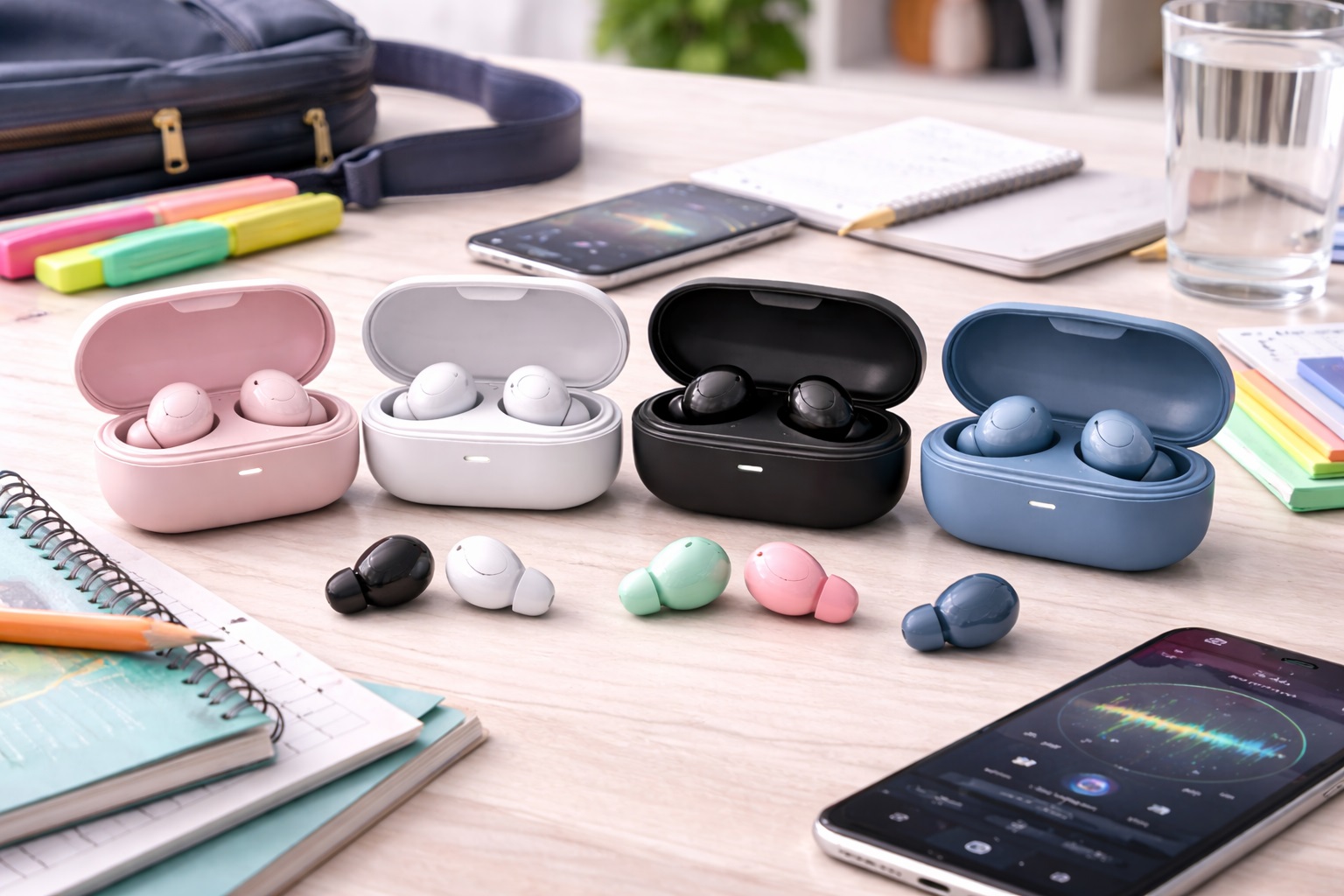
Best Bluetooth Earbuds for Students on a Tight Budget
A student's earbuds get asked to do more than almost anyone else's. The same pair might carry a lecture recording on the walk to class, handle a group project call between classes, block out a noisy dormitory hallway during an evening study session, and still sound decent enough for music on the way to dinner, all while surviving being stuffed into a backpack pocket alongside textbooks and water bottles. Few other daily users demand quite that much range from a single pair of earbuds, and few have quite as limited a budget to meet those demands across a full academic year.
This guide compares the most practical options for students who use earbuds for studying, online classes, music, and calls on a student budget. Rather than treating any one of these use cases as the priority, the reviews below weigh how well each option covers the realistic mix of a student's day — enough battery to survive a full schedule of classes, enough noise reduction to make a shared living space usable for studying, clear enough calls for group projects and virtual office hours, and a price that respects an actual student budget rather than a professional one with more disposable income.
Below is a full comparison table, detailed reviews of the strongest student-friendly options, a buying guide built around the specific pressures of student life, and answers to the questions students ask most often before choosing a pair to get them through a semester.
Why Student Life Demands a Different Kind of Earbud
Most buying guides assume a fairly consistent daily routine — an office worker's calls, a commuter's transit ride, a gym-goer's workout. Student life resists that kind of consistency almost by design. A single day might swing between a lecture hall, a noisy dining hall, a quiet library, a shared dorm room with a roommate on their own call, and a late-night study session, each demanding something slightly different from the same pair of earbuds. This variability is exactly why a well-rounded option often serves students better than one narrowly specialized for a single scenario.
Budget constraints also shape this category more directly than almost any other buyer segment. Most students are working with a genuinely limited amount of discretionary spending, which makes price-to-performance ratio a bigger factor here than it might be for a working professional with a more flexible budget. The picks below specifically account for this, favoring options that deliver strong value across a student's realistic daily needs rather than the most feature-packed option regardless of cost.
Top Picks (Detailed Reviews)
1. Balanced Study-Friendly Earbuds – Best Overall for Students
Built to cover the realistic range of a student's day rather than specializing narrowly, this option combines decent ANC for noisy study spaces, workable call quality for group projects and online classes, and solid all-day battery life, all at a price that respects a typical student budget without feeling like a compromise.
- Pros:
- Balanced performance across studying, calls, and music listening
- Solid all-day battery life suited to a full class schedule
- Reasonable price relative to the breadth of features covered
- Comfortable for extended daily wear between classes and study sessions
- Cons:
- Does not lead the category in any single specialized feature
- ANC is solid rather than class-leading
Best For: Students who want one dependable pair that handles the full range of a typical school day well.
Why We Recommend It: Most students benefit more from broad, reliable coverage across studying, calls, and music than from a pair that excels narrowly in one area while falling short in the others that matter just as often.
2. Long-Battery Classroom Earbuds – Best for All-Day Campus Use
Between back-to-back classes, study sessions, and campus commuting, students often go many hours without a convenient charging opportunity. This option prioritizes extended battery life and generous case recharge capacity, reducing the risk of running out of power midway through a long academic day.
- Pros:
- Extended battery life suited to a packed daily class schedule
- Case holds multiple additional full charges for long campus days
- Reasonable sound and call quality alongside the extended battery
- Good option for students without easy access to charging between classes
- Cons:
- Case is somewhat bulkier to accommodate the larger battery
- ANC is more basic than dedicated focus-oriented options
Best For: Students with a packed daily schedule and limited opportunities to charge between classes.
Why We Recommend It: A dead battery partway through a long campus day is a common and avoidable frustration, and this option is specifically built to minimize that risk across demanding schedules.
3. Focus-Mode ANC Earbuds – Best for Studying in Noisy Dorms and Libraries
Shared living spaces and busy libraries create a specific kind of background noise that makes focused studying difficult. This option's ANC is tuned to reduce that kind of distraction while remaining comfortable for extended study sessions, helping create a more usable focus environment without needing to find a private space every time.
- Pros:
- ANC tuned specifically for reducing dorm and library background noise
- Comfortable for genuinely extended study sessions
- Good battery life to sustain ANC use through long study blocks
- Reasonable call and music performance alongside the ANC focus
- Cons:
- Priced a bit higher than the most basic budget options
- Not as fully isolating as flagship travel-focused ANC models
Best For: Students living in shared dorms or relying on busy libraries for studying.
Why We Recommend It: Finding quiet, private study space is a genuine challenge in most student housing, and effective ANC directly addresses that challenge without requiring a change in living situation.
4. Budget Student Earbuds – Best Value on a Student Budget
For students working with a genuinely tight budget, this option covers the core needs — reasonable sound, workable calls, and dependable connectivity — without the specialized features that drive up the price of the more focused options in this list, making it accessible to nearly any student spending limit.
- Pros:
- Among the lowest prices while still delivering workable core performance
- Reasonable sound and call quality for everyday student use
- Low financial risk for a limited student budget
- Functional enough to cover most day-to-day needs adequately
- Cons:
- ANC and battery life are more basic than pricier alternatives
- Build quality is adequate rather than especially durable
Best For: Students whose budget is the primary constraint above every other consideration.
Why We Recommend It: Not every student can justify spending significantly on earbuds, and this option delivers genuinely usable performance without requiring a purchase that strains a tight budget.
5. Clear-Call Earbuds for Online Classes – Best for Virtual Lectures and Discussion
Group projects, virtual office hours, and the occasional remote class all depend on being clearly heard, and this option specifically prioritizes microphone quality and call clarity, making it a strong choice for students whose coursework involves regular video calls and discussion sections.
- Pros:
- Clear voice pickup suited to group project calls and discussions
- Reasonable background noise handling for calls from shared spaces
- Solid connection stability during video calls specifically
- Good value for students with regular online class components
- Cons:
- Music playback sound quality is secondary to call performance
- ANC is functional rather than a standout feature
Best For: Students with coursework that regularly involves video calls, group projects, or virtual office hours.
Why We Recommend It: Being clearly heard during a graded discussion or group project call matters academically in a way that music quality never will, and this option is built specifically around that need.
6. Durable Everyday Earbuds – Best for Campus Life and Daily Wear
Backpacks, dining halls, and busy campus commutes put real wear on daily-use electronics, and this option's sturdier build and solid sweat and splash resistance rating hold up better to the general wear and tear of campus life than more delicate alternatives.
- Pros:
- Sturdier build resists everyday drops and rough handling
- Solid sweat and splash resistance for campus commuting and activity
- Secure fit that holds during a busy walk between classes
- Good value for students who are hard on their belongings
- Cons:
- Slightly bulkier than the most compact competitors
- ANC and call features are competent rather than standout
Best For: Students who are hard on their electronics or have previously damaged a more delicate pair.
Why We Recommend It: Longevity is its own form of value on a student budget, and a sturdier build means fewer mid-semester replacements even if peak specialized performance is not the headline feature.
7. Compact Discreet Earbuds – Best for Quiet Libraries and Shared Spaces
Some study environments call for a lower-profile look and feel, and this option's smaller housing sits more discreetly in the ear than bulkier designs, which suits quiet libraries, shared study rooms, and lecture halls where a large, visible earbud can feel out of place.
- Pros:
- Smaller, more discreet housing suited to quiet shared spaces
- Comfortable fit despite the compact design
- Solid call and connection performance for everyday use
- Good option for students who prefer a low-profile look
- Cons:
- Smaller housing means a somewhat smaller battery than bulkier alternatives
- ANC is more basic than dedicated focus-oriented options
Best For: Students who prefer a discreet, low-profile look for lecture halls and shared study spaces.
Why We Recommend It: Appearance and discretion are legitimate considerations in shared academic spaces, and this option balances a low-profile design with dependable everyday student performance.
Common Assumptions Students Make Worth Questioning
It is easy to assume that the most expensive available option is automatically the best choice for a student, but premium features like the most aggressive ANC or the largest feature set often go underused relative to their cost for a typical student's actual daily needs. A well-rounded mid-range or budget option frequently delivers better real value for a student's specific mix of studying, calls, and casual listening, since the added cost of premium extras rarely translates into a proportional improvement in day-to-day usefulness for most academic schedules.
Another common assumption is that any pair of earbuds will handle online classes and group project calls adequately. Call quality varies significantly between models, and a pair that sounds great for music can still transmit a muffled or unclear voice during an important discussion section, which is worth checking specifically rather than assuming it follows automatically from good general reviews.
There is also a tendency to underestimate how much daily wear campus life puts on a pair of earbuds. Between backpacks, dining halls, and constant transitions between locations, student-use earbuds often experience more daily handling than a typical office worker's pair, making durability a more relevant factor than it might initially seem when comparing otherwise similar options on paper.
How Remote and Hybrid Learning Changed What Students Need
A decade ago, a student's earbuds mainly needed to handle music between classes and the occasional phone call. The rise of remote and hybrid learning has expanded that considerably, adding video lectures, virtual office hours, online group projects, and recorded coursework to the daily mix, often stacked in the same afternoon as an in-person class and a study session in a shared space. A single pair of earbuds today is realistically expected to handle a far wider range of academic tasks than it once was.
This shift is part of why call quality and multipoint connectivity, once considered mainly business-oriented features, have become genuinely relevant to student shopping as well. A student moving between a laptop for an online class and a phone for a quick text between buildings faces the same daily friction a remote-working professional does, just wrapped in an academic schedule rather than an office one.
Recognizing this shift matters when shopping, since a pair marketed purely around music listening or casual daily use may not serve a genuinely mixed academic schedule as well as one built with these broader modern student needs in mind from the outset.
Buying Guide: How to Choose the Best Bluetooth Earbuds for Students
These are the factors that matter most for the specific mix of demands a student's daily schedule places on a pair of earbuds.
1. Battery Life for a Full Class Day
Check whether stated battery life realistically covers a full day of classes, study sessions, and commuting without a convenient charging break, since student schedules often leave little room for a midday recharge between locations.
2. ANC for Noisy Dorms and Study Spaces
Effective noise reduction can make a shared dorm room or busy library genuinely usable for focused studying, which is one of the more practically valuable features for many students specifically living in shared housing.
3. Call and Microphone Quality for Online Classes
Group projects and virtual office hours depend on being clearly heard, so check feedback specifically about call clarity rather than assuming it follows from good music playback quality alone at a similar price.
4. Comfort for Long Study Sessions
Extended study sessions test comfort differently than a short commute, so prioritize feedback about comfort during genuinely long, continuous wear over a brief first impression from a quick trial.
5. Durability for Campus Life
Backpacks, dining halls, and constant daily transitions put more wear on earbuds than many other daily routines, making a reasonably sturdy build a practical consideration for student use over a full term.
6. Budget Considerations for Students
Match spending to a realistic student budget rather than a professional one, since many premium features go underused relative to their added cost for typical student needs and daily habits.
7. Multipoint for Switching Between Laptop and Phone
Students frequently switch between a laptop for classes and a phone for messages or calls, making reliable multipoint connection a genuinely useful feature for reducing daily friction throughout a busy schedule.
8. Sound Quality for Music and Lecture Audio
Reasonable sound clarity matters not just for music but for following recorded lectures or podcasts clearly, which benefits from decent midrange clarity more than bass-heavy tuning aimed at music alone.
9. Discreet Use in Quiet Spaces
A smaller, lower-profile design can be more appropriate for quiet libraries and lecture halls than a bulkier, more visually prominent pair, depending on your specific campus culture and personal preferences.
10. Charging Convenience Between Classes
Fast partial charging during short breaks between classes can matter more for student schedules than maximum total battery capacity, since long uninterrupted charging windows are often unavailable during a busy day.
11. Compatibility with School Laptops and Tablets
Confirm reliable Bluetooth pairing and performance with the specific laptop or tablet used for coursework, since occasional compatibility quirks can affect the online class experience unexpectedly.
12. Balancing Study Needs with Everyday Use
The best pick depends on how your specific mix of studying, calls, and casual listening breaks down, not on which single model claims to lead every category simultaneously in marketing copy alone.
Frequently Asked Questions
1. What earbuds are best for studying with background noise?
Earbuds with effective ANC tuned for steady background noise, such as dorm activity or library chatter, work best for creating a usable focus environment during long study sessions.
2. Can I use Bluetooth earbuds for online classes?
Yes, most Bluetooth earbuds connect easily to a laptop or tablet for online classes, though call and microphone quality vary between models, which is worth checking if discussions or group calls are involved regularly.
3. How much should a student spend on earbuds?
A moderate, budget-friendly price point generally covers a student's realistic needs well, since many premium features go underused relative to their added cost for typical daily student use and habits.
4. Do I need ANC for studying in a dorm?
Not strictly, but it is one of the more practically valuable features for students in shared living situations, since it can make a noisy environment genuinely usable for focused academic work.
5. How long should battery life last for a full class day?
Look for earbuds that realistically cover a full day of classes and study sessions on a single charge, since convenient charging breaks are often limited during a busy academic schedule between buildings.
6. Are budget earbuds good enough for students?
Many are, especially options specifically designed to balance core student needs like calls, reasonable sound, and dependable connectivity without unnecessary premium extras that raise the price unnecessarily.
7. Can earbuds handle both music and class calls well?
Some do this well by balancing both use cases in their design, though highly specialized options tend to favor one over the other, so a well-rounded pick often suits mixed student needs best overall.
8. Is it okay to wear earbuds during an in-person lecture?
This depends on individual class policies, though many students use a single earbud or keep volume low for supplemental audio without disrupting attention to the lecture itself, where explicitly permitted.
9. How do I keep earbuds from getting lost or misplaced on campus?
Keeping earbuds in a dedicated bag pocket, using the case consistently, and choosing a case with a secure closure all help reduce the common risk of misplacing small items during a hectic day.
10. Do multipoint earbuds help for switching between laptop and phone?
Yes, multipoint connection removes the friction of manually re-pairing every time you switch between a laptop for classes and a phone for calls or messages throughout a busy day.
11. What is the best fit for wearing earbuds all day on campus?
A secure, comfortable fit tested across multiple included ear tip sizes generally holds up best over a long day of classes, studying, and commuting between different campus locations.
12. Should students prioritize sound quality or practicality?
For most students, practicality — battery life, call clarity, durability, and price — matters more day to day than maximum audio fidelity, which fewer students will notice or benefit from consistently in practice.
Matching Earbuds to Your Actual Student Schedule
Not every student's schedule places the same demands on a pair of earbuds. A student with heavy coursework involving group projects and virtual discussions should prioritize call clarity above nearly everything else, since that is the feature that will actually affect academic collaboration. A student living in a noisy dorm or relying on a busy library benefits more from effective ANC than from features aimed at other use cases entirely.
Students commuting significant distances to campus, or with especially long days between classes, should weight battery life and durability more heavily than students living close to campus with more predictable, shorter days. And a student on an especially tight budget should feel comfortable prioritizing the most affordable genuinely workable option, since the gap in real-world usefulness between a well-chosen budget pair and a pricier alternative is often smaller than marketing suggests.
It is also worth thinking about how your schedule tends to shift across a single week rather than assuming every day looks the same. A week with two or three online discussion sections mixed with several quieter independent study days benefits from a pair that performs reasonably well across both scenarios rather than one narrowly optimized for a single situation. Reviewing a typical week from the past month, rather than guessing at an idealized routine, often reveals a clearer picture of which factors actually deserve the most weight in a final decision.
Being honest about which of these patterns describes your own semester is the fastest way to narrow this list down to the pick most likely to actually serve you well through a full academic term.
Final Verdict
- Best Overall for Students: Balanced Study-Friendly Earbuds — covers the full range of a student's day well.
- Best for All-Day Campus Use: Long-Battery Classroom Earbuds — minimizes the risk of running out mid-schedule.
- Best for Studying in Noisy Dorms and Libraries: Focus-Mode ANC Earbuds — makes shared spaces usable for concentration.
- Best Value on a Student Budget: Budget Student Earbuds — workable performance without straining a tight budget.
- Best for Virtual Lectures and Discussion: Clear-Call Earbuds for Online Classes — built for group projects and video calls.
- Best for Campus Life and Daily Wear: Durable Everyday Earbuds — holds up to backpacks and busy daily handling.
- Best for Quiet Libraries and Shared Spaces: Compact Discreet Earbuds — a low-profile choice for shared academic settings.
Choosing earbuds as a student comes down to being honest about your actual daily mix of classes, studying, calls, and casual listening, rather than defaulting to whichever pair has the flashiest feature list or the biggest price tag. A student with a call-heavy course load and one with a mostly independent study routine have genuinely different priorities, and matching the pick above to your own semester tends to produce a far better result than chasing the single most impressive spec sheet available.
It is also worth reassessing your setup as your course load or living situation changes from semester to semester. A pair chosen for a quiet single dorm room may not serve as well after a move to a shared apartment with roommates, and a pick chosen for a light course load may fall short once group projects and virtual discussions become a bigger part of your schedule. Revisiting the buying guide above at the start of a new term, if your daily patterns have shifted meaningfully, is a reasonable habit for getting the most out of a student budget.
Finally, keep in mind that a good pair of student earbuds is ultimately a practical tool rather than a status item, and the value it provides shows up in small daily conveniences rather than one dramatic feature — a study session that stays quiet enough to focus, a group call where everyone hears you clearly, a battery that never quite runs out before the last class of the day ends. Those small, repeated conveniences add up meaningfully across a full semester, which is exactly why it is worth spending a little extra time matching a choice from this guide to your own actual routine rather than settling for whatever happens to be most convenient to buy.