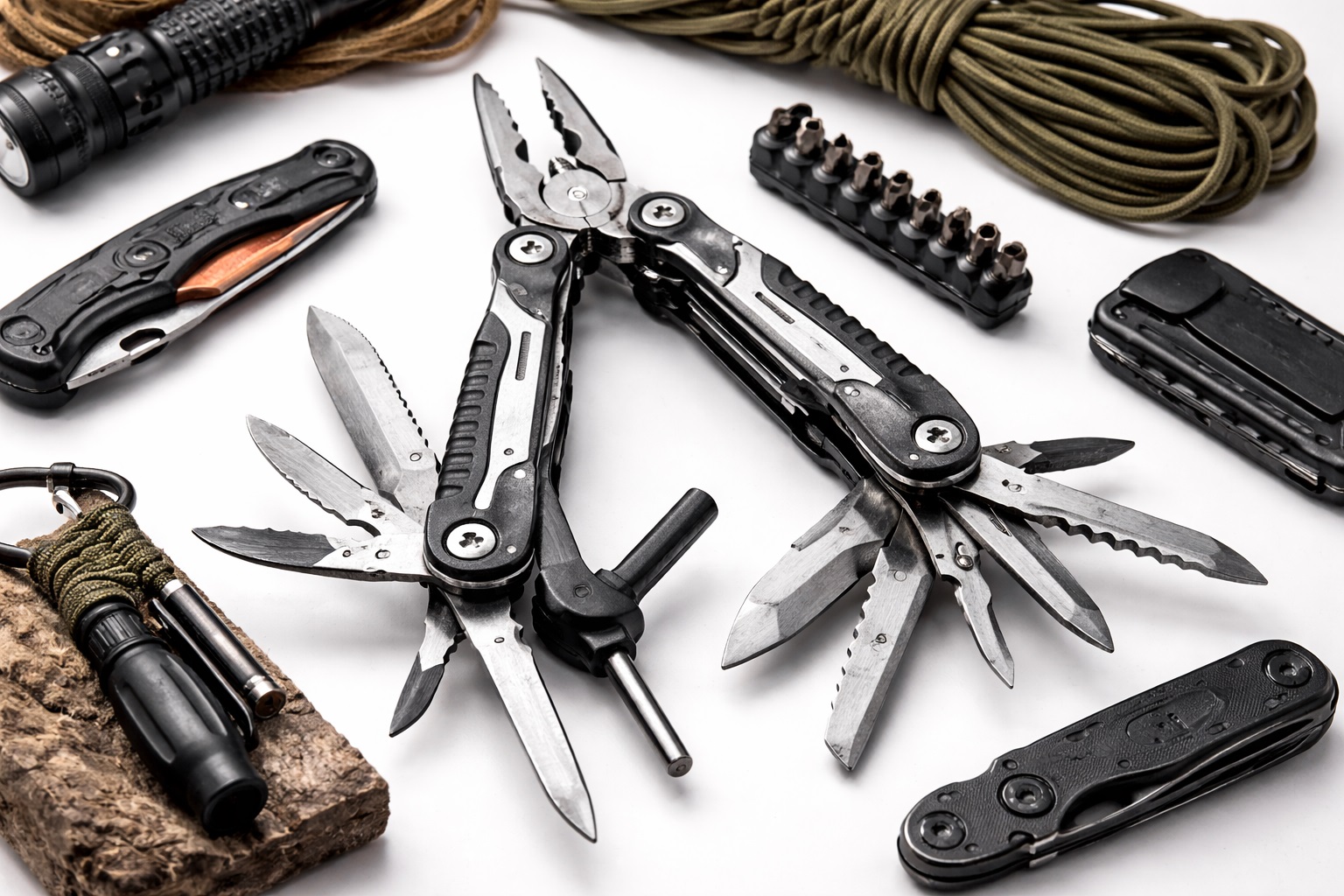
Best Durable Multi-Tool in 2026
Longevity is the quiet metric that separates a genuinely good multi-tool from one that merely looks good on a store shelf. A tool bought for its long-term durability needs to survive years of pivots opening and closing, pliers gripping stubborn hardware, and blades cutting through everything from cardboard to cordage, without the mechanism loosening, the springs weakening, or the steel degrading under ordinary daily conditions. This guide compares the multi-tools available in 2026 that are most consistently recognized for holding up over years of regular use rather than months of light use before problems start to appear, focusing on the materials and construction details that actually determine how long a tool lasts. A tool's first week of use rarely reveals much about its true durability; the real test comes after a year or two of pockets, toolboxes, weather, and repeated hard use, which is the lens applied throughout this guide rather than judging tools solely on how they feel fresh out of the packaging.
Below, you will find detailed reviews of eight multi-tools chosen specifically for their track record of durability, followed by a practical buying guide covering the features that separate a tool built to last from one that will need replacing far sooner than expected. Each review focuses on what makes that particular model likely to remain functional and comfortable to use for years, rather than simply listing specifications. Pay close attention to the pros and cons for each entry, since a tool's weaknesses often show up specifically in long-term ownership rather than in a quick first impression, since a shiny, tight-feeling tool at the store can still hide mediocre steel or thin coatings underneath.
This guide also answers common questions about keeping a multi-tool in good working condition over the long run, from basic maintenance habits to how to judge whether a given price reflects genuine long-term value. By the end, the goal is a clear sense of which model is most likely to still be earning its place in your pocket or toolbox five or ten years from now, along with the small habits that make that outcome far more likely regardless of which model you ultimately choose. None of these habits are complicated or time-consuming; they simply need to become routine rather than an afterthought.
Top 8 Best Multi-Tool Picks (Detailed Reviews)
Gerber Suspension-NXT – Best For Long-Term Value on a Budget
The Gerber Suspension-NXT proves that durability doesn't have to come with a premium price tag, using spring-loaded pliers built on a frame that holds up well to years of repeated opening and closing. At roughly $40, it's the most affordable tool in this roundup, yet the spring mechanism and pivot construction show few signs of the early wear that often plagues cheaper multi-tools. For anyone who wants a long-lasting tool without a large upfront investment, it's a genuinely smart starting point. Even after a couple of years of regular pocket carry, owners commonly report the pliers still snapping open with the same crispness as when the tool was new.
- Pros:
- Spring-loaded pliers hold up well over years of use
- Excellent durability relative to its price
- Lightweight and easy to carry daily
- Cons:
- Fewer premium materials than higher-priced models
- Smaller overall tool selection
Best For: Buyers who want strong long-term durability without paying a premium price.
Why We Recommend It: It's rare to find a tool this affordable that still holds its mechanism tightness after extended use, making it an easy recommendation for anyone budget-conscious but durability-focused. It also demonstrates that thoughtful engineering, rather than sheer material cost, can be the deciding factor in how long a tool actually lasts.
Gerber Center-Drive – Best For Long-Term Fastening Reliability
The Gerber Center-Drive's full-size, in-line driver axis is built to withstand repeated torque without the bit socket loosening or wearing down the way offset designs sometimes do over years of use. At about $110, it's a mid-range investment that pays off for anyone who regularly relies on the driver function, since a worn-out bit interface is one of the more common failure points on lesser multi-tools. The tool also accepts widely available replacement bits, so even the parts that do eventually wear can be swapped rather than forcing a full replacement of the entire unit.
- Pros:
- In-line driver axis resists wear from repeated torque
- Accepts standard, easily replaceable bit sets
- Reputable Gerber build quality
- Cons:
- Pliers are secondary to the driver in this design
- Mid-range price for a fairly specialized tool
Best For: Users who put heavy, repeated wear on the driver function and need it to stay tight over time.
Why We Recommend It: The in-line design distributes torque more evenly than offset drivers, which meaningfully reduces the wear that eventually loosens a bit-holding mechanism. Users who put this tool through years of regular fastening tasks consistently report the driver still gripping bits securely without slipping.
Leatherman Skeletool – Best For Long-Term Everyday Carry Comfort
The Leatherman Skeletool's minimalist lightweight design isn't just about shedding weight; fewer moving parts also means fewer components that can wear out or loosen over years of daily use. At around $75, it strikes a solid balance between price and long-term reliability, and the pared-down tool selection keeps the mechanisms simple enough to maintain easily for the long haul. There's a real argument that a tool doing less, but doing it reliably for a decade, beats a more complex tool that starts to feel worn after just a couple of years.
- Pros:
- Fewer moving parts means fewer long-term failure points
- Comfortable, lightweight design for daily carry
- Backed by Leatherman's reputation for durability
- Cons:
- Fewer specialized tools than full-size models
- Not ideal for users who want maximum tool variety
Best For: Daily carry users who want a simple, durable design that avoids unnecessary complexity.
Why We Recommend It: A simpler mechanism with fewer parts is inherently easier to keep running smoothly for years, and the Skeletool's focused design reflects that philosophy well. There's a reason it has remained a popular choice among long-term multi-tool owners despite competition from more feature-packed alternatives.
SOG PowerPint – Best For Durable Performance on a Budget
The SOG PowerPint's compound leverage technology is built into a compact frame that has proven itself capable of handling repeated heavy use without the leverage linkage loosening prematurely. At around $50, it remains one of the more affordable options here, and the core mechanism has a reputation for staying tight and responsive well beyond the point where cheaper multi-tools typically start to feel sloppy. It's a good example of how a smart mechanical design can outperform a similarly priced competitor purely on engineering, without relying on premium materials to make up the difference.
- Pros:
- Compound leverage linkage resists loosening over time
- Very accessible price point for the durability offered
- Compact enough for daily carry
- Cons:
- Fewer premium materials than higher-end options
- Smaller tool selection than full-size models
Best For: Buyers who want proven mechanical durability without paying a premium price.
Why We Recommend It: The leverage system is engineered to handle real stress repeatedly, which is exactly the kind of design detail that predicts long-term durability.
Leatherman Free P4 – Best For Long-Term Premium Build Quality
The Leatherman Free P4's magnetic opening system sits inside one of the most tightly toleranced multi-tool bodies available, which translates directly into a mechanism that stays smooth and precise for far longer than looser, more budget-oriented designs. At around $150, it's the most expensive tool in this lineup, but the materials and assembly quality are built with long-term ownership in mind rather than just a strong first impression. Owners who have carried the tool daily for several years frequently note that the magnetic opening mechanism still snaps shut with the same precision as day one.
- Pros:
- Exceptionally tight tolerances resist long-term wear
- Premium materials throughout the build
- Backed by Leatherman's reputation for durability
- Cons:
- Highest price point in this roundup
- Limited color and finish choices
Best For: Buyers who want the strongest possible assurance that their multi-tool will still perform like new after years of use.
Why We Recommend It: Tighter tolerances and premium materials are the two biggest predictors of long-term durability, and the Free P4 delivers both at a genuinely premium level. For buyers who plan to keep and use a single multi-tool for the next decade or more, this level of build quality tends to justify the higher initial price.
Victorinox SwissTool Spirit – Best For Corrosion Resistance Over Time
The Victorinox SwissTool Spirit's ergonomic stainless steel construction is specifically suited to resisting the slow corrosion that eventually stiffens pivots and dulls blades on lesser tools. At around $135, it's a premium choice, but the stainless components are built to stay smooth and functional even after years of exposure to moisture, sweat, and everyday grime. This matters more than most buyers initially expect, since corrosion at the pivots is one of the most common reasons a multi-tool eventually feels gritty or stiff to operate.
- Pros:
- Stainless steel resists long-term corrosion effectively
- Comfortable, ergonomic grip during extended use
- Reputable Victorinox engineering
- Cons:
- Premium price relative to similar tool counts
- Limited color options
Best For: Anyone whose multi-tool will regularly face moisture, sweat, or humid conditions over the long term.
Why We Recommend It: Corrosion resistance is one of the most important, and most overlooked, factors in a tool's actual lifespan, and this model handles it exceptionally well. Anyone whose work or hobbies involve regular contact with water, whether fishing, boating, or outdoor labor, should weigh this factor heavily.
Victorinox Swiss Army Champ – Best For Long-Term Tool Variety
The Victorinox Swiss Army Champ packs 33 tools into a compact frame engineered to keep each individual implement functional even after years of occasional use. At around $100, it offers strong long-term value, since even tools that are used infrequently still need to stay in working order when the moment finally comes to use them, which the Champ's build quality generally supports well. Even the smaller, more specialized implements tend to retain their action and edge over years of intermittent use, rather than seizing up from disuse.
- Pros:
- 33 tools built to stay functional even with infrequent use
- Compact for the number of functions included
- Reputable Victorinox construction
- Cons:
- Some tools see only rare use
- Thicker profile than simpler designs
Best For: Buyers who want a wide range of tools that will still work reliably years down the road.
Why We Recommend It: A tool with this many components needs consistent build quality across every implement, and the Champ delivers that consistency remarkably well over time. It's a strong option for anyone who values having a dependable backup tool ready for whatever specific task eventually comes up.
Leatherman Wave Plus – Best For Long-Term All-Around Reliability
The Leatherman Wave Plus's 17-in-1 functionality is backed by a frame and pivot design that has earned a long track record for staying reliable well beyond the first few years of ownership. At roughly $120, it represents a strong middle ground between the most premium options and the most budget-friendly ones, offering durability that holds up to genuinely heavy, repeated use without the premium price of the top-tier models. It's the kind of tool that shows up in secondhand markets still functioning perfectly a decade after purchase, which speaks volumes about how it ages.
- Pros:
- 17-in-1 functionality with a strong durability track record
- Solid, reputable build quality
- More affordable than the top-tier Leatherman models
- Cons:
- Bulkier than minimalist designs
- Limited color options
Best For: Buyers who want proven, all-around long-term reliability without paying for the most premium tier.
Why We Recommend It: Few multi-tools combine tool count, strength, and a track record of durability as effectively as the Wave Plus, making it a dependable long-term choice for most users. It has effectively become a benchmark that newer multi-tools are still measured against.
Buying Guide: How to Choose the Most Durable Multi-Tool
Choosing a multi-tool built to last means looking past the initial impression and focusing on the specific materials, tolerances, and design choices that determine how the tool performs after years of real use. The sections below walk through the factors most closely tied to genuine long-term durability.
1. Steel Quality and Edge Retention
Higher-grade stainless steels resist corrosion and hold an edge longer than budget alloys, which directly affects how often the blade needs sharpening and how well it resists rust over years of use. This is one of the clearest indicators of long-term durability in any multi-tool, and it's usually worth researching before purchase rather than assuming all stainless steels perform equally.
2. Pivot Tolerances and Fit
Tightly machined pivots stay smooth and precise for far longer than looser tolerances that develop play and wobble after repeated use. A tool that feels solid and snug out of the box is generally a good early sign of long-term durability, while noticeable play right from the start rarely improves with time.
3. Spring and Locking Mechanism Strength
Springs and locks that are engineered for repeated cycling hold up much better over years of daily opening and closing than lighter-duty components. Weak springs are often one of the first parts to fail on a lower-quality multi-tool, showing up as a lock that no longer engages with the same confident click it once did.
4. Corrosion Resistance in Everyday Conditions
Sweat, humidity, and incidental water exposure are unavoidable during normal use, so components that resist corrosion under these everyday conditions last significantly longer than those that only hold up in dry, controlled environments. Even a tool that never leaves an office desk will still encounter enough ambient humidity to matter over several years.
5. Simplicity of Design
Tools with fewer moving parts generally have fewer components that can wear out or fail, which is why minimalist designs sometimes outlast more complex, feature-packed alternatives over the long run, particularly in tools carried and used every single day.
6. Brand Track Record
Manufacturers with decades of experience producing multi-tools tend to have refined their designs through years of real-world feedback, which shows up in details like pivot durability and material selection that newer brands haven't yet perfected. Long-standing brands also tend to maintain consistent parts availability, which matters if something eventually needs replacing.
7. Replaceable Parts and Serviceability
A multi-tool that allows worn bits, pliers heads, or other components to be replaced can remain functional far longer than one that must be discarded entirely once a single part wears out. This kind of serviceability is often overlooked at the point of purchase but becomes very important several years in.
8. Warranty Length and Coverage
A long warranty, especially one covering the tool for its lifetime, reflects genuine manufacturer confidence in the durability of the materials and assembly, and it protects your investment if a defect does appear. Keep the original receipt or register the product where possible, since warranty claims are usually smoother with proof of purchase.
9. Coatings and Surface Treatments
Coated or treated surfaces resist the small scuffs, scratches, and corrosion that accumulate over years of pocket or belt carry, helping the tool maintain both its function and its appearance for longer. A tool that still looks presentable after years of use is often also mechanically sound underneath.
10. Weight Distribution and Handle Material
Handle materials that resist cracking, warping, or excessive wear extend the usable life of the tool, and a well-balanced design reduces the strain that leads to premature fatigue in the pivots. This is easy to overlook on a spec sheet but noticeable the moment you actually use the tool for a repetitive task.
11. Maintenance Requirements
Tools that are easy to clean and lubricate tend to actually receive that maintenance, while tools that are a hassle to service often get neglected, which shortens their effective lifespan regardless of how well they were built. Choosing a tool you'll actually be willing to maintain is often more important than chasing the single highest-rated material on paper.
12. Real-World Usage Patterns
A tool used daily for demanding tasks needs a higher durability standard than one used occasionally for light jobs, so match your expectations for longevity to how heavily the tool will actually be used. Buying more durability than you need isn't a mistake, but it does mean paying for capability you may never fully use.
13. Total Cost of Ownership
A slightly more expensive tool that lasts twice as long as a cheaper alternative often ends up being the more economical choice, so it's worth calculating value over the tool's expected lifespan rather than focusing only on the upfront price. Dividing the purchase price by the number of years you realistically expect to use the tool gives a much clearer picture than sticker price alone.
Frequently Asked Questions
What makes one multi-tool more durable than another?
Steel quality, pivot tolerances, spring strength, and corrosion resistance are the biggest factors, and premium tools generally invest more in each of these areas than budget alternatives. That said, some budget-friendly designs make smart trade-offs that hold up surprisingly well despite the lower price.
How long should a good multi-tool last?
A well-made multi-tool with proper care can reasonably last a decade or more, while cheaper or poorly maintained tools may need replacing within a few years. The specific lifespan always depends heavily on how often the tool is used and how well it's looked after.
Does a higher price always mean better durability?
Generally yes, but not always; some mid-priced tools use smart, simple designs that outlast pricier options with more complex mechanisms, so it's worth reading into specific build details rather than price alone. Comparing steel grades and pivot construction between two similarly priced tools often reveals a clearer winner than the price tag suggests.
How can I extend the life of my multi-tool?
Keep it clean and dry, lubricate the pivots periodically, avoid using it for tasks it wasn't designed for, and store it properly when not in use. Occasionally inspecting the blade and pivots for early wear also helps catch small issues before they become bigger problems.
What's the most common reason multi-tools fail early?
Corrosion from moisture exposure and loosening pivots from lack of lubrication are the two most common culprits behind a multi-tool's premature failure, and both are largely preventable with a few minutes of basic care every so often.
Is titanium more durable than stainless steel?
Titanium is lighter and resists corrosion well, but it isn't necessarily stronger than a quality stainless steel, so the actual durability advantage depends heavily on the specific alloy and construction used. Weight savings, rather than raw durability, are usually the main reason to choose titanium over a good stainless option.
Should I oil my multi-tool regularly?
Yes, a small amount of lubricant applied to the pivots every few months helps prevent the grinding and stiffness that eventually wears down the mechanism. A light machine oil works well and doesn't attract as much dust and grit as heavier lubricants.
Do warranties actually reflect a tool's real-world durability?
They're a reasonable indicator, since manufacturers offering long warranties generally have confidence in their materials and assembly, though normal wear is usually excluded from coverage. Reading the fine print before purchase helps set realistic expectations if something eventually does go wrong.
Can a multi-tool be repaired instead of replaced?
Some models support replacement parts like bits or pliers heads, which can extend the tool's usable life considerably instead of requiring a full replacement. Checking parts availability before buying is a smart step for anyone planning to own the tool for many years.
Are simpler multi-tools really more durable?
Often yes, since fewer moving parts means fewer components that can wear out, loosen, or fail over years of regular use. This is one of the more underrated principles in choosing gear meant to last.
How do I know if a multi-tool's pivots are wearing out?
Look for developing looseness, wobble, or grinding sensations when opening and closing the tools, which typically signal it's time for lubrication or, eventually, replacement of a worn component. Catching these signs early usually prevents more serious damage down the line.
Does frequent use wear out a multi-tool faster?
Frequent use does add wear, but tools built with durability in mind are specifically designed to handle that repeated cycling far better than budget alternatives. If you use a multi-tool daily, it's worth prioritizing durability features even more heavily than someone who reaches for one only occasionally.
Is it worth paying more upfront for a longer-lasting multi-tool?
In most cases yes, since the cost of replacing a cheaper tool every couple of years often exceeds the price difference of a single durable one bought upfront. Treat the purchase as a long-term investment rather than a one-time expense, and the math generally favors paying a bit more for genuine durability.
Final Verdict
- Top Pick: Leatherman Free P4 for its exceptionally tight tolerances and premium materials built for the long haul.
- Budget Choice: Gerber Suspension-NXT for durability that far exceeds what its low price would suggest.
- Premium Choice: Victorinox SwissTool Spirit for outstanding corrosion resistance and comfort over years of use.
When durability is the priority, the small construction details, such as pivot tolerances, steel grade, and corrosion resistance, matter far more than a long list of features that mostly go unused. It's worth spending a few extra minutes reading through owner feedback focused specifically on long-term use rather than initial unboxing impressions before making a final decision. The Leatherman Free P4 stands out as the strongest overall choice for anyone who wants their multi-tool to feel and perform like new even after years of regular use, while the Gerber Suspension-NXT proves that genuine mechanical durability doesn't require a large budget, making it an excellent choice for anyone building out a first tool collection. For buyers most concerned about corrosion in humid or sweaty conditions, the Victorinox SwissTool Spirit offers standout long-term resistance alongside a comfortable grip, and it remains a smart pick for anyone who spends significant time outdoors or working with their hands, whether that means regular yard work, boating, fishing, or general home maintenance over the years. Whichever model you choose, a little routine maintenance, cleaning, and lubrication will do more for its lifespan than almost any other single factor. Buyers who want a proven all-around performer without stepping up to the top price tier should also strongly consider the Leatherman Wave Plus, which has built a long track record of reliability across a wide range of everyday and demanding tasks alike, and continues to earn recommendations from long-term owners year after year.