Best USB Hubs for Travel: Connect Everything, Wherever You Work
Modern laptops have traded away ports in favor of thinner, lighter designs, and travelers feel that tradeoff more than almost anyone. A laptop with just one or two USB-C ports works fine at a home desk with a permanent dock, but on the road it becomes a genuine bottleneck the moment you need to charge the laptop, connect an external drive, plug in a mouse, and hook up to a hotel room television or a conference room projector all within the same short work session. A good travel USB hub exists specifically to solve this bottleneck without requiring you to carry a full desktop docking station.
Not every hub is built with travel in mind, even when it's marketed that way. Some prioritize raw port count above everything else, cramming in every connector type imaginable at the cost of size and weight. Others go the opposite direction, staying pocket-sized but offering only the bare essentials. Still others focus specifically on presentation-ready video output for travelers who regularly need to connect to unfamiliar displays and projectors. Picking the right one starts with being honest about which of these scenarios actually describes your typical trip.
This guide covers six distinct approaches to the travel USB hub problem, followed by a detailed buying framework and answers to the most common questions travelers ask before choosing one. Because travel needs vary so much — a quick weekend trip with a single laptop versus a multi-week work trip requiring full desk-replacement connectivity — the right choice really does depend on your specific pattern of travel and work.
It's also worth thinking about how a hub actually fails you on the road, since that reveals what really matters beyond a spec sheet. The complaints that come up most often aren't about missing an exotic port type — they're about a hub that's too bulky to bother packing, a cable that tangles constantly with everything else in a bag, or a video connection that drops out at the exact moment a client meeting starts. Keeping those real-world failure points in mind while comparing the categories below is often more useful than fixating purely on total port count.
It is also worth thinking about how a hub fits into your device ecosystem rather than evaluating it purely in isolation. A hub that pairs well with your specific laptop but conflicts with, say, a tablet you also travel with can end up feeling like only a partial solution. Considering the full set of devices you are likely to connect during a typical trip, not just the laptop itself, gives a more complete picture of whether a given hub's port selection actually matches your real needs.
Top Picks Reviewed
7-in-1 Travel Hub – Best For All-Around Connectivity
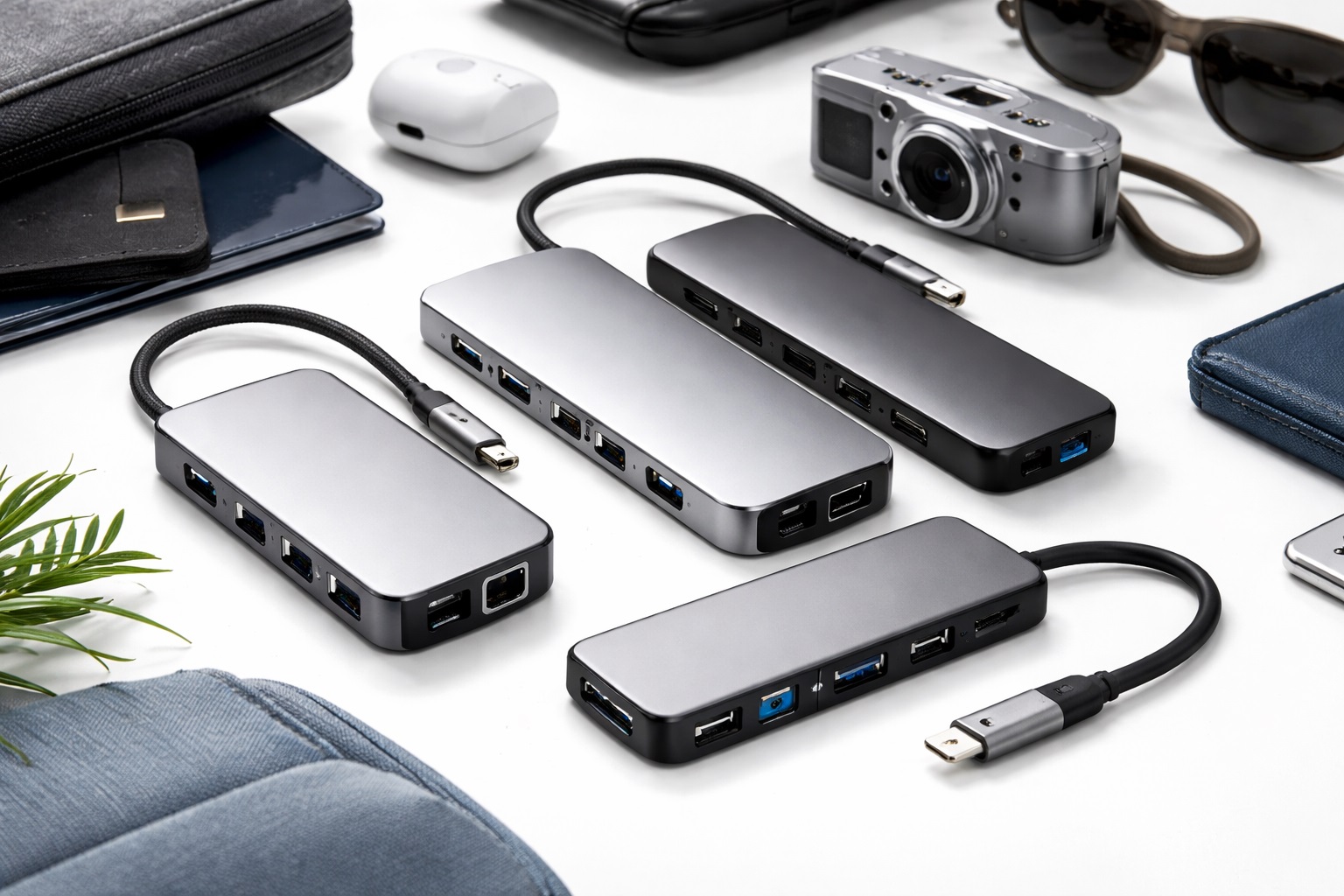
This category packs a broad mix of port types — typically a combination of USB-A, USB-C, HDMI, and sometimes an SD card reader — into a single compact unit designed to handle nearly any connectivity need that comes up during a trip. It's built around the idea that a traveler shouldn't have to guess in advance exactly which port they'll need on a given day, since a work trip can involve everything from a client presentation to transferring photos off a camera's SD card. Carrying one hub that handles all of this removes the mental overhead of trying to predict exactly which single-purpose adapter you might need on any given day of the trip.
- Pros:
- Covers the broadest range of connectivity needs from a single device
- Reduces the need to pack multiple single-purpose adapters
- Well suited to trips where you can't predict exactly what you'll need to connect
- Cons:
- Larger and heavier than hubs with a more limited port selection
- Some included ports may go unused on any given trip, adding bulk without benefit that day
Best For: Travelers who want one hub that can handle almost any connectivity scenario without needing to pack multiple specialized adapters.
Why We Recommend It: It removes the guesswork from packing for connectivity needs, trading a bit of extra size for genuine peace of mind that you'll have the right port no matter what comes up.
Mini Pocket Hub – Best For Minimal Bulk
Stripped down to the smallest reasonable size, this category focuses on a handful of essential ports rather than trying to cover every possible scenario. It's designed to disappear into a jacket pocket or a small compartment in a laptop bag, prioritizing the assumption that most travel connectivity needs boil down to just a couple of specific port types used repeatedly. It's a good match for anyone who has already noticed which one or two ports they actually reach for on every trip, rather than needing to plan for every possible scenario.
- Pros:
- Genuinely small and light, adding minimal bulk to a travel bag
- Covers the core connectivity needs most travelers actually use most often
- Easy to keep permanently in a bag without it feeling like a burden
- Cons:
- Limited port selection may not cover less common connectivity needs
- Not a good fit for trips requiring presentation or display connectivity
Best For: Minimalist travelers whose connectivity needs are predictable and limited to a small, consistent set of port types.
Why We Recommend It: It solves the core connectivity problem without asking you to carry more hub than you actually need, which matters for anyone who prioritizes packing light above all else.
USB-C Travel Multiport – Best For Modern USB-C Laptops
Built specifically around USB-C laptops that have moved away from older port types entirely, this category typically includes pass-through charging alongside a mix of USB-A and other common ports, letting a single USB-C cable both power the laptop and deliver hub connectivity at the same time. This addresses a common frustration with USB-C-only laptops, where the sole port is often needed simultaneously for both charging and peripherals. Anyone who has had to choose between charging their laptop or connecting a mouse, because only one port was available, understands immediately why this category exists.
- Pros:
- Pass-through charging solves the single-port dilemma common to modern thin laptops
- Well matched to laptops that have moved entirely to USB-C connectivity
- Generally compact, since it's designed around a specific modern port standard
- Cons:
- Requires a laptop with USB-C to work at all, ruling out older devices
- Charging pass-through wattage limits vary and should be checked against your laptop's actual power needs
Best For: Owners of modern, USB-C-only laptops who need to charge and connect peripherals from the same single port simultaneously.
Why We Recommend It: It directly solves the single-port bottleneck that defines the modern USB-C laptop experience, rather than working around it with an awkward combination of separate adapters.
Hub With HDMI for Presentations – Best For Client Meetings and Presentations
Built with a dedicated focus on reliable video output, this category prioritizes a stable HDMI connection capable of handling unfamiliar projectors, conference room displays, and hotel televisions without the connection dropouts or resolution issues that cheaper, more generalized hubs sometimes produce. For business travelers whose trips regularly include presentations, this reliability matters more than any other single feature. A connection that works flawlessly ninety percent of the time still isn't good enough if the failure happens to land during a moment that actually matters in front of a client.
- Pros:
- Prioritizes stable, reliable video output over unfamiliar displays and projectors
- Reduces the risk of an embarrassing connection failure during an important presentation
- Usually still includes standard USB ports alongside the dedicated video focus
- Cons:
- Video-focused engineering can add cost compared to a more generalized hub
- May offer fewer total ports than a hub designed purely around maximizing port count
Best For: Business travelers whose trips regularly involve presenting to clients or connecting to unfamiliar meeting room displays.
Why We Recommend It: It treats video reliability as the priority it actually is for presentation-heavy travel, rather than treating HDMI as just one more port on a generic feature list.
Budget Travel Hub – Best For Occasional Travelers
Not every traveler needs a specialized hub engineered for a specific scenario. A budget-oriented option in this category covers the fundamental need — connecting a handful of common peripherals to a laptop — without the added cost of specialized presentation features, premium materials, or an extensive port selection most people won't fully use. It's a sensible starting point for anyone who isn't yet sure how much they'll actually rely on a dedicated hub before their next trip even happens.
- Pros:
- Lower price makes it accessible for travelers who only occasionally need extra connectivity
- Covers essential, everyday connectivity needs adequately
- A reasonable low-risk option for testing whether a travel hub actually fits your routine
- Cons:
- Build quality and port durability can be more basic than pricier dedicated options
- Lacks specialized features like reliable HDMI output or high-wattage pass-through charging
Best For: Occasional travelers who need basic extra connectivity without paying for specialized capabilities they'll rarely use.
Why We Recommend It: It delivers the essential function at an accessible price, which suits anyone still figuring out exactly how much they'll rely on a hub while traveling.
Slim Folding Cable Hub – Best For Tangle-Free Packing
This category integrates its cable directly into a slim, folding body rather than relying on a separate dangling cable that can tangle with other items in a bag. The folding design allows the whole unit to collapse into a flatter shape for storage, then unfold for use, addressing one of the more mundane but genuinely persistent annoyances of travel tech — cables that seem to tangle themselves the moment they're packed. It's a small quality-of-life improvement that becomes more appreciated the more frequently you actually travel and repack a bag. It's a category best appreciated by comparison — once you've dealt with a separate cable working its way into a knot with a phone charger and a pair of earbuds at the bottom of a bag, the appeal of a self-contained, cable-free design becomes obvious rather than a minor nice-to-have.
- Pros:
- No loose, separate cable to tangle with other items in a bag
- Folds into a flatter, more compact shape for storage
- A tidy, low-hassle solution for travelers tired of cable management issues
- Cons:
- Integrated cable design means less flexibility in cable length compared to separate-cable hubs
- Folding hinge is a moving part that could wear with extensive repeated use
Best For: Travelers who are specifically tired of dealing with tangled cables and want a tidier, more self-contained connectivity solution.
Why We Recommend It: It solves a small but genuinely persistent travel annoyance directly, making packing and unpacking noticeably less fiddly than with a hub that has a separate loose cable.
Buying Guide: How to Choose the Best USB Hub for Travel
Before making a purchase, it helps to think through your actual travel pattern honestly — how often you travel, what kind of work you do on the road, and which specific connectivity scenarios actually come up for you repeatedly.
1. Size and Weight for Bag Travel
Consider how much spare capacity your travel bag genuinely has. A hub that seems reasonably compact in isolation can still feel like an unwelcome addition once it's competing for space with a laptop, charger, and other daily travel essentials you're not willing to leave behind.
2. Bus-Powered Operation Without a Wall Adapter
Most travel hubs draw power directly from the laptop's USB connection rather than requiring a separate wall adapter, which matters significantly for travel since it means one less charger and cable to pack, track, and eventually search for in a cluttered bag.
3. Port Combination: USB-A, USB-C, HDMI, and SD
Think honestly about which specific port types you actually use regularly rather than assuming more is always better. A hub loaded with ports you never use adds unnecessary size and cost without meaningful benefit to your actual trips.
4. Cable Length and Cable Management
A cable that's too short can be awkward in tight hotel room setups, while one that's too long adds unnecessary bulk and tangling risk. Consider whether an integrated folding design or a standard separate cable better suits your packing habits and typical seating arrangements.
5. Compatibility With MacBook and Windows Laptops
Confirm the hub's connector type and any specific driver requirements match your actual laptop, since some hubs are optimized for a particular operating system's display or charging behavior even if broadly compatible with others on paper.
6. Pass-Through Charging Wattage
If you rely on pass-through charging through the hub, check the specific wattage supported against your laptop's actual charging requirements, since insufficient wattage can result in slow charging or a laptop that slowly loses charge even while connected and appearing to charge.
7. HDMI Output Reliability
If presentations are a regular part of your travel, prioritize a hub with a specific reputation for stable video output rather than treating HDMI as just another port on a generic spec sheet, since not all implementations perform equally well in practice.
8. Build Quality and Port Durability
A travel hub experiences more physical handling than one that stays permanently connected at a desk — packed and unpacked repeatedly, cables plugged and unplugged often. Favor options with a reasonable reputation for durability under this kind of regular, repeated use.
9. Number of Simultaneous Connections Needed
Consider the maximum number of devices you realistically need connected at once during a typical work session, rather than the theoretical maximum the hub supports, to avoid over-buying port capacity you won't use on a typical trip.
10. Data Transfer Speed for File-Heavy Work
If your travel work involves transferring large files, such as photos or videos from an external drive, check the hub's stated data transfer speeds, since these can vary meaningfully between products at different price points and affect real workflow time.
11. Included Carrying Case or Pouch
Some travel-specific hubs include a small pouch or case for protection during transit, which can be a meaningful convenience if you don't already have a dedicated spot for small electronics in your travel bag.
12. Warranty and Manufacturer Support
A reasonable warranty is worth checking before purchase, particularly for a hub that will see regular travel wear and tear, where a failure while away from home creates real inconvenience to your work and travel schedule.
13. Ethernet Port for Reliable Backup Connectivity
Hotel and conference Wi-Fi can be unpredictable, and a hub that includes a wired Ethernet port gives you a reliable fallback for critical video calls or large file transfers when wireless connectivity is congested or simply unavailable. This is a niche need for casual travelers, but for anyone whose work depends on a stable connection at a specific moment, such as a scheduled client call, having a wired backup option can be worth the modest added bulk.
Frequently Asked Questions
How many ports do I actually need in a travel USB hub?
This depends entirely on your specific work pattern, but most travelers find that three to five ports covering their most common needs — such as a mouse, external drive, and charging — cover the vast majority of everyday situations without needing the maximum possible port count. Reviewing what you actually plugged in during your last few trips is a more reliable guide than guessing in advance.
Will a USB hub slow down my laptop's charging speed?
It can, if the hub's pass-through charging wattage is lower than what your laptop actually requires for full-speed charging. Checking the hub's specific charging wattage against your laptop's charger rating before relying on it as your primary charging method is worth doing, especially before a trip where reliable charging matters most.
Do I need a hub with HDMI if I only use my laptop's built-in screen?
Not necessarily, though many travelers underestimate how often an unexpected need to connect to an external display comes up — a hotel television, a client's conference room, or an airport lounge presentation screen. If there's any reasonable chance you'll need external display output, including HDMI is a sensible precaution.
Can a bus-powered hub handle high-power devices like external hard drives?
Many bus-powered hubs can handle standard external hard drives without issue, though very power-hungry devices may require additional power beyond what bus power alone provides. Checking the specific hub's power output specifications against your intended devices avoids this problem before it occurs.
Is it better to buy a hub with a long cable or one with a compact, integrated design?
This depends on how you'll typically use it. A longer separate cable offers flexibility for awkward seating arrangements, such as a hotel desk far from an outlet, while an integrated compact design minimizes bulk and avoids tangling, which many travelers prioritize more highly.
Do travel hubs work reliably with unfamiliar hotel room televisions?
Generally yes, particularly hubs specifically designed with reliable HDMI output in mind, though very old or unusual televisions can occasionally present compatibility quirks regardless of hub quality. Testing the connection early during a trip, rather than right before an important use, is a sensible precaution.
How do I know if a hub is compatible with both my work laptop and personal laptop?
Check the connector type required by both laptops, typically USB-C on modern devices, and confirm the hub doesn't rely on operating-system-specific drivers that might only work fully with one platform. Most modern hubs support broad compatibility, but it's worth confirming for less common laptop models.
What's the most common failure point for travel USB hubs?
Cable and port wear from repeated packing and unpacking is one of the more common long-term issues, along with occasional compatibility quirks with specific external displays. Reading verified user reviews that mention long-term travel use, rather than only initial impressions, helps identify which specific products hold up well over time.
Should I buy a hub with more ports than I currently need in case my needs grow?
This can be a reasonable approach if you expect your travel work to become more demanding, such as taking on more presentation-heavy trips in the future. For most people, though, buying based on current, actual needs rather than hypothetical future ones tends to produce a better fit and avoids paying for capacity that may never get used.
Do travel hubs generally support 4K video output for presentations?
Many modern hubs do support 4K output, though actual resolution and refresh rate can depend on both the hub and the specific display or projector you're connecting to. If crisp video output matters for your presentations, checking the hub's specific supported resolution against your typical display setup is worth the extra few minutes.
Should I buy a hub before a big trip or wait until I know what I'll need?
If you have a reasonable sense of your typical connectivity needs from past trips, buying in advance and testing the hub at home before departure is a sensible approach. This lets you identify and resolve any compatibility issues while you still have easy access to support or a return option.
Can I return a travel USB hub if it doesn't work well with my specific laptop?
Most retailers offer a return window, typically between 15 and 30 days. It's worth checking the specific return policy before purchasing and retaining original packaging during your evaluation period in case of a compatibility issue with your specific device, and testing the hub thoroughly at home before your return window closes.
Are more expensive travel hubs actually more reliable, or just more feature-rich?
Both, to varying degrees. Premium hubs generally use higher-quality components that improve reliability, alongside additional features like more ports or better video output stability. That said, many mid-range and budget options from reputable manufacturers are perfectly reliable for everyday travel needs without the premium price.
Can a travel hub support multiple external displays at once?
Some higher-end hubs support dual external displays, though this depends heavily on both the hub and your laptop's graphics capabilities, since not every laptop can drive two external monitors simultaneously regardless of the hub used. Checking your laptop's specific multi-display support alongside the hub's capabilities is worth doing if this matters to your work.
Do I need a different hub for international travel with different plug standards?
The USB hub itself typically isn't affected by regional plug standards, since it draws power through the laptop's USB connection rather than a wall outlet directly. What does matter is ensuring your laptop's own charger is compatible with or adapted for the electrical standards of your destination.
How do I keep track of a small travel hub so it doesn't get lost during a trip?
Designating one specific pocket or pouch in your travel bag exclusively for the hub, and consistently returning it there after each use, is one of the simplest ways to avoid losing a small item during the general disorder of travel. Attaching it to a keyring-style pouch or brightly colored case can also make it easier to spot.
Do travel hubs support fast charging for phones or tablets plugged into a spare port?
Many hubs do provide reasonable charging output to phones and tablets through a spare USB-A or USB-C port, though the wattage delivered is often lower than what a dedicated fast charger provides, since the hub is typically prioritizing power for the laptop connection first. If fast-charging a phone through the hub matters to you, checking the specific output wattage of each port is worth doing rather than assuming every port on the hub charges at the same speed.
Final Verdict
The right travel USB hub depends heavily on the specific pattern of your trips rather than simply choosing the option with the most ports or the lowest price. A predictable, port-light setup calls for a very different hub than a demanding multi-week business trip requiring presentation-ready video output.
- For unpredictable or varied connectivity needs: a 7-in-1 hub covers nearly any scenario from a single compact device.
- For presentation-heavy business travel: a hub built around reliable HDMI output solves the specific risk of a failed connection during an important meeting.
- For minimalist or occasional travel: a mini pocket hub or budget option covers the essential need without unnecessary bulk or cost.
Match the hub to your actual travel habits and the specific connectivity scenarios that come up repeatedly for you, rather than assuming more ports or a higher price automatically means better value. A travel hub chosen with your real trips in mind will earn a permanent place in your bag rather than becoming another accessory that gets left behind after the first trip.
It's also reasonable to expect your needs to shift over time as your travel patterns change. A hub that felt perfectly sized for occasional weekend trips might feel limiting once travel becomes a weekly routine, and a feature-packed hub bought for a demanding work trip might feel like overkill for a simple personal getaway. Because most options across every category here are moderately priced, treating this as a decision you can revisit as your travel habits evolve, rather than a single permanent choice, keeps your connectivity setup matched to how you actually work on the road.