Best Lightweight USB Hubs for Travel and On-the-Go Work
Every gram matters differently once a laptop bag has to carry a full day of work rather than sit next to a desk. A hub that seems perfectly reasonable at home can feel like dead weight after the third security line, the second train transfer, or a full day of walking between meetings with everything you own on your shoulder. Choosing a lightweight USB hub is really a question of what you are willing to carry every single day, not just what looks capable on a spec sheet.
This guide is built around that reality. It focuses on hubs sized and powered for travelers and remote workers who carry everything in a single bag — people for whom a hub is one more object competing for pocket space alongside a charger, a notebook, and whatever else the day requires. The goal is not simply the smallest hub available, but one that still delivers enough ports and reliable performance to be worth packing in the first place.
Anyone who has traveled regularly for work knows the quiet frustration of an accessory that looked fine on a store shelf but turned into dead weight after a few trips. That is usually a sign the buying decision focused on features rather than on how the item would actually be carried day to day. A hub chosen with real travel patterns in mind — how often you fly, how much you already carry, and how much you are willing to add to that load — tends to hold up far better than one chosen purely on a comparison chart.
The picks below cover a range of strategies for solving that balance: ultra-compact all-in-one designs, hubs small enough to live permanently on a keychain, and slim options built specifically around the ports modern laptops actually ship with. Each takes a different view of the trade-off between size, weight, and capability, and the right one depends on how you travel and what you plug in once you get where you are going.
It also helps to separate two things that often get confused when shopping for travel gear: physical size and actual capability. A hub can be extremely small and still cover every port a working traveler needs, while a slightly larger one might still fall short on data speed or power delivery. Weight and dimensions are easy to compare at a glance, but they only tell part of the story — the ports themselves, and how reliably they perform under daily use, matter just as much for a hub that has to earn its place in a bag every day.
There is also a difference between packing for a single trip and building a permanent piece of travel gear. Someone flying twice a year for a family visit has very different priorities than someone who works from a different city every week. The former can reasonably prioritize low cost and simplicity, while the latter benefits more from paying for genuine durability and refined portability, since the cost of that investment gets spread across far more trips. Being honest about which category you actually fall into before shopping tends to save both money and second-guessing later.
Top Picks Reviewed
The options below range from all-in-one compact designs to ultra-minimal keychain hubs, each suited to a slightly different travel style. Some prioritize raw minimalism, while others accept a little more size in exchange for broader port coverage — worth weighing against how you actually pack and what you plan to connect once you arrive. None of these categories is universally correct; each simply optimizes for a different point on the spectrum between capability and carry weight, and the right choice depends entirely on which end of that spectrum matters more for your own trips.
1. Ultra-Compact 3-in-1 Hub – Best For Balanced Everyday Carry
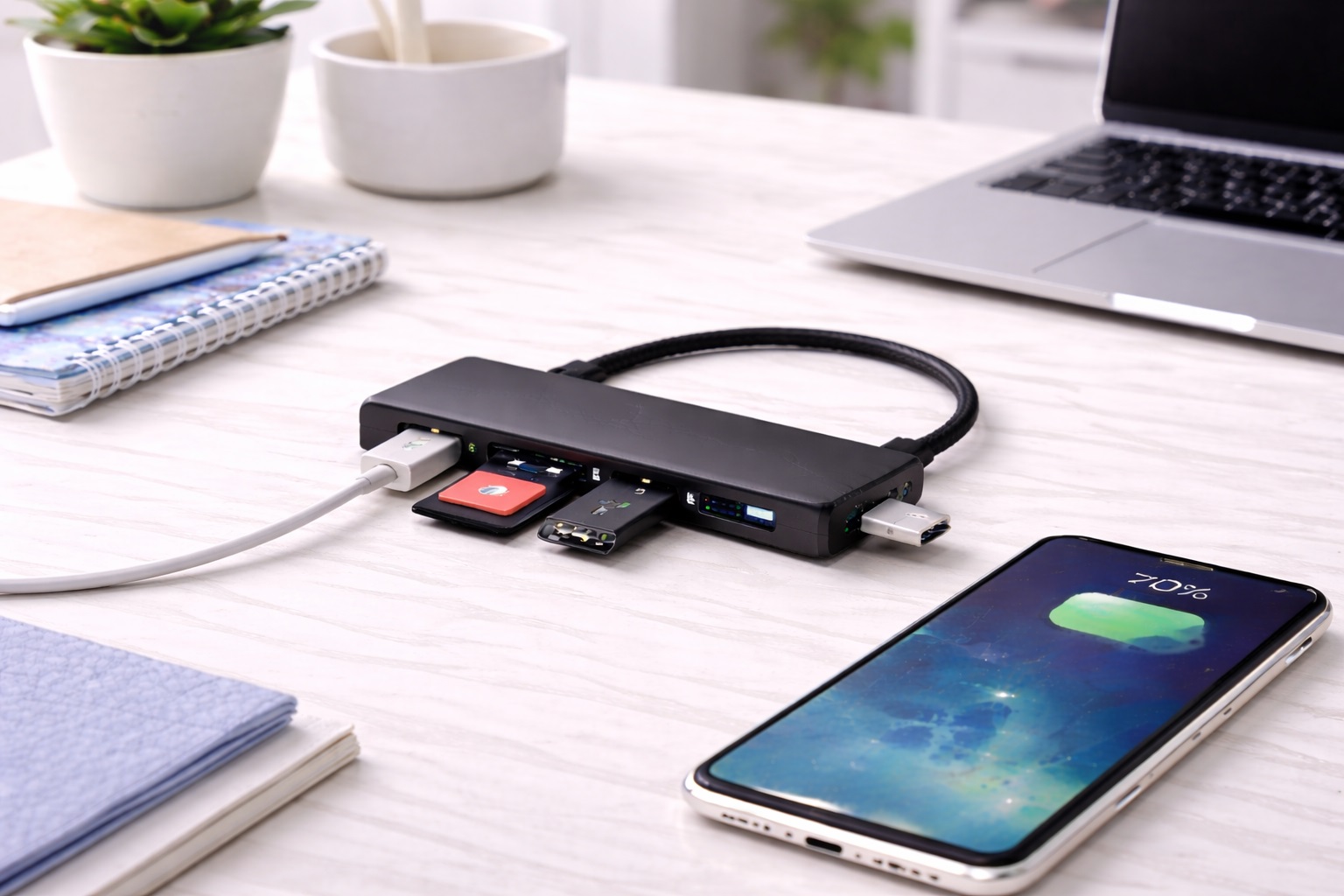
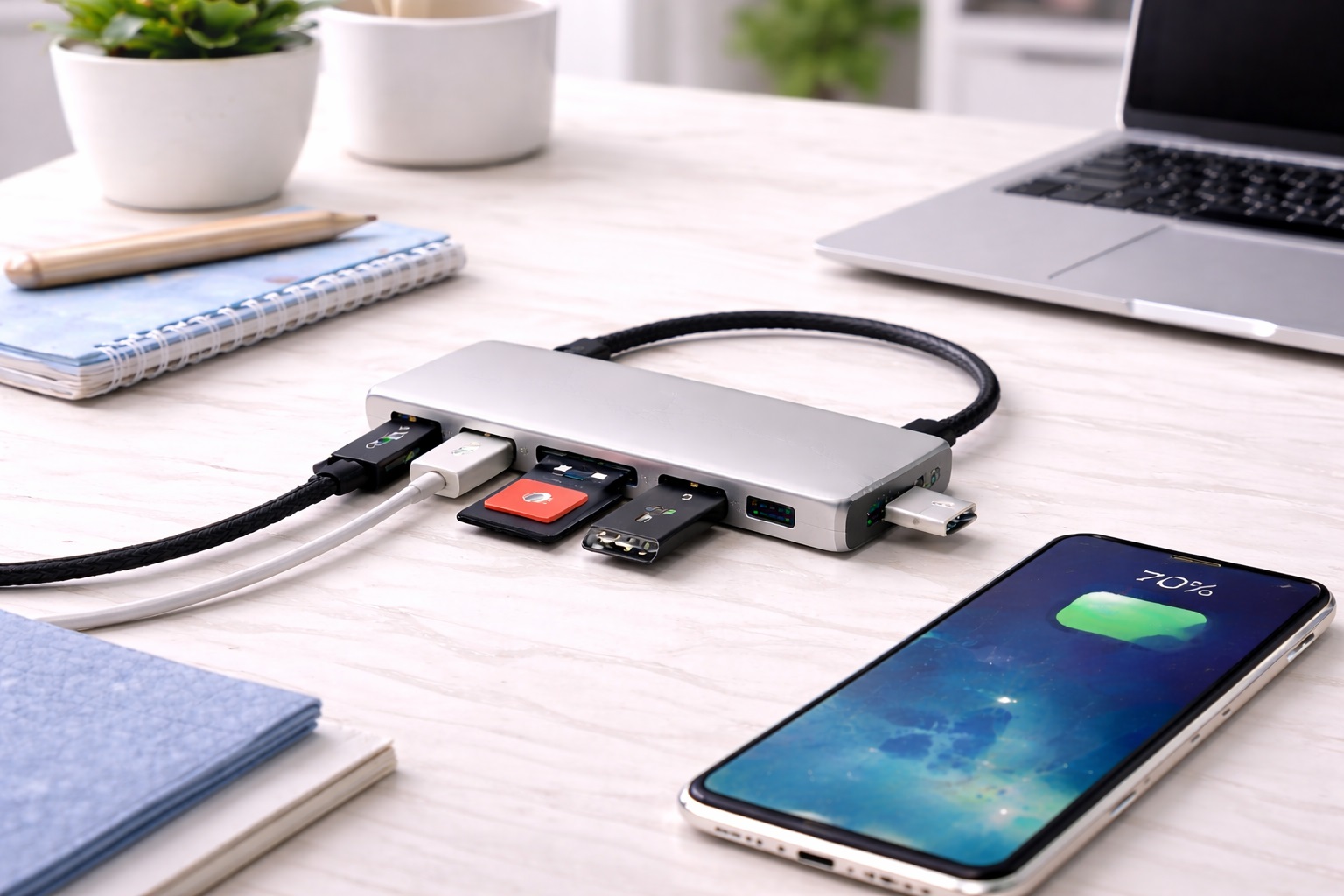
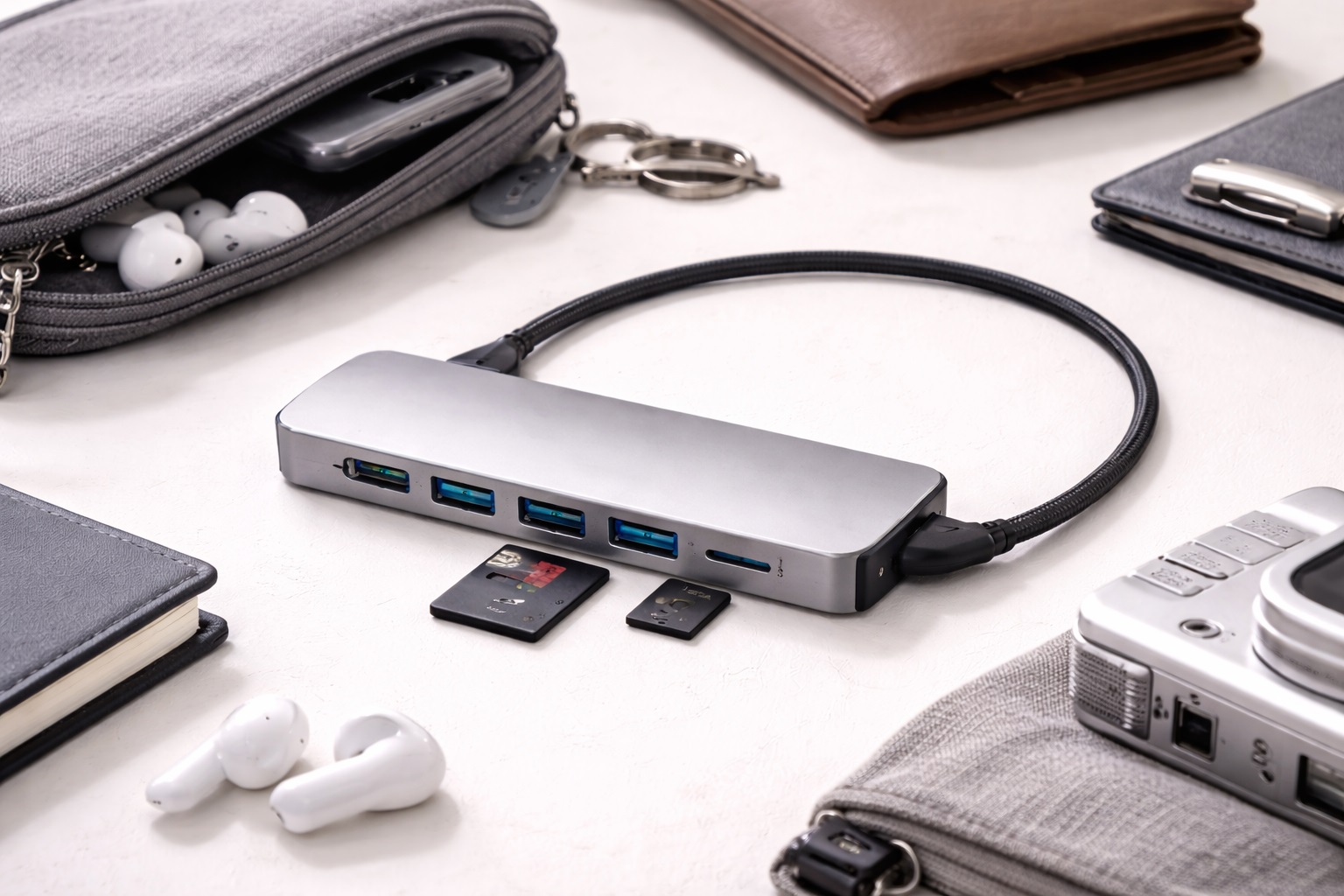
This style condenses a handful of essential ports into a single small unit, aiming for the sweet spot between usefulness and packability. It is built for travelers who want more than a single extra port but are not willing to carry a full-size hub just to get it. The appeal is straightforward: it covers most of what a working traveler needs to plug in during a trip without asking for a dedicated bag compartment of its own.
- Pros:
- Covers several port types in one compact unit rather than requiring multiple accessories
- Small enough to live in a laptop sleeve pocket without adding noticeable bulk
- Balances port variety against overall size better than single-purpose adapters
- Cons:
- Still larger than the most minimal keychain or pocket options
- Fitting three port types into a small shell can mean tighter port spacing
Best For: Travelers who want broad port coverage without carrying a full desktop-style hub, especially those who plug in more than one device type on a given trip.
Why We Recommend It: It is the most balanced option here for someone who needs real versatility but still wants everything to disappear into a bag between uses.
2. Pocket USB Hub – Best For Minimal Daily Bulk
Built to slide into a jacket or bag pocket without being felt, this style trims the hub down close to the minimum size needed to still function as a hub. It suits travelers who value how little they notice carrying it more than how many ports it offers. For someone who already carries a full daily bag, an accessory that adds essentially no perceived weight is worth more than a few extra ports it would rarely use.
- Pros:
- Genuinely pocketable rather than just labeled compact
- Lightweight enough to forget you are carrying it until you need it
- Easy to keep as a permanent fixture in a travel bag's small-items pocket
- Cons:
- Smaller shells typically mean fewer total ports
- Very small hubs can be easy to misplace in a large bag
Best For: Anyone who travels often enough that carrying weight, not just packed size, has become a real consideration.
Why We Recommend It: When the goal is to feel the hub as little as possible during travel, a design built specifically around pocket size delivers on that goal directly.
3. Keychain-Size USB Hub – Best For Absolute Minimalists
This is the smallest category here, often designed to clip onto a keyring or bag strap so it is never separately packed at all. It sacrifices port count and sometimes speed in exchange for being essentially unnoticeable. For someone who has left a hub behind on a trip before, the appeal of one that is physically attached to something you never forget is hard to overstate.
- Pros:
- Small enough to attach to keys or a bag strap rather than being packed loose
- Effectively impossible to forget since it travels attached to something else
- The lightest option among all the styles covered here
- Cons:
- Usually limited to one or two ports
- Not well suited to demanding data transfer or multi-device charging needs
Best For: Light travelers whose connectivity needs are occasional and modest rather than constant.
Why We Recommend It: For a traveler who wants backup connectivity without dedicating any real space to it, attaching a hub to something already carried is the most efficient answer available.
4. Lightweight Cable Hub – Best For Simple Cable-Style Carry
Rather than a rigid housing, this style integrates hub functionality into a flexible cable-like form, coiling small enough to tuck into a charger pouch or cable organizer alongside other travel cords. It appeals most to travelers who have already built a habit of organizing cables in one dedicated spot and would rather add to that system than start a new one for a separate hub.
- Pros:
- Flexible form factor packs alongside cables rather than needing its own dedicated space
- Tends to be lighter than rigid hub housings of similar port count
- Coils down small for storage in a cable pouch
- Cons:
- Flexible designs can be less structurally durable over years of daily travel
- Ports may sit closer together than a rigid housing allows
Best For: Travelers who already organize cables in a dedicated pouch and want the hub to fit into that same system.
Why We Recommend It: It solves the packing problem by fitting into a storage habit travelers already have, rather than asking for a new dedicated spot in the bag.
5. Budget Travel USB Hub – Best For Occasional Travelers
A straightforward, no-frills hub aimed at travelers who need basic extra connectivity a few times a year rather than as a daily-carry essential. It covers the fundamentals without the added cost of premium materials or advanced port combinations. For someone packing for a single trip rather than building a permanent travel kit, this is usually the more sensible purchase.
- Pros:
- Lower cost than premium ultra-compact or cable-integrated designs
- Covers basic travel connectivity needs without unnecessary extras
- A reasonable choice for a backup hub kept in a travel bag rather than used daily
- Cons:
- Build materials are typically more basic than pricier lightweight options
- Fewer premium touches like cable wraps or travel pouches included
Best For: Occasional travelers who do not need a dedicated premium travel hub for a few trips a year.
Why We Recommend It: Paying for premium travel-specific features makes less sense for infrequent use, and a simple budget hub covers the same basic need.
6. Slim Hub for MacBook – Best For Modern Ultrabook Owners
Designed around the port layout of current ultrabooks and MacBooks, this style plugs directly into the laptop and is shaped to sit flush against the machine rather than dangling from a cable, minimizing both size and the number of loose cords in a bag. It reflects a broader shift in how thin laptops are used on the road, where the laptop itself has become the hub for everything else a traveler carries.
- Pros:
- Matches the exact port type modern ultrabooks already use
- Sits flush against the laptop rather than requiring a separate connecting cable
- Reduces the total number of loose cords needed for a travel setup
- Cons:
- Only useful for laptops with the matching port type
- Flush-mount designs can block adjacent ports on some laptop models
Best For: Travelers whose laptop is the center of their setup and who want the hub to feel like an extension of it rather than a separate accessory.
Why We Recommend It: Matching the hub directly to the laptop's port layout removes an entire cable from the travel kit while keeping the whole setup compact.
Buying Guide: How to Choose the Best Lightweight USB Hub for Travel
Before making a purchase decision, weigh these factors against your actual travel habits rather than a generic feature list. A hub bought for occasional weekend trips has different priorities than one meant to survive weekly flights for years. Reading through a spec sheet in isolation rarely tells you which of these factors will actually matter once the hub is living in your bag, so it helps to picture a real trip while comparing options rather than treating every listed feature as equally important.
1. Weight Under 100 Grams
For most travel hubs, staying under roughly 100 grams is the threshold where the accessory stops feeling like an added burden. Check the listed weight specifically rather than assuming compact dimensions mean light weight, since some small housings use denser materials that add weight the size does not suggest.
2. Bus-Powered Operation (No Adapter Needed)
A hub that draws power directly from the connected device avoids the need to pack a separate power adapter, which often weighs more than the hub itself and adds one more item that can be forgotten or lost. Bus-powered designs also mean one less charger to hunt for in an unfamiliar hotel room or airport lounge.
3. Cable Wrap or Travel Pouch Included
A built-in cable wrap or included pouch keeps the hub from tangling loose in a bag and protects the connector when not in use, which matters more for an item handled daily than one that stays on a desk. It also makes the hub faster to find inside a bag, since it is not loose among cables and chargers of similar size.
4. Compact Size When Packed Away
Consider the hub's packed size, not just its size in use. Some designs fold or collapse for storage, while others keep a fixed shape that takes up the same space whether connected or sitting in a bag, which matters when every pocket of a travel bag is already accounted for.
5. Reliable Data and Charging Performance Despite Small Size
A compact travel hub still needs to perform consistently. Check that the rated data speeds and charging output match your actual devices, since very small housings sometimes compromise on these to save space, and a hub that cannot keep up with a quick file transfer between meetings undermines the entire point of carrying it.
6. Durability for Daily Travel and Bag Life
A hub carried daily experiences drops, temperature swings, and the general wear of living in a bag alongside keys and chargers. Favor designs with solid strain relief at the cable or connector rather than the thinnest possible housing, since the connector joint is usually the first place a travel accessory fails.
7. Port Selection Matched to Travel Devices
Rather than maximizing total port count, match the port types to what you actually carry — a phone charging cable, an external drive, or a presentation adapter — since travel hubs have less room to spare for ports you never use. A hub built around your real travel kit will feel more useful than one built around a generic feature list.
8. Airport and Bag-Friendly Design
A hub with no separate power brick and a simple, low-profile shape tends to move through security screening and cramped overhead bins more easily than a bulkier multi-piece setup, and it is one less item that has to be unpacked and repacked at a checkpoint.
9. Price and Value
Ultra-compact and travel-specific features add cost. Weigh how often you actually travel against how much you are willing to pay for a hub built specifically around portability, since the premium for shaving off a few grams is only worth it if you feel that weight regularly.
10. Brand Reliability
Established manufacturers tend to offer steadier build quality and more consistent long-term performance, which matters for a hub that gets packed and unpacked on every trip, since inconsistent quality control shows up faster under that kind of repeated handling.
11. Warranty and Support
A travel hub sees more handling and more environmental variation than a desk-bound one. Warranty coverage is a reasonable indicator of how well it is expected to hold up under that use, and it can matter more here than for accessories that never leave a single desk.
12. Compatibility With Your Travel Devices
Confirm the hub works with the laptop, tablet, or phone you actually travel with, including any operating system quirks, before relying on it as your only connectivity option on the road, since discovering a compatibility gap mid-trip is far more disruptive than catching it before you leave.
Frequently Asked Questions
1. What should I look for when buying a lightweight USB hub for travel?
Prioritize weight and bus-powered operation first, then confirm the ports match what you actually plug in while traveling. A hub that is light but missing the right port defeats the purpose just as much as one that is heavy but versatile, so treat both factors as equally important rather than optimizing for size alone.
2. Is spending more always better for a travel USB hub?
Not necessarily. Premium travel-specific features like included pouches or ultra-slim housings matter most for frequent travelers. Occasional travelers may get equal value from a simpler, lower-cost hub, since the premium features only pay off with repeated use.
3. How long should a quality lightweight USB hub last?
With regular travel use, a well-built hub from an established brand typically lasts several years, though frequent handling and bag wear can shorten that compared to a desk-bound hub. Warranty length is a useful indicator of expected durability, and how the hub is stored between trips also plays a real role in its lifespan.
4. What are the most common complaints about lightweight travel USB hubs?
Frequent issues include connectors that loosen after repeated packing and unpacking, cables that fray from being coiled tightly, and port counts that feel limiting once travelers are actually on the road. Reading reviews from frequent travelers helps surface these issues early, particularly reviews written after months of actual use rather than an initial unboxing.
5. Can I return a lightweight USB hub if it doesn't suit my travel needs?
Most retailers allow returns within 15 to 30 days. Test the hub on an actual short trip if possible before that window closes, since travel use often reveals fit issues that a quick home test does not, including how it feels after a full day of carrying rather than just sitting on a table.
6. Does a smaller hub mean slower data transfer?
Not inherently, but very small or very cheap housings sometimes cut corners on internal components to save space. Check the rated transfer speed specifically rather than assuming size and performance are directly linked, since two hubs of similar size can perform very differently in practice.
7. Do I need a hub with its own power adapter for travel?
Most travelers are better served by a bus-powered hub that draws power from the connected device, since it removes the need to pack and manage a separate adapter and its cable. Powered hubs exist for higher-demand setups, but they add weight and complexity that most travel scenarios do not require.
8. Are there significant differences between brands in this category?
Yes. Established brands typically offer steadier quality control and more reliable warranty support, though smaller specialist brands sometimes lead on travel-specific design details like included pouches or reinforced cables, so it is worth weighing both against your specific priorities.
9. How important is warranty coverage for a travel USB hub?
Warranty coverage matters more for travel gear than for stationary desk accessories, since travel hubs face more physical stress from packing, unpacking, and temperature or pressure changes during transit than an equivalent accessory that never leaves a desk.
10. What's the best way to compare lightweight travel USB hub options before buying?
List your actual travel frequency, the devices you bring, and how much weight you are willing to add to your bag, then compare models against those specific criteria rather than a general feature list. That short list will usually narrow the field faster than reading every available review.
11. Is it worth buying a travel USB hub from an online marketplace versus a retail store?
Online marketplaces typically offer a wider selection of ultra-compact and travel-specific designs, while a physical store lets you judge actual weight and size in hand before committing, which can matter more for travel gear than for desk accessories, since photographs alone rarely convey how light or small something truly feels.
12. Can a lightweight hub handle both data transfer and device charging at once?
Many compact hubs support simultaneous data and charging, but the combined load can affect performance on very small units. Check the specifications for how the hub behaves when both functions are used at the same time, particularly if you regularly need to transfer files while charging a phone or tablet on the same trip.
Final Verdict
The right lightweight USB hub for travel depends less on finding the single smallest option available and more on matching the hub's design to how often you travel and what you actually need connected once you arrive. Chasing the absolute lightest hub on the market can leave you without a port you actually need, while overbuying capability can leave you carrying weight that never gets used.
- For frequent travelers: An ultra-compact 3-in-1 hub offers the best balance of real port coverage against packed size.
- For minimalists: A keychain-size or pocket hub adds backup connectivity without ever feeling like a separate item to pack.
- For MacBook and ultrabook owners: A slim hub matched to the laptop's exact port layout keeps the whole travel setup compact.
- For occasional travelers: A simple budget travel hub covers the basics without paying for premium travel-specific extras.
- For cable-organizer users: A flexible cable-style hub fits directly into a pouch system you already use for other cords.
Whichever style fits your habits, weigh actual carried weight and bus-powered convenience as heavily as port count. A travel hub earns its place in a bag by being used without a second thought, and that only happens when its size and power needs genuinely match how you travel rather than how it looks in a product photo. The most reliable way to judge that fit is against your own last few trips rather than an idealized version of how you imagine you might travel in the future.
Give any new travel hub an actual trip before deciding it is the right one. A short weekend test often reveals more about how a hub behaves in a real bag, at a real airport, and plugged into real devices than any spec sheet can, and it is far easier to return or replace a hub after one trip than after it has become a permanent fixture in your travel kit.
Pay attention, too, to how the hub interacts with the rest of what you carry. A design that seemed ideal in isolation can still feel wrong once it is competing for the same pocket as a passport, a phone, and a set of headphones. The best lightweight hub is ultimately the one you stop thinking about entirely — it goes into the bag without a second thought, comes out when needed, and never becomes the item you have to dig for at exactly the wrong moment. Judged by that standard rather than by spec sheets alone, the right choice tends to become obvious after just a trip or two of real use.