Best Programmable Slow Cooker in 2026
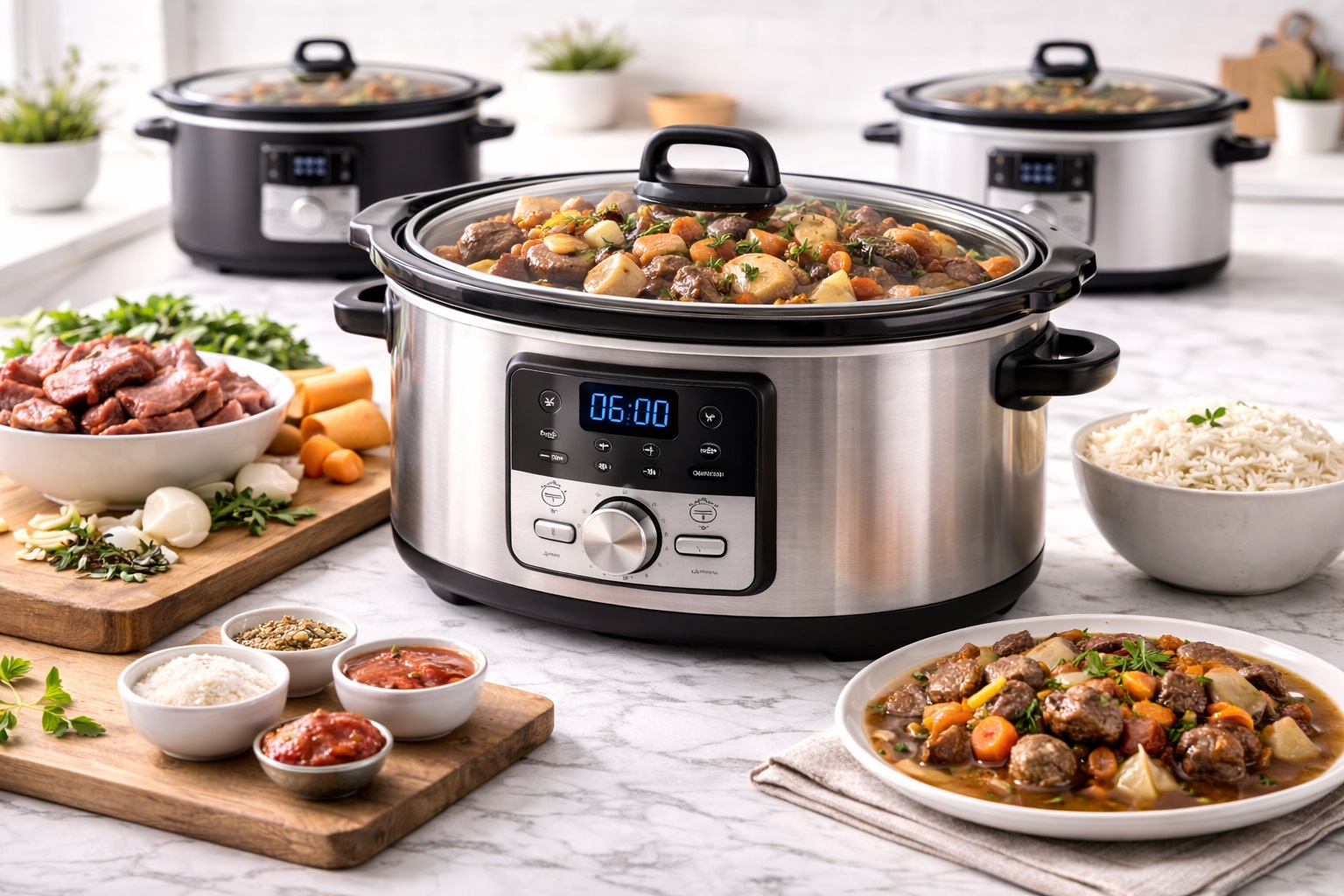
A programmable slow cooker takes one of the biggest sources of frustration out of hands-off cooking: guessing when to switch a pot from cooking to warm. With a digital timer, you set the cook time once and the unit handles the rest, often shifting automatically to a warm setting so dinner doesn't overcook while you're stuck in traffic or finishing up at work. This guide compares eight slow cookers with an eye specifically on timer control, digital features, and how much of a genuine upgrade that automation provides over a manual dial, since not every price increase actually buys better timer performance.
Not every model marketed alongside "programmable" options actually centers its design around a digital timer, so this guide is upfront about which of the eight picks below are true programmable standouts and which are included as reasonable alternatives for other strengths, like build quality or capacity. Being clear about that distinction matters more than pretending every option here is equally focused on timer control, and it should help you avoid buying on assumption rather than confirmed features.
Below you'll find detailed reviews of all eight models, a buying guide focused on what programmable features actually deliver in daily use, and answers to the questions shoppers most often ask before choosing a digital slow cooker over a manual one. Each section aims to separate genuine automation from features that simply sound advanced on a spec sheet.
If a hands-off, set-and-forget routine is the main reason you're shopping, pay close attention to which models genuinely offer a digital timer with auto-warm versus which ones rely on manual dials or other forms of automation, like a temperature probe. Both approaches can work well, but they solve slightly different problems, and knowing which problem you're actually trying to solve makes the choice much clearer.
Top 8 Best Slow Cooker Picks (Detailed Reviews)
1. All-Clad Gourmet – Best Premium Pick for Serious Cooks
The All-Clad Gourmet leads this list on construction quality rather than a specific timer feature, built around an aluminum insert designed for more even heat distribution and backed by a well-established premium cookware brand. At around $200, it's the most expensive model here, and while premium slow cookers like this often include some form of digital control panel, its standout trait per the manufacturer is build quality rather than a headline programmable timer. If a digital timer with auto-warm is your top priority, it's worth confirming the specific control features before buying, since All-Clad's reputation here rests more on materials than on timer sophistication. Shoppers who already own other All-Clad cookware may still find the brand consistency appealing on its own merits.
- Pros:
- Professional-grade construction and materials
- Aluminum insert supports even heat distribution
- Backed by a well-established premium cookware brand
- Built to last for years of frequent use
- Cons:
- Highest price point in this comparison
- Timer sophistication is secondary to its build-quality focus
- Not the best choice if a specific digital feature set is your priority
Best For: Shoppers who prioritize premium construction and are willing to confirm timer specifics separately, rather than buying on timer features alone, especially those already invested in higher-end cookware.
Why We Recommend It: If long-term durability matters more to you than a specific digital feature set, this is the most premium-built option on the list, even if it isn't the definitive timer pick for this particular theme.
2. Crock-Pot 6-Quart – Best True Programmable Timer
Of the eight models compared here, the Crock-Pot 6-Quart is the clearest fit for anyone specifically shopping for programmable timer control. Its digital timer lets you set a cook duration in advance, and the unit automatically switches to warm once that time elapses, exactly the kind of hands-off automation a "programmable slow cooker" search is usually looking for. At around $50, it's also one of the more affordable options here, which makes the fit even stronger for most shoppers who don't want to overpay just to get reliable timer control.
- Pros:
- Programmable digital timer with auto-warm
- Well-known, dependable brand
- Straightforward digital interface that's easy to learn
- Wide availability of parts and accessories
- Cons:
- 6-quart capacity is smaller than some competitors
- Ceramic insert is heavy to lift when full
- Fewer extra cooking modes than multi-cooker style units
Best For: Shoppers whose primary reason for buying is genuine, reliable programmable timer control, especially those with unpredictable daily schedules.
Why We Recommend It: It's the most direct match for the "programmable" theme of this guide, delivering the core feature shoppers are searching for without unnecessary extras or added complexity.
3. BLACK+DECKER 7-Quart – Best Manual Budget Alternative
To be upfront, the BLACK+DECKER 7-Quart uses manual dial controls rather than a digital timer, so it isn't a true fit for shoppers who specifically need programmable automation. It's included here as an honest budget alternative: at around $40, it's the least expensive option in this comparison, and it still offers a full 7-quart capacity and a locking lid for transport. If you decide a manual unit is acceptable, this is a reasonable low-cost option to consider, and it still delivers reliable, consistent slow cooking without any digital extras.
- Pros:
- Lowest price in this comparison
- Full 7-quart capacity
- Locking lid included for transport
- Simple mechanical dial with fewer parts to fail
- Cons:
- No digital timer or programmable functions
- Requires you to be present to switch settings manually
- No auto-warm safety net if you run late
Best For: Budget shoppers who have decided manual control is an acceptable tradeoff for a lower price, or who are usually home to manage cook times themselves.
Why We Recommend It: It's an honest low-cost alternative for anyone comparing programmable models against a basic manual option before deciding whether the automation is worth paying extra for in the first place.
4. Ninja Foodi Multi-Cooker – Best Multi-Mode Programmable Cooking
The Ninja Foodi Multi-Cooker's standout feature is its ability to sear and slow cook in the same pot, and multi-cookers of this type typically pair that versatility with a digital control panel for setting different modes and cook times. At about $180, it's priced near the top of this list, reflecting both its multi-function design and the additional hardware needed to manage several cooking modes through one interface. It's a natural fit for anyone who wants programmable convenience without owning several separate appliances.
- Pros:
- Sear-then-slow-cook function in one pot
- Digital multi-mode control panel
- Strong reputation for durability
- Reduces the need for separate cookware
- Cons:
- Higher price point than most dedicated slow cookers
- More complexity than shoppers who want a single, simple timer may need
- Larger footprint takes up more counter space
Best For: Shoppers who want programmable control across multiple cooking functions, not just a single slow-cook timer, and who are comfortable paying more for that flexibility.
Why We Recommend It: It extends the idea of "programmable" beyond a basic timer, adding digital control over several distinct cooking modes in one appliance built to handle daily use.
5. GreenPan Elite – Best Ceramic Insert, Confirm Timer Features
The GreenPan Elite is best known for its ceramic nonstick coating, which makes cleanup considerably easier after starchy dishes, rather than for a specific programmable timer feature. At about $120, it sits in the upper-middle of this price range. As with All-Clad, if a digital timer with auto-warm is essential to you, it's worth checking this model's specific control panel rather than assuming it matches Crock-Pot's programmable depth. Its main selling point remains the coating rather than any specific timer sophistication.
- Pros:
- Ceramic nonstick coating simplifies cleanup
- PFOA-free materials for everyday cooking
- Premium look and finish
- Handles starchy dishes without heavy sticking
- Cons:
- Timer functionality is not its headline feature
- Higher price than standard ceramic-insert cookers
- Nonstick coating needs gentler utensils and cleaning
Best For: Shoppers who value easy cleanup as much as, or more than, programmable timer depth, particularly those who cook starchy dishes often.
Why We Recommend It: It's a strong pick if nonstick convenience matters to you, though it's worth verifying its digital controls if timer automation is your single top requirement.
6. Cuisinart MSC-600 – Best Mid-Range Pick for Timed Convenience
The Cuisinart MSC-600 uses a cast aluminum pot rather than the standard ceramic insert, and mid-range appliances at this roughly $90 price point commonly include at least a basic digital timer alongside that construction. It sits comfortably between the budget manual option and the pricier multi-cookers on this list, offering a reasonable middle ground for shoppers who want some automation without paying premium prices for features they may not need.
- Pros:
- Cast aluminum pot for durable heat retention
- Recognizable, established kitchen appliance brand
- Reasonable mid-range price
- Consistent heat retention for dense dishes
- Cons:
- Fewer advanced smart features than premium multi-cookers
- Styling is plainer than some competitors at this price
- Digital controls are basic compared to full multi-cookers
Best For: Shoppers who want a reasonably priced middle ground between basic manual control and full multi-cooker complexity, without overpaying for unused modes.
Why We Recommend It: Its construction quality and mid-range price make it a sensible pick for shoppers who want some digital convenience without paying for features they won't use regularly.
7. Hamilton Beach Set & Forget – Best for Automated Temperature Control
The Hamilton Beach Set & Forget takes a different approach to automation than a simple timer: its built-in temperature probe tracks the internal temperature of a roast or whole bird and adjusts accordingly, rather than relying purely on elapsed time. For shoppers whose real goal is "walk away and trust the appliance," this is a genuinely useful alternative to timer-based control, at a mid-range price of about $60. It's a reminder that "programmable" doesn't have to mean a countdown clock specifically.
- Pros:
- Built-in temperature probe for doneness accuracy
- True "set and forget" automation, just based on temperature rather than time
- Mid-range price for its feature set
- Reduces the risk of undercooked or overdone roasts
- Cons:
- Not a traditional programmable timer in the Crock-Pot sense
- Probe feature takes a little practice to use confidently
- Priced above the most basic entry-level models
Best For: Shoppers who care more about accurate, hands-off doneness than a specific countdown timer, particularly for roasts and whole birds.
Why We Recommend It: It reframes "programmable" around temperature rather than time, which can be an even more reliable form of automation for large cuts of meat than a simple clock-based timer.
8. KitchenAid 6-Quart – Best Versatile Cooking Modes
The KitchenAid 6-Quart offers four distinct cooking modes, and appliances built around multiple selectable modes like this typically rely on a digital interface to switch between them, adding a layer of programmable convenience beyond a single manual dial. At around $100, it costs more than entry-level manual units but less than premium multi-cookers, while still carrying KitchenAid's recognizable countertop styling. Households that already own other KitchenAid appliances may especially appreciate the matching design alongside the added functionality.
- Pros:
- Four cooking modes add real flexibility
- Digital interface for switching between modes
- Stylish design that matches other KitchenAid appliances
- Matches other KitchenAid countertop appliances
- Cons:
- 6-quart capacity may be tight for larger households
- Premium styling adds to the cost versus basic models
- More modes than some casual cooks will regularly use
Best For: Shoppers who want programmable convenience spread across several distinct cooking modes rather than a single slow-cook setting, and who value matching countertop styling.
Why We Recommend It: The combination of digital control and mode flexibility makes it a well-rounded option for households with varied weekly menus and changing cooking needs.
Buying Guide: How to Choose the Best Programmable Slow Cooker
Not all "programmable" features are created equal, and understanding what each type of automation actually does will help you avoid paying for a feature that doesn't match how you cook. The following sections break down the practical differences between digital timers, temperature probes, and multi-mode controls, so you can shop with a clearer sense of what each label actually promises.
1. What "Programmable" Really Means
At its simplest, a programmable slow cooker lets you set a cook time in advance and often switches automatically to a warm setting once that time elapses. Some models extend this idea to multiple modes or temperature-based automation rather than a simple countdown.
Understanding which type of automation a specific model offers is more useful than assuming every appliance labeled "smart" or "digital" works the same way. Reading the specific product description carefully avoids disappointment after purchase.
2. Digital Timers vs Manual Dials
A digital timer lets you set an exact cook duration and walk away, while a manual dial requires you to be present to switch settings or turn the unit off. The tradeoff is convenience versus simplicity and, usually, a lower price.
If your schedule is unpredictable, the digital option tends to pay for itself quickly in prevented overcooking, especially on days that run longer than planned. Neither approach is inherently better; it depends entirely on how consistent your daily routine is.
3. Auto-Warm Functionality
Auto-warm is often paired with digital timers and automatically lowers the cooking temperature once the set time is up, keeping food at a safe serving temperature without further cooking it.
This feature is especially useful for households with staggered mealtimes, since it buys extra flexibility without sacrificing food safety or texture.
4. Temperature Probes as a Different Kind of Automation
Rather than tracking elapsed time, a temperature probe tracks the actual internal temperature of the food, which can be more accurate for large cuts of meat or whole poultry.
This is a genuinely different approach to "hands-off" cooking, and it's worth considering alongside timer-based models rather than assuming a timer is always the superior option for every dish.
5. Multi-Mode Programmable Cooking
Some slow cookers now double as multi-cookers with searing, sautéing, or steaming functions, all managed through a digital interface. This adds versatility but also cost and complexity.
If you'll genuinely use several modes regularly, this can be a worthwhile upgrade; if not, a simpler programmable timer may serve you just as well for considerably less money. Be honest with yourself about which modes you'll actually use before paying extra for them.
6. Capacity and Household Size
Programmable features don't replace the need to size the cooker correctly. A 4 to 5 quart unit suits one or two people, while 6 to 7 quarts fits most families.
Don't let an appealing digital feature set distract you from matching capacity to your actual household size and typical recipes, since an undersized cooker undermines even the best timer.
7. Insert Material and Cooking Evenness
Ceramic, ceramic nonstick, and cast aluminum or metal inserts all interact differently with heat, which can matter as much as the control method for how evenly your food cooks.
A great digital timer paired with an insert that heats unevenly won't necessarily produce better results than a manual dial paired with a well-designed insert and good technique. Don't let an impressive control panel distract from the fundamentals of the cooking vessel itself.
8. Lid Design and Portability
A locking lid is useful if you transport meals to gatherings, regardless of whether the unit underneath is programmable or manual.
Digital features and portability features are independent of each other, so check for both rather than assuming a higher-tech unit automatically includes a secure, travel-ready lid.
9. Checking Programmable Features Before You Buy
Not every model marketed with modern styling or a premium price actually centers its design around a digital timer. It's worth checking the specific control panel description before assuming a unit is fully programmable.
This is especially true for premium or multi-function models, where the headline feature may be construction quality or versatility rather than timer sophistication specifically. A quick look at the product listing's control panel details can save disappointment later.
10. Reliability of Digital Controls Over Time
Digital control panels add convenience but also introduce electronic components that can eventually wear out, unlike a simple mechanical dial.
Established brands with a track record of reliable electronics are generally a safer bet for a control panel you'll depend on for years of regular cooking, and their customer support tends to be easier to reach if something eventually goes wrong.
11. Price vs Automation Features
A modest price increase, often just $10 to $20, is frequently enough to move from a basic manual dial to a genuine programmable timer with auto-warm.
Beyond that first step up, additional price increases tend to reflect construction quality or extra cooking modes rather than better timer functionality specifically, so weigh what you're actually paying for before assuming a pricier model automates more effectively.
12. Brand Reputation and Support
Established brands typically offer clearer documentation for their digital features, along with more accessible customer support if a control panel malfunctions.
This matters more for programmable units than for basic manual ones, since there's simply more electronics that could eventually need troubleshooting or replacement, and a well-documented model makes that process considerably less frustrating.
13. Energy Use of Programmable Models
Digital control panels use a small amount of standby power even when not actively cooking, though this is generally negligible compared to the appliance's overall energy use during cooking.
Programmable models with auto-warm can actually save energy compared to a manual unit left on a cooking setting too long by mistake, since it prevents unnecessary extended high-heat cooking.
Frequently Asked Questions
What does "programmable" mean for a slow cooker?
It generally means the unit has a digital timer that lets you set a cook duration in advance, often paired with an auto-warm function that activates once that time elapses. Some models extend this to multiple selectable cooking modes rather than a single countdown, and a few use a temperature probe instead of a clock entirely.
Is Crock-Pot's programmable timer the most reliable option here?
Among the models compared, the Crock-Pot 6-Quart is the clearest example of a dedicated programmable timer, pairing that feature with a well-established brand reputation and a moderate price. It's the model most worth considering first for shoppers focused purely on timer control, since its whole design centers on that single feature.
Do all slow cookers have auto-warm?
No, auto-warm is typically limited to programmable or digital models. Manual dial units usually require you to switch the setting yourself once cooking time is complete, so check for this feature specifically if it matters to you, rather than assuming it's included by default.
Can I add a timer to a manual slow cooker?
Not directly, though some cooks use a separate plug-in timer to control when the unit receives power, which is a rough workaround rather than a true replacement for a built-in programmable timer with auto-warm. For most people, upgrading to a genuinely programmable model is the simpler route.
Is a programmable slow cooker worth the extra cost?
If your schedule is unpredictable or you're regularly away from home for long cooking sessions, a programmable timer with auto-warm is usually worth a modest price increase over a manual model. If you're generally home to manage cooking, the upgrade matters less, and a manual dial can serve you just as well.
How accurate are digital timers on slow cookers?
Digital timers are generally accurate for tracking elapsed cooking time, though actual doneness can still vary based on food quantity, starting temperature, and the specific recipe being used. A timer tracks time reliably, but it can't account for every variable in the pot.
Is a premium slow cooker worth it?
Premium models often offer sturdier construction and additional features, but the presence of a high price tag doesn't automatically mean a more sophisticated programmable timer, so it's worth checking the specific control features before assuming otherwise. Construction quality and timer sophistication are two separate things worth evaluating on their own terms.
How do I maintain my slow cooker?
Clean the insert and lid after each use, check whether they're dishwasher safe, and follow the manufacturer's manual for care instructions, paying particular attention to keeping the digital control panel dry and free of spills. A damp cloth is usually sufficient for wiping down the exterior and control area.
Do multi-cookers count as programmable slow cookers?
Many multi-cookers include a slow cook function alongside searing or other modes, all managed through a digital interface, so they generally qualify as programmable, just with more functions than a dedicated slow cooker offers. Whether that extra complexity is worth it depends on how many of those modes you'll actually use.
What happens if the power goes out during a programmed cook?
Most programmable slow cookers will stop cooking and may lose their programmed settings during a power outage, so it's wise to check food safety and cooking time manually afterward rather than assuming the cycle continued as planned uninterrupted. This is one area where a manual dial and a digital timer behave essentially the same way.
Can a temperature probe replace a timer?
For roasts and whole poultry, a temperature probe can be an even more reliable form of automation than a timer, since it tracks actual doneness rather than elapsed time alone. For soups, stews, or shredded dishes, a straightforward timer is usually sufficient.
How long do digital control panels typically last?
With normal care and use, digital control panels on reputable brands typically last as long as the rest of the appliance, though keeping them dry and avoiding steam exposure helps extend their lifespan considerably. Wiping spills promptly is a simple habit that protects the electronics underneath.
Should I always choose digital over manual controls?
Not necessarily, manual controls are simpler, often cheaper, and have fewer components that could eventually fail, making them a reasonable choice if you're usually home to manage cook times yourself rather than relying on automation. The right answer depends entirely on your own routine, not on which option seems more advanced.
Final Verdict
- Top Pick: Crock-Pot 6-Quart for the clearest, most reliable programmable digital timer in this comparison, at an accessible price.
- Budget Choice: BLACK+DECKER 7-Quart for the lowest price, with the tradeoff of manual rather than digital controls.
- Premium Choice: All-Clad Gourmet for buyers prioritizing premium construction and long-term durability, with timer specifics worth confirming separately.
If programmable timer control is genuinely your top priority, the Crock-Pot 6-Quart is the most direct match on this list, pairing a true digital timer and auto-warm function with an accessible price. The BLACK+DECKER remains worth considering only if you've decided manual control is an acceptable tradeoff for the lowest price available. And the All-Clad Gourmet is best reserved for shoppers who value premium construction above all else, understanding that its programmable depth isn't the headline reason to choose it. Matching the type of automation, timer-based, temperature-based, or manual, to how you actually cook will serve you better than assuming every "smart" looking appliance works the same way. Take a moment to confirm the specific control features of any model before buying, rather than assuming a higher price always means a more advanced timer.