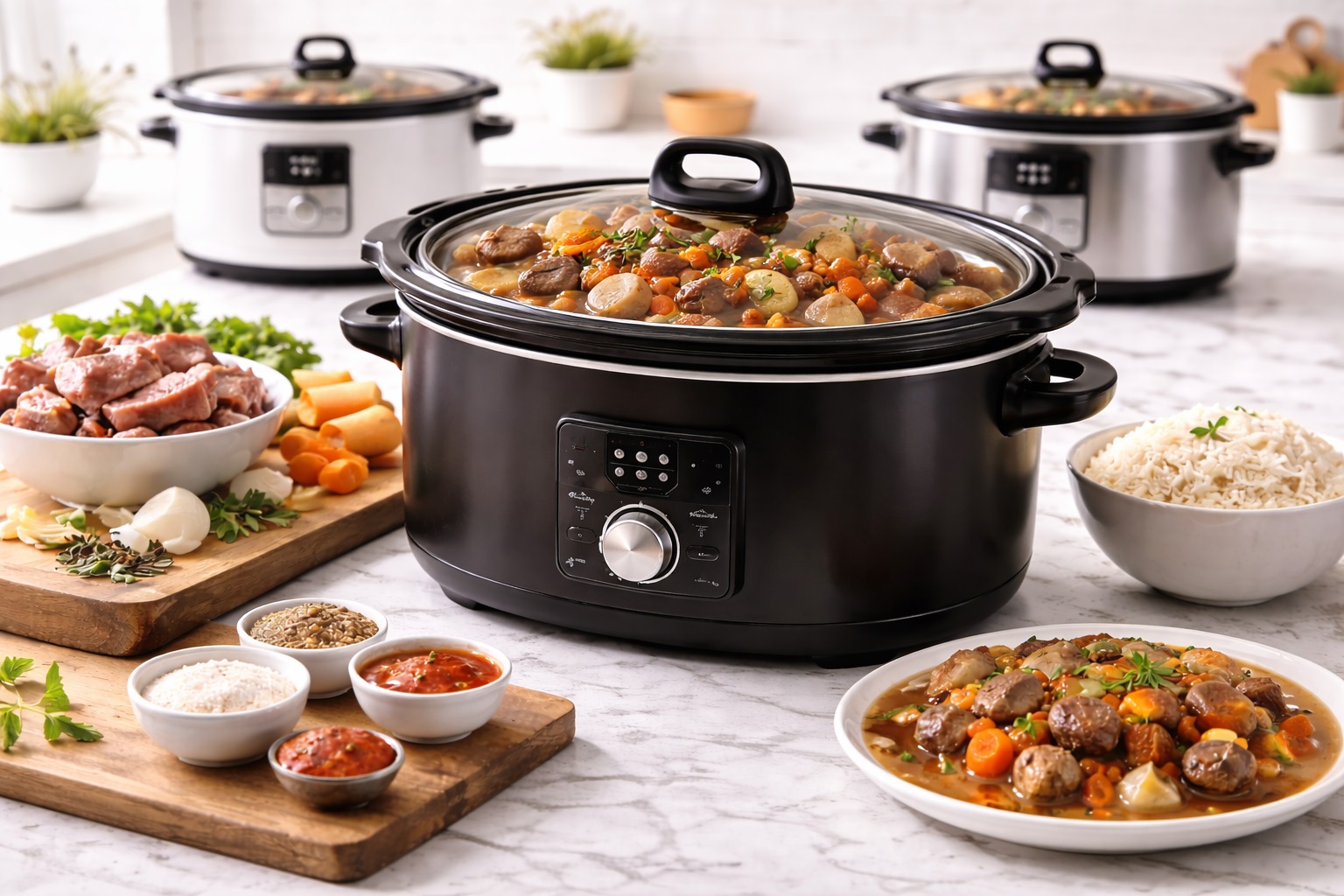
Best Budget Slow Cooker in 2026
A slow cooker doesn't need a premium price tag to earn a permanent spot on your counter. Plenty of affordable models handle the basics of low, steady cooking perfectly well, and the real skill in shopping on a budget is knowing which features are genuinely worth paying extra for and which ones you can skip without losing much. This guide compares eight slow cookers across a wide price range, from simple $40 units to pricier options included here as a reference point for what more money buys, so you can see the whole spectrum before deciding where your own budget should land.
Value isn't only about the lowest sticker price. A $40 cooker that needs replacing in a year isn't necessarily cheaper than a $60 model that lasts five years, so this guide looks at durability, features, and everyday usability alongside price, since those factors ultimately determine how satisfied you'll be with the purchase months down the road. Some of the extras found on higher-priced units, like temperature probes or multiple cooking modes, are nice conveniences rather than necessities, and knowing the difference helps you spend wisely instead of simply spending less. The goal is to identify the point where extra spending stops paying you back in genuine everyday usefulness.
Below you'll find detailed reviews of eight models, a buying guide focused specifically on getting the most value for your money, and answers to common questions budget-minded shoppers ask before buying their first, or next, slow cooker. Each section is meant to help you spend with intention rather than simply chasing the lowest number on the price tag.
Keep in mind that "budget" doesn't have to mean "bare minimum." Several of the models below balance an accessible price with genuinely useful features, and a couple of pricier options are included so you can see exactly what you'd be giving up, or gaining, at each step up the price ladder.
Top 8 Best Slow Cooker Picks (Detailed Reviews)
1. Hamilton Beach Set & Forget – Best Overall Value
The Hamilton Beach Set & Forget earns its spot at the top of this list by pairing a genuinely useful feature, a built-in temperature probe, with a price that stays reasonable at around $60. That probe lets the cooker track a roast or whole chicken's internal temperature rather than relying purely on elapsed time, which is the kind of feature you'd expect to pay considerably more for elsewhere. For shoppers who want more than the bare minimum without stepping into premium territory, this is usually the smartest place to spend. It's the kind of upgrade that pays for itself the first time it saves a roast from overcooking while you're out of the house.
- Pros:
- Built-in temperature probe for doneness accuracy
- "Set and forget" convenience at a mid-range price
- Strong feature-to-price ratio compared to pricier models
- Cons:
- Probe feature takes a little practice to use confidently
- Priced above the most basic entry-level models
- Not the cheapest option if price is your only concern
Best For: Budget-conscious shoppers who still want one standout feature that basic units don't offer, particularly those who cook roasts often.
Why We Recommend It: It delivers a genuinely useful upgrade, accurate doneness tracking, without pushing into premium pricing, which is exactly the balance a value-focused buyer wants from a first meaningful upgrade.
2. GreenPan Elite – Best Ceramic Insert for the Price
The GreenPan Elite brings ceramic nonstick technology, the kind usually associated with higher-end cookware, to a slow cooker priced at around $120. The nonstick coating means less scrubbing after starchy dishes like chili or baked beans, and it's made without PTFE or PFOA, which appeals to shoppers who care about what their cookware is made from. It costs more than the most basic units on this list, but the cleanup savings can make the price feel more reasonable over time, particularly for households that cook rice-based or starchy dishes on a regular basis.
- Pros:
- Ceramic nonstick coating reduces cleanup time
- PFOA-free materials for everyday cooking
- Premium finish at a sub-premium price relative to boutique brands
- Handles starchy dishes without heavy sticking
- Cons:
- Higher price than the cheapest units in this comparison
- Nonstick coating needs gentler utensils and cleaning
- Not the most economical choice for occasional cooks
Best For: Shoppers who are willing to spend a bit more specifically to cut down on cleanup time and appreciate a nicer finish on the counter.
Why We Recommend It: The nonstick insert offsets its higher price with real time savings for anyone who cooks starchy or sticky dishes regularly, and the PFOA-free build is a bonus for health-conscious households.
3. BLACK+DECKER 7-Quart – Best True Budget Pick
If your priority is simply spending as little as possible while still getting a full-size, reliable slow cooker, the BLACK+DECKER 7-Quart is the most straightforward choice here. At around $40, it's the least expensive model in this comparison, yet it still includes a 7-quart capacity and a locking lid for transport, features that matter regardless of price point. Controls are manual rather than digital, which keeps costs down but means you'll want to be home to switch the unit off. For a household stocking a kitchen for the first time, or replacing a worn-out unit without wanting to spend much, this remains one of the most sensible starting points.
- Pros:
- Lowest price in this comparison
- Full 7-quart capacity despite the low cost
- Locking lid included even at this price tier
- Cons:
- Manual dial control rather than a digital timer
- Fewer advanced cooking modes than pricier options
- No temperature probe or auto-warm feature
Best For: Shoppers who want the lowest possible price without sacrificing basic capacity and reliability, including first-time buyers on a tight budget.
Why We Recommend It: It proves that a genuinely useful slow cooker doesn't require a big budget, covering the essentials at the most accessible price on this list without cutting corners on capacity.
4. Ninja Foodi Multi-Cooker – Best Splurge-Worthy Multi-Cooker
At around $180, the Ninja Foodi Multi-Cooker sits well outside typical budget territory, but it's worth including here as a reference point for shoppers debating whether to stretch their spending. Its ability to sear meat and then slow cook in the same pot replaces a separate skillet step, which is a genuine functional upgrade rather than just a marketing feature. Most budget shoppers won't need this, but for some, it may be worth saving up for, especially if it replaces both a slow cooker and a separate stovetop pan you'd otherwise use for browning.
- Pros:
- Sear-then-slow-cook function in one pot
- Multi-cooker versatility beyond basic slow cooking
- Strong reputation for durability
- Reduces the need for separate cookware
- Cons:
- Well above typical budget pricing
- More functionality than most casual cooks need
- Larger footprint takes up more counter space
Best For: Shoppers who have decided to stretch their budget for genuine added functionality rather than just a bigger price tag, or who already dirty a separate pan for browning.
Why We Recommend It: It's included as an honest look at what you get by spending significantly more, so you can decide if the extra cost is worth it for how you actually cook on a typical week.
5. KitchenAid 6-Quart – Best Mid-Range All-Rounder
The KitchenAid 6-Quart sits in the middle of this list on price, around $100, and offers four cooking modes that give it more flexibility than a single-setting budget unit. For shoppers who've decided a basic model won't quite cover their needs but who don't want to jump all the way to premium pricing, this is a reasonable middle ground worth considering, particularly if your weekly meals vary between soups, roasts, and casseroles.
- Pros:
- Four cooking modes add real flexibility
- Recognizable, well-regarded appliance brand
- Reasonable mid-range price for the feature set
- Stylish design that suits a modern kitchen
- Cons:
- Costs more than twice as much as the cheapest option here
- 6-quart capacity may be tight for larger households
- Some cooking modes may go unused by casual cooks
Best For: Shoppers upgrading from a basic unit who want more versatility without paying premium prices or outgrowing a single-mode cooker.
Why We Recommend It: It's a sensible middle step for anyone who has outgrown entry-level features but doesn't need the most expensive option on the list to feel like a meaningful upgrade.
6. Crock-Pot 6-Quart – Best Budget-Friendly Programmable Option
Crock-Pot's 6-Quart model brings a programmable digital timer with auto-warm to a price point of around $50, only slightly above the cheapest manual unit here. That makes it one of the better value propositions on this list for anyone who specifically wants digital, hands-off control without paying a large premium for it. It's a sensible pick for a first-time buyer who is on the fence between manual and programmable controls.
- Pros:
- Programmable digital timer with auto-warm at a low price
- Well-known, dependable brand
- Small price gap over the cheapest manual option
- Widely available parts and accessories
- Cons:
- 6-quart capacity is smaller than the largest budget option
- Ceramic insert is heavy when full
- Fewer specialized features than pricier models
Best For: Budget shoppers who specifically want a programmable timer without paying much more than a basic manual unit, especially those juggling busy schedules.
Why We Recommend It: It closes the gap between "cheapest" and "most convenient" better than almost anything else on this list, making it hard to beat on price-to-feature ratio.
7. Cuisinart MSC-600 – Best Value for Durability
The Cuisinart MSC-600 uses a cast aluminum pot instead of the more common ceramic insert, priced at around $90. That construction tends to hold up well over years of regular use, which matters if you're trying to avoid replacing a cheap cooker every year or two. It sits above the true budget picks on this list but below the premium tier, making it a reasonable middle path for anyone who has been replacing cheaper units too often.
- Pros:
- Cast aluminum pot built for durability
- Recognizable, established kitchen appliance brand
- Reasonable price for the construction quality
- Consistent heat retention for dense dishes
- Cons:
- Fewer smart features than programmable competitors
- Costs more than the cheapest units here
- Styling is plainer than some higher-priced competitors
Best For: Shoppers who'd rather pay a bit more upfront for durability than replace a cheaper unit sooner, or who cook dense dishes often.
Why We Recommend It: Its sturdier construction is a reasonable value argument for anyone planning to keep their slow cooker for years rather than replacing it every season.
8. All-Clad Gourmet – Best for Long-Term Investment
At around $200, the All-Clad Gourmet is the most expensive model in this comparison and, on paper, the least "budget" option here. It's included so shoppers can see the full range of what's available, from an aluminum insert built for even heat distribution to premium cookware-grade construction. Very few budget shoppers need this, but for those planning to keep one slow cooker for a decade or more, it's worth understanding what the higher price buys, and how it compares to the far cheaper options above.
- Pros:
- Professional-grade construction and materials
- Aluminum insert supports even heat distribution
- Backed by a well-established premium cookware brand
- Built to last for years of frequent use
- Cons:
- Highest price point in this comparison by a wide margin
- Far more than most casual cooks need
- Not a practical choice for a first slow cooker on a budget
Best For: Shoppers with a longer time horizon who see this as a one-time purchase rather than a budget appliance, and who value premium materials for their own sake.
Why We Recommend It: It's a useful reference point for the top of the market, even if it's not the pick for most value-focused shoppers browsing this particular list.
Buying Guide: How to Choose the Best Budget Slow Cooker
Shopping on a budget doesn't mean ignoring quality, it means being deliberate about where your money goes. The following sections break down what actually affects value in a slow cooker, so you can spend your budget on the features that matter most for how you cook.
1. What "Value" Really Means
Value isn't the same as the lowest price. A cooker that lasts years and cooks evenly is often a better deal than a slightly cheaper one that wears out quickly or cooks unevenly.
Try to think in terms of cost per year of use rather than sticker price alone, since a small price difference upfront often matters less than how long the appliance actually lasts. A $20 gap between two models is easy to justify if it buys noticeably better reliability.
2. Capacity and Household Size
Buying the wrong capacity is one of the most common budget mistakes. A cooker too small for your household means cooking in multiple batches, which wastes both time and energy.
As a rough guide, 4 to 5 quarts suits one or two people, while 6 to 7 quarts fits most families, so match capacity to your household before comparing prices. Buying slightly larger than you think you need is usually cheaper than buying twice.
3. Insert Material and Price Tradeoffs
Basic ceramic inserts are the most common and generally the least expensive to manufacture, while nonstick coatings and metal inserts add cost but can also add convenience or durability.
If cleanup time matters more to you than upfront price, a nonstick coating can be worth the extra cost even on a budget. Over months of regular use, the time saved scrubbing pots can add up considerably.
4. Manual Controls Can Still Be a Smart Choice
Manual dial controls are usually the least expensive option and are often just as reliable as digital controls for straightforward, at-home cooking.
They're a sensible choice if you're usually home to switch the unit off or on, since you won't be paying for automation you don't need. Simpler controls also mean fewer electronic parts that could eventually fail, which can be a quiet advantage for long-term reliability.
5. Where to Spend a Little More
A small increase in budget, from around $40 to around $60, often buys a genuinely useful upgrade like a programmable timer or a temperature probe.
That first step up in price tends to offer the best value-per-dollar of any upgrade on this list, more than jumping straight to premium models. Beyond that point, returns on extra spending tend to diminish for most everyday cooks, unless a specific feature genuinely fits how you cook.
6. Features Worth Paying For
Auto-warm functions, temperature probes, and locking lids tend to deliver real everyday convenience rather than being purely cosmetic upgrades.
These features are worth prioritizing over styling or brand prestige if you're trying to stretch a limited budget, since they change how the appliance actually performs day to day rather than just how it looks on the counter.
7. Features You Can Often Skip
Multiple cooking modes, searing functions, and premium materials add cost but are only worth it if you'll genuinely use them regularly.
If your cooking is mostly soups, stews, and simple roasts, a basic model with one or two solid features usually covers your needs without unused extras sitting idle.
8. Lid Design and Portability on a Budget
A locking lid doesn't have to cost much extra and is worth prioritizing if you ever transport meals to gatherings or a relative's house.
Even affordable models increasingly include this feature, so it's worth checking for before assuming you need to spend more to get it, rather than treating it as an automatic premium extra.
9. Cleaning and Maintenance Costs Over Time
A cheaper unit that's harder to clean can end up costing more in time and frustration than a slightly pricier model with an easy-clean insert.
Checking whether the insert is dishwasher safe is a simple way to estimate the real, ongoing cost of owning a particular model, beyond just its purchase price, since daily cleanup adds up over the life of the appliance.
10. Brand Reputation and Reliability
Well-known brands are generally a safer bet on a budget because replacement parts, customer support, and community troubleshooting tips are easier to find.
A slightly higher price from an established brand can sometimes be a better value than a lesser-known brand's rock-bottom price, especially if something eventually needs replacing or a part fails outside a short warranty window.
11. Energy Efficiency and Running Costs
Slow cookers are generally efficient appliances, using far less energy than an oven over a comparable cooking time, which helps offset their purchase price over time.
Larger units and multi-function cookers may use somewhat more power, worth a passing thought if you cook daily, though the difference is rarely dramatic enough to outweigh other factors like capacity or durability.
12. Warranty Coverage and Peace of Mind
A basic warranty is standard across most of these models, but it's worth checking exactly what's covered and for how long before you buy.
A slightly higher price paired with clearer, longer warranty coverage can be a genuinely better value than the absolute cheapest option available with minimal support behind it.
13. Long-Term Value Versus Upfront Price
The cheapest option isn't automatically the best value, and the most expensive option isn't automatically overkill, it depends entirely on how often and how seriously you cook.
Weighing how many years you expect to use the appliance against its price is usually the most useful budgeting exercise before you buy, more useful than comparing sticker prices alone side by side in a store aisle.
Frequently Asked Questions
What's the best budget slow cooker overall?
Among the models compared here, the Hamilton Beach Set & Forget offers the strongest overall balance of price and useful features, while the BLACK+DECKER 7-Quart is the better pick if price alone is your top priority. Neither requires you to compromise much on core cooking performance, which is exactly what a value-focused buyer should look for.
Do cheaper slow cookers cook food as well as expensive ones?
For most everyday dishes like soups, stews, and shredded meats, basic and premium slow cookers produce similar results, since the core low-and-slow cooking method is the same across price tiers. The differences mainly show up in extra features rather than fundamental cooking quality, so don't assume a higher price automatically means better-tasting food.
Is it worth paying more for a programmable timer?
If your schedule is unpredictable, a programmable timer with auto-warm can prevent overcooked meals and is often worth a modest increase in price over a manual model. If you're usually home to switch the unit off, the upgrade matters less, and a manual model can serve you just as well.
What features should I skip to save money?
Multiple cooking modes, searing functions, and premium materials are the easiest features to skip if your cooking needs are straightforward, since basic models handle everyday slow cooking just as well. Save these upgrades for if your habits change later, rather than paying for them upfront on the chance you might use them.
How much should I expect to spend on a good slow cooker?
A solid, reliable slow cooker with useful features typically falls in the $40 to $100 range, with prices above that reflecting premium materials or multi-cooker functionality rather than better basic cooking performance. Anything within that range should cover most household needs comfortably, without requiring you to compromise on capacity or reliability.
Are budget slow cookers safe to use?
Yes, reputable budget brands follow the same basic safety standards as premium ones, though it's still worth checking for auto shut-off features if you plan to leave the unit unattended for long periods. Always place the cooker on a stable, heat-safe surface away from curious pets or children.
Ceramic, nonstick, or metal insert: which gives the best value?
Ceramic is usually the most affordable and works well for most dishes, nonstick coatings add value through easier cleanup, and metal inserts can offer better durability, the right choice depends on your priorities. None of the three is objectively better in every situation, so match the material to how you actually cook and clean up afterward.
Is a premium slow cooker worth it?
Premium models often offer sturdier construction and additional features, but for most home cooks, a well-chosen mid-range or budget model covers everyday needs just as effectively. The extra spend is easiest to justify if you cook large cuts of meat often or plan to use the appliance for many years.
How do I maintain my slow cooker?
Clean the insert and lid after each use, check whether they're dishwasher safe, and follow the manufacturer's manual for specific care instructions to extend the appliance's lifespan. Letting a hot insert cool before washing also helps avoid cracking, especially with ceramic models.
Do budget slow cookers have shorter lifespans than premium ones?
Not necessarily, a well-reviewed budget model from an established brand can last just as long as a pricier one, though premium materials sometimes offer extra durability under heavy daily use. Brand reputation often matters more than price alone when it comes to long-term reliability.
Can I find a good slow cooker under $50?
Yes, models like the BLACK+DECKER 7-Quart and Crock-Pot 6-Quart in this comparison both fall at or near $50 while still covering the essentials most households need. Both remain solid, dependable choices at that price point for everyday cooking.
What's the difference between the low and high settings?
The high setting cooks food faster at a higher temperature, while low extends cooking time at a gentler temperature, both are designed to reach a similar safe result over different durations. Many cooks start on high and switch to low for longer, more tender results, particularly for tougher cuts of meat.
Is it better to buy a cheap slow cooker now or save for a pricier one later?
If you cook often, investing a bit more upfront in a durable, well-reviewed model can be more economical over time than repeatedly replacing a cheaper unit that wears out quickly. If you cook only occasionally, a basic unit is usually the more sensible choice, and there's little reason to spend more than you need to.
Final Verdict
- Top Pick: Hamilton Beach Set & Forget for the best overall balance of price and useful features.
- Budget Choice: BLACK+DECKER 7-Quart for the lowest price in this entire comparison.
- Premium Choice: All-Clad Gourmet for shoppers willing to spend well beyond typical budget pricing for premium construction.
Buying on a budget works best when you separate genuinely useful features from nice-to-have extras. The BLACK+DECKER covers the basics at the lowest price here, the Hamilton Beach adds real value with its temperature probe for only a modest premium, and the All-Clad sits at the far end of the spectrum for anyone deciding that long-term investment matters more than upfront savings. Most shoppers reading a budget-focused guide will find their answer somewhere between the first two, with the pricier options included mainly as an honest comparison point. Whatever you choose, matching the purchase to how often and how seriously you actually cook will serve you better than chasing the lowest price tag alone.