Best Lightweight Keyboard Wrist Rests to Buy in 2026
Not every desk accessory needs to be substantial to do its job well. A wrist rest that feels dense and heavy in the hand isn't necessarily more supportive than a lighter one — often it's simply built with more material than the task actually requires. For anyone who moves their setup around, carries gear between rooms, or simply prefers a desk that doesn't feel weighed down with bulky accessories, a genuinely lightweight wrist rest delivers the same core ergonomic benefit without the extra mass.
This guide is built for users who specifically want ergonomic wrist support in a feather-light, easy-to-carry format — whether that's because the rest needs to move between a home office and a shared family space, because a heavier product feels unnecessarily cumbersome on a minimalist desk, or simply because a lighter accessory is easier to reposition throughout the day. It compares the three most practical lightweight materials, explains how weight interacts with comfort and durability, and answers the questions that come up most when shopping specifically for a lighter option.
Being lightweight doesn't mean being flimsy. The products discussed here achieve a lower weight through smart material choices rather than by simply using less padding, which is an important distinction to understand before assuming that "lightweight" and "less supportive" mean the same thing.
It's also worth noting that weight and thickness aren't always the same measurement. A rest can be thin without being especially light, or reasonably thick while still weighing very little, depending on the density of the material used. Keep both dimensions in mind as you compare the options below, since either one might matter more depending on your specific reason for wanting a lighter product.
Weight also plays into a detail that's easy to overlook: how a wrist rest feels when you pick it up one-handed to wipe down a desk or move it to a different room for a video call. A genuinely light rest can be relocated in a single motion; a dense gel or oversized foam block often needs both hands and more attention, which adds friction to what should be a five-second adjustment. None of this changes the ergonomic math at the wrist, but it does change how often you'll actually bother repositioning the rest correctly instead of leaving it wherever it landed.
Top 3 Lightweight Keyboard Wrist Rests (Detailed Reviews)
1. Memory Foam Keyboard Wrist Rest – Best Overall Lightweight Option
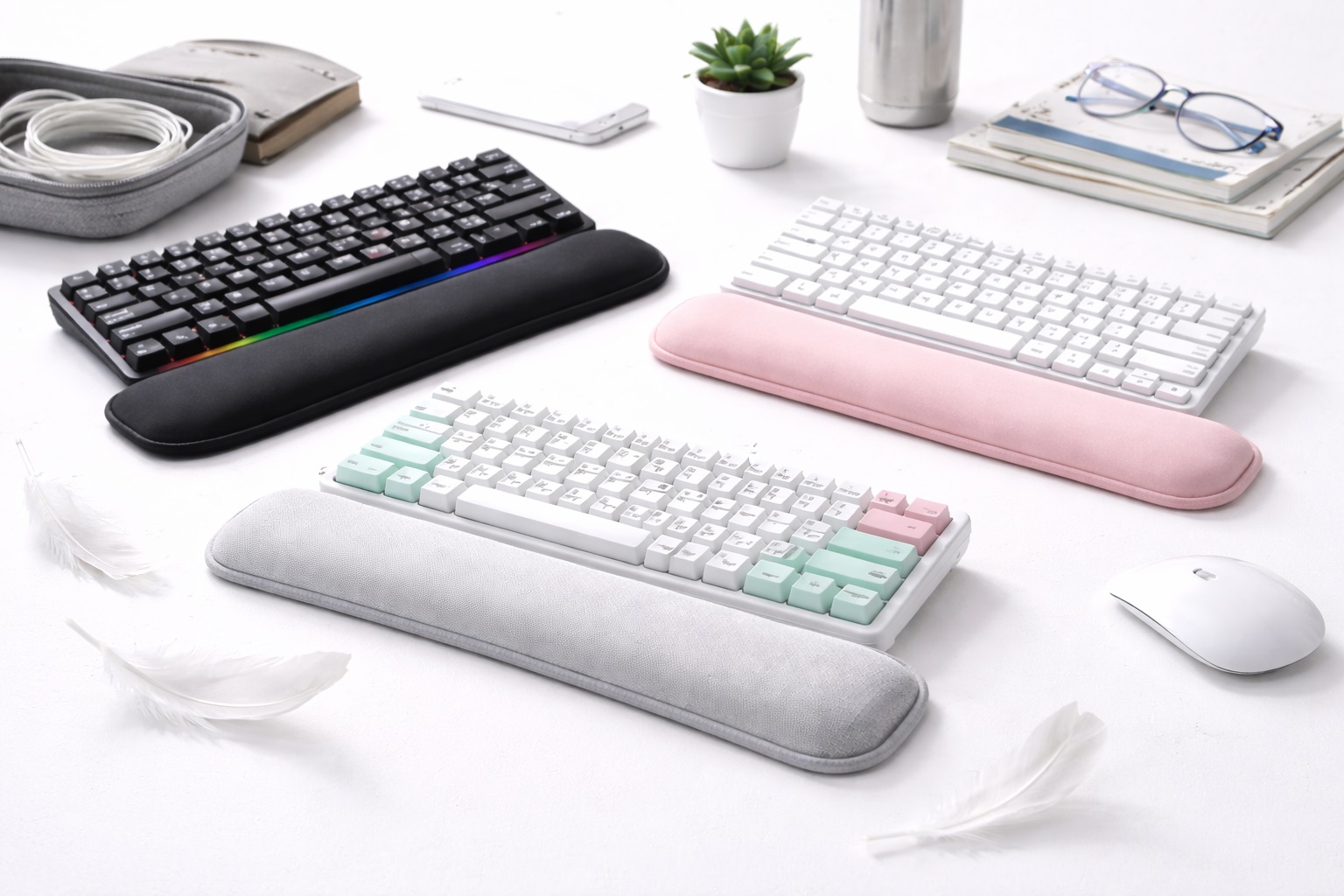
Memory foam wrist rests conform to the shape of the wrist and palm, distributing pressure evenly across the contact surface rather than concentrating it at one point the way a rigid surface does. Because memory foam achieves its cushioning through cellular structure rather than sheer density, a well-made foam rest can weigh notably less than a comparably sized gel model while still offering excellent pressure distribution. Most include a non-slip base that keeps the rest anchored during typing despite its low weight, along with a washable fabric cover that's easy to maintain since lighter accessories tend to get picked up, moved, and handled more often than heavier ones that stay put. The open-cell structure that gives memory foam its adaptive feel is also what keeps its weight down relative to volume, which is part of why it remains the most common material in genuinely lightweight wrist rest designs rather than a rare exception. Manufacturers building specifically for the lightweight category also tend to trim the foam core's thickness slightly compared to a standard desk model, shaving additional grams without meaningfully changing how the surface feels under the wrist during normal use.
- Pros:
- Conforms to wrist shape for even pressure distribution
- Non-slip base prevents movement during typing
- Washable fabric cover on most models
- More comfortable than gel for extended sessions on most wrists
- Cons:
- Can retain heat during extended use in warm environments
- Memory foam compresses over time with heavy daily use
Best For: Users who want the lightest practical option without sacrificing the adaptive comfort that makes a wrist rest worth using in the first place, particularly those who reposition their setup frequently.
Why We Recommend It: Memory foam's cellular structure gives it a favorable comfort-to-weight ratio that denser materials simply can't match. For anyone prioritizing a light, easy-to-handle accessory, foam delivers that without the usual tradeoff of feeling insubstantial or unsupportive.
2. Gel Wrist Rest – Best Lightweight Option for Consistent Firmness
Gel wrist rests use a dense silicone fill that stays cool to the touch and holds a consistent firmness over time, unlike memory foam which slowly compresses with repeated pressure. Gel models do tend to weigh somewhat more than an equivalent foam rest given the denser fill material, but many manufacturers offset this with thinner, more compact designs that keep the overall weight reasonable while preserving the cooling and consistency gel is known for. The smooth surface also wipes clean easily, a convenience that matters more for an accessory that gets moved and handled frequently. Buyers specifically shopping the lightweight category should look for gel models that state a reduced fill volume rather than assuming any gel rest automatically qualifies, since standard-volume gel designs remain noticeably heavier than a foam equivalent regardless of how compact they look on a product page.
- Pros:
- Cool to the touch during extended sessions
- Maintains consistent firmness over time without compression
- Easy to wipe clean surface
- Preferred texture for users who find foam too warm
- Cons:
- Firmer than memory foam — some find it less conforming
- Gel can feel cold in air-conditioned environments
Best For: Users who want a lightweight rest but prioritize consistent, unchanging firmness over the adaptive softness of foam, particularly in warmer rooms.
Why We Recommend It: A thin, well-designed gel rest offers a genuinely different feel from foam while still keeping overall weight manageable. It's the right lightweight choice for anyone who has already decided they prefer gel's cooler, firmer surface over foam's conforming one.
3. Leather or Faux Leather Wrist Rest – Best Lightweight Option With a Premium Look
Leather-covered wrist rests wrap a foam or gel core in genuine or synthetic leather, and when built over a foam core specifically, they can remain relatively light while still offering a more polished, durable surface than fabric. The leather layer itself adds only a small amount of weight compared to the core material, so a leather-wrapped foam rest can come close to matching the weight of an all-foam equivalent while looking considerably more refined on a desk. Faux leather covers tend to weigh marginally less than genuine leather of the same thickness, which is worth checking if the covering material itself is a deciding factor between two otherwise similar lightweight models. The tradeoff remains a higher price than fabric-covered alternatives, along with a surface that feels cool and slightly slippery before it's broken in.
- Pros:
- Premium professional appearance
- Wipe-clean surface for easy maintenance
- More durable surface than fabric alternatives
- Genuine leather improves in texture over time
- Cons:
- Higher cost than foam or gel alternatives with fabric covers
- Leather surface can be cool and slightly slippery initially
Best For: Users who want a lightweight rest that still looks and feels like a considered desk accessory rather than a purely functional, utilitarian one.
Why We Recommend It: A leather-wrapped foam core proves that lightweight and premium-looking aren't mutually exclusive. For anyone who wants both a light accessory and a polished appearance, this combination delivers more of both than either extreme alone.
Buying Guide: How to Choose the Best Lightweight Keyboard Wrist Rest
These factors focus specifically on what changes when minimizing weight is a primary goal rather than a secondary consideration.
1. Understand What Actually Drives Weight
Weight in a wrist rest comes primarily from the density and volume of the core material, not the fabric or leather covering. Denser gel fills weigh more than an equivalent volume of memory foam, and thicker rests of any material weigh more than thinner ones. Understanding this helps you evaluate whether a "lightweight" label reflects a genuinely different construction or just a smaller size. Two rests of identical outer dimensions can differ in weight by a significant margin purely because one uses a lower-density foam core, so dimensions alone are never a reliable proxy for how light a product will actually feel once it arrives.
2. Don't Confuse Thin With Light
A thin rest isn't automatically light if it uses a dense material, and a thicker rest isn't automatically heavy if it uses an airy, low-density foam. Check the actual listed weight rather than assuming based on visual thickness alone. Product photography in particular can be misleading here, since a thin rest photographed close up can look nearly identical to a thicker one, making the specification sheet a far more reliable source than the images on a listing page.
3. Match Width to Your Keyboard Regardless of Weight Goals
A wrist rest should still match or slightly exceed your keyboard's width even when weight is the priority. Going narrower to save weight leaves your outer wrist unsupported, which undermines the entire purpose of buying the rest in the first place. A common mistake is sizing down specifically to shave a small amount of additional weight, only to end up with a rest that supports the inner two-thirds of the hand while leaving the pinky-side edge floating unsupported during normal typing posture.
4. Height Still Needs to Match Your Keyboard's Home Row
Regardless of how light the rest is, it should sit at or slightly below your keyboard's home row. A rest that's too high forces the wrists into extension, and this ergonomic requirement doesn't change based on the product's weight. It's worth measuring your own keyboard's front-edge height with a ruler before ordering, since manufacturer height specifications for wrist rests are sometimes given as an average that doesn't account for keyboards with unusually tall or short front profiles.
5. Check That a Lighter Base Still Grips the Desk
A lighter overall rest sometimes means a lighter, less substantial non-slip base as well, which can occasionally reduce grip compared to a heavier model with a denser rubber base. Check reviews specifically for slip complaints on lightweight models rather than assuming grip performance carries over from heavier versions of the same product line.
6. Consider Whether You'll Move It Often
If the main reason you want a lightweight rest is because you move it between locations or desks regularly, prioritize models specifically designed for portability, which often combine low weight with a more compact folded or rolled profile. A rest designed for a fixed desk position rarely folds or rolls at all, so if portability is the actual driver behind your weight preference, prioritize the folding or rolling detail specifically over the raw weight figure alone.
7. Weigh Durability Against Minimal Material
Using less material to reduce weight can sometimes mean a thinner cushioning layer that compresses or wears faster than a more substantial equivalent. Balance your weight priority against how long you expect the rest to last under daily use. If you type for several hours a day, a slightly heavier model with a fuller cushioning layer may outlast a minimal-material lightweight version by a meaningful margin, even though both are marketed toward similar buyers.
8. Look for Lightweight-Specific Product Lines
Many manufacturers offer a dedicated lightweight or travel-oriented version within their product range, engineered specifically to reduce weight rather than simply being a smaller cut of the standard model. These purpose-built options usually perform better than assuming any small rest qualifies as lightweight.
9. Check Cleaning Requirements Alongside Weight
Fabric-covered lightweight rests still need regular washing to stay hygienic, regardless of how little they weigh. Leather remains the easier wipe-clean option if maintenance simplicity matters as much as weight to your decision.
10. Measure for Full Keyboard Coverage
Full-size keyboards run 17 to 18 inches wide. A lightweight rest that's also undersized in length leaves the number pad section uncovered. Confirm the length covers your full keyboard before assuming a lighter product automatically means a smaller footprint you need to accept.
11. Budget for Replacement Based on Material, Not Weight Alone
Lightweight foam models in the $10–$20 range may need replacing annually just like their standard-weight counterparts, since replacement frequency is driven more by material quality than by weight specifically. A well-reviewed lightweight foam model from an established maker often outlasts a cheaper unbranded version that happens to be heavier, so treat weight and expected lifespan as two separate purchasing questions rather than assuming one predicts the other. Factor this into your overall cost expectations rather than assuming lighter automatically means cheaper to maintain.
12. Test Real-World Comfort, Not Just the Spec Sheet
A rest that looks impressively light on paper still needs to feel comfortable under sustained use. Weight specifications matter, but they shouldn't be the only factor — give any new lightweight rest a genuine trial period of daily use before judging whether it delivers adequate support. A single afternoon of testing rarely reveals how a foam core behaves after several weeks of repeated compression, so hold off on a final verdict until you've used the rest through at least a couple of full work weeks.
13. Consider How Weight Interacts With Desk Stability
A very light rest sitting on a smooth or slightly angled desk surface can occasionally shift more easily than a heavier one, simply because there's less mass helping to keep it anchored between the non-slip base and the desk. If your desk has an unusual surface or slight tilt, weigh this against the benefits of a lighter product before committing. Adding a thin strip of adhesive-backed rubber grip beneath a lightweight rest is a simple, low-cost fix if you find that a very light model shifts more than you'd like on a particular desk surface.
14. Decide If You Need One Rest or a Matching Pair
If you're buying a lightweight rest specifically because you want to reduce the overall weight and clutter on your desk, consider whether a single rest spanning both keyboard and mouse areas might reduce total weight more than two separate light rests bought individually, since a single unit often uses material more efficiently than two smaller ones. A combined keyboard-and-mouse rest also keeps both wrists at a consistent height relative to each other, which some users find more comfortable than two separately purchased pieces that don't quite match in thickness.
15. Reassess Whether Weight Is Really the Priority
Before finalizing a purchase based on weight alone, double check that weight is genuinely the constraint driving your decision, rather than a proxy for wanting a slimmer, less bulky-looking product. In some cases, a slim but slightly heavier gel rest achieves the visual and spatial goal just as well as a true featherweight foam option. Being honest about which outcome you actually want — less mass in your hand, a slimmer profile on the desk, or simply easier portability — will point you toward the right material faster than shopping by weight figures in isolation.
16. Compare Published Weight Figures, Not Just Marketing Copy
Product listings often use words like "ultra-light" or "featherweight" without a number attached. Whenever possible, compare the actual listed weight in ounces or grams across two or three candidates rather than trusting descriptive language alone, since the same adjective gets used loosely across very different actual weights.
17. Factor In Shipping Weight If Buying Multiple Accessories
If you're ordering a wrist rest alongside a matching mouse pad or other desk accessories, the combined lightweight construction can also mean lower shipping costs on weight-based shipping calculations, which is a minor but real secondary benefit of choosing the lighter option across your whole order.
Frequently Asked Questions
Does a lighter wrist rest mean less ergonomic support?
Not necessarily. Weight comes primarily from material density rather than support quality. A well-engineered lightweight foam rest can distribute pressure just as effectively as a heavier gel model, since the ergonomic benefit depends more on shape, height, and conforming ability than on raw mass.
Should I use a lightweight keyboard wrist rest while actively typing?
Ergonomic guidance suggests resting the wrists during typing pauses rather than maintaining constant contact while keys are being pressed. Resting your wrists on the pad while your fingers actively move over keys can increase pressure on the carpal tunnel. Use the rest as a support reference between typing bursts, regardless of its weight.
How do I know what height lightweight keyboard wrist rest I need?
The wrist rest height should match or sit slightly lower than your keyboard's home row. If your keyboard has a steep positive tilt, a taller wrist rest is appropriate. For flatter keyboards, a lower-profile rest suits better, and this holds regardless of the product's overall weight.
Does a lightweight keyboard wrist rest actually help with wrist pain?
For discomfort caused by hovering the wrists unsupported during typing pauses, a wrist rest provides direct relief. For pain caused by incorrect typing technique or repetitive motion, a lightweight rest alone won't resolve the underlying cause any more than a heavier one would.
How do I clean a lightweight keyboard wrist rest?
Fabric-covered wrist rests can be hand-washed or machine-washed on a gentle cycle if the cover is removable. Leather or faux leather surfaces wipe clean with a damp cloth. Gel rests can be wiped directly with a mild detergent solution. Let all surfaces dry completely before returning them to use.
Can I use a lightweight keyboard wrist rest with any keyboard?
Yes, though the height match matters. Verify the wrist rest height suits your keyboard's profile. Ultra-thin keyboards pair with thinner rests; taller mechanical keyboards pair with correspondingly taller ones regardless of overall weight.
Is the most expensive lightweight keyboard wrist rest always the best?
Not necessarily. Higher price often means more features, but many mid-range lightweight options offer excellent comfort for everyday use. Focus on the material and construction quality that matters for your specific needs rather than price alone.
How long should a quality lightweight keyboard wrist rest last?
A well-built product from a reputable brand typically lasts two to five years with reasonable care, similar to standard-weight equivalents. Checking warranty terms at purchase remains a useful quality indicator regardless of the product's weight class.
Can I return a lightweight keyboard wrist rest if it doesn't suit me?
Most retailers offer a 15 to 30 day return window. Keep the original packaging during your evaluation period so you retain the option to return the product if the lighter construction doesn't provide the support you expected.
What is the best lightweight keyboard wrist rest for users who want ergonomic wrist support in a feather-light, easy-to-carry format?
The best choice depends on your specific priorities. Review the buying guide factors above and match each option — memory foam, gel, or leather — to how much you value minimal weight versus other factors like firmness consistency or surface appearance.
Does brand name matter when choosing a lightweight keyboard wrist rest?
Established brands generally offer better quality control and more accurate published weight specifications, which matters when you're specifically shopping by weight. Newer brands sometimes offer excellent value, but verify actual weight figures rather than relying on marketing descriptions alone.
Will a lightweight wrist rest wear out faster than a heavier one?
Not inherently. Wear is driven more by material quality and daily use patterns than by weight itself. A well-made lightweight foam rest can last just as long as a heavier equivalent, though very thin, minimal-material designs may have less cushioning left to compress before bottoming out.
Why would someone specifically want a lighter wrist rest if weight doesn't affect comfort?
Weight matters for reasons beyond comfort at the desk — portability, ease of repositioning, and simply preferring a desk that feels less cluttered with substantial accessories are all valid reasons on their own, independent of any ergonomic difference between lightweight and standard-weight options.
Does a lightweight wrist rest cost more or less than a standard one?
Price is driven more by material quality and brand than by weight class specifically. A well-made lightweight foam rest is often priced similarly to a standard equivalent, since the manufacturing cost comes primarily from the material and construction rather than the finished product's weight.
Can a lightweight wrist rest still support a full-size keyboard properly?
Yes, provided the length and width match the keyboard's dimensions. Weight and size are independent properties — a lightweight rest can still be built to the correct footprint for a full-size keyboard, so don't assume a lighter product is automatically undersized.
Is a lightweight wrist rest a good option for shared or hot-desk workspaces?
Yes. A light rest is easier for multiple people to move, store, and hand off between desk sessions than a bulkier standard model, which makes the lightweight category a practical fit for shared office setups where the accessory travels between users rather than staying permanently on one desk.
Does reducing weight ever compromise the non-slip base specifically?
It can, in a small number of designs, since a lighter overall product sometimes pairs with a thinner rubber base layer. This is a legitimate tradeoff to check in reviews rather than a universal rule, and it doesn't apply to every lightweight model equally.
Final Verdict
- Best Overall Lightweight Option: Memory Foam Keyboard Wrist Rest – the most favorable comfort-to-weight ratio of the three materials compared.
- Best Lightweight Option for Consistent Firmness: Gel Wrist Rest – a thinner, cooler alternative for those who prefer firm, unchanging support.
- Best Lightweight Option With a Premium Look: Leather or Faux Leather Wrist Rest – a leather-wrapped foam core that stays light while looking more polished.
A lightweight wrist rest doesn't have to mean a compromised one. The best options achieve their lower weight through smart material choices rather than simply stripping away the cushioning that makes a wrist rest useful in the first place. Match the material to your specific reason for wanting something lighter — whether that's portability, desk aesthetics, or simply personal preference — and you'll end up with a rest that's genuinely easy to live with rather than one that only looks good on a spec sheet.