Best Keyboard Wrist Rests for Beginners in 2026: Top Picks
If you've never owned a wrist rest before, the shelf of options at any office supply store or online retailer can be oddly overwhelming. Foam, gel, leather, contoured, flat, wide, narrow — the choices multiply fast, and a beginner has no easy way to know which of those differences actually matters day to day. Most first-time buyers end up picking whatever is cheapest or best-reviewed, then discover a few weeks later that the height is wrong for their keyboard, or the material feels unpleasant after an hour of typing.
This guide is built specifically for someone starting from zero: a first-time wrist rest buyer who's noticed early typing discomfort, or who simply wants to build good ergonomic habits before pain becomes a problem. Rather than assuming prior knowledge, it walks through the three most practical starting materials, explains how to judge fit and height without guesswork, and answers the questions beginners ask most often before their first purchase.
None of the products discussed here require any special skill to use correctly. The goal is to help you make one confident decision the first time, rather than buying two or three wrist rests before landing on the right one. A wrist rest is a small, inexpensive accessory in the context of a full desk setup, but it's often the first ergonomic change people make, largely because it doesn't require rearranging furniture or buying a new chair.
It's worth setting expectations early: a wrist rest is a support tool, not a cure for existing pain. If you're already experiencing persistent discomfort, a properly sized rest paired with correct typing habits can meaningfully improve daily comfort, but it works best as part of a broader setup rather than a standalone fix. Keep that in mind as you compare the options below.
It also helps to know upfront that the three materials compared here — memory foam, gel, and leather — cover the vast majority of what a beginner will encounter while shopping. There are more exotic options on the market, but they tend to be variations on these same three cores rather than fundamentally different approaches, so understanding these basics gives you a solid frame of reference for evaluating almost anything else you come across later.
Top 3 Keyboard Wrist Rests for Beginners (Detailed Reviews)
1. Memory Foam Keyboard Wrist Rest – Best Overall for Beginners
Memory foam is the material most beginners should start with, and for good reason. It conforms gradually to the shape of your wrist and palm rather than pushing back against them, spreading contact pressure across a wider area instead of concentrating it at one point. That's the opposite of what happens with a hard, flat surface, where the edge of the desk or a rigid pad can dig into the same spot for hours. Most memory foam wrist rests also include a non-slip rubberized base, which matters more than it sounds — a rest that creeps forward every time you lift your hands quickly becomes annoying enough that people stop using it entirely within days. A removable, washable fabric cover is standard on most models, which is worth checking for specifically since skin oils and hand lotion residue build up over months of daily contact and are otherwise impossible to fully clean off a fixed cover.
- Pros:
- Conforms to wrist shape for even pressure distribution
- Non-slip base prevents movement during typing
- Washable fabric cover on most models
- More comfortable than gel for extended sessions on most wrists
- Cons:
- Can retain heat during extended use in warm environments
- Memory foam compresses over time with heavy daily use
Best For: First-time buyers who type for long stretches at a desk and want the most forgiving, adaptive surface to start building better wrist habits without any learning curve or strong material preference already in mind.
Why We Recommend It: As a first purchase, memory foam removes the guesswork. It doesn't require you to have strong preferences about firmness or temperature — it simply adapts to whatever hand shape rests on it, which makes it the safest recommendation for someone who has never used a wrist rest and isn't sure what they'll like. If you only buy one wrist rest to try, this is the sensible starting point.
2. Gel Wrist Rest – Best for Beginners Who Run Warm
Gel wrist rests replace the foam core with a dense silicone gel fill, and the difference is noticeable within seconds of resting your hands on one. The surface feels cool rather than neutral, and unlike memory foam it doesn't slowly compress and soften with daily pressure — it stays at roughly the same firmness for the life of the product. That consistency appeals to beginners who dislike the slightly "sinking" feeling of foam, or who simply run warm at their desk and find memory foam becomes uncomfortably warm during a long afternoon of typing. The smooth exterior is also easy to wipe down, which is a small but genuine convenience advantage over a fabric-covered alternative, particularly for anyone who eats or drinks at their desk regularly.
- Pros:
- Cool to the touch during extended sessions
- Maintains consistent firmness over time without compression
- Easy to wipe clean surface
- Preferred texture for users who find foam too warm
- Cons:
- Firmer than memory foam — some find it less conforming
- Gel can feel cold in air-conditioned environments
Best For: Beginners who already know they dislike warm or sticky surfaces, or who work in air-conditioned offices where a cooler wrist rest feels more pleasant through the day and doesn't accumulate the same warmth as foam over long sessions.
Why We Recommend It: Not every first-time buyer wants the same thing from a wrist rest, and gel is the clearest alternative path for someone who tries foam and finds it too warm or too soft. It's a genuinely different feel rather than a lesser version of memory foam, and for the right person it's the more comfortable everyday choice.
3. Leather or Faux Leather Wrist Rest – Best for a Professional Desk Look
Leather-covered wrist rests wrap a foam or gel core in genuine or synthetic leather, and the appeal for a beginner is often less about ergonomics and more about how the finished desk setup looks. These rests suit a home office or shared workspace where appearance matters, and they hold up better than fabric over years of use — leather doesn't fray, pill, or absorb stains the way cloth covers eventually do. Genuine leather versions actually improve with age, developing a slightly worn, softened texture rather than looking tired, which is unusual among desk accessories that typically look worse the longer they're used. The tradeoff is a higher price point than an equivalent foam or gel model with a fabric cover, and a surface that can feel a touch cool and slippery straight out of the box before it's been broken in through regular use.
- Pros:
- Premium professional appearance
- Wipe-clean surface for easy maintenance
- More durable surface than fabric alternatives
- Genuine leather improves in texture over time
- Cons:
- Higher cost than foam or gel alternatives with fabric covers
- Leather surface can be cool and slightly slippery initially
Best For: Beginners setting up a home office or client-facing desk who want their first wrist rest to match a more polished, professional appearance rather than a purely utilitarian one, and who don't mind paying more upfront for that look.
Why We Recommend It: For a first-time buyer who cares as much about desk aesthetics as comfort, leather delivers both a durable surface and a look that fits a professional setting — a combination fabric-covered rests generally can't match, and one that ages better rather than worse.
Buying Guide: How to Choose the Best Keyboard Wrist Rest for Beginners
These factors are written specifically for someone buying their first wrist rest, in the order that actually matters when you've never owned one before.
1. Start With Material, Not Brand
As a beginner, it's easy to fixate on brand reputation before understanding what you actually want to feel under your hands. Memory foam adapts and softens with body heat, gel stays cool and firm, and leather is durable but has its own break-in feel. Decide on the material characteristics you want first — adaptive, cool, or durable — then compare brands within that category rather than starting from a brand name and working backward.
2. Match Width to Your Keyboard, Not Your Desk
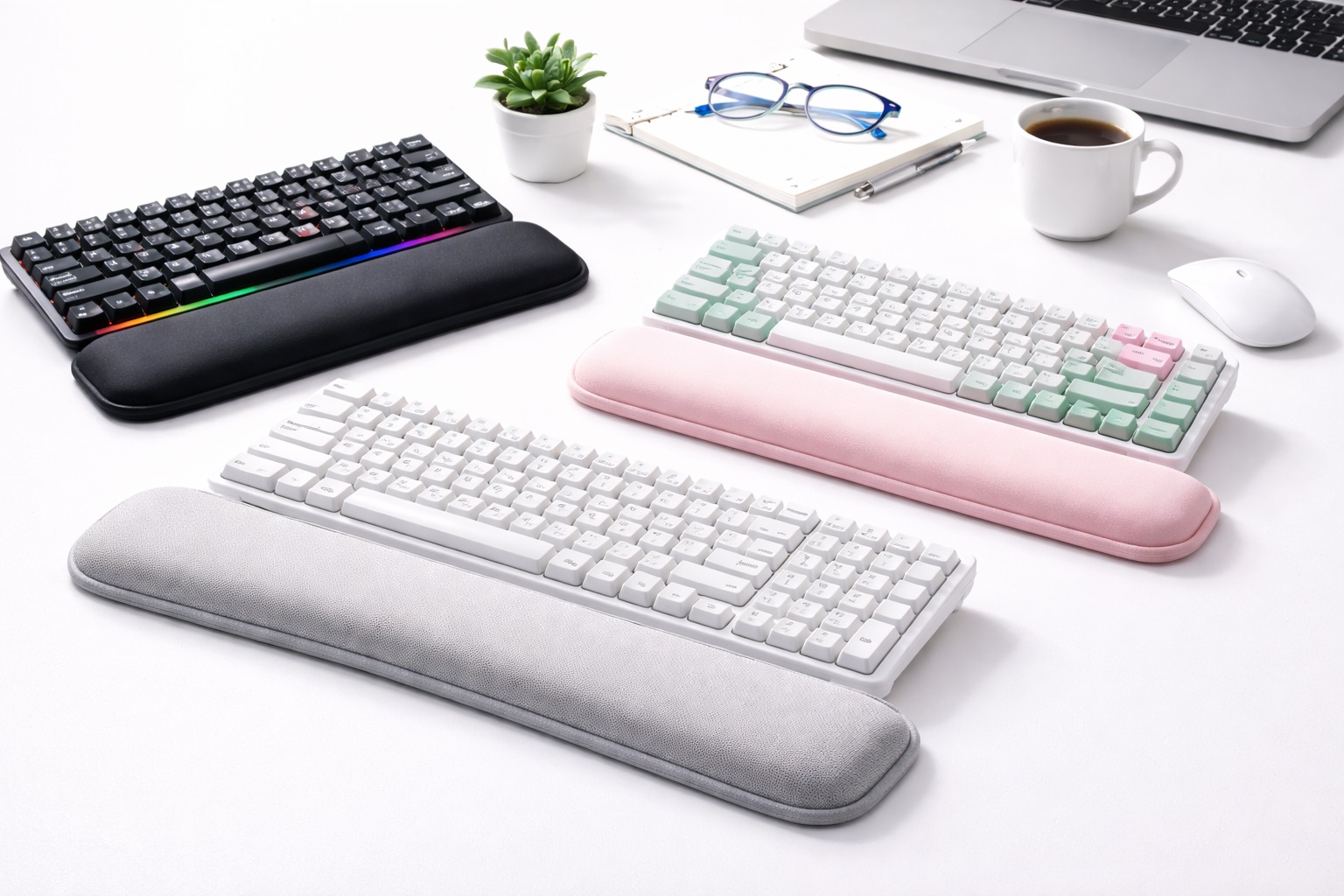
A common first-purchase mistake is buying a wrist rest sized to fit available desk space rather than the keyboard itself. The rest should match or slightly exceed your keyboard's width. A full-size keyboard with a number pad needs a noticeably wider rest than a tenkeyless board, and a narrow rest under a wide keyboard leaves your outer wrist unsupported exactly where fatigue tends to start after long sessions.
3. Get the Height Right Before Anything Else
Height is the single detail beginners overlook most, and it's the one most likely to cause discomfort rather than prevent it. The rest should sit at or slightly below your keyboard's home row. Too high forces your wrists upward into extension, which increases rather than reduces carpal tunnel risk. Too low leaves your wrists unsupported during pauses, which defeats the purpose entirely and can feel worse than having no rest at all.
4. Check the Base Before You Check Reviews for Comfort
A wrist rest that slides across the desk every time you lift your hands will frustrate you into abandoning it within a week, regardless of how comfortable the material is. Look specifically for mentions of base slip in reviews before comfort ratings. Textured rubber bases grip reliably on most desk surfaces; smooth plastic bases are hit or miss depending on your desk material and finish. If your desk has a glass, glossy laminate, or highly polished wood surface, pay extra attention to base grip complaints in reviews, since these surfaces are where slip issues show up most often.
5. Learn Correct Usage From Day One
A wrist rest is meant for pauses between typing, not constant contact while your fingers are actively moving across the keys. Resting your wrists on any surface while typing increases pressure on the ulnar nerve. As a beginner, building the habit of using the rest between bursts rather than continuously will do more for your comfort than any material choice you make.
6. Think About How You'll Clean It
Fabric-covered rests, whether foam or gel, accumulate skin oils over months of daily contact. If the cover isn't removable and washable, that buildup becomes permanent and eventually affects how the surface feels. Leather wipes clean with a damp cloth in seconds. Factor this into your decision now rather than discovering the maintenance gap after a few months of regular use.
7. Consider Buying a Matched Set
Some wrist rests are designed to pair with a specific mouse pad, matching both material and height so both hands get consistent support. For a first-time buyer, a matched set removes the guesswork of pairing heights and materials separately — useful if you're setting up ergonomics for the first time and want one less decision to make on your own. If you use your mouse for extended periods, giving that hand the same quality of support as your typing hand is worth the modest extra cost of buying the pair together.
8. Understand Firmness Behavior Over Time
Gel holds a constant firmness for the life of the product. Memory foam compresses under pressure and slowly recovers, which some beginners initially mistake for the product being defective or wearing out prematurely. Neither is wrong — they simply behave differently, and knowing this in advance avoids unnecessary buyer's remorse in the first few weeks of ownership.
9. Measure for Full-Size Keyboard Coverage
Full-size keyboards run 17 to 18 inches wide. A rest that's shorter than this leaves the number pad section uncovered, which matters if you use it regularly for data entry or spreadsheet work. Measure your keyboard before ordering rather than assuming a "standard" wrist rest will cover the full width, and add an inch or two of margin if you're unsure which size to pick.
10. Budget for Replacement, Not Just Purchase
Wrist rests are consumable. Foam compresses and fabric wears with daily use. Budget models in the $10–$20 range may need replacing annually, while a well-built memory foam model can last three to five years with proper care. As a beginner, it's worth weighing total cost over time rather than just the sticker price at checkout.
11. Don't Overthink the First Purchase
Because this is likely your first wrist rest, resist the urge to research for weeks before buying. Memory foam is a safe, adaptable starting point for most people. If it doesn't suit your preferences after a few weeks of regular use, you'll have a much clearer idea of what to look for in a second purchase rather than guessing blind again. Treat the first purchase as information gathering as much as a final decision, and you'll worry less about getting it perfectly right on the first try.
12. Pair It With Correct Keyboard Setup
A wrist rest works best alongside a keyboard positioned at the right height and tilt for your chair and desk. As a beginner, check your overall typing posture at the same time you introduce a wrist rest — the two changes reinforce each other far more than either does alone, and fixing one without the other often limits the benefit you'll actually feel.
13. Test Comfort Over a Full Week, Not a Few Minutes
A wrist rest can feel fine for the first few minutes in a store or right out of the box, and still turn out to be the wrong choice once you've used it for several full working days. Fatigue, temperature preference, and firmness tolerance only become clear after repeated real-world sessions, so give any new rest at least a week of normal use before judging it, rather than making a snap decision on day one.
14. Decide Whether Portability Matters to You
Some beginners only use one desk and never move their setup, while others split time between a home desk, an office, or a laptop on the go. If you fall into the second group, a thinner, lighter rest that's easy to slip into a bag is worth prioritizing over a bulkier option, even if the bulkier version feels marginally more plush when compared side by side at a desk.
Frequently Asked Questions
Should I use a keyboard wrist rest for beginners while actively typing?
Ergonomic guidance suggests resting the wrists during typing pauses rather than maintaining constant contact while keys are being pressed. Resting your wrists on the pad while your fingers actively move over keys can increase pressure on the carpal tunnel. Use the rest as a support reference between typing bursts rather than continuous contact, especially in your first few weeks of use.
How do I know what height keyboard wrist rest for beginners I need?
The wrist rest height should match or sit slightly lower than your keyboard's home row. If your keyboard has a steep positive tilt, a taller wrist rest is appropriate. For keyboards with zero or negative tilt, a flatter wrist rest suits better. Getting this wrong increases rather than reduces wrist strain, so it's worth double-checking before you settle into daily use.
Does a keyboard wrist rest for beginners actually help with wrist pain?
For discomfort caused by hovering the wrists unsupported during typing pauses, a wrist rest provides direct relief. For pain caused by incorrect typing technique or repetitive strain, the wrist rest alone won't resolve the underlying cause. Combined with correct keyboard height, regular breaks, and proper technique, it contributes to a healthier overall setup rather than acting as a standalone fix.
How do I clean a keyboard wrist rest for beginners?
Fabric-covered wrist rests can be hand-washed or machine-washed on a gentle cycle if the cover is removable. Leather or faux leather surfaces wipe clean with a damp cloth. Gel rests can be wiped directly with a mild detergent solution. Let all surfaces dry completely before returning them to use to avoid trapping moisture against the core.
Can I use a keyboard wrist rest for beginners with any keyboard?
Yes, though the height match matters. Verify the wrist rest height suits your keyboard's profile. Ultra-thin keyboards pair with thinner rests; tall mechanical keyboards pair with correspondingly taller ones. Most wrist rests don't attach to the keyboard and stay in position through their non-slip base alone, so they can move between different keyboards if needed.
Is the most expensive keyboard wrist rest for beginners always the best choice?
Not necessarily. Higher price often means more features, but many mid-range options offer excellent performance for everyday use, especially for a first purchase. Focus on the material and fit factors that matter for your specific setup rather than price alone, and treat your first rest as a learning purchase rather than a lifetime commitment.
How long should a quality keyboard wrist rest for beginners last?
A well-built product from a reputable brand typically lasts two to five years with reasonable care. Checking the warranty terms at purchase is a useful quality indicator, especially when you don't yet have a track record with a given brand or model line.
Can I return a keyboard wrist rest for beginners if it doesn't suit me?
Most retailers offer a 15 to 30 day return window. Keep the original packaging during your evaluation period so you retain the option to return the product if it doesn't meet your needs after a week or two of actual daily use.
What is the best keyboard wrist rest for beginners experiencing typing discomfort or wanting preventative ergonomics?
The best choice depends on your specific priorities. Review the buying guide factors above and match each option — memory foam, gel, or leather — to what matters most for your typing habits, desk setup, and how much you already know about your own comfort preferences.
Does brand name matter when choosing a keyboard wrist rest for beginners?
Established brands generally offer better quality control, customer support, and warranty reliability, which can matter more for a first-time buyer who doesn't yet know what to expect from the category. That said, newer brands sometimes offer excellent value — read verified reviews carefully before purchasing either way.
Do I need a wrist rest if I don't currently have any wrist pain?
A wrist rest used correctly during typing pauses can help prevent the kind of unsupported hovering that contributes to strain over time. Starting with good habits before discomfort appears is a reasonable, low-cost precaution, particularly for anyone spending several hours a day at a keyboard for work or study.
What's the biggest mistake beginners make with their first wrist rest?
The two most common mistakes are choosing a rest that doesn't match the keyboard's width or height, and using it as a surface to rest on continuously while typing rather than only between bursts. Both undermine the ergonomic benefit the product is meant to provide, even when the material itself is a good choice.
Will a wrist rest slow down my typing speed while I get used to it?
Most beginners notice no meaningful change in typing speed once they've adjusted to the new hand position, which usually takes a few days. Any initial slowdown tends to come from awkward positioning rather than the rest itself, and typically resolves once the height and placement are dialed in correctly.
Can I use a wrist rest with a laptop keyboard instead of a full desktop keyboard?
Yes, though laptop keyboards sit lower and often have a different tilt than standalone keyboards, so a slimmer rest usually fits better than a thick one designed for a full-size mechanical board. Pay closer attention to height matching in this case, since laptop typing posture already differs from a desktop setup.
Should beginners buy from a physical store to try before buying, or is ordering online fine?
Ordering online is fine as long as the retailer offers a reasonable return window, since most of what matters — height match, base grip on your specific desk, and long-session comfort — can't really be judged in a two-minute in-store test anyway. A generous return policy matters more for a first purchase than being able to touch the product beforehand.
Final Verdict
- Best Overall for Beginners: Memory Foam Keyboard Wrist Rest – the most adaptive, forgiving starting point for anyone new to using a wrist rest.
- Best for Beginners Who Run Warm: Gel Wrist Rest – a cooler, firmer alternative for those who find foam too warm.
- Best for a Professional Desk Look: Leather or Faux Leather Wrist Rest – the durable, polished option for a client-facing or design-conscious setup.
Your first wrist rest doesn't need to be a perfect decision — it needs to fit your keyboard, sit at the right height, and stay in place while you type. Memory foam is the safest starting point for most beginners, but gel and leather both serve real preferences that some first-time buyers already know they have. Use the guide above to match the option to your habits, and don't be afraid to adjust course once you've spent a few weeks learning what actually works for your hands, your desk, and your daily routine.
Whichever material you choose, remember that the wrist rest is only one part of a comfortable typing setup. Keyboard height, chair position, and monitor placement all interact with how your wrists feel by the end of the day, so treat this purchase as the first step in a broader habit rather than the final word on desk ergonomics. Most beginners who start here go on to make small, incremental adjustments to the rest of their setup once they notice how much a properly supported wrist position changes daily comfort.