Best Lightweight USB Hub for Travel: Top Picks for 2026
Weight is a strange thing to obsess over in a laptop bag until you've actually carried one across an airport, up several flights of stairs, or on a daily commute for months on end. Every gram in that bag gets felt eventually, and a USB hub — an accessory that exists purely to add convenience — shouldn't be the item that makes the bag noticeably heavier. That's the specific angle this guide takes: not which hub has the most features, but which one adds the least weight for the connectivity it provides.
This distinction matters because the two goals sometimes pull in opposite directions. A hub with more ports, HDMI output, and a metal housing is often more capable, but it's also heavier and bulkier than a minimal plastic hub with three ports. The right choice depends on how much capability is genuinely needed versus how much weight is worth tolerating to get it — a trade-off that's personal to each traveler's actual habits.
The three picks below represent distinct points along that trade-off, from the near-weightless minimal hub to a slightly heavier all-in-one option that still qualifies as lightweight relative to its category.
It also helps to separate two related but different ideas: physical weight and physical size. A hub can be small but still made from a dense material that makes it surprisingly heavy for its footprint, while another hub can be slightly larger but built from lighter materials that end up weighing less overall. Judging portability by size alone can be misleading — the actual weight specification, when available, is the more reliable number to compare across candidates, even when it takes a bit more digging through a listing to find it.
Frequent travelers often develop a mental limit for how many grams they're willing to add to a bag before a new accessory purchase starts to feel like a compromise rather than a convenience. This guide is built around respecting that limit rather than assuming everyone wants the most feature-complete hub regardless of what it costs in carried weight, since the right amount of capability is always relative to how much a given traveler is willing to carry for it.
Top Picks Reviewed
1. Ultra-Slim USB-C Hub with HDMI and PD – Best Capability-to-Weight Ratio
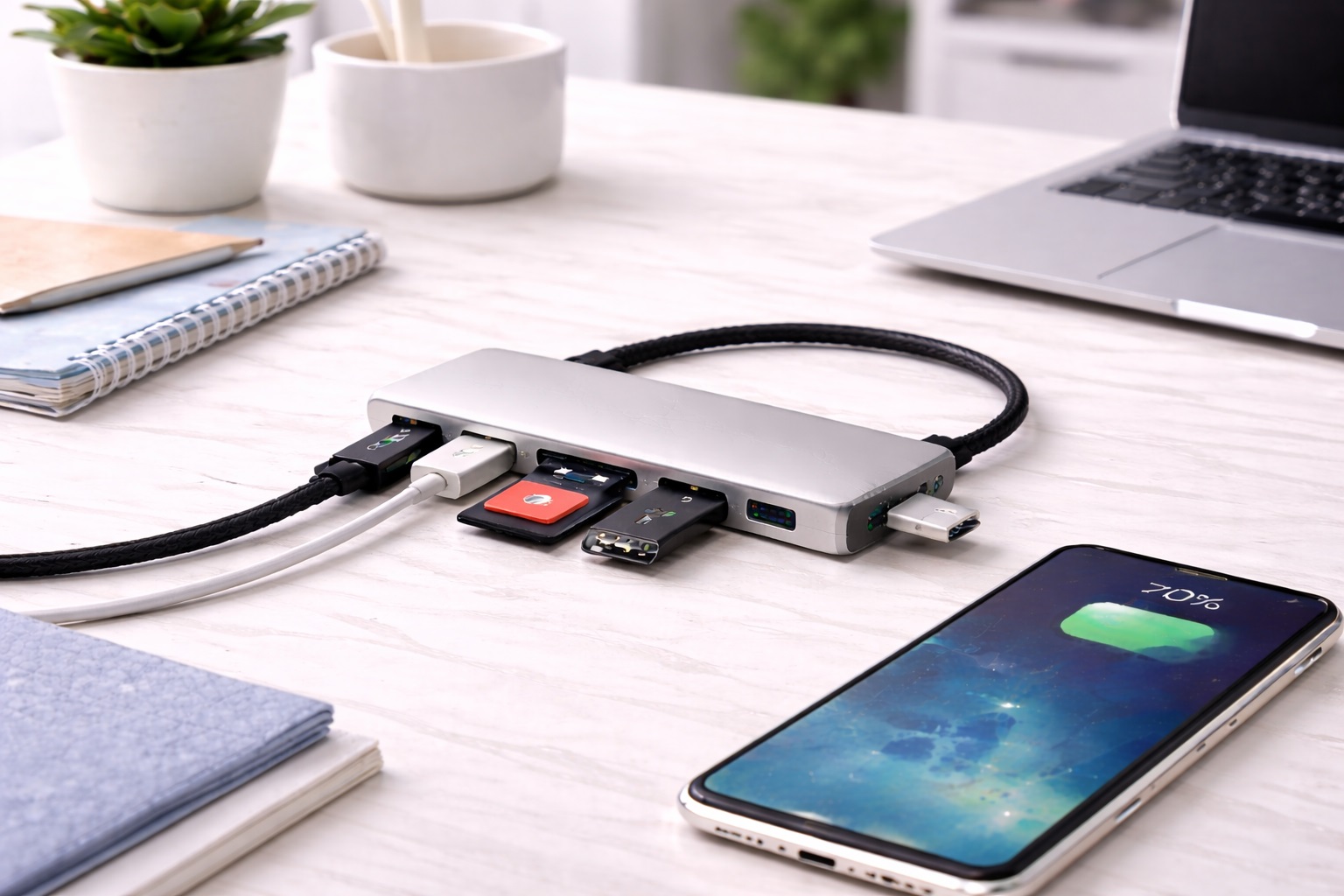
A slim USB-C hub built with a thin aluminum or aluminum-alloy shell manages to include HDMI output, PD passthrough, and USB-A data ports while staying close to the weight of a phone charger. These hubs use a flattened, elongated design rather than a boxy one, which keeps material use — and therefore weight — to a minimum without removing any of the core connectivity a traveling laptop user actually needs. The engineering trade-off manufacturers make here is deliberate: rather than maximizing port count, they focus on the small handful of connections a traveler actually reaches for, then build the thinnest possible housing around exactly that set.
- Pros:
- Full connectivity set — video, charging, and data — in a slim housing
- Aluminum shell adds durability without much added weight
- Flat profile slides easily into a laptop sleeve pocket
- Single cable reduces the total number of accessories to pack
- Covers most realistic travel scenarios without needing a second adapter
- Cons:
- Slightly heavier than a bare-bones three-port hub
- Premium materials push the price above basic plastic alternatives
Best For: Travelers who need to occasionally connect to an external monitor or projector and don't want to carry a separate charger, and who are willing to accept a small weight premium for that capability. This tends to describe consultants, hybrid workers who split time between a home office and client sites, and anyone whose travel schedule is unpredictable enough that packing for every scenario is simpler than packing differently each time, since guessing wrong about what a destination requires is far more disruptive than carrying a slightly heavier hub everywhere.
Why We Recommend It: This is the pick for someone who wants one hub to cover nearly every travel scenario without assembling a bag full of single-purpose adapters. The weight added over a minimal hub is small enough that most travelers won't notice it, while the capability gained is substantial. It's the option that removes the most decision-making from a trip: instead of assessing in advance whether a specific destination will require a monitor connection, this hub is simply ready for it either way.
2. Minimalist 3-Port Hub – Best for Absolute Minimum Weight
Stripped down to just three or four USB-A ports with no video output, no card reader, and no extra features, a minimalist hub is built for one purpose: adding ports while adding almost nothing to the bag's total weight. These are often built from lightweight plastic and sized barely larger than the connector itself, which makes them close to disappearing into a pocket or a cable pouch. For anyone who has ever dug through a bag looking for an accessory they forgot they packed, that's not a downside — it's precisely the point of a hub this size.
- Pros:
- Among the lightest hubs available in any category
- Small enough to lose track of in a bag, in the best way
- Inexpensive, so losing or replacing one isn't a significant cost
- No cable of its own in some designs — plugs directly into the port
- Simple enough that there's essentially no learning curve at all
- Cons:
- No video output or fast charging passthrough
- Limited to basic peripherals like a mouse, keyboard, or flash drive
Best For: Travelers whose only real need is a couple of extra ports for a mouse and a flash drive, without any requirement for video output or high-power charging. This describes a large share of casual travelers, students on shorter trips, and anyone whose laptop usage away from home is closer to occasional checking of email than a full working setup requiring a monitor or extensive peripherals.
Why We Recommend It: For minimalist packers, this hub barely registers as an added item. It solves the specific, narrow problem of a laptop with too few ports without asking the traveler to accept any real weight trade-off in return. There's a certain honesty to this category of product — it doesn't try to be more than it is, and for a large share of travelers, that's exactly enough.
3. Foldable or Cable-Integrated Travel Hub – Best for Tangle-Free Packing
Some travel-oriented hubs are designed with a foldable connector or a very short integrated cable that wraps around the body of the unit, eliminating the loose cable that normally tangles with headphone wires and chargers in a bag. This design prioritizes packing convenience as much as raw weight, though the units themselves also tend to be light. The engineering focus here is less about shaving grams and more about reducing the friction of actually using the accessory — a hub that's light but constantly tangled with headphone cables saves little real time compared to one that comes out of a pouch ready to plug in immediately.
- Pros:
- No loose cable to tangle with other bag contents
- Compact folded shape takes up minimal pouch space
- Light enough to qualify as a genuinely portable accessory
- Reduces the small daily frustration of untangling cables before use
- Purpose-built for the specific habits of someone who travels frequently
- Cons:
- Short integrated cable limits placement flexibility once connected
- Folding mechanism is a potential long-term wear point
Best For: Frequent travelers who pack and unpack their bag daily and want to avoid the small but repeated annoyance of tangled cables in a pouch or pocket. Business travelers moving through several destinations in a single trip, in particular, tend to notice this benefit the most, since their bag gets opened and repacked more often than a typical vacation traveler's, sometimes several times within the same day.
Why We Recommend It: The value of this design isn't measured in grams alone — it's measured in the seconds saved every time the bag gets opened and the hub comes out ready to use, without wrestling with a tangled cord first. Multiply that small saving by dozens of trips over a year and the cumulative benefit becomes far more noticeable than the spec sheet alone would suggest.
Buying Guide: How to Choose the Best Lightweight USB Hub
Use these factors to weigh true portability against the connectivity you actually need while traveling.
| Priority | Lean Toward | Trade-Off Accepted |
|---|---|---|
| Absolute minimum weight | Minimalist plastic hub, no video output | No HDMI, limited to basic peripherals |
| One hub for most scenarios | Slim aluminum hub with HDMI and PD | A modest weight increase over minimal hubs |
| Tangle-free daily packing | Foldable or integrated-cable design | Shorter effective cable reach once connected |
1. Actual Weight in Grams
Product listings don't always state weight clearly, but it's worth searching for the specification directly or checking reviews that mention it. A hub under 50 grams is genuinely unnoticeable in a bag; anything approaching 150 grams or more starts to register as a deliberate addition rather than an afterthought. When two listings look otherwise similar, the weight figure is often the fastest way to break the tie, so it's worth digging for even when the manufacturer buries it deep in the specifications tab. A quick message to the seller or a search through the questions-and-answers section of a listing will often surface the number when it isn't printed anywhere obvious.
2. Material and Its Weight Trade-Off
Aluminum housings are more durable and often look more premium, but they add weight compared to plastic. For travel specifically, a well-made plastic shell can be the better choice purely on a weight basis, provided the connector itself is solidly built and unlikely to crack under regular use. A hybrid design — plastic body with a reinforced metal connector tip — often splits the difference reasonably well for regular travelers, offering most of the durability benefit of metal without the full weight penalty that comes with an all-aluminum shell.
3. Matching Ports to Actual Travel Needs
Consider what you genuinely plug in while traveling — often just a mouse, a charging cable, and occasionally a monitor at a hotel desk or conference room. A hub with exactly that connectivity, and nothing more, keeps both the weight and the price down without any real functional loss. It's worth tracking your actual usage for a week or two before buying if you're unsure, rather than guessing at a feature list based on what sounds useful in the abstract. A simple notes app entry logging what you actually plugged in and where over a couple of trips gives a far clearer picture than trying to anticipate every possible scenario in advance.
4. Cable Length vs No Cable
Some lightweight hubs plug directly into the laptop with no cable at all, which saves weight but limits how flexibly the hub can be positioned. Others include a short cable for more placement freedom at the cost of a few extra grams. Neither is objectively better — it depends on whether you value flexibility or minimal weight more, and both options are common enough that the choice really comes down to personal preference rather than one being a clearly superior design. Handling a specific model in person, if possible, or watching an unboxing video online is a reasonable way to judge which approach feels more natural before committing to a purchase.
5. Durability for Frequent Handling
A hub that travels daily gets more handling — packed, unpacked, dropped into a bag repeatedly — than one that stays permanently on a desk. A slightly heavier but sturdier build can outlast a very light one that cracks after a few months of travel wear, which is worth weighing against pure weight savings. Reviews that specifically mention months of regular travel use are more informative here than reviews written the week a product arrived. Filtering reviews by keywords like "months later" or "still works" can surface these longer-term accounts among a larger pool of first-impression posts.
6. Bag Placement and Pocket Fit
A hub's actual footprint matters as much as its weight for travel use. A flat, elongated shape fits into a laptop sleeve's front pocket more easily than a boxy or cube-shaped hub, even if the two weigh roughly the same amount. Checking the physical dimensions against your specific bag's pocket sizes avoids an awkward surprise after the product arrives, and a quick measurement of the pocket itself before ordering takes less time than dealing with a return later.
7. Power Delivery for Charging on the Go
If the hub includes PD passthrough, verify the wattage supports your laptop's charging needs before relying on it exclusively while traveling. A mismatch means carrying a separate charger anyway, which defeats the purpose of consolidating connectivity into one lightweight accessory. This is especially worth checking for larger laptops that draw more power than an entry-level ultrabook, since an underpowered hub might keep a battery from draining further without actually charging it while in heavy use.
8. Video Output Necessity
HDMI output adds weight and cost. If your travel routine rarely involves connecting to an external display, skipping this feature keeps the hub lighter and cheaper without any real loss for your actual use case. It's a feature that's easy to add later with a separate small adapter if an unexpected need comes up during a specific trip, and packing that adapter only on trips where it's genuinely likely to be needed — a conference, a client site visit, a stay somewhere with a known workstation setup — is a reasonable middle ground between full preparedness and minimal weight.
9. Included Carrying Pouch or Case
Some travel-focused hubs include a small fabric pouch or hard case. While this adds a small amount of weight itself, it can meaningfully reduce wear on the connector and cable during transit, extending the hub's usable life. For a device that gets tossed into a bag alongside keys and chargers daily, this modest protection often pays for itself in avoided repairs or replacements. A cheap third-party pouch works just as well if the manufacturer doesn't include one, so this shouldn't be treated as a deciding factor on its own, though it's a nice convenience when it's already part of the package.
10. Warranty and Replaceability
Travel accessories get lost more often than desk-bound ones. An inexpensive, widely available hub is easier and cheaper to replace on the road than a premium model that might require ordering a specific replacement from a single retailer. Choosing a model sold widely, rather than an obscure one-off, makes a mid-trip replacement far less stressful if it's ever needed, since a local electronics shop in an unfamiliar city is more likely to carry a common brand than a niche one, and a common model is also easier to order for overnight delivery to a hotel if a replacement can wait a day.
11. Airport Security Considerations
USB hubs are unremarkable to airport security and rarely need to be removed from a bag during screening, unlike laptops and larger electronics. This isn't a differentiator between hub models, but it's a reasonable point of reassurance for anyone packing one for the first time and unsure whether it needs special handling at a checkpoint. It can simply stay wherever it normally lives in the bag, whether that's a dedicated cable pouch or loose alongside other small electronics, with no separate bin or bag required at the checkpoint.
12. Real-World Weight Comparison
Rather than comparing hubs to some abstract ideal, compare the candidate hub's weight to something you already carry — a set of earbuds, a portable charger, a pen. This kind of everyday comparison makes the actual weight impact far more concrete than a number in grams on a spec sheet, and it often reveals that the difference between two competing hubs is smaller in practice than the listed numbers suggest, which can save time spent agonizing over a decision that ultimately makes little practical difference in the bag once the accessory is actually in use day to day.
Frequently Asked Questions
1. How much does a typical lightweight USB hub weigh?
Minimalist hubs with just a few USB-A ports often weigh under 50 grams. Hubs with HDMI output and PD passthrough in a slim aluminum housing typically weigh between 60 and 120 grams. Both are light enough to be barely noticeable in a laptop bag, and the difference between them is roughly the weight of a few coins, small enough that it rarely factors meaningfully into an actual packing decision once the rest of the bag's contents are accounted for.
2. Is a plastic or aluminum hub better for travel?
Aluminum is generally more durable but adds weight. Plastic is lighter but can feel less premium and may be more prone to cracking if dropped repeatedly. For most travelers, a well-reviewed plastic hub is a reasonable trade-off, while frequent flyers who value durability may prefer the slight weight increase of aluminum for the extra peace of mind over months of regular handling and the occasional accidental drop that any well-used travel accessory eventually experiences.
3. Do I need HDMI output on a travel hub?
Only if you regularly present to an external display, connect to a hotel or conference room monitor, or work from locations with a secondary screen. If that's not part of your routine, skipping HDMI keeps the hub lighter and less expensive, and you can always add a separate compact adapter later for the rare occasion it's needed.
4. Can a lightweight hub still charge my laptop?
Yes, many slim hubs include PD passthrough that supports laptop charging alongside data and video connections. Check the specific wattage rating against your laptop's charging requirement before relying on it as your only charger while traveling, since an underpowered passthrough may charge slowly or not keep up under heavy use, which becomes obvious only after a full day away from a wall outlet rather than during a quick test at home.
5. Will airport security have any issue with a USB hub?
No. USB hubs are small, unremarkable electronic accessories that don't require separate screening like laptops or tablets. They can stay in your bag through standard security checks without any special handling, packed alongside cables and chargers as usual.
6. How do I know if a hub is genuinely lightweight or just marketed that way?
Look for the actual weight specification in grams, either in the listing or in reviews. Marketing terms like "slim" or "portable" aren't standardized, so the number itself is the only reliable comparison point between different models, and it's worth being skeptical of a listing that emphasizes portability without stating a specific weight, since that omission sometimes suggests the number isn't as competitive as the surrounding marketing language implies.
7. Is the most expensive lightweight USB hub always the best?
Not always. Price often reflects premium materials or extra features rather than a meaningful difference in weight. Match the product to your actual travel habits rather than assuming a higher price guarantees a better travel experience, since a cheaper minimalist hub sometimes serves a light packer better than an expensive all-in-one that mostly sits unused beyond its basic ports.
8. How long should a quality lightweight USB hub last?
A well-built lightweight hub from a reputable manufacturer typically lasts two to five years even with regular travel handling. Warranty length is a useful indicator of manufacturer confidence in durability under repeated packing and unpacking, and a hub that survives a full year of frequent trips without connector wear is generally a good long-term bet worth sticking with for future purchases from the same manufacturer.
9. Can I return a lightweight USB hub if it doesn't suit me?
Most retailers offer fifteen to thirty day return windows. Keep original packaging during your evaluation period, especially if you're testing the hub across an actual trip to confirm it meets your needs before committing to it as your permanent travel accessory for future trips.
10. What should I prioritize when buying a lightweight USB hub?
Start with the actual weight in grams and the ports you genuinely use while traveling, then compare materials and included accessories like a carrying pouch between the remaining shortlisted options. Everything past that point is a matter of personal preference rather than a functional requirement.
11. Does brand name matter for a lightweight USB hub?
Established brands offer better warranty support and more consistent quality control, which matters more for a travel accessory subjected to regular handling. Newer brands can still offer good value — read verified reviews that specifically mention durability over multiple trips rather than just first impressions out of the box, since it's the months-later feedback that best predicts how the hub will hold up on your own travel schedule.
12. Is a foldable or integrated-cable hub worth the extra cost?
If you pack and unpack your bag daily and find loose cables frustrating, yes — the tangle-free design solves a real recurring annoyance. If your bag stays packed for longer stretches between uses, a standard cabled hub offers the same core functionality for less money and one less moving part to eventually wear out.
Final Verdict
- Best Capability-to-Weight Ratio: Ultra-Slim USB-C Hub with HDMI and PD — full travel connectivity in a genuinely slim housing.
- Best for Absolute Minimum Weight: Minimalist 3-Port Hub — the lightest possible option for basic port expansion.
- Best for Tangle-Free Packing: Foldable or Cable-Integrated Travel Hub — solves the daily annoyance of tangled cables in a bag.
The right lightweight USB hub comes down to how much capability you're willing to carry a few extra grams for. A traveler who occasionally presents on an external screen gets more value from the slim all-in-one hub, while someone who only ever plugs in a mouse and a flash drive is better served by the minimalist option. Either way, the goal is the same: connectivity that earns its place in the bag without becoming a burden to carry.
Before committing to a specific model, it's worth testing the shortlisted option around the house for a week — plugging and unplugging it the way you would on an actual trip, checking how it sits in your specific bag's pockets, and confirming the cable or connector reaches comfortably in the positions you'd actually use it, whether that's a coffee shop table, a hotel desk, or a shared workspace. This small trial run at home catches most mismatches before they turn into an inconvenience halfway through an actual trip, when a return or exchange is far less convenient to arrange. A hub that passes that test is one you can pack with confidence rather than hope.