Best Quiet Keyboards for Calls & Video Meetings 2026
Nothing derails a video call quite like the sound of forty loud mechanical switches clacking away every time someone types a note during a meeting. If you've ever been asked to mute yourself while taking notes, or noticed a colleague wince every time you hit the spacebar, you already understand the specific problem this guide addresses: finding a keyboard that lets you type naturally during calls without becoming a distraction to everyone else on the line.
This isn't the same question as "what's the best keyboard overall." A keyboard that's excellent for gaming or long-form writing in isolation can be genuinely disruptive on a call if its switches are loud, its keycaps clatter, or its feet don't grip the desk and it shifts audibly with every keystroke. The criteria that matter here are specific: acoustic signature, how the microphone on your headset or laptop picks up that sound, and whether the typing feel that suits your speed also happens to be a quiet one.
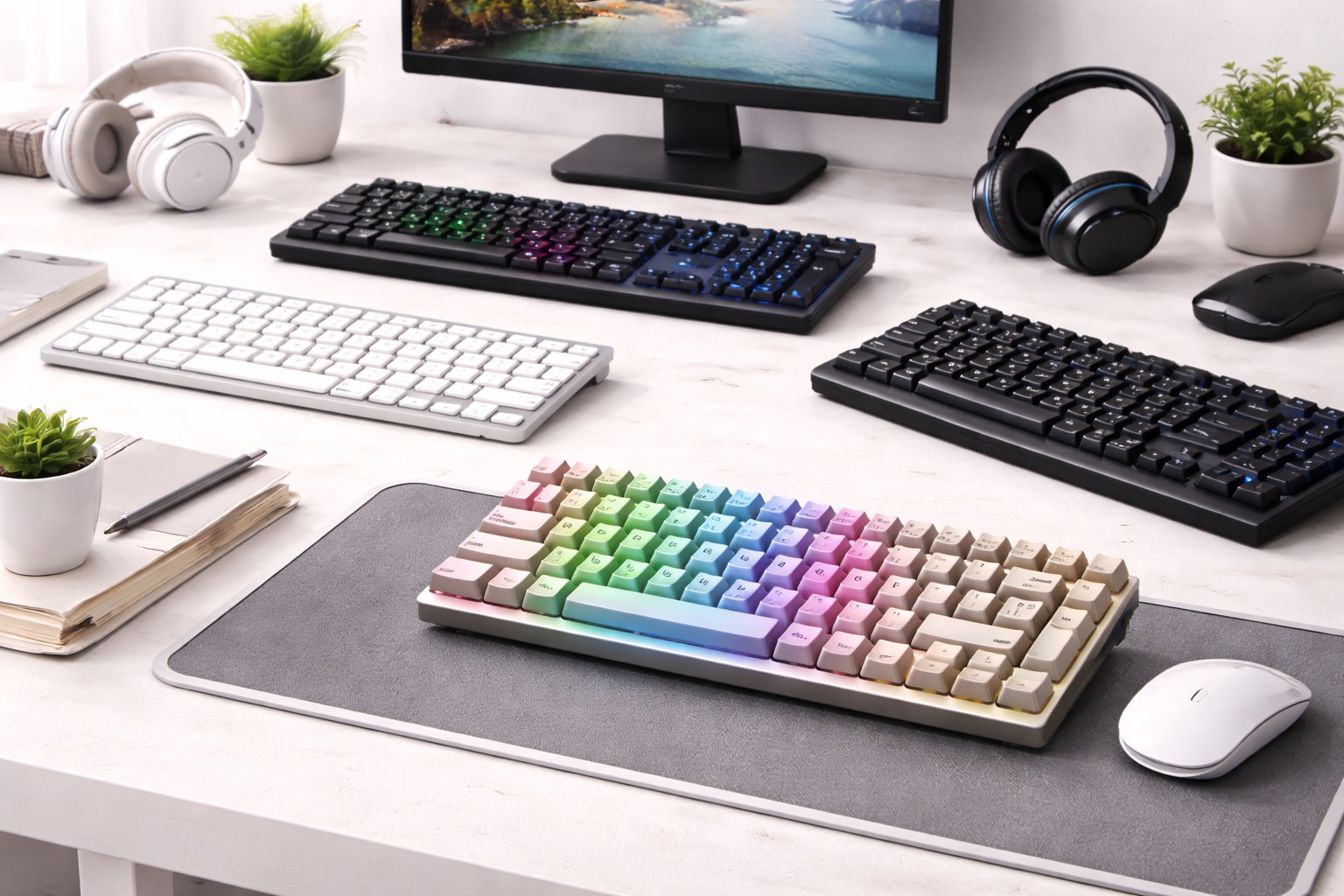
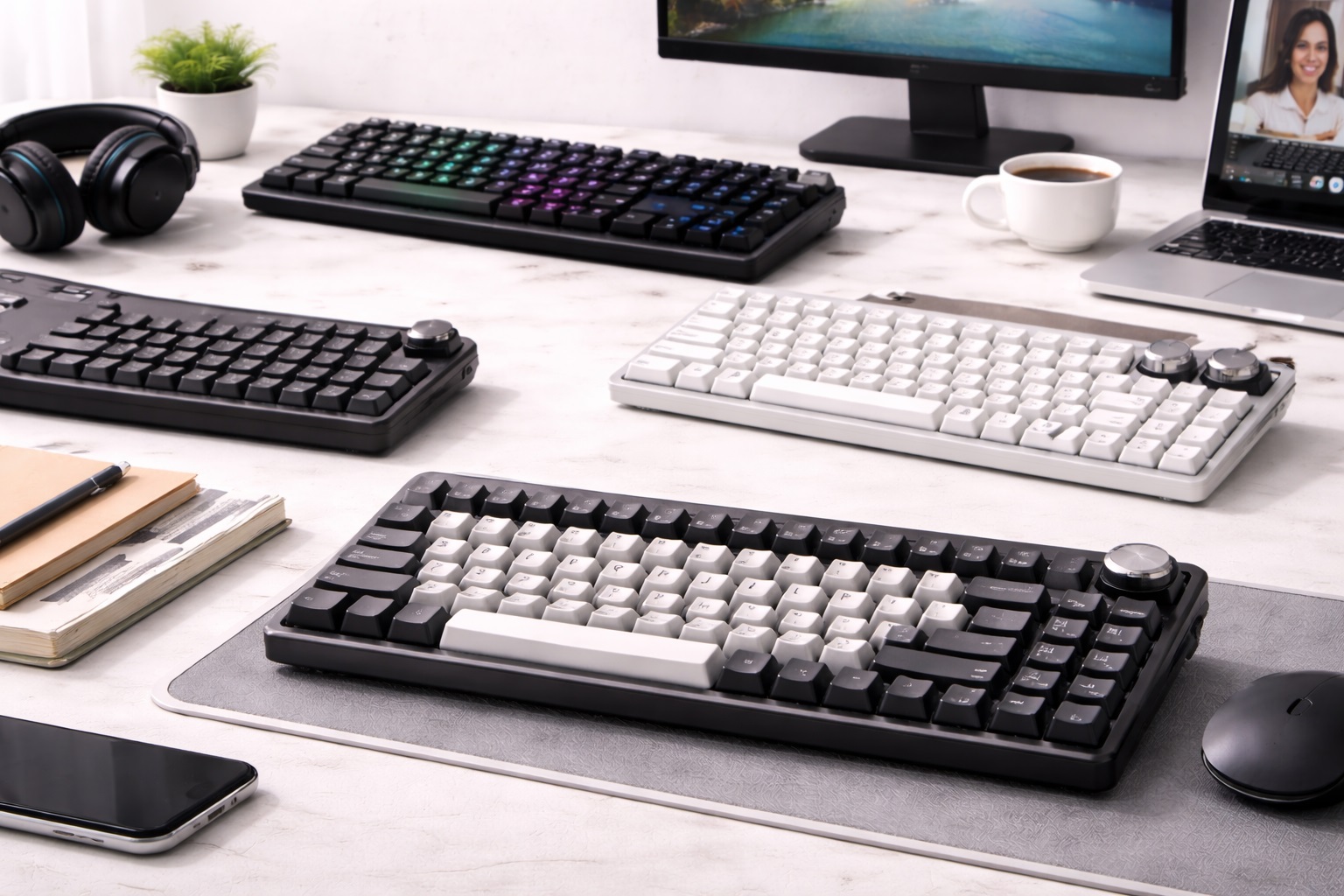
We've compared three practical categories for this exact use case: wireless mechanical keyboards that deliver satisfying feedback while staying quiet enough for calls when paired with the right switch type, silent membrane keyboards built specifically around noise reduction, and compact TKL or 60% layouts that reduce the sheer number of keys within range of a microphone. None of these is automatically the right answer — the correct choice depends on how much you value tactile feedback against how strict your meeting environment actually is about noise.
The reviews below break down where each style succeeds and where it falls short specifically for call-heavy remote work, and the buying guide that follows covers the acoustic and ergonomic factors that don't always show up clearly in a product listing.
Top 3 Keyboards for Calls & Meetings (Detailed Reviews)
1. Wireless Mechanical Keyboard – Best For Typing Feel Without Cable Clutter on Calls
A wireless mechanical keyboard combines the tactile feedback and durability of mechanical switches with cable-free Bluetooth or 2.4GHz connectivity, which matters on a cluttered call setup where cable management around a webcam and headset is already a minor headache. Mechanical switches typically last 50 to 100 million keystrokes, making the keyboard a genuine long-term investment rather than something you'll be replacing every year. For call-heavy use specifically, the switch type you choose within this category matters enormously — quieter linear or silent-tuned switches keep the tactile feel while avoiding the sharp click that carries clearly through an open microphone.
Most modern wireless mechanical keyboards include USB-C charging and support pairing with multiple devices, letting you switch between a work laptop and a personal machine without re-pairing every time. The audible trade-off is real, though: even quieter mechanical switches produce more sound than a membrane keyboard, and if your calls happen in a shared space or your microphone sits close to the keyboard, that difference is noticeable to everyone on the line. Choosing the right switch variant within this category is not optional — it's the entire point if calls are your primary use case. Someone who tests a board with the wrong switch variant installed can end up blaming the whole category for a problem that a simple switch swap, or a different purchase within the same product line, would have solved entirely.
- Pros:
- Excellent typing feedback with mechanical switches, especially over long typing sessions
- Wireless freedom reduces cable clutter around a call setup
- Long switch lifespan makes it a durable long-term choice
- Multi-device pairing supports switching between work and personal machines
- Cons:
- Even quiet-tuned mechanical switches are audible on a sensitive microphone
- Standard clicky or tactile switch variants are genuinely disruptive on calls
Best For: Remote workers who type heavily between calls and want mechanical feel, provided they specifically choose a quiet-tuned switch variant.
Why We Recommend It: For anyone who spends significant time typing outside of calls and doesn't want to sacrifice feel entirely, a wireless mechanical keyboard built around quiet switches offers the best middle ground — satisfying feedback for solo work with acceptable noise for occasional note-taking during meetings.
2. Silent Membrane Keyboard – Best For Meetings in Shared or Sensitive Environments
Silent membrane keyboards use rubber dome switches beneath a silicone membrane that muffles key sound dramatically compared to any mechanical alternative, making this the safest default choice for anyone whose calls happen in an open office, a shared household, or any setting where keyboard noise has previously been flagged as a problem. Modern membrane designs have improved considerably over older, mushier models, offering more consistent key response while retaining the fundamentally quiet acoustic signature that makes the category useful for this exact scenario.
The typing feel is softer and less precise than mechanical switches, which some heavy typists notice and dislike over long sessions, and the keyboards generally don't match mechanical designs for total lifespan. For call-focused use specifically, though, that trade-off is usually worth it: a membrane keyboard lets you take notes, type responses, or jot down action items during a meeting without anyone on the call noticing you're typing at all, which is precisely the requirement this category is built to solve. Anyone who has previously been asked mid-meeting to "hang on, let me stop typing" tends to notice the difference within the first few calls after switching to a genuinely quiet membrane board.
- Pros:
- Quiet enough that typing during a live call goes unnoticed by other participants
- Generally more affordable than mechanical alternatives
- Wireless options are widely available for a clean call setup
- Lighter and thinner than most mechanical keyboards, easier to tuck away
- Cons:
- Softer, less precise typing feedback than mechanical switches
- Shorter typical lifespan than mechanical designs under heavy daily use
Best For: Anyone whose calls happen in a shared office, open floor plan, or household where keyboard noise has been a specific, previously noticed issue.
Why We Recommend It: When avoiding any distraction during a call is the top priority — more important than typing feel or long-term durability — a genuinely quiet membrane keyboard solves the problem directly and without compromise, which is exactly what this use case calls for.
3. Compact TKL or 60% Keyboard – Best For Minimizing Noise Exposure Near Your Microphone
Tenkeyless (TKL) keyboards remove the number pad to reduce overall width by roughly 20%, and 60% keyboards go further, removing the function row and navigation cluster for an even smaller footprint. For call-specific use, the practical benefit isn't just desk space — a smaller keyboard can generally sit farther from a desk-mounted microphone or be positioned outside its primary pickup radius, which reduces how much keystroke noise actually reaches the call regardless of switch type.
Both formats are available in either mechanical or membrane switch variants, so the noise reduction from a smaller footprint stacks with the switch choice you make within it — a compact membrane board positioned away from the mic is about as quiet a combination as this category offers. The adjustment period for missing keys, particularly on a 60% layout where function keys require a secondary key combination, is a genuine consideration if you rely on those keys regularly during calls for screen sharing or presentation controls.
- Pros:
- Smaller footprint allows positioning farther from a desk microphone
- Available in both mechanical and membrane switch variants
- More portable for anyone moving between a home office and a coworking space
- Frees up desk space for notes or a second monitor during calls
- Cons:
- Missing number pad and navigation keys require an adjustment period
- Function keys on 60% models require a secondary key combination, which can slow you down mid-call
Best For: Users with a desk-mounted microphone who want the physical distance between keyboard and mic to do some of the noise-reduction work.
Why We Recommend It: Distance from the microphone is an underrated factor in call noise, and a compact layout gives you more flexibility in desk arrangement than a full-size board, especially when combined with quieter switches for a genuinely low-noise call setup.
Buying Guide: How to Choose the Best Keyboard for Calls & Meetings
Use these fifteen factors to evaluate a keyboard specifically for call and meeting use, rather than general typing performance alone.
1. Switch Type and Acoustic Signature
Mechanical switches vary enormously in loudness — clicky switches (like Cherry MX Blue) are the loudest and least suitable for calls, while linear switches (like MX Red) are quieter, and silent-tuned linear switches (like MX Silent Red) are specifically engineered to minimize noise through an internal dampening ring or stem design. Membrane keyboards are quieter than nearly all mechanical options by default, since there's no physical switch housing to produce a click at all. Match your switch choice to how strict your call environment actually is, and don't assume a keyboard marketed as "office friendly" is automatically quiet enough — check independent sound tests specifically.
2. Microphone Proximity and Pickup Pattern
How much keyboard noise reaches your call depends heavily on your microphone's position and pickup pattern, not just the keyboard itself. A directional microphone positioned away from the keyboard picks up far less typing noise than an omnidirectional one sitting right next to it, regardless of switch type. Headset microphones that sit close to your mouth and point away from the desk generally perform best here, while built-in laptop microphones tend to pick up considerably more ambient keyboard noise since they're often positioned closer to the keys.
3. Keycap Material and Fit
Loose-fitting or thin keycaps can produce a rattling sound distinct from the switch noise itself, adding to overall acoustic signature in a way that's easy to overlook when evaluating switch type alone. PBT keycaps generally fit more precisely and produce less incidental rattle than looser ABS caps on lower-cost boards, and thicker keycap walls tend to dampen resonance better than thin, hollow-sounding caps.
4. Typing Speed and Feedback Needs
If you type extensively between calls — drafting documents, coding, or writing notes — typing feel matters for comfort and speed, not just call noise. Balancing genuine typing preference against acoustic requirements is the core tension this entire buying decision revolves around, and it's worth being honest with yourself about which matters more for your specific daily routine before settling on a switch type.
5. Wireless Connectivity for a Clean Call Setup
Bluetooth keyboards reduce cable clutter around a webcam and headset setup, which matters more on video calls where your desk is visible on camera. 2.4GHz USB receivers offer marginally lower latency but require a dongle, which is a minor consideration for typing-only use during calls. Either connection type is generally reliable enough for meeting use, so this factor comes down more to desk tidiness than functional performance.
6. Keyboard Feet and Desk Stability
A keyboard that shifts or vibrates against the desk during typing adds an additional noise source beyond the switches themselves. Rubberized feet that grip the desk surface reduce this incidental noise, which matters more on hard desk surfaces than on a padded desk mat, and a keyboard that slides during fast typing is also more likely to bump into a nearby microphone stand or cable.
7. Layout Size for Your Desk Setup
A full-size layout with a number pad takes up more desk space, which matters on a call-focused setup where a webcam, notes, and possibly a second monitor also need room. TKL and compact layouts free up space directly in front of your camera and monitor, which can also improve your on-camera framing if your keyboard was previously visible in frame.
8. Function Key Accessibility
If you regularly use function keys for screen sharing, mute toggles, or presentation controls during calls, a full-size or TKL layout with dedicated function keys avoids the extra step of a function-layer combination that a 60% board requires, which can otherwise cost you a second or two of fumbling mid-presentation.
9. Backlighting Necessity for Video Visibility
Backlighting is mostly irrelevant to call noise but worth considering if your desk setup has low ambient light and your hands are occasionally visible on camera. RGB lighting specifically can be distracting on camera and is worth disabling or choosing a single, subtle color during calls, since shifting colors in the background or foreground of a video feed can pull attention away from what you're actually presenting.
10. Noise Testing Before Committing
Because acoustic signature is difficult to judge from a spec sheet alone, look specifically for video reviews that include typing sound tests, ideally recorded through a microphone similar to what you use for calls, rather than relying on written descriptions of "quiet" or "loud." Two keyboards can both be marketed as quiet while sounding meaningfully different once you actually hear a side-by-side recording.
11. Battery Life for All-Day Meeting Schedules
A wireless keyboard running out of charge mid-meeting is a genuine disruption. Check expected battery life against your actual daily meeting load, and favor USB-C rechargeable designs that can be topped up quickly during a short break between calls, since a keyboard that needs replaceable batteries is less convenient to top up on short notice between back-to-back meetings.
12. Programmability for Meeting Shortcuts
Some keyboards support onboard macro programming, which can be used to create one-key shortcuts for muting, camera toggling, or opening meeting software, reducing the number of keystrokes — and therefore noise — needed during a call. Onboard programmability that doesn't rely on proprietary software is particularly useful if you switch between a work laptop and a personal computer throughout the day.
13. Desk Surface and Mat Damping
The surface a keyboard sits on affects how much incidental vibration and resonance carries beyond the keys themselves. A hard desk surface, especially glass or bare wood, tends to amplify low-frequency thump from bottoming out a keystroke, while a padded desk mat absorbs a meaningful portion of that vibration before it can travel into the desk and, from there, into a desk-mounted microphone stand. This is a low-cost addition worth considering before assuming a keyboard itself is too loud for your setup.
14. Keyboard Chassis Material and Resonance
A keyboard's internal case material changes how switch noise resonates rather than originates. Hollow plastic cases with thin internal bracing tend to amplify a hollow, clacky undertone beneath each keystroke, while keyboards with foam dampening layers or denser internal construction absorb more of that resonance before it becomes audible. Two keyboards using an identical switch can still sound noticeably different on a call purely because of this internal construction difference, which rarely appears anywhere on a spec sheet.
15. Hot-Swappable Switches and Long-Term Flexibility
Some mechanical keyboards use hot-swappable sockets that let you change switches without soldering, which is worth checking if you're not fully certain a given switch's acoustic profile will suit your call environment long-term. Buying a hot-swappable board means a wrong first guess on switch type isn't a wasted purchase — you can simply swap in quieter switches later without replacing the entire keyboard, extending the useful life of an otherwise good chassis and keycap set.
16. Cable and Dongle Management for a Tidy Call Setup
Even a wireless keyboard often ships with a USB-C charging cable and a small 2.4GHz dongle, both of which can add visual and physical clutter to a desk that's already on camera during calls. A keyboard that stores its dongle inside the chassis when not in use, or one that charges quickly enough that you rarely need the cable connected during a call, keeps the visible setup cleaner. This is a minor factor compared to switch type, but it compounds with everything else on a desk built around minimizing distraction during meetings.
Frequently Asked Questions
1. What's the quietest type of keyboard for video calls?
Silent membrane keyboards are typically the quietest option available, since there's no discrete mechanical switch housing to produce an audible click. Among mechanical keyboards, switches specifically labeled as silent or silent linear (such as silent red variants) reduce noise substantially while keeping some tactile feedback, though they still won't match a membrane keyboard's near-silence, particularly on the bottom-out sound when a key is pressed fully.
2. Will my microphone pick up keyboard noise even with a quiet keyboard?
It depends on microphone type and position. A directional headset microphone positioned away from the keyboard picks up far less noise than a desk-mounted microphone sitting close to the board, regardless of how quiet the keyboard itself is, so upgrading your microphone setup can sometimes solve the problem more effectively than upgrading the keyboard alone.
3. Should I mute myself before typing during a call?
If your keyboard is genuinely quiet and positioned appropriately relative to your microphone, muting for routine note-taking usually isn't necessary. For any keyboard with audible mechanical switches, muting during heavy typing remains good call etiquette, especially in larger group calls where several participants might be typing simultaneously.
4. Can I use a mechanical keyboard for calls if I choose the right switches?
Yes, provided you select silent or silent-linear switch variants specifically. Standard clicky or tactile mechanical switches remain noticeably audible on most calls and are not a good match for this use case, so it's worth confirming the exact switch designation before purchasing rather than assuming all mechanical keyboards behave similarly.
5. Does keyboard position relative to my microphone actually matter?
Significantly. Increasing the physical distance between the keyboard and a desk-mounted microphone reduces pickup noise meaningfully, even without changing the keyboard itself. This is one of the simplest and most overlooked fixes for call noise complaints, and it costs nothing beyond rearranging your existing desk setup.
6. Is the most expensive keyboard for calls always the best choice?
Not necessarily. Price often reflects build materials, programmability, or premium switches rather than acoustic performance specifically. A mid-range keyboard with genuinely quiet switches usually outperforms an expensive keyboard with loud clicky switches for this exact use case, so focus your budget on the specific acoustic and ergonomic features that matter for your routine.
7. How long should a quality keyboard for calls last?
A well-built keyboard from a reputable brand typically lasts two to five years or longer with regular use. Mechanical switches generally outlast membrane switches in raw keystroke lifespan, though both should comfortably cover several years of daily meeting use before any noticeable degradation in feel or acoustic behavior.
8. Can I return a keyboard if it turns out to be too loud on calls?
Most retailers offer a 15 to 30 day return window, which is generally enough time to test the keyboard through several real calls. Keep original packaging until you've confirmed it performs acceptably during an actual meeting, not just in a quiet room by yourself, since the acoustic experience over a live microphone can differ noticeably from how a keyboard sounds to your own ears.
9. What's the best overall choice for someone who takes calls all day and types heavily between them?
A wireless mechanical keyboard with silent-tuned switches typically offers the best balance for this specific pattern, preserving typing feel for solo work while staying reasonably quiet during the calls themselves. It's worth pairing that keyboard choice with a directional microphone for the best combined result.
10. Does brand name matter when choosing a keyboard for calls?
Established brands generally offer more consistent switch quality control and clearer specifications about acoustic tuning. Independent noise-test reviews matter more than brand reputation alone, since acoustic performance varies significantly even within a single manufacturer's lineup, sometimes between otherwise similar models in the same product line.
11. Are wireless keyboards inherently quieter than wired ones?
No — connectivity type has no direct effect on switch noise. Wireless simply removes cable clutter from your desk setup. Acoustic performance depends entirely on switch type, keycap fit, and desk stability, not on whether the keyboard is wired or wireless, so don't assume a wireless label implies anything about how loud the switches themselves are.
12. Should I test my keyboard's noise level with my actual headset before relying on it for calls?
Yes. Recording a short test call with a colleague, or reviewing a recorded meeting, is the most reliable way to confirm your specific keyboard and microphone combination is acceptably quiet, since acoustic experience varies by desk, room, and hardware combination in ways that generic online reviews can't fully predict for your particular setup.
13. Does a desk mat actually help reduce keyboard noise?
Yes, to a meaningful degree. A padded desk mat absorbs vibration and low-frequency thump before it travels through the desk surface, which is particularly useful on hard desks like glass or bare wood where sound otherwise resonates more freely. It's a low-cost addition worth trying before assuming the keyboard itself needs replacing.
14. Are hot-swappable mechanical keyboards worth it for this specific use case?
Often, yes. Since acoustic preference is hard to judge perfectly before real-world call testing, a hot-swappable board lets you correct a wrong switch choice later without buying an entirely new keyboard. This flexibility is particularly valuable if you're not certain in advance how strict your specific meeting environment will turn out to be.
15. Do rubber O-ring dampeners help quiet down louder mechanical switches?
They can help modestly. O-rings installed under keycaps reduce the bottom-out noise when a key is pressed fully, softening the sharpest part of the sound, though they don't address the initial click of a clicky switch itself. For genuinely quiet call use, choosing a silent-tuned switch from the outset is more effective than trying to dampen a loud switch after the fact.
16. Does the dongle or charging cable that ships with a wireless keyboard matter much?
Not for noise, but it can matter for a tidy on-camera desk setup. A dongle that stores inside the keyboard when not paired, and fast enough charging that the cable rarely needs to stay connected during a call, both reduce visible clutter. It's a small convenience factor worth checking once the core acoustic and ergonomic questions are already settled.
Final Verdict
- Best Overall for Calls: Wireless Mechanical Keyboard with silent switches – satisfying feel without excessive noise, once the right switch variant is chosen.
- Best for Shared or Sensitive Environments: Silent Membrane Keyboard – the safest default when avoiding any distraction is the top priority.
- Best for Microphone-Sensitive Setups: Compact TKL or 60% Keyboard – reduces noise exposure through smaller footprint and flexible desk positioning.
The right keyboard for calls depends on how much typing feel you're willing to trade for acoustic discretion, and how strict your specific meeting environment actually requires you to be. Test any serious contender through a real call with a colleague before committing, since the difference between a keyboard that sounds fine in an empty room and one that sounds fine over a live microphone can be considerable.