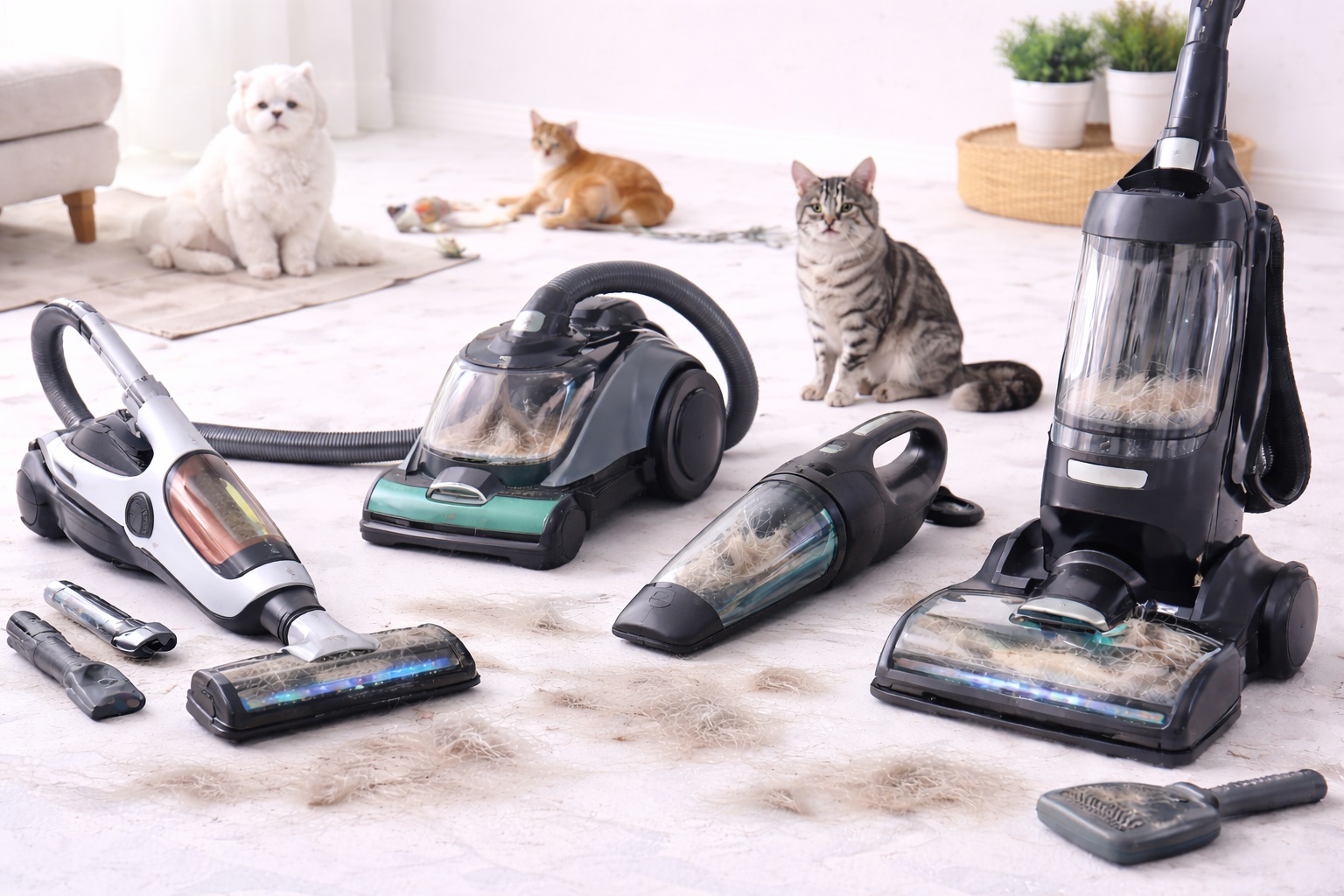
Best Durable Pet Vacuums: Built to Handle Years of Heavy Pet Hair Cleaning
Multi-pet households and heavy shedding environments put a very different level of stress on a vacuum than an occasional single-pet cleaning routine. Daily use, larger volumes of hair and dander, and more frequent emptying all accelerate wear on motors, brush rolls, and seals. A vacuum that looks identical on paper to a lighter-duty model can fail within a year under this kind of sustained demand, while a genuinely durable design keeps performing consistently for several years under the same conditions.
Households sometimes assume that a higher price automatically signals better durability, but this is not consistently true across the vacuum market. Plenty of expensive models emphasize smart features, app connectivity, or sleek industrial design rather than the specific structural and mechanical choices that actually determine how long a machine lasts under demanding daily use. Durability is not always obvious from a spec sheet or a showroom demonstration. It shows up in motor housing quality, how well seals hold up against dust intrusion, whether the brush roll bearings are sealed against fine hair working its way in, and how the manufacturer has designed the unit's most heavily used moving parts. Reviews written many months or years after purchase, describing real long-term use, tend to reveal far more about durability than any initial unboxing impression ever could.
This guide compares three vacuum categories known for holding up well under heavy, sustained pet hair demands, walks through the specific durability factors worth checking before buying, and answers the most common questions from owners trying to avoid a vacuum that wears out well before its time.
Top 3 Durable Pet Vacuums (Detailed Reviews)
1. Commercial-Grade Upright Vacuum – Best for Sustained Daily Heavy Use
A commercial-grade upright vacuum is engineered from the outset for hours of daily operation rather than occasional home cleaning, which makes it a strong match for multi-pet households generating heavy hair volume every day. These models typically use more robust motor housings, metal internal components in places consumer models use plastic, and brush rolls rated for extended continuous operation without overheating. The trade-off is a higher upfront cost and a simpler feature set than premium consumer models.
- Pros:
- Motor and components engineered for continuous daily operation
- Simpler design with fewer failure-prone electronic features
- Metal components in high-wear areas outlast plastic equivalents
- Typically backed by longer commercial-grade warranties
- Cons:
- Fewer smart or convenience features than premium consumer models
- Heavier overall build than lightweight consumer alternatives
Best For: Multi-pet households or anyone vacuuming daily who wants a machine engineered specifically for sustained heavy-duty performance over many years.
Why We Recommend It: Commercial-grade construction directly addresses the wear pattern heavy pet hair households actually experience. The simpler design also means fewer electronic components that can fail, which contributes meaningfully to a longer working life under daily demand.
Owners who have previously worn out one or more consumer-grade vacuums under heavy pet hair use often find that stepping up to a commercial-grade model, despite the higher initial cost, actually reduces total spending over a five-year period once replacement cycles are factored in.
The straightforward mechanical design also tends to be easier to troubleshoot when something does go wrong, since there are fewer sensors, circuit boards, or proprietary electronic modules standing between a visible symptom and its underlying cause.
2. Bagged Upright with Sealed HEPA System – Best for Long-Term Filtration Reliability
A bagged upright vacuum with a fully sealed HEPA filtration system tends to hold up exceptionally well under heavy, sustained pet hair loads, since bags contain fine dust and dander more completely than many bagless bins, reducing internal component exposure to abrasive fine particles over time. The sealed system design also prevents the gradual performance degradation that can affect bagless models as seals wear and airflow paths develop small leaks.
- Pros:
- Sealed bag system reduces internal dust exposure and wear
- Consistent suction performance maintained over more years of use
- HEPA filtration remains effective longer with less internal contamination
- Simpler emptying process reduces spillback and mess
- Cons:
- Ongoing bag replacement is a ongoing cost bagless models avoid
- Heavier shedding households need to budget for more frequent bag changes
Best For: Heavy shedding, multi-pet households prioritizing long-term consistent performance and willing to accept the ongoing cost of replacement bags.
Why We Recommend It: The sealed bag system's protective effect on internal components is a genuine durability advantage under heavy pet hair loads specifically, even though it comes with an ongoing consumable cost that bagless designs avoid.
Households that have struggled with bagless vacuums losing suction and requiring more frequent internal cleaning under heavy pet hair volume often find the switch to a sealed bagged system meaningfully reduces both maintenance time and the frequency of performance complaints over several years of ownership.
Buying bags in bulk when a favored brand runs a sale is a simple way to offset the ongoing cost disadvantage of this category, and most bags store indefinitely without any degradation while waiting to be used, making a larger stock-up purchase a reasonable way to lock in savings ahead of a price increase.
3. Corded Canister Vacuum with Metal Wand and Reinforced Hose – Best for Long-Term Structural Reliability
A corded canister vacuum built with a metal telescoping wand and a reinforced, kink-resistant hose avoids one of the most common failure points in lighter-duty vacuums — cracked plastic wands and hoses that develop leaks or splits after repeated flexing. For households using the vacuum daily across multiple rooms and stairs, this structural durability directly extends the unit's working life beyond what a plastic-wand equivalent typically achieves.
- Pros:
- Metal wand resists cracking and breaking under repeated daily use
- Reinforced hose avoids common kink and leak failure points
- Corded design avoids battery degradation entirely
- Canister motor unit typically outlasts integrated stick vacuum motors
- Cons:
- Bulkier to store and maneuver than lightweight stick alternatives
- Hose and wand combination takes some adjustment for new users
Best For: Households wanting maximum structural longevity from the physical components most prone to wear and breakage under daily heavy use.
Why We Recommend It: The metal wand and reinforced hose specifically target the components that fail first in lower-durability vacuums. For households that value structural longevity above convenience features, this combination delivers the most reliable long-term performance.
Because the motor and electronics live in a separate canister unit rather than integrated into a handheld or stick body, this design also tends to be easier and cheaper to repair when something eventually does need attention, since individual components can often be serviced or replaced independently.
Households with stairs or multiple levels particularly benefit from this format's long-term reliability, since the wand and hose absorb the bulk of the physical stress from repeated stair-climbing use that would otherwise fall on a rigid stick vacuum's more integrated body.
Buying Guide: How to Choose the Best Durable Pet Vacuum
Durability shows up in specific design and material choices rather than a single overall rating, so check each of the following before assuming a model will hold up under heavy pet hair demands.
1. Motor Housing and Heat Dissipation
Motors under sustained heavy use generate more heat, and housings designed with adequate ventilation and heat dissipation last longer than tightly sealed, poorly ventilated designs that can suffer premature motor wear from overheating.
Reviews mentioning extended vacuuming sessions across multiple rooms without the motor audibly straining or the unit becoming noticeably hot to the touch are a good sign of adequate heat management in the design.
Manufacturers who publish duty-cycle ratings, describing how long a motor can run continuously before needing a cooldown period, give a more concrete answer than general marketing language about power and performance alone.
2. Material Quality in High-Wear Areas
Wands, hose connectors, and brush roll housings experience the most repeated stress. Metal or reinforced composite materials in these specific areas outlast standard plastic significantly under daily flexing and use.
Examining specific joint and connector points in product photos or unboxing videos, rather than relying on general material descriptions, gives a more accurate sense of where a manufacturer invested in durability and where they cut costs.
A wand that visibly flexes or creaks under normal handling in a store demonstration is a reasonable early warning sign, whereas a solid, minimal-flex feel generally correlates with better long-term structural performance.
3. Sealed Brush Roll Bearings
Fine pet hair and dander can work into unsealed brush roll bearings over time, gradually degrading rotation smoothness and motor efficiency. Sealed bearing designs resist this intrusion and maintain smoother operation over more years of heavy use.
A brush roll that still spins freely and quietly after extended heavy use, without an audible grinding or resistance developing, is one of the clearest signs that bearing sealing has been done well.
Multi-pet households with a mix of long and short-haired animals should pay particular attention to this feature, since the combination of fine and coarse hair together tends to work into unsealed bearings faster than either hair type alone.
4. Filtration System Type and Seal Quality
A fully sealed filtration path, whether bagged or bagless, protects internal components from abrasive fine dust exposure better than a system with small air leaks around poorly fitted seals or gaskets.
Over time, poorly sealed systems tend to show gradually declining suction that no amount of filter cleaning fully restores, which is a strong signal that dust has been bypassing the filter and affecting internal components directly.
Testing suction immediately after a full filter clean and comparing it against suction after several weeks of heavy use offers a rough, practical way to gauge how well a specific unit's seals are actually holding up in your own home.
5. Warranty Length as a Durability Signal
Manufacturers confident in long-term durability typically back that confidence with longer warranty periods. A vacuum marketed as heavy-duty but backed only by a short warranty is worth additional scrutiny before purchase.
Reading the specific warranty terms, not just the headline length, matters too, since some warranties exclude motor or brush roll components that are actually the most likely to wear under heavy use.
A manufacturer offering an extended warranty as a paid add-on, beyond the standard coverage, can also be a useful signal of how confident they are in their own product's reliability once the standard period expires.
6. Repairability and Service Network Availability
A vacuum that can be professionally serviced when a component eventually fails has a meaningfully longer effective lifespan than one designed to be replaced outright at the first significant failure.
Checking whether authorized repair centers exist in your region before buying avoids discovering, only after a failure occurs, that a specific brand offers no practical repair option where you live.
Some manufacturers also offer mail-in repair services even without a local service center, which is worth checking as an alternative if no repair option exists nearby but the brand otherwise scores well on other durability factors.
7. Replacement Part Availability Over Time
Even the most durable vacuum eventually needs a replacement brush roll, filter, or belt. Confirm that these parts remain available for the specific model years into the future, not just at the time of purchase.
Manufacturers with a long track record of supporting older models with replacement parts are generally a safer bet than newer brands without an established history of long-term parts availability.
Buying a spare brush roll or filter at the same time as the initial purchase is a reasonable hedge for heavy-use households, ensuring a replacement is on hand even if a specific part is discontinued or becomes harder to source later.
8. Build Weight as a Durability Indicator
While not universally true, a noticeably heavier unit for its size sometimes indicates more substantial internal components rather than the thinnest possible plastic shell used to minimize manufacturing cost.
This should be weighed against maneuverability needs, since the most durable option is not useful if its weight discourages regular use, so balance this factor against your own physical comfort using the machine.
Testing the actual weight in person, including lifting it up a flight of stairs if that is part of your regular routine, gives a more realistic sense of daily comfort than a listed weight figure alone.
9. Bagged Versus Bagless Long-Term Trade-offs
Bagged systems tend to protect internal components better over time by containing fine dust more completely, while bagless systems avoid ongoing bag costs but expose components to more direct dust contact during use and emptying.
Heavy shedding, multi-pet households specifically may find the durability advantage of a bagged system worth the ongoing bag expense, while lighter-shedding households may reasonably prioritize the lower running cost of bagless design instead.
Calculating the approximate annual bag cost based on your household's typical usage frequency, and comparing that against the durability benefit described in long-term reviews, helps make this trade-off decision more concretely rather than abstractly.
10. Cord and Cable Strain Relief Design
For corded models, the point where the cord exits the vacuum body is a common failure point under repeated winding and unwinding. Reinforced strain relief at this junction meaningfully extends cord life under frequent daily use.
Avoiding sharp bends or aggressive yanking when storing the cord, and using any built-in cord wrap feature as intended, further extends the life of this vulnerable connection point regardless of the underlying design quality.
A retractable cord mechanism, while convenient, sometimes introduces its own additional failure point over time, so households prioritizing maximum longevity may reasonably prefer a simpler manual wrap-around cord design instead.
11. Independent Long-Term Owner Reviews
Reviews written a year or more after purchase, specifically describing performance under heavy pet hair conditions, are the most reliable durability indicator available, far more so than expert reviews based on short-term testing alone.
Look for patterns across many independent long-term reviews rather than drawing conclusions from a single account, since individual units can vary even within a generally reliable model line.
Owner forums and community discussion groups dedicated to pet-related topics often surface more candid long-term feedback than retailer review sections, since participants there tend to share ongoing experiences rather than a single post-purchase impression.
12. Manufacturer Track Record for Heavy-Duty Models
Brands with an established history of commercial or heavy-duty product lines tend to apply that same engineering discipline to their consumer pet-focused models, more so than brands without any heavy-duty manufacturing background.
Researching a manufacturer's commercial or professional product lineup, even if you are buying a consumer model, gives a useful signal about the engineering standards the company applies across its full range.
A brand that supplies vacuums to commercial cleaning services, hotels, or grooming facilities has necessarily been tested against far more demanding conditions than a typical home ever produces, which is a meaningful indirect signal of durability for a heavy-shedding household as well.
13. Attachment and Accessory Build Quality
Crevice tools, upholstery brushes, and pet-hair-specific attachments see frequent connecting and disconnecting in a heavy-use household, and the connection points themselves are a common early failure spot on otherwise durable machines.
Attachments with metal or reinforced-plastic connector collars tend to hold a snug fit far longer than thin plastic equivalents, which can loosen and rattle after repeated use, eventually reducing suction at the tool head.
Buying a spare motorized pet-hair attachment when it is available as an accessory purchase is worth considering for households that rely on it daily, since this smaller component often wears out well before the main vacuum body does.
14. Vibration and Joint Stress Over Time
Daily operation subjects handle joints, swivel connectors, and hose fittings to repeated vibration and flexing that gradually loosens poorly engineered connections long before the motor itself shows any sign of wear.
A unit that feels tight and rattle-free when new but develops noticeable looseness at joints within the first few months is showing an early warning sign worth taking seriously rather than dismissing as normal break-in.
Manufacturers that use threaded metal fasteners rather than friction-fit plastic clips at major stress points generally produce a unit that resists this kind of gradual loosening far better across years of daily heavy use.
15. Storage Conditions and Environmental Exposure
Where a vacuum is stored between uses affects its lifespan more than many households realize. A garage or unconditioned space subject to temperature swings and humidity can degrade seals, plastics, and electronics faster than climate-controlled indoor storage.
Households in humid climates should pay particular attention to filter and bag storage specifically, since dampness can promote mold growth in a filter that has not fully dried between uses, which also shortens its effective working life.
A simple closet or utility room, kept at a relatively stable indoor temperature, is generally a better long-term storage choice than a garage or unheated basement for households wanting to maximize the working life of an otherwise durable machine.
Frequently Asked Questions
1. What actually makes a pet vacuum more durable than another?
Motor housing quality, sealed brush roll bearings, reinforced high-wear components like wands and hoses, and a sealed filtration system together determine most of a vacuum's real-world durability under heavy pet hair use. No single feature guarantees durability on its own, and a model excelling on paper in one area can still disappoint if it neglects the others.
2. Are commercial-grade vacuums worth it for a heavy-shedding home?
For households vacuuming daily with multiple pets, yes, since commercial-grade engineering is specifically built for the sustained demand this situation creates, often outlasting several consumer-grade replacements over the same period. The simpler feature set is a reasonable trade-off for that added reliability in genuinely heavy-use homes.
3. Do bagged vacuums really last longer than bagless ones?
Under heavy pet hair loads specifically, bagged systems often do last longer, since they contain fine dust more completely and expose internal components to less direct abrasive contact over time, though bagless designs continue to improve in this area with better sealing and pre-filter stages.
4. How can I tell if a vacuum is genuinely built to last before buying it?
Long-term owner reviews, warranty length, and manufacturer track record in heavy-duty product lines are the most reliable indicators available before actually owning the unit yourself for an extended period. No marketing description substitutes for this kind of accumulated real-world evidence.
5. Is the most expensive durable pet vacuum always the best?
Not always. Some mid-range models specifically engineered with sealed bearings and reinforced components outperform pricier options that prioritize convenience features over core durability. Compare the specific engineering details rather than price alone when evaluating durability claims.
6. How long should a genuinely durable pet vacuum last?
A well-built, genuinely durable pet vacuum under heavy daily multi-pet use can often reach five years or more, compared to one to three years for a lighter-duty model under the same demanding conditions. Actual lifespan still depends heavily on how consistently maintenance is performed.
7. Can I return a durable pet vacuum if it doesn't suit me?
Most retailers offer a 15 to 30 day return window, though durability itself is difficult to assess in that short a period. Reading long-term reviews before purchase matters more here than with most other vacuum categories, since the return window cannot substitute for years of use.
8. What should I prioritize when buying a durable pet vacuum?
Prioritize sealed brush roll bearings and reinforced high-wear components first, since these directly address the specific failure points heavy pet hair use accelerates most. Warranty length and repairability are worth weighing next, once those baseline construction factors are confirmed.
9. Does brand name matter for durable pet vacuum?
Yes, more so than in some other vacuum categories. Brands with an established commercial or heavy-duty product history tend to apply more rigorous engineering standards throughout their lineup, even on models marketed toward general consumers.
10. Is a heavier vacuum always more durable?
Not always, but it can be a rough signal of more substantial internal components rather than minimal materials used purely to reduce manufacturing cost, so it is worth considering alongside other durability indicators rather than alone as a deciding factor.
11. How much more should I expect to pay for genuine durability?
Durable, heavy-duty models typically cost somewhat more upfront than standard consumer equivalents, though this premium is often recovered over several years through avoided replacement purchases in heavy-use households facing constant pet hair volume.
12. Can regular maintenance extend a less durable vacuum's lifespan?
Yes, to a meaningful degree. Consistent filter cleaning, brush roll clearing, and gentle handling of cords and hoses can extend almost any vacuum's working life beyond what its base build quality alone would suggest, though it cannot fully compensate for genuinely poor underlying construction.
13. Do extended warranties make sense for durable pet vacuums?
Often, yes, particularly for heavy-use multi-pet households where accelerated wear is more likely to trigger a claim within the extended period than in a lighter-use home. Weigh the extended warranty cost against the price of the specific components most likely to need replacement first, such as the motor or brush roll assembly.
14. Does climate affect how long a pet vacuum lasts?
Yes. Households in humid or high-heat climates tend to see faster degradation of seals, plastics, and filters than those in stable, climate-controlled environments, making indoor climate-controlled storage more valuable for maximizing a vacuum's working life than owners in milder climates might realize.
15. What's the best way to store a vacuum to maximize its lifespan?
A climate-controlled indoor space, away from direct sun exposure and humidity swings, with the cord loosely wrapped rather than tightly cinched, protects seals, plastics, and cord insulation better than garage or basement storage over several years of ownership.
Final Verdict
- Best for Sustained Daily Heavy Use: Commercial-Grade Upright Vacuum — engineered specifically for continuous demanding operation in multi-pet households.
- Best for Long-Term Filtration Reliability: Bagged Upright with Sealed HEPA System — the most consistent performance over years of heavy pet hair volume.
- Best for Long-Term Structural Reliability: Corded Canister Vacuum with Metal Wand and Reinforced Hose — the strongest resistance to the physical wear points that fail first in lighter-duty vacuums.
Genuine durability under heavy pet hair demands comes down to specific engineering choices — sealed bearings, reinforced high-wear components, and protective filtration design — rather than any single headline specification. Use the comparisons and buying factors above to identify a model actually built for the sustained demands of a multi-pet, heavy-shedding household rather than one merely marketed toward pet owners in general.
Choosing durability upfront costs more at the point of purchase, but for households vacuuming daily against a constant tide of pet hair, that investment consistently pays for itself by avoiding the frustration and expense of replacing a worn-out machine every year or two. A vacuum built to actually last through this level of demand becomes one of the more reliable, unremarkable parts of a busy pet household's routine, which is exactly what it should be.
Before finalizing a purchase, take a moment to honestly estimate how many pets you have, how heavily they shed, and how many rooms you realistically vacuum each week. That honest accounting, more than any single spec on a product page, should guide how much you invest in durability versus how much you allocate toward other convenience features.