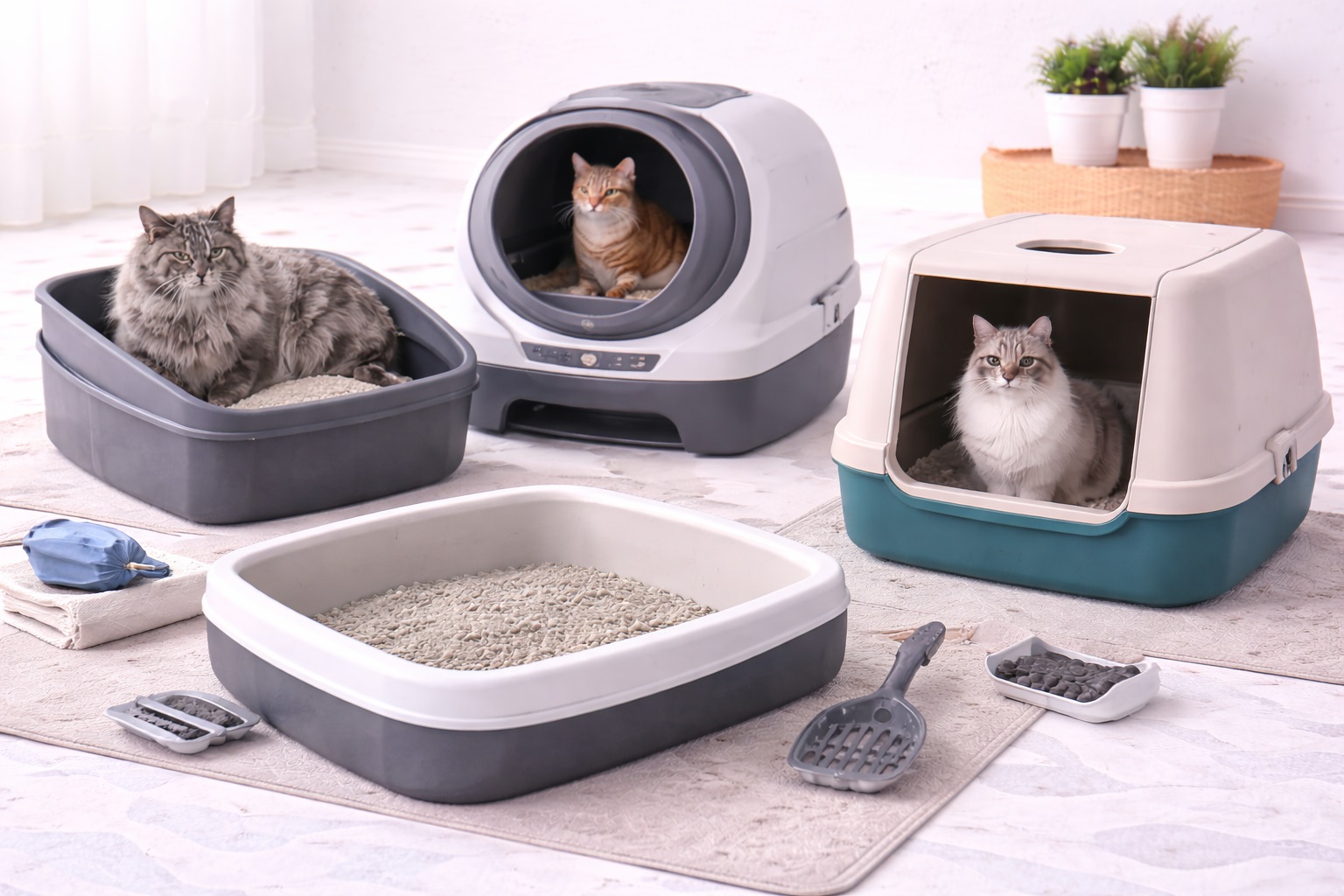
Best Litter Boxes for Large Cats: Room to Move, Less Mess
A cat that outgrows its litter box does not stop needing to go — it just starts looking for somewhere else to do it. That is the practical reality behind most litter box complaints from owners of Maine Coons, Ragdolls, Norwegian Forest Cats, and other large breeds: the box was sized for an average ten-pound cat, and the cat in question weighs closer to eighteen. Squeezing into a cramped pan, turning around without room to do so, or having to hang a back leg over the rim to squat are all reasons a large cat starts avoiding the box entirely.
This guide focuses specifically on what changes when the cat using the box is unusually large — how much interior space actually matters, which enclosed designs still work at that size, and where automation earns its cost. Rather than ranking products by price or popularity, each section below explains the tradeoffs of a design category so you can match the box to your cat's size, your household's pet mix, and how much daily maintenance you're willing to do.
It helps to think of the decision in two stages. First, rule out any design whose interior dimensions cannot physically accommodate your cat comfortably — no amount of clever features makes up for a box that is simply too small. Second, once you have a shortlist of properly sized options, weigh the secondary factors: whether a dog in the house needs to be kept out, how much odor control matters in your living space, and whether you would rather scoop by hand or pay more to automate it. Owners who skip the first step and shop on features alone are the ones most likely to end up with a box their cat quietly refuses to use.
Top Picks Reviewed
1. Top-Entry Enclosed Litter Box – Best for Dog-Proofing and Containment
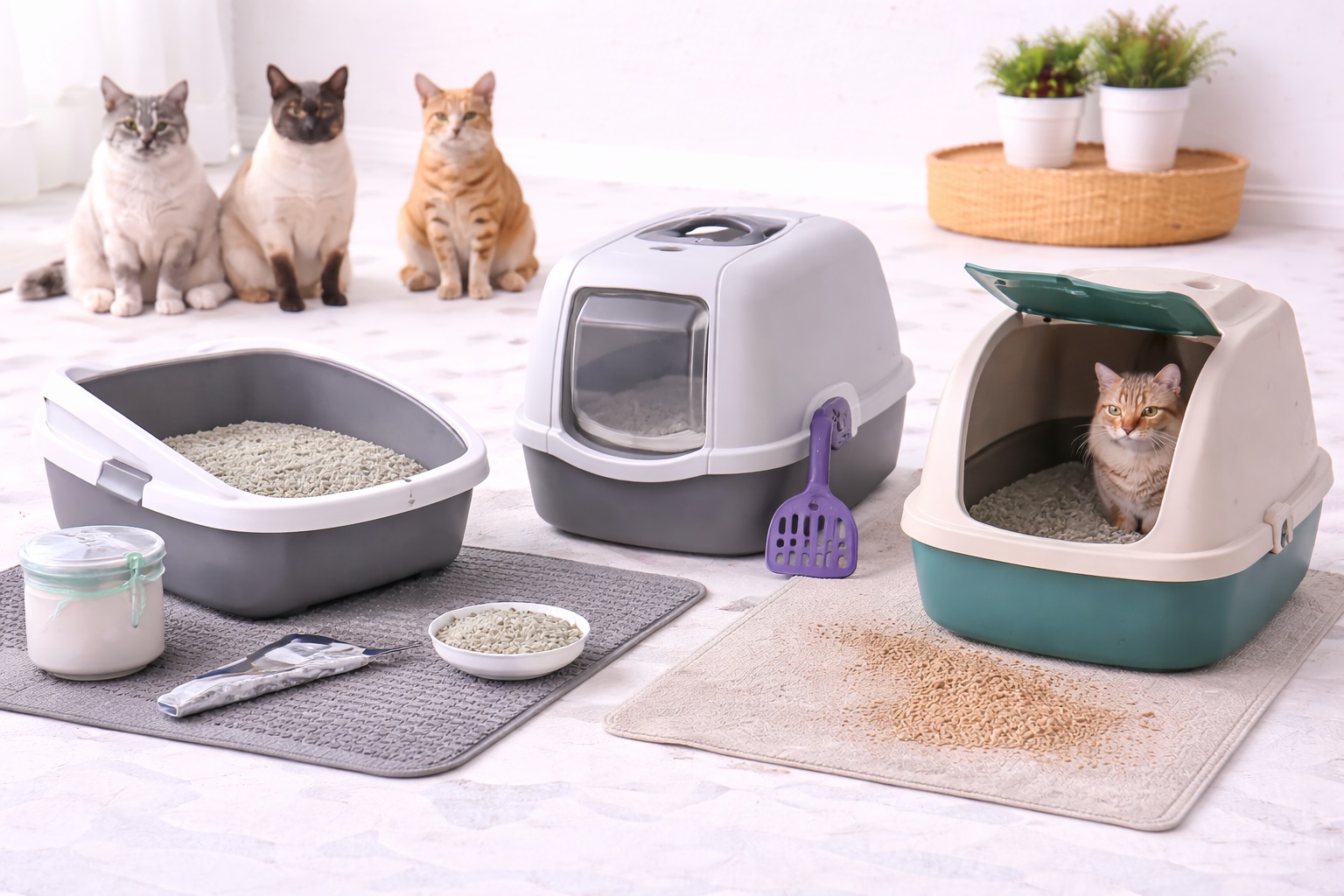
A top-entry box asks the cat to climb in from above rather than walk in through a side opening. For large cats with the leg length and jumping ability to clear the rim easily, this works well and creates a genuinely dog-proof setup, since most dogs cannot replicate the vertical entry. Litter that clings to paws falls back through the top opening on the way out instead of trailing across the floor, and the fully enclosed shell holds odor in far better than an open pan. For this to work at large-cat size, the manufacturer needs to have deliberately built the tunnel and interior chamber wider and taller than a standard model — a generic top-entry box designed around an average-size cat will feel cramped and may discourage use rather than solve the dog-access problem it promises to solve.
- Pros:
- Dogs cannot follow the cat in, which ends a common multi-pet conflict
- Tracking drops sharply because litter is knocked off paws on the way out
- Enclosed walls trap odor more effectively than an open tray
- Large-breed models are built with taller shells to give big cats headroom
- Cons:
- Senior or arthritic large cats may find the vertical climb difficult
- Interior footprint is still constrained by the width of the entry tunnel
Best For: Multi-pet homes where a dog and a large cat share space and the litter box needs to stay off-limits to the dog without a separate room.
Why We Recommend It: It solves three separate annoyances at once — dog access, tracked litter, and escaping odor — in a single design, which is a rare combination for large cats specifically since most top-entry boxes are undersized for anything bigger than a standard cat. Owners who have tried and abandoned a standard top-entry box because their large cat seemed reluctant to use it are often better served trying a properly sized version before ruling the design out altogether.
2. Jumbo Open-Top Litter Box – Best for Maximum Interior Space
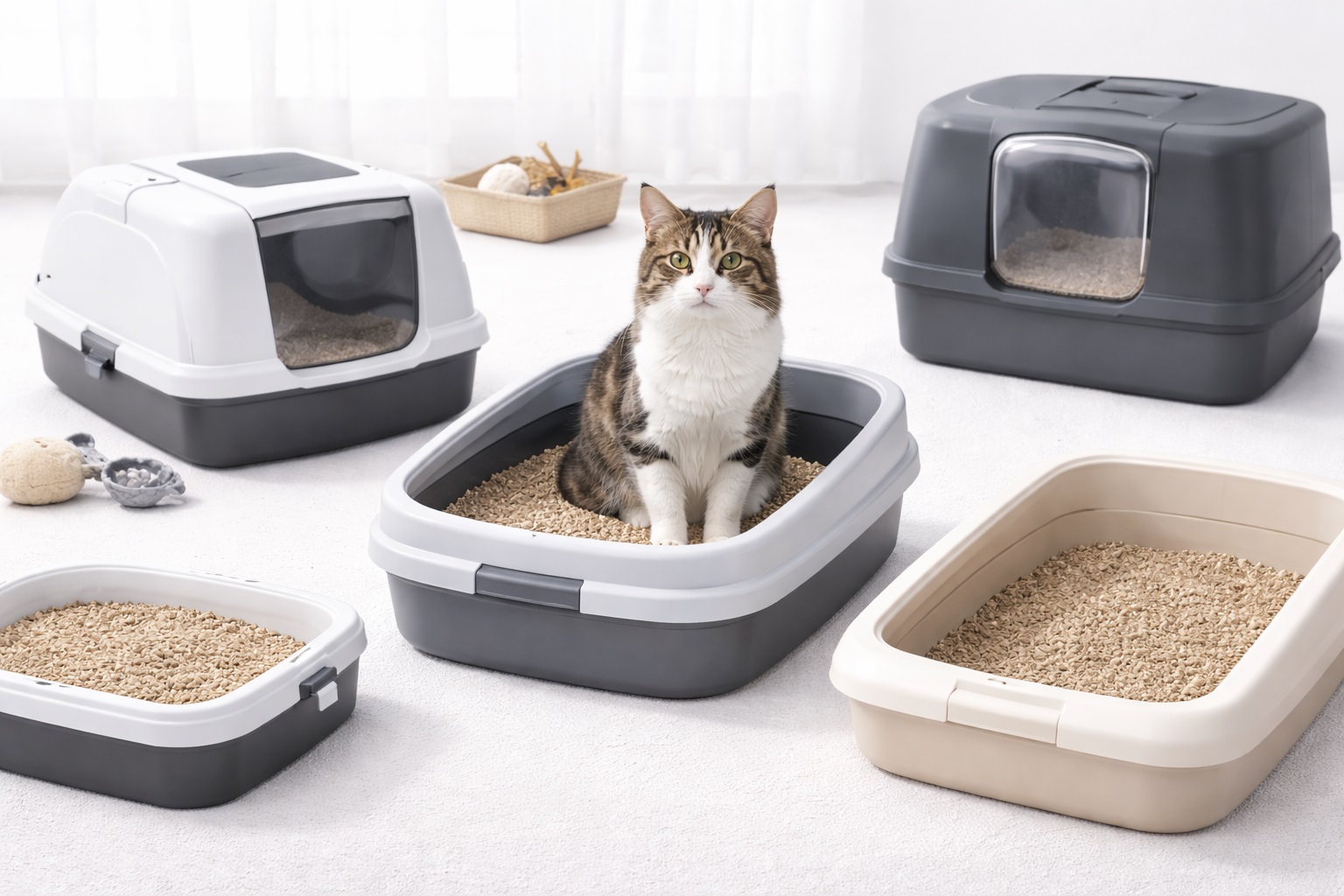
An oversized open pan, often built 30 to 36 inches long with correspondingly deep sides, gives a large cat the one thing a standard box cannot: room to turn a full circle, dig, and position without hanging over an edge. Because there is no lid or tunnel restricting the footprint, every inch of the box is usable floor space. High side walls (8 to 10 inches) help contain kicked litter even without a cover. This is generally the simplest and least expensive path to solving a space problem, since it does not require paying for a hood, an automated mechanism, or a specialized entry design — it simply gives the cat more room to work with.
- Pros:
- Largest usable interior of any common design at this size class
- No entry restriction, so mobility-limited or senior cats can step in easily
- Open top means owners can see waste at a glance and scoop faster
- High side walls reduce scatter despite the lack of a cover
- Cons:
- No odor containment beyond what the litter itself absorbs
- Its footprint often will not fit in a standard litter cabinet or closet nook
Best For: Households with a large-breed cat and no dog to keep out, where floor space for a bigger footprint is available.
Why We Recommend It: Undersized boxes are the single most common reason large cats stop using the litter box, and an oversized open pan removes that constraint entirely rather than compromising with a slightly bigger version of a standard box. It is also the easiest option to test first, since it involves no mechanical parts or unfamiliar entry style for the cat to adjust to — just more of the same experience the cat already knows, at a scale that actually fits.
3. Automatic Self-Cleaning Litter Box (Large-Cat Capacity) – Best for Odor Control and Convenience
Large-capacity automatic boxes use a sensor to detect when the cat has left, then rake waste into a sealed compartment on a delay. Because a bigger cat also means a bigger platform and a heavier daily waste load, look specifically for models rated for large-breed weight and higher clump volume rather than a standard automatic unit. The sealed compartment is what actually controls odor between manual cleanings, not the automation itself. Owners considering this route for a large cat should also check the platform's actual footprint rather than assuming "large capacity" refers to interior space rather than just waste-bin size, since the two are marketed inconsistently across brands.
- Pros:
- Waste is sealed away within minutes of use rather than sitting exposed
- Weight-rated platforms are built to handle repeated heavy-cat use without wear
- Cuts daily manual scooping down to periodic waste-bag changes
- Larger clump-storage capacity means fewer trips to empty it
- Cons:
- Meaningfully more expensive upfront than a manual pan of any size
- Moving mechanical parts need periodic cleaning and occasional part replacement
Best For: Owners who want odor and scooping handled automatically and are willing to pay for a unit rated specifically for large-breed cats.
Why We Recommend It: A standard-size automatic litter box often cannot handle the waste volume or weight of a large cat reliably, so a large-capacity model addresses both the mechanical strain and the odor-control goal that draws people to automation in the first place. It is worth budgeting for the possibility of an occasional service call or replacement part, since more moving components generally means more that can eventually need attention compared with a simple pan.
Buying Guide: How to Choose the Best Litter Boxes for Large Cats
The factors below are specific to what changes once the cat in question is noticeably bigger than average — not a generic litter box checklist. Some of these considerations overlap with general litter box advice, but each one plays out differently once you are shopping for a genuinely large-breed cat rather than an average ten-pound housecat, and treating them as identical is where a lot of otherwise well-intentioned purchases go wrong.
1. Interior Length and Width for Large Breeds
The standard rule of thumb — 1.5 times the cat's body length from nose to base of tail — still applies, but for a Maine Coon or Norwegian Forest Cat that number often lands at 30 inches or more, well past what most boxes sold as "jumbo" actually measure. Check the interior dimensions printed by the manufacturer rather than the box's overall exterior size, since walls and hoods eat into usable space. Also account for hood or dome height if you are considering an enclosed model sized for large cats, since manufacturers advertise overall length more prominently than usable interior length, and the gap between the two figures is often where owners get caught out after purchase.
2. Side Wall Height Versus Entry Height
Tall side walls contain scatter and litter kicked during digging, but they also raise the step-over height at the entry point. For large cats this is rarely a problem at their full adult size, but it matters if the same box will need to serve the cat as a kitten or later as a senior with reduced mobility. A reasonable middle ground for most large cats is a wall around seven inches paired with an entry cutout closer to four inches, which controls scatter without demanding an awkward step-over from a cat with stiffening hips.
3. Weight Rating of the Box Itself
A large cat regularly stepping in, turning, and digging puts more repeated stress on the shell than an average-weight cat does. Cheaper thin-walled plastic can crack or bow under that use over time. Look for a stated weight capacity rather than assuming any "large cat" label means reinforced construction. This becomes especially relevant with hooded or top-entry designs, where the lid or tunnel is a stress point that a heavier cat repeatedly pushes against or lands on when entering. Reading verified owner reviews from people with similarly large cats is often more informative than the manufacturer's own weight specification, since real-world use tends to surface stress points that lab testing on an empty box does not.
4. Number of Boxes for Multiple Cats
The standard guidance is one box per cat plus one spare. This does not change because the cats are large, but it does mean the total floor space required to house that many oversized boxes is considerably more than a household of average-size cats would need, which affects where boxes can realistically be placed. In practice this means a two-cat household with large breeds may need three oversized boxes rather than three standard ones, a space requirement that is easy to underestimate when planning a home around pets.
5. Litter Volume Needed to Fill a Larger Box
A bigger footprint holds more litter at the same depth, which increases the cost of maintaining it and the weight of a full box during cleaning. Filling a jumbo box to the recommended two to three inches of depth can use noticeably more litter per fill than a standard box, a recurring cost worth factoring in before choosing the largest available option. Buying litter in bulk becomes more cost-effective once a household is consistently running one or more jumbo boxes, and tracking how quickly a bag empties helps establish a realistic monthly budget rather than guessing at it. Some owners find it worthwhile to keep a slightly shallower fill depth in a jumbo box than the maximum recommendation, topping it up more frequently rather than always filling to the deepest suggested level, simply to manage the ongoing litter cost.
6. Placement and Household Traffic
Large cats still prefer a quiet, low-traffic spot with a visible escape route, but a jumbo box's larger footprint limits where it physically fits. Measure the intended location before buying rather than after, since a box that will not fit through a doorway or under a shelf defeats the purpose of buying the bigger size. A jumbo box also generates more sound during digging simply because there is more surface area for litter to scatter against, which is worth considering if the box will sit near a bedroom or shared living space. A washable mat placed under and around the box helps contain any litter that does escape regardless of design, and is a cheap addition worth pairing with any large-cat box.
7. Scooping Frequency for Heavier Waste Loads
A larger cat typically produces a larger daily waste volume. Scooping once or twice daily remains the standard recommendation, but with a bigger cat that interval matters more, since waste left in a bigger box is easier for the cat to avoid stepping around and easier for owners to underestimate because it is more spread out. Twice-daily scooping is the more reliable standard in single-box, single-large-cat households for exactly this reason — a bigger box filling up with waste can look deceptively clean at a glance.
8. Litter Type and Clumping Strength
Unscented, fine-grain clumping litter is the most broadly tolerated option for most cats regardless of size. For large cats producing heavier waste, a litter with strong clump integrity matters more, since a clump that breaks apart during scooping leaves debris behind rather than lifting cleanly out. Silica crystal and plant-based alternatives can work for large cats too, but they typically need to be layered deeper to manage the higher waste volume, which affects both ongoing cost and how often the box needs a full changeover. Whatever type you choose, introduce it gradually alongside the current litter rather than switching all at once, since an abrupt change in texture is a common reason cats temporarily avoid the box.
9. Cleaning and Replacement Schedule
Fully emptying, washing, and disinfecting the box every two to four weeks applies at any size. Larger boxes take longer to clean simply because there is more surface area, and heavier daily use from a large cat can wear down plastic finish faster, so expect to replace a jumbo box somewhat sooner than a lightly used standard one. Because a full jumbo box is heavier to lift, some owners find it easier to scoop most of the litter into a bag first before carrying the empty shell to a sink or tub for the deeper clean.
10. Introducing a Larger Box to a Cat Already Set in Its Habits
Place the new, larger box next to the old one rather than swapping abruptly. Adult cats that have used an undersized box for years can be hesitant about an unfamiliar shape or footprint at first, and a gradual transition avoids creating litter box anxiety that undoes the point of upgrading. If the cat continues avoiding the new box after a week or two, check for other deterrents first — an unfamiliar litter texture, lingering scent from cleaning products, or a placement the cat finds less secure than the old spot. Patience matters more than speed here; most cats adapt within one to two weeks once the new box has been left in place consistently and kept just as clean as the old one throughout the transition.
11. Dog-Proofing Without Sacrificing Space
Top-entry design is the most reliable dog deterrent, but it is also the most space-restrictive option for a large cat. Where an open jumbo box is preferred for interior room, consider elevated placement, a baby gate with a cat-sized gap, or a dedicated room with a cat door instead of relying on the box design alone. A determined or unusually agile dog can sometimes still reach an open jumbo box regardless of placement, so households with persistent access problems may need to combine two of these strategies rather than trusting just one. Puppies in particular tend to be more persistent about investigating a litter box than adult dogs who have already been trained to leave it alone, so a new puppy in the household is often the trigger for finally switching to a dog-resistant design.
12. Cost Versus Long-Term Value
Jumbo and large-breed-rated boxes cost more upfront than standard pans, and automatic large-capacity units cost more still. Weigh that against the cost of a cat refusing to use an undersized box — cleanup, potential damage to flooring or furniture, and the stress of retraining a cat that has started going elsewhere in the home. Many owners find that a mid-range jumbo pan delivers most of the practical benefit of a premium large-breed system, reserving the extra spend on automation only if daily scooping is genuinely the bigger pain point than sheer size. Framed that way, the higher upfront cost of a properly sized box is usually the cheaper choice over the life of the product, not the more expensive one.
Frequently Asked Questions
1. How much bigger does a litter box need to be for a large cat?
Aim for at least 1.5 times your cat's body length in interior dimension. For breeds like Maine Coons that can mean an interior of 30 inches or more, well beyond what many boxes labeled "large" actually provide once you check the printed interior measurements. Measuring your specific cat rather than relying on general breed averages gives a more accurate number, since size varies meaningfully even within large breeds.
2. Will my large cat use a top-entry box comfortably?
Most healthy adult large cats manage top-entry boxes without issue, since the vertical jump is well within their ability. Senior cats or those recovering from injury or arthritis may struggle with the climb and are better served by a low-entry open box instead. If mobility becomes a concern later in life, it is worth keeping a low-entry box on hand as a backup even if the top-entry model has worked well for years.
3. Why does my large cat stand with its back half hanging out of the box?
This is one of the clearest signs the box is too small. The cat is trying to use it anyway but cannot fully turn or position inside, which often leads to waste landing outside the box rather than in it. Switching to a genuinely larger box typically resolves this within days once the cat has enough room to fully turn and position before squatting.
4. How many litter boxes should a household with one large cat have?
Two is the standard recommendation even for a single cat — one primary box and one alternative — so the cat always has an option if one is temporarily dirty or otherwise unavailable. Households with two or more large cats should scale this up accordingly rather than assuming one extra box covers every additional cat.
5. Do large cats need a different litter type than smaller cats?
Not fundamentally. Unscented, fine clumping litter remains the most widely tolerated choice. The bigger factor for large cats is clump strength and the volume of litter needed to properly fill a bigger box. Scented litter is generally an owner preference rather than a cat preference, and most cats of any size tolerate it less well than unscented options.
6. Are covered litter boxes bad for large cats?
Not inherently, provided the enclosed shell has enough interior headroom and floor space for the cat to turn comfortably. A covered box that is roomy inside is fine; one that is covered but was really sized for an average cat is the actual problem. Airflow and interior size are the deciding factors, not whether the box has a lid at all.
7. How do I stop my dog from getting into my large cat's litter box?
Top-entry design is the most effective single change. Beyond that, a baby gate with a cat-sized gap, elevated placement, or a separate room with a cat door all work well in combination with box design. Combining two of these approaches tends to work more reliably than relying on any single method alone.
8. Is an automatic litter box worth it for a large cat?
It can be, provided the unit is rated for large-breed weight and higher waste volume. A standard-size automatic box is more likely to jam, misjudge weight, or need emptying too frequently when used by a genuinely large cat. Read the manufacturer's stated weight and clump-volume ratings carefully before assuming any automatic box will handle a large cat's daily output.
9. How often should I replace a litter box used by a large cat?
Every one to two years is reasonable for a heavily used large-cat box, somewhat sooner than the two-to-five-year range typical of lighter, average use, since scratches that harbor bacteria accumulate faster under repeated heavy use. Inspecting the interior surface periodically for scratches or persistent staining is a simple way to judge when replacement is actually due.
10. What is the biggest mistake owners of large cats make with litter boxes?
Assuming a box labeled "jumbo" or "extra-large" is automatically big enough without checking the actual interior dimensions against the cat's measured body length. Measuring the cat directly, rather than trusting packaging language, avoids this mistake entirely.
11. Can I use a storage bin as a DIY large-cat litter box?
Many owners do, since plastic storage totes are inexpensive and available in far larger sizes than most commercial litter boxes. Cut an entry opening with smooth edges and confirm the plastic is sturdy enough not to crack under regular stepping and digging. This approach also allows for far more flexibility in exact dimensions than most retail litter boxes offer.
12. Does litter box shape matter as much as size for a large cat?
Size matters more, but shape affects usable space — a rectangular box with squared corners typically gives more usable floor area than an oval or corner-fit design of the same overall footprint. That said, a well-designed jumbo box in either shape will outperform a poorly sized box regardless of its shape.
Final Verdict
- Best for Dog-Proofing and Containment: Top-Entry Enclosed Litter Box — the strongest all-around choice for multi-pet homes needing dog access control.
- Best for Maximum Interior Space: Jumbo Open-Top Litter Box — the most direct fix for a large cat that has simply outgrown a standard box.
- Best for Odor Control and Convenience: Automatic Self-Cleaning Litter Box (large-cat capacity) — the right pick for owners prioritizing hands-off waste management at scale.
The right box for a large cat comes down to matching real interior dimensions, weight capacity, and household pet mix to the cat in front of you rather than trusting a size label. Use the comparisons and buying factors above to narrow the field before you buy.
If you are starting from scratch with a newly adopted large-breed cat, it is worth erring toward the roomier option even if your cat currently seems to manage fine in a smaller box — large breeds keep growing well past a year of age, and a box that fits a ten-month-old Maine Coon comfortably may already feel tight by the time the cat reaches full adult size. Buying once for the size the cat will eventually reach is usually cheaper in the long run than upgrading twice. Whatever design you land on, the real test is simple: watch how your cat actually uses it for the first week or two, and be willing to adjust if the behavior tells you the fit isn't quite right.