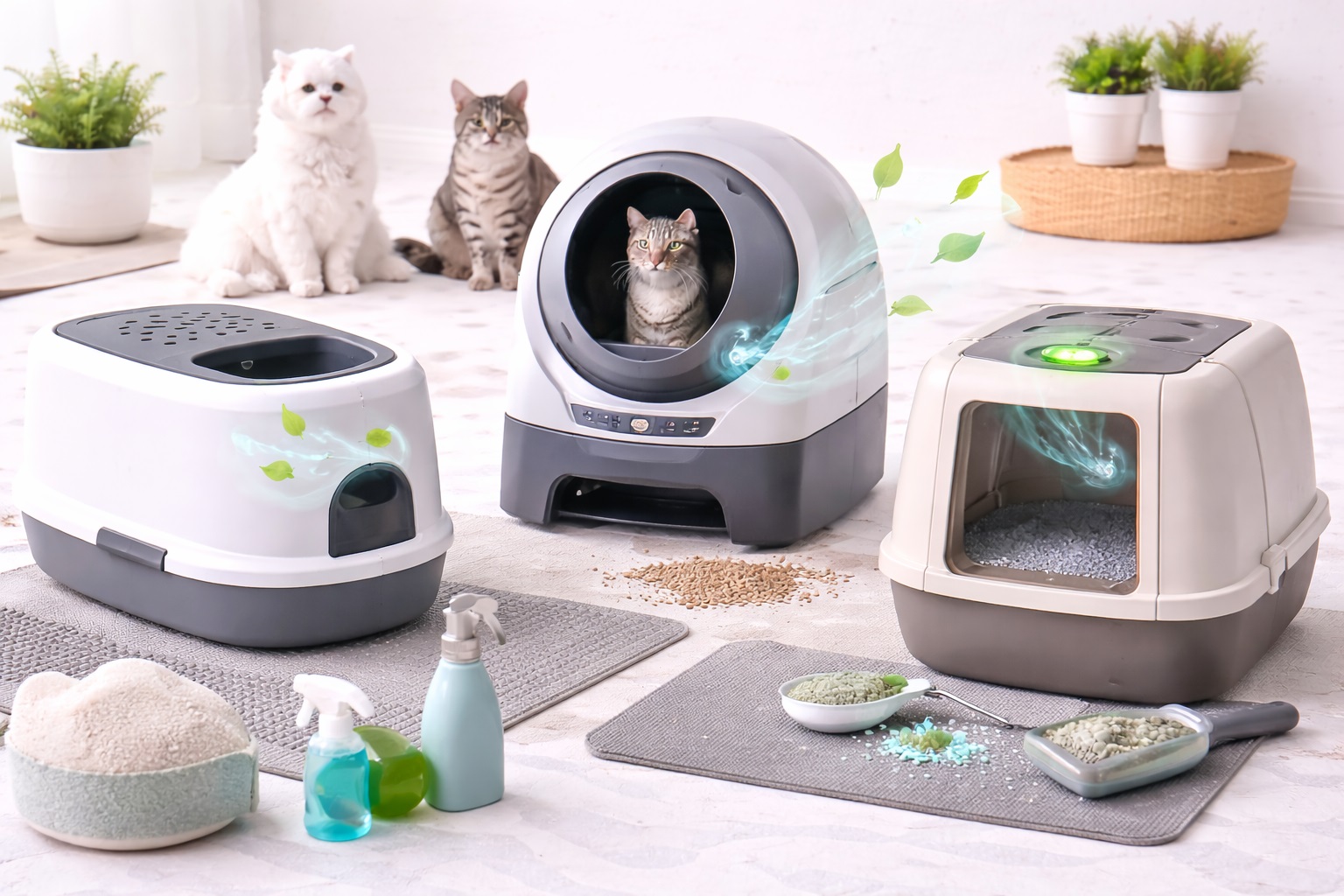
Best Cat Litter Boxes for Odor Control: Fresher Home, Happier Household
Litter box odor is one of the most common frustrations cat owners bring up, and it is also one of the most solvable with the right combination of box design, litter choice, and cleaning habits. The instinct to reach for the most heavily perfumed litter or the most sealed, air-tight box is understandable, but it is not always the most effective approach — cats themselves can be put off by strong fragrances, and a completely sealed box can actually concentrate odor between cleanings rather than dispersing it away from living spaces.
Effective odor control is really about managing three things at once: containing waste promptly, allowing enough airflow that ammonia and other odor compounds do not build up to overwhelming levels, and choosing materials and designs that do not themselves absorb and later re-release odor. A box that gets these three factors right can keep a home smelling genuinely fresh even with a litter box in a fairly central location, while one that gets them wrong can leave a persistent smell no amount of air freshener fully covers.
This guide compares three practical litter box categories built around effective odor management, walks through the specific factors that determine real-world odor control, and answers the questions cat owners ask most often when trying to solve this particular household challenge.
Top 3 Cat Litter Boxes for Odor Control (Detailed Reviews)
1. Enclosed Box with Carbon Filter – Best for Passive Odor Absorption
An enclosed litter box fitted with a replaceable activated carbon filter uses the same odor-absorbing technology found in many air purifiers, capturing airborne odor compounds as air passes through rather than simply masking them. Combined with the physical containment of an enclosed design, this creates a genuinely effective passive odor management system that works continuously between cleanings rather than only at the moment of scooping.
- Pros:
- Activated carbon filter actively captures odor compounds, not just masks them
- Enclosed design contains both odor and visual mess
- Works passively and continuously between cleaning sessions
- No added fragrance needed, appealing to fragrance-sensitive cats
- Cons:
- Filter needs periodic replacement to remain effective
- Enclosed design requires more disciplined scooping to avoid internal odor buildup
Best For: Cat owners wanting genuine odor absorption rather than fragrance masking, particularly in homes where the box is in a central or shared living area.
Why We Recommend It: The carbon filtration approach addresses odor at its source rather than covering it with fragrance, which tends to produce a more genuinely neutral-smelling result. This makes it particularly well suited to households sensitive to strong scents.
Replacing the filter on the manufacturer's suggested schedule, typically every one to two months depending on use, is essential to maintaining this benefit, since a saturated filter stops absorbing effectively long before it looks visibly dirty.
Households with multiple cats sharing one box should expect to replace filters somewhat more frequently than the manufacturer's baseline recommendation, since higher waste volume saturates the carbon material faster than a single-cat household would typically experience.
2. Self-Cleaning Litter Box with Waste Sealing – Best for Immediate Waste Removal
A self-cleaning litter box that automatically sifts and seals waste into a separate compartment shortly after use addresses odor at its most direct source — waste sitting exposed in the box. By removing and sealing waste within minutes rather than hours, this design prevents the odor buildup that occurs as waste sits and ammonia compounds develop and escape into the room over time.
- Pros:
- Automatic waste removal happens within minutes of use, not hours
- Sealed waste compartment contains odor far more effectively than exposed waste
- Reduces manual scooping frequency significantly
- Consistent odor control regardless of how busy the owner's schedule is
- Cons:
- Higher upfront cost than manual box designs
- Mechanical parts require occasional maintenance and cleaning
Best For: Busy households wanting consistent odor control without relying on remembering to scoop multiple times daily.
Why We Recommend It: Removing waste within minutes rather than hours is the single most effective way to prevent odor from developing in the first place. This design achieves that consistently regardless of the owner's daily schedule, which manual scooping cannot guarantee.
Households switching from a manual box to this style often report the most noticeable odor improvement occurs specifically during the hours they previously were away from home and unable to scoop promptly after each use.
Regularly checking and emptying the sealed waste receptacle, even though it holds several days' worth of waste, remains an important part of the routine, since an overfilled receptacle can eventually compromise the seal that keeps odor contained in the first place.
3. Open-Top Box with Odor-Neutralizing Crystal Litter – Best for Simple, Low-Maintenance Odor Control
Pairing a simple open-top box with a crystal or silica-based litter formulated specifically for odor neutralization offers an effective, low-complexity approach that avoids the added cost and maintenance of filters or automated mechanisms. These litters absorb liquid waste directly into the crystal structure, trapping odor at the source rather than requiring separate filtration or automation to manage it.
- Pros:
- No filters, automation, or moving parts to maintain
- Crystal litter absorbs and traps odor directly at the source
- Lower upfront cost than automated or filtered alternatives
- Open design keeps interior easy to inspect and fully scoop
- Cons:
- Lacks the physical containment of enclosed designs
- Crystal litter typically costs more per bag than traditional clay litter
Best For: Cat owners wanting effective odor control without the added cost or maintenance complexity of filters or automated mechanisms.
Why We Recommend It: This combination proves that effective odor control does not require the most elaborate or expensive solution. A well-chosen litter formula paired with a simple, easy-to-scoop box handles the core odor problem directly and reliably.
Because the litter itself does most of the odor-control work in this setup, choosing a well-reviewed crystal formula specifically marketed for odor performance matters more here than any feature of the box itself.
This approach also travels well for households that move frequently or prefer flexibility, since a simple open box requires no assembly, calibration, or ongoing filter sourcing, making it easy to replicate the same setup in a new home without any adjustment period.
Buying Guide: How to Choose the Best Cat Litter Box for Odor Control
Effective odor control comes from a combination of box design, litter choice, and consistent cleaning habits rather than any single feature alone.
1. Enclosed Versus Open Design Trade-offs
Enclosed boxes contain odor from escaping into the room but can concentrate it internally between cleanings if scooping is delayed. Open boxes disperse odor more into the room immediately but avoid internal concentration. Match this trade-off to your cleaning consistency and box location.
A household able to scoop at least once daily generally does better with an enclosed design, while one prone to less frequent scooping may find an open box with strong-performing litter a more forgiving choice.
Some hybrid designs offer a removable top, letting a household run the box enclosed for odor containment and open for easier scooping access, effectively combining the benefits of both approaches at once.
2. Carbon Filtration Effectiveness and Replacement Schedule
Activated carbon filters genuinely absorb odor compounds but lose effectiveness gradually as they saturate. Confirm the manufacturer's recommended replacement interval and factor this ongoing cost into your overall odor control budget.
Setting a recurring calendar reminder for filter replacement, rather than waiting for odor to become noticeable again, keeps this feature working continuously rather than allowing gaps in effectiveness between replacements.
Buying replacement filters in bulk, when the manufacturer or a compatible third party offers a multi-pack discount, both reduces per-unit cost and removes the friction of remembering to reorder each time a filter is due for replacement.
3. Litter Absorbency and Odor-Trapping Formula
Clumping clay, crystal, and plant-based litters all handle odor differently. Crystal litters tend to excel specifically at ammonia odor absorption, while high-quality clumping clay offers strong all-around performance at a lower cost per use.
Reading reviews that specifically mention multi-cat households and ammonia smell, rather than general litter reviews, gives a clearer picture of true odor performance under realistic heavy-use conditions.
Switching litter formulas gradually, mixing the new type in increasing proportions with the old over a week or two, avoids the litter box avoidance that can result from an abrupt change a cat finds unfamiliar or uncomfortable.
4. Scooping Frequency Requirements
No box design or litter formula fully substitutes for prompt waste removal. Daily scooping remains the single most effective odor control practice regardless of which box or litter you choose.
Households finding daily scooping difficult to maintain consistently are often better served by a self-cleaning design specifically, since it removes the human consistency factor from this critical step entirely.
Even a quick twice-daily check, rather than a single longer scooping session, can meaningfully reduce odor buildup by catching fresh waste before it has time to fully develop its strongest smell.
5. Ventilation and Airflow Design
Enclosed boxes benefit from deliberate ventilation openings that allow airflow through the box without compromising physical containment, helping prevent the buildup of concentrated odor that a fully sealed design can create.
A box placed in a naturally well-ventilated area of the home, near an air vent or window where practical, further supports whatever ventilation features the box itself includes.
A small, quiet fan positioned nearby, angled to draw air away from the litter box rather than directly across a person's usual path through the room, can meaningfully improve airflow in spaces that otherwise feel stagnant.
6. Material Non-Porosity and Odor Absorption Resistance
Smooth, non-porous plastic resists absorbing odor into the material itself better than textured or lower-quality plastics, which can retain smell even after thorough cleaning over months of use.
A box that still smells faintly even immediately after a deep clean with soap and water is showing signs of the material itself having absorbed odor, which is a signal to consider replacement rather than continued cleaning attempts.
Avoiding harsh abrasive scrubbing pads on plastic litter boxes helps preserve the smooth surface finish that resists odor absorption, since scratches and micro-abrasions create tiny crevices where odor-causing residue can accumulate over time.
7. Litter Depth and Coverage
Insufficient litter depth fails to fully absorb waste, allowing odor to escape more readily. Most litters perform best at a depth of two to three inches, deep enough for proper clumping and absorption without excessive waste.
Checking litter depth weekly and topping off as needed, rather than only refilling when the box runs low, helps maintain consistent odor-absorbing performance throughout the litter's full usage cycle.
Excessively deep litter beyond the recommended range does not necessarily improve odor absorption further and mainly adds unnecessary cost and mess, so more is not automatically better once the recommended depth range is reached.
8. Full Litter Change Frequency
Even with regular scooping, litter gradually loses absorptive capacity and needs full replacement, typically every two to four weeks depending on litter type and number of cats using the box.
Signs that a full change is overdue include persistent odor even immediately after scooping and visibly reduced clumping performance compared to when the litter was fresh.
Keeping a simple written or app-based log of full litter change dates helps establish a consistent rhythm, particularly in busy multi-cat households where it can otherwise be easy to lose track of which box was last fully refreshed.
9. Box Placement for Odor Management
Placement in a well-ventilated area away from direct airflow paths into main living spaces reduces how noticeable any residual odor becomes, independent of the box and litter choices themselves.
Avoid placing a litter box in a small, enclosed closet with no ventilation, since this can concentrate odor more than almost any box design choice could offset on its own.
If a closet placement is otherwise ideal for privacy and space, propping the door open a few inches or installing a small vent cut-out can meaningfully improve airflow without sacrificing the private feel a closet placement provides.
10. Multi-Cat Odor Load Considerations
More cats sharing boxes generates proportionally more odor-causing waste. Multi-cat households benefit from more frequent scooping, additional boxes, and litter formulas specifically rated for higher odor loads.
Products marketed specifically for multi-cat households often include stronger odor-neutralizing formulations, making this a worthwhile category to search specifically rather than relying on general single-cat product reviews.
Distributing boxes across a larger home rather than clustering several in one room also helps spread the odor load more evenly, reducing the concentrated smell that can develop when many cats share a small, single litter area.
11. Fragrance Sensitivity Considerations
Many cats are put off by strongly fragranced litters, sometimes leading to litter box avoidance that creates a worse odor problem than the fragrance was meant to solve. Unscented, odor-neutralizing formulas are often a safer default choice.
If considering a scented option, introducing it gradually alongside the cat's current unscented litter helps gauge tolerance before committing to a full switch that the cat might reject entirely.
Cats that consistently avoid the box shortly after a scented litter switch are usually signaling a genuine sensitivity rather than a passing preference, and reverting to an unscented formula promptly is generally the better response.
12. Long-Term Odor Control Cost Comparison
Filtered, self-cleaning, and premium litter approaches each carry different ongoing costs — replacement filters, waste liners, or higher-priced litter. Compare total ongoing cost against the odor control benefit each approach delivers for your specific household.
Calculating an approximate monthly cost for each approach based on your actual number of cats and litter usage rate gives a more realistic comparison than looking at upfront box price alone.
Households that value their time highly may find the higher ongoing cost of a self-cleaning system easily justified, while those with more flexible schedules and fewer cats may find a simple, low-cost manual setup delivers equally good results for considerably less money.
13. Testing Odor Control Before Committing Long-Term
Before investing in a premium filtered or automated system, trial a mid-range litter formula and consistent daily scooping for two to three weeks to establish a realistic baseline for how much odor improvement comes from habit alone versus how much genuinely requires added technology.
This baseline period also reveals which specific odor problem is most persistent in your home — ammonia smell right after use, lingering smell between full changes, or odor that escapes into nearby rooms — which points toward the specific product category most worth the added investment.
Households that see a meaningful improvement from consistent scooping alone during this trial period may find a simple, lower-cost setup sufficient, while those still struggling despite disciplined habits are better candidates for filtration or automation as the next step.
14. Seasonal and Climate Effects on Odor Intensity
Warmer, more humid conditions accelerate the bacterial activity that produces ammonia odor from urine, meaning a setup that performs adequately in cooler months may need more frequent attention during summer or in naturally humid climates.
Households in consistently warm or humid regions may benefit from choosing litter formulas specifically rated for high-humidity performance and scheduling slightly more frequent full litter changes during the warmest months of the year.
Air conditioning or a dehumidifier running in the room where the litter box is kept can also meaningfully reduce ambient humidity around the box, indirectly supporting whatever litter or filtration choice is already in place.
15. Recognizing When a Setup Needs to Change
A sudden increase in odor despite an unchanged routine can signal a health issue in the cat, a litter or box nearing the end of its effective life, or a change in the number of cats using a shared box, and is worth investigating rather than simply adding more fragrance to compensate.
Aging cats sometimes produce noticeably stronger-smelling waste due to changes in diet, hydration, or underlying health conditions, which may call for a more absorbent litter formula or more frequent scooping than was previously necessary at a younger age.
If odor persists despite addressing habits, litter choice, and box condition, a veterinary check is a reasonable next step, since certain health conditions can measurably change the smell of a cat's waste independent of any household-side factor.
Frequently Asked Questions
1. How many litter boxes do I need for one cat?
The standard guidance is one litter box per cat plus one additional box, and this ratio matters for odor control specifically, since overloaded boxes shared among too few options tend to generate stronger, more persistent odor. Adding an extra box is often one of the simplest odor improvements a multi-cat household can make.
2. Why does my cat refuse to use the litter box?
Common causes include an overly strong fragrance, insufficient cleanliness, or a box location the cat finds uncomfortable, alongside possible medical issues worth ruling out with a veterinarian if avoidance is sudden or persistent. A box that smells strongly even to a human nose is often intolerable to a cat's far more sensitive sense of smell.
3. How do I stop my dog from accessing the cat litter box?
A high-sided enclosed box, a top-entry design, or physically separating the litter area behind a barrier are effective approaches, chosen based on the specific dog's size and persistence level in the household. Enclosed designs also happen to support odor control goals at the same time, making them a reasonable dual-purpose choice.
4. What actually causes litter box odor most directly?
Ammonia compounds from urine breaking down over time are the primary source of persistent litter box odor, which is why prompt waste removal and adequate litter absorbency matter more than fragrance or air freshener alone. Solid waste left too long contributes as well, though ammonia buildup is typically the more noticeable factor.
5. Is the most expensive cat litter box for odor control always the best?
Not necessarily. A well-chosen litter formula paired with consistent scooping can rival the odor performance of expensive automated systems, particularly in single-cat households with a manageable daily routine. Multi-cat or busy households may see more value from investing in automation.
6. How long should a quality odor-control litter box last?
With regular cleaning and reasonable care, a well-built litter box typically lasts several years, though the material itself should be replaced sooner if it develops persistent absorbed odor that cleaning no longer resolves. This absorbed-odor point is often the practical end of a box's useful life well before it physically breaks.
7. Can I return a cat litter box for odor control if it doesn't suit me?
Most retailers offer a 15 to 30 day return window. Test actual odor performance in your specific home environment within that window rather than relying solely on marketing claims, since odor performance can vary noticeably between households.
8. What should I prioritize when buying a cat litter box for odor control?
Prioritize litter absorbency and scooping consistency first, since these two factors have the largest overall impact on odor regardless of which box design you eventually choose. Box features like filters or enclosures provide meaningful but secondary improvement on top of that foundation.
9. Does brand name matter for cat litter box for odor control?
Somewhat, particularly for litter formulas where established brands have more consistent quality control, though many effective options exist across a range of price points and lesser-known brands. Independent odor-performance reviews are more informative than brand reputation alone.
10. Do air fresheners or sprays actually help with litter box odor?
They can mask odor temporarily but do not address the underlying cause, and some fragrances may bother cats enough to affect litter box use, making prompt scooping and quality litter the more reliable long-term solution. Relying on fragrance as a primary strategy tends to be the least durable fix available.
11. Is baking soda an effective addition for odor control?
A thin layer of baking soda mixed into litter can provide modest additional odor absorption for some households, though it is a supplement to, not a replacement for, regular scooping and quality litter. Some cats may also be sensitive to the texture change, so introduce it gradually.
12. How often should the entire litter box be deep cleaned, not just scooped?
A full wash with mild soap and water every two to four weeks, alongside full litter replacement, helps prevent the gradual odor buildup that scooping alone cannot fully address over time. Avoid harsh chemical cleaners, since residue can irritate a cat's paws and discourage box use.
13. Can litter box odor indicate a health problem in my cat?
Yes, in some cases. A sudden, unexplained change in odor intensity or smell character, especially alongside changes in urination frequency or litter box avoidance, is worth mentioning to a veterinarian, since certain urinary or digestive conditions can noticeably alter waste odor independent of any change in litter or cleaning routine.
14. Should odor control needs differ between kittens and adult cats?
Kittens typically produce less waste volume, so odor may be less immediately noticeable, but they are also more sensitive to strong fragrances and rougher litter textures. A gentle, unscented litter and a low-entry box generally suit kittens better than adult-focused odor-control products designed around heavier waste loads.
15. Does humidity in my home make litter box odor worse?
Yes. Warmer, more humid conditions accelerate the bacterial processes that produce ammonia odor, so homes in humid climates or during summer months may need more frequent scooping and full litter changes than the same setup would require in a cooler, drier environment.
Final Verdict
- Best for Passive Odor Absorption: Enclosed Box with Carbon Filter — continuous odor capture without relying on added fragrance.
- Best for Immediate Waste Removal: Self-Cleaning Litter Box with Waste Sealing — the most consistent odor control regardless of daily schedule.
- Best for Simple, Low-Maintenance Odor Control: Open-Top Box with Odor-Neutralizing Crystal Litter — effective results without added cost or mechanical complexity.
Genuine odor control comes down to a combination of prompt waste removal, adequate litter absorbency, and a box design suited to your cleaning consistency and home layout, rather than any single miracle feature. Use the comparisons and buying factors above to build an approach that keeps your home smelling fresh without compromising your cat's comfort or willingness to use the box.
Odor control is ultimately a maintenance habit as much as a product choice, and even the most well-engineered box or filtration system cannot fully compensate for infrequent scooping or long-overdue litter changes. Choosing a setup that matches your realistic daily routine, rather than an idealized one, tends to produce the most consistent long-term results for keeping a home genuinely fresh.