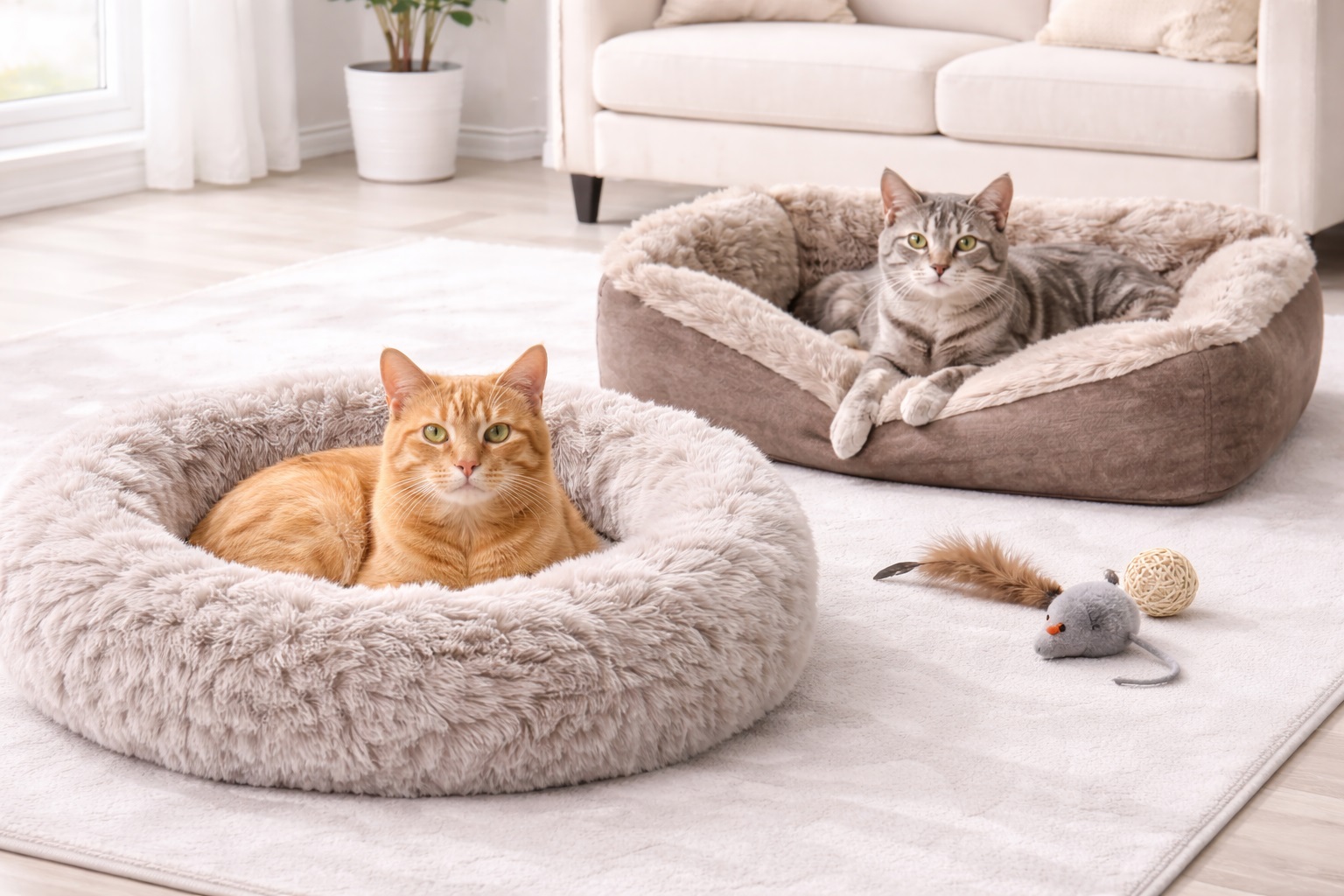
Best Dog Beds for Cats: Oversized Comfort Cats Love
Plenty of cats bypass the cat bed entirely in favor of a dog bed, whether it belongs to a housemate dog or was bought specifically because a cat kept claiming the neighbor's dog bed on a visit. The larger surface area, the plush filling, and the raised bolster edges that dog beds are known for happen to suit many cats just as well as they suit dogs, particularly cats that like to sprawl out fully or press their back against a raised rim while sleeping.
This guide looks specifically at dog beds through the lens of cat comfort and cat behavior, which differs from dog behavior in a few important ways. Cats spend more total hours per day asleep than most dogs, seek out warm sunlit spots more deliberately, and are generally more sensitive to a bed's texture and to being watched or approached while resting. A dog bed chosen for a cat should account for these tendencies rather than assuming any bed that fits a cat's size will automatically suit a cat's preferences.
We also address the common situation where a cat and dog share a home and either compete for the same bed or the cat has simply taken over a bed originally purchased for the dog. Understanding why a cat prefers a particular dog bed style helps in choosing either a second bed of the same type for the dog, or a similar cat-specific option that satisfies the same underlying preference without the ongoing competition.
Because cats are lighter than most dogs, filling and foam density requirements differ somewhat from a bed's original dog-focused design intent, and washability matters just as much given how much time a well-loved bed spends in continuous use under a napping cat. Use the comparison tools and detailed reviews below to find a dog-style bed that genuinely suits your cat's specific habits.
Price is worth thinking through with the same care as any other purchase decision. Because cats are lighter than dogs, a bed marketed for a large dog is rarely necessary purely for weight support, and choosing a small or medium dog-size option instead of a larger, pricier one often delivers the same comfort at a lower cost. That said, extremely cheap filled cushions frequently compress and lose their shape within a few months under continuous daily napping, so it is worth balancing initial cost against how long a bed is likely to remain genuinely comfortable rather than choosing purely on price at checkout.
It is also worth acknowledging that cat preferences can be genuinely individual and sometimes contradictory to general trends. A cat that avoids enclosed spaces everywhere else in the home might still choose a cave bed specifically because of its texture, and a cat that typically prefers height might make an exception for an especially soft donut bed on the floor. Observing your own cat's actual choices over a week or two, rather than assuming a single universal cat preference applies, remains the most reliable way to choose well.
Top Picks Reviewed
1. Oversized Plush Donut Bed – Best for Sprawling and Curling Cats
A large plush donut bed, originally designed for medium dogs, gives cats considerably more room to stretch, sprawl, or curl than a dedicated cat bed typically offers, while the raised rim still provides the pressed-against edge many cats seek out. The oversized dimensions also allow more than one cat to share the same bed comfortably in multi-cat households, which a smaller cat-specific bed usually cannot accommodate.
- Pros:
- Generous size allows full stretching or tight curling depending on preference
- Raised rim offers a pressed-against edge cats often seek while resting
- Large enough for two cats to share in multi-cat households
- Plush filling suits cats that dislike firm surfaces
- Cons:
- Takes up more floor space than a cat-specific bed
- Filling can flatten faster if used by multiple cats regularly
Best For: Multi-cat households and cats that alternate between sprawling and curling depending on mood and temperature.
Why We Recommend It: The extra size that makes a donut bed a dog product works in a cat's favor by removing the space constraint that limits how a cat can position itself, which single-cat-sized beds often impose without the owner realizing it.
2. Bolster Nest Bed, Medium Size – Best for Anxious or Skittish Cats
A medium bolster nest bed with raised edges on multiple sides gives a cat a partially enclosed space that reduces visual exposure from several directions at once, which matters for cats that startle easily or prefer not to be watched while resting. This differs from a fully enclosed cave bed by still allowing the cat to see out and monitor the room, addressing a cat's instinct to avoid being caught fully unaware while asleep.
- Pros:
- Partial enclosure reduces visual exposure without fully blocking sightlines
- Suits cats that want to monitor the room while resting
- Soft filling comfortable for typical curled cat sleeping positions
- Machine-washable cover on most models
- Cons:
- Less enclosed than a dedicated cave-style bed for very anxious cats
- Filling compresses over time with regular use
Best For: Cats that are easily startled or prefer to keep a clear line of sight to the rest of the room while sleeping.
Why We Recommend It: Cats have a strong instinct to avoid being surprised while vulnerable, and a bolster nest bed satisfies both the desire for physical support and the need to monitor surroundings, a balance a fully open or fully closed bed does not offer as well.
3. Faux Fur Cave Bed – Best for Deep Sleepers and Cold-Sensitive Cats
A hooded cave bed with a soft faux fur interior gives a cat a fully enclosed, den-like space that traps body heat effectively, which suits cats that sleep deeply and for long stretches, particularly older cats and those in homes that run cool during winter months. Many cats treat the entrance as a doorway and sleep with only their head or paws visible from outside.
- Pros:
- Fully enclosed design traps body heat effectively
- Suits deep, extended sleeping typical of many cats
- Reduces visual and auditory stimulation for uninterrupted rest
- Soft faux fur interior mimics a natural denning texture
- Cons:
- Not every cat accepts a fully enclosed structure immediately
- Hood fabric can be more cumbersome to launder than a flat cover
Best For: Older cats, cold-sensitive cats, and deep sleepers that favor long, uninterrupted rest periods.
Why We Recommend It: Cats already gravitate toward enclosed spaces like boxes and closets, and a cave-style dog bed channels that same instinct into a dedicated, comfortable, washable space rather than a cardboard box in the corner.
4. Orthopedic Foam Bed, Small-Medium Size – Best for Senior Cats
An orthopedic foam bed sized for a small to medium dog works well for senior cats dealing with arthritis or reduced mobility, since the supportive foam reduces pressure on joints during the many hours older cats spend resting each day. A low entry profile matters here as much as it does for aging dogs, since a senior cat may avoid a bed that requires stepping over a tall bolster edge.
- Pros:
- Supportive foam reduces joint pressure for aging cats
- Low entry profile suits cats with reduced mobility
- Maintains shape better than loose-fill alternatives over time
- Washable cover simplifies routine cleaning
- Cons:
- Costs more than a basic filled cushion
- Less enclosed feeling than a bolster or cave bed
Best For: Senior cats and any cat showing signs of joint stiffness or reduced mobility during play and movement.
Why We Recommend It: Senior cats rest for the majority of the day, making genuine joint support meaningfully more important than it might seem for a species people don't always associate with the same orthopedic concerns as aging dogs.
5. Elevated Mesh Cot, Small Size – Best for Warm-Weather Cats
A small elevated cot with a taut mesh surface appeals to cats seeking a cooler resting spot, particularly in warm climates or during summer months when a cat's preference for sunlit windowsills can tip into genuine overheating. The airflow underneath the mesh keeps the surface cooler than any filled cushion, and the lack of filling means nothing to trap fur or odor over time.
- Pros:
- Airflow beneath the cat helps regulate body temperature
- No filling to trap shed fur or hold odor over time
- Wipes clean quickly for routine maintenance
- Lightweight and easy to reposition near a sunny window
- Cons:
- Less cushioning than foam or plush alternatives
- Some cats prefer more enclosed designs over an open mesh surface
Best For: Cats in warm climates, sun-seeking cats prone to overheating, and households wanting a low-maintenance option.
Why We Recommend It: Cats already position themselves near cool surfaces during warm weather by instinct, and an elevated mesh bed gives that instinct a comfortable, dedicated option rather than leaving the cat to choose a bare tile floor over its bed.
6. Quilted Mat-Style Bed – Best for Multiple Locations Around the Home
A flat, quilted mat without a raised edge or hood is the most versatile and lowest-cost option for cats that maintain several favorite resting spots throughout the home rather than a single primary bed. The thin, foldable profile fits easily onto windowsills, inside closets, or atop furniture, following a cat's tendency to rotate between multiple locations across the day depending on sunlight and household activity.
- Pros:
- Thin profile fits windowsills, shelves, and furniture tops
- Inexpensive enough to place in several locations around the home
- Machine washable and quick to dry given the thin construction
- Foldable for easy storage or repositioning
- Cons:
- Minimal cushioning compared to foam or plush alternatives
- No raised edge for cats that specifically seek bolster support
Best For: Cats that rotate between multiple favorite spots throughout the day, and households wanting affordable coverage across several rooms.
Why We Recommend It: Cats are natural spot-rotators rather than single-location sleepers, and placing several inexpensive mats around a home suits that behavior better than investing heavily in one large bed the cat may only use part of the time.
7. Heated Small Dog Bed – Best for Cold Homes and Older Cats
A low-wattage heated bed insert designed for small dogs provides consistent, gentle warmth that suits cats just as well, particularly senior cats whose circulation has slowed and cats in homes that run cold during winter. The chew-resistant cord construction, originally built with dogs in mind, is a genuine safety advantage for households with a cat that might otherwise investigate a standard heating pad cord.
- Pros:
- Consistent gentle warmth benefits senior and cold-sensitive cats
- Chew-resistant cord designed with pet safety in mind
- Often removable for unheated use during warmer months
- Helps cats with joint stiffness stay comfortable in cold weather
- Cons:
- Requires access to a power outlet near the bed's location
- Higher upfront cost than an equivalent unheated bed
Best For: Senior cats, cats with thin coats, and households in cold climates seeking a warmer alternative to a standard cushion.
Why We Recommend It: Cats seek out warm surfaces instinctively, whether a sunny windowsill or a laptop left running, and a heated bed satisfies that same drive directly rather than leaving the cat to find its own, sometimes inconvenient, heat source.
8. Furniture-Style Raised Bed – Best for Cats That Prefer Height
A furniture-style raised dog bed with a cushioned platform appeals to cats that instinctively prefer elevated resting spots, a well-documented feline preference tied to both safety and visibility. Many cats choose the top of a raised furniture-style bed over a floor-level cushion given the option, particularly in multi-pet households where height offers a cat a retreat from a dog at floor level.
- Pros:
- Raised platform satisfies a cat's instinctive preference for height
- Offers a retreat above floor-level activity in multi-pet homes
- Sturdy frame handles repeated jumping on and off
- Removable cushion cover simplifies washing
- Cons:
- Takes up more floor space than a low-profile bed
- Higher cost than a simple cushion
Best For: Cats in multi-pet households seeking elevation away from dogs or other cats, and cats with an established preference for height.
Why We Recommend It: A cat's preference for height is rooted in both safety instincts and a desire to observe surroundings from above, and a raised furniture-style bed directly satisfies that instinct better than any floor-level design can.
9. Waterproof-Lined Bolster Bed – Best for Easy Cleanup in Multi-Pet Homes
A bolster bed with a waterproof inner liner protects the internal filling from moisture, fur, and dander buildup that accumulates faster in homes with multiple pets sharing sleeping spaces. The outer cover still washes normally, while the liner ensures that whatever gets through the surface fabric does not permanently damage or add odor to the bed's core filling over years of shared use.
- Pros:
- Waterproof liner protects filling from moisture and buildup
- Outer cover washes normally for routine maintenance
- Extends effective lifespan in busy multi-pet households
- Raised bolster edge still provides the security many cats seek
- Cons:
- Liner adds modestly to the overall cost
- Liner material can feel slightly less soft against direct contact
Best For: Multi-pet households where beds see heavier use and require more frequent, thorough cleaning.
Why We Recommend It: A shared or frequently used bed benefits from the same moisture protection that prevents permanent odor buildup, extending its usable life well beyond a standard bolster bed without a liner.
Across all nine of these styles, one pattern is worth naming directly: a bed's original design intent for a dog does not determine whether a cat will use it, since cats respond primarily to size, texture, warmth, and structure rather than to which species a product was marketed toward. This is exactly why so many cats end up claiming a dog's bed outright, and why building a shopping decision around a cat's demonstrated preferences, rather than the label on the packaging, produces the best long-term outcome.
Buying Guide: How to Choose the Best Dog Bed for Your Cat
Use these factors to match a dog-style bed to your cat's specific size, habits, and household situation. None of these factors work in isolation — a bed that gets the size right but ignores your cat's preference for enclosure, or one that suits temperature needs but sits in a location the cat never visits, will still go unused regardless of how well it scores on any single criterion.
1. Size Down From Standard Dog Bed Sizing
A bed sized for a small to medium dog is usually appropriately generous for a cat, offering room to sprawl without being so oversized that a raised bolster edge becomes unreachable while curled.
2. Consider Whether Your Cat Prefers Enclosure or Visibility
Some cats want a fully enclosed cave bed, others prefer a partially open bolster nest that still allows a clear line of sight, and some prefer a fully open flat mat. Observe your cat's existing resting habits before choosing a structure.
3. Prioritize Warmth for Senior or Thin-Coated Cats
Older cats and thin-coated breeds benefit from plush filling, a hooded design, or a heated insert more than a healthy young cat with a dense coat might need.
4. Account for Multi-Cat or Multi-Pet Households
An oversized bed can accommodate more than one cat, while a distinct bed style for each pet reduces resource competition and helps establish each animal's own recognized space.
5. Check Washability Given Shed Fur Accumulation
Cats shed continuously rather than seasonally in many climates, and a bed used daily accumulates fur quickly. A removable, machine-washable cover keeps the bed sanitary without frequent full replacement.
6. Think About Placement Near Sunlight
Cats gravitate toward sunlit spots throughout the day. Placing a bed near a window that receives natural light, or choosing a portable style that can follow the sun, increases how often the bed actually gets used. Observe which windows in your home get sun at different times of day, since a bed placed near a morning-sun window may see less use in the afternoon than one positioned differently.
7. Consider Height Preference
Many cats prefer elevated resting spots over floor-level ones. A raised furniture-style bed or a cot placed on an existing piece of furniture may see more use than a floor cushion for cats with this established preference.
8. Evaluate Non-Slip Backing on Hard Floors
A lightweight bed on hardwood or tile can slide as a cat jumps in or repositions itself. A rubberized non-slip base keeps the bed anchored in its intended spot.
9. Plan for Multiple Bed Locations
Cats commonly rotate between several favorite resting spots throughout a single day. Placing lower-cost mats in a few locations often suits actual cat behavior better than a single, more expensive bed in one fixed spot.
10. Weigh Filling Type Against Long-Term Use
Standard polyester filling compresses over months of daily use. Memory foam or higher-density filling holds shape considerably longer, which matters given how many hours cats spend resting on the same surface.
11. Consider a Second Bed to Reduce Competition
If a cat has taken over a bed originally purchased for a dog, adding a second bed of a similar style for each pet resolves the underlying preference without ongoing competition over one shared space.
12. Balance Price Against Realistic Lifespan
A well-made bed typically lasts several years with regular washing. Comparing price against expected years of use gives a clearer sense of value than judging on sticker price alone, particularly since a cat's lighter body weight generally means less compression wear than the same bed would experience under a larger dog.
Frequently Asked Questions
1. Why does my cat prefer the dog's bed over its own cat bed?
Dog beds are often larger, plusher, and offer a more substantial raised edge than many cat-specific beds, all of which can appeal to a cat's preference for space and pressed-against support. The fabric texture and any lingering scent of a familiar housemate can also play a role in the preference.
2. Is it safe for a cat to use a dog bed?
Generally yes, provided the bed is a reasonable size and made from pet-safe materials. There is no inherent safety concern with a cat using a dog-designed bed, though it is worth checking that any decorative trim or attachments are securely fastened and cannot be chewed loose.
3. What size dog bed is appropriate for a cat?
A bed designed for a small to medium dog typically suits a cat well, offering enough room to stretch or curl without being so large that a raised edge becomes functionally out of reach.
4. Do cats prefer enclosed or open beds?
It varies by cat. Some strongly prefer a fully enclosed cave bed, while others prefer to keep a clear line of sight and choose a partially open bolster nest or flat mat instead.
5. How often should a cat's dog-style bed be washed?
Weekly washing is a reasonable baseline given continuous shedding, with more frequent washing appropriate in households with allergies or multiple pets sharing the same bed.
6. Should I buy a matching bed for my dog if the cat has taken theirs over?
Often, yes. Adding a second bed of a similar style resolves the underlying competition without requiring either pet to give up a preferred design.
7. Do cats need orthopedic support like dogs do?
Senior cats and those with arthritis benefit from supportive foam in the same way senior dogs do, even though this is discussed less often for cats specifically.
8. Can heated dog beds be used safely for cats?
Yes, low-wattage heated beds designed for small dogs are generally safe for cats and are often built with pet-specific safety features like chew-resistant cords.
9. Why does my cat like elevated beds so much?
Height offers cats a vantage point to observe their surroundings and a sense of safety from potential threats at floor level, an instinct that predates domestication and is shared broadly across both wild and domestic cat species.
10. Is the most expensive dog bed for cats always the best choice?
Not necessarily. Matching the bed's structure to your specific cat's demonstrated preferences matters more than price alone.
11. Can multiple cats share one large dog bed?
Often, yes, particularly with oversized donut or bolster styles, though cats with established territorial tendencies may still prefer separate beds.
12. How long does a dog-style bed typically last with cat use?
With regular washing and normal use, most quality beds hold their shape for two to four years, similar to expectations for dog use given comparable body weights.
Final Verdict
- Best for Sprawling and Curling Cats: Oversized Plush Donut Bed — generous room with a supportive raised rim.
- Best for Anxious or Skittish Cats: Bolster Nest Bed, Medium Size — partial enclosure without blocking sightlines.
- Best for Deep Sleepers and Cold-Sensitive Cats: Faux Fur Cave Bed — enclosed warmth for extended rest.
- Best for Senior Cats: Orthopedic Foam Bed, Small-Medium Size — joint support for aging cats.
- Best for Warm-Weather Cats: Elevated Mesh Cot, Small Size — cooler sleeping with easy cleanup.
- Best for Multiple Locations Around the Home: Quilted Mat-Style Bed — affordable coverage for spot-rotating cats.
- Best for Cold Homes and Older Cats: Heated Small Dog Bed — consistent warmth for senior and thin-coated cats.
- Best for Cats That Prefer Height: Furniture-Style Raised Bed — elevation that satisfies an instinctive preference.
- Best for Easy Cleanup in Multi-Pet Homes: Waterproof-Lined Bolster Bed — extended lifespan under heavier shared use.
The right dog bed for your cat comes down to observing how your specific cat already rests — whether it seeks enclosure or open visibility, height or ground level, warmth or a cool surface — rather than assuming any dog bed will suit any cat equally well. Use the comparisons and detailed reviews above to find a match that turns an occasional borrowed spot into a genuinely dedicated favorite, and be prepared to try a second style if the first choice goes unused, since cat preferences can take some trial and error to pin down precisely.