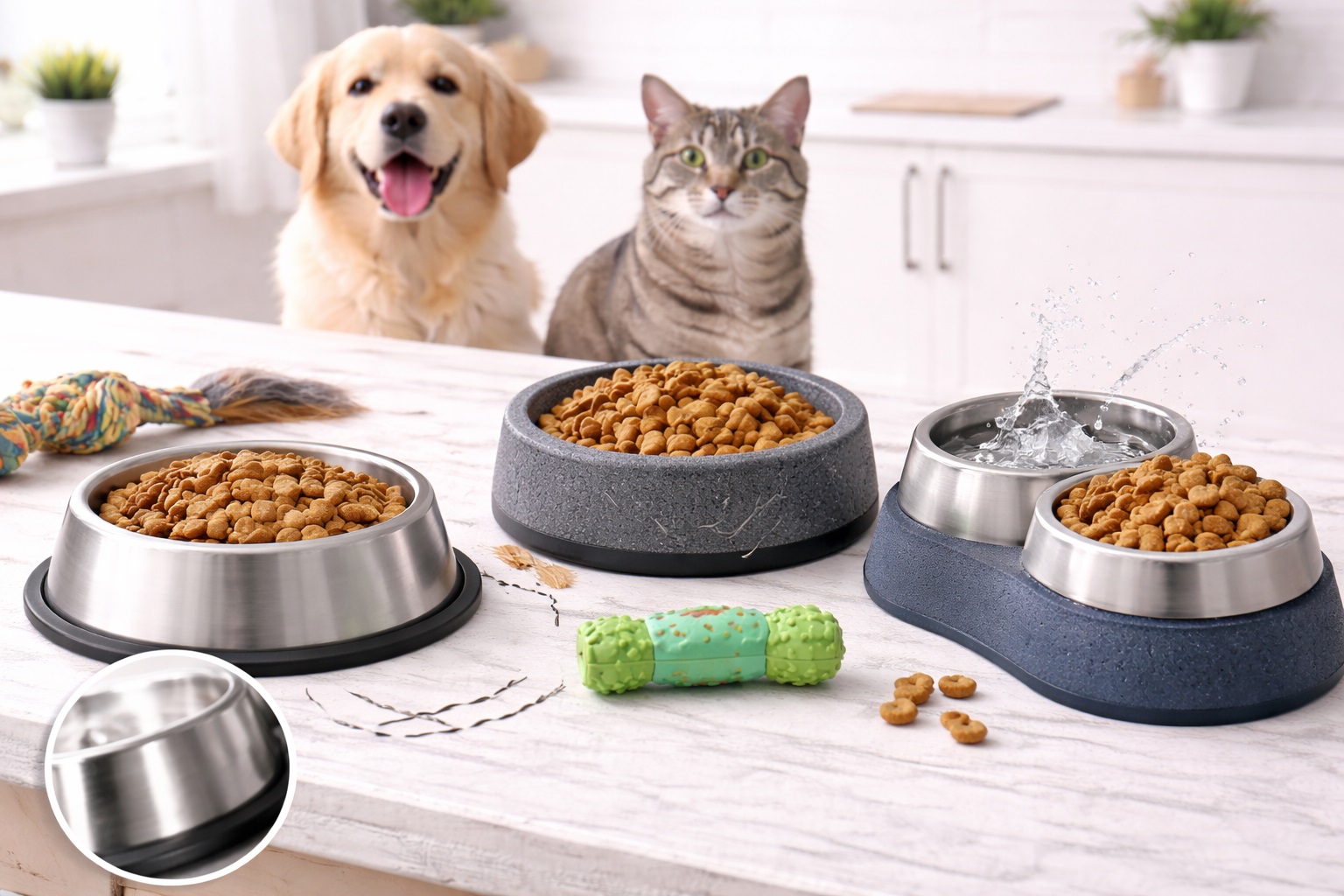
Best Durable Pet Food Bowls That Survive Years of Daily Use
A pet bowl gets used at least twice a day, washed almost as often, and left on the floor where it takes the occasional kick, drop, or curious chew. Over months and years, that daily wear separates bowls that were built to last from bowls that look fine in a store display but start chipping, staining, or scratching within a matter of weeks of regular household use.
This guide compares the most practical options for pet owners who want a bowl that maintains its integrity, appearance, and hygiene through years of daily use and repeated washing. Rather than judging bowls on how they look on day one, the focus here is on how each material and design category holds up over the long stretch of ordinary use that a feeding bowl actually experiences, from the first month through several years of daily washing and handling.
Below is a full comparison table, detailed reviews of the bowl types worth considering, a buying guide built specifically around durability factors, and answers to the questions pet owners ask most often when shopping for a bowl meant to last through years of regular household use.
Why Durability Matters More Than It First Appears
A bowl that degrades quietly is easy to miss until the damage is already a hygiene problem. Plastic develops scratches invisible from a distance but large enough at the microscopic level to trap bacteria. Thin ceramic chips at the rim in ways that are easy to overlook until a chipped edge causes a mouth injury. Lightweight steel bowls dent and lose their shape after repeated drops, changing how they sit and how food pools inside them. None of these failure modes happen overnight — they build gradually across months of ordinary use, which is exactly why it is easy to keep using a bowl well past the point where it still serves its purpose safely.
Buying for durability up front is also a cost decision, not just a quality one. A bowl that needs replacing every few months adds up over a pet's lifetime, while a well-built bowl in the right material can realistically serve for years with nothing more than routine washing. The reviews and buying guide below are built around that longer view rather than around initial price alone, and each recommendation is chosen specifically for how it holds up rather than for how it looks in a first impression.
Top Picks (Detailed Reviews)
1. Heavy-Gauge Stainless Steel Bowl – Best Overall Durability
A thick, heavy-gauge stainless steel bowl is the benchmark for long-term durability in pet feeding equipment. Unlike thin, lightweight steel bowls that dent easily, a heavier gauge resists denting, does not warp under normal use, and keeps its shape through years of dishwasher cycles. The non-porous surface also means it never develops the scratches that eventually compromise hygiene in softer materials.
- Pros:
- Resists denting, warping, and surface scratching far better than thin steel
- Non-porous surface stays hygienic indefinitely with normal washing
- Will not rust under normal indoor use and regular drying
- Keeps its appearance without staining or discoloration over time
- Cons:
- Heavier gauge steel costs more upfront than thin, lightweight versions
- No insulating properties, so contents reach room temperature quickly
Best For: Owners who want one bowl that will still look and perform the same after years of daily washing.
Why We Recommend It: Thickness is the single biggest factor separating a stainless bowl that lasts a lifetime from one that dents and warps within a year, and a heavy gauge is worth paying slightly more for up front.
2. Thick-Walled Stoneware Ceramic Bowl – Best for Chip Resistance
Not all ceramic is equally durable. A thick-walled stoneware bowl with a reinforced rim resists the chipping that thinner, decorative ceramic bowls are prone to. The dense material also holds up to repeated dishwasher cycles without the glaze dulling or crazing, which is the fine surface cracking that develops in lower-quality ceramic over time.
- Pros:
- Reinforced rim resists chipping far better than thin decorative ceramic
- Dense stoneware body resists cracking under normal drops on hard flooring
- Glaze holds up to years of dishwasher cycles without dulling
- Heavier weight keeps the bowl stable during feeding
- Cons:
- Still breakable under a hard enough impact, unlike steel
- Should be inspected periodically for hairline cracks near the base
Best For: Owners who prefer the look and weight of ceramic but want a version built to resist the common failure points of cheaper ceramic bowls.
Why We Recommend It: Most ceramic bowl complaints trace back to thin walls and unreinforced rims, and a properly built stoneware bowl solves both problems while keeping the aesthetic appeal that draws owners to ceramic in the first place.
3. Reinforced Rubber-Bonded Steel Bowl – Best for Active Chewers
Some dogs treat an empty bowl as a chew toy, and a standard bowl with a loosely attached rubber base often ends up with the rubber ring chewed off within weeks. A reinforced design bonds the rubber base directly into the steel with a molded lip, making it far harder for a determined chewer to peel away.
- Pros:
- Bonded rubber base resists peeling and chewing damage
- Steel body itself is immune to chewing damage
- Base still provides genuine slip resistance during feeding
- Suitable for large, strong-jawed breeds that damage standard bowls
- Cons:
- Costs more than a standard rubber-ring stainless bowl
- The bonded base can make full separation for deep cleaning slightly harder
Best For: Households with a dog that has previously chewed the rubber base off a standard steel bowl.
Why We Recommend It: A loose rubber ring is one of the most common durability failure points in an otherwise solid steel bowl, and bonding it into the base directly removes that weak point entirely.
4. Weighted Non-Tip Ceramic Bowl – Best for Enthusiastic Eaters
A weighted ceramic bowl uses a thicker, heavier base specifically to resist tipping and sliding, which matters both for mess control and for the bowl's own longevity — a bowl that gets knocked around the kitchen floor daily accumulates far more chips and cracks than one that stays in place.
- Pros:
- Heavy base resists being pushed or tipped during feeding
- Reduced movement means fewer accidental drops and impacts over time
- Dishwasher safe and easy to keep hygienic
- Stable, attractive option for a permanent feeding station
- Cons:
- Considerably heavier and less practical for travel
- Still vulnerable to chipping if actually dropped from a height
Best For: Fast or enthusiastic eaters whose bowl movement during meals has caused chips or cracks in lighter bowls.
Why We Recommend It: Reducing how much a bowl moves during feeding is one of the simplest ways to extend its working life, since much of the damage to ceramic and lightweight steel bowls happens from repeated small impacts rather than a single dramatic drop.
5. Double-Wall Insulated Steel Bowl – Best for Outdoor and Multi-Surface Use
A double-wall insulated steel bowl adds a second layer of steel with an air gap between, which keeps food and water closer to a stable temperature and adds structural rigidity that resists denting even more than a single-wall heavy-gauge bowl. This construction holds up especially well outdoors, where bowls face more temperature swings and rougher surfaces.
- Pros:
- Extra structural rigidity resists denting even under rough outdoor use
- Insulation keeps water cooler for longer in warm weather
- Non-porous steel surface remains easy to sanitize
- Holds up well on patios, decks, and other hard outdoor surfaces
- Cons:
- Bulkier and heavier than a standard single-wall steel bowl
- Premium construction comes at a higher price point
Best For: Outdoor feeding stations, patios, and households that keep a water bowl outside for part of the day.
Why We Recommend It: Outdoor conditions are harder on a bowl than indoor use, and the added rigidity and temperature stability of a double-wall design directly addresses the wear pattern that outdoor bowls experience.
6. Commercial-Grade Elevated Steel Diner – Best for Multi-Dog Households
Multi-dog households put more cumulative wear on feeding equipment than a single-pet home, and a commercial-grade elevated diner is built with a welded steel frame designed for repeated heavy use rather than light home use. The removable steel bowls resist denting even when swapped in and out frequently for cleaning.
- Pros:
- Welded frame construction holds up to repeated heavy daily use
- Elevated design reduces spillage and keeps feeding stations organized
- Removable bowls make washing multiple bowls at once straightforward
- Built to handle wear from multiple pets rather than a single light user
- Cons:
- Larger footprint requires more dedicated floor space
- Higher cost reflects the commercial-grade build quality
Best For: Multi-dog households, boarding facilities, and any setting where feeding equipment sees heavier-than-average daily use.
Why We Recommend It: Equipment built for commercial or multi-pet use tends to outlast standard single-pet bowls by a wide margin, since it is engineered around a higher baseline of daily wear from the start.
7. Heavy-Duty BPA-Free Plastic Bowl – Best Budget Durable Option
Not every household needs steel or ceramic, and a genuinely heavy-duty BPA-free plastic bowl — thicker and more rigid than a standard bargain bowl — can offer reasonable durability at a lower price point, provided it is replaced proactively once scratching becomes visible rather than waited out indefinitely.
- Pros:
- Lowest cost among genuinely durable bowl options
- Thicker walls resist cracking better than thin bargain plastic
- Lightweight and easy to move between feeding locations
- Reasonable option for households on a tighter budget
- Cons:
- Surface scratches accumulate faster than steel or ceramic regardless of thickness
- Requires more proactive replacement to stay fully hygienic
Best For: Budget-conscious owners who want the sturdiest plastic option available and are willing to replace it on a defined schedule.
Why We Recommend It: It acknowledges that not every household will choose steel or ceramic, and steers that choice toward the most durable version of plastic rather than the thinnest, least durable bargain option.
Common Durability Myths Worth Knowing
Several assumptions about durable pet bowls turn out to be only partly true once you look closely at how bowls actually fail over time. The most common one is that price alone signals durability — a premium-priced bowl with a decorative but thin ceramic body can chip just as easily as a budget version, while a mid-priced heavy-gauge steel bowl can outlast both. Price reflects brand and design as much as it reflects the material thickness and construction quality that actually determine how long a bowl lasts.
Another common assumption is that stainless steel is universally indestructible. It resists scratching, staining, and rust extremely well, but thin, lightweight steel bowls still dent under repeated impact, and a dented bowl can develop uneven contact with the floor that makes it wobble or tip more easily during feeding. Gauge and construction quality matter within the steel category itself, not just the choice of steel over other materials.
There is also a tendency to assume that a bowl showing no obvious surface damage is still fully hygienic. Bacteria can accumulate in scratches too fine to see with the naked eye, particularly on plastic and lower-quality ceramic glazes. Treating a bowl's visible condition as the only signal for when to replace it can mean holding onto a bowl well past the point where its surface still supports easy, thorough cleaning.
Buying Guide: How to Choose the Best Durable Pet Food Bowl
These are the factors that most directly determine whether a bowl survives years of use or needs replacing within months.
1. Material Thickness and Gauge
For steel bowls, a heavier gauge resists denting and warping far better than thin, lightweight steel. For ceramic, wall thickness at the rim and base determines chip and crack resistance. Thickness is often not advertised prominently, so checking product weight relative to size can be a useful proxy when specifications are unclear. If two bowls of similar dimensions differ noticeably in weight, the heavier one is very often the more durable choice.
2. Dishwasher and Daily-Wash Durability
A bowl washed daily for years needs a surface and glaze that holds up to that repeated cycle without dulling, staining, or developing microscopic surface damage. Confirm dishwasher-safe ratings apply to long-term use, not just occasional washing, since some manufacturer guidance distinguishes between the two.
3. Chip and Crack Resistance for Ceramic
Reinforced rims and thicker walls resist the chipping that ends a ceramic bowl's usable life. A chip is not cosmetic — it creates a rough edge that can injure the mouth and a crevice that is difficult to fully sanitize, so any chipped ceramic bowl should be retired rather than kept in rotation.
4. Rust and Corrosion Resistance for Steel
True stainless steel resists rust indefinitely under normal indoor conditions. Lower-grade steel or steel with a thin coating can develop rust spots after prolonged moisture exposure, particularly if left wet or used outdoors without adequate drying. Checking for a genuine stainless steel grade designation is worth the extra minute during a purchase decision.
5. Base Stability and Anti-Tip Design
A bowl that slides or tips accumulates far more incidental damage than one that stays in place, since much of the wear on lightweight bowls comes from repeated small impacts rather than a single dramatic drop. Weighted bases and bonded rubber rings both address this directly, and the difference in long-term wear is often visible within the first few months of use.
6. Surface Scratch Resistance and Hygiene Over Time
Scratches are not just cosmetic — they are where bacteria collect despite regular washing. Materials that resist scratching, like stainless steel and dense ceramic, maintain hygiene standards for far longer than softer plastics, which is one of the clearest practical arguments for paying more upfront for a scratch-resistant material.
7. Size and Capacity for Long-Term Use
A bowl sized correctly for your pet's actual portions experiences more even wear than one that is chronically overfilled or has food regularly spilling over the rim, which can accelerate surface wear at the edges over years of daily use.
8. Weight vs. Portability Trade-off
The heaviest, most durable bowls are rarely the most portable ones. Decide whether the bowl needs to travel regularly or will stay in one fixed feeding location, since that answer changes which durability features matter most and can mean choosing a slightly lighter option deliberately.
9. Chew and Bite Resistance
For households with a dog that chews at its bowl between meals, look specifically for bonded rather than adhesive-attached rubber bases, and avoid soft plastics that show tooth marks easily, since visible bite marks are usually an early sign of a bowl's declining lifespan.
10. Manufacturer Warranty as a Durability Signal
A longer warranty period is one of the more reliable signals that a manufacturer trusts its own material and construction quality. Short or no warranty periods are worth treating as a caution sign on a bowl marketed specifically as durable, since confidence in a product's longevity usually shows up in the terms offered.
11. Cost Per Year of Use vs. Upfront Price
A bowl that costs more upfront but lasts five years is a better value than one that costs half as much but needs replacing every six months. Calculating an approximate cost per year of expected use gives a clearer picture than comparing sticker prices alone, especially when weighing a premium steel or ceramic option against a cheaper alternative.
12. Signs of Wear That Signal Replacement Time
Visible chips, deep scratches, a peeling rubber base, rust spots, or a glaze that has become dull and rough are all signs that a bowl has reached the end of its safe, hygienic life regardless of how sturdy it may still look overall. A brief visual check every couple of months is enough to catch these signs before they become a genuine hygiene concern.
Frequently Asked Questions
1. What is the most durable material for a pet food bowl?
Heavy-gauge stainless steel is generally the most durable option, resisting denting, scratching, staining, and rust under normal use for years. Thick, reinforced ceramic is a close second in terms of longevity, though it remains breakable under hard impact in a way steel is not.
2. How long should a durable pet food bowl last?
A well-built stainless steel or reinforced ceramic bowl can reasonably last five years or more with normal daily washing. Lower-quality materials, especially thin plastic, often need replacing within one to two years as surface scratching accumulates.
3. Are ceramic bowls durable enough for daily use?
Quality, thick-walled ceramic with a reinforced rim holds up well to daily use and washing. Thinner decorative ceramic is more prone to chipping and should be checked periodically for cracks near the base, especially in households with hard flooring.
4. Can stainless steel bowls rust?
True stainless steel resists rust indefinitely under normal indoor conditions. Lower-grade steel with a thin surface coating can develop rust spots over time, particularly with prolonged moisture exposure, so it is worth confirming the grade of steel used before purchase.
5. Is a heavier bowl always more durable?
Generally yes for steel and ceramic, since additional weight usually reflects thicker material and more robust construction. This is not true for plastic, where weight does not reliably indicate wall thickness or impact resistance, so judge plastic bowls on wall thickness directly rather than overall weight.
6. Do durable bowls cost much more than standard bowls?
There is typically a moderate price premium for heavier-gauge steel or reinforced ceramic, but the cost difference is often recovered over time by avoiding repeated replacement of a lower-quality bowl every year or two.
7. How can I tell if my pet's bowl needs replacing?
Look for visible chips, deep surface scratches, a peeling or loose rubber base, rust spots, or a dulled and rough glaze. Any of these signs indicates the bowl has reached the end of its safe, hygienic service life, even if it still holds food without leaking.
8. Are dishwasher-safe bowls more durable long-term?
Being dishwasher-safe does not automatically mean a bowl is durable, but it does mean daily washing is easier and less likely to be skipped, which supports long-term hygiene regardless of the material's inherent durability rating.
9. Do chew-resistant bowls exist for aggressive chewers?
Yes. Solid steel bowls with a bonded, rather than adhesive, rubber base resist chewing damage far better than standard bowls, since the steel body itself is immune to bite damage and only the base attachment method is really at risk.
10. What warranty should I expect on a quality pet bowl?
Warranty terms vary, but a manufacturer confident in its material and construction typically offers a more substantial warranty than one selling a lower-quality product. Treat warranty length as one useful signal among several, not the only one worth weighing.
11. Is plastic ever a durable choice?
A genuinely heavy-duty, thick-walled BPA-free plastic bowl can offer reasonable durability at a lower price point, though it will still develop surface scratches faster than steel or ceramic and should be replaced proactively on a defined schedule.
12. Does bowl size affect durability?
Indirectly. A bowl sized correctly for a pet's portions experiences more even wear than one that is chronically overfilled, which can accelerate rim and edge wear regardless of the base material's inherent durability over the years.
Matching Durability to Your Household's Actual Wear Pattern
Not every household puts the same amount of stress on a feeding bowl, and it is worth being honest about which pattern actually describes your situation before choosing. A single, calm indoor cat that eats from a fixed spot on a soft mat puts very little wear on a bowl compared to a large, energetic dog that pushes its bowl across tile flooring at every meal, or a household running two or three pets through the same feeding station in rotation.
For lighter wear situations, a mid-weight stainless steel or a well-made ceramic bowl will likely last for years without any of the reinforced or commercial-grade features discussed above. For heavier wear situations — active chewers, enthusiastic eaters, outdoor feeding stations, or multi-pet households — the reinforced and heavier-duty picks in this guide earn their higher price by directly addressing the specific way those bowls tend to fail.
Rather than defaulting to the single most expensive or most heavily built option regardless of need, matching the bowl category to your actual daily wear pattern tends to produce the best combination of longevity and value. A bowl over-built for a light-use household is not wasted money exactly, but it is rarely necessary, while a bowl under-built for a heavy-use household will fail well before its expected lifespan and needs replacing sooner than its price would suggest.
Final Verdict
- Best Overall Durability: Heavy-Gauge Stainless Steel Bowl — resists denting, staining, and scratching indefinitely.
- Best for Chip Resistance: Thick-Walled Stoneware Ceramic Bowl — reinforced rim solves ceramic's most common failure point.
- Best for Active Chewers: Reinforced Rubber-Bonded Steel Bowl — bonded base resists peeling and chewing damage.
- Best for Enthusiastic Eaters: Weighted Non-Tip Ceramic Bowl — reduced movement means fewer chips and cracks over time.
- Best for Outdoor Use: Double-Wall Insulated Steel Bowl — extra rigidity and temperature stability for outdoor conditions.
- Best for Multi-Dog Households: Commercial-Grade Elevated Steel Diner — built for a higher baseline of daily wear.
- Best Budget Durable Option: Heavy-Duty BPA-Free Plastic Bowl — the sturdiest version of the most affordable material.
Durability in a pet bowl comes down to matching material thickness and construction to how much daily wear your household actually puts on feeding equipment. A single quiet, low-traffic home has different needs than a multi-dog household with an enthusiastic chewer, and the right choice from this list depends on which of those situations sounds closest to your own. Buying with the long view in mind — years of washing and daily use rather than how a bowl looks in the first week — consistently produces a better outcome than chasing the lowest price alone.
It is also worth revisiting your feeding setup periodically rather than assuming an initial purchase will remain the right fit forever. A bowl that suited a younger, calmer pet may not hold up once that pet becomes a more enthusiastic eater, and a bowl bought for a single-pet household may need reconsidering once a second animal joins the family. Checking bowl condition every few months, and being willing to size up or step up in build quality when wear patterns change, is a simple habit that keeps feeding equipment safe and hygienic for years rather than months. The extra few minutes spent choosing the right category of bowl at the outset, informed by the comparisons and guide above, tends to save far more time and expense than it costs.