Best Easy-to-Clean Pet Water Fountains for 2026
A pet water fountain only delivers on its promise of fresher, more appealing water if you actually keep up with cleaning it. That sounds obvious, but it's the single biggest reason fountains end up back in a cupboard a few months after purchase. Buyers pick a model based on capacity or looks, discover that the pump housing has eleven fiddly pieces and a filter cage that traps hair in a spot you can't reach with a sponge, and the whole thing quietly stops getting cleaned. Once that happens, the fountain becomes worse for your pet than a plain bowl, because stagnant, slime-lined water sitting inside a pump is exactly the environment that flowing water was supposed to prevent.
An easy-to-clean pet water fountain is defined less by its price tag and more by its physical design: how many pieces come apart, whether those pieces survive a dishwasher cycle, how wide the openings are, and whether the pump motor is exposed enough to wipe down without disassembling half the unit. A fountain with a wide-mouth reservoir, a snap-apart pump housing, and two or three washable components will realistically get cleaned every few days. A fountain with a narrow spout, a multi-part waterfall tower, and hand-wash-only instructions will realistically get cleaned every few weeks, if that.
It's worth separating two different ideas that both get called "easy to clean." The first is how long a single cleaning session takes once you commit to doing it — fewer parts, wider access, and dishwasher compatibility all shrink that time. The second is how often a cleaning session becomes necessary in the first place — surface material plays the bigger role here, since non-porous materials resist the buildup that forces an unscheduled scrub. The best fountains for a low-maintenance routine score well on both fronts at once, and the worst require frequent attention while also being tedious to actually clean.
This guide compares the practical fountain designs that consistently score well on ease of cleaning, walks through the ten design factors that actually determine how much scrubbing you'll be doing over a year of ownership, and answers the questions that come up most often once a fountain has been living on your kitchen floor for a month or two. Where relevant, we also note where a design trades ease of cleaning for other benefits, like capacity or a lower price, so you can weigh that trade-off against your own routine rather than assuming the lowest-maintenance option is automatically the right one for your household.
Top Easy-to-Clean Pet Water Fountains (Detailed Reviews)
1. Stainless Steel Filtered Fountain – Best for Fast, Simple Wipe-Downs
A stainless steel fountain is the closest thing to a low-effort cleaning routine in this category. The non-porous surface doesn't hold onto biofilm the way plastic does, so a quick rinse and wipe between full cleans keeps the water looking and smelling fresh. Because the metal resists staining and doesn't scratch easily under a sponge or dishwasher cycle, you can clean it more aggressively without worrying about degrading the surface over time, which matters if you're someone who cleans on a strict schedule rather than only when it looks obviously dirty.
The practical day-to-day benefit shows up in how little effort a mid-week wipe-down takes. Because grime doesn't cling to the smooth metal surface, a paper towel or dish brush lifts most residue in a single pass, rather than requiring you to scrub at a film that's partially bonded to the material. Over months of ownership, that difference between "wipes off" and "has to be scrubbed off" is what actually determines whether cleaning becomes a habit or a chore you start avoiding.
- Pros:
- Non-porous surface wipes clean quickly between full washes
- Dishwasher safe, so deep cleaning takes no manual scrubbing
- Resists scratching, so the surface stays smooth and easy to wipe for years
- Filter removes debris that would otherwise sit in the reservoir and cause odor
- Cons:
- Costs more upfront than an equivalent plastic model
- Heavier construction makes it slightly more awkward to lift into a sink or dishwasher
Best For: Owners who want to clean quickly and often without worrying about the surface degrading from repeated washing.
Why We Recommend It: The biggest hidden cost of an easy-to-clean fountain is the material's tolerance for frequent washing. Plastic that gets scrubbed daily eventually clouds and roughens, which makes it harder to clean, not easier. Stainless steel doesn't have that problem, so the fountain stays just as easy to clean on day 400 as it was on day one.
2. Ceramic Filtered Fountain – Best for Staying Clean Between Washes
Ceramic shares the non-porous, bacteria-resistant surface of stainless steel, which means less buildup forms between cleaning sessions in the first place. That's a genuinely different kind of easy: rather than being simple to scrub once buildup appears, a ceramic fountain is less prone to needing a hard scrub at all. The glazed surface also doesn't hold onto smells from previous fills, so refilling with fresh water doesn't require rinsing away lingering odor the way some plastic models do after a week of use.
This matters most for households that clean on a realistic schedule rather than an ideal one. If a full disassembly and wash happens every ten or twelve days instead of every week, a ceramic reservoir is far more forgiving of that gap than a plastic one, because the glazed surface simply doesn't accumulate the same film in the interim. The heavier ceramic base also means the unit doesn't slide or tip during cleaning, which sounds minor but avoids the spilled-water cleanup that turns a quick wash into a bigger job.
- Pros:
- Glazed surface resists bacterial buildup as well as stainless steel
- Doesn't retain odors between fills, so quick refills stay genuinely fresh
- Dishwasher safe for the removable components
- Heavy base keeps the unit stable during cleaning and refilling
- Cons:
- Higher price point than plastic or entry-level stainless options
- Cracks or chips if dropped, unlike more forgiving materials
Best For: Owners who want a fountain that needs less frequent deep cleaning because grime and odor don't build up as quickly on the surface.
Why We Recommend It: Easy cleaning isn't only about how simple a wash is once you start — it's also about how often you're forced to do one. Ceramic's resistance to buildup means the gap between necessary cleanings stretches out, which is the more sustainable version of "easy to clean" for anyone who won't stick to a rigid schedule.
3. Multi-Tier Plastic Filtered Fountain – Best Budget Option for Simple Routines
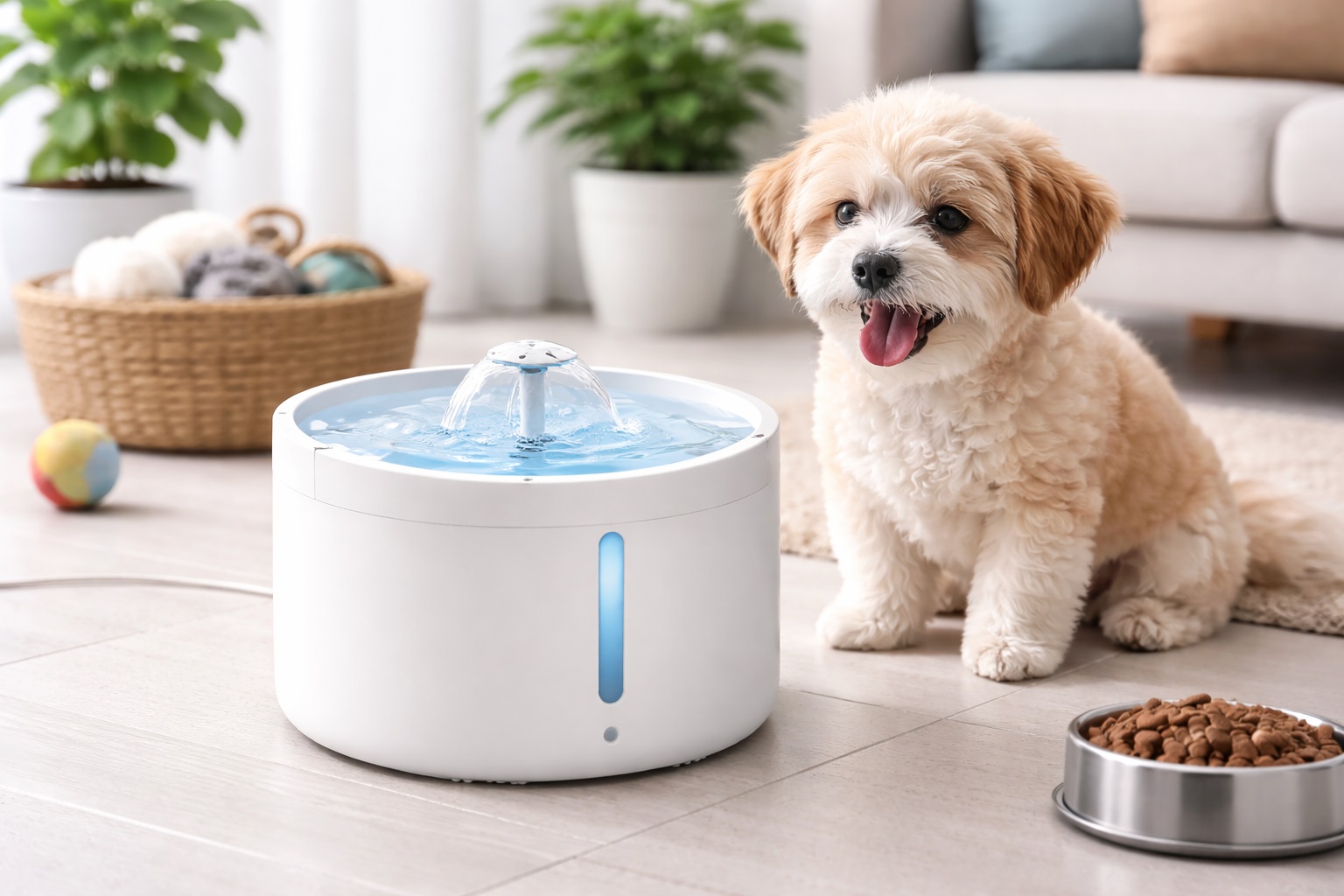
A multi-tier plastic fountain won't match stainless steel or ceramic for long-term surface hygiene, but the better designs in this category use fewer components and wider tiers that are genuinely easy to reach with a sponge or bottle brush. For owners who want an affordable option and are willing to clean a little more often to compensate for the plastic surface, a simple multi-tier design keeps the actual cleaning task quick even if it needs to happen more frequently.
The key is picking a multi-tier model that keeps its tiers open and shallow rather than enclosed. Designs with a wide upper basin and a wide lower basin, connected by a simple visible channel, let you see and reach every surface that touches water. Designs that route water through hidden internal chambers to create a waterfall effect look more elaborate but hide the exact spots where grime accumulates, which defeats the purpose of choosing an affordable, low-maintenance option in the first place.
- Pros:
- Wide, open tiers are easy to reach and scrub by hand
- BPA-free plastic components are typically dishwasher safe
- Lower price point than metal or ceramic alternatives
- Simple carbon filter is easy to pop out and replace without tools
- Cons:
- Plastic scratches over time, and scratches are harder to fully clean than smooth surfaces
- Needs a firmer, more frequent cleaning schedule to stay hygienic
Best For: Budget-conscious owners who don't mind a slightly more frequent cleaning routine in exchange for a lower purchase price.
Why We Recommend It: Not every household wants to spend on stainless steel or ceramic, and a well-designed plastic fountain with few parts and open tiers can still be genuinely quick to clean — it just asks a little more of your routine to stay that way.
4. Compact Single-Basin Fountain – Best for Minimal Parts and Small Spaces
A compact single-basin fountain strips the design down to essentially one reservoir, one pump, and one filter, with no separate tiers or waterfall tower to manage. That simplicity is its own form of easy cleaning: there are fewer seams for grime to hide in, fewer pieces to keep track of during reassembly, and less overall surface area to wash. For owners short on counter or floor space, or anyone who just wants the least complicated fountain to live with, a single-basin design trades some visual flair for a genuinely lower cleaning burden.
- Pros:
- Fewest components of any format, minimizing reassembly mistakes
- Small footprint suits apartments and single-pet households
- Single flow path is easy to visually inspect for residue
- Quick to empty, rinse, and refill in a single motion
- Cons:
- Lower water capacity than multi-tier or larger designs
- Not ideal for multiple pets needing simultaneous access
Best For: Single-pet households or smaller living spaces where minimal parts and a fast rinse-and-refill routine matter more than capacity.
Why We Recommend It: Every part a fountain doesn't have is a part you'll never have to clean, lose, or reassemble incorrectly. For owners who value simplicity above all else, a compact single-basin design delivers the lowest-friction cleaning routine of any fountain style, even if it means refilling more often.
Buying Guide: How to Choose the Easiest Pet Water Fountain to Clean
Use these ten factors to judge how much real maintenance work a fountain will actually create once it's living on your floor.
1. Count the Parts Before You Buy
Every seam, filter cage, and diffuser disc is one more piece you have to separate, wash, and correctly reassemble. Look at product photos and manuals before purchasing and count how many individual components come apart. Fountains with three or four washable pieces stay in rotation far longer than ones with eight or more, simply because reassembly friction adds up over months of use.
It also helps to think about how the parts fit back together. A fountain where every piece only fits one way, often with a visible notch or asymmetric shape, prevents the frustrating trial-and-error of reassembling a symmetrical part backward and discovering the pump won't seal properly.
2. Confirm What's Actually Dishwasher Safe
"Dishwasher safe" sometimes applies only to the outer bowl, not the pump housing, filter cage, or internal tubing. Check the specific parts covered by that claim rather than assuming the whole unit can go in. A fountain where only the main reservoir is dishwasher safe still leaves you hand-washing the parts most prone to slime.
Pump motors themselves should almost never go in a dishwasher regardless of what accompanying plastic housing is rated for, since water pressure and heat can damage the internal motor. Confirm the manual's specific guidance on the motor unit before running a full cycle.
3. Look for Wide Openings and Flat Surfaces
Narrow spouts, tall waterfall towers, and tight corners are difficult to reach with a standard sponge or bottle brush. A wide, shallow reservoir with gently sloped sides lets you wipe the entire interior by hand in seconds, which matters on days you don't have time for a full disassembly and wash.
If you do want a taller, multi-level design for aesthetic or multi-pet reasons, at minimum check whether a bottle brush or narrow cleaning tool is included or recommended by the manufacturer, since that's usually a sign they've anticipated the access problem.
4. Check How the Pump Comes Apart
The pump housing accumulates the most buildup because it's the last place water flows before recirculating. A pump that snaps open tool-free for cleaning is far more likely to actually get cleaned than one that requires a screwdriver or careful disassembly of small internal parts.
Look specifically for a pump impeller that lifts straight out, since that single component collects hair and mineral scale faster than any other part of the fountain and is the piece most often skipped during a rushed cleaning session.
5. Factor In Filter Access and Replacement
A filter that pops out from the top in one motion is easier to live with than one buried under a diffuser plate you have to remove first. Replacement filters typically cost $8–$20 per set and need changing every 2–4 weeks, so easy access reduces the friction of a task you'll repeat often.
Also check whether replacement filters are a standard size sold by multiple third-party brands, or a proprietary shape only the original manufacturer sells, since the latter can become harder to source over the life of the fountain.
6. Prioritize Non-Porous Materials for Buildup Resistance
Stainless steel and ceramic resist the microscopic surface scratches that let bacteria take hold in plastic over time. Choosing a non-porous material doesn't eliminate cleaning, but it reduces how aggressively you need to scrub and how quickly grime reappears after a wash.
This becomes more noticeable the longer you own the fountain. A brand-new plastic unit and a brand-new stainless unit clean about equally well; the gap widens after months of scrubbing, once the plastic has accumulated fine surface scratches that a smooth metal or ceramic surface never develops.
7. Avoid Multi-Chamber Waterfall Designs If Simplicity Matters
Multi-level waterfall fountains look appealing but often route water through several small channels that are difficult to flush completely. Unless you specifically want the multi-tier design for multi-pet access, a single reservoir with one flow path is simpler to keep clean.
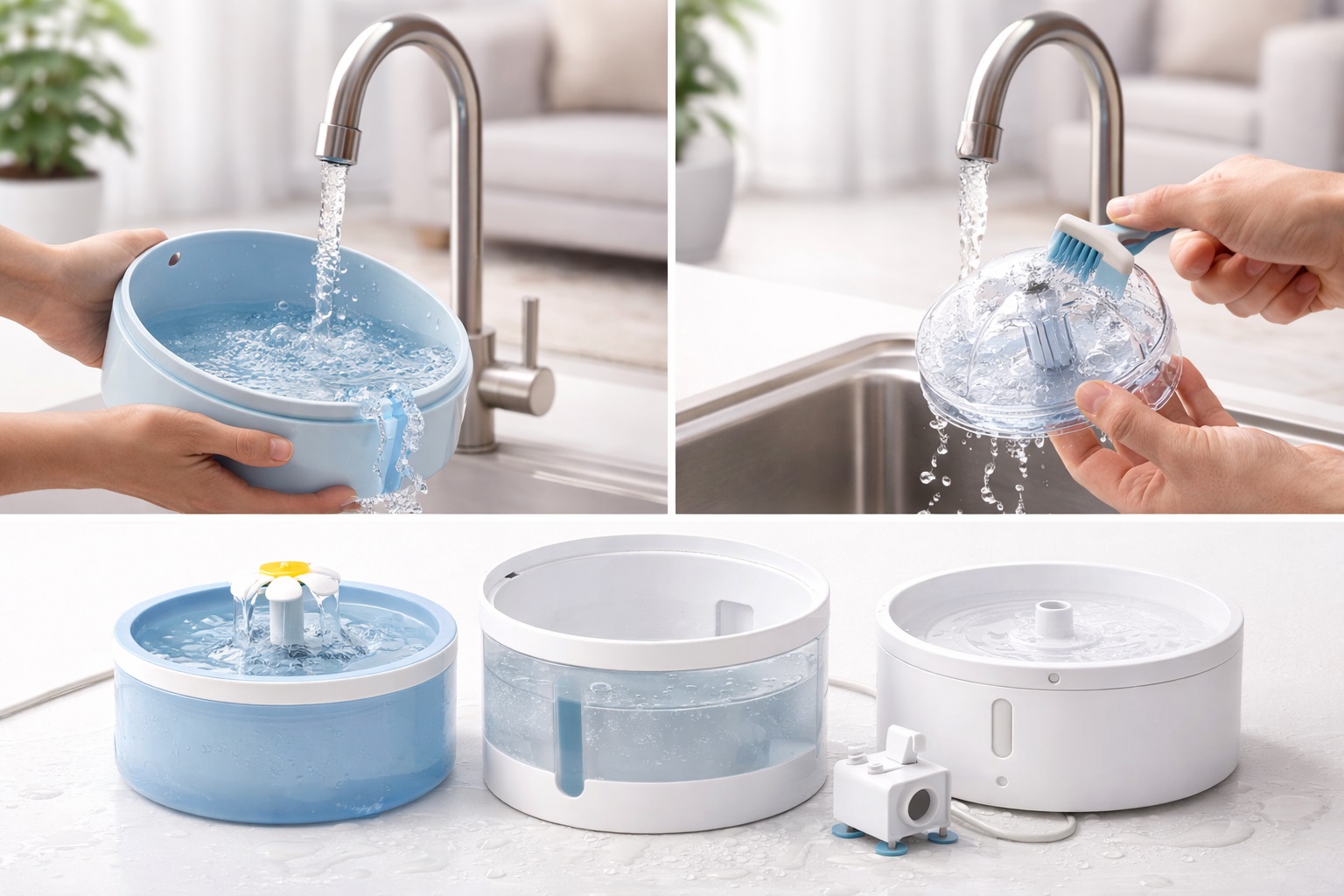
If a waterfall design is important to you visually, look specifically for one advertised as tool-free disassembly, since manufacturers who've solved the access problem tend to highlight it directly in the product description rather than leaving buyers to discover it after purchase. Product photos showing the unit fully disassembled into its component pieces are a good sign the manufacturer expects and supports regular cleaning, rather than treating the fountain as a sealed unit meant to be wiped externally only.
8. Read Real Owner Reviews for Cleaning Complaints
Marketing copy rarely mentions how hard a pump is to reassemble. Verified owner reviews are the most reliable source for cleaning-specific complaints, so search reviews for mentions of "hard to clean," "mold," or "hidden corners" before buying.
Pay particular attention to reviews written a few months after purchase rather than immediately after unboxing, since cleaning difficulty is usually a slow realization rather than something apparent on day one.
9. Match the Cleaning Schedule to Your Realistic Habits
Manufacturers generally recommend wiping the bowl every 3–4 days and doing a full disassembly and wash every 1–2 weeks. Be honest about which of these you'll actually do, and pick a fountain simple enough to fit that real routine rather than an ideal one.
If your household tends to fall behind on chores, lean toward the simplest possible design rather than the one with the most features, since a fountain that's actually cleaned on a slightly relaxed schedule beats an elaborate one that's cleaned rarely.
10. Consider Replacement Part Availability
Pumps and filter cages eventually wear out even on easy-to-clean models. Check that the manufacturer sells replacement pumps and filters directly, since a fountain that's otherwise perfect becomes disposable the moment a part fails and can't be replaced.
A quick way to check this before buying is searching for the model name plus "replacement pump" or "replacement filter" to confirm those parts are actively sold and in stock, rather than discovering the gap only after the original part fails.
A Simple Weekly Cleaning Routine That Actually Works
Even the easiest fountain to clean only stays that way if it's paired with a routine you'll actually follow. Rather than treating cleaning as a single occasional event, it helps to split the task into small, low-effort steps spread across the week, so no single session ever feels like a big undertaking. The table below outlines a realistic split that keeps water fresh without requiring a full disassembly more than once a week.
| Task | Frequency | Time Required |
|---|---|---|
| Top off water level, quick visual check for debris | Daily | Under 1 minute |
| Wipe visible surfaces and rinse the bowl | Every 3–4 days | 2–3 minutes |
| Full disassembly, wash all parts, rinse pump housing | Every 1–2 weeks | 10–15 minutes |
| Replace or rinse the filter cartridge | Every 2–4 weeks | 2–3 minutes |
| Deep descale for mineral buildup on the pump impeller | Every 4–8 weeks | 10–15 minutes |
Notice that the daily and every-few-days steps take almost no time at all — they're really just quick checks. The only step that requires real attention is the full disassembly, and choosing a fountain with fewer parts and an accessible pump is precisely what keeps that step from turning into a ten-minute job that stretches into twenty. A fountain that's genuinely easy to clean makes this entire schedule feel effortless rather than like a chore added to an already busy week, which is ultimately the real test of whether a design lives up to its "easy to clean" label once it's actually in your home.
Frequently Asked Questions
1. How often does an easy-to-clean fountain actually need cleaning?
Even the easiest designs should have the bowl wiped every 3–4 days and a full disassembly and wash every 1–2 weeks, with filters changed every 2–4 weeks. "Easy to clean" reduces how long each session takes, not how often you need to do it.
2. What's the single biggest factor in how easy a fountain is to clean?
Part count. A fountain with fewer components that come apart for washing is almost always faster and simpler to clean than one with more parts, regardless of material or price. Access to the pump housing is the second-biggest factor, since that's where the most stubborn buildup tends to form.
3. Are stainless steel or ceramic fountains really easier to clean than plastic?
They don't have fewer parts, but their non-porous surfaces resist bacterial buildup and staining better, so less scrubbing is needed to get them fully clean and buildup reappears more slowly afterward, which lowers the total effort over time. Over a year of ownership, that gap in effort tends to widen rather than stay constant, since plastic accumulates fine scratches with every wash that make future cleaning progressively harder.
4. Can I put the whole fountain in the dishwasher?
Only if the manufacturer specifically lists each part as dishwasher safe. Pump motors generally should never go in a dishwasher, even when the surrounding housing is safe to wash that way, since heat and water pressure can damage the internal motor.
5. Why does my fountain develop slime even though I clean it regularly?
Slime usually forms in spots a cleaning routine misses — inside pump housings, along filter cage seams, or in narrow tubing. If buildup keeps recurring, the fountain likely has an inaccessible area that needs a smaller brush or more thorough disassembly to reach fully. A small, soft-bristled brush designed for baby bottles or straws is often the easiest tool for reaching narrow pump channels that a sponge can't get into.
6. Do fewer parts mean a less effective fountain?
Not necessarily. Simpler designs with a single flow path and a basic filter cage still circulate and filter water effectively; they just have fewer surfaces for bacteria to hide on, which is a genuine advantage rather than a compromise on performance.
7. Is a more expensive fountain always easier to clean?
Not always. Price often reflects material and capacity more than cleaning design. Some mid-priced plastic models with open, wide tiers are easier to clean day-to-day than pricier multi-chamber waterfall designs that look more elaborate.
8. How long should an easy-to-clean fountain last with regular washing?
A well-built fountain from a reputable manufacturer typically lasts 2–5 years with consistent cleaning. Frequent dishwasher use on non-porous materials generally doesn't shorten that lifespan the way repeated scrubbing can with plastic.
9. Can I return a fountain if the cleaning process turns out to be harder than expected?
Most retailers offer 15–30 day return windows, which is enough time to run through several real cleaning cycles and judge whether the design fits your routine before the window closes.
10. What should I prioritize first when shopping specifically for easy cleaning?
Start with part count and dishwasher-safe coverage, then check material and filter access. Those factors determine your actual weekly time investment far more than brand name or overall price, and they're easy to verify from product listings and owner reviews before you buy, well before the fountain arrives at your home and the real cleaning routine begins.
Final Verdict
- Best for Fast, Simple Wipe-Downs: Stainless Steel Filtered Fountain — quickest routine cleaning with no surface degradation over time.
- Best for Staying Clean Between Washes: Ceramic Filtered Fountain — resists buildup and odor longer, reducing how often deep cleaning is needed.
- Best Budget Option for Simple Routines: Multi-Tier Plastic Filtered Fountain — fewer barriers to quick hand-washing at a lower price.
- Best for Minimal Parts and Small Spaces: Compact Single-Basin Fountain — the simplest possible design for a low-friction routine.
The easiest fountain to clean is the one whose design matches the cleaning habits you'll actually keep up with — not necessarily the one with the most features. A fountain that looks impressive in photos but buries its pump under a maze of tiers will lose to a simpler design every time once real life gets busy and cleaning sessions get shorter and less frequent than planned. Use the comparisons and buying factors above to pick a fountain that stays fresh because it's genuinely simple to maintain, not because it demands more discipline than you're likely to give it. When in doubt, favor fewer parts and a non-porous surface over extra features — that combination is what keeps a fountain in daily use, clean and running, long after the novelty of a new gadget has worn off.