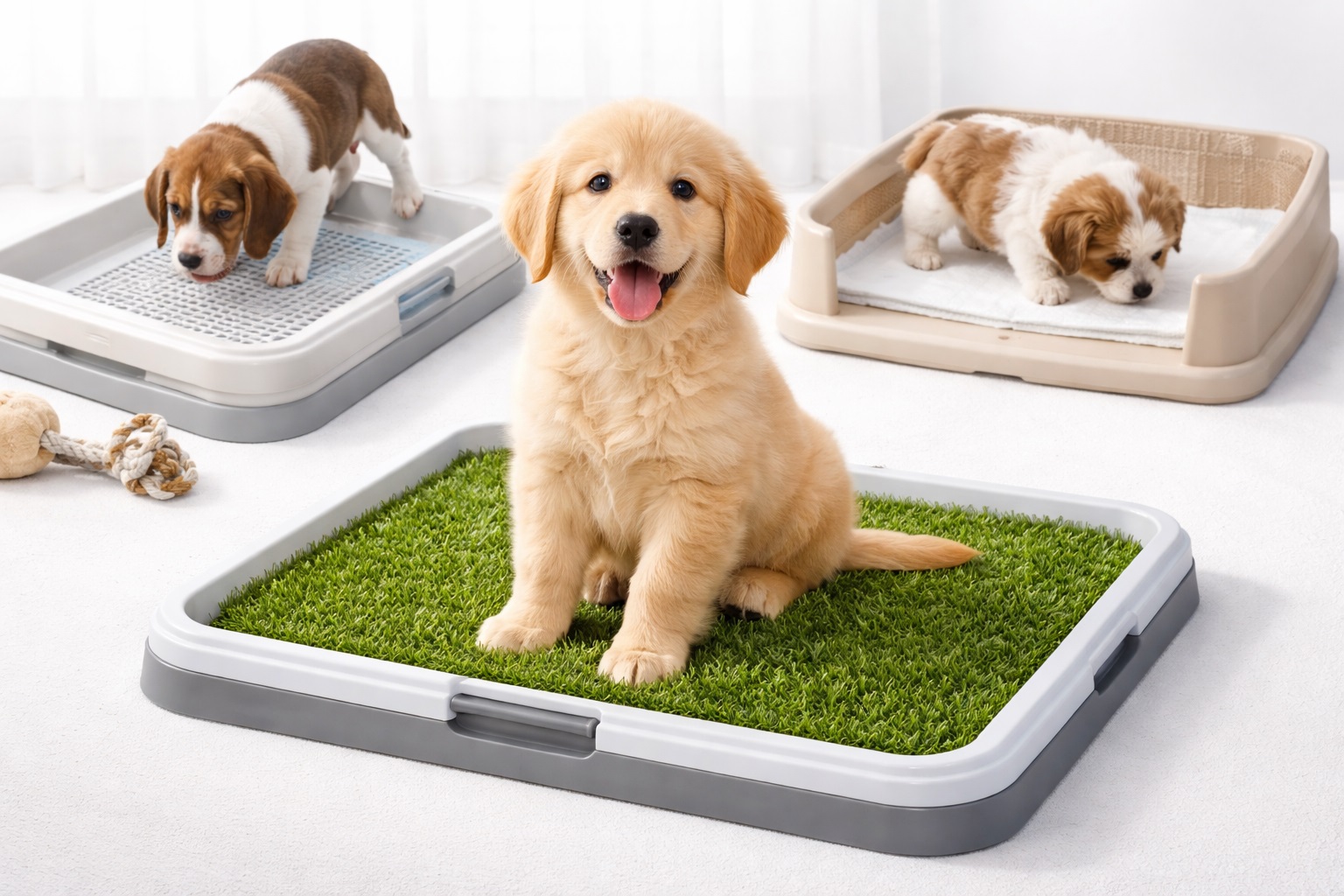
Best Litter Boxes for Training Puppies: Indoor Potty Made Easy
A new puppy cannot hold its bladder for long, and it cannot yet tell the difference between the living room rug and an appropriate place to go. Physically, a young puppy's bladder control develops gradually over several months, which means accidents in the earliest weeks are a matter of biology rather than defiance or a failure to understand the rules. An indoor puppy litter box gives a young dog one consistent, designated spot to use while its bladder control and understanding of house rules are still developing, which matters most in the early weeks before a puppy has had its full round of vaccinations and cannot yet spend unsupervised time outdoors.
This guide looks specifically and deliberately at indoor training systems built for young puppies rather than general dog litter products intended for grown dogs, since a system that works for house-training has different priorities than one meant for an apartment-bound adult dog long-term. A training-focused system needs to be easy to clean multiple times a day, forgiving of frequent misses while the puppy is still learning, and simple enough that the routine around it does not become a chore in itself. The right choice depends on your puppy's current size, how much space you can dedicate to a training area, and whether you plan to eventually transition to fully outdoor potty habits or keep an indoor option permanently.
None of the designs below are a substitute for close supervision during the first several weeks and a consistent schedule built around your puppy's actual habits — the box or pad is simply the tool that makes the schedule easier to enforce. Puppies that are taken to the same spot at the same times, and rewarded immediately when they use it, learn faster regardless of which specific product sits in that spot.
It is worth setting expectations up front: no indoor system trains a puppy by itself. Every design below still depends on the owner noticing pre-elimination cues, maintaining a consistent schedule, and cleaning up thoroughly so residual odor does not undermine the routine. The differences between the three approaches covered here come down to how much mess they contain, how closely they resemble what the puppy will eventually use outdoors, and how accessible they are for a puppy that is still physically small. None of that replaces supervision in the early weeks, but the right equipment does make consistency considerably easier to maintain day after day.
Top Picks Reviewed
1. Tray-and-Grid Indoor Litter Box with Pad Holder – Best for Odor and Mess Control
This design holds a standard puppy training pad flat under a raised plastic grid, so the puppy stands and walks on the grid itself rather than directly on the absorbent pad. Urine passes through the grid and is absorbed below, out of paw contact, which keeps the puppy's feet dry and prevents the pad from being shredded or dragged around the room during use. The raised sides of the tray also contain any splashing at the edges of the pad. Because the pad sits flat and secured under the grid rather than loose on the floor, it also stops a bored or teething puppy from picking the pad up and shredding it across the room, which is one of the more common frustrations with bare pad training in the first few weeks.
- Pros:
- Grid keeps paws off the wet pad, reducing tracked mess around the house
- Raised edges contain splashing better than a bare pad on the floor
- Compatible with standard-size training pads, which are widely available and inexpensive
- Easy to wipe down and reuse between pad changes
- Cons:
- Pads need replacing every use or two to keep odor under control
- Some puppies chew or dig at the corner of the grid out of curiosity
Best For: New puppy owners who want a straightforward, inexpensive setup using widely available training pads rather than a specialty litter substrate.
Why We Recommend It: It solves the biggest complaint about bare training pads — puppies dragging, shredding, or standing directly in the wet pad — while remaining compatible with pads you can buy at any pet or grocery store, keeping ongoing costs low. It is also the easiest design for a new owner to understand at a glance, since setup involves nothing more than placing a pad under the grid and replacing it on a schedule, with no substrate to measure or turf to rinse.
2. Artificial Grass Potty Pad System – Best for a Realistic Outdoor Transition
This design uses a tray of synthetic turf over an absorbent base or drainage layer, giving the puppy a texture that closely resembles the grass it will eventually be trained to use outdoors. Because the surface feels similar to natural grass, many owners find this approach makes the eventual move to exclusively outdoor potty breaks smoother than a switch from cloth-textured pads to grass and pavement. Some versions include a scent additive designed to attract the puppy back to the same spot, though a clean, consistently placed tray works just as reliably as the primary cue.
- Pros:
- Texture mirrors real grass, which can ease the transition to outdoor training
- Turf layer is typically removable and rinsable rather than fully disposable
- Reduces per-use cost compared with replacing a pad every session
- Less prone to being torn apart by a chewing or digging puppy than paper pads
- Cons:
- Requires regular rinsing and full washing to prevent odor buildup in the turf fibers
- Needs a drying period after washing, so a second tray is useful for uninterrupted use
Best For: Owners who intend to eventually train the puppy to go outdoors and want the indoor surface to feel as similar as possible to what comes next.
Why We Recommend It: Puppies generalize based on surface texture and feel, so training on something grass-like from the start can shorten the adjustment period once outdoor access becomes available, compared with a puppy that only knows paper or fabric-textured pads. Owners who live in apartments without easy ground-floor access, or who face long waits for an elevator during a puppy's most urgent moments, often find this the most realistic long-term indoor solution rather than a strictly temporary training tool.
3. Low-Entry Enclosed Puppy Litter Box – Best for Small Breeds and Confined Spaces
Built with shallow walls and a low entry point, this design gives very young or small-breed puppies a defined, contained area without requiring them to step over a tall rim. A lightly raised lip contains loose litter substrate or pad edges while staying low enough for a puppy with short legs to enter without hesitation. Some versions include a partial cover for a bit of privacy without limiting access. Because young puppies have limited depth perception and coordination, the difference between a two-inch entry lip and a five-inch one can be the difference between a puppy that uses the station confidently and one that hesitates or avoids it entirely.
- Pros:
- Low entry suits young or small-breed puppies that cannot yet climb over tall sides
- Shallow, defined footprint keeps the designated area clearly separate from the rest of the room
- Works with pads, puppy-specific litter substrate, or a grass insert depending on the model
- Compact enough for apartments or crate-adjacent placement
- Cons:
- Low walls provide less splash and scatter containment than a taller design
- Puppy will likely outgrow the size within a few months of steady growth
Best For: Small-breed puppies or very young puppies of any breed who need an accessible, low-barrier introduction to the concept of a designated potty spot.
Why We Recommend It: A box that is physically too difficult to enter defeats its own purpose, and this design removes that barrier for puppies too small or young to manage a taller-sided box, making it easier to build the habit early. Because the design is naturally sized for a young or small puppy, it also transitions well into a permanent long-term solution for toy breeds that will never grow much beyond the size they are trained at.
Buying Guide: How to Choose the Best Litter Box for Training Puppies
Indoor puppy training is as much about routine as it is about equipment, but the right setup removes friction from that routine rather than adding to it. These factors are specific to house-training rather than general dog-supply shopping, and they are worth reviewing together before you buy rather than discovering them one at a time after a few frustrating weeks. A little planning up front around size, placement, and your long-term intentions for the puppy saves a second or third purchase later once the first setup turns out not to fit the household.
1. Choosing Between Pads, Grass, and Litter Substrate
Pad-based systems are the cheapest to start with and easiest to find, grass systems ease the transition to outdoor training, and litter-substrate systems behave more like a cat box with a scoopable material. None is objectively superior — the right choice depends on whether you plan to keep an indoor option long-term or move to outdoor-only potty breaks once the puppy is fully vaccinated and reliably house-trained. Some owners start with pads for the first few weeks simply because they are the easiest to find on short notice, then switch to grass or litter substrate once the puppy has settled into a rhythm and the long-term plan becomes clearer.
2. Sizing for Your Puppy's Adult Size
A toy or small breed can use the same compact indoor station for its entire life if you choose to keep one, but a puppy that will grow into a large adult dog will outgrow a small tray within months. If you expect to keep an indoor option available long-term, consider sizing up earlier rather than replacing the setup repeatedly as the puppy grows. As a rough guide, the station should comfortably fit the puppy's expected adult body length with room to turn, which for many medium and large breeds means the indoor option becomes impractical past a certain size and outdoor training becomes the long-term goal by necessity.
3. Placement in a Consistent, Accessible Location
Choose one location and keep it consistent — moving the station around confuses a puppy that is still learning where to go. A spot near the puppy's main living area, away from food and water bowls, and easy for the puppy to reach quickly when the urge strikes works best, particularly overnight or when the puppy is confined to a small area. Avoid placing the station right next to the puppy's bed or crate, since most dogs instinctively avoid eliminating too close to where they sleep, which can create confusion if the two areas are too close together.
4. Building a Consistent Schedule Around the Box
Puppies typically need to go shortly after waking, after eating, after active play, and after a nap, since digestion and activity both trigger the urge fairly predictably at this age. Bringing the puppy to the indoor station calmly and without excessive fuss at these predictable times, rather than waiting for signs of urgency, builds the habit faster than relying on the puppy to find the spot independently in the early weeks.
5. Positive Reinforcement at the Moment of Use
Reward immediately when the puppy uses the designated area — a treat and calm praise within seconds of finishing, not minutes later. A short, upbeat verbal cue said consistently every time can also help the puppy associate a specific word with the action, which becomes useful later when you want to prompt elimination on command during walks. Puppies do not connect a reward with an action that happened much earlier, and a delayed reward risks reinforcing whatever the puppy happens to be doing at the moment it arrives instead, so timing matters more than the size or quality of the reward itself. Keep a small stash of treats near the station itself so you are never scrambling to reward the moment it happens, since even a short delay meaningfully weakens the association you are trying to build.
6. Deciding Whether to Transition to Outdoor-Only
Many owners use an indoor station only during the vaccination window and early weeks, then phase it out once the puppy can reliably hold its bladder and has safe outdoor access. Others, particularly in apartments or with small breeds, keep an indoor option permanently. Decide your long-term plan early, since it affects which product features matter most. If outdoor transition is the goal, it helps to begin taking the puppy outside for at least some scheduled trips once vaccinations allow, running the two routines in parallel for a few weeks rather than switching abruptly on a single day.
7. Cleaning and Odor Control Between Uses
Whatever system you choose, odor left behind from a previous use can either attract the puppy back to the same spot (helpful) or, if not cleaned properly elsewhere in the home, encourage the puppy to treat other odor-marked areas as acceptable too. Clean the station regularly and use an enzymatic cleaner on any accidents that happen outside it. Standard household cleaners can mask odor to a human nose while leaving enough scent behind for a puppy to detect, which is why enzymatic formulas made specifically for pet accidents outperform general-purpose cleaning sprays for this particular purpose.
8. Handling Accidents Outside the Designated Area
Accidents during training are normal and expected, not a sign of a failed product or a stubborn puppy, and most puppies have several before the habit fully settles regardless of how well the equipment and schedule are managed. Clean thoroughly with an enzymatic cleaner to remove the scent completely, since regular cleaning products can leave residual odor markers that draw the puppy back to the same spot repeatedly. Blot up fresh accidents before applying any cleaner rather than rubbing the area, which spreads the affected area wider and pushes moisture deeper into carpet fibers or flooring seams.
9. Multi-Puppy or Multi-Dog Households
If you are training more than one puppy at once, or introducing a puppy alongside an existing adult dog, provide a station sized or positioned so both animals are not competing for the same small space at the same time, which can create stress and inconsistent use for either dog. An established adult dog can also inadvertently teach a new puppy bad habits or good ones simply through proximity, so supervising early interactions around the training area is worth the extra attention during the adjustment period.
10. Recognizing the Signs a Puppy Needs to Go
Circling, sniffing the floor intently, sudden restlessness, whining, or heading toward a door or the training station's general area are all common pre-elimination signals worth learning to recognize quickly. Learning to spot these cues in your specific puppy allows you to redirect to the station before an accident happens rather than after. Keeping a brief log of when accidents happen during the first couple of weeks can also reveal a pattern — a specific time of day or trigger — that helps you anticipate the need before the signal even appears.
11. Realistic Timelines for Full House-Training
Most puppies show meaningful progress within four to six weeks of consistent training, though full reliability often takes several months and varies significantly by breed, individual temperament, and how consistently the schedule is followed. Occasional regressions, especially during growth spurts or schedule changes, are normal rather than a sign that training has failed. Moving to a new home, a change in the household routine, or the arrival of another pet can all trigger a temporary step backward even in a puppy that had seemed fully trained, and returning briefly to a stricter schedule usually resolves it.
12. Cost and Long-Term Value of Indoor Systems
Pad-based systems have a low upfront cost but an ongoing per-pad expense; grass and litter-substrate systems cost more initially but lower the recurring cost over time. Factor in whether you plan to use the system for a few months during training or keep it as a permanent household fixture when weighing the higher upfront cost of reusable designs. Over a full year of daily use, a reusable grass or litter-substrate system frequently ends up cheaper than continuously restocking disposable pads, even though the shelf price looks higher at the point of purchase.
Frequently Asked Questions
1. How long does it take to litter train a puppy?
Most puppies show noticeable progress within four to six weeks of consistent scheduling and positive reinforcement, though full reliability can take several months. Smaller breeds and individual temperament both affect the timeline meaningfully. Consistency in scheduling and cleanup tends to matter more than any single product choice in how quickly a puppy reaches reliable use.
2. What age should I start indoor potty training?
You can begin as soon as a puppy comes home, often around eight weeks old. Early weeks are actually when indoor training matters most, since the puppy typically cannot go outdoors safely until its vaccination schedule is complete. Starting immediately, even before the puppy fully understands the routine, establishes the location and habit sooner than waiting for an arbitrary age milestone.
3. Can I use regular cat litter in a puppy training box?
It is not recommended. Standard clumping cat litter can be harmful if a puppy ingests it, and most puppy-specific litter substrates are formulated to be safer if a curious puppy chews or licks the material. If you choose a litter-substrate approach at all, look specifically for products labeled for dogs rather than repurposing cat litter you already have at home.
4. Do I need both an indoor station and an outdoor routine?
Many owners run both in parallel during the early weeks, then gradually phase out the indoor option once the puppy is older and has reliable outdoor access, though small-breed or apartment households often keep both permanently. Running both at once during the transition is not confusing for most puppies as long as each option is kept consistently in the same place.
5. Why does my puppy avoid the indoor training station?
Common causes include a station that is too small, an unfamiliar surface texture, a location the puppy finds exposed or noisy, or a station that was not cleaned frequently enough. Address the environment before assuming the puppy is simply resistant to training. Ruling out these practical causes first resolves the majority of avoidance cases without needing to change the product entirely.
6. Is grass pad training better than paper pad training?
Neither is universally better — grass systems can ease an eventual outdoor transition, while paper pads are cheaper and simpler to start with. The right choice depends on your long-term plan for the puppy's potty routine. Some owners even use both in sequence, starting with pads for convenience and moving to grass once an outdoor transition is on the horizon.
7. How many indoor potty stations does one puppy need?
One consistently placed station is usually sufficient for a single puppy. Adding a second station in a different frequently used area of the home can help during the earliest weeks when accidents are more common. Too many stations spread around the house can dilute the routine, though, so consolidate down to one primary spot once the puppy shows a clear preference.
8. Will indoor litter training confuse a puppy about going outside later?
Not typically, provided the transition is handled gradually. Puppies generalize the concept of "this is where I go" reasonably well when the outdoor routine is introduced consistently alongside a gradual reduction in indoor station availability. The key is a gradual, overlapping transition rather than an abrupt switch from one routine to the other on a single day.
9. Which breeds benefit most from indoor litter training?
Small and toy breeds, and dogs in apartment or high-rise living situations, benefit most from a long-term indoor option, since outdoor access may be less immediate or convenient throughout the dog's life, not just during puppyhood. Toy breeds with small bladders in particular often continue to benefit from an available indoor option well into adulthood.
10. How do I stop accidents when I'm not home to supervise?
Confine the puppy to a smaller area containing the training station when unsupervised, such as a puppy-proofed room or an exercise pen, so the station is the most convenient and closest option available. Free-roaming access to a full home before house-training is reliable is one of the most common causes of repeated accidents in unsupervised periods.
11. Should I punish my puppy for accidents?
No. Punishment after the fact does not connect to the action in a puppy's mind and can create anxiety around elimination in general, which often makes house-training harder rather than easier. Redirect calmly and reward successful use instead. A puppy that seems to "know it did wrong" after an accident is typically reacting to the owner's tone and body language in the moment, not to genuine understanding of the earlier action.
12. When can I stop using the indoor training box entirely?
Once the puppy is reliably signaling to go outside, has completed its vaccination schedule, and has gone several consecutive weeks without an indoor accident, most owners begin phasing out the indoor station gradually rather than removing it all at once. Keep the station available a little longer than seems necessary rather than removing it too early, since a single setback after an early removal can be more disruptive than a few extra weeks of overlap.
Final Verdict
- Best for Odor and Mess Control: Tray-and-Grid Indoor Litter Box — the most practical, budget-friendly starting point for most new puppy owners.
- Best for a Realistic Outdoor Transition: Artificial Grass Potty Pad System — the strongest choice if outdoor training is the eventual goal.
- Best for Small Breeds and Confined Spaces: Low-Entry Enclosed Puppy Litter Box — the right fit for small or very young puppies needing an accessible introduction to the routine.
Whichever system you choose, the equipment matters far less in the end than the consistency behind it. A clearly placed, regularly cleaned station paired with a predictable schedule and immediate positive reinforcement will get most puppies reliably house-trained faster than any single product feature. Expect setbacks along the way, keep the routine steady through them, and adjust the setup only when the puppy's behavior tells you something about the current one isn't working.
It is also worth remembering that every puppy progresses on its own timeline, and comparing your dog's pace against a neighbor's or a breed average rarely helps and can add unnecessary pressure to what should be a fairly low-stress process. Keep sessions calm, keep cleanup thorough, and treat the occasional accident as information about the schedule or environment rather than a failure on the puppy's part or yours. Owners who stay consistent through the first month typically find the second month considerably easier, as the habit becomes self-reinforcing once the puppy associates the station with both relief and reward.