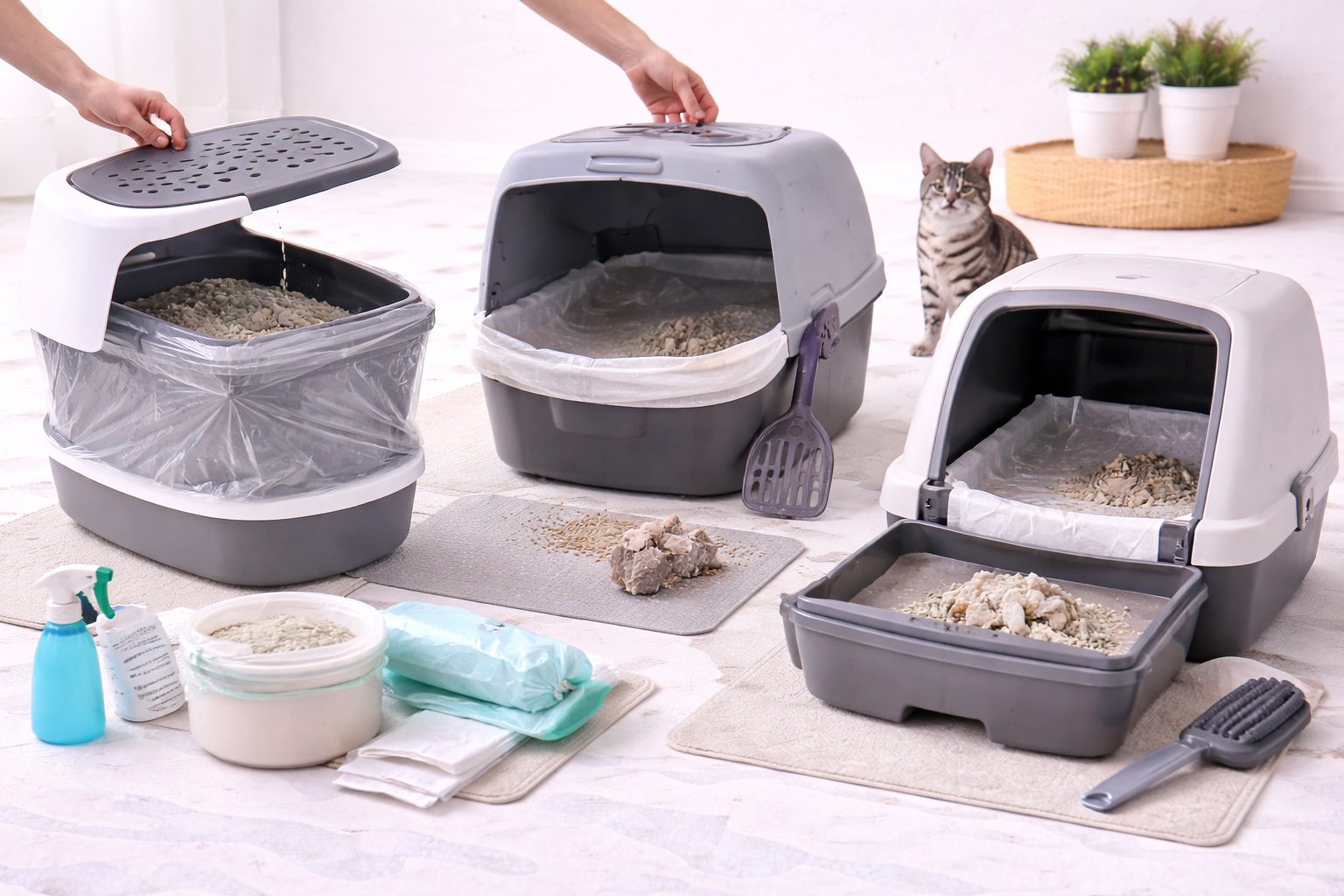
Best Easy-to-Clean Cat Litter Boxes: Less Scooping Effort, More Happy Cats
Litter box maintenance is one of those recurring tasks that either becomes an easy daily habit or a chore that quietly gets put off, and the box design itself plays a bigger role in that outcome than most owners initially assume. A box with a wide, accessible opening, a shape that lets a scoop reach every corner, and litter that clumps cleanly takes a fraction of the time to maintain properly compared to a box with awkward angles, a narrow entry, or litter that crumbles apart during scooping.
The stakes here are not purely about convenience for the owner. A litter box that is difficult to clean tends to get cleaned less often, and cats are notably sensitive to litter box cleanliness — a box that goes even a day or two without scooping can prompt a cat to look elsewhere, creating a much bigger problem than the original maintenance inconvenience. Choosing a genuinely easy-to-clean design is as much about supporting consistent cat hygiene as it is about saving the owner time and effort.
This guide compares three practical litter box categories built around minimizing cleaning effort, walks through the specific design factors that determine how easy a box actually is to maintain day to day, and answers the questions cat owners ask most often when trying to reduce the burden of this routine task.
Top 3 Easy-to-Clean Cat Litter Boxes (Detailed Reviews)
1. Self-Cleaning Litter Box – Best for Minimal Daily Scooping Effort
A self-cleaning litter box automatically sifts waste into a separate sealed compartment shortly after each use, removing the need for manual scooping almost entirely under normal circumstances. For owners whose primary frustration is the daily scooping routine itself, this category directly addresses the problem at its source rather than simply making manual scooping somewhat easier.
- Pros:
- Automates the single most repetitive litter box maintenance task
- Sealed waste compartment reduces both odor and direct waste contact
- Consistent cleanliness regardless of the owner's daily schedule
- Often includes app or indicator alerts for waste compartment emptying
- Cons:
- Highest upfront cost among easy-to-clean categories
- Mechanical components require occasional cleaning and maintenance themselves
Best For: Owners wanting to essentially eliminate manual scooping from their routine and willing to invest in the higher upfront cost.
Why We Recommend It: No other category removes as much of the recurring manual effort as a genuinely reliable self-cleaning box. For busy households or those simply wanting the lowest possible ongoing maintenance burden, this is the most direct solution available.
Even with automation handling routine waste removal, periodically wiping down the sifting mechanism and sensor components remains necessary, so this category reduces daily effort substantially without eliminating maintenance responsibility entirely.
Owners transitioning from years of manual scooping often describe the adjustment period as surprisingly short, with most reporting full comfort with the new automated routine within the first couple of weeks of regular use.
2. Sifting Litter Box with Removable Tray – Best for Fast Manual Cleaning Without Automation
A sifting litter box uses a slotted upper tray that separates clumped waste from clean litter when lifted and shaken, dramatically speeding up manual cleaning compared to scooping through loose litter by hand. This design keeps the simplicity and lower cost of a manual box while specifically addressing the time-consuming part of the process — separating waste from usable litter.
- Pros:
- Significantly faster manual cleaning than scooping through loose litter
- No electronics or automation to malfunction over time
- Lower cost than fully automated self-cleaning systems
- Full manual control and visibility over the cleaning process
- Cons:
- Still requires the owner to perform the cleaning action daily
- Sifting tray slots can require occasional clearing of stuck litter
Best For: Owners wanting significantly faster manual cleaning without the cost or complexity of an automated system.
Why We Recommend It: The sifting design solves the most time-consuming part of manual scooping — separating waste from clean litter — without introducing any of the mechanical complexity or cost of full automation, making it an efficient middle-ground solution.
Pairing this design with a clumping litter specifically formulated for sifting trays produces the cleanest separation results, since some litter formulas clump more reliably and hold together better through the shaking motion than others.
Because the tray itself requires only occasional rinsing rather than any electrical maintenance, this design also tends to hold up reliably in humid bathrooms or utility rooms where an electronic self-cleaning system might face added wear from moisture exposure.
3. Wide-Opening Bagless Box with Non-Stick Surface – Best for Simple, Fast Manual Scooping
A basic litter box with a deliberately wide opening and a smooth, non-stick interior surface speeds up traditional manual scooping without introducing any automation or sifting mechanism at all. The wide opening allows full scoop access to every corner without awkward angling, while the non-stick surface prevents waste and litter from sticking to the interior walls during use.
- Pros:
- Wide opening allows unobstructed full-scoop access to every area
- Non-stick surface prevents waste adhesion, simplifying full cleans
- No mechanisms or trays that can jam, stick, or need replacement
- Lowest overall cost among the three easy-to-clean categories
- Cons:
- No odor or scatter containment beyond the box's own walls
- Non-stick coating may wear down gradually over extended use
Best For: Owners wanting the simplest possible easy-to-clean design without paying for sifting trays or automation.
Why We Recommend It: This design proves that easy maintenance does not require added mechanisms or cost — a well-shaped box with the right surface finish meaningfully speeds up standard manual scooping on its own.
Reapplying a food-safe silicone spray or similar non-stick treatment periodically, once the factory coating begins to wear, can extend this box's easy-cleaning benefit well beyond what the original finish alone would provide.
This category is also a sensible starting point for owners uncertain whether a more elaborate easy-clean solution is worth the investment, since it establishes a baseline of reasonably easy manual cleaning before deciding whether sifting or full automation would meaningfully improve on that experience.
Buying Guide: How to Choose the Best Easy-to-Clean Cat Litter Box
Genuine cleaning ease comes from specific, checkable design choices rather than marketing language alone, so verify each of the following before assuming a box will actually stay easy to maintain.
1. Opening Width and Scoop Access
A box with a wide opening allows a standard scoop to reach every corner without repeated repositioning. Narrow openings, particularly on hooded or top-entry designs, can make thorough scooping noticeably more time-consuming.
Testing whether your specific scoop reaches all four corners of a box without needing to tilt or angle awkwardly is a practical way to assess this factor before committing to a purchase.
A box with a slightly larger footprint than strictly necessary for the cat's size often makes scooping meaningfully easier, since the extra margin around the edges gives the scoop more room to maneuver without repeatedly bumping into the walls.
2. Interior Surface Finish
A smooth, non-stick interior resists waste and litter adhesion far better than a textured or porous surface, directly reducing the time and effort needed for both daily scooping and periodic full cleans.
Running a hand across the interior surface, or checking close-up product photos for any visible texture, helps assess this factor before purchase, since a smooth appearance in wider photos does not always reflect the actual interior finish.
Reviews specifically mentioning how easily waste releases during scooping, rather than general cleanliness comments, give the clearest indication of whether a box's surface finish genuinely lives up to its non-stick marketing claims.
3. Sifting Mechanism Reliability
For sifting box designs, confirm the tray slots are appropriately sized for the litter type you plan to use — slots too small clog easily, while slots too large let clumps break apart before full separation occurs.
Reviews mentioning a specific litter brand alongside a sifting box model give the most reliable indication of whether that particular litter and tray combination actually performs well together.
Rinsing the sifting tray periodically under running water, even between full litter changes, helps prevent fine litter dust and residue from gradually building up and reducing the effectiveness of the slots over time.
4. Automation Reliability for Self-Cleaning Systems
Self-cleaning boxes depend on sensors and motors functioning consistently. Research reliability specifically, including how the manufacturer handles malfunctions, since a failure in this category creates more disruption than a simple manual box would.
Choosing a model with a strong track record of several years on the market, rather than a brand-new release, reduces the risk of encountering unresolved reliability issues that newer products sometimes have.
Checking whether the manufacturer offers a responsive support line or troubleshooting resource specifically for the automated mechanism is worthwhile, since a malfunction in this category is more disruptive to resolve independently than a simple manual box issue would be.
5. Waste Compartment Capacity and Access
Larger sealed waste compartments on self-cleaning boxes require less frequent emptying, an important factor for multi-cat households generating more waste volume. Confirm the compartment is easy to access and empty when it does fill.
Checking whether replacement waste liners are proprietary or compatible with standard bags affects both convenience and ongoing cost, so this is worth confirming before committing to a specific self-cleaning model.
Multi-cat households in particular should look closely at compartment capacity, since a compartment sized for a single cat's typical waste volume may require far more frequent emptying than the manufacturer's stated interval suggests once shared among several cats.
6. Full Litter Change Ease
Beyond daily maintenance, periodic full litter changes should also be straightforward. A box that is easy to tip, empty, and rinse fully simplifies this less frequent but more involved task.
Boxes with rounded rather than sharply squared bases tend to pour out more completely during a full change, leaving less residual litter and debris behind in corners.
A box light enough to comfortably carry to an outdoor trash area or bathroom for emptying, without straining, also meaningfully reduces the friction of performing a full litter change on a regular schedule.
7. Material Resistance to Odor Absorption
A surface that resists absorbing odor into the material itself stays easier to keep genuinely clean-smelling over time, compared to a porous surface that can retain odor even after thorough cleaning.
A box that still smells faintly immediately after a full wash with soap and water is showing signs of odor absorbed into the material, which no amount of additional scooping effort can fully resolve.
Replacing a box once absorbed odor develops, rather than continuing to deep clean an already saturated material, is usually the more time-efficient decision, since further cleaning attempts on a saturated surface produce diminishing returns.
8. Number of Boxes Relative to Cleaning Routine
Multiple accessible boxes distribute waste volume more evenly than one heavily used box, which can make each individual box easier to keep consistently clean, particularly in multi-cat households.
The standard one-per-cat-plus-one guideline supports easier cleaning as a side benefit, since no single box accumulates waste as quickly as it would if forced to serve multiple cats alone.
Spacing multiple boxes across a rotating cleaning schedule, rather than cleaning all of them on the same day, can also help spread the total maintenance workload more evenly across the week instead of concentrating it into one longer session.
9. Litter Type Compatibility
Some easy-to-clean box designs, particularly sifting trays, perform noticeably better with certain litter types than others. Confirm the box and your preferred litter formula are genuinely compatible before committing to either.
If switching to a new litter type specifically to improve sifting performance, transition gradually to avoid the litter box avoidance that an abrupt full switch can sometimes trigger in a sensitive cat.
Keeping a small reserve of your cat's established litter type on hand during any transition period provides a fallback option if the cat shows clear resistance to the new formula before the switch is fully complete.
10. Time Investment Versus Cost Trade-off
Self-cleaning systems cost more upfront but save the most ongoing time, while sifting trays offer a moderate time savings at a lower cost, and simple wide-opening boxes save time only through their shape and surface finish at minimal added cost.
Estimating your own time value and daily availability for litter box maintenance helps determine which point on this cost-versus-effort spectrum makes the most sense for your specific household.
Households with unpredictable schedules, such as shift workers or frequent travelers, may find the consistency of a self-cleaning system worth its higher cost specifically because it removes reliance on a fixed daily routine that their lifestyle cannot guarantee.
11. Maintenance of the Maintenance Features Themselves
Ironically, features designed to reduce cleaning effort — sifting mechanisms, automation sensors, non-stick coatings — themselves require some periodic maintenance to keep functioning as intended.
Building this secondary maintenance into your routine, even if only monthly, prevents the easy-cleaning features from gradually degrading and losing the very benefit they were chosen to provide.
Setting a calendar reminder specifically for this secondary maintenance, separate from daily scooping reminders, helps ensure it does not get overlooked simply because it happens far less frequently than the primary cleaning task.
12. Long-Term Reviews on Actual Cleaning Experience
Initial unboxing impressions rarely capture how easy a box remains to clean after months of regular use. Prioritize reviews written well after purchase that specifically describe the ongoing cleaning routine rather than first impressions alone.
Look for consistent patterns across many long-term reviews rather than drawing conclusions from a single account, since individual units and cleaning habits can vary even within a generally well-regarded model.
Owner forums and community groups focused on cat care often surface more candid long-term feedback about ongoing cleaning experience than retailer review sections, since discussions there tend to follow a product's performance over an extended period rather than stopping at a single post-purchase review.
13. Cleaning Supplies That Complement an Easy-Clean Box
A dedicated, well-sized scoop matched to the box's litter type, a small covered bin for used litter near the box, and a mild, unscented cleaner for periodic full washes all support whatever ease-of-cleaning benefit the box design itself provides.
Keeping these supplies stored directly at the litter box location, rather than in a separate closet, removes a small but real point of friction that can otherwise delay routine scooping on busier days.
A slotted scoop with fine enough gaps to sift clumps effectively without excessive litter waste pairs particularly well with sifting tray designs, since a mismatched scoop can partially undo the time savings the tray itself provides.
14. Adapting the Cleaning Routine for Travel or Time Away
An easy-to-clean box becomes especially valuable when a pet sitter or family member is covering litter duty temporarily, since a simple, low-friction routine is easier to hand off clearly than a more involved manual process.
Leaving brief written instructions specific to the box's design, particularly for sifting trays or self-cleaning systems with their own maintenance quirks, helps ensure consistent care continues even when someone unfamiliar with the setup is filling in.
Self-cleaning boxes with a longer between-empty interval offer a genuine advantage during short trips, since a household away for a few days may return to a compartment that has not yet reached capacity, unlike a manual box requiring daily attention.
15. Involving Multiple Household Members in a Shared Routine
In households where litter box duty is shared among several people, a genuinely easy-to-clean design reduces the chance that the task gets skipped due to unclear expectations or assumptions that someone else already handled it.
A simple visible checklist or rotating schedule posted near the box helps distribute the task fairly, particularly for a box design simple enough that any household member can perform the cleaning without special instruction.
Choosing a design that is equally easy for every household member to use correctly, rather than one requiring specialized knowledge held by just one person, supports more consistent cleaning overall when responsibility is shared rather than concentrated on a single individual.
Frequently Asked Questions
1. How many litter boxes do I need for one cat?
The standard guidance is one litter box per cat plus one additional box, and following this ratio also makes each individual box genuinely easier to keep clean, since waste volume is spread more evenly. This holds true regardless of which easy-to-clean design you ultimately choose.
2. Why does my cat refuse to use the litter box?
Common causes include insufficient cleanliness, an uncomfortable box size or location, or a recent change the cat finds unfamiliar, alongside possible medical issues worth ruling out with a veterinarian if avoidance is sudden or persistent. A newly introduced easy-clean design is itself a common temporary cause of hesitation.
3. How do I stop my dog from accessing the cat litter box?
A high-sided box, a hooded design, or physically separating the litter area behind a barrier are effective approaches, chosen based on the specific dog's size and persistence level in the household. Some easy-clean designs can be combined with these approaches without losing their maintenance benefits.
4. Is a self-cleaning litter box actually worth the cost for easier maintenance?
For owners specifically prioritizing minimal manual effort, yes, though the higher upfront cost and its own maintenance needs should be weighed against a sifting or wide-opening box's lower cost and simpler mechanics. Consider your specific schedule and budget constraints before committing to the more expensive option.
5. Is the most expensive easy-to-clean cat litter box always the best?
Not necessarily. A well-designed sifting or wide-opening box can deliver most of the practical time savings of a self-cleaning system at a fraction of the cost, depending on your specific priorities and daily availability for manual cleaning.
6. How long should a quality easy-to-clean litter box last?
With regular maintenance of both the box and any mechanical features, a well-built easy-to-clean litter box typically lasts several years, similar to standard boxes, though self-cleaning systems may need component replacement sooner due to their added mechanical parts.
7. Can I return an easy-to-clean cat litter box if it doesn't suit me?
Most retailers offer a 15 to 30 day return window. Test the actual cleaning routine, not just initial setup, within that window before deciding, since ease of ongoing maintenance is the primary reason for this specific purchase.
8. What should I prioritize when buying an easy-to-clean cat litter box?
Prioritize opening width and interior surface finish first for manual boxes, or automation reliability specifically for self-cleaning systems, since these factors most directly determine real-world cleaning ease day to day.
9. Does brand name matter for easy-to-clean cat litter box?
Somewhat, particularly for self-cleaning systems where established brands tend to have more refined, reliable mechanisms, though well-designed sifting and basic boxes exist across many brands and price points regardless of reputation.
10. Do sifting litter boxes work with any type of litter?
Not equally well. Clumping litters formulated specifically for sifting trays generally perform best, while some looser or non-clumping formulas may not separate as cleanly through the slotted tray design during shaking.
11. How often do self-cleaning litter boxes need their own maintenance?
Most manufacturers recommend a deeper clean of sensors and sifting components every few weeks, in addition to routine waste compartment emptying, to keep the automated system functioning reliably over its full lifespan.
12. Can an easy-to-clean box still smell bad if not maintained properly?
Yes. Easy-to-clean features reduce the effort required for maintenance but do not eliminate the need for it, so consistent cleaning remains necessary regardless of how convenient the box design makes that process feel.
13. Can I train my cat to adjust to a new easy-to-clean box design?
Most cats adapt within a week or two if the new box is introduced alongside the old one temporarily rather than as an abrupt full replacement, giving the cat a chance to investigate and use the new design at its own pace before the old box is removed entirely.
14. Does an easy-to-clean design mean the box is less durable overall?
Not inherently. Features like a smooth non-stick surface or a sifting tray do not compromise structural durability on their own, though self-cleaning systems do introduce mechanical components that can eventually need repair or replacement, unlike a simple manual box's more limited parts.
15. What is the fastest way to perform a full litter change?
Tipping the emptied box outdoors or over a large trash bag, rinsing with a hose or in a tub, and drying fully before refilling is typically the fastest approach, and a box with a smooth, rounded interior and manageable weight makes each of these steps noticeably quicker.
16. Is it normal for cleaning effort to increase as a cat ages?
Yes, often. Senior cats may produce different waste consistency due to diet or health changes, and some develop reduced litter box aim or mobility limitations that increase mess around the box. Revisiting your easy-clean setup periodically as a cat ages helps keep maintenance manageable even as underlying needs shift.
Final Verdict
- Best for Minimal Daily Scooping Effort: Self-Cleaning Litter Box — the most complete automation of the recurring cleaning task.
- Best for Fast Manual Cleaning Without Automation: Sifting Litter Box with Removable Tray — significant time savings at a lower cost than full automation.
- Best for Simple, Fast Manual Scooping: Wide-Opening Bagless Box with Non-Stick Surface — proves that thoughtful basic design alone meaningfully reduces cleaning effort.
Reducing litter box maintenance effort ultimately supports both your own convenience and your cat's consistent hygiene, since a box that stays genuinely easy to clean gets cleaned more reliably. Use the comparisons and buying factors above to find the option that best matches your budget, your cat's needs, and how much manual effort you realistically want to invest in this recurring task.
Whichever category you choose, the real payoff comes from actually using the easy-cleaning features consistently rather than letting them sit unused. A well-chosen box removes the friction that leads to postponed scooping, but the daily habit itself still matters most for keeping both your home and your cat genuinely comfortable over the long run.
Take a moment to think honestly about which part of litter box maintenance actually bothers you most — the daily scooping itself, the smell, or the periodic full cleaning — and let that specific frustration guide which category from this guide you try first. Solving the actual pain point in your own routine will do more for your long-term satisfaction than chasing every available feature at once.