Best Dog-Proof Cat Litter Boxes: Privacy and Access for Cats, Denied for Dogs
Multi-pet households often run into a specific and unpleasant problem: dogs that treat the litter box as an accessible snack source. Beyond simply being an off-putting habit, litter box raiding by dogs can also disrupt a cat's willingness to use the box at all, since cats are sensitive to their litter area feeling disturbed or unsafe. Solving this requires a litter box designed with dog access specifically in mind, not just a generic covered box that a determined or persistent dog can still nose open or knock over.
The engineering challenge here is balancing two competing needs at once. The box has to be genuinely difficult or impossible for a dog to access, while remaining comfortable, easy to enter, and unobstructed enough that the cat continues using it willingly. A box that succeeds at keeping the dog out but makes the cat's entry cramped, awkward, or claustrophobic often backfires, leading to litter box avoidance and accidents elsewhere in the home — arguably a worse outcome than the original problem.
This guide compares three practical dog-proof litter box designs, walks through the specific factors that determine whether a box actually works for both animals in a shared household, and answers the questions multi-pet owners ask most often when solving this particular challenge.
Top 3 Dog-Proof Cat Litter Boxes (Detailed Reviews)
1. Top-Entry Enclosed Litter Box – Best for Reliable Containment and Dog-Proofing
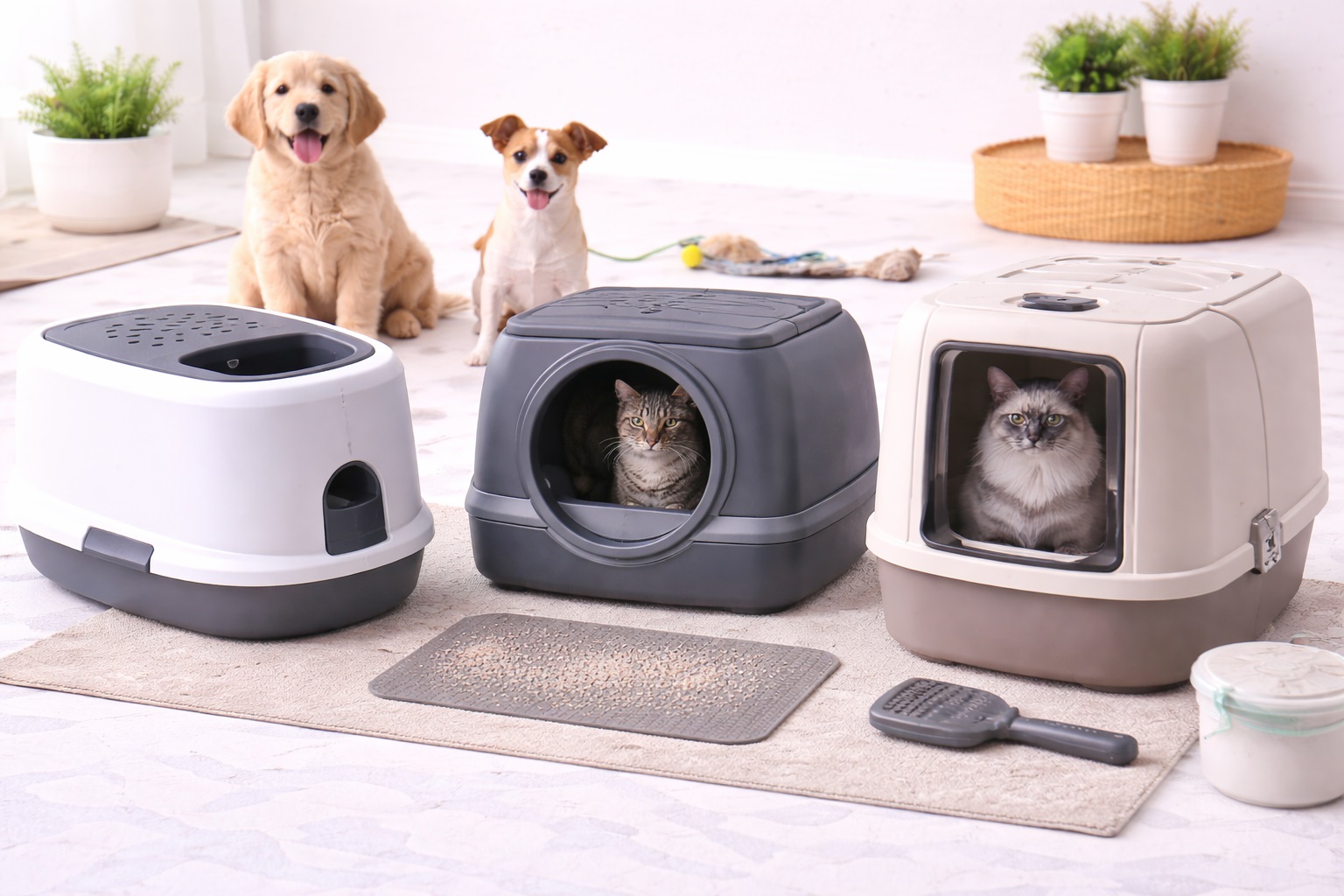
A top-entry litter box requires the cat to climb up and drop in through an opening in the lid, which is a movement most dogs cannot replicate, making this one of the most reliably dog-proof designs available. Because the entry point is elevated and requires a jump most dogs are physically unable to make cleanly, this design solves the access problem structurally rather than relying on a door or barrier a persistent dog might eventually learn to push through or knock aside.
- Pros:
- Entry design is physically inaccessible to the vast majority of dogs
- Fully enclosed body contains litter scatter and odor better than open designs
- No door or flap for a dog to nose open or damage over time
- Simple, largely mechanical design with few parts that can fail
- Cons:
- Some cats, particularly seniors or those with mobility issues, struggle with the jump-in entry
- Interior visibility and cleaning access is more limited than an open-top box
Best For: Multi-pet households with an agile, healthy cat and a persistent dog that can push through or reach into most standard covered boxes.
Why We Recommend It: The top-entry design solves dog-proofing at a structural level rather than relying on a barrier a determined dog might eventually overcome. For most healthy adult cats, the entry method quickly becomes routine and unbothered.
Households introducing this style for the first time often report a short adjustment period of a week or two while the cat learns the new entry motion, after which most cats use it as readily as any other box design.
Placing a small step or low platform near the entry point can help kittens, smaller cats, or seniors manage the jump more comfortably, without compromising the design's fundamental inaccessibility to a dog standing at floor level.
2. High-Sided Box with Swinging Door – Best for Cat Comfort with Moderate Dog Deterrence
A high-sided enclosed litter box with a weighted swinging door offers a middle-ground solution — the door swings open easily for the cat's low, direct approach but tends to deter smaller or less motivated dogs whose typical nose-first investigation does not generate the same forward momentum a cat's entry does. High side walls also help contain litter scatter and reduce visibility into the box, appealing to cats that prefer privacy while using it.
- Pros:
- Comfortable, low-effort entry that most cats adapt to immediately
- High walls contain scatter and provide a sense of privacy
- Swinging door reduces sightlines into the box for shy cats
- More spacious interior than most top-entry designs
- Cons:
- Larger or more determined dogs can still push through the swinging door
- Door hinge is a moving part that may need occasional maintenance
Best For: Households with smaller dogs or dogs that are only mildly interested in the litter box, prioritizing cat comfort alongside moderate deterrence.
Why We Recommend It: This design prioritizes a comfortable, unobstructed experience for the cat while still meaningfully raising the effort required for a dog to gain access. For households without a highly persistent or large dog, this balance often works well in practice.
Adding a slightly weighted or stiffer door than the base model ships with can increase deterrence further for households finding the standard door too easy for their dog to push through, without significantly increasing the effort required from the cat.
3. Baby-Gate Enclosed Litter Area with Cat Door – Best for Complete Room Separation
Rather than relying on the litter box itself for dog-proofing, this approach places a standard or preferred litter box inside a small enclosed area — a laundry room, closet, or gated corner — accessed only through a cat-sized door or a gap sized specifically for a cat but not the household dog. This decouples litter box comfort entirely from dog-proofing, since any litter box the cat prefers can be used once the space itself is properly secured.
- Pros:
- Works with any litter box style the cat already prefers
- Complete physical separation is highly reliable against persistent dogs
- Creates a quiet, private dedicated litter area
- Scales easily to multiple boxes for multi-cat households
- Cons:
- Requires available space and installation effort beyond simply buying a box
- A small cat door cut into a larger dog's reach may need reinforcement over time
Best For: Households with a persistent or large dog capable of overcoming most standalone dog-proof box designs, and available space for a dedicated litter area.
Why We Recommend It: When a dog is determined and physically capable enough to defeat most standalone dog-proof boxes, physically separating the space rather than relying on the box design alone tends to be the most reliable long-term solution.
This approach also has the side benefit of letting a household choose the litter box style purely on the cat's preference and cleaning convenience, since dog access is handled entirely by the room barrier rather than the box itself.
A pressure-mounted gate with a cut-out sized specifically for the cat, rather than a fixed cat door installed into a wall or existing door, offers a reversible option for renters or households not wanting to make permanent modifications.
Buying Guide: How to Choose the Best Dog-Proof Cat Litter Box
Solving the dog-access problem effectively requires weighing your specific dog's size, persistence, and intelligence against your cat's comfort needs.
1. Dog Size and Breed Considerations
A small dog may be physically unable to reach into a design that a larger, more determined breed could defeat easily. Match the dog-proofing method to your specific dog's size and demonstrated persistence rather than a generic assumption.
Breeds known for problem-solving and persistence, such as many terrier and working breeds, often require a more physically robust barrier than a generally food-motivated but less determined breed would need.
A dog's individual personality within a breed also matters considerably, since some breeds known generally for persistence include plenty of individuals with little actual interest in the litter box, so observed behavior should ultimately guide the decision more than breed generalizations alone.
2. Cat Comfort and Entry Ease
A dog-proof design that discourages the cat from using the box entirely defeats its purpose and can lead to litter box avoidance. Prioritize designs your specific cat can enter comfortably, especially for senior cats or those with joint issues.
Watching your cat's first several uses of a new dog-proof box closely helps catch any hesitation or difficulty early, before it develops into a learned avoidance of the box altogether.
Signs of struggle worth watching for include hesitating at the entrance, attempting to enter and backing out, or eliminating just outside the box rather than inside it, all of which suggest the specific design is not yet comfortable for that individual cat.
3. Box Size Relative to Cat Size
Dog-proofing features like elevated entries or narrow doorways should not come at the cost of adequate interior space. A cramped dog-proof box is uncomfortable regardless of how well it deters the dog.
General sizing guidance suggests a litter box interior should be at least one and a half times the cat's body length, and this remains true even when evaluating dog-proof designs with more constrained entry points.
Larger cat breeds in particular are sometimes overlooked in dog-proof product sizing, since manufacturers often design around an average-sized cat, so measuring your specific cat and comparing against listed interior dimensions before buying is a worthwhile step.
4. Weight and Stability Against a Curious Dog
Even a box a dog cannot fully access can be knocked over or dragged if it is lightweight. A heavier base or a design that can be secured against a wall reduces this risk in households with an especially persistent dog.
Some owners add a small amount of weight, such as a sandbag or brick discreetly placed at the base, to increase stability further without altering the design a cat is already accustomed to using.
Placing the box in a corner, where two walls naturally limit the angles from which a dog can push or tip it, provides additional stability without requiring any modification to the box itself.
5. Cleaning Access Trade-offs
Dog-proof designs often sacrifice some cleaning convenience for security — a top-entry box, for instance, typically requires more disassembly to scoop and clean than a standard open box. Factor this into your daily maintenance routine expectations.
Choosing a design with a removable top or a large enough opening for a full-size scoop helps offset this trade-off, since a design that is dog-proof but genuinely difficult to clean tends to get neglected over time.
Establishing a fixed daily scooping time, rather than cleaning only when the box visibly needs it, helps counteract the natural tendency to put off a slightly more inconvenient cleaning process on a busy day.
6. Multi-Cat Household Adaptations
Multiple cats sharing dog-proof boxes need enough total access points to avoid one cat guarding the box against others. Consider multiple dog-proof boxes or a shared secured room area rather than a single box for several cats.
The general guideline of one litter box per cat plus one extra applies just as strongly to dog-proof setups, even though the added security features can sometimes tempt owners to under-provide access points to save space or cost.
Spacing multiple boxes across different rooms rather than clustering them together also matters in dog-proof setups, since one guarded chokepoint area can just as easily prevent a subordinate cat from reaching any box at all.
7. Odor Containment Alongside Dog-Proofing
Fully enclosed dog-proof designs tend to contain odor more effectively than open boxes, though this also means odor can concentrate more within the enclosed space if not scooped regularly, requiring a slightly more disciplined cleaning schedule.
A charcoal filter or ventilation opening, where included, helps offset the odor concentration that comes with fully enclosed designs, but should not be relied upon as a substitute for regular scooping.
Replacing charcoal filter inserts on the manufacturer's recommended schedule, rather than leaving one in place indefinitely, keeps this feature actually functioning as intended rather than becoming a saturated, ineffective component still sitting in the box.
8. Transition Period for an Existing Cat
Cats accustomed to an open box may need a gradual introduction to a new dog-proof design. Placing the new box beside the old one initially, then slowly phasing out the old option, eases this transition considerably.
Avoid removing the familiar box abruptly, since a sudden, forced switch is more likely to cause litter box avoidance than a gradual transition that lets the cat investigate the new option at its own pace.
Using the same litter type in the new box that the cat is already accustomed to, at least initially, removes one additional variable from the transition and makes it easier to isolate whether any hesitation is about the box design itself.
9. Material Durability Against Chewing or Scratching Dogs
Some dogs attempt to chew or paw at a box they cannot fully access. Thicker, more durable plastic resists this better than thinner, lightweight materials that can crack or develop access points over time under repeated pressure.
Inspecting the box periodically for early signs of wear at the edges a dog focuses on repeatedly helps catch a developing weak point before it becomes a full access breach.
Some manufacturers offer reinforced or heavy-duty variants of their standard dog-proof designs specifically marketed toward households with persistent chewers, which is worth checking before assuming the standard version will hold up long-term.
10. Placement Strategy Beyond the Box Itself
Even the best dog-proof box benefits from thoughtful placement — a room with a door that can be propped open just enough for the cat, or a raised platform a dog cannot easily climb, adds another layer of separation.
Corners and elevated furniture that a cat can reach but a dog cannot are worth considering as box locations, effectively using the home's existing layout as an additional dog-proofing measure.
A low platform or set of steps that only a cat will bother using, placed alongside an otherwise standard box on furniture out of a dog's reach, can sometimes solve the problem with minimal cost or specialized equipment at all.
11. Cost Versus Effectiveness Trade-offs
More elaborate dog-proofing solutions, such as a fully secured separate room, typically cost more in setup effort or materials than a standalone box, but may be the only reliable option for a highly persistent dog.
Start with the least elaborate solution that seems plausible for your specific dog's persistence level, and escalate to a more involved setup only if the simpler option genuinely fails in practice.
Keeping receipts and being willing to return a first attempt that clearly does not work, rather than trying to force a solution that is failing, keeps the overall cost of finding the right fit manageable even after a few attempts.
12. Long-Term Adaptability as Pets Age
A young, agile cat may handle a top-entry design easily, but the same box may become difficult as the cat ages or develops joint issues. Consider how the dog-proofing solution will need to adapt over the pet's lifetime.
Households anticipating an aging cat may prefer the room-separation approach specifically because it allows switching to a more accessible ground-level box without needing to solve the dog-access problem all over again.
Revisiting the setup periodically as your cat ages, rather than assuming the original solution will remain appropriate indefinitely, helps catch the point at which a design switch becomes necessary before it turns into a litter box avoidance problem.
13. Litter Type Compatibility with Enclosed Designs
Enclosed and top-entry dog-proof boxes trap more dust and odor inside the body than an open box, which makes litter choice more consequential than it might be otherwise. Low-dust, clumping litters tend to work best in these more confined designs.
A litter that tracks heavily can also become more noticeable in a top-entry design, since the cat must climb through an opening that naturally collects loose granules clinging to its paws on the way out.
Placing a textured mat directly beneath the exit point, sized generously enough to catch several steps' worth of paw contact, meaningfully reduces the amount of litter that ends up scattered across the surrounding floor.
14. Noise and Startle Sensitivity in Skittish Cats
A swinging door or a lid that shifts unexpectedly can startle a naturally nervous cat, sometimes creating a negative association that leads to avoidance. Households with an already anxious cat should weigh this risk when selecting a dog-proof design.
Testing the door or lid mechanism yourself before introducing the box, to confirm it moves smoothly and quietly rather than banging or catching, can help avoid a startling first experience for a sensitive cat.
Applying a small amount of silicone lubricant to hinges or sliding mechanisms periodically keeps the motion smooth over time, preventing the gradual stiffening that can turn a quiet, familiar door into a sudden, startling one.
15. Recognizing When a Solution Has Failed and Needs Escalation
Continued evidence of dog access, such as disturbed litter or a visibly emptier box after the dog has been alone with it, signals that the current solution is not working and needs to escalate to a more secure option rather than being left as is.
Watching for secondary signs in the cat, including new reluctance to approach the box or eliminating elsewhere in the home, helps catch a failing setup before it develops into a more entrenched litter box avoidance habit.
Escalating promptly from a standalone box to full room separation, rather than trying several intermediate standalone options in sequence, is often the more efficient path once it becomes clear a persistent dog can defeat ordinary barrier designs.
Frequently Asked Questions
1. How many litter boxes do I need for one cat?
The standard guidance is one litter box per cat plus one additional box, meaning even a single-cat household benefits from two available boxes, and this guidance holds regardless of whether dog-proofing is also a consideration. Multi-cat homes should apply this same ratio across whichever dog-proof solution they eventually choose.
2. Why does my cat refuse to use the litter box?
Common causes include a box that is too small, too dirty, poorly located, or recently changed in a way the cat finds uncomfortable, alongside possible medical issues that should be ruled out with a veterinarian if avoidance is sudden or persistent. A newly introduced dog-proof design is itself a common temporary cause of hesitation.
3. How do I stop my dog from accessing the cat litter box?
Effective approaches include a top-entry box, a high-sided box with a door, or physically separating the litter area behind a barrier with a cat-sized opening, chosen based on your specific dog's size and persistence level. Combining two of these approaches offers extra assurance for particularly determined dogs.
4. Will a covered litter box alone keep a determined dog out?
Not always. A standard covered box with a simple door is often insufficient against a persistent or larger dog, which is why purpose-built dog-proof designs or room separation are usually more reliable solutions. Testing the actual box against your dog's real behavior remains more informative than any general product claim.
5. Is the most expensive dog-proof cat litter box always the best?
Not necessarily. The right choice depends more on matching the design to your specific dog's persistence and your cat's comfort needs than on price alone, and effective mid-range options are widely available. A simpler, well-matched solution often outperforms an expensive one that is a poor fit for your specific pets.
6. How long should a quality dog-proof cat litter box last?
With regular cleaning and reasonable care, a well-built dog-proof litter box typically lasts several years, similar to standard litter boxes, though households with especially persistent dogs may see more wear on doors and edges. Periodic inspection for developing weak points helps extend its effective working life.
7. Can I return a dog-proof cat litter box if it doesn't suit me?
Most retailers offer a 15 to 30 day return window. Test both your cat's willingness to use it and your dog's actual ability to access it within that window before deciding, since both factors matter equally to a successful purchase.
8. What should I prioritize when buying a dog-proof cat litter box?
Prioritize matching the design's deterrence level to your specific dog's size and persistence, while ensuring the entry remains comfortable and unobstructed for your cat. Cleaning convenience is worth weighing as a close third consideration.
9. Does brand name matter for dog-proof cat litter box?
Somewhat less than the specific design chosen. A well-designed top-entry or separated-room approach from a lesser-known brand can outperform a poorly designed covered box from a major brand for this specific problem, so focus on design fit over brand reputation.
10. Can a dog-proof litter box work in a single-cat household?
Yes, the same design principles apply regardless of how many cats are in the household, though multi-cat homes should ensure enough total access points are available across whichever dog-proof solution is chosen, since sharing constraints apply just as much here as with standard boxes.
11. What if my cat still won't use a dog-proof box after a fair trial period?
Consider switching to the room-separation approach instead, which allows using a standard box style the cat already accepts while solving dog access through the room barrier rather than the box design itself. This decouples the two problems entirely.
12. Can training stop a dog from bothering the litter box instead of a special box?
Consistent training can reduce interest in some dogs, particularly less food-motivated breeds, but a physical barrier remains the more reliable solution for persistent or highly food-driven dogs regardless of training effort, since the motivation for many dogs is strong enough to override typical obedience training.
13. Should I supervise my cat and dog when introducing a new dog-proof box?
Brief supervised sessions during the first few days help confirm the cat is comfortable using the new box and that the dog is genuinely unable to access it, catching any design issues early before they become established habits for either animal.
14. Are automatic self-cleaning litter boxes also dog-proof?
Not automatically. Many self-cleaning boxes have open or low-walled designs that a dog can still reach into, so dog-proofing needs to be evaluated separately from the automatic cleaning feature rather than assumed to come bundled with it.
15. Can a dog-proof litter box help reduce litter tracking through the house?
Somewhat, particularly enclosed designs that contain more scatter within the box body itself, though a dedicated litter mat at the exit point remains the more direct and reliable solution for tracking regardless of which dog-proof design is chosen.
Final Verdict
- Best for Reliable Containment and Dog-Proofing: Top-Entry Enclosed Litter Box — the most structurally reliable design against most dogs.
- Best for Cat Comfort with Moderate Dog Deterrence: High-Sided Box with Swinging Door — the most comfortable option for cats when the dog is only mildly persistent.
- Best for Complete Room Separation: Baby-Gate Enclosed Litter Area with Cat Door — the most reliable solution against a large or highly determined dog.
Solving the dog-access problem effectively means matching the level of security to your specific dog's size and persistence, without sacrificing the comfort and accessibility your cat needs to keep using the box willingly. Use the comparisons and buying factors above to find the right balance for your particular household.
Most multi-pet households eventually settle into a solution through some trial and adjustment rather than getting it exactly right on the first attempt, and that is a normal part of the process. Paying close attention to how your specific cat and dog respond to whatever solution you try first will tell you quickly whether to stick with it or move toward a more secure option, and that responsiveness matters more than picking the theoretically perfect box from the start.