Best Dog Leash for Indoor Training: Top Picks for 2026
Indoor training calls for a different tool than a standard neighborhood walking leash. Inside the house, the priorities shift toward close control, minimal bulk, and a leash the dog barely notices between commands. A leash that works fine on a sidewalk can be too long, too heavy, or too clumsy for teaching sit-stay, working on door manners, or correcting jumping and counter-surfing in a hallway or living room.
This guide breaks down the leash types that actually suit indoor training work, what separates a genuinely useful option from one that just adds friction to a session, and how to match length, material, and hardware to your specific training goals rather than defaulting to whatever leash is already hanging by the door.
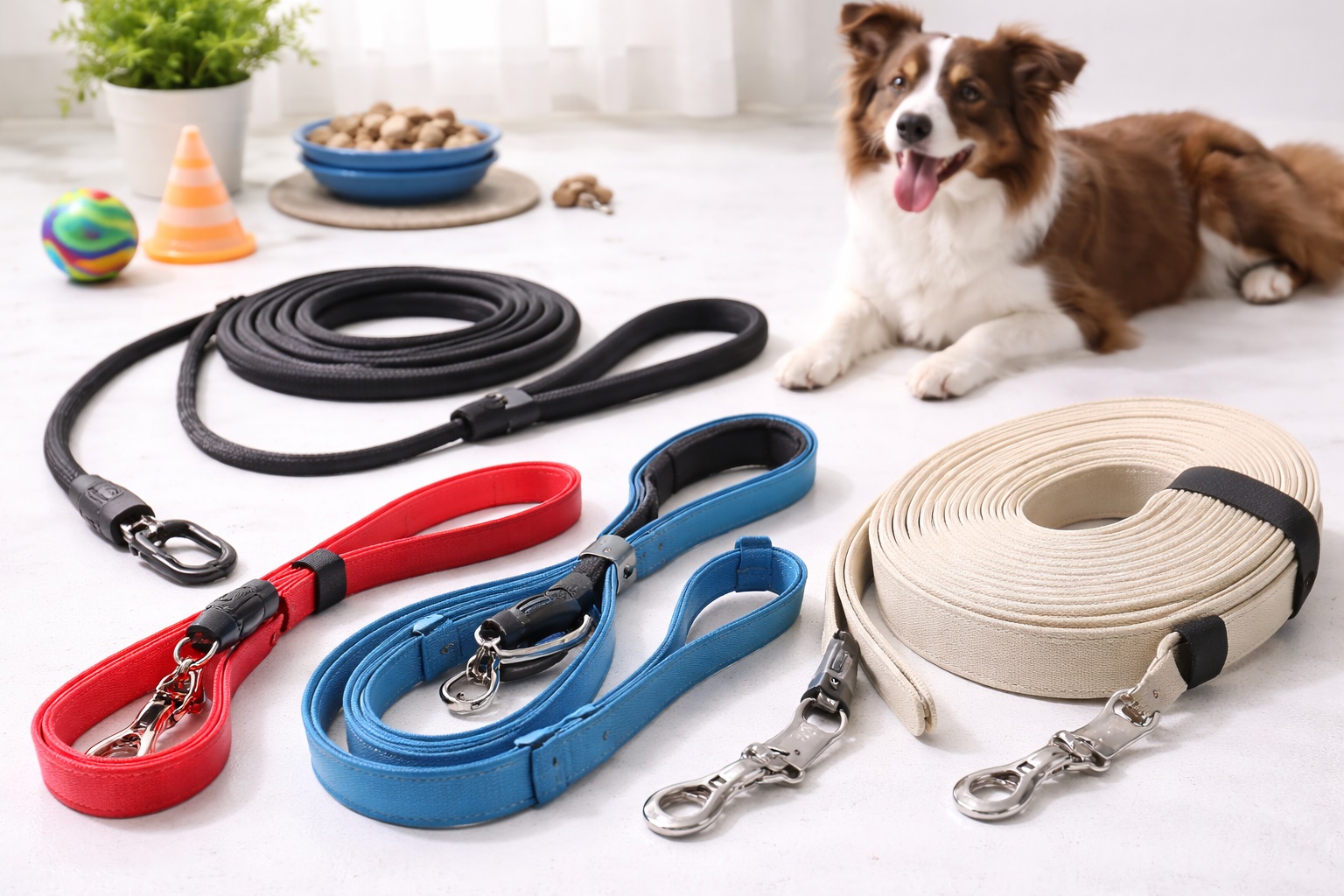
None of this requires expensive gear. Most of the leashes that work well indoors are simple, inexpensive, and already familiar to anyone who has trained a dog before — the difference is in matching the right style to the right moment rather than using one all-purpose leash for every situation. A short lead for close obedience work, a longer line for supervised freedom, and a compact option for doorway control cover almost every scenario a household training program runs into. The comparisons below focus on those practical distinctions rather than brand marketing.
Safety is worth thinking about upfront, not as an afterthought. Indoor spaces have their own hazards that outdoor walking doesn't — stair railings, table legs, other pets underfoot, small children — and a leash that drags or tangles easily can turn a training session into a trip hazard. Choosing hardware rated for your dog's size and strength, and picking a length that matches the room you're actually training in, prevents most of the avoidable problems before they start.
Top 6 Dog Leashes for Indoor Training (Detailed Reviews)
1. Short Training Leash (2-4 ft) – Best for Close-Control Training
A short 2 to 4 foot leash keeps the dog within arm's reach at all times, which is exactly the range needed for obedience drills, impulse control exercises, and correcting behavior the instant it starts. Because the dog cannot drift far enough to rehearse unwanted habits like counter-surfing or bolting through doorways, every repetition stays productive. Most versions are made from lightweight nylon or biothane so the dog barely registers the leash's weight during a session, which keeps focus on the handler rather than the equipment.
- Pros:
- Maximum handler control for behavior correction
- Lightweight — dog barely notices the leash
- Well suited to apartments and small training spaces
- Durable snap clip for repeated attach and detach
- Cons:
- Too short for outdoor or distance recall work
- Some dogs find the closeness frustrating at first
Best For: Indoor obedience sessions, behavior correction, and situations where the handler needs the dog within immediate reach at all times.
Why We Recommend It: A short lead is the right default for indoor training because it removes the dog's ability to self-reward unwanted behavior while keeping the handler close enough for instant correction and praise — the timing that makes training actually stick.
2. Slip Training Lead – Best for Quick-On Quick-Off Training
A slip lead combines a collar and leash in a single loop that goes over the dog's head and tightens gently under tension. It is the tool most professional trainers reach for because it can be applied and removed in seconds, with no separate collar required. Fitted correctly, a slip lead gives immediate, proportional feedback — light pressure for light pulling, no pinching, no buckles to fumble with mid-session.
- Pros:
- No separate collar needed — quick on and off between sessions
- Immediate pressure feedback for timing-sensitive correction
- Standard tool among professional trainers
- Compact and lightweight when not in use
- Cons:
- Requires correct fit to avoid pressure on the throat
- Not ideal for dogs that lunge or bolt unpredictably
Best For: Dogs already in a structured training program and handlers who need to apply and remove a leash quickly between short indoor drills.
Why We Recommend It: The tightening-and-releasing mechanism gives a dog clearer, faster feedback than a fixed leash clipped to a separate collar, which shortens the learning curve for handlers who are still building their timing.
3. Long House Line (10-15 ft) – Best for Freedom Within Boundaries
A house line is a lightweight long line left dragging behind the dog indoors, so the handler can step on it or scoop it up without ever having to chase or grab the dog directly. It is especially useful for newly adopted dogs still learning household boundaries, for reinforcing recall in a low-distraction setting, and for interrupting jumping, chewing, or door-dashing before it becomes a habit.
- Pros:
- Allows supervised freedom of movement around the home
- Quick step-on or grab for instant control
- Builds reliable recall in a low-distraction setting
- No heavy hardware — comfortable to drag indoors
- Cons:
- Can snag on furniture legs in cluttered rooms
- Not built for regular outdoor use in its lightweight form
Best For: Newly adopted dogs, puppies in early house training, and any handler working on dependable indoor recall.
Why We Recommend It: A house line lets the dog move naturally while the handler retains the ability to interrupt a problem behavior the moment it starts, which builds better habits than constant hands-on restraint or, on the other extreme, no restraint at all.
4. Traffic Lead (Short Padded-Handle Leash) – Best for Tight-Space Door and Hallway Control
A traffic lead is a short leash, typically 12 to 24 inches, with a second handle positioned near the clip so the handler can hold the dog close in tight quarters — doorways, stairwells, narrow hallways, or crowded entryways where a longer leash becomes a tripping hazard for both dog and handler. It is a purpose-built tool for the specific moments indoor training sessions tend to break down: greeting guests at the door, moving through a hallway without pulling toward another room, or managing a reactive response near a window.
- Pros:
- Second handle gives instant close control without shortening grip on a longer leash
- Ideal for doorway and entryway behavior work
- Reduces tripping risk in narrow indoor spaces
- Padded handle reduces hand strain during repeated short holds
- Cons:
- Too short for any exercise requiring distance
- Not a substitute for a primary training leash — best used alongside one
Best For: Door-greeting practice, hallway transitions, and any indoor moment where the dog needs to be held close and steady for a few seconds.
Why We Recommend It: Many indoor training breakdowns happen in tight spaces rather than open rooms, and the traffic lead's secondary handle solves exactly that problem without requiring the handler to switch leashes mid-session.
5. Standard 6 ft Leash – Best for General Indoor Recall Practice
A standard 6 foot leash sits between the close-control short lead and the freedom of a house line, giving enough slack for a dog to move a few steps away and practice coming back on a verbal or hand cue, while still leaving the handler close enough to step on the leash if the dog ignores the recall. It's the leash most households already own, which makes it a practical starting point before investing in more specialized equipment, and it transitions naturally to short outdoor walks once indoor recall is solid.
- Pros:
- Versatile length for both close control and short-distance recall
- Already owned by most dog households — no new purchase required to start
- Transitions naturally from indoor practice to short outdoor walks
- Wide range of materials and price points available
- Cons:
- Not as precise as a short lead for close-quarters correction
- Can drag and tangle around furniture legs if left loose
Best For: General-purpose indoor recall practice and households that want one leash that handles most everyday training moments reasonably well.
Why We Recommend It: For handlers who are not yet ready to commit to specialized equipment, the standard 6 foot leash provides a reasonable middle ground that supports early recall training without requiring an additional purchase.
6. Bungee or Shock-Absorbing Short Leash – Best for Reducing Handler Strain
A bungee-style leash includes a stretch section near the handle that absorbs the sudden jolt of a lunge or pull, which reduces strain on the handler's shoulder and wrist during sessions with a strong or excitable dog. For indoor training specifically, this matters most during early-stage impulse control work, when a dog is still learning not to launch toward the door, a visitor, or another pet the moment stimulation appears. The give in the leash absorbs that first burst of energy rather than transmitting it directly to the handler's arm.
- Pros:
- Reduces shoulder and wrist strain from sudden pulls
- Useful for young, strong, or easily excitable dogs
- Still short enough for close-control indoor work
- Comfortable for handlers managing multiple short sessions per day
- Cons:
- The stretch can slightly delay correction timing compared to a rigid leash
- Not ideal for precision obedience work requiring instant feedback
Best For: Handlers training strong, young, or easily excitable dogs who need to reduce physical strain during frequent indoor sessions.
Why We Recommend It: For dogs still learning impulse control, the shock absorption prevents the handler from bearing the full force of an unexpected lunge, which makes it easier to stay consistent across multiple sessions in a day without physical fatigue becoming a limiting factor.
Buying Guide: How to Choose the Best Dog Leash for Indoor Training
Use these factors to match a leash to your actual training goals rather than buying on price or appearance alone. Most households find that no single leash covers every situation, so think of this guide as a way to identify which one or two styles actually fit your dog's stage of training rather than searching for one leash that does everything equally well. A puppy just learning basic manners has very different needs than an adult dog working through leash reactivity, and the right equipment reflects that difference.
1. Length for Your Training Purpose
Short leads of 2 to 4 feet suit close-control obedience work. House lines of 10 to 15 feet suit recall and boundary training. A traffic lead's extra handle suits doorway and hallway control, and a standard 6 foot leash covers general recall practice in between. Choose length based on what you are actually training that session, not habit or whatever is closest to the door.
2. Clip Strength
The clip should be rated with a comfortable safety margin above your dog's body weight. A clip that pops open under a sudden lunge is a real safety issue, not a minor inconvenience — check the rated strength before buying, especially for larger or stronger dogs. Manufacturers typically list a maximum pull rating, and it's worth comparing that figure against your dog's weight rather than assuming any clip will hold.
3. Handle Comfort
Training sessions involve repeated tension and release, which is harder on the handler's hand than a steady walking pace. A padded or rubberized handle reduces fatigue and slipping compared to bare nylon webbing, particularly during longer or more frequent sessions. If you run multiple short sessions per day, handle comfort adds up over a week of consistent practice.
4. Material Durability
Nylon is affordable, widely available, and durable enough for most training use. Biothane resists water and wipes clean easily, which suits dogs that drool, chew, or get underfoot during meal prep. Leather looks and feels premium but needs conditioning to avoid cracking. Cotton is soft on the hands but wears faster than synthetic options under repeated training tension, so it suits lighter use better than daily drilling.
5. Weight Appropriate for Pet Size
A leash that is heavier than necessary adds unnecessary drag for a small or toy breed and can make them reluctant to move freely during a session. Choose the lightest leash that still offers adequate strength for your dog's actual size — a leash built for a large breed is often overkill for a ten pound companion dog.
6. Quick-Release Hardware
A quick-release clip allows fast detachment if a training situation turns unexpectedly, such as a dog becoming tangled around furniture or another pet. Standard bolt snaps are secure but slower to release. Decide which trade-off matters more for your household based on how supervised your training sessions typically are.
7. Chew Resistance
Dogs that chew out of boredom, frustration, or excitement can go through a standard nylon leash quickly, especially during longer sessions or when left unsupervised while wearing a house line. Wire-core or chain-reinforced leashes resist this, and if your dog is a known chewer, that resistance is a safety feature, not a luxury — a leash chewed through mid-session is a real containment failure.
8. Indoor-Specific vs. Dual-Purpose Design
A leash used only indoors can prioritize lightness and feel over weatherproofing. A leash meant to double for outdoor walks needs to balance both, which usually means accepting a slightly heavier or bulkier design than a dedicated indoor lead. Decide early whether you want one leash for everything or a dedicated indoor setup.
9. Grip Points and Handle Placement
Leashes with a secondary handle closer to the clip — like a traffic lead — give far more precise control in tight indoor spaces than a single end-of-leash handle. If door manners or hallway behavior are part of your training plan, this feature matters more than overall length.
10. Compatibility with Your Training Method
Some structured training programs specify particular equipment, especially around collar and leash combinations. If you are working with a trainer, confirm which leash style they recommend before buying so your at-home practice stays consistent with your sessions and doesn't send mixed signals to the dog.
11. Ease of Cleaning
Indoor training happens near carpets, furniture, and floors, and leashes pick up dirt, drool, and occasional accidents faster than expected. Biothane and coated nylon wipe clean in seconds; cotton and untreated leather require more careful maintenance to avoid odor and staining over time.
12. Storage and Accessibility
A leash that lives in a drawer rarely gets used consistently. Keeping a short lead or slip lead somewhere immediately accessible — a hook by the main living area, not just the front door — makes it far more likely you'll actually grab it for a quick correction or a short training moment rather than skipping the opportunity because the leash was out of reach.
Common Mistakes to Avoid
A few recurring mistakes account for most of the frustration households report with indoor leash training. The first is using a single leash for every purpose — a 6 foot walking leash is rarely the right tool for close-quarters obedience work, and forcing it to double for both jobs usually means it does neither particularly well. The second is skipping the fitting check on slip leads and harnesses; a slip lead that sits too low on the neck or too loose to tighten properly delivers confusing feedback rather than clear communication, which slows progress more than it helps. The third is leaving a house line unsupervised for long stretches, which risks tangling around furniture or, in multi-pet households, another animal. None of these mistakes require expensive fixes — they're mostly a matter of matching the tool to the moment and staying attentive during active training time.
Frequently Asked Questions
1. What length leash is best for indoor training?
Use 2 to 4 feet for close-control obedience work, around 6 feet for indoor recall practice with a bit more distance, and 10 to 15 feet for supervised freedom with quick pickup capability. Match the length to the specific skill you're working on that session.
2. Is a slip lead safe for daily use?
A slip lead is a training tool rather than a permanent everyday collar. Fitted and used correctly, it delivers safe, clear feedback. Used incorrectly on a dog that lunges hard, it can put pressure on the throat, so learning proper technique — or consulting a trainer — matters before regular use.
3. Can I use a retractable leash for indoor training?
It's generally not recommended. Retractable leashes give inconsistent tension, which makes it hard for a dog to connect a specific action with a specific feedback signal. A fixed-length leash communicates far more clearly during structured training.
4. Do I need more than one leash for indoor training?
Many handlers keep two: a short lead or slip lead for focused obedience drills and a longer house line for supervised freedom and recall practice. A traffic lead is a useful third option if doorway or hallway behavior is a specific issue.
5. Is the most expensive dog leash for indoor training always the best?
Not necessarily. Price often reflects materials and hardware finish, but plenty of mid-range leashes perform just as well for everyday indoor training. Match the leash to your actual training goals rather than the highest price tag available.
6. How long should a quality training leash last?
A well-made leash from a reputable brand typically holds up for two to five years of regular training use, longer with light use or careful storage. Warranty length is often a reasonable signal of how confident the manufacturer is in its own durability.
7. Can I return a leash if it doesn't suit my dog?
Most retailers offer a 15 to 30 day return window. Keep the original packaging and tags until you've confirmed the fit and length work for your training sessions, in case a return or exchange becomes necessary.
8. What should I prioritize first when buying a training leash?
Start with the specific skill you're training — close-control obedience, recall, or doorway manners — since that determines length and handle placement before material or price become relevant factors.
9. Does brand name matter for a training leash?
Established brands tend to offer more consistent hardware quality and better warranty support. Newer or lesser-known brands can still offer good value, so checking verified reviews before buying is worthwhile either way.
10. Can a house line replace a normal leash for walks?
Not for regular outdoor walking. A house line is built for lightweight indoor dragging and supervised freedom, not for the pulling forces and weather exposure of daily outdoor walks — use a standard walking leash for that purpose instead.
11. How do I stop my dog from chewing the leash during training?
Keep sessions short enough to hold focus, redirect chewing attempts immediately with a cue and reward, and consider a chew-resistant material if the behavior persists. A leash that gets chewed through repeatedly is both a training distraction and a safety issue.
12. How many training sessions per day should I run with a leash?
Short, frequent sessions of five to ten minutes generally hold a dog's focus better than one long session. Two or three brief sessions spread across the day, each ending on a successful repetition, tend to produce more consistent progress than a single extended drill that runs past the point of engagement.
13. Will a shock-absorbing leash slow down my dog's training progress?
Not meaningfully for most households. The stretch is small and primarily softens sudden jolts rather than delaying every correction. For high-precision competition-style obedience work a rigid leash gives slightly crisper feedback, but for everyday household training the comfort benefit for the handler generally outweighs the minor difference in feel.
14. Should puppies use the same leash setup as adult dogs for indoor training?
Puppies generally do best with a lightweight short lead or a soft slip lead sized appropriately for their smaller frame, since standard adult hardware can be disproportionately heavy for a young dog still building coordination. As the puppy grows and training goals shift toward recall and boundary work, transitioning to a house line or standard 6 foot leash becomes appropriate. Reassess the setup every few months during the first year rather than assuming one leash will suit the dog at every stage of growth.
Final Verdict
- Best for Close-Control Training: Short Training Leash (2-4 ft) — the tightest control for focused indoor obedience sessions.
- Best for Quick-On Quick-Off Training: Slip Training Lead — the fastest, clearest feedback tool for structured sessions.
- Best for Freedom Within Boundaries: Long House Line (10-15 ft) — the best option for building recall and boundary habits.
- Best for Tight-Space Control: Traffic Lead — the most practical tool for doorway and hallway management.
- Best General-Purpose Option: Standard 6 ft Leash — the most versatile starting point for early recall practice.
- Best for Reducing Handler Strain: Bungee or Shock-Absorbing Short Leash — the most comfortable option for training strong or excitable dogs.
The right dog leash for indoor training comes down to matching length and handle design to the specific skill you're building, not defaulting to whatever leash is closest at hand. Most households end up using two or three of these styles for different parts of a training routine — a short lead or slip lead for focused correction, a longer line for supervised freedom, and occasionally a traffic lead for doorway moments — and that layered approach tends to produce better results than trying to make one leash do everything. Start with whichever tool matches the skill you're working on this week, and add to the setup as your training goals change. As your dog's training progresses from basic obedience to more advanced impulse control and household manners, revisit this list — the leash that served you well during the first few weeks of training may no longer be the best fit six months later, and that's a normal part of the process rather than a sign the original choice was wrong.